
Jieyang, China
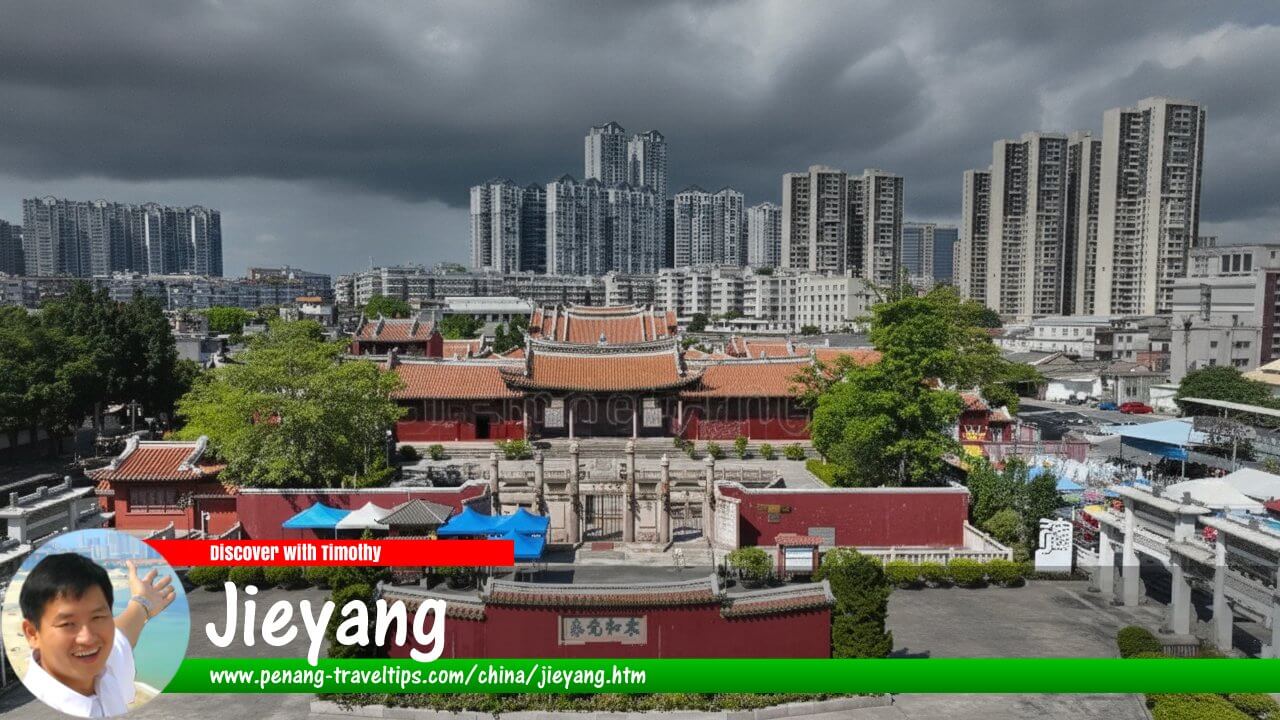 Jieyang, China (Photo edited with AI on 16 June 2026)
Jieyang (Chinese: 揭阳; pinyin: Jiēyáng) is a prefecture-level city in eastern Guangdong Province, China. Situated in the heart of the Chaoshan region, Jieyang is one of the most historically significant cities in eastern Guangdong and serves as an important cultural, commercial, and transportation center. The city is known for its rich heritage, traditional Chaoshan culture, distinctive cuisine, historical landmarks, and growing industrial economy. As part of the Guangdong-Hong Kong-Macao Greater Bay Area's wider sphere of influence, Jieyang continues to develop as an important regional hub while preserving its historical identity.1
The name "Jieyang" literally means "the sunny side of the Jie Mountain" or "north of Jie Mountain." In traditional Chinese geographical naming conventions, locations situated on the sunny side of a mountain or the northern side of a river often received the suffix "yang." The city was named after its location relative to the ancient Jie Mountain, which was an important landmark in the area. The name has been in use for many centuries and reflects the city's long historical roots.2
Quick Facts
- English Name: Jieyang
- Chinese Name: 揭阳
- Pinyin: Jiēyáng
- Province: Guangdong
- Administrative Status: Prefecture-level city
- Region: Chaoshan Region
- Area: Approximately 5,265 square kilometres
- Population: More than 5.5 million
- Climate: Humid Subtropical
- Airport: Jieyang Chaoshan International Airport
- Main Language: Teochew (Chaoshan dialect) and Mandarin
- Major Industries: Manufacturing, metal products, textiles, commerce
- Known For: Chaoshan culture, historical sites, traditional crafts
- Major River: Rong River
Geography
Jieyang is located in eastern Guangdong Province along the lower reaches of the Rong River. The city lies between Shantou and Chaozhou, forming part of the historic Chaoshan region. It borders Shanwei to the west, Meizhou to the north, Chaozhou to the east, and the South China Sea to the south.1
The city's terrain consists of plains, river valleys, low hills, and coastal areas. The central and southern parts are largely flat and fertile, making them suitable for agriculture and urban development. Northern districts become increasingly mountainous as they approach the uplands of eastern Guangdong.
The Rong River system is one of the most important geographical features of Jieyang. Historically, the river provided transportation routes, irrigation, and opportunities for trade. Numerous tributaries and waterways have contributed to the development of settlements throughout the region.
Jieyang experiences a humid subtropical climate characterized by hot summers, mild winters, and abundant rainfall. Average annual temperatures range between 21°C and 23°C. Monsoon influences bring significant precipitation, particularly between April and September.
The city enjoys convenient access to both inland Guangdong and coastal shipping routes. Its strategic location has contributed significantly to its historical and modern economic importance.
History
The history of Jieyang dates back more than two thousand years. Archaeological evidence indicates that human settlements existed in the area long before formal Chinese administration was established. During the Qin and Han dynasties, the region became increasingly integrated into imperial China.2
Jieyang County was officially established during the Han Dynasty, making it one of the oldest administrative divisions in Guangdong. Over subsequent centuries, the city developed into an important regional center for trade, agriculture, education, and culture.
During the Tang and Song dynasties, economic prosperity increased as maritime trade expanded along China's southeastern coast. Merchants from the Chaoshan region participated actively in commerce with other parts of China and neighboring countries.
The Ming and Qing dynasties saw continued growth in agriculture, handicrafts, and overseas trade. Like other cities in the Chaoshan region, Jieyang developed strong connections with overseas Chinese communities throughout Southeast Asia. Large numbers of emigrants settled in Thailand, Singapore, Malaysia, Indonesia, and other countries while maintaining close ties with their hometowns.3
Traditional Chaoshan culture flourished during this period. Distinctive forms of architecture, cuisine, opera, folk customs, and religious practices became deeply rooted in local society. Many ancestral halls, temples, and historical buildings constructed during these centuries still survive today.
In the twentieth century, Jieyang experienced political upheavals associated with the fall of the Qing Dynasty, the Republican era, the Second Sino-Japanese War, and the Chinese Civil War. Following the establishment of the People's Republic of China in 1949, the city underwent significant economic and social transformations.
Administrative reforms eventually elevated Jieyang to prefecture-level city status in 1991. Since then, infrastructure development, industrialization, and urban expansion have accelerated, transforming the city into a major economic center in eastern Guangdong.4
Economy and Products
Jieyang has one of the most dynamic economies in eastern Guangdong. Manufacturing, commerce, agriculture, logistics, and services form the backbone of the local economy. The city benefits from its location within the economically vibrant Chaoshan region and its extensive overseas Chinese connections.
The manufacturing sector is particularly important. Jieyang is known for producing hardware products, stainless steel goods, machinery, plastics, electronics, footwear, textiles, and household products. Numerous factories supply domestic and international markets.5
The city has gained national recognition as an important center for stainless steel production. Industrial clusters specializing in metal processing and hardware manufacturing contribute significantly to employment and exports.
Agriculture remains important in rural areas. Farmers cultivate rice, vegetables, fruits, sugarcane, and other crops. Lychees, longans, bananas, and citrus fruits are among the region's notable agricultural products.
Fishing and aquaculture are also significant due to the city's proximity to coastal waters and river systems. Seafood plays an important role in both the local economy and cuisine.
Commercial activity is concentrated in urban districts, where wholesale markets, retail centers, logistics facilities, and financial services support regional trade. Growing transportation infrastructure has strengthened Jieyang's role as a distribution center for eastern Guangdong.
Tourism contributes increasingly to the economy, particularly through cultural heritage sites, traditional architecture, religious landmarks, and Chaoshan cultural attractions.
How to Go There
By Air
Jieyang Chaoshan International Airport is located approximately 20 kilometres northeast of Jieyang's urban center. It serves as the primary airport for the Chaoshan region, including Jieyang, Shantou, and Chaozhou.6
The airport is served by airlines including Air China, China Southern Airlines, China Eastern Airlines, Shenzhen Airlines, Hainan Airlines, Xiamen Airlines, Sichuan Airlines, and Spring Airlines. Domestic flights connect the airport with Beijing, Shanghai, Guangzhou, Shenzhen, Chengdu, Chongqing, Kunming, Xi'an, Hangzhou, Nanjing, Wuhan, and many other cities.
International and regional services connect Chaoshan with destinations such as Bangkok, Singapore, Kuala Lumpur, Hong Kong, Macau, and Taipei, subject to airline schedules and market demand.
By Train
Jieyang Railway Station serves conventional rail services, while nearby high-speed railway stations connect the city with China's extensive high-speed rail network.
Chaoshan Railway Station, located near the airport, is one of the region's most important high-speed rail hubs. It offers convenient connections to Guangzhou, Shenzhen, Xiamen, Fuzhou, Hangzhou, Shanghai, and other major cities.7
By Long-Distance Bus
Jieyang has several major long-distance bus terminals providing coach services to cities throughout Guangdong Province and neighboring provinces, including Guangzhou, Shenzhen, Dongguan, Foshan, Meizhou, Xiamen, and Fuzhou.
By Road
Modern expressways connect Jieyang with the Pearl River Delta, Fujian Province, and other parts of southern China. Private vehicles and intercity buses offer convenient travel options.
How to Travel Locally
Jieyang provides a variety of transportation options for residents and visitors.
- City Buses: Extensive public bus networks serve urban districts and surrounding towns.
- Taxis: Metered taxis are readily available throughout the city.
- E-Hailing Services: Didi is widely used and functions similarly to Uber.
- Airport Shuttle Services: Dedicated buses connect the airport with urban areas and neighboring cities.
- Bicycles and E-Bikes: Popular for short-distance travel within urban neighborhoods.
Jieyang currently does not have a subway, MRT, metro, or LRT system. Traditional forms of transportation such as trishaws, rickshaws, and tuk-tuks are generally not part of the city's transport network. Most local transportation relies on buses, taxis, ride-hailing services, bicycles, and private vehicles.
Tourist Attractions
Jieyang Tower
One of the city's most recognizable landmarks, Jieyang Tower is a modern structure inspired by traditional Chinese architecture. It serves as a cultural symbol and observation point overlooking the city.
Huangqi Mountain Scenic Area
This scenic mountain area offers hiking trails, temples, viewpoints, and natural landscapes. It is a popular recreational destination for both residents and visitors.
Jinxian Gate
Jinxian Gate is one of the most famous historical structures in Jieyang. Dating back centuries, it reflects traditional Chinese architectural styles and local history.
Confucius Temple of Jieyang
This well-preserved temple complex honors Confucius and serves as an important cultural and educational landmark. Traditional ceremonies and cultural events are occasionally held here.
Rongjiang River Scenic Area
The Rong River waterfront offers pleasant views, walking paths, and opportunities to experience the city's historic relationship with its waterways.
Guandi Temple
Dedicated to the Chinese deity Guan Yu, this historic temple attracts worshippers and visitors interested in local religious traditions.
Xuegong Cultural Area
The ancient academy district contains historical educational buildings and provides insight into the city's scholarly traditions.
Chaoshan Folk Culture Villages
Several traditional villages around Jieyang preserve distinctive Chaoshan architecture, ancestral halls, temples, and cultural practices.
Wangtian Lake Ecological Tourism Resort
This recreational area combines natural scenery, lakeside landscapes, gardens, and leisure facilities suitable for family visits.
Puning Square and Historic Sites
Located within Jieyang's jurisdiction, Puning offers historical temples, traditional neighborhoods, and modern commercial districts that reflect the region's development.
Jieyang, China on  the Map of Cities in China
References
- Wikipedia – Jieyang
- Encyclopaedia Britannica – Guangdong Province
- Wikipedia – Chaoshan Region
- Jieyang Municipal Government
- Invest Guangdong
- Wikipedia – Jieyang Chaoshan International Airport
- Wikipedia – Chaoshan Railway Station
Page Details
This page was created/modified on 16 June 2026. Hi, my name is Timothy and created it from my research, for my own entertainment, knowledge and to satisfy my curiosity. I am providing the information to you in good faith and hope it is useful. I try to get the details as accurate as possible. I also try to update the page whenever I stumble on new details. So this and all my other pages are perpetual work in progress. If you discover any error, please politely inform me, pointing out where the error lies, and I will correct it as soon as possible. Your helpfulness will keep this page accurate, relevant and helpful to those who need the information.