
Chaozhou, China
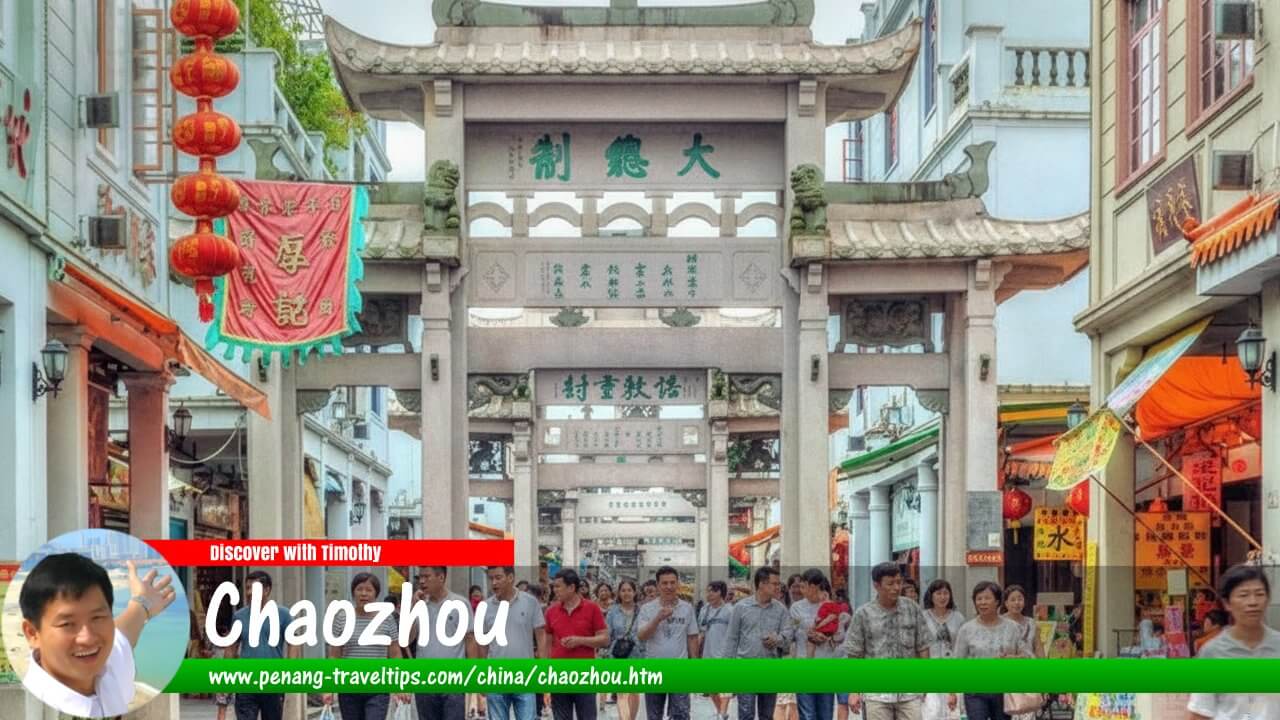 Chaozhou, China (Photo edited with AI on 16 June 2026)
Chaozhou (Chinese: 潮州; pinyin: Cháozhōu) is a prefecture-level city in eastern Guangdong Province, China. It is one of the most historically significant cities in southern China and serves as the cultural heartland of the Chaoshan region. Known for its ancient heritage, traditional architecture, distinctive dialect, celebrated cuisine, and enduring customs, Chaozhou has played an important role in the history of Guangdong for more than a thousand years. The city is widely regarded as the birthplace of Teochew or Chaoshan culture, which has spread throughout Southeast Asia and beyond through generations of overseas Chinese migrants.1
The name "Chaozhou" literally means "Prefecture of Tides." The character "潮" (cháo) means "tide," referring to the tidal influences of the Han River and nearby coastal waters, while "州" (zhōu) historically referred to an administrative prefecture. The name reflects the city's close relationship with the waterways and maritime environment that have shaped its history and prosperity. Chaozhou has retained this name through much of its history, becoming synonymous with a unique regional culture recognized throughout the Chinese-speaking world.2
Quick Facts
- English Name: Chaozhou
- Chinese Name: 潮州
- Pinyin: Cháozhōu
- Province: Guangdong
- Administrative Status: Prefecture-level city
- Region: Chaoshan Region
- Area: Approximately 3,100 square kilometres
- Population: Approximately 2.5 million
- Climate: Humid Subtropical
- Airport: Jieyang Chaoshan International Airport
- Main River: Han River
- Known For: Teochew culture, cuisine, opera, and historic architecture
- Main Language: Teochew (Chaoshan dialect) and Mandarin
- Major Industries: Ceramics, food processing, tourism, manufacturing
Geography
Chaozhou is situated in eastern Guangdong Province, forming part of the historic Chaoshan region together with Shantou and Jieyang. The city lies along the middle and lower reaches of the Han River, one of the most important rivers in eastern Guangdong. It is bordered by Jieyang to the west, Shantou to the south, Meizhou to the north, and Fujian Province to the northeast.1
The geography of Chaozhou consists of fertile river plains, rolling hills, and mountainous areas in the north. The Han River has played a crucial role in shaping the city's development, providing fertile agricultural land, transportation routes, and water resources for centuries.
The southern portions of the municipality are relatively flat and densely populated, while the northern areas contain forested hills and mountain ranges. These natural features contribute to the scenic beauty of the region and provide habitats for diverse plant and animal life.
Chaozhou experiences a humid subtropical climate. Summers are long, hot, and humid, while winters are generally mild and dry. Average annual temperatures range from 21°C to 22°C, and annual rainfall exceeds 1,500 millimetres. Typhoons occasionally affect the region during the summer and autumn months.
The city's location near the South China Sea has historically facilitated maritime trade and cultural exchanges with Southeast Asia and other parts of the world.
History
Chaozhou possesses a history spanning more than 1,600 years. The area became part of organized Chinese administration during the Qin and Han dynasties, although archaeological evidence suggests much earlier human settlement. The city emerged as an important regional center during the Jin Dynasty when the administrative unit of Chao Prefecture was established.2
Throughout the Tang and Song dynasties, Chaozhou grew into a prosperous center of commerce, agriculture, education, and culture. Its strategic location along trade routes connecting inland China with coastal ports contributed significantly to its development.
One of the most famous historical figures associated with Chaozhou is Han Yu, a renowned scholar and statesman of the Tang Dynasty. Exiled to Chaozhou in 819 CE, Han Yu introduced educational reforms, promoted infrastructure improvements, and contributed greatly to local development. He remains highly respected in the city today.3
During the Song, Yuan, Ming, and Qing dynasties, Chaozhou became one of southern China's most important cultural centers. Distinctive traditions emerged in language, music, opera, cuisine, woodcarving, embroidery, and architecture.
The city's maritime connections encouraged trade with Southeast Asia. Large numbers of Chaozhou residents emigrated abroad during the nineteenth and twentieth centuries, settling in Thailand, Singapore, Malaysia, Indonesia, Vietnam, Cambodia, and other countries. These overseas Chinese communities maintained strong ties with their ancestral homeland and helped spread Teochew culture worldwide.4
Following the establishment of the People's Republic of China in 1949, Chaozhou underwent modernization and economic reforms. While industrialization transformed parts of the city, many historical neighborhoods, temples, and cultural traditions were preserved.
Today, Chaozhou is recognized as one of China's National Famous Historical and Cultural Cities. Its ancient urban core remains one of the best-preserved examples of traditional city planning in southern China.
Economy and Products
Chaozhou's economy combines traditional industries with modern manufacturing, services, and tourism. The city is particularly known for ceramics, food production, handicrafts, and cultural industries.
The ceramics industry has a history extending back centuries. Chaozhou is one of China's most important ceramic-producing regions, manufacturing porcelain, household items, decorative products, and artistic works that are exported worldwide.5
Food processing is another important economic sector. Chaozhou cuisine, widely regarded as one of the major schools of Cantonese cooking, contributes significantly to the local economy. Traditional products include preserved foods, pastries, tea products, seafood specialties, and confectionery.
Handicrafts remain highly valued. Chaozhou is famous for woodcarving, embroidery, lacquerware, jade carving, and traditional musical instruments. Many of these crafts have been recognized as important forms of intangible cultural heritage.
Agriculture continues to play a role in rural areas. Rice, vegetables, fruits, and tea are among the major agricultural products. Citrus fruits and specialty teas are particularly well known.
Modern manufacturing sectors include electronics, packaging materials, machinery, textiles, and consumer goods. Industrial parks and improved transportation infrastructure have attracted investment and stimulated economic growth.
Tourism has become increasingly important as visitors seek to experience Chaozhou's rich cultural heritage, historical monuments, traditional neighborhoods, and culinary attractions.
How to Go There
By Air
Chaozhou is served by Jieyang Chaoshan International Airport, located approximately 20 kilometres southwest of Chaozhou city centre. The airport serves Chaozhou, Jieyang, and Shantou, making it the primary aviation gateway for the entire Chaoshan region.6
Airlines operating at the airport include Air China, China Southern Airlines, China Eastern Airlines, Shenzhen Airlines, Xiamen Airlines, Hainan Airlines, Spring Airlines, and Sichuan Airlines. Domestic flights connect Chaozhou with Beijing, Shanghai, Guangzhou, Shenzhen, Chengdu, Chongqing, Xi'an, Hangzhou, Kunming, Wuhan, and numerous other Chinese cities.
International and regional flights periodically connect the airport with destinations such as Bangkok, Singapore, Kuala Lumpur, Hong Kong, Macau, and Taipei.
By Train
Chaozhou Railway Station is located in Xiangqiao District and provides conventional rail services. High-speed rail travelers often use nearby Chaoshan Railway Station, located approximately 15 kilometres from central Chaozhou.
Chaoshan Railway Station is a major stop on China's high-speed rail network, offering convenient connections to Guangzhou, Shenzhen, Xiamen, Fuzhou, Hangzhou, Shanghai, and other major cities.7
By Long-Distance Bus
Several long-distance bus terminals operate within Chaozhou, offering regular services to cities throughout Guangdong Province and neighboring provinces including Fujian, Jiangxi, and Guangxi.
By Road
Modern expressways connect Chaozhou with Shantou, Jieyang, Guangzhou, Shenzhen, and Fujian Province, making travel by private vehicle or coach convenient.
How to Travel Locally
Visitors can travel around Chaozhou using a variety of transportation options.
- Public Buses: An extensive network serves urban districts and nearby towns.
- Taxis: Metered taxis are widely available.
- E-Hailing Services: Didi operates throughout the city and serves a similar role to Uber.
- Bicycles and E-Bikes: Popular for short-distance travel, particularly within the historic district.
- Tourist Shuttle Services: Available at some major attractions during peak travel seasons.
Chaozhou currently does not have a subway, metro, MRT, or LRT system. Traditional forms of transport such as trishaws, rickshaws, and tuk-tuks are generally not part of the city's public transportation network. Most local travel is conducted by bus, taxi, ride-hailing services, bicycle, or private vehicle.
Tourist Attractions
Guangji Bridge
One of China's most famous ancient bridges, Guangji Bridge spans the Han River and is known for its unique combination of stone arches and floating pontoon sections. Originally constructed during the Song Dynasty, it remains a symbol of Chaozhou.8
Guangji Gate Tower
This imposing city gate forms part of Chaozhou's ancient city wall and serves as one of the most recognizable landmarks in the historic center.
Kaiyuan Temple
Founded during the Tang Dynasty, Kaiyuan Temple is one of the oldest and most important Buddhist temples in Guangdong Province. Its architecture and religious significance attract numerous visitors.
Han Wen Gong Temple
Dedicated to the scholar Han Yu, this temple commemorates his contributions to Chaozhou's development and educational traditions.
Ancient City of Chaozhou
The historic urban core contains traditional streets, old residences, temples, shops, and cultural landmarks that preserve the atmosphere of earlier centuries.
Paifang Street
This pedestrian street is lined with traditional archways, historic buildings, shops, tea houses, and restaurants serving authentic Teochew cuisine.
West Lake Park
A scenic urban park featuring lakes, gardens, pavilions, and cultural monuments. It is a popular recreational area for residents and tourists.
Longhu Ancient Village
This well-preserved traditional village showcases classic Chaoshan architecture, ancestral halls, and historic residences dating back several centuries.
Phoenix Mountain Scenic Area
Located in the northern part of the municipality, this mountain area is famous for natural scenery, hiking trails, tea plantations, and cool temperatures.
Danfu Tea Plantations
Chaozhou's mountainous regions are renowned for producing Phoenix Dancong tea, one of China's most celebrated oolong teas. Visitors can tour plantations and learn about tea cultivation.
Chaozhou, China on  the Map of Cities in China
References
- Wikipedia – Chaozhou
- Encyclopaedia Britannica – Guangdong Province
- Wikipedia – Han Yu
- Wikipedia – Teochew People
- Chaozhou Municipal Government
- Wikipedia – Jieyang Chaoshan International Airport
- Wikipedia – Chaoshan Railway Station
- Wikipedia – Guangji Bridge
Page Details
This page was created/modified on 16 June 2026. Hi, my name is Timothy and created it from my research, for my own entertainment, knowledge and to satisfy my curiosity. I am providing the information to you in good faith and hope it is useful. I try to get the details as accurate as possible. I also try to update the page whenever I stumble on new details. So this and all my other pages are perpetual work in progress. If you discover any error, please politely inform me, pointing out where the error lies, and I will correct it as soon as possible. Your helpfulness will keep this page accurate, relevant and helpful to those who need the information.