
Jalan Perak, Kepala Batas
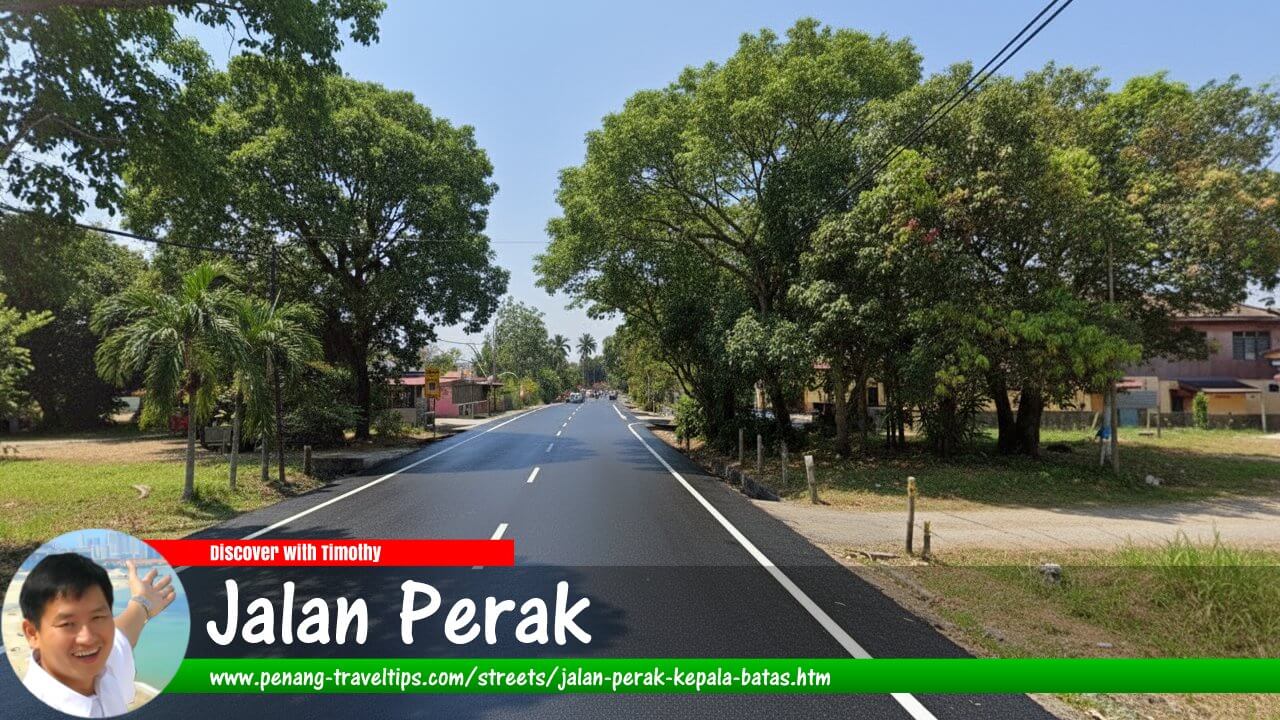 Jalan Perak, Kepala Batas (AI-edited photograph on 3 January 2026)
Jalan Perak is a short yet strategically important road in Kepala Batas, Seberang Perai Utara. With a length of approximately 1.93 kilometres, the road forms part of State Route P5 and functions as a key connector between several major local roads. Despite its modest length, Jalan Perak plays an essential role in linking residential neighbourhoods, local commercial areas, and important north–south travel corridors within the district.1
Quick Facts
- Road name: Jalan Perak
- Alternate designation: State Route P5
- Location: Kepala Batas, Seberang Perai Utara
- Approximate length: 1.93 km
- Northern terminus: Jalan Kedah
- Southern terminus: Junction of Jalan Permatang Bogak and Jalan Pajak Song
- Primary function: Local and state connector road
Geographical Context
Jalan Perak is situated within the semi-urban fabric of Kepala Batas, an area known for its blend of traditional villages, modern housing estates, and growing commercial activity. The road runs roughly north to south, providing a direct and efficient link between Jalan Kedah in the north and the southern junction formed with Jalan Permatang Bogak and Jalan Pajak Song.2
The surrounding landscape along Jalan Perak reflects the transitional character of Kepala Batas. Residential homes, small shops, and community facilities line parts of the road, while quieter stretches feature greenery and open spaces that soften its urban presence.2
Role as State Route P5
As State Route P5, Jalan Perak forms part of Penang’s state road network. State routes typically serve to connect towns, villages, and major federal roads, and Jalan Perak fulfills this role by acting as a feeder and distributor road within northern Seberang Perai.1
Although it does not carry the same long-distance traffic volumes as federal routes, its importance lies in facilitating smooth local movement and reducing pressure on larger arterial roads in the area.1
Route Alignment and Junctions
At its northern end, Jalan Perak meets Jalan Kedah, one of the most significant roads in Kepala Batas and part of Federal Route 1. This connection allows traffic from Jalan Perak to access a major north–south corridor that leads toward the Penang–Kedah state border and southern Seberang Perai.3
To the south, the road terminates at a multi-road junction with Jalan Permatang Bogak and Jalan Pajak Song. This junction serves as a local hub, distributing traffic toward residential areas, schools, and smaller commercial zones within Kepala Batas.3
Physical Characteristics
Jalan Perak is generally built as a two-lane undivided road, suitable for the moderate traffic volumes it handles. Road width, shoulder conditions, and drainage features vary slightly along its length, reflecting phased upgrades and the surrounding land use patterns.4
In busier sections, roadside lighting and basic pedestrian infrastructure are present, while quieter stretches rely more on natural lighting and simpler road furniture. The overall design prioritises functionality and accessibility over high-speed travel.4
Traffic Patterns and Usage
Traffic along Jalan Perak is typically light to moderate, with peak usage occurring during weekday mornings and late afternoons. Most vehicles using the road are private cars and motorcycles, reflecting its role as a local connector rather than a through route for heavy traffic.3
The road is frequently used by residents commuting to work, students travelling to nearby schools, and shoppers accessing local amenities. Its relatively short length makes it an efficient alternative to longer detours via larger roads.3
Economic and Community Importance
Despite its size, Jalan Perak contributes meaningfully to the local economy of Kepala Batas. Small businesses located along the road benefit from steady local traffic and easy accessibility, supporting neighbourhood-level commerce and services.2
For the surrounding community, the road provides essential access to homes, places of worship, and community facilities. It functions as a shared space where daily routines intersect, reinforcing its value beyond pure transportation.2
Historical Development
The alignment of Jalan Perak reflects gradual development rather than a single large-scale construction project. Like many state roads in Seberang Perai, it evolved from earlier village access routes that were upgraded over time to accommodate increased traffic and urban growth.5
Subsequent improvements, including resurfacing and drainage works, have enhanced road safety and usability while preserving its original role as a neighbourhood connector.5
Relationship with Surrounding Roads
Jalan Perak’s importance is closely tied to the network of roads it connects. By linking Jalan Kedah with Jalan Permatang Bogak and Jalan Pajak Song, it helps distribute traffic more evenly and improves overall network resilience in Kepala Batas.1
This interconnectedness allows motorists to choose alternative routes during congestion or roadworks, highlighting the value of smaller state roads within the broader transport system.1
Future Outlook
Looking ahead, Jalan Perak is likely to remain a stable component of Kepala Batas’s road network. Rather than major expansion, future efforts are expected to focus on routine maintenance, safety enhancements, and modest upgrades to support pedestrian and cyclist needs.4
As Kepala Batas continues to develop, Jalan Perak will continue to serve as a dependable local artery, quietly supporting daily life and movement within the community while maintaining its role as State Route P5.1
Jalan Perak on the Map of Roads in Penang
References
- Penang State Roads – Wikipedia
- Kepala Batas – Wikipedia
- Federal Route 1 (Malaysia) – Wikipedia
- Public Works Department of Malaysia
- Seberang Perai – Wikipedia
Page Details
This page was created on 3 January 2026. Hi, my name is Timothy and created it from my research, for my own entertainment, knowledge and to satisfy my curiosity. I am providing the information to you in good faith and hope it is useful. I try to get the details as accurate as possible. I also try to update the page whenever I stumble on new details. So this and all my other pages are perpetual work in progress. If you discover any error, please politely inform me, pointing out where the error lies, and I will correct it as soon as possible. Your helpfulness will keep this page accurate, relevant and helpful to those who need the information.Want to share your Penang travel experiences or get tips from fellow travellers?
Join the Penang Travel Tips Facebook GroupUseful guides for visiting Penang
My Videos of Penang
 Latest Pages & Updates
Buy Me A Coffee
If you enjoy the information I provide and want to support the work I do, please buy me a coffee! I appreciate it immensely, thank you so much!
