
Sekolah Kebangsaan Sungai Gelugor
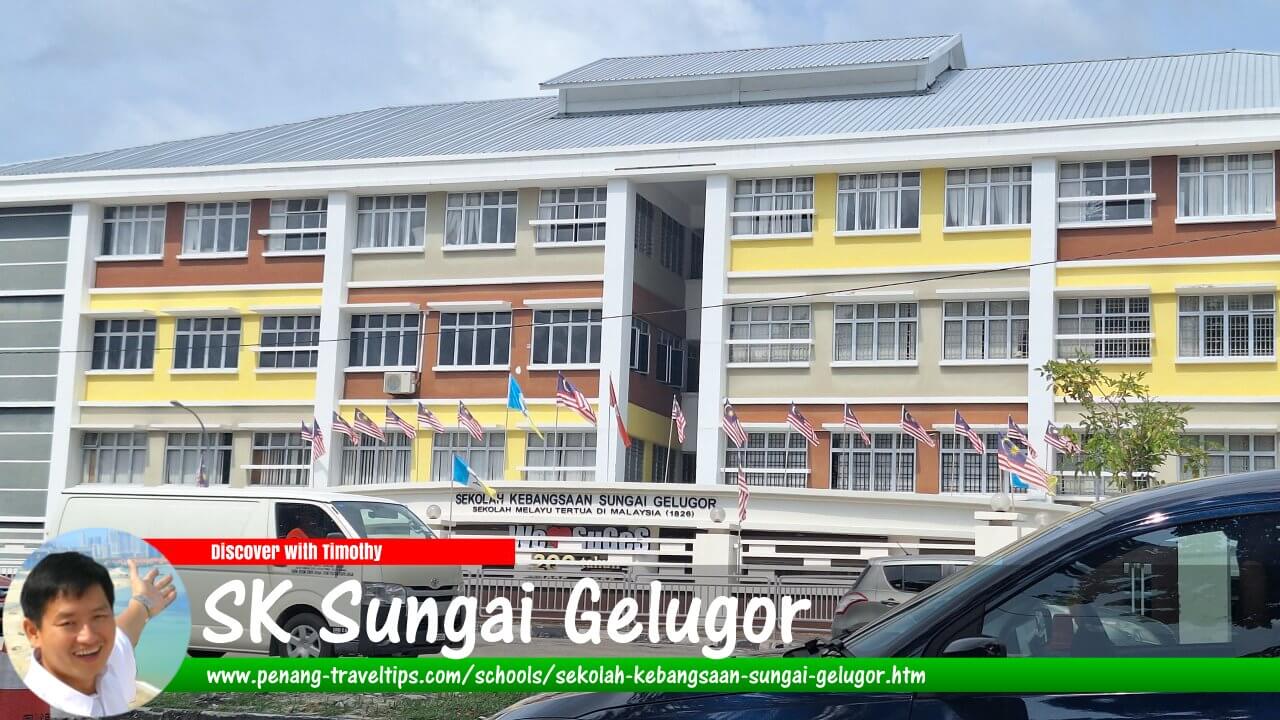 Sekolah Kebangsaan Sungai Gelugor (5 September 2026)
Also available: Sekolah Kebangsaan Sungai Gelugor (Edisi Melayu)
Sekolah Kebangsaan Sungai Gelugor (SK Sungai Gelugor) is a primary school in Gelugor, Penang, Malaysia. Located along Jalan Sultan Azlan Shah, the school is notable for its exceptionally long history, having been established in 1826. It is widely recognised as the oldest Malay school in Malaysia and is regarded as an important landmark in the history of education in Penang and the country.
From its origins as a modest school serving the local Malay community, SK Sungai Gelugor has evolved into a modern national primary school while retaining an important physical link with its past. Its original school building, known as Sekolah A, has been preserved and now houses the SK Sungai Gelugor Heritage and Cultural Gallery. The gallery contains historical objects, photographs, documents and educational artefacts that illustrate the development of Malay education over almost two centuries.
Quick Facts
Name: Sekolah Kebangsaan Sungai Gelugor
Abbreviation: SK Sungai Gelugor / SKSG
Type: National primary school
Established: 1826
School Code: PBA 1009
Address: Jalan Sultan Azlan Shah, 11700 Gelugor, Pulau Pinang
District: Timur Laut
State: Penang
Parliamentary constituency: Bukit Gelugor
State constituency: Seri Delima
Telephone: 04-656 6624
Fax: 04-653 0534
School session: One session
Location
Sekolah Kebangsaan Sungai Gelugor is located in Kampung Gelugor, along Jalan Sultan Azlan Shah in Gelugor, on Penang Island. The school occupies a site within an established urban area south of central George Town, surrounded by residential neighbourhoods and other community facilities.
Its location is significant because Gelugor is one of the older settlements on the island. The area developed from an agricultural and plantation landscape into an increasingly urbanised part of Penang, particularly during the twentieth century. SK Sungai Gelugor consequently reflects not only the history of education but also the transformation of the surrounding community.
Founding in 1826
The origins of SK Sungai Gelugor date to 1826, when the school was established in Gelugor during the British colonial period. The school is traditionally associated with David Brown, a Scottish landowner and plantation owner who was based in the Gelugor area.
According to accounts preserved by the school and repeated in recent historical reports, Brown provided a simple structure for educational purposes. The early school was intended particularly for the children of plantation workers and provided instruction in the Malay language, the Quran and Jawi writing.
The school's beginnings were therefore quite different from those of a modern government primary school. Education was closely connected with the local community and religious instruction. The teaching of Jawi was especially important because Jawi was a major written form of Malay at the time.
The school's own historical account also records that the community had already been conducting Quranic and religious instruction before the formal establishment of the school. This suggests that the institution grew from an existing tradition of community-based education rather than appearing entirely as a new institution in 1826.
David Brown and the Early School
David Brown played an important role in the early history of the school. Contemporary descriptions of its origins differ somewhat in their details, but they consistently associate the foundation of the school with Brown and his activities in Gelugor.
Some accounts describe the earliest premises as a simple shed or wooden structure, while other descriptions refer to an earlier barn or plantation building being adapted for educational purposes. Whatever its precise form, the early school was a modest institution compared with the substantial school campus that exists today.
The school initially catered primarily to the local Malay community. Its curriculum combined basic Malay-language education with Islamic learning and Jawi. This combination reflected the educational needs and cultural environment of the Malay population of nineteenth-century Penang.
Development under the Straits Settlements
A significant stage in the school's development came in 1838, when the administration of the Straits Settlements took over its management. The government subsequently established an official school building known as Sekolah A.
The establishment of Sekolah A marked an important transition from community-based instruction to a more organised form of public education. It formed part of wider efforts to develop Malay vernacular education and improve literacy among the local population.
Historical accounts describe the school as offering education to boys from Standard One through Standard Four during its earlier period. The school was headed by Munshi Shaikh Mohd Tambi, who led a small teaching staff.
The development of SK Sungai Gelugor was significant beyond the boundaries of Gelugor. Its experience became part of the wider development of Malay vernacular schooling in British Malaya, at a time when different systems of education were being established for different communities.
The School During the Second World War
The history of SK Sungai Gelugor was interrupted by the Japanese occupation of Malaya during the Second World War.
According to the school's historical record, the school reopened on 26 April 1942 during the Japanese occupation. At that time, it reportedly had 285 pupils and eight teachers, under the leadership of headmaster Omar Haji Nasaruddin.
Following the Japanese surrender in 1945, the school was temporarily closed again. It reopened on 1 October 1945, with 174 pupils and five teachers. The headmaster at the time was Abdullah bin Yahaya.
The post-war reopening represented the continuation of an educational institution that had already survived more than a century of political and social change. The school subsequently continued to serve the local community as Malaya moved towards independence.
Post-war Development
As the population of Gelugor grew, the school required additional facilities. A two-storey extension was constructed in 1975 to accommodate the needs of a growing school population.
The new building cost $187,000 and contained eight classrooms, a teachers' room and toilet facilities. It was officially opened on 5 November 1976 by Datuk Abdul Rahman Haji Arshad, then Deputy Director-General of Education Malaysia.
The construction of additional facilities illustrates how the school gradually changed from a small nineteenth-century institution into a larger modern primary school. The original historic building, however, remained an important part of the school compound.
Modernisation of the School
Further major improvements were undertaken in the twenty-first century. By the 2010s, SK Sungai Gelugor had developed into a substantially larger school equipped with modern facilities.
In 2016, reports on the school noted the completion of two new four-storey buildings. The upgrading programme provided additional facilities while allowing the school to continue operating on its historic site.
The modern buildings stand in marked contrast to the much older structures associated with the school's origins. This combination of old and new is one of the distinctive characteristics of SK Sungai Gelugor: a modern primary school campus exists alongside a surviving nineteenth-century educational building.
Sekolah A and the Heritage Building
The historic Sekolah A building is the most important physical reminder of SK Sungai Gelugor's early history. Rather than being demolished as the school expanded, the building was retained and subsequently conserved.
The building is significant because it provides a tangible connection with the early development of Malay education under the Straits Settlements. Its continued presence also helps demonstrate how educational facilities evolved over successive generations.
In 2023, the school was reported to have received an Anugerah Warisan 100 Tahun recognition for the preservation of its historic building. The continued care of the structure has largely been attributed to the commitment of successive generations of teachers and the school community.
Heritage and Cultural Gallery
The original building now houses the SK Sungai Gelugor Heritage and Cultural Gallery. The gallery was officially opened on 31 March 2016 by the then Minister of Education, Datuk Seri Mahdzir Khalid.
The gallery was established to preserve the history of the school and to provide a place where pupils, teachers, former pupils and members of the public can learn about its heritage.
Among the materials displayed are old documents, archival photographs, school desks, chairs and blackboards. The collection also includes Jawi textbooks, traditional writing materials and older teaching aids.
Other exhibits include former school badges and uniforms, traditional musical instruments, examples of Jawi writing, handicrafts and materials relating to local customs. Books, trophies, certificates and souvenirs donated by former pupils also form part of the collection.
The gallery therefore serves a purpose beyond simply displaying old objects. It functions as an informal educational resource, allowing present-day pupils to see how education was conducted in earlier generations.
The school has also used the gallery to strengthen pupils' awareness of their own institutional history. Visitors from other schools, universities and community organisations have visited the gallery, while educational delegations from countries including Thailand, Indonesia, Singapore and Japan have also been received as part of cultural exchange programmes.
Education and the Local Community
Although SK Sungai Gelugor began primarily as a school for the local Malay community, its role has changed over time. Today it serves children from the wider Gelugor area and forms part of the national primary education system.
The school has retained Malay language and cultural traditions as important elements of its identity while providing education within the Malaysian national school system. Its long history has consequently become a shared part of the heritage of the surrounding community.
The school also has a preschool programme and a Program Pendidikan Khas Integrasi (PPKI), reflecting the broader range of educational needs served by the school in the present day.
Academic and Co-curricular Activities
Like other Malaysian national primary schools, SK Sungai Gelugor provides education at the primary level and places emphasis on academic learning, character development and co-curricular activities.
The school's activities include sports, uniformed bodies, clubs and societies. Its official school portal highlights a range of activities involving pupils, including sports competitions, technology-based learning, environmental programmes, cultural celebrations and national-day activities.
Football is among the sports in which the school has participated competitively. The school has also highlighted its pupils' participation in district and state-level activities.
Technology has increasingly become part of the school's educational environment. The school maintains digital resources and uses information technology in teaching and administration, demonstrating the contrast between its nineteenth-century origins and its twenty-first-century educational role.
Patriotism and National History
SK Sungai Gelugor's own history provides a natural setting for teaching pupils about Malaysia's past. The school has traditionally placed considerable emphasis on National Day and Malaysia Day activities.
Past celebrations have included historical exhibitions, quizzes, colouring and drawing competitions, parades, singing competitions and poetry recitals. These activities are intended to help pupils understand the country's journey towards independence while encouraging appreciation of Malaysia's multicultural society.
The school's nearly two-century history provides an especially useful context for such activities. Generations of pupils have passed through the school during periods ranging from British colonial rule and the Japanese occupation to the establishment of the Federation of Malaya and modern Malaysia.
A School with Nearly Two Centuries of History
By 2026, SK Sungai Gelugor has reached approximately 200 years since its establishment in 1826. Few educational institutions in Malaysia can trace their origins back so far while continuing to operate as a school on the same historic site.
Its significance lies not simply in its age. The history of SK Sungai Gelugor illustrates the changing nature of education in Penang: from informal religious and community instruction, to nineteenth-century Malay vernacular schooling, to post-war education, and eventually to the modern national school system.
The survival of the original Sekolah A building makes this history especially tangible. While classrooms, teaching methods and technology have changed dramatically, the historic structure remains as a physical reminder of the generations who attended school there before the development of the modern campus.
Preserving the School's Heritage
The preservation of SK Sungai Gelugor's heritage has become an important responsibility of the school community. Teachers, former pupils, local residents and other organisations have contributed photographs, documents and objects to help record the institution's past.
The Heritage and Cultural Gallery provides a permanent home for many of these materials. Its collection ensures that historical objects which might otherwise have been discarded or forgotten can be preserved for future generations.
The gallery also gives present-day pupils an opportunity to understand that their school is more than a collection of modern classrooms. It is part of a much longer story involving the development of Gelugor, Malay education and Penang itself.
Importance in the History of Malaysian Education
SK Sungai Gelugor occupies a special place in Malaysian educational history because of its early establishment and its association with the development of Malay vernacular education.
Its origins predate the establishment of the Federation of Malaya by more than a century. They also predate many of the educational institutions that later became prominent in Penang and elsewhere in Malaya.
The school therefore represents an important chapter in the history of formal education in the Malay community. Its story also demonstrates how an institution established to meet the needs of a small nineteenth-century community could survive successive generations of social, political and technological change.
SK Sungai Gelugor Today
Today, SK Sungai Gelugor combines the functions of a contemporary national primary school with the responsibilities of a heritage institution. Its modern classrooms and facilities support present-day education, while the preserved Sekolah A building and Heritage and Cultural Gallery keep its early history visible.
The school continues to operate at Jalan Sultan Azlan Shah in Gelugor and remains closely connected with the surrounding community. Its official school portal records educational programmes, sporting activities, cultural events and other activities involving pupils and teachers.
Recent attention to the condition of school facilities has also highlighted the continuing need to maintain a comfortable learning environment. In March 2026, the Penang State Education Department said that issues involving classroom ventilation and fans at schools, including SK Sungai Gelugor, were being addressed to ensure suitable conditions for pupils.
Legacy
The legacy of Sekolah Kebangsaan Sungai Gelugor is inseparable from the history of Gelugor itself. From its beginnings in 1826, the school has witnessed the transformation of the area from a plantation landscape into an established urban community.
It has also witnessed the transformation of education: from Quranic instruction, Malay-language lessons and Jawi writing in a simple early school, to the comprehensive national primary education provided today.
For that reason, SK Sungai Gelugor is significant not merely because it is old. It is significant because it remains a functioning school whose history can still be seen, studied and experienced on its own campus. The preservation of Sekolah A and the Heritage and Cultural Gallery ensures that the story of the school remains part of the living heritage of Gelugor and Penang.
With its origins in 1826, SK Sungai Gelugor stands as one of the most enduring educational institutions in Malaysia and an important reminder of the long history of organised Malay education in Penang.
Sekolah Kebangsaan Sungai Gelugor is  on the Map of Gelugor, Penang
References
- Sekolah Kebangsaan Sungai Gelugor – Warisan SKSG
- Sekolah Kebangsaan Sungai Gelugor – Official School Portal
- Bernama – SK Sungai Gelugor: Oldest Malay School In Malaysia, A 200-year Old Heritage
- New Straits Times – 200 years strong: SK Sungai Gelugor, Malaysia's oldest Malay school
- The Star – New look for 190-year-old SK Sungai Gelugor
- Buletin Mutiara – Dedikasi warga pendidik SK Sungai Gelugor kekalkan bangunan warisan hampir 200 tahun
- RTM – Fasiliti sekolah diperbaiki untuk keselesaan pembelajaran
Page Details
This page was created on 16 August 2025. Hi, my name is Timothy and created it from my research, for my own entertainment, knowledge and to satisfy my curiosity. I am providing the information to you in good faith and hope it is useful. I try to get the details as accurate as possible. I also try to update the page whenever I stumble on new details. So this and all my other pages are perpetual work in progress. If you discover any error, please politely inform me, pointing out where the error lies, and I will correct it as soon as possible. Your helpfulness will keep this page accurate, relevant and helpful to those who need the information.Want to share your Penang travel experiences or get tips from fellow travellers?
Join the Penang Travel Tips Facebook GroupUseful guides for visiting Penang
My Videos of Penang
 Latest Pages & Updates
Buy Me A Coffee
If you enjoy the information I provide and want to support the work I do, please buy me a coffee! I appreciate it immensely, thank you so much!
