
Philippines Travel Guide
 Go Back
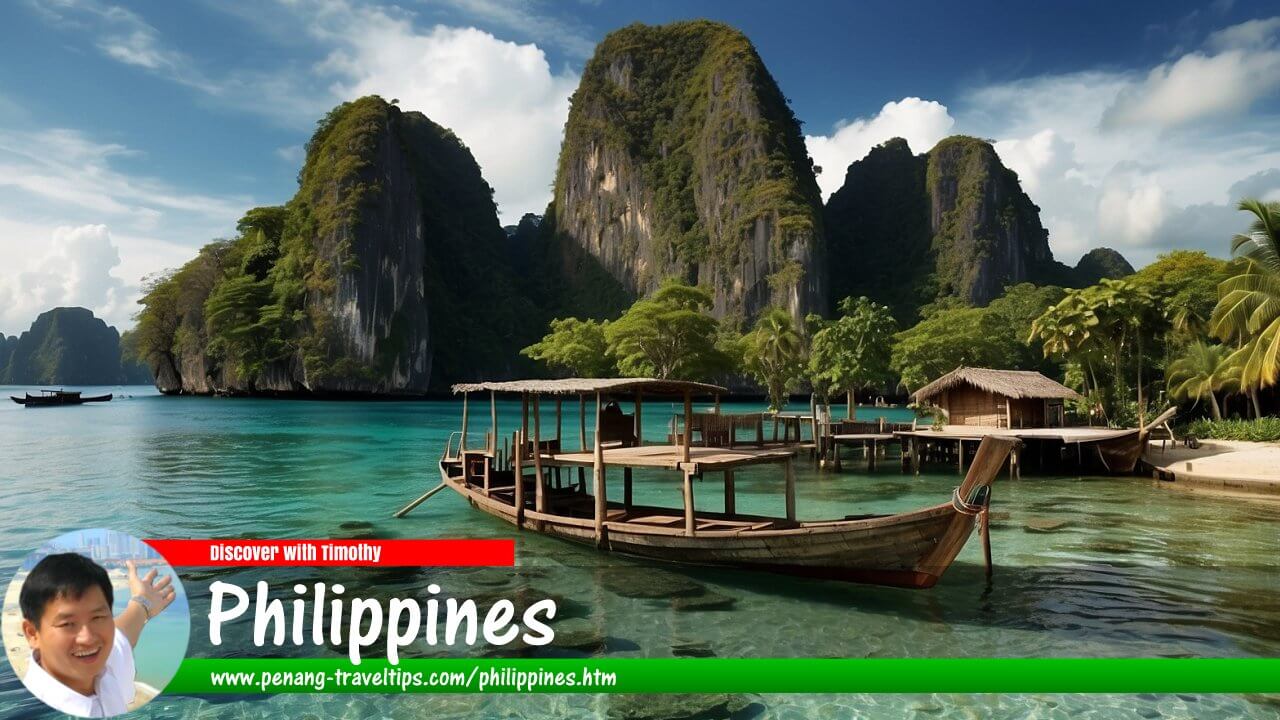 Philippines Travel Guide (AI Image generated on 19 August 2026)
Also available: Panduan Melawat Philippines
Introduction to the Philippines
The Philippines is an archipelago in Southeast Asia made up of more than 7,000 islands, offering an extraordinary variety of beaches, mountains, forests, historic cities and vibrant cultures. Its tropical climate, English-speaking population and warm hospitality have made it a popular destination for travellers from around the world.
The country is particularly well known for its spectacular islands and beaches, including Boracay, Palawan, Cebu and Siargao. Beyond its natural attractions, the Philippines also offers Spanish colonial heritage, colourful festivals, diverse regional cuisines and some of the most welcoming communities in Asia.
Where Is the Philippines?
The Philippines lies in the western Pacific Ocean, to the east of Vietnam and north of Indonesia. It is separated from mainland Southeast Asia by the South China Sea and from Taiwan by the Bashi Channel.
Because the country consists of thousands of islands, its geography is remarkably diverse. There are volcanic mountains, coral reefs, limestone cliffs, tropical rainforests, rice terraces and extensive coastlines. This geographical diversity is one of the main reasons why different parts of the Philippines offer very different travel experiences.
Main Cities of the Philippines
- Manila (1,661,000)
- Quezon City (2,700,000)
- Antipolo City (634,000)
- Caloocan City (1,379,000)
- Cebu City (799,000)
- Davao City (1,363,000)
- Pasig City (617,000)
- Taguig City (613,000)
- Valenzuela City (569,000)
- Zamboanga City (774,000)
Places of Interest in the Philippines
- Baguio
- Banaue Rice Terrace
- Chocolate Hills
- Coconut Palace
- Corregidor Island
- Mount Apo National Park
- Mount Mayon
- Mount Pinatubo
- Pagsanjan Falls
- Taal Volcano
Ten Biggest Islands of the Philippines
- Luzon (104,688 sq km)
- Mindanao (97,530 sq km)
- Negros (13,074 sq km)
- Samar (12,849 sq km)
- Palawan (12,189 sq km)
- Panay (12,011 sq km)
- Mindoro (10,572 sq km)
- Leyte (7,368 sq km)
- Cebu Island (4,468 sq km)
- Bohol (3,821 sq km)
The Three Main Island Groups
The Philippines is traditionally divided into three major geographical island groups: Luzon, Visayas and Mindanao. Each has its own distinctive character and includes numerous destinations of interest to visitors.
Luzon
Luzon is the largest and most populous island group and is home to Manila, the national capital. It includes the surrounding provinces as well as major destinations such as Banaue, Sagada, Baguio and the volcanic landscapes of northern and central Luzon.
Northern Luzon is particularly famous for the Banaue Rice Terraces, which are among the most remarkable examples of traditional agricultural landscapes in Asia. The Cordillera mountain region also provides opportunities to experience the cultures of several indigenous communities.
Visayas
The Visayas is a central island group consisting of numerous islands and provinces. It includes some of the Philippines' most popular beach and diving destinations, such as Cebu, Bohol, Boracay, Negros, Panay and Siquijor.
The region is also known for its colourful festivals. Cebu's Sinulog, Iloilo's Dinagyang and Bacolod's MassKara are among the best-known celebrations.
Mindanao
Mindanao is the second-largest island group and occupies much of the southern Philippines. It is geographically diverse, with mountains, forests, waterfalls, beaches and offshore islands.
Destinations such as Davao, Camiguin and Siargao provide a different experience from the more heavily visited areas of Luzon and the Visayas. Mindanao is also home to Mount Apo, the highest mountain in the Philippines.
Manila
Manila is the capital and one of the main gateways into the Philippines. It is a densely populated metropolitan area where historic districts, modern commercial centres, shopping malls and busy neighbourhoods exist side by side.
For many international visitors, Manila is primarily a transportation hub. However, the city itself has several important historical and cultural attractions and is worth exploring rather than simply passing through.
Intramuros
Intramuros is Manila's historic walled district and one of the country's most important reminders of its Spanish colonial past. Its stone walls, churches, plazas and historic buildings provide a striking contrast with the modern city surrounding it.
Among the principal attractions within Intramuros are Fort Santiago, Manila Cathedral and San Agustin Church. San Agustin Church is particularly significant because it is one of the Baroque Churches of the Philippines inscribed on the UNESCO World Heritage List. 1
Fort Santiago
Fort Santiago is a historic fortress within Intramuros. It played an important role during the Spanish colonial period and later became associated with the imprisonment of Filipino national hero José Rizal before his execution in 1896.
The fort contains historical structures, gardens and exhibitions that help visitors understand Manila's colonial and wartime history.
Manila Cathedral
Manila Cathedral stands within Intramuros and is one of the most recognisable religious buildings in the capital. The present structure is the latest of several cathedrals that have occupied the site, following repeated destruction and reconstruction.
San Agustin Church
San Agustin Church is the oldest stone church in the Philippines and one of the country's most important examples of Spanish colonial religious architecture. Together with three other churches, it forms the UNESCO-listed Baroque Churches of the Philippines. 1
Quezon City and Metro Manila
Metro Manila extends far beyond the historic centre. The metropolitan area includes numerous cities, each with its own commercial districts, restaurants, shopping centres and attractions.
Quezon City, for example, was once the national capital and remains one of the country's largest urban centres. Makati and Bonifacio Global City are major business and commercial districts, while Pasay is home to important transport facilities and entertainment complexes.
Palawan
Palawan is one of the Philippines' most celebrated island destinations. It is particularly famous for its limestone cliffs, turquoise waters, coral reefs and secluded islands.
Two of the best-known destinations are El Nido and Coron. Both are renowned for island-hopping, snorkelling, diving and dramatic coastal scenery.
El Nido
El Nido lies in northern Palawan and is surrounded by towering limestone karst formations, hidden lagoons and numerous small islands. Island-hopping tours are the main activity for visitors.
The Bacuit Archipelago around El Nido contains numerous beaches, lagoons and marine habitats. The landscape is particularly spectacular when viewed from the water.
Coron
Coron is located in northern Palawan and is particularly famous for its clear waters, limestone islands and World War II shipwreck diving sites.
The surrounding waters are also suitable for snorkelling and kayaking. Coron Town itself is relatively small, with most visitors spending their time exploring the islands and marine environment around it.
Puerto Princesa
Puerto Princesa is the capital of Palawan and an important gateway to the island. It is also the starting point for visiting the Puerto Princesa Subterranean River National Park.
Puerto Princesa Subterranean River
The Puerto Princesa Subterranean River National Park protects a spectacular limestone karst landscape and an underground river that flows directly into the sea. The site is recognised as a UNESCO World Heritage Site and is also one of the New7Wonders of Nature. 2
Visitors can explore part of the underground river by boat, accompanied by local guides. Access is regulated, so advance arrangements are advisable, particularly during busy periods.
Boracay
Boracay is perhaps the most internationally famous beach destination in the Philippines. Its principal attraction is White Beach, a long stretch of fine white sand divided into several stations.
Boracay offers a wide range of accommodation, restaurants, water sports and nightlife. It is therefore suitable for travellers looking for a combination of beautiful beaches and convenient tourist facilities.
The island has undergone major rehabilitation in recent years, with authorities introducing measures intended to improve environmental management and regulate tourism activities. 3
Cebu
Cebu is one of the Philippines' most important tourism and transportation hubs. Cebu City provides an urban base, while the surrounding island and neighbouring islands offer beaches, diving, waterfalls and other outdoor activities.
Cebu City
Cebu City is one of the oldest cities in the Philippines and has an important place in the country's history. Among its notable attractions are Magellan's Cross, Basilica Minore del Santo Niño and Fort San Pedro.
Magellan's Cross
Magellan's Cross is traditionally associated with the arrival of Christianity in the Philippines in 1521. The historic marker is housed in a small chapel near the Basilica Minore del Santo Niño.
Basilica Minore del Santo Niño
Basilica Minore del Santo Niño is one of the most important Catholic pilgrimage sites in the Philippines. It houses the Santo Niño de Cebu, a revered image of the Child Jesus.
The basilica is closely associated with Cebu's Sinulog Festival, one of the country's largest and most famous religious and cultural celebrations.
Bohol
Bohol is famous for the Chocolate Hills, tarsiers, beaches and historic churches. The island can easily be combined with Cebu because of the regular transport connections between them.
Chocolate Hills
The Chocolate Hills are a remarkable geological landscape consisting of hundreds of rounded hills spread across central Bohol. During the dry season, the vegetation turns brown, giving the hills their distinctive name.
Philippine Tarsier
The Philippine tarsier is one of the world's smallest primates and is native to the Philippines. Its large eyes and tiny body make it one of the country's most recognisable animals.
Visitors should choose responsible wildlife facilities that follow conservation guidelines and avoid touching, disturbing or using flash photography on the animals.
Siargao
Siargao is an island in northeastern Mindanao that has become internationally known as a surfing destination. Its laid-back atmosphere, tropical scenery and growing collection of cafes and resorts have also attracted travellers who are not surfers.
Cloud 9
Cloud 9 is the most famous surfing area on Siargao. It is known for powerful waves and attracts experienced surfers from around the world.
Beginners can find other areas around the island with more suitable conditions and can take lessons from local instructors.
Banaue Rice Terraces
The Banaue Rice Terraces are among the most extraordinary cultural landscapes in the Philippines. They were constructed by the Ifugao people using traditional methods adapted to the mountainous terrain.
The terraces are often described as being thousands of years old, although the precise dating and development of the different terrace systems are more complex. The broader Rice Terraces of the Philippine Cordilleras are recognised by UNESCO as a World Heritage Site. 4
Banaue is particularly suitable for travellers interested in indigenous cultures, mountain scenery, trekking and traditional agricultural practices.
Vigan
Vigan is one of the best-preserved Spanish colonial towns in Asia. Its historic centre is characterised by cobbled streets, ancestral houses and architecture reflecting a mixture of Asian and European influences.
The Historic City of Vigan is inscribed on the UNESCO World Heritage List. 5
Vigan is an excellent destination for travellers who want to experience a very different side of the Philippines from its beaches and tropical islands.
Other Notable Destinations
The Philippines has far more destinations than can be covered in a single journey. Depending on your interests, other places worth considering include the following:
- Baguio – a mountain city known for its cooler climate, pine forests and gardens.
- Tagaytay – a popular highland destination overlooking Taal Volcano and Taal Lake.
- Davao – a major city in Mindanao and gateway to Mount Apo and surrounding attractions.
- Camiguin – a volcanic island known for hot springs, waterfalls and scenic landscapes.
- Moalboal – famous for its sardine run and marine activities.
- Oslob – known for whale shark tourism, although responsible wildlife practices should be carefully considered.
- Siqiujor – a small island known for beaches, waterfalls and a relaxed atmosphere.
- Boracay – one of the country's best-known beach resorts.
What Makes the Philippines Special?
The greatest strength of the Philippines as a tourist destination is the variety of experiences available within one country. A single trip can combine a modern Asian metropolis, Spanish colonial heritage, mountain villages, tropical beaches, coral reefs and remote islands.
The country's cultural diversity is equally important. Filipino culture has been shaped by indigenous traditions as well as centuries of interaction with Asian neighbours, Spain, the United States and other parts of the world.
For Malaysian travellers, the Philippines can therefore offer both familiar and unfamiliar experiences: tropical weather and Southeast Asian hospitality on one hand, but a predominantly Christian culture, strong Spanish influences and an island geography quite different from Malaysia on the other.
Planning a First Visit
For a first visit, it is usually better to concentrate on one or two regions rather than attempt to see the entire country. The Philippines' geography means that travelling between islands can consume considerable time.
A traveller interested in history and urban culture might combine Manila with nearby destinations. Someone seeking beaches could concentrate on Palawan, Boracay or Cebu, while nature lovers might prefer northern Luzon, Bohol or Siargao.
The most important principle is to allow enough time between destinations. Island transfers, domestic flights and ground transportation can make an itinerary that looks simple on a map considerably longer in practice.
Geography, Climate and Best Time to Visit the Philippines
The Philippines is an archipelagic country consisting of thousands of islands spread across the western Pacific Ocean. Its geography is one of the main reasons why the country offers such a wide variety of travel experiences, from tropical beaches and coral reefs to volcanic mountains, rice terraces and dense forests.
Geography of the Philippines
The Philippines is located in Southeast Asia, between the South China Sea to the west and the Philippine Sea and Pacific Ocean to the east. It lies relatively close to Taiwan in the north, Vietnam to the west and Indonesia and Malaysia to the south. 6
The country is divided geographically into three major island groups: Luzon, Visayas and Mindanao. These island groups contain numerous provinces, cities and smaller islands, each with its own landscape and culture.
Luzon
Luzon is the largest island and contains Manila, the country's capital and principal metropolitan centre. It also includes the Cordillera mountain region, the northern rice terraces, the beaches of northern and central Luzon, and several important volcanoes.
Northern Luzon is mountainous and offers a cooler climate in elevated areas. Destinations such as Banaue, Sagada and Baguio are especially popular with travellers looking for mountain scenery and cultural experiences.
Visayas
The Visayas consists of numerous islands in the central Philippines. Cebu, Bohol, Panay, Negros, Leyte and Samar are among the major islands in this region.
The Visayas is particularly important for tourism because it contains many of the country's best-known beaches, diving areas and island destinations. Boracay, Bohol, Cebu and Siquijor are among the most popular.
Mindanao
Mindanao is the second-largest island group and occupies much of the southern Philippines. It has extensive mountains and forests, fertile agricultural areas and numerous coastal and island destinations.
Davao is the principal urban centre, while Siargao and Camiguin are among the best-known destinations for international visitors.
Volcanoes and Mountains
The Philippines lies along the Pacific Ring of Fire, a region characterised by considerable tectonic and volcanic activity. As a result, the country has numerous volcanoes and mountainous landscapes.
Some of the best-known volcanoes include Mayon, Taal, Pinatubo and Kanlaon. Their landscapes have become important tourist attractions, although volcanic activity can occasionally result in restrictions or closures.
Mayon Volcano
Mayon Volcano in Albay is famous for its remarkably symmetrical cone. It is considered one of the most visually striking volcanoes in the Philippines.
The area around Mayon offers viewpoints, nature activities and opportunities to explore the countryside of Albay. However, access to areas close to the volcano may be restricted when volcanic activity increases.
Taal Volcano
Taal Volcano is located within Taal Lake in Batangas. Its unusual setting, with a volcano within a lake on an island, has made it one of the country's most recognisable geological features.
Because Taal is an active volcanic system, visitors should always check the latest volcanic alert level and access restrictions before planning a visit.
Mount Pinatubo
Mount Pinatubo became internationally known after its major eruption in 1991. Today, its crater lake and surrounding landscape are visited as part of organised trekking and off-road excursions.
The journey to the crater is itself part of the experience, usually involving an off-road vehicle followed by a trek through the volcanic landscape.
Mount Apo
Mount Apo is the highest mountain in the Philippines, rising to approximately 2,954 metres above sea level. It is located on Mindanao and is an important destination for mountain trekking and nature tourism.
Beaches and Islands
The Philippines has an enormous coastline and thousands of islands, making beach tourism one of the country's greatest attractions. The character of each island varies considerably.
Some destinations are highly developed, with large resorts and nightlife, while others remain relatively quiet and are better suited to travellers seeking nature and solitude.
White Beach, Boracay
White Beach on Boracay is famous for its exceptionally fine sand and clear tropical waters. The beach is divided into stations, with different sections offering different atmospheres and accommodation options.
Palawan
Palawan is particularly famous for its limestone islands, lagoons and clear waters. El Nido and Coron are among the country's premier destinations for island-hopping, snorkelling and diving.
Siargao
Siargao combines beaches and tropical scenery with a strong surfing culture. Although Cloud 9 attracts experienced surfers, the island has many other attractions for visitors who simply want to enjoy its relaxed atmosphere.
Climate of the Philippines
The Philippines has a tropical maritime climate, generally characterised by warm temperatures, high humidity and significant rainfall. However, the climate varies considerably between regions because of the country's geography and exposure to different weather systems. 7
For travellers from Malaysia, the climate will generally feel familiar. Both countries are tropical and experience high humidity, but the Philippines has a particularly important additional consideration: the country is frequently affected by tropical cyclones, especially during the wet season.
Rainy and Dry Seasons
Many parts of the Philippines experience a broad distinction between a dry season and a rainy season. The exact timing varies by location, so there is no single "best month" for the entire country.
Dry season: Generally from around November or December to April or May in many parts of the country.
Rainy season: Generally from around May or June to October, although timing varies between regions.
Typhoon season: Tropical cyclones can occur throughout the year, but activity is generally greatest from around June to November.
These periods should be regarded as general patterns rather than fixed rules. Weather conditions differ between Manila, Palawan, Cebu, Mindanao and other regions.
When Is the Best Time to Visit?
For many popular destinations, the period from December to April is generally attractive because conditions are often drier and more suitable for outdoor activities. This is also a popular travel period, so accommodation and flights can be more expensive.
The best time therefore depends on what you want to do. Beach holidays, mountain trekking, diving and city sightseeing may each have different ideal periods.
Visiting During the Dry Season
The dry season is often the most convenient period for a first visit. Clearer skies and lower rainfall make it easier to plan island-hopping, hiking and sightseeing.
However, the most popular destinations can become crowded during Christmas, New Year, Easter and other holiday periods. Advance booking is recommended during these times.
Visiting During the Rainy Season
Travelling during the rainy season can have advantages, including lower accommodation prices and fewer visitors. The landscape can also be particularly lush and green.
The disadvantage is that heavy rain can disrupt outdoor activities and transportation. Boat trips may be cancelled because of rough seas, while domestic flights can occasionally be delayed by bad weather.
If travelling during this period, it is wise to maintain some flexibility in the itinerary rather than scheduling important island transfers immediately before an international flight.
Typhoons in the Philippines
The Philippines is one of the countries most frequently affected by tropical cyclones. These storms are locally called bagyo and can bring strong winds, heavy rain, flooding and landslides.
The Philippine Atmospheric, Geophysical and Astronomical Services Administration, better known as PAGASA, monitors tropical cyclones and issues weather warnings. 8
Travellers should check official weather information before travelling between islands, particularly when a tropical cyclone is developing. Boat services may be suspended for safety reasons even when conditions at the departure point appear relatively calm.
Weather in Manila
Manila is hot and humid throughout much of the year. The city can receive heavy rainfall during the wet season, while the dry season generally provides more favourable conditions for sightseeing.
Because Manila is a large and densely populated metropolitan area, heavy rainfall can also cause traffic congestion and localised flooding.
Weather in Palawan
Palawan generally has a warm tropical climate throughout the year. The timing and intensity of rainfall vary between different parts of the island.
For island-hopping in El Nido and Coron, calmer seas and clearer weather are particularly desirable. Always check local conditions before booking boat excursions.
Weather in Cebu and Bohol
Cebu and Bohol can be visited throughout much of the year, although rainfall varies seasonally. Their central location makes them popular choices for combining beach holidays with cultural and historical sightseeing.
For diving and island-hopping, visibility and sea conditions are important considerations in addition to rainfall.
Weather in Northern Luzon
Northern Luzon has more pronounced differences between lowland and mountain climates. Destinations such as Baguio, Banaue and Sagada can be considerably cooler than Manila.
Mountain weather can change quickly, so visitors should bring suitable clothing even when travelling during a generally warm period.
Weather in Mindanao
Mindanao has a more varied rainfall pattern, with significant differences between locations. Some areas can experience substantial rainfall even during periods that are relatively dry elsewhere in the country.
Travellers heading to Siargao, Davao or other parts of Mindanao should therefore check the local forecast rather than relying solely on a general Philippines weather forecast.
Best Time for Beach Holidays
For a beach holiday, the drier months are generally preferable because they offer better chances of sunny weather and calmer seas. December to April is often a good period for popular destinations such as Boracay, Palawan and parts of the Visayas.
Nevertheless, conditions can vary from island to island. A period that is excellent for Boracay may not necessarily be equally ideal for every destination in Palawan or Mindanao.
Best Time for Diving
The Philippines is one of the world's major diving destinations, with coral reefs, marine biodiversity and numerous wrecks. Diving conditions depend on the particular location and season.
Popular diving areas include Coron, Malapascua, Apo Island, Moalboal, Anilao and Tubbataha Reefs. Tubbataha, in particular, is a protected marine area and UNESCO World Heritage Site that is accessible mainly through liveaboard diving expeditions during its limited diving season. 9
Best Time for Surfing
For surfing, the ideal period depends on the destination. Siargao is particularly famous for its surfing season, with larger swells generally arriving during the latter part of the year.
Beginners should not assume that the biggest waves are necessarily the best conditions. Local surf schools can advise visitors on beaches and times that are appropriate for their ability.
Best Time for Hiking
Mountain trekking is generally more comfortable during periods of lower rainfall. Trails can become slippery or muddy during heavy rain, and landslides may occasionally affect access to mountainous areas.
For destinations such as Banaue, Sagada and Mount Apo, travellers should check local trail conditions and consider using an experienced guide where appropriate.
Festivals and Cultural Events
The Philippines has a vibrant festival culture, with celebrations taking place throughout the year. Many festivals combine religious traditions with music, dance, costumes, processions and street performances.
Sinulog Festival
Sinulog is held in Cebu and is associated with the Santo Niño. It is one of the Philippines' best-known festivals and attracts large crowds.
Ati-Atihan Festival
Ati-Atihan is held in Kalibo, Aklan, and is another major celebration associated with the Santo Niño. It is known for energetic street dancing, music and elaborate costumes.
Dinagyang Festival
Dinagyang takes place in Iloilo and is famous for large-scale performances, colourful costumes and choreographed street dancing.
MassKara Festival
MassKara Festival is held in Bacolod and is known for its distinctive smiling masks, dancing and colourful celebrations.
Christmas in the Philippines
The Philippines is predominantly Christian and is famous for having one of the world's longest Christmas seasons. Christmas-related activities can begin well before December and continue into January.
Visitors during this period will encounter elaborate decorations, Christmas music, festive markets and large family gatherings. It is an interesting time to experience Filipino culture, although popular travel dates can be particularly busy.
Holy Week
Holy Week is one of the most significant periods in the predominantly Catholic Philippines. Many Filipinos travel to visit family or religious sites during this period.
Travellers should expect heavier traffic, crowded transport and possible changes to business opening hours. Accommodation and domestic transport can also become more difficult to secure.
Best Time for Malaysian Travellers
For Malaysians planning their first trip, January to April is generally a convenient period to consider, particularly if the main objective is island-hopping, beach activities and sightseeing.
However, there is no need to restrict travel to these months. The Philippines can be visited throughout the year if the itinerary is chosen according to regional weather conditions.
The most important consideration is to check the weather for the specific islands and cities you intend to visit rather than relying on a single nationwide forecast.
How Long Should You Visit?
The enormous geographical spread of the Philippines means that a longer trip does not necessarily mean seeing more places. Domestic flights and boat transfers can take considerable time, particularly when travelling between distant island groups.
For a first visit, 7 to 10 days is enough to explore one or two areas without making the itinerary excessively rushed. Two weeks allows a more varied trip combining Manila with one or two major island destinations.
3–5 days: Concentrate on one destination, such as Manila, Cebu, Boracay or Palawan.
7 days: Combine two nearby destinations or concentrate on one island group.
10 days: Suitable for combining a major city with one or two island destinations.
14 days: Allows a broader itinerary, although domestic travel should still be kept manageable.
3 weeks or more: Suitable for travellers who want to explore several regions at a slower pace.
Choosing the Right Season
There is no universally perfect time to visit the Philippines. The best period depends on the destinations you intend to visit, the activities you want to do and your tolerance for crowds and rain.
For a first-time Malaysian visitor seeking a combination of beaches, sightseeing and comfortable weather, the dry season is generally the safest choice. For travellers willing to accept occasional rain in exchange for lower prices and fewer tourists, the shoulder and wet seasons can also be rewarding.
Whatever month you choose, remember that the Philippines is an island country. Weather at your destination matters more than the weather in Manila.
Getting to and Around the Philippines
For Malaysian travellers, getting to the Philippines is relatively straightforward because the country is well connected by air to Malaysia and has an extensive domestic transport network. The main challenge is not reaching the Philippines but moving efficiently between its many islands.
Travelling from Malaysia to the Philippines
The easiest way to travel from Malaysia to the Philippines is by air. Most international visitors arrive through Manila or Cebu, although other international airports also serve selected destinations.
Direct flights from Kuala Lumpur make Manila and several other Philippine destinations accessible without having to transit through another country. Flight schedules vary, so travellers should compare the available routes when planning their itinerary.
Manila as an International Gateway
Ninoy Aquino International Airport (NAIA) in Metro Manila has traditionally been the principal international gateway to the Philippines. It serves a large number of international and domestic flights and is convenient for visitors whose itinerary begins in Manila.
Manila is also a useful connecting point for travellers who intend to continue to other parts of Luzon or take a domestic flight to destinations elsewhere in the country.
Clark International Airport
Clark International Airport in Pampanga provides an alternative gateway to the Philippines. It is located north of Metro Manila and can be particularly convenient for travellers visiting Central Luzon or destinations around Clark and Angeles.
Clark is also useful for some travellers who prefer to avoid the congestion of Metro Manila. The airport has international and domestic connections to various destinations in the Philippines. 10
Cebu as a Gateway
Mactan-Cebu International Airport is the principal gateway to Cebu and an important international and domestic hub for the Visayas. It is especially convenient for travellers planning to visit Cebu, Bohol, Boracay or other islands in the central Philippines.
For some itineraries, flying directly to Cebu rather than Manila can save considerable travelling time, especially when the main purpose of the trip is to explore the Visayas.
Other International Airports
The Philippines has several other international airports, including those serving Clark, Puerto Princesa, Davao, Iloilo, Kalibo, Bohol and other areas. The availability of international routes varies according to the airport and season. 11
When planning a trip, it is worth checking whether you can fly directly to or near your intended destination rather than automatically routing everything through Manila.
Entry Requirements for Malaysians
Malaysian passport holders are generally admitted to the Philippines without a visa for an initial stay of up to 30 days, subject to the applicable entry requirements. 12
Travellers should have a passport with sufficient validity and may be required to present evidence of onward or return travel. Immigration requirements can change, so Malaysians should check the latest official requirements before departure.
eTravel Registration
Travellers entering the Philippines are required to complete the country's eTravel registration as applicable. The system is the Philippine government's digital platform for collecting passenger information for border control and other government purposes. 13
The official eTravel registration is free of charge. Travellers should be particularly careful of unofficial websites that ask for payment to complete the registration. 14
It is advisable to complete the registration using the official government platform before travelling and to keep the resulting information readily accessible on your phone.
Staying Longer Than 30 Days
Malaysians who wish to stay longer than the initial visa-free period should make the necessary arrangements with the Philippine Bureau of Immigration. Eligible temporary visitors may apply for an extension of their authorised stay. 15
Do not assume that simply remaining in the country after the permitted period is acceptable. Check the extension requirements and complete the necessary immigration procedures before the authorised stay expires.
Domestic Flights
Because the Philippines consists of thousands of islands, domestic flights are often the most practical way to travel between distant destinations. Airlines operate routes connecting Manila, Cebu, Davao, Puerto Princesa, Bohol, Boracay and many other cities and islands.
For example, a traveller visiting Manila, Palawan and Cebu may find it much more efficient to fly between these destinations rather than attempt to travel entirely by land and sea.
Major Domestic Airlines
The Philippine domestic aviation market is served by several airlines, including Philippine Airlines, Cebu Pacific and AirAsia Philippines. Smaller airlines also operate selected routes.
Fares can vary considerably depending on the booking date, travel season, baggage allowance and additional services. Low advertised fares may not include checked baggage, seat selection or meals.
Choosing Your Domestic Airport
Pay attention to the airport used by your domestic flight. Large metropolitan areas may have more than one airport or terminal arrangement, while some island destinations are served by airports located a considerable distance from the main tourist area.
For Boracay, for example, travellers may arrive through Caticlan or Kalibo depending on the flight chosen. Caticlan is closer to Boracay, while Kalibo is farther away and requires a longer ground transfer.
Ferries Between Islands
Ferries are an important part of the Philippine transport system and are particularly useful for travelling between nearby islands. They can be cheaper than flying and can provide an enjoyable way to experience the country's maritime landscape.
Popular ferry routes connect destinations such as Cebu and Bohol, Cebu and Siquijor, and various islands within the Visayas.
However, ferry services are more vulnerable to weather conditions than flights. Services can be delayed or suspended when seas become rough, particularly during storms and tropical cyclones.
Fast Ferries
Fast ferries are commonly used on shorter inter-island routes. They can significantly reduce travel time compared with conventional ferries and are popular among tourists moving between major destinations.
When booking a ferry, check the departure and arrival ports carefully. The name of a destination may refer to a city or island while the actual port may be some distance away.
Overnight Ferries
For longer journeys, overnight ferries can provide an economical alternative to flying. Some vessels offer sleeping accommodation, allowing passengers to travel while they sleep.
The level of comfort varies considerably between operators and vessels. Travellers who value comfort may prefer a private cabin, while budget travellers can choose shared accommodation.
Jeepneys
The jeepney is one of the most recognisable forms of public transport in the Philippines. These colourful vehicles evolved from military jeeps and have become an important part of everyday transportation.
Jeepneys operate on fixed routes and are generally inexpensive. However, using them can be confusing for first-time visitors because routes may not be obvious to someone unfamiliar with the city.
For short trips, ask the driver or a local passenger whether the jeepney is travelling towards your destination before boarding.
Tricycles
Tricycles are motorcycle-based vehicles with a passenger sidecar and are common in smaller towns and communities. They are particularly useful for short journeys where conventional buses or taxis are unavailable.
Fares may be fixed, shared or negotiated depending on the location and type of service. It is sensible to confirm the fare before beginning a private journey.
Taxis
Taxis are widely available in major Philippine cities. In Manila and other large urban areas, metered taxis can be used for journeys within the city.
Travellers should ensure that the meter is being used when appropriate and should avoid accepting unexplained additional charges.
E-Hailing Services
E-hailing applications such as Grab are widely used in major Philippine cities and can be particularly convenient for visitors. The application allows passengers to see the estimated fare and identify the vehicle before boarding.
E-hailing is often easier for tourists than negotiating with an unfamiliar taxi driver, particularly when travelling from an airport or hotel.
Buses
Buses are important for travelling between towns and cities, particularly on the larger islands. Long-distance bus services connect many destinations in Luzon and the Visayas.
Travel times can be considerably longer than the distance on a map suggests because of traffic, road conditions, stops and ferry crossings on routes that involve island connections.
Private Cars and Drivers
Hiring a private car with a driver can be a convenient option for families or groups. It is especially useful when visiting several attractions in rural areas where public transportation is limited.
A private vehicle also allows travellers to stop at viewpoints, restaurants and smaller attractions along the way. The disadvantage is the higher cost compared with public transportation.
Driving in the Philippines
Self-driving is possible, but it is not necessarily the easiest option for first-time visitors. Traffic in major cities can be heavy, and driving conditions vary considerably between urban centres and rural areas.
Visitors who intend to drive should ensure that their driving licence and any international driving documentation meet Philippine requirements. They should also confirm that their rental agreement and insurance provide appropriate coverage.
Motorcycles and Scooters
Motorcycles and scooters are commonly used on smaller islands and in tourist destinations. They can be a convenient way to explore places such as Siargao, Bohol and parts of Palawan.
However, visitors should not rent a motorcycle simply because it appears to be the easiest option. Roads can be unfamiliar, traffic conditions can be unpredictable and weather can change quickly.
Always wear a proper helmet and ensure that you are legally permitted and adequately insured to ride the vehicle.
Getting Around Manila
Manila is a huge metropolitan area, and travelling between districts can take much longer than expected because of traffic congestion. It is therefore important to consider the location of your hotel when planning sightseeing.
The metropolitan area has several forms of public transportation, including buses, jeepneys, trains, taxis and e-hailing services.
Light Rail Transit and Metro Rail Transit
The LRT and MRT systems provide an alternative to road traffic on selected routes through Metro Manila. They can be particularly useful during peak traffic periods, although trains can become extremely crowded.
For tourists, rail travel can be convenient when attractions and accommodation are located close to stations.
Getting Around Cebu
Cebu City has taxis, buses, jeepneys and e-hailing services. Visitors staying in the city can generally get around without renting a car.
For attractions outside Cebu City, however, organised tours, private drivers or rental vehicles can be more convenient.
Getting Around Bohol
Visitors to Bohol commonly use private cars with drivers, organised tours, taxis or motorcycles to explore the island.
The main attractions are spread across a relatively large area, so a private vehicle or organised tour can be more efficient than relying entirely on public transportation.
Getting Around Palawan
Transportation in Palawan depends greatly on the destination. Puerto Princesa has taxis, tricycles and other local transport, while El Nido and Coron have numerous tricycles and tourism-related transfer services.
Island-hopping excursions are generally organised by boat, while longer journeys between towns may involve vans or buses.
Getting Around Boracay
Boracay is relatively compact, and electric tricycles are the principal form of local transport for many visitors. Walking is also practical along sections of White Beach and between nearby establishments.
The island's compact size means that renting a car is unnecessary for most visitors.
Getting Around Siargao
Motorcycles and tricycles are commonly used on Siargao. Visitors who are comfortable riding may find a motorcycle convenient for exploring the island independently.
Those who do not ride can arrange tricycle transfers, private vehicles or tours. Roads outside the main settlements can vary considerably in quality.
Island-Hopping
Island-hopping is one of the defining experiences of travelling in the Philippines. Boat tours allow visitors to explore beaches, lagoons, reefs and small islands that cannot be reached by road.
El Nido, Coron, Cebu, Bohol, Siargao and many other destinations offer different forms of island-hopping.
Before booking, check what is included in the price. Some tours include meals, snorkelling equipment and entrance fees, while others charge these separately.
Choosing Between Air, Sea and Land Transport
Air: Best for long distances and journeys between distant island groups.
Fast ferry: Best for shorter journeys between nearby islands.
Conventional ferry: Useful for longer island routes and budget travel.
Bus: Best for travelling between towns and cities on the same island.
Private car: Convenient for families, groups and rural sightseeing.
Jeepney: Cheap and authentic for short urban journeys, but less straightforward for first-time visitors.
Tricycle: Convenient for short journeys in smaller towns and tourist areas.
E-hailing: Convenient for city travel where the service is available.
Allow Extra Time for Transfers
One of the most important lessons when travelling around the Philippines is to allow plenty of time for transfers. A journey that appears simple may involve a flight, airport transfer, ferry, another vehicle and several hours of waiting.
Avoid scheduling an important international flight immediately after a long ferry journey or a domestic flight with a tight connection. Weather and transport delays can occur, particularly during the rainy and typhoon seasons.
Open-Jaw Itineraries
Because the Philippines is geographically spread out, an open-jaw itinerary can save considerable time. This means flying into one city and returning home from another.
For example, a traveller could fly into Manila, travel through Palawan and Cebu, and then depart internationally from Cebu rather than returning all the way to Manila.
Recommended Transport Strategy for a First Visit
For a first visit, it is generally best to combine different modes of transportation rather than trying to use only one. Use domestic flights for long distances, ferries for shorter island connections and local transport for sightseeing within each destination.
This approach makes it possible to experience more of the country without spending the majority of the holiday sitting in transit.
Planning Your Route
A sensible itinerary should follow the geography of the Philippines. Instead of jumping repeatedly between Luzon, Visayas and Mindanao, group destinations that are relatively close together.
For example, Manila, Palawan and Cebu can form one itinerary, while Cebu, Bohol and Siquijor can form another. Travellers with more time can add Boracay or Siargao depending on their interests.
The Philippines rewards travellers who slow down and enjoy each island rather than trying to collect as many destinations as possible. Fewer destinations with more time at each one usually make for a much more enjoyable trip.
Where to Stay in the Philippines
The Philippines offers a very wide range of accommodation, from international luxury resorts and boutique hotels to budget hostels, guesthouses and family-run homestays. The best place to stay depends greatly on the destination, the purpose of your trip and how much time you want to spend travelling each day.
For a first visit, it is usually better to choose accommodation that is conveniently located rather than simply choosing the cheapest or most luxurious property. In large cities and on popular islands, the right location can make a substantial difference to the quality of your holiday.
Types of Accommodation
Luxury Resorts
The Philippines has numerous luxury resorts, particularly on islands and coastal destinations such as Boracay, Palawan, Cebu and Bohol. These properties often have private beaches, swimming pools, restaurants, spas and organised excursions.
Luxury resorts are particularly suitable for travellers who want a relaxing holiday where most facilities are available within the property. They can also be a good choice for honeymoons, anniversaries and other special occasions.
Beach Resorts
Beach resorts are among the most common types of accommodation in the country's island destinations. They range from simple beachfront cottages to large international resorts.
Before booking a beach resort, check whether it actually has direct beach access. Some properties advertised as being "near the beach" may be several minutes away on foot.
Boutique Hotels
Boutique hotels offer a smaller-scale alternative to large resorts. They often emphasise local design, personalised service and a distinctive atmosphere.
They are particularly appealing in places such as Manila, Vigan, Cebu City and other historic or cultural destinations where the hotel itself can form part of the travel experience.
Budget Hotels
Budget hotels are widely available throughout the Philippines. They are suitable for travellers who intend to spend most of their time sightseeing and simply need a clean and convenient place to sleep.
Prices vary considerably according to location and season. A modest hotel in Manila or Cebu City may cost more than a similar property in a smaller provincial town.
Hostels
Hostels are particularly popular with backpackers and younger travellers. Many provide dormitory beds as well as private rooms, communal kitchens and social areas.
Hostels can also be useful for solo travellers because they provide opportunities to meet other visitors and join shared excursions.
Guesthouses and Homestays
Guesthouses and homestays can provide a more personal experience, particularly in smaller towns and rural destinations. They are often run by local families and can be an excellent way to experience everyday Filipino hospitality.
Standards vary, so read recent reviews carefully and confirm what facilities are included before booking.
Where to Stay in Manila
Manila is a huge metropolitan area, and choosing the right neighbourhood is particularly important. The best area depends on whether your priority is sightseeing, shopping, nightlife, business or convenient access to the airport.
Intramuros
Intramuros is the historic heart of Manila. Staying here puts you close to Fort Santiago, San Agustin Church, Manila Cathedral and other colonial-era attractions.
It is an interesting choice for travellers who want to experience the historical side of Manila, although there are fewer accommodation choices here than in the major commercial districts.
Makati
Makati is one of Metro Manila's principal business and commercial districts. It has a large selection of hotels, restaurants, shopping malls and nightlife venues.
For first-time visitors who want a modern and convenient base, Makati is one of the more practical choices.
Bonifacio Global City
Bonifacio Global City (BGC) is a modern, planned business and lifestyle district with high-end hotels, restaurants, shopping centres and offices.
BGC is particularly suitable for travellers who prefer a modern urban environment. It is also popular with business travellers and visitors looking for contemporary restaurants and entertainment.
Malate and Ermita
Malate and Ermita are established districts closer to Manila Bay and several traditional tourist attractions. They offer a wide range of hotels and restaurants at different price levels.
These areas can be convenient for visitors interested in the historic and cultural attractions of central Manila.
Pasay
Pasay is convenient for travellers who need relatively easy access to the airport, entertainment venues and major transport connections.
It can be particularly useful for a short overnight stay before an early flight, although it may be less appealing as a base for a longer sightseeing holiday.
Where to Stay in Cebu
Cebu offers accommodation ranging from city hotels to beachfront resorts. Visitors should distinguish between Cebu City, which is an urban destination, and the resort areas elsewhere on Cebu Island.
Cebu City
Cebu City is suitable for travellers interested in history, shopping, restaurants and urban attractions. It is also a useful transportation base for exploring other parts of Cebu and nearby islands.
Mactan Island
Mactan Island is connected to Cebu by bridges and is home to numerous beach and luxury resorts. It is particularly convenient for travellers who want a resort holiday while remaining close to Mactan-Cebu International Airport.
Mactan is a better choice than Cebu City for travellers whose priority is swimming, resort facilities and relaxation rather than urban sightseeing.
Moalboal
Moalboal is located on the southwestern side of Cebu and is popular with divers and snorkellers. It is famous for its sardine run and has a large selection of budget accommodation and smaller resorts.
Oslob
Oslob is located in southern Cebu and is known for whale shark tourism and nearby natural attractions. Accommodation is generally simpler than in the major resort areas.
Where to Stay in Bohol
Most tourists visiting Bohol choose between staying near Panglao Island or in Tagbilaran and the surrounding areas.
Panglao Island
Panglao is the principal tourist area and offers a wide range of resorts, hotels, restaurants and diving facilities.
Alona Beach is the best-known tourist area and is particularly convenient for visitors who want easy access to restaurants, nightlife and island-hopping tours.
Tagbilaran
Tagbilaran City is the provincial capital and offers a more urban environment. It can be useful for travellers whose priority is transport connections rather than beach access.
Where to Stay in Boracay
Boracay is compact but has several distinct accommodation areas. The most important consideration is which part of White Beach you want to be near.
Station 1
Station 1 is generally associated with a quieter and more upscale atmosphere. It contains many luxury resorts and has a broad stretch of beautiful beachfront.
Station 2
Station 2 is the busiest and most commercial section of White Beach. It is close to restaurants, shops, shopping areas and nightlife.
For first-time visitors who want to be in the centre of the action, Station 2 is highly convenient, although it can be noisy and crowded.
Station 3
Station 3 generally has a more relaxed atmosphere and includes a mixture of budget and mid-range accommodation.
It is a good choice for travellers who want to stay close to White Beach without being in the busiest part of Boracay.
Where to Stay in Palawan
Palawan has several major tourist bases, most notably Puerto Princesa, El Nido and Coron. These destinations offer very different experiences.
Puerto Princesa
Puerto Princesa is a practical base for visiting the Underground River and exploring the surrounding area. It has a larger selection of hotels and restaurants than many other parts of Palawan.
El Nido
El Nido is ideal for travellers whose priority is island-hopping, lagoons and dramatic limestone scenery.
Accommodation ranges from inexpensive guesthouses in El Nido town to luxury resorts located on private islands and beaches farther away.
Coron
Coron is particularly popular with divers, snorkellers and travellers interested in island excursions. Coron Town has a large range of hotels, guesthouses and restaurants.
Some luxury resorts are located on islands away from the town, providing a much more secluded experience.
Where to Stay in Siargao
The principal tourist area of Siargao is around General Luna. It is the best base for most first-time visitors because it has the largest concentration of accommodation, restaurants, cafes and tour operators.
Travellers looking for a quieter experience can stay farther from General Luna. However, doing so may mean longer journeys to restaurants and activities.
Where to Stay in Vigan
Vigan has a number of hotels and guesthouses near its historic centre. Staying close to Calle Crisologo allows visitors to explore the heritage district conveniently, particularly in the evening when the atmosphere can be especially attractive.
Some historic properties have been converted into hotels, allowing visitors to stay within buildings that reflect the architectural character of the old city.
Where to Stay in Banaue
Accommodation in Banaue is generally simpler than in major beach destinations. Visitors will find guesthouses, inns and small hotels, many of which cater to hikers and travellers exploring the rice terraces.
Some properties offer spectacular mountain views. These can be worth prioritising because the scenery is one of the main reasons for visiting Banaue.
Where to Stay in Davao
Davao City offers a broad range of hotels, from budget properties to international brands. The city is a convenient base for exploring attractions in southeastern Mindanao.
Travellers who intend to climb Mount Apo or visit more remote destinations should consider whether an overnight stay outside the city would be more convenient.
Where to Stay in Camiguin
Camiguin has a selection of small resorts, guesthouses and beachfront accommodation. The island is relatively quiet compared with destinations such as Boracay and Palawan.
A small resort or guesthouse can be ideal for visitors who want to enjoy the island's waterfalls, hot springs and natural attractions at a relaxed pace.
How Much Does Accommodation Cost?
Accommodation prices in the Philippines vary enormously according to destination, season, location and standard. Budget travellers can find inexpensive rooms and dormitory beds, while luxury resorts can cost several hundred dollars per night or more.
Budget: Hostels, guesthouses and simple hotels.
Mid-range: Comfortable hotels and smaller resorts with private rooms and standard facilities.
Upper mid-range: Better-located hotels and resorts with more extensive facilities.
Luxury: High-end resorts, international hotel brands and private-island properties.
These categories are only broad guidelines. A room that is inexpensive in Manila may be relatively expensive in a remote island destination because accommodation supply is more limited.
Booking Accommodation
Hotels and resorts can be booked through major online accommodation platforms or directly with the property. Comparing both options can sometimes reveal differences in price, cancellation conditions and included benefits.
Before booking, check the total price rather than just the advertised nightly rate. Taxes, service charges, breakfast, resort fees, airport transfers and other extras may affect the final cost.
Read Recent Reviews
Reviews can be particularly useful in the Philippines because the quality of accommodation can vary considerably even within the same price category.
Pay particular attention to recent comments about cleanliness, water pressure, electricity, Wi-Fi, noise, air-conditioning and the actual location of the property.
A hotel may have received excellent reviews several years ago but have changed management or standards since then.
Location Matters
A cheap hotel located far from the attractions you want to visit may ultimately cost more in transportation and time than a slightly more expensive hotel in a convenient location.
This is especially important in Manila, where traffic can turn a short distance into a lengthy journey. It also matters on islands where roads may be slow or transportation options limited.
Resort Islands and Private Islands
Some Philippine resorts are located on private islands or isolated stretches of coastline. These properties can offer exceptional privacy and scenery but may require boat transfers.
Before booking such accommodation, check whether boat transfers are included, how frequently boats operate and what happens if bad weather prevents the transfer.
Family Accommodation
Families travelling with children should consider room size, swimming-pool safety, beach conditions, availability of connecting rooms and access to restaurants.
A resort with extensive facilities may be more convenient for families than a small hotel, particularly when travelling with young children.
Accommodation for Couples
Couples have a wide range of choices, from boutique hotels in historic cities to secluded island resorts. Palawan, Boracay, Bohol and Siargao are particularly popular for romantic holidays.
For a special occasion, a private villa or beachfront room can provide a more memorable experience than simply choosing the largest hotel.
Accommodation for Solo Travellers
Solo travellers often benefit from staying in hostels, guesthouses or smaller hotels in areas where restaurants and activities are within walking distance.
A sociable hostel can also make it easier to find companions for island-hopping and other tours, potentially reducing the cost of shared activities.
Staying in the City or at a Resort?
A useful rule is to choose a city hotel for sightseeing and a resort for relaxation. Trying to combine both experiences in a single property can sometimes result in compromises.
For example, a traveller visiting Cebu may stay in Cebu City for a few nights to explore historical attractions before moving to a beach resort on Mactan Island.
Splitting Your Stay
For longer holidays, splitting your stay between different types of accommodation can provide a more varied experience. A trip might begin with a city hotel, continue with a beach resort and end at a smaller guesthouse.
This approach also allows you to choose accommodation according to the activities planned in each part of the journey.
Booking During Peak Periods
Accommodation can become significantly more expensive and difficult to secure during Christmas, New Year, Holy Week and major festivals. Popular beach destinations can also become busy during school holidays and long weekends.
If travelling during these periods, booking accommodation well in advance is advisable, particularly for the most popular resorts and beachfront properties.
What to Check Before Booking
- Exact location and distance from the attractions you intend to visit.
- Airport or ferry transfer arrangements.
- Breakfast and other meals included in the rate.
- Wi-Fi availability and reliability.
- Air-conditioning, especially during the hotter months.
- Swimming pool or beach access, if these are important to you.
- Cancellation policy in case your travel plans change.
- Additional taxes and charges that may not appear in the initial price.
- Recent guest reviews rather than relying solely on the overall rating.
Accommodation and Electricity
Power interruptions can occasionally occur in some parts of the Philippines, particularly on smaller islands. Many established hotels and resorts have backup generators, but smaller properties may not.
If reliable electricity is important for work, communication or medical equipment, check recent reviews and ask the accommodation provider about its backup power arrangements.
Internet Connectivity
Wi-Fi is widely available in hotels, resorts and cafes in major tourist destinations. However, internet speeds and reliability can vary considerably, particularly on remote islands.
Travellers who need dependable internet should consider purchasing a local SIM or eSIM with mobile data as a backup.
Safety and Security
Choose accommodation with appropriate security measures, particularly in busy urban areas. Keep passports, cash and valuables securely stored and avoid leaving important belongings unattended.
In resorts, follow local instructions concerning swimming areas, boat excursions and weather conditions. The sea can become dangerous very quickly during storms.
Choosing Accommodation for a First Visit
For a first trip to the Philippines, the ideal accommodation strategy is usually a mixture of convenience and experience. Stay in a well-located hotel in Manila or Cebu, then choose a resort or guesthouse that allows you to enjoy the character of your island destination.
Most importantly, do not underestimate the importance of location. The Philippines is geographically spread out, and choosing accommodation close to your main activities can save hours of unnecessary travel.
What to Eat in the Philippines
Food is an important part of the travel experience in the Philippines. Filipino cuisine reflects the country's Austronesian heritage as well as centuries of interaction with Spain, China, the United States and neighbouring Southeast Asian countries. The result is a distinctive cuisine that combines rice, seafood, meat, vegetables, tropical fruits and a wide variety of sauces and seasonings.
For Malaysian travellers, Filipino food can feel both familiar and different. Rice is a staple, seafood is abundant and many dishes combine sweet, salty, sour and savoury flavours. However, Filipino cuisine generally uses less chilli than Malaysian cuisine, although spicy dishes are available.
Rice as a Staple
Rice is central to everyday Filipino meals. It is commonly served alongside meat, seafood, vegetables, eggs and sauces, and is eaten at breakfast as well as lunch and dinner.
Travellers accustomed to Malaysian food will find the importance of rice very familiar. In many local eateries, a meal without rice would seem incomplete.
Adobo
Adobo is arguably the best-known Filipino dish internationally. It is usually made by braising chicken, pork or both in a mixture containing vinegar, soy sauce, garlic, bay leaves and black pepper.
The combination of vinegar and soy sauce gives adobo its characteristic salty and slightly sour flavour. Different regions and families prepare it differently, so there is no single definitive recipe.
Chicken adobo is particularly common, while pork adobo is also widely enjoyed. Some versions combine both meats or add ingredients such as coconut milk.
Lechon
Lechon is a whole roasted pig and is one of the Philippines' most celebrated dishes. The pig is traditionally roasted slowly over charcoal or an open fire until the skin becomes crisp while the meat remains tender.
Lechon is particularly associated with celebrations, fiestas, weddings and other special occasions. Cebu is especially famous for its style of lechon.
Sinigang
Sinigang is a popular Filipino sour soup or stew. Its distinctive sourness commonly comes from tamarind, although other souring ingredients can also be used.
The dish may contain pork, beef, shrimp, fish or other ingredients together with vegetables such as water spinach, radish, okra and eggplant.
For Malaysians, sinigang can be an interesting introduction to Filipino cuisine because its sour and savoury character is quite different from the richer flavours of many Malaysian dishes.
Kare-Kare
Kare-kare is a rich stew traditionally prepared with meat and vegetables in a peanut-based sauce. It is commonly served with bagoong, a fermented seafood paste that provides a strong salty contrast to the relatively mild stew.
The dish is particularly distinctive because of its combination of creamy peanut flavour, vegetables and savoury fermented seafood.
Crispy Pata
Crispy pata consists of a deep-fried pork leg that is crispy on the outside and tender inside. It is commonly served with a dipping sauce containing soy sauce, vinegar and other seasonings.
This is a rich and substantial dish, so it is usually best ordered for sharing rather than as an individual meal.
Bulalo
Bulalo is a beef soup made with beef shank and marrow bones. The bones are simmered for an extended period to produce a rich broth, which is served with vegetables such as corn and cabbage.
Bulalo is particularly associated with the cooler highland areas of Luzon, including Tagaytay and Batangas.
Pancit
Pancit refers to a broad family of Filipino noodle dishes. The name and preparation reflect the historical influence of Chinese cuisine on the Philippines.
There are many varieties, including pancit bihon, pancit canton and pancit palabok. They may contain noodles stir-fried with meat, seafood and vegetables or served with a savoury sauce.
Lumpia
Lumpia is the Filipino version of a spring roll. It can be filled with vegetables, meat or seafood and may be served fried or fresh, depending on the variety.
Fried lumpia is a common appetiser and snack. It is particularly easy to share when eating with a group.
Chicken Inasal
Chicken inasal originated in the Visayas, particularly Bacolod, and is one of the Philippines' most popular grilled chicken dishes.
The chicken is marinated and grilled over charcoal, producing a smoky flavour. It is commonly served with rice and a dipping sauce, and the chicken may be brushed with a mixture containing annatto oil.
Bangus
Bangus, or milkfish, is the national fish of the Philippines. It is widely eaten and can be prepared in many ways, including grilled, fried, stuffed or marinated.
Bangus contains numerous small bones, so diners unfamiliar with the fish should take some care when eating it.
Daing na Bangus
Daing na bangus is milkfish that has been marinated, usually with vinegar, garlic and salt, before being fried. It is particularly popular as a breakfast dish and is often served with rice and eggs.
Kinilaw
Kinilaw is a Filipino preparation of raw or lightly cured seafood. Fresh fish is typically treated with vinegar and combined with ingredients such as ginger, onion and chilli.
Kinilaw is somewhat comparable to other Southeast Asian and Pacific preparations of seafood cured with acid, although the Filipino use of vinegar gives it its distinctive character.
Because the dish uses raw or minimally cooked seafood, choose a reputable establishment with good food-handling practices.
Fish and Seafood
With thousands of islands and an extensive coastline, the Philippines naturally has a strong seafood tradition. Fish, prawns, squid, crabs, shellfish and other marine products are widely available.
Seafood is particularly appealing in coastal destinations such as Palawan, Cebu, Bohol and Siargao, where visitors can often enjoy freshly caught fish and shellfish.
Filipino Breakfast
Breakfast in the Philippines is often hearty and commonly includes rice, eggs and meat or fish. One of the best-known breakfast combinations is silog.
The word "silog" is derived from sinangag, meaning garlic fried rice, and itlog, meaning egg. Different meats or other main ingredients are combined with these two components to create various breakfast dishes.
Tapsilog
Tapsilog consists of tapa, garlic fried rice and egg. Tapa is traditionally cured or marinated beef, although variations exist.
Longsilog
Longsilog consists of longganisa, garlic fried rice and egg. Longganisa is a Filipino-style sausage that varies considerably between regions.
Bangsilog
Bangsilog combines bangus with garlic fried rice and egg. It is a good choice for travellers who want to try milkfish in a traditional Filipino breakfast.
Filipino Street Food
Street food is an important part of Filipino food culture. Markets, roadside stalls and casual eateries offer inexpensive snacks that can provide a glimpse into everyday life.
Fish Balls
Fish balls are inexpensive fried snacks commonly served on skewers with dipping sauces. They are particularly popular as a casual street snack.
Kwek-Kwek
Kwek-kwek consists of hard-boiled quail eggs coated in an orange-coloured batter and deep-fried. They are usually served with a dipping sauce.
Isaw
Isaw is grilled chicken or pork intestine served on skewers. It is a well-known Filipino street food but may not appeal to every visitor.
Balut
Balut is a fertilised duck egg that has been incubated and boiled. It is one of the Philippines' most famous traditional foods and is often presented to adventurous visitors as a culinary challenge.
There is no obligation to try it. Filipino cuisine is sufficiently diverse that visitors can enjoy many traditional dishes without eating foods they find unfamiliar.
Filipino Desserts
Filipino desserts tend to be sweet and often make extensive use of coconut, rice, condensed milk, evaporated milk and tropical fruits.
Halo-Halo
Halo-halo is one of the Philippines' most famous desserts. It consists of a mixture of sweetened fruits, beans, jellies and other ingredients topped with shaved ice, evaporated milk and often ice cream or other toppings.
The ingredients are mixed together before eating, hence the name halo-halo, which means "mix-mix".
Leche Flan
Leche flan is a rich Filipino custard dessert similar to crème caramel. It is made with eggs and milk and topped with caramelised sugar.
Ube
Ube, or purple yam, has become one of the most recognisable Filipino flavours. It is used in ice cream, cakes, pastries, breads, drinks and many other desserts.
Turon
Turon is a fried banana spring roll, usually made with banana and sometimes jackfruit wrapped in a thin wrapper and coated with caramelised sugar.
Filipino Fruits
The tropical climate of the Philippines supports a wide range of fruits. Mangoes, bananas, pineapples, papayas, coconuts, watermelons and many other fruits are readily available.
Carabao Mango
Carabao mango is particularly famous for its sweetness and is considered one of the Philippines' signature fruits. Fresh Philippine mangoes are commonly served on their own, in desserts or as part of fruit-based dishes.
Durian
Durian is also grown in the Philippines, particularly in Mindanao. Davao is one of the country's major durian-producing areas.
As elsewhere in Southeast Asia, durian has a distinctive smell and flavour that people either love or dislike.
Filipino Drinks
Calamansi Juice
Calamansi is a small citrus fruit widely used in Filipino cuisine. Its juice is commonly mixed with water and sugar to make a refreshing drink.
Calamansi has a sharp, citrusy flavour somewhat reminiscent of a combination of lime and mandarin.
Buko Juice
Buko juice is fresh coconut water, often served directly from a young coconut or in a glass. It is particularly refreshing in the country's hot and humid climate.
Salabat
Salabat is a traditional Filipino ginger drink. It is commonly served warm and can be enjoyed as a simple beverage or alongside breakfast.
Filipino Coffee
Coffee is widely consumed in the Philippines, and locally grown coffee is produced in several regions. The country grows different varieties of coffee, including Arabica, Robusta, Excelsa and Liberica.
Visitors interested in coffee can look for locally produced beans and specialty coffee shops, particularly in larger cities and tourist destinations.
Fast Food in the Philippines
Fast food is extremely popular in the Philippines, and local chains are an important part of the country's food culture.
Jollibee
Jollibee is the Philippines' best-known home-grown fast-food chain. It serves Filipino-style fried chicken, burgers, spaghetti, rice meals and other dishes.
Its sweet-style spaghetti is particularly distinctive. The sauce is noticeably sweeter than the tomato-based spaghetti commonly found in Western countries.
Chowking
Chowking combines Filipino fast-food dining with Chinese-influenced dishes such as noodles, rice meals and dumplings.
Max's Restaurant
Max's Restaurant is known for Filipino comfort food, particularly its fried chicken. It has a longer history than many modern fast-food chains and is part of the country's restaurant culture.
Filipino Food and Chinese Influence
Chinese influence on Filipino cuisine is particularly evident in noodle dishes, dumplings and certain cooking techniques. Chinese traders had established commercial links with communities in the Philippine archipelago long before the Spanish colonial period.
This influence can be seen in dishes such as pancit, lumpia and siopao, although these foods have developed distinctly Filipino characteristics over time.
Spanish Influence
Spanish colonial rule also had a major influence on Filipino food. Dishes and ingredients associated with Spanish cuisine were adapted to local ingredients and cooking traditions.
Names such as menudo, mechado, afritada and caldereta reflect this historical influence, although Filipino versions are not necessarily identical to their Spanish counterparts.
Regional Filipino Cuisine
One of the best ways to understand Filipino food is to recognise that there is no single uniform "Filipino cuisine". Regional cooking traditions differ significantly across the archipelago.
Cebu
Cebu is particularly famous for lechon. The island also offers a wide variety of seafood and Visayan dishes.
Bacolod
Bacolod is strongly associated with chicken inasal. The dish is so closely linked to the city that Bacolod is sometimes called the "City of Smiles" and is widely recognised as a destination for inasal.
Ilocos
The Ilocos region has a distinctive cuisine that includes dishes such as bagnet, a crispy deep-fried pork dish, and pinakbet, a vegetable dish commonly associated with northern Luzon.
Bicol
Bicolano cuisine is known for the use of coconut milk and chilli. Bicol Express, a spicy dish made with pork, coconut milk and chilli, is one of the region's best-known foods.
Pampanga
Pampanga is widely regarded as one of the major culinary centres of the Philippines. Kapampangan cuisine includes numerous traditional dishes and is particularly known for elaborate cooking.
Halal Food in the Philippines
For Muslim travellers, food planning requires more attention than it does in Malaysia because the Philippines is predominantly Christian. Nevertheless, halal food is available, particularly in Muslim-majority areas and major cities.
Halal options are generally easier to find in Metro Manila, Davao City and areas with significant Muslim communities. Mindanao in particular has a substantial Muslim population and a stronger tradition of halal cuisine.
In tourist destinations, some hotels and restaurants may also be able to accommodate Muslim guests, but travellers should confirm the ingredients and preparation methods rather than assuming that a restaurant is halal.
Muslim-Friendly Food Choices
Muslim travellers can often choose seafood, vegetarian dishes, fresh fruit and other foods that do not contain pork or alcohol. However, ingredients such as pork, lard and alcohol may be used in sauces, marinades and cooking processes.
For this reason, asking about the ingredients is important. A dish that appears to contain only vegetables or seafood may still be cooked with pork products.
Finding Halal Restaurants
Travellers looking for halal food should search specifically for halal-certified or Muslim-owned restaurants. Mosques and local Muslim communities can also be useful sources of information about nearby halal eateries.
In smaller islands and rural areas, halal restaurants may be difficult to find. Muslim travellers who are particularly strict about halal certification may therefore wish to plan meals in advance and choose accommodation with cooking facilities when visiting remote destinations.
Vegetarian and Vegan Food
Vegetarian food is increasingly available in Philippine cities and tourist destinations. However, Filipino cuisine traditionally uses meat, seafood and animal-based ingredients extensively.
Vegetarians should clarify whether vegetable dishes contain fish sauce, shrimp paste, meat stock or other animal-derived ingredients.
In major tourist centres such as Manila, Cebu, Boracay, El Nido and Siargao, dedicated vegetarian and vegan restaurants are easier to find than in smaller towns.
Food Safety
Food safety is an important consideration, particularly when eating street food or in remote destinations. Choose restaurants that appear busy with local customers and where food is freshly prepared.
When eating seafood, especially raw or lightly cooked seafood, make sure it comes from a reputable establishment. Travellers should also drink bottled or properly treated water when the safety of local tap water is uncertain.
Eating at Local Carinderias
A carinderia is a small local eatery serving inexpensive home-style Filipino food. These establishments can be excellent places to experience everyday Filipino cuisine at relatively low prices.
Dishes are often displayed in serving trays, allowing customers to point to what they want. The selection may include meat, fish, vegetables, rice and soups.
For visitors who want an authentic and inexpensive dining experience, a busy carinderia can be more interesting than an international restaurant.
Filipino Food Etiquette
Filipino meals are often communal, particularly when families and groups eat together. Several dishes may be placed on the table and shared among everyone.
Hospitality is highly valued in Filipino culture, and guests may be encouraged to eat more than they initially intended. Accepting a little more food can be a friendly way of appreciating the host's hospitality.
What Malaysians Should Try
Malaysians visiting the Philippines should consider trying at least a few dishes that are particularly representative of the country:
- Chicken or pork adobo for a classic Filipino dish.
- Sinigang for its distinctive sour flavour.
- Cebu lechon for one of the country's most famous specialities.
- Chicken inasal when visiting Bacolod or elsewhere in the Visayas.
- Halo-halo as a Filipino dessert.
- Silog for a traditional Filipino breakfast.
- Kinilaw for a taste of Filipino-style seafood.
- Fresh Philippine mangoes for a simple but excellent tropical treat.
Food Prices
Food prices vary considerably between local eateries, shopping malls, tourist restaurants and luxury resorts. Local carinderias and street-food stalls can be very inexpensive, while international restaurants and resort dining can be substantially more expensive.
Travellers on a budget can eat well by combining local restaurants with occasional meals at more tourist-oriented establishments.
Eating at Resorts
Resort restaurants are convenient but usually more expensive than local establishments. This is especially noticeable on smaller islands where a resort may have limited competition.
If staying at a resort for several days, consider exploring nearby restaurants when practical. This provides an opportunity to experience local cuisine while keeping food costs under control.
A Food Adventure Across the Philippines
The Philippines is best approached as a collection of regional food cultures rather than as a single cuisine. A traveller who moves from Manila to Cebu, Bohol, Palawan, Ilocos or Mindanao will encounter different ingredients, cooking methods and specialities.
For Malaysians, Filipino food offers plenty of familiar ingredients while introducing distinctive combinations of sweet, sour, salty and savoury flavours. Do not limit yourself to the dishes you already know. Some of the most memorable meals may come from a small local eatery serving something you have never encountered before.
Practical Travel Information for the Philippines
Planning a trip to the Philippines requires a little more thought than visiting a compact country because the attractions are spread across a vast archipelago. Flights, ferries and road journeys can take a significant portion of your holiday, so a well-planned itinerary can make the difference between a relaxing trip and one spent constantly in transit.
How Long Should You Spend in the Philippines?
There is no single ideal length of stay. A short trip of about one week can concentrate on Manila and one major island destination, while two weeks allows travellers to combine several destinations at a more comfortable pace.
Travellers with three weeks or more can explore several regions, but it is still advisable to resist the temptation to visit too many islands. The Philippines is a country where slow travel can be considerably more rewarding than trying to collect as many destinations as possible.
Suggested One-Week Itinerary
For a first visit of approximately seven days, one possible itinerary is to spend a short time in Manila before flying to Cebu or Bohol. This provides a combination of history, culture, beaches and natural attractions without requiring too many domestic transfers.
- Days 1–2: Manila and Intramuros.
- Days 3–5: Cebu or Bohol.
- Days 6–7: Beach or island activities before returning to Manila.
This is only a suggested framework. Travellers whose main interest is beaches may prefer to spend the entire week in Palawan or Boracay rather than dividing their time between several destinations.
Suggested Two-Week Itinerary
Two weeks provides considerably more flexibility. A popular approach is to combine Manila with Cebu and either Bohol or Palawan.
- Days 1–2: Manila.
- Days 3–6: Cebu and nearby attractions.
- Days 7–9: Bohol.
- Days 10–13: Palawan, Boracay or another island destination.
- Day 14: Return to Manila for departure.
Another option is to concentrate entirely on Palawan, combining Puerto Princesa, El Nido and Coron. This reduces the number of major inter-island flights and can create a more relaxed nature-focused holiday.
Getting Around the Philippines
The Philippines has a large domestic transport network, but travelling between islands is not always straightforward. The most practical combination for tourists is usually domestic flights, ferries, buses, vans, taxis and ride-hailing services.
Domestic Flights
Flying is often the fastest way to travel between major islands. Manila, Cebu and Clark are important aviation hubs, while many tourist destinations have their own airports.
Domestic flights can save many hours compared with travelling entirely by road and ferry. However, travellers should allow sufficient time for delays and avoid scheduling a very tight connection between separate tickets.
Ferries
Ferries are essential for reaching many islands and can be an enjoyable part of the journey. Routes range from short local boat crossings to longer inter-island services.
Ferry schedules can be affected by weather, especially during periods of rough seas or tropical storms. Always check the latest departure information rather than relying entirely on an old timetable.
Buses and Vans
Buses and shared vans connect many cities and towns on the larger islands. They are generally much cheaper than private transport but can take considerably longer because of traffic and road conditions.
Taxis
Taxis are widely available in major cities and airports. In busy urban areas, travellers should use reputable taxi services or app-based alternatives where available.
Ride-Hailing
Ride-hailing services are useful in major Philippine cities and can make urban transportation easier, particularly for visitors unfamiliar with local taxi practices.
Tricycles
Tricycles are a common form of local transportation, particularly outside major cities. They are generally used for short journeys and can be especially useful in smaller towns and island destinations.
Jeepneys
Jeepneys are one of the most distinctive forms of Philippine public transportation. They evolved from American military jeeps and have become an iconic part of everyday Philippine life.
Using a jeepney can be an interesting cultural experience, although the routes and payment system can be confusing for first-time visitors. For longer journeys or when carrying luggage, a taxi or ride-hailing service may be more convenient.
Driving in the Philippines
Self-driving is possible in the Philippines, but it is not necessarily the easiest option for first-time visitors. Traffic can be heavy in major cities, roads vary considerably in quality and driving conditions may be unfamiliar.
On smaller islands, however, renting a car or motorcycle can provide greater flexibility. Travellers should make sure they have the appropriate driving licence and insurance before renting a vehicle.
Weather in the Philippines
The Philippines has a tropical climate, but weather conditions vary considerably between regions. The country is affected by monsoon systems and tropical cyclones, so weather should be considered carefully when planning an island holiday.
Broadly speaking, many parts of the country experience a dry season and a wet season, although the exact timing differs from one region to another.
Dry Season
The dry months are generally popular with tourists because they provide more favourable conditions for beaches, island hopping and outdoor activities. This is also when popular destinations can become busiest.
Wet Season
The wet season can bring heavy rain and tropical storms. However, it does not necessarily rain continuously every day, and some destinations can still be visited during this period.
The advantage is that accommodation can sometimes be cheaper and popular attractions less crowded.
Typhoon Season
The Philippines lies in a region affected by tropical cyclones. Typhoons can disrupt flights, ferry services and outdoor activities, particularly during the months when cyclone activity is greatest.
Travellers should monitor official weather information before travelling between islands and should be prepared to adjust their itinerary when necessary.
Best Time to Visit
There is no single best month for the entire Philippines because the country is geographically extensive. Instead, choose the season according to the destinations you intend to visit.
For a beach-focused holiday, prioritise a period with favourable conditions at your chosen island. For mountain destinations, check the local climate because conditions can differ substantially from coastal areas.
Currency
The currency of the Philippines is the Philippine peso (PHP). Banknotes and coins are used throughout the country.
Credit and debit cards are widely accepted in hotels, shopping centres and larger restaurants in major cities and tourist destinations. However, cash remains important, especially in smaller towns, markets, local eateries and remote islands.
It is therefore sensible to carry some Philippine pesos even when you expect to pay mainly by card.
ATMs and Cash
ATMs are common in cities and established tourist areas but may be much less available on smaller islands. Travellers heading to remote destinations should withdraw sufficient cash before leaving larger towns.
It is also wise to carry smaller denominations because small shops, tricycles and local eateries may not always have sufficient change for large notes.
Internet and Mobile Connectivity
Mobile connectivity is widely available in populated parts of the Philippines, although coverage can be weaker on remote islands and in mountainous areas.
Travellers who need regular internet access can purchase a local SIM or eSIM, depending on their device. A local data connection can be particularly useful for navigation, ride-hailing and communication.
Language
The Philippines has two official languages, Filipino and English. English is widely used in education, government, business and tourism.
For Malaysian travellers, this makes the Philippines relatively easy to navigate. English is commonly understood in hotels, airports, restaurants and tourist attractions.
Many Filipinos also speak regional languages such as Cebuano, Ilocano, Hiligaynon and Waray. Language varies significantly between regions.
Religion
The Philippines is predominantly Christian, with Roman Catholicism having a particularly strong presence. Christian festivals, churches and religious traditions are therefore an important part of the country's cultural landscape.
There are also significant Muslim communities, particularly in parts of Mindanao and the Bangsamoro region. The country therefore has considerable religious and cultural diversity. 22
Muslim Travellers
Muslim visitors can travel comfortably in the Philippines with some advance planning. Halal food is available, particularly in areas with established Muslim communities and in major cities, although it is not as ubiquitous as in Malaysia.
Travellers who require strictly halal-certified food should research restaurants before visiting smaller islands and remote destinations. It may also be useful to identify nearby mosques when planning an itinerary.
The Department of Tourism also promotes destinations in Muslim-majority areas of Mindanao, including places with significant Islamic cultural heritage. 23
Electricity
The Philippines generally uses electricity at 220 volts and 60 hertz. Plug types commonly encountered include Type A and Type B, with some Type C outlets also found.
Travellers should bring a universal travel adaptor if their devices use a different plug configuration.
Time Zone
The Philippines uses Philippine Standard Time, which is UTC+8. There is no daylight-saving time.
This makes the Philippines particularly convenient for Malaysian travellers because Malaysia and the Philippines share the same time zone.
Safety
Most tourist areas can be visited safely with normal travel precautions. However, travellers should remain alert in crowded areas, particularly in large cities and transport hubs.
Keep passports, phones, wallets and other valuables secure, and avoid displaying large amounts of cash in public.
Travellers should also check current government travel advisories before visiting remote areas, particularly in parts of Mindanao where security conditions can differ from those in the country's main tourist destinations.
Natural Hazards
The Philippines is exposed to several natural hazards, including typhoons, earthquakes, volcanic eruptions, landslides and flooding.
This does not mean that travellers should avoid the country. It simply means that visitors should pay attention to local warnings and be prepared to modify their plans when necessary.
Responsible Tourism
The Philippines' spectacular natural environment is also fragile. Coral reefs, marine animals, forests and historic sites need to be protected so that future generations can enjoy them.
When snorkelling or diving, avoid touching coral and marine animals. Do not collect shells, coral or other natural objects, and follow the instructions of local guides and protected-area authorities.
Respect Wildlife
Never touch, chase or feed wild animals unless an authorised conservation programme specifically permits the activity. This is particularly important when visiting tarsier sanctuaries and marine environments.
Reduce Plastic Waste
Island destinations can struggle with waste management because transporting rubbish away from remote communities is difficult. Travellers can help by carrying reusable water bottles and avoiding unnecessary single-use plastics.
Respecting Filipino Culture
Filipinos are generally known for their friendliness and hospitality. Visitors should reciprocate by behaving respectfully, particularly when visiting churches, indigenous communities and culturally important sites.
Dress modestly when entering churches and other religious sites, and ask permission before photographing people in situations where privacy may be expected.
Tipping
Tipping practices in the Philippines are different from those in Malaysia and vary according to the type of establishment. Some restaurants add a service charge, while others may leave tipping entirely to the customer.
Check the bill before adding a tip so that you understand whether a service charge has already been included.
Public Holidays and Festivals
Major holidays such as Christmas, New Year and Holy Week can produce exceptionally busy travel periods. Hotels, flights and ferries may become more expensive or sell out well in advance.
Filipino festivals can also attract large crowds. While attending a festival can be an excellent cultural experience, travellers should book accommodation early and expect increased traffic and transportation demand.
Travel Insurance
Travel insurance is strongly recommended, particularly for a country where flights, ferries and outdoor activities form an important part of the travel experience.
Choose a policy that provides appropriate coverage for medical expenses, trip interruption, baggage problems and activities such as diving or other adventure sports if you intend to participate in them.
What to Pack
- Lightweight clothing suitable for a tropical climate.
- Comfortable walking shoes or sandals.
- Swimwear and sun protection.
- Insect repellent.
- A light rain jacket or compact umbrella.
- Universal travel adaptor.
- Reusable water bottle.
- Basic medication and personal toiletries.
- Copies of important travel documents.
- Dry bag or waterproof pouch for island excursions.
For mountain destinations such as Banaue, Sagada and Baguio, bring warmer clothing because temperatures can be noticeably cooler than on the coast.
How Much Time to Allow for Transfers?
Do not plan Philippine itineraries as though every journey will run exactly according to schedule. Flights can be delayed, ferries can be cancelled because of weather and road journeys can take longer than expected.
Allowing some buffer time between major connections is one of the simplest ways to make a Philippine holiday less stressful.
Should You Visit Several Islands?
Yes, but moderation is the key. Travellers sometimes underestimate how long it takes to move between islands. A destination that looks close on a map may require a flight, airport transfer, ferry and road journey.
For a short holiday, two destinations may be enough. For a longer holiday, three or four can work well if the transportation connections are logical.
Recommended Travel Style for Malaysians
For Malaysians, the Philippines can be an excellent short-haul holiday destination because of the relatively short travel distance, English-speaking environment, tropical climate and wide range of attractions.
A first trip can be structured around Manila plus one or two island destinations. Repeat visitors can then explore destinations such as Palawan, Siargao, Batanes, Camiguin, northern Luzon or parts of Mindanao.
Philippines Travel Guide: Final Advice
The Philippines is not a country that should be rushed. Its greatest attraction lies not only in individual landmarks but in the experience of moving between islands, discovering different cultures and enjoying the country's extraordinary natural environment.
Choose your destinations according to your interests, allow enough time for transportation and keep your itinerary flexible enough to cope with tropical weather. Whether you are interested in beaches, diving, history, food, hiking, wildlife or cultural experiences, there is likely to be a part of the Philippines that suits you.
Above all, leave room for spontaneity. Some of the most memorable experiences may come from an unplanned meal at a local eatery, a conversation with a Filipino family, a quiet beach discovered away from the main tourist centre or a journey through scenery that was not in your original itinerary.
References
- Department of Tourism, Republic of the Philippines. Love the Philippines – Official Tourism Website. https://www.tourism.gov.ph/
- Department of Tourism, Republic of the Philippines. Destinations. https://www.tourism.gov.ph/destination/
- Department of Tourism, Republic of the Philippines. Explore, Move and Stay in the Philippines. https://www.tourism.gov.ph/
- Philippine Statistics Authority. Philippine Statistical Yearbook and tourism-related statistics. https://psa.gov.ph/
- Bangko Sentral ng Pilipinas. Philippine Currency. https://www.bsp.gov.ph/
- Philippine Airlines. Domestic and International Flight Information. https://www.philippineairlines.com/
- Cebu Pacific. Flight Network and Travel Information. https://www.cebupacificair.com/
- Philippine Ports Authority. Port and Maritime Information. https://www.ppa.com.ph/
- Department of Transportation, Republic of the Philippines. Transportation Information. https://dotr.gov.ph/
- Philippine Atmospheric, Geophysical and Astronomical Services Administration (PAGASA). Climate and Weather Information. https://www.pagasa.dost.gov.ph/
- Philippine Institute of Volcanology and Seismology (PHIVOLCS). Volcano, Earthquake and Tsunami Information. https://www.phivolcs.dost.gov.ph/
- Bureau of Immigration, Republic of the Philippines. Immigration and Entry Information. https://immigration.gov.ph/
- Department of Foreign Affairs, Republic of the Philippines. Philippine Foreign Affairs and Consular Information. https://dfa.gov.ph/
- Philippine Department of Environment and Natural Resources. Environmental and Protected Area Information. https://www.denr.gov.ph/
- National Commission for Culture and the Arts, Philippines. Philippine Cultural Heritage. https://ncca.gov.ph/
- UNESCO World Heritage Centre. Philippines – Baroque Churches of the Philippines, Historic City of Vigan, and Rice Terraces of the Philippine Cordilleras. https://whc.unesco.org/en/statesparties/ph/
- UNESCO World Heritage Centre. Puerto-Princesa Subterranean River National Park. https://whc.unesco.org/en/list/652/
- UNESCO World Heritage Centre. Rice Terraces of the Philippine Cordilleras. https://whc.unesco.org/en/list/722/
- UNESCO World Heritage Centre. Historic City of Vigan. https://whc.unesco.org/en/list/502/
- UNESCO World Heritage Centre. Baroque Churches of the Philippines. https://whc.unesco.org/en/list/677/
- UNESCO World Heritage Centre. Tubbataha Reefs Natural Park. https://whc.unesco.org/en/list/653/
- National Commission on Muslim Filipinos. Muslim Communities and Islamic Affairs in the Philippines. https://ncmf.gov.ph/
- Department of Tourism, Republic of the Philippines. Destinations and Islamic Heritage in Mindanao. https://www.tourism.gov.ph/destination/
Page Details
This page was created on 19 August 2026. Hi, my name is Timothy and created it from my research, for my own entertainment, knowledge and to satisfy my curiosity. I am providing the information to you in good faith and hope it is useful. I try to get the details as accurate as possible. I also try to update the page whenever I stumble on new details. So this and all my other pages are perpetual work in progress. If you discover any error, please politely inform me, pointing out where the error lies, and I will correct it as soon as possible. Your helpfulness will keep this page accurate, relevant and helpful to those who need the information.Buy Me A Coffee
If you enjoy the information I provide and want to support the work I do, please buy me a coffee! I appreciate it immensely, thank you so much!
