
Jalan McDougall, Kuching
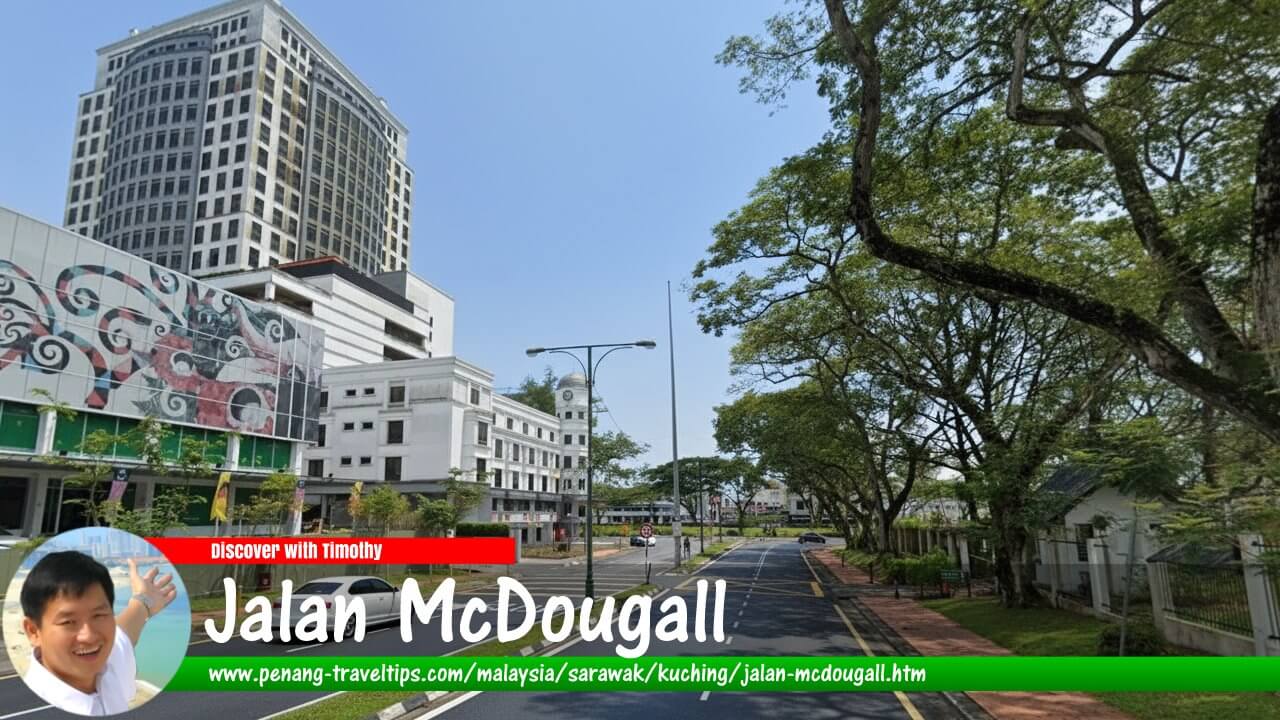 Jalan McDougall, Kuching (AI generated on 30 December 2025)
Jalan McDougall is a short but historically resonant road in central Kuching, Sarawak, measuring about 449 metres and linking Jalan Tun Abang Haji Openg in the west with Jalan Tabuan in the east.
Although modest in length, the road occupies a strategic position within Kuching’s inner urban area, connecting administrative, residential, and institutional zones. Its name and surroundings offer insights into the city’s colonial past and subsequent urban development1.
Quick Facts
Road Name: Jalan McDougall
Length: 449 metres
Location: Central Kuching, Sarawak, Malaysia
Connects: Jalan Tun Abang Haji Openg and Jalan Tabuan
Character: Institutional, residential, low-traffic
Era of Development: Late Brooke / early colonial period
Historical Background
Jalan McDougall emerged during a period when Kuching was expanding beyond its original riverfront nucleus. In the late 19th and early 20th centuries, the Brooke administration and subsequent British colonial authorities oversaw the gradual development of inland roads to serve government offices, mission schools, and residential quarters2.
The road’s scale and alignment suggest that it was designed primarily for local access rather than heavy commercial traffic. Over time, as Kuching grew into a modern capital city, Jalan McDougall remained largely intact, retaining its original role as a connector between larger arterial roads.
Origin of the Name
The name “McDougall” is associated with early European figures involved in Sarawak’s missionary and colonial history. It is commonly linked to Francis Thomas McDougall, the first Anglican Bishop of Labuan and Sarawak, who played a significant role in education and missionary work during the Brooke era3.
Naming streets after prominent colonial or missionary figures was a common practice in Kuching during that period. Jalan McDougall stands today as a reminder of the city’s early interactions with Western religious and administrative institutions.
Character and Streetscape
Jalan McDougall has a quiet, understated character that distinguishes it from busier roads nearby. Traffic volumes are generally light, and the street is used mainly by residents, office workers, and visitors to nearby institutions.
The surrounding environment includes a mix of older buildings, low-rise residences, and institutional premises. Mature trees and long-established plots give the road a settled and slightly secluded feel, despite its central location.
Surrounding Roads and Connectivity
The importance of Jalan McDougall lies in how it links two more prominent roads. To the west, Jalan Tun Abang Haji Openg provides access toward Kuching’s civic core and the historic riverfront. To the east, Jalan Tabuan leads toward established residential areas and connects further to Jalan Padungan.
Other nearby roads include:
- Jalan Rock
- Jalan Crookshank
- Jalan Datuk Ajibah Abol
This network allows Jalan McDougall to function as a discreet but useful connector within central Kuching.
Notable Sights and Nearby Attractions
While Jalan McDougall itself does not host major tourist attractions, its proximity to key parts of Kuching makes it notable. Within a short drive or walk are government offices, schools, and community facilities that serve the surrounding neighbourhoods.
The road is also close to Padang Merdeka, the Sarawak Museum complex, and the Kuching Waterfront area. These nearby landmarks place Jalan McDougall within one of Kuching’s most historically layered urban zones4.
Residential Properties and Real Estate
Residential properties along and around Jalan McDougall are generally low-density and mature, consisting mainly of landed houses and small apartment blocks. Typical residential units range from approximately 1,000 to 1,800 square feet (about 93 to 167 sq metres).
As of early 2024, landed residential properties in this part of central Kuching typically command sale prices ranging from MYR 550,000 to MYR 1 million, depending on size, condition, and exact location. Rental prices generally fall between MYR 1,600 and MYR 3,200 per month for family-sized homes5.
Compared with Singapore’s property market—where central-area apartments often exceed SGD 2,000 per square foot and monthly rents commonly surpass SGD 4,000 for similar-sized units—properties near Jalan McDougall remain markedly more affordable. This contrast reflects differences in land scarcity, population density, and market demand.
Public Transport and Accessibility
Kuching does not have an MRT or urban rail system similar to Singapore’s. Consequently, there are no Singapore MRT stations or rail lines serving Jalan McDougall.
Public transport access is provided by local bus services, with nearby bus stops located along Jalan Tun Abang Haji Openg and Jalan Tabuan. These routes connect the area to the city centre, Padungan, Batu Lintang, and other residential districts. Ride-hailing services are widely used and offer convenient access throughout the day6.
Fun Facts
- Jalan McDougall is named after a key figure in Sarawak’s early missionary history.
- Despite being under 500 metres long, it links two major urban roads in central Kuching.
- The street retains a noticeably quieter atmosphere than nearby arterial routes.
Conclusion
Jalan McDougall is a small but meaningful component of Kuching’s urban landscape. Shaped by colonial-era planning and sustained by everyday civic and residential use, the road offers a glimpse into the city’s layered history. Its calm character, historical name, and strategic location ensure that it remains an enduring part of central Kuching’s evolving streetscape7.
Map of Kuching, Kuching
References
- Sarawak Tourism Board – Kuching Overview
- Encyclopaedia Britannica – Kuching
- Anglican Church in Malaysia – Historical Background
- Sarawak Museum Department
- iProperty Malaysia – Kuching Property Listings
- Sarawak Transport Company
- Time Out – Kuching City Guide
Page Details
This page was created on 30 December 2025. Hi, my name is Timothy and created it from my research, for my own entertainment, knowledge and to satisfy my curiosity. I am providing the information to you in good faith and hope it is useful. I try to get the details as accurate as possible. I also try to update the page whenever I stumble on new details. So this and all my other pages are perpetual work in progress. If you discover any error, please politely inform me, pointing out where the error lies, and I will correct it as soon as possible. Your helpfulness will keep this page accurate, relevant and helpful to those who need the information.Streets of Kuching Directory
Want to share your Kuching travel experiences or get tips from fellow travellers?
Join the Kuching Travel Tips Facebook GroupBuy Me A Coffee
If you enjoy the information I provide and want to support the work I do, please buy me a coffee! I appreciate it immensely, thank you so much!
