
Kuala Kangsar Travel Guide
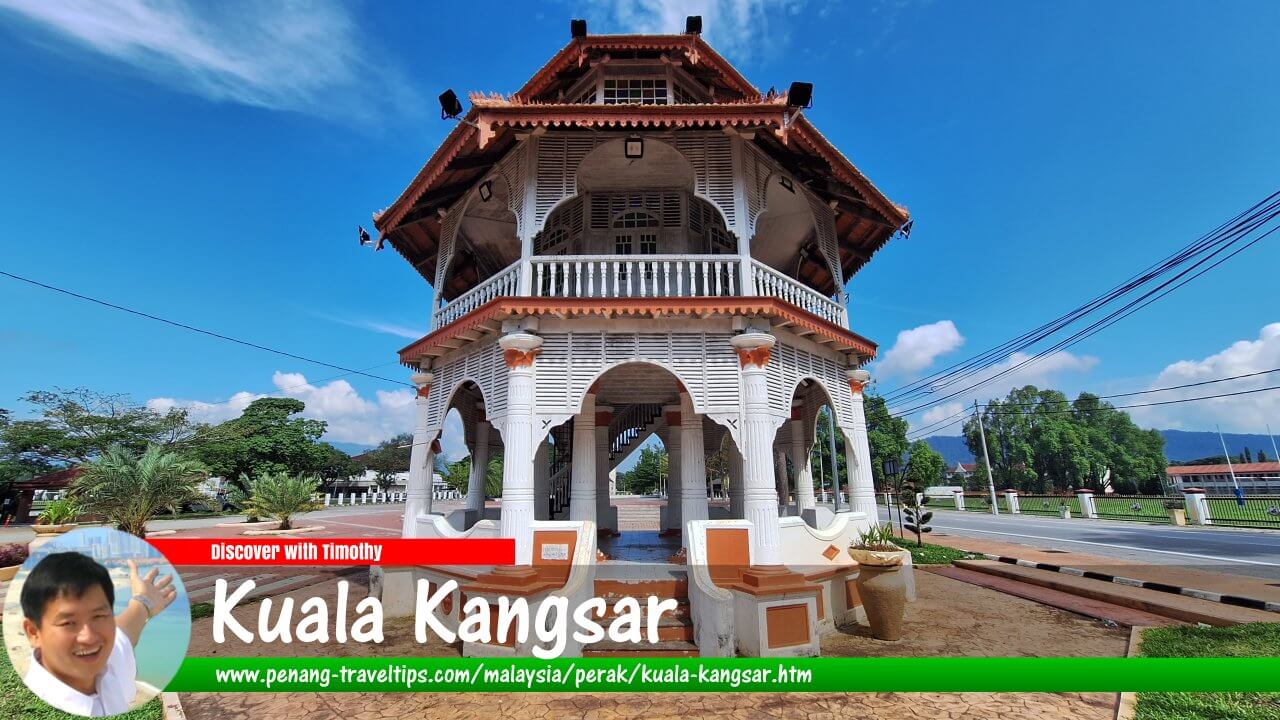 Kuala Kangsar Travel Guide (24 July 2023)
Also available: Panduan Melawat Kuala Kangsar
Kuala Kangsar is the Royal Town of Perak, located on the banks of the Perak River in northern Perak. It is one of the state's most historically significant towns, with a close association with the Perak royal family, traditional Malay culture, historic architecture and important episodes in the development of modern Malaysia.
Unlike larger Perak towns such as Ipoh, Kuala Kangsar has retained a relatively quiet and small-town character. Its principal attractions are concentrated around the royal precinct of Bukit Chandan, the old town, the Perak River and several nearby villages. Visitors can see royal palaces, a historic mosque with golden domes, museums, an early 20th-century Malay residential school, traditional crafts and historic bridges.
Kuala Kangsar is particularly rewarding for travellers interested in Malaysian history, Malay culture, Islamic architecture, traditional crafts and the institution of the Malay sultanate. It can be visited as a day trip from Ipoh or Penang, but staying overnight allows more time to explore the town and surrounding countryside.
Quick Facts
- Town: Kuala Kangsar
- State: Perak
- District: Kuala Kangsar
- Status: Royal Town of Perak
- River: Perak River
- Main heritage area: Bukit Chandan
- Best known for: Ubudiah Mosque, Istana Kenangan, Sultan Azlan Shah Gallery, the Perak royal heritage and traditional crafts
- Historic school: Malay College Kuala Kangsar (MCKK), established in 1905
- Local handicraft: Labu Sayong pottery
- Transport: Car, KTM/ETS train, bus and e-hailing services
Where is Kuala Kangsar?
Kuala Kangsar is situated in northern Perak, approximately 48 kilometres north of Ipoh. The town occupies a strategic position beside the Perak River, close to the confluence with the smaller Sungai Kangsar. The river has played an important role in the history and geography of the town.
The town is connected to Ipoh and other parts of Perak by road and railway. The North-South Expressway passes near Kuala Kangsar, while the main West Coast railway line serves the town through Kuala Kangsar railway station.
The wider Kuala Kangsar District is considerably larger than the town itself. It contains extensive agricultural and forested areas as well as smaller settlements such as Padang Rengas, Manong, Kati, Sauk, Karai and Lubok Merbau. The district's landscape includes hills, forests and the Perak River corridor.
Why is Kuala Kangsar the Royal Town of Perak?
Kuala Kangsar's identity is inseparable from the Sultanate of Perak. The Perak Sultanate was established in the 16th century, and successive rulers traditionally moved between different settlements along the Perak River. Kuala Kangsar eventually emerged as the principal royal centre.
During the reign of Sultan Idris Murshidul Aadzam Shah I, who became Sultan of Perak in 1887, the royal residence was moved from Sayong to the higher ground of Bukit Chandan. The move was partly associated with the vulnerability of Sayong to flooding. Bukit Chandan subsequently became the principal royal precinct of Kuala Kangsar.
The royal presence explains the concentration of palaces, mosques, royal burial grounds and other institutions in the Bukit Chandan area. It also explains why Kuala Kangsar remains officially known as the Royal Town of Perak.
History of Kuala Kangsar
Early settlements along the Perak River
The Perak River was historically one of the principal transportation routes through the interior of the Malay Peninsula. Settlements developed along its banks, and several locations along the river served at different times as royal residences of the Perak sultans.
Before Kuala Kangsar became the principal royal centre, places such as Tanah Abang, Kota Lama Kanan and Sayong were associated with earlier phases of the Perak Sultanate.
The origin of the name Kuala Kangsar
There are two commonly cited explanations for the name Kuala Kangsar.
The first connects the name with the kangsar tree, which was said to grow along the banks of the Perak River. The second derives it from Kuala Kurang Sa, meaning roughly “one short of a hundred”. According to this explanation, 99 tributaries or streams were counted in the wider river system, hence the expression kurang satu, or one short of a hundred.
Both explanations remain part of the local historical tradition, although the exact linguistic origin of the name is presented differently in different historical accounts.
Kuala Kangsar as a royal centre
The development of Bukit Chandan as a royal precinct transformed Kuala Kangsar into one of the most important centres of Malay royal culture in Perak. Palaces and other royal buildings were constructed around the hill, while the town below developed as a centre of commerce and administration.
The town subsequently became associated with several important institutions and events in the history of Perak and Malaya.
The First Rubber Trees in Malaya
Kuala Kangsar has an important place in the history of the rubber industry. In 1877, Sir Hugh Low, the British Resident of Perak, planted nine rubber seedlings at his official residence in Kuala Kangsar. The seedlings had originated from Kew Gardens in London via Singapore.
Rubber eventually became one of the most important agricultural commodities in Malaya. The surviving historic rubber tree in Kuala Kangsar is therefore associated with the early development of an industry that later transformed the economy and landscape of the Malay Peninsula.
The tree is located near the junction of Jalan Raja Chulan and Jalan Stesen, close to the Kuala Kangsar District and Land Office.
Important Historical Events in Kuala Kangsar
The First Durbar of the Federated Malay States
Kuala Kangsar hosted the first Durbar of the Federated Malay States in 1897. The meeting brought together the rulers of Perak, Selangor, Negeri Sembilan and Pahang with British officials.
The Durbar was an important development in the political history of British Malaya and reflected the relationship between the Malay rulers and the emerging federal administrative structure.
The establishment of Malay College Kuala Kangsar
Another important milestone came in 1905 with the establishment of the Malay College Kuala Kangsar (MCKK). The school was initially known as the Malay Residential School of Kuala Kangsar and was established on 2 January 1905. It was the first fully residential school in Malaysia.
MCKK was established to provide a modern education for Malay boys, initially with particular emphasis on the sons of Malay rulers and aristocratic families. The school later broadened its intake and became one of Malaysia's most prominent residential schools.
The school's historic buildings, particularly the Big School, are important examples of colonial-era institutional architecture. The Big School was completed in 1909 and officially opened later that year.
Places to Visit in Kuala Kangsar
1. Ubudiah Mosque
Ubudiah Mosque is perhaps the most recognisable landmark in Kuala Kangsar. Located on Bukit Chandan, the mosque is distinguished by its golden dome, smaller domes and minarets, and is regarded as one of Malaysia's notable examples of Islamic architecture.
Construction began in 1911 during the reign of Sultan Idris Murshidul Aadzam Shah I. The mosque was commissioned as an expression of gratitude following the Sultan's recovery from illness. Its name, Ubudiah, refers to submission to the will of Allah.
The mosque was designed by British architect Arthur Benison Hubback, who was responsible for a number of important public buildings in British Malaya. The building combines Islamic and Moorish architectural influences with a distinctive Perak royal identity.
Visitors should remember that Ubudiah Mosque remains an active place of worship. Appropriate clothing and respectful behaviour are required, and access to prayer areas may be restricted during religious activities.
2. Istana Kenangan
Istana Kenangan, also known as the Royal Museum, is one of Kuala Kangsar's most distinctive historic buildings. It was built in the early 1930s as a temporary royal residence for Sultan Iskandar Shah while the new Istana Iskandariah was being completed.
The palace is notable for its timber construction and elaborate traditional Malay decorative details. Its exterior has a distinctive yellow and black appearance, while the building incorporates intricate woodwork and traditional craftsmanship.
The former palace has subsequently been used as a museum, allowing visitors to see a historic royal residence and learn more about the material culture of the Perak royal household.
3. Istana Iskandariah
Istana Iskandariah is the principal royal palace on Bukit Chandan. Completed in the 1930s, it replaced the older royal residence and remains associated with major royal ceremonies in Perak.
The palace combines Islamic and Moorish influences with elements of Art Deco architecture. Unlike the Royal Museum, Istana Iskandariah is an active royal residence and is not generally open to casual public visits.
Visitors can appreciate the palace from appropriate public areas around Bukit Chandan, while respecting security arrangements and restrictions around the royal precinct.
4. Sultan Azlan Shah Gallery
Sultan Azlan Shah Gallery occupies a historic building associated with Sultan Idris Shah I. The building was completed in 1903 and was later converted into a gallery, which opened to the public in 2003.
The gallery provides an opportunity to learn about the life and reign of Sultan Azlan Muhibbuddin Shah, who was Sultan of Perak from 1984 to 2014 and also served as Lord President of Malaysia's Federal Court.
The building itself is an important attraction, with decorative woodwork and architectural details that reflect the artistic traditions associated with Kuala Kangsar.
5. Perak Royal Mausoleum
The Perak Royal Mausoleum is located near Ubudiah Mosque on Bukit Chandan. It is the burial place of members of the Perak royal family and is an important religious and historical site.
The mausoleum forms part of the wider royal landscape of Bukit Chandan, where the mosque, palaces, gallery and other institutions illustrate the long connection between Kuala Kangsar and the Perak Sultanate.
As with any royal mausoleum and Islamic religious site, visitors should dress modestly and observe any restrictions imposed at the entrance.
6. Malay College Kuala Kangsar
Malay College Kuala Kangsar (MCKK) is one of the best-known educational institutions in Malaysia. Established in 1905, it was originally intended to provide residential education for Malay boys from royal and aristocratic families.
The school's historic architecture is particularly notable. The Big School, completed in 1909, displays a pseudo-Greco-Roman style and remains one of the defining buildings of the campus.
MCKK has produced generations of prominent Malaysians in politics, government, education, law, the military, business and the arts. It is a functioning school, however, so visitors should not assume that the campus is freely accessible. Those wishing to visit should check with the school regarding access.
7. Victoria Bridge
Victoria Bridge is a historic railway bridge across the Perak River at Karai, in the wider Kuala Kangsar District. Built during the colonial period, it is one of the surviving examples of early railway engineering in Perak.
The bridge is particularly interesting to visitors who enjoy industrial heritage, railway history and photography. Its setting beside the river and surrounding rural landscape contrasts strongly with the royal precinct of Kuala Kangsar.
Because Victoria Bridge is outside the town centre, it is best visited by car as part of a wider exploration of the district.
8. Balai Gambang Cempaka Sari
Balai Gambang Cempaka Sari is a ceremonial royal boat associated with the Sultan of Perak. The vessel has been used during royal ceremonies and is an unusual attraction because it connects the royal institution directly with the Perak River.
Tourism Perak has promoted public cruises using the vessel on selected weekends from Jeti Lembah, although availability can vary. Visitors interested in taking the cruise should check the latest operating schedule before travelling.
Traditional Crafts of Kuala Kangsar
Kuala Kangsar is an important centre for several forms of traditional Malay craftsmanship. These crafts are not simply souvenirs; they form part of the cultural identity of the royal town and its surrounding villages.
Labu Sayong
Labu Sayong is the most recognisable traditional craft associated with Kuala Kangsar. These black earthenware vessels are traditionally used to store and cool drinking water. Their distinctive gourd-like form gives them their name.
The craft is particularly associated with Sayong, a settlement across the Perak River from Kuala Kangsar. Visitors interested in traditional pottery can look for workshops and craft outlets in the area.
Tekat
Tekat is a traditional Malay embroidery technique involving gold thread applied to a textile surface. The craft has traditionally been associated with royal and ceremonial culture and remains part of Kuala Kangsar's heritage.
Rattan and other handicrafts
Other traditional products associated with Kuala Kangsar include rattan handicrafts, woven items and traditional musical instruments. Tourism Perak also highlights the area's traditional blacksmithing and keris-making heritage.
Food in Kuala Kangsar
Kuala Kangsar has a distinctive local food culture that reflects the culinary traditions of Perak. The town is particularly associated with Malay dishes and traditional snacks.
Laksa Kuala
Laksa Kuala is one of the local dishes most closely associated with Kuala Kangsar. It is a regional style of laksa that can be found at local stalls and eateries.
Murtabak
Murtabak is another popular local food. The savoury stuffed flatbread is widely available in Malaysian towns, but Kuala Kangsar has several establishments associated with the dish.
Cendol
Cendol is a familiar Malaysian dessert of shaved ice, coconut milk, palm sugar and green rice-flour jelly. It makes a suitable refreshment when exploring Kuala Kangsar in hot weather.
Local traditional delicacies
Tourism Perak also highlights local specialities such as apam Kuala, kundas and putu Perak. These traditional foods are particularly interesting for visitors who want to explore the less internationally familiar side of Perak's culinary heritage.
Where to Stay in Kuala Kangsar
Kuala Kangsar has a smaller accommodation sector than Ipoh or Taiping. For visitors spending one or two nights in town, staying close to the town centre is generally convenient for accessing restaurants, shops and the royal precinct.
Visitors who prefer a wider selection of hotels can also stay in Ipoh and visit Kuala Kangsar as a day trip. Ipoh is close enough for this to be practical, particularly for travellers with their own vehicle.
Staying overnight in Kuala Kangsar, however, offers a different experience. The town is quieter after the daytime visitors have departed, and the slower pace suits travellers interested in heritage and local life.
How to Get to Kuala Kangsar
By car
Kuala Kangsar is conveniently accessible by the North-South Expressway. The town can be reached from the expressway through the Kuala Kangsar interchange, followed by local roads into the town.
From Ipoh, the journey is relatively short. From Penang, Kuala Kangsar can be reached by travelling south along the North-South Expressway. The town can therefore be incorporated into a road trip between Penang and destinations further south in Perak.
By train
KTM and ETS services connect Kuala Kangsar with the West Coast railway network. The railway provides a convenient option for visitors travelling between Kuala Lumpur, Ipoh, Taiping, Penang and other destinations along the route.
For international visitors arriving in Malaysia without a car, travelling by ETS to Kuala Kangsar and using local transport or e-hailing services is a practical way to reach the town.
By bus
Intercity buses and local services connect Kuala Kangsar with other towns in Perak and neighbouring states. Bus travel is generally economical, although journey times depend on the route and traffic.
Getting Around Kuala Kangsar
A car is the most convenient way to explore Kuala Kangsar and its surrounding district. This is especially useful if you want to visit Victoria Bridge, Sayong or other villages outside the town centre.
Within the central area, several attractions can be combined in a short driving itinerary. The royal precinct of Bukit Chandan, the town centre and the riverfront are relatively close to one another.
E-hailing can be useful for visitors without a car, although availability may be more limited than in larger cities. Travellers planning to visit several rural attractions should arrange their transport in advance rather than relying entirely on on-demand services.
How Long Should You Spend in Kuala Kangsar?
One day is enough for a first visit. A day trip can cover the Ubudiah Mosque, Istana Kenangan, Sultan Azlan Shah Gallery, MCKK and the old town, with time for a local lunch.
Two days allows a much more relaxed experience. The second day can include traditional crafts in Sayong, Victoria Bridge or other attractions in the wider district.
Travellers interested primarily in royal architecture and history can therefore visit Kuala Kangsar in a day, while those interested in local culture and the surrounding countryside should consider staying overnight.
Suggested One-Day Itinerary
Morning – Royal Kuala Kangsar
- Start with breakfast in the town centre.
- Travel to Bukit Chandan.
- Visit or view the Ubudiah Mosque, observing religious-site etiquette.
- Explore the Istana Kenangan / Royal Museum if open.
- Visit the Sultan Azlan Shah Gallery.
Afternoon – Town and culture
- Have lunch featuring local food such as Laksa Kuala.
- See the area around Malay College Kuala Kangsar, subject to access restrictions.
- Explore local shops and traditional crafts.
- Visit a Labu Sayong workshop or craft outlet in Sayong if time permits.
- End the day beside the Perak River or return to the town centre.
Suggested Two-Day Itinerary
Day 1 – Royal heritage
- Breakfast in Kuala Kangsar.
- Explore Bukit Chandan.
- Visit Ubudiah Mosque.
- Visit Istana Kenangan.
- Visit Sultan Azlan Shah Gallery.
- See the royal precinct and Perak Royal Mausoleum from appropriate public areas.
- Have dinner in the town centre.
Day 2 – Culture and the wider district
- Visit MCKK from publicly accessible areas or by prior arrangement.
- Explore local shops and traditional food.
- Travel to Sayong to learn about Labu Sayong pottery.
- Continue to Karai and Victoria Bridge if transport and time permit.
- Return to Kuala Kangsar for an early dinner or continue to your next destination.
Best Time to Visit Kuala Kangsar
Kuala Kangsar can be visited throughout the year. The town has a tropical climate, with warm temperatures and the possibility of rain at any time.
For sightseeing, morning and late afternoon are generally the most comfortable periods, especially for visiting the royal precinct and walking around the town.
Travellers planning to visit Victoria Bridge or craft villages should allow flexibility for rain, particularly during wetter periods. An umbrella or lightweight rain jacket is useful.
Religious and royal sites also require a more respectful approach to clothing and behaviour than ordinary tourist attractions. Visitors should check any current access restrictions before travelling.
Kuala Kangsar and the Perak River
The Perak River is fundamental to understanding Kuala Kangsar. Before modern roads and railways transformed transportation, the river was an important route through the interior of Perak.
The royal settlements of Perak developed along the river, and Kuala Kangsar eventually became the most enduring royal centre. Even today, the river helps explain the town's layout and its relationship with settlements such as Sayong and Karai.
A visit to Kuala Kangsar is therefore not simply a tour of palaces and mosques. It is also an opportunity to understand the importance of rivers in the development of the Malay states.
Kuala Kangsar as a Centre of Malay Culture
Kuala Kangsar has a particularly strong association with traditional Malay culture because the royal institution has remained central to the town's identity. This is reflected in its architecture, crafts, ceremonies, food and surviving traditional settlements.
Labu Sayong is a particularly good example. The pottery tradition is associated with Sayong, while the wider town retains connections with tekad embroidery, rattan work, blacksmithing and traditional musical instruments.
The presence of MCKK adds another dimension. The school represents the introduction of modern education to Malay society during the colonial period, while its alumni have subsequently played prominent roles in Malaysian public life.
Practical Travel Tips
- Dress appropriately at religious sites. Ubudiah Mosque is an active mosque and visitors should observe its rules.
- Respect royal property. Not every palace or royal building is open to the public.
- Check opening hours before visiting museums. Opening arrangements can change.
- Consider hiring or arranging a car if you want to visit Victoria Bridge, Sayong and other rural attractions.
- Try local food. Laksa Kuala and traditional Perak snacks are part of the Kuala Kangsar experience.
- Look for traditional crafts. Labu Sayong is one of the town's most distinctive cultural products.
- Allow extra time for photography. The royal precinct contains some of Perak's most distinctive architecture.
- Do not assume that historic buildings are public attractions. Some are functioning institutions or royal properties.
Why Visit Kuala Kangsar?
Kuala Kangsar offers something that few other towns in Malaysia can provide: a relatively compact landscape in which the history of a Malay royal state, colonial administration, modern education, Islamic architecture and traditional craftsmanship can all be explored together.
The town's most famous attraction, Ubudiah Mosque, represents the Islamic and royal heritage of Perak. Istana Kenangan illustrates traditional Malay royal architecture. Istana Iskandariah continues the living royal tradition. MCKK represents the development of modern Malay education, while Labu Sayong represents a craft tradition rooted in local communities.
The town is also quieter than many of Malaysia's better-known heritage destinations. Visitors can explore its attractions without the scale and intensity of a major city, while the Perak River and surrounding countryside provide a strong connection with the natural landscape.
For international visitors, Kuala Kangsar provides an especially useful introduction to an aspect of Malaysian history that can be overlooked when travelling between Kuala Lumpur and Penang: the continuing role of the Malay rulers and the traditional states within modern Malaysia.
For Malaysian travellers, the town offers an opportunity to explore one of Perak's most important historical centres and to see how royal traditions, local crafts, education and modern state institutions developed alongside one another.
Chronology of Kuala Kangsar Architectural Heritage
1877 - First Rubber Tree in Malaya was planted.
1903 - Istana Ulu was built.
1905 - Kuala Kangsar Malay College opened.
1917 - Ubudiah Mosque was built.
1926 - Istana Iskandariah and Istana Kenangan were built.
1930 - Pavilion Square Tower was built.
Conclusion
Kuala Kangsar is one of the most rewarding heritage destinations in Perak. Its importance does not rest on a single attraction but on the combination of royal history, Islamic architecture, traditional Malay culture, education, craftsmanship and the Perak River.
A visit to Ubudiah Mosque, Istana Kenangan and Sultan Azlan Shah Gallery provides an introduction to the royal heritage of Perak, while MCKK and the historic town centre reveal other aspects of Kuala Kangsar's development. A longer visit can extend to Sayong and Victoria Bridge, providing a broader view of the district.
For travellers exploring Perak by road or rail, Kuala Kangsar is therefore more than a convenient stop between Ipoh and northern destinations. It is a historic royal town in its own right, and one of the best places in Malaysia to encounter the living heritage of the Malay sultanate.
Map of Kuala Kangsar
Places of Interest in Kuala Kangsar
- Al-Ghufran Perak Royal Mausoleum (GPS: 4.7646, 100.95052)

- Arena Kuala Kangsar (GPS: 4.77414, 100.94368)

- Dataran Sungai Perak Indah (GPS: 4.77313, 100.94433)

- Iskandar Bridge (GPS: 4.81831, 100.9639)

- Istana Iskandariah (GPS: 4.76211, 100.95454)

- Istana Kenangan / Kuala Kangsar Royal Museum (GPS: 4.76024, 100.95577)

- Jeti Dataran Sungai Perak Indah (GPS: 4.77295, 100.94426)

- Istana Ulu (GPS: 4.76665, 100.9479)

- Kuala Kangsar Clock Tower (GPS: 4.77212, 100.94214)

- Malay College Kuala Kangsar (GPS: 4.77595, 100.93856)

- Oldest Rubber Tree of Malaya (GPS: 4.77451, 100.94097)

- Masjid Ridzuaniah (GPS: 4.77504, 100.94018)

- Pavilion Square Tower (GPS: 4.77442, 100.93905)

- Sayong (GPS: 6.435766, 100.190755)

- Sultan Abdul Jalil Bridge (GPS: 4.77871, 100.94598)

- Taman Bandar (GPS: 4.77393, 100.94414)

- Ubudiah Mosque (GPS: 4.7642, 100.9509)
- Victoria Bridge (GPS: 4.83709, 100.9622)

Streets in Kuala Kangsar
- Jalan Daeng Selili
- Jalan Dato Maharaja Lela
- Jalan Nakhoda
- Jalan Shahbandar
- Jalan Taiping
- Jalan Temenggong
- Jalan Temenggong Wan Hassan
Categories of sights in Kuala Kangsar
- Bridges in Kuala Kangsar
- Historic Buildings in Kuala Kangsar
- Historic Sites in Kuala Kangsar
- Palaces in Kuala Kangsar
- Mausoleums in Kuala Kangsar
- Mosques in Kuala Kangsar
References
- Pejabat Tanah dan Galian Negeri Perak – Sejarah Kuala Kangsar
- Tourism Perak – Kuala Kangsar
- Tourism Perak – Kuala Kangsar
- Tourism Perak – Architectural Heritages
- Tourism Perak – Architecture & Heritage
- Tourism Perak – Perak Fun Map
- Malay College Kuala Kangsar – History
- Malay College Kuala Kangsar – Historic Buildings
- Perak State Government – My Local Stats: Kuala Kangsar
- Perak State Government – Kuala Kangsar District Profile
Page Details
This page was created on 12 September 2026. Hi, my name is Timothy and created it from my research, for my own entertainment, knowledge and to satisfy my curiosity. I am providing the information to you in good faith and hope it is useful. I try to get the details as accurate as possible. I also try to update the page whenever I stumble on new details. So this and all my other pages are perpetual work in progress. If you discover any error, please politely inform me, pointing out where the error lies, and I will correct it as soon as possible. Your helpfulness will keep this page accurate, relevant and helpful to those who need the information.Buy Me A Coffee
If you enjoy the information I provide and want to support the work I do, please buy me a coffee! I appreciate it immensely, thank you so much!
