
Maran Travel Guide
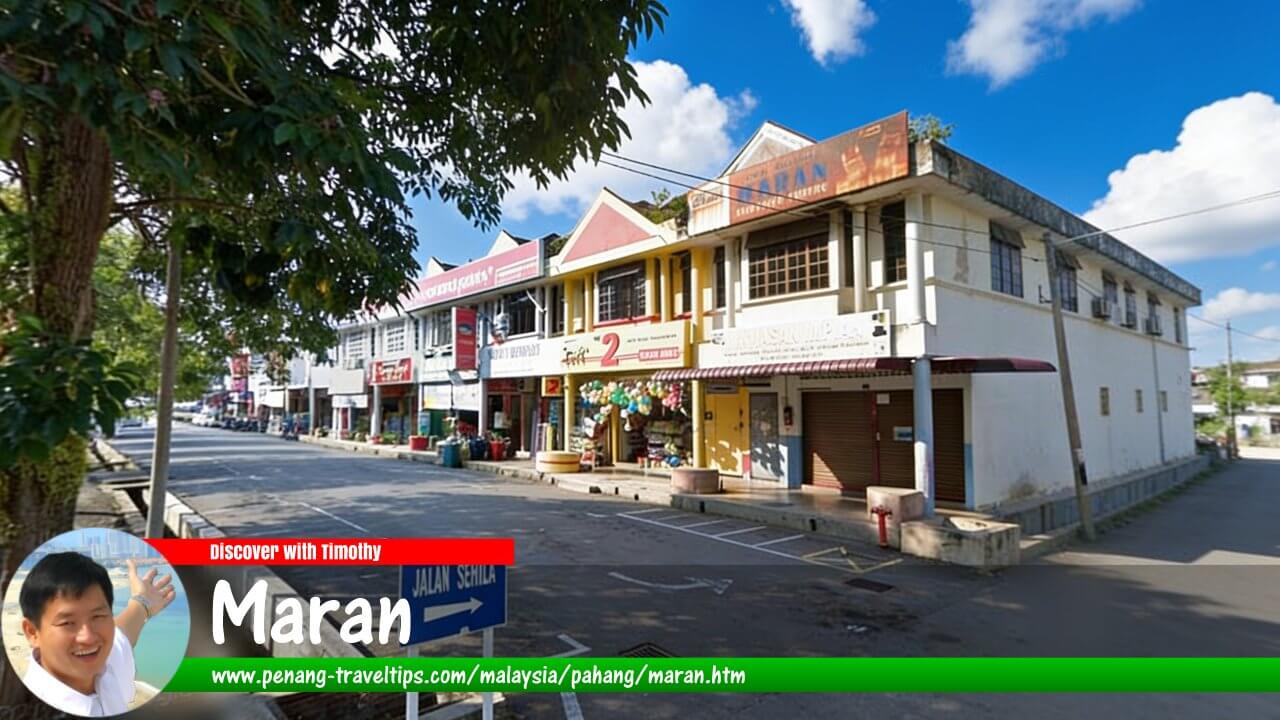 Maran Travel Guide (AI generated on 10 September 2026)
Also available: Panduan Melawat Maran
Maran is a town in central Pahang and the administrative centre of Maran District. Situated roughly halfway between Temerloh and Kuantan, the town is surrounded by forests, agricultural estates, rolling hills and river valleys. It is best known as a gateway to waterfalls, rivers, recreational forests and the wider Jengka area, making it a useful destination for travellers interested in nature and rural Pahang. 1
Quick Facts
- Town: Maran
- State: Pahang, Malaysia
- District: Maran District
- Role: District administrative centre
- District established: 1 January 1981
- Approximate district area: 1,995 sq km
- Setting: Forests, plantations, hills, rivers and rural settlements
- Nearest major towns: Temerloh and Kuantan
- Major attractions: Taman Tasik Maran, Hutan Lipur Teladas, Galeri Tokoh, Maran Hills Golf Resort and surrounding waterfalls and recreation areas
- Nearby nature destinations: Lubuk Yu, Che Minah Sayang, Jerangkang and Jeram Pelangi
- Family attraction: Jengka Wonderland
- Main access: East Coast Expressway and Federal Route 2
- Public transport: Bus and taxi services from Maran; Jengka Sentral serves the wider district
- Accommodation: Hotels, guesthouses, homestays, campsites and lakeside chalets
Getting to know Maran
Maran is not a large city, but it occupies an important position in the geography of central Pahang. It serves as the administrative centre of Maran District and provides government services, shops, restaurants, accommodation and other facilities for communities spread across a relatively large rural area.
For travellers, Maran is particularly interesting because of its proximity to natural attractions. Tourism Pahang describes the town as a gateway to waterfalls, rivers and forests, while the surrounding landscape includes plantations and gently rolling terrain. The town also serves as a convenient base for exploring destinations around Jengka and Kuala Sentul. 1
Maran is therefore different from Pahang's major tourist centres such as Kuantan or Fraser's Hill. It is better understood as a small inland town and nature-oriented travel base, where the attractions are spread around the district rather than concentrated in the town centre.
Geography and landscape
Maran District is located in central Pahang and is one of the 11 administrative districts of the state. The district covers approximately 1,995 square kilometres, with Bandar Maran serving as its administrative centre. 2
The landscape around Maran consists of a mixture of forest, agricultural land, plantations, rivers and low hills. The district includes extensive areas associated with the Jengka development region, while smaller settlements are distributed along roads and river valleys.
This rural setting is one of Maran's main attractions. Visitors do not come here primarily for urban sightseeing. Instead, the town provides access to swimming holes, waterfalls, recreational forests, cycling routes, fishing areas and other outdoor activities.
The Maran River and its surrounding waterways have also influenced the settlement pattern of the area. Several recreational destinations are associated with rivers, including Che Minah Sayang and Lubuk Yu, where relatively shallow and flowing water provides opportunities for swimming and family recreation.
History of Maran
Before Maran became a district
Maran as a modern administrative district is relatively recent. Before the district was established, the town of Maran was located in Mukim Luit and was administered under the Pekan Municipal Board. Chenor, meanwhile, was a separate urban settlement within the neighbouring Temerloh District. 3
Government and public-service buildings were already present in Maran before the formation of the district. Historical records of the local authority mention facilities including a police station, district office, telecommunications office, Islamic religious office, veterinary and agricultural offices, a health office, post office, school, market and timber-related businesses. 3
Creation of Maran District
A major change occurred in 1981, when Maran became a separate administrative district. The new district was formed from parts of the former Temerloh and Pekan districts and initially comprised four mukim: Luit, Chenor, Kertau and Bukit Segumpal. Maran became the tenth district in Pahang. 3
The creation of the district also brought a substantial portion of the Jengka development area under the administration of Maran. Jengka had been developed as a major land-development region, and its towns and settlements subsequently became an important part of the economic and demographic landscape of the district. 3
The establishment of Maran District helped consolidate government administration in an area that had previously been divided between neighbouring districts. The District and Land Office was established in May 1981, shortly after the district itself was created. 4
How did Maran get its name?
The name Maran has two explanations recorded by the Maran District Council. The more administrative explanation is that the name was taken from a small river flowing from Hulu Teladas towards Ulu Kampung Luit. This river eventually became known as Sungai Maran, and the settlement took its name from the river. 5
There is also an Orang Asli oral tradition associated with the name. According to a story related by Batin Tawang bin Isa, an Orang Asli headman from the area near Kampung Merbau, seven Orang Asli men once spent the night beside the river. While they slept, they were supposedly awakened by an apparition believed to resemble a supernatural tiger.
Six of the men ran away, while one remained behind. According to the story, the apparition did not harm him. Instead, it referred to itself as Maran, described as meaning a friend or companion, and told the man to follow his companions along the river. The river subsequently became known as Sungai Maran. 5
The district council itself cautions that this story has not been verified as established historical fact. It is therefore best presented as an oral tradition rather than a confirmed explanation for the town's name. The documented explanation linking Maran to the small river is the safer historical account. 5
Things to do in Maran
Taman Tasik Maran
Taman Tasik Maran is one of the most accessible attractions in the town. The lake and park provide a pleasant setting for walking, jogging, cycling, fishing and boating. The area also has a mini waterpark suitable for family recreation. 6
Visitors who prefer a slower pace can simply spend time beside the lake. The park is particularly useful for travellers who want an easy outdoor activity without committing to a long hike or demanding jungle excursion.
Accommodation is also available at the lakeside, with the Maran District Council listing its own chalets at Taman Tasik Maran. The chalets are located about 2 km from the town centre. 7
Galeri Tokoh
Galeri Tokoh is a compact museum and gallery that presents information about notable figures associated with Maran. Tourism Pahang describes the attraction as featuring colourful three-dimensional displays. 1
It is a relatively small attraction, but it provides useful context for visitors who want to understand the people and local history behind the district rather than concentrating exclusively on its natural attractions.
Maran Hills Golf Resort
Maran Hills Golf Resort occupies an elevated position overlooking the town. Its 18-hole golf course provides views across the surrounding landscape, while the clubhouse includes a restaurant. 1
The resort is therefore relevant not only to golfers but also to visitors looking for a different perspective of Maran and its surrounding countryside.
Hutan Lipur Teladas
Hutan Lipur Teladas, also known as Teladas Eco Rimba Park, is one of the closest nature attractions to Maran. Tourism Pahang describes it as a recreational forest located just outside the town, with a suspension bridge, shelters, facilities and swimming areas. 8
The attraction is particularly suitable for visitors who want to combine a short nature excursion with a stay in Maran. As with any river or waterfall destination, visitors should check local conditions before entering the water, especially after heavy rain.
Waterfalls and rivers around Maran
The wider Maran area has a reputation for waterfalls and river recreation. These destinations are generally more suitable for travellers with their own vehicle because they are scattered across rural areas rather than concentrated around the town centre.
Jeram Pelangi
Jeram Pelangi is located around Kampung Kuala Sentul and is associated with a more adventurous style of nature travel. Access can involve a long hike, a four-wheel-drive vehicle or a mountain bike, depending on the route and current conditions. Some visitors choose to camp overnight. 9
Because access is more demanding than to a town park, visitors should make appropriate preparations and check current local access conditions before setting out.
Berkelah Waterfall
Berkelah Waterfall is another well-known natural attraction in the Maran area. It is associated with a series of cascades, including a prominent waterfall with an approximately 50-metre drop. 9
The site is more appropriate for travellers specifically seeking a forest and waterfall experience rather than those simply looking for a short outing from the town.
Jerangkang
Jerangkang Waterfall is another destination associated with the forests around Maran. Tourism Pahang notes that access to the waterfall near Paya Gelugor can involve a four-wheel-drive vehicle, with local villagers able to arrange access. 9
Che Minah Sayang
Che Minah Sayang Recreation Park is located between Maran and Jerantut, not far from Jengka. The recreation area is associated with a shallow, clear river surrounded by greenery and is considered suitable for family outings. 10
Facilities include food stalls, changing rooms, toilets and a playground. The shallow river makes the location particularly appealing for families, although visitors should still supervise children closely around the water. 10
Lubuk Yu
Taman Eko Rimba Lubuk Yu is approximately 32 km from Maran and is centred on the Jempul River. It is popular for swimming in the gently flowing river and has facilities including parking, toilets, a café and camping sites. 11
The area is also known for butterflies, including the Rajah Brooke's Birdwing. Recreational activities such as hammock camping and other outdoor events have also been organised there. 11
Jengka and nearby attractions
The Maran District extends beyond the town itself. One of the most significant nearby urban areas is Bandar Tun Abdul Razak Jengka, commonly known as Bandar Pusat Jengka. The town developed as part of the Jengka regional development programme and today provides additional shops, accommodation and services.
Jengka Wonderland
Jengka Wonderland is a family-oriented waterpark in Bandar Pusat Jengka. Tourism Pahang describes it as featuring water slides and pools, with architecture influenced by Middle Eastern design. 12
The waterpark can be a useful alternative for families who want a recreational day that does not involve hiking or river swimming.
Other attractions
The wider district includes other attractions and places of interest, including Rabbitland near the Jengka area, Bukit Kertau in Chenor, local galleries and religious sites. The Sri Marathandavar Aalayam Temple is particularly significant to Hindu devotees and attracts visitors for religious observances and festivals. 9
These attractions illustrate the variety of the Maran District, which combines Malay rural settlements, Orang Asli heritage, plantation communities, Hindu religious traditions and newer development associated with Jengka.
What to eat in Maran
Maran does not have the same national reputation for food as Temerloh, which is widely known as the town of ikan patin. Nevertheless, visitors can find the everyday food associated with small-town Pahang, including rice dishes, noodles, Malay cuisine, drinks and simple meals at local restaurants and food stalls.
For visitors interested in Pahang cuisine, it is worth looking for freshwater fish dishes. Temerloh and the surrounding central Pahang region are particularly associated with patin, and the fish is commonly prepared in local styles including patin tempoyak. 13
Maran also has food-truck and casual dining activity around places such as Laman Qalbu, which Tourism Pahang identifies as one of the town's local attractions. 1
Because Maran is a small town, restaurant opening hours and available menus can vary. Visitors travelling into the more remote recreational areas should eat in town or bring suitable food and drinking water rather than assuming that restaurants will be available near every attraction.
Where to stay in Maran
Accommodation in Maran is relatively modest compared with larger Pahang destinations, but there are several practical options. The Maran District Council currently lists Chalet Majlis Daerah Maran and Chalet Pejabat Daerah Maran at Taman Tasik Maran, as well as a campsite at Kampung Kuala Sentul. 14
The lakeside chalets are particularly convenient for visitors who want to combine accommodation with access to Taman Tasik Maran. The council's chalet information places the accommodation about 2 km from the town centre. 7
For visitors who prefer conventional hotel accommodation, additional options are available in Bandar Tun Abdul Razak Jengka. The district council's current accommodation list includes Mercu View Resort, Hotel Suhaznik, Hotel Isoria and The Baiti Guest House, as well as several homestays. 14
There are also accommodation options at Sri Jaya and other parts of the district. Travellers planning to visit remote waterfalls or recreation forests should choose their accommodation according to their route rather than assuming that everything is within easy reach of Maran town.
How to get to Maran
By car
Driving is the most convenient way to visit Maran. The town is served by the East Coast Expressway, while the older Federal Route 2 provides an alternative road through the central Pahang corridor.
For motorists approaching from Kuala Lumpur, the usual route is the Kuala Lumpur–Karak Expressway followed by the East Coast Expressway. The Maran Interchange provides access from the expressway towards the town. The interchange is designated Exit 825. 15
Travellers coming from Kuantan can similarly use the East Coast Expressway and leave at the Maran interchange. Maran lies roughly halfway between Temerloh and Kuantan, making it a practical stop between the two towns. 1
Those travelling from Jerantut can approach Maran by the road network connecting Jerantut with the Maran area. This route is particularly useful for visitors combining Maran with Jerantut or a journey towards Taman Negara.
By bus
Maran has a bus and taxi terminal located in Bandar Baru Maran, behind Tunas Manja Supermarket. The district council identifies it as the town's main terminal for bus and taxi services. 16
Public transport is therefore possible, but services are less frequent than in Malaysia's major cities. Visitors should check current schedules before travelling, particularly if they need to continue from Maran to a rural attraction.
By train
At present, Maran is not served by the existing KTM Intercity railway. This is important for travellers who may assume that every major Pahang district town has a conventional railway station.
The situation is expected to change with the East Coast Rail Link (ECRL). The planned ECRL network includes a Maran station, and Malaysia Rail Link has stated that the Kota Bharu–Gombak section is scheduled to begin commercial operations in January 2027, subject to completion and commissioning. 17
The ECRL is therefore likely to make Maran considerably more accessible by rail in the future. Travellers planning trips after the expected opening should check the latest official timetable, station arrangements and fares before making travel plans.
How to get around Maran
A private car is strongly recommended for visitors who intend to explore the wider district. The town itself is compact, but many of Maran's most interesting attractions are located outside the urban area.
A car is particularly useful for reaching Teladas, Lubuk Yu, Che Minah Sayang and other recreational sites. Some waterfall destinations require four-wheel-drive access or local arrangements, so a normal passenger car should not automatically be assumed to be suitable for every route.
Taxis are available through the town's transport facilities, while e-hailing availability may be more limited than in Kuala Lumpur, Penang or Johor Bahru. Visitors relying on public transport should therefore plan the return journey before travelling to remote locations.
There are organised outdoor activities and local operators for some nature destinations. Where a waterfall or forest attraction requires a guide, four-wheel-drive vehicle or local access arrangement, it is sensible to make arrangements in advance rather than arriving without a confirmed means of reaching the site.
When to visit Maran
Maran can be visited throughout the year, but the best time depends on the purpose of the trip. For sightseeing around town, food and easy recreation, most periods are suitable.
For waterfalls, rivers and forest activities, weather conditions are more important. Heavy rain can make rivers rise rapidly, affect water clarity and make forest tracks slippery. Visitors should check the weather and local conditions before entering rivers or undertaking jungle activities.
Early morning and late afternoon are generally more comfortable for outdoor activities than the middle of the day. These periods are particularly suitable for walking around Taman Tasik Maran, cycling or visiting open recreational areas.
How long should you stay?
A one-day visit is sufficient for travellers who simply want to see the town, visit Taman Tasik Maran, explore a gallery and have a meal before continuing their journey.
A two-day, one-night trip is more suitable for visitors who want to experience Maran at a slower pace and include one nearby nature attraction. This allows enough time for the town and a recreational site without rushing.
Travellers interested in waterfalls, camping, river activities and the Jengka area should consider staying for two or three nights. The attractions are spread across the district, so travel time between them should be included when planning an itinerary.
Suggested Maran itineraries
One-day Maran visit
- Morning: Arrive in Maran and have breakfast in town.
- Morning: Visit Galeri Tokoh and explore the town centre.
- Late morning: Continue to Taman Tasik Maran for a walk or other recreational activity.
- Lunch: Have a local meal in Maran.
- Afternoon: Visit Hutan Lipur Teladas if weather and access conditions are suitable.
- Late afternoon: Return to Maran before continuing towards Temerloh, Kuantan or another destination.
Two-day nature itinerary
- Day 1 morning: Arrive in Maran and explore the town.
- Day 1 afternoon: Spend time at Taman Tasik Maran.
- Day 1 evening: Have dinner in town and stay overnight.
- Day 2 morning: Travel to a nearby river or recreational forest such as Che Minah Sayang or Lubuk Yu.
- Day 2 afternoon: Return towards Maran or continue to Jengka.
- Day 2 evening: Continue to your next destination or stay another night if exploring the wider district.
Family-oriented itinerary
- Morning: Visit Taman Tasik Maran.
- Late morning: Explore Galeri Tokoh or another local attraction.
- Lunch: Eat at a local restaurant or food outlet.
- Afternoon: Travel to Bandar Tun Abdul Razak Jengka.
- Afternoon: Visit Jengka Wonderland if operating and suitable for the family.
- Evening: Return to Maran or stay in the Jengka area.
Practical tips for visitors
- Use a car if possible: Many attractions are outside the town and public transport is limited.
- Check the weather: River and waterfall conditions can change after heavy rain.
- Plan remote trips carefully: Some waterfalls require four-wheel-drive vehicles, hiking or local assistance.
- Bring drinking water: Do not assume that shops or restaurants will be available near forest attractions.
- Wear suitable footwear: Sandals may be adequate for some parks, but proper shoes are preferable for forest trails.
- Respect local communities: Some recreational areas are close to villages and traditional settlements.
- Keep the rivers clean: Take rubbish with you and avoid using the natural environment as a disposal area.
- Check accommodation in advance: Maran has fewer accommodation choices than larger towns, especially during weekends and holiday periods.
- Check ECRL information before travelling by rail: The Maran ECRL station is part of the new railway project and is expected to become relevant to travellers once passenger services begin.
Maran and the experience of central Pahang
Maran offers a different perspective of Pahang from the state's better-known destinations. There is no coastline here and no major metropolitan centre. Instead, the town is surrounded by the forests, plantations, rivers and small settlements that characterise much of inland Pahang.
Its relatively recent history as an administrative district is also significant. Maran only became a separate district in 1981, after having been divided between the former Pekan and Temerloh districts. The subsequent development of Jengka further changed the economic and settlement pattern of the area. 3
For travellers, this history is best appreciated alongside the landscape. A visit to the town centre can be followed by a lakeside walk, a waterfall excursion, a river picnic or a trip into the Jengka area. In this sense, Maran is less a conventional sightseeing destination and more a base for discovering rural and natural Pahang.
Conclusion
Maran is a small but strategically located town in central Pahang and the administrative centre of one of the state's 11 districts. Its history is closely connected with the creation of the Maran District in 1981, while its name is associated with the Maran River and an Orang Asli oral tradition whose historical accuracy remains unverified.
Today, the town's main appeal lies in its surroundings. Taman Tasik Maran provides an accessible recreational area close to the town centre, while Teladas, Lubuk Yu, Che Minah Sayang, Jeram Pelangi and Jerangkang offer opportunities for visitors to experience rivers, forests and waterfalls. The Jengka area adds further attractions, including Jengka Wonderland and other family and cultural destinations.
Maran is therefore best suited to travellers who enjoy nature, rural landscapes, small-town life and outdoor activities. With road access through the East Coast Expressway, bus and taxi facilities in town, a growing range of accommodation and the forthcoming ECRL connection, Maran is also becoming increasingly accessible as a base for exploring central Pahang.
References
- Tourism Pahang, Maran – Back to Nature: https://www.pahangtourism.org.my/destination/nature-adventure/maran
- Majlis Daerah Maran, Annual Report 2024 – Latar Belakang Maran: https://www.mdmaran.gov.my/sites/default/files/md-maran/resource/publications/annual_report_2024/2024_full-compressed-1.pdf
- Majlis Daerah Maran, Latar Belakang, mengenai pentadbiran Maran sebelum dan selepas pembentukan daerah: https://www.mdmaran.gov.my/en/md-maran/profile/background
- Majlis Daerah Maran, maklumat sejarah penubuhan Daerah Maran: https://www.mdmaran.gov.my/ms/md-maran/profil/latar-belakang
- Majlis Daerah Maran, Info Maran, mengenai asal-usul nama Maran dan cerita lisan Orang Asli: https://www.mdmaran.gov.my/en/visitors/maran-info
- Tourism Pahang, Taman Tasik Maran: https://www.pahangtourism.org.my/destination/must-visit-places-in-pahang/item?files_order=ordering&id=34%3Ataman-tasik-maran
- Majlis Daerah Maran, Chalet: https://www.mdmaran.gov.my/en/visitors/places-interest/chalet
- Tourism Pahang, Must Visit Places in Pahang – Maran: https://www.pahangtourism.org.my/index.php?id=9&view=category
- Tourism Pahang, Maran – Back to Nature, information on Jeram Pelangi, Berkelah, Jerangkang and other attractions: https://www.pahangtourism.org.my/travel-info/downloads/1-brochure?download=8%3Amaran-brochure
- Tourism Pahang, Che Minah Sayang Recreation Park: https://www.pahangtourism.org.my/destination/must-visit-places-in-pahang/item?files_order=ordering&id=36%3Ache-minah-sayang-recreation-park
- Tourism Pahang, Taman Eko Rimba Lubuk Yu: https://www.pahangtourism.org.my/destination/must-visit-places-in-pahang/item?files_order=ordering&id=37%3Ataman-eko-rimba-lubuk-yu
- Tourism Pahang, Jengka Wonderland: https://www.pahangtourism.org.my/destination/must-visit-places-in-pahang/item?files_order=ordering&id=40%3Ajengka-wonderland
- Majlis Perbandaran Temerloh, Temerloh Background, regarding Temerloh and its association with freshwater fish and patin: https://www.mpt.gov.my/en/node/76
- Majlis Daerah Maran, Penginapan / Accommodation, current accommodation listings: https://www.mdmaran.gov.my/en/visitors/accomodation
- AFA Prime Berhad, East Coast Expressway, interchange information including Maran Exit 825: https://www.afaprime.com/?page_id=54
- Majlis Daerah Maran, Transportation, regarding the Maran Bus and Taxi Terminal and Jengka Sentral: https://www.mdmaran.gov.my/en/visitors/transportation
- Malaysia Rail Link, ECRL Project Hits 92.6% Completion, On Track for 2027 Launch: https://www.mrl.com.my/en/ecrlprojecthits92-6-completionontrackfor-2027-launch/
Page Details
This page was created on 10 September 2026. Hi, my name is Timothy and created it from my research, for my own entertainment, knowledge and to satisfy my curiosity. I am providing the information to you in good faith and hope it is useful. I try to get the details as accurate as possible. I also try to update the page whenever I stumble on new details. So this and all my other pages are perpetual work in progress. If you discover any error, please politely inform me, pointing out where the error lies, and I will correct it as soon as possible. Your helpfulness will keep this page accurate, relevant and helpful to those who need the information.Buy Me A Coffee
If you enjoy the information I provide and want to support the work I do, please buy me a coffee! I appreciate it immensely, thank you so much!
