
Bangsar Travel Guide
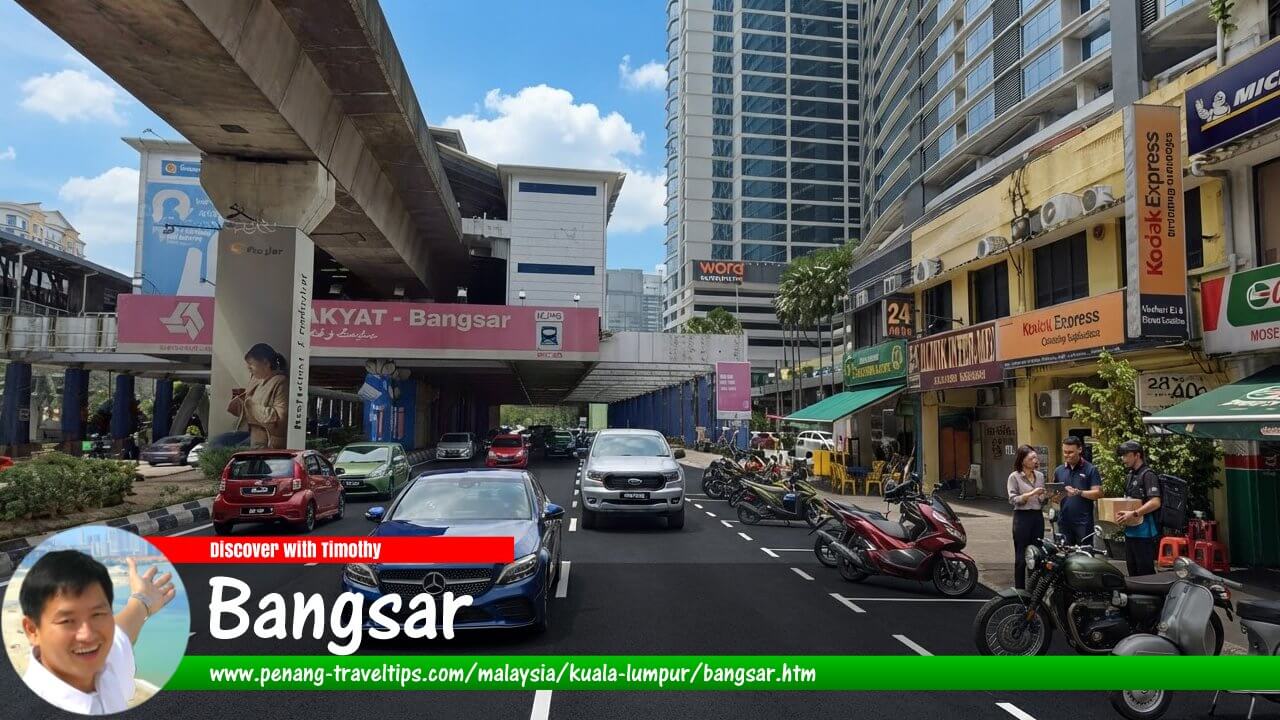 Bangsar, Kuala Lumpur (AI Image created on 8 August 2026)
Bangsar is one of Kuala Lumpur’s most popular and affluent neighbourhoods, located about 4 km southwest of the city centre. Known for its cosmopolitan atmosphere, bustling nightlife, and trendy cafés, Bangsar attracts both locals and expatriates seeking a lively yet comfortable urban lifestyle1.
Quick Facts
- Location: Southwest of central Kuala Lumpur
- Established: Mid-20th century; developed extensively from the 1970s onwards
- Type: Mature residential and commercial suburb
- Public Transport: LRT Kelana Jaya Line (Bangsar and Abdullah Hukum Stations)
- Nearby Expressways: Federal Highway (E1), New Pantai Expressway (NPE, E10), Sprint Expressway (E23)
- Property Types: Bungalows, semi-detached homes, condominiums, and serviced apartments
History and Development
Bangsar was originally part of a rubber estate owned by European planters during the British colonial era. The area began to transform into a residential suburb in the 1960s and 1970s, attracting middle- and upper-income families seeking proximity to the city. Over the decades, Bangsar evolved into one of Kuala Lumpur’s most fashionable districts, characterised by modern housing, international schools, and a dynamic commercial scene2.
Neighbourhood Character
Today, Bangsar is a blend of old charm and modern sophistication. Its tree-lined streets and hilltop homes contrast with bustling commercial hubs such as Bangsar Village and Jalan Telawi, where cafés, restaurants, and boutique stores line the streets. The area is well known for its vibrant nightlife, attracting a cosmopolitan crowd of young professionals, expatriates, and tourists3.
Residential Areas
Bangsar consists of several sub-neighbourhoods, each with its distinct character. These include Bangsar Baru, Bukit Bandaraya, Lucky Garden, and Bangsar Park — the latter being one of Kuala Lumpur’s earliest planned residential estates. Property values here remain among the highest in the Klang Valley, with bungalows often priced above RM4 million and condominiums starting from around RM800,0004.
Accessibility and Transportation
Bangsar enjoys excellent connectivity via several major routes. The Federal Highway (E1) links it directly to both Kuala Lumpur city centre and Petaling Jaya, while the New Pantai Expressway (NPE, E10) and Sprint Expressway (E23) provide fast access to Mid Valley City, Damansara, and Mont Kiara. Public transport is well established, with two stations on the LRT Kelana Jaya Line — Bangsar Station and Abdullah Hukum Station — offering seamless connections to KL Sentral, KLCC, and Subang Jaya5.
Commercial and Lifestyle Hubs
The commercial heart of Bangsar is centred around Jalan Telawi and Bangsar Village shopping centres, home to stylish boutiques, restaurants, and nightlife spots. The Bangsar Shopping Centre (BSC) on Jalan Maarof caters to a more upscale clientele, featuring fine dining, designer labels, and premium supermarkets. Meanwhile, the nearby Mid Valley Megamall and The Gardens Mall are just a few minutes’ drive away, further enhancing Bangsar’s appeal as a lifestyle destination6.
Community and Lifestyle
Bangsar is renowned for its diverse community, where Malaysians and expatriates live side by side. It is also a hub for international schools, healthcare facilities, and co-working spaces. The abundance of cafés, yoga studios, and art spaces reflects a laid-back yet sophisticated lifestyle that defines the neighbourhood’s unique character7.
Landmarks and Attractions
Among Bangsar’s notable landmarks are Bangsar Shopping Centre, Bangsar Village I & II, and Jalan Telawi’s popular food and nightlife strip. The area also offers easy access to nearby attractions such as Mid Valley City, Perdana Botanical Gardens, and the National Museum of Malaysia. Cultural events and weekend markets are common, giving Bangsar a vibrant social atmosphere year-round8.
Where to Stay
Bangsar has a good range of accommodation in and around the neighbourhood, although its hotels are more dispersed than those in the Kuala Lumpur city centre. The area is particularly suitable for visitors who want to stay in a lively residential neighbourhood with restaurants, cafés, shopping and nightlife close at hand.
One of the most convenient full-service hotels for visitors exploring Bangsar is Pullman Kuala Lumpur Bangsar, located along Jalan Pantai Baru on the southern side of the neighbourhood. The hotel offers conventional five-star accommodation together with restaurants, meeting facilities, a swimming pool and other hotel amenities. Its location also makes it convenient for reaching Bangsar, Bangsar South and the KL Sentral area.
Holiday Inn Kuala Lumpur Bangsar is another practical choice, located on Jalan Maarof close to the main Bangsar commercial areas. It provides conventional hotel accommodation and is particularly convenient for visitors who want to be close to Jalan Telawi, Bangsar Village and the neighbourhood's restaurants and cafés.
Visitors who prefer serviced-apartment accommodation can also look around the Bangsar and Bangsar South areas. Alila Bangsar Kuala Lumpur, although technically on the Brickfields side of the neighbourhood boundary, is particularly convenient for Bangsar visitors. The property is connected to Bangsar LRT Station and offers hotel-style facilities together with a more residential accommodation experience.
For longer stays, serviced residences and privately operated apartments around Jalan Maarof, Bangsar Baru, Lucky Garden and Bangsar South provide additional choices. These can be particularly useful for visitors who want a kitchen, living area or more space than a conventional hotel room. Because individually operated apartments can change ownership and management, visitors should check the current facilities and terms before booking.
Overall, Bangsar is a good neighbourhood in which to stay if the visitor wants a more local and residential experience while remaining within easy reach of central Kuala Lumpur. The area is especially attractive to visitors who intend to spend much of their time eating, drinking and exploring neighbourhood shops rather than staying exclusively around the major tourist districts.
What to Eat and Where to Eat
Bangsar is one of Kuala Lumpur's best-known neighbourhoods for eating and drinking. The greatest concentration of restaurants and cafés is around Bangsar Baru, particularly Jalan Telawi, while Lucky Garden, Jalan Bangkung, Jalan Kemuja and Jalan Maarof provide additional choices. The dining scene ranges from inexpensive Indian-Muslim and South Indian restaurants to Chinese restaurants, cafés, international cuisine and more sophisticated dining establishments.
One of Bangsar's most famous food institutions is Sri Nirwana Maju on Jalan Telawi 3. The restaurant is particularly well known for its South Indian banana leaf rice, accompanied by vegetables, curries and optional meat or seafood dishes. Its chicken biryani is another popular choice. Michelin currently lists Nirwana as a Bib Gourmand restaurant, recognising its combination of quality and value. The restaurant is halal and is an excellent introduction to South Indian food in Kuala Lumpur1.
For Indian-Muslim cuisine, Mahbub Restaurant in Lucky Garden is another Bangsar institution. The restaurant began in Bangsar in 1974 and is particularly famous for its nasi briyani ayam madu, or honey chicken biryani. Other choices include mutton biryani, nasi buhara, ayam tandoori, murtabak and various curries. It is a particularly useful recommendation for visitors looking for a substantial halal Malaysian-Indian meal2.
Nasi Kandar Rasmeena on Jalan Bangsar provides another convenient halal option. It is particularly suited to visitors who want nasi kandar with rice, curries and assorted lauk, and its location makes it easy to combine with an exploration of the older commercial streets of Bangsar.
For Chinese food, Paradise Dynasty at Bangsar Village II is a popular choice, particularly for xiao long bao and other Chinese dishes. Village Roast Duck, also at Bangsar Village, offers roast duck and other Chinese-style dishes. Visitors should note that these establishments are not halal.
Bangsar is also well known for its café culture. Antipodean Cafe on Jalan Telawi 2 is one of the neighbourhood's long-established cafés, known for generous breakfast dishes, coffee and an informal atmosphere. VCR Bangsar is another popular café in the Telawi area, while Pulp at APW Bangsar is particularly interesting for visitors interested in specialty coffee and the neighbourhood's creative scene3.
For Vietnamese food, Super Saigon Bangsar on Jalan Bangkung is a good option, serving dishes such as pho and other Vietnamese favourites. It gives visitors an alternative to the neighbourhood's strong Indian, Malaysian and Chinese food traditions.
Visitors seeking a more contemporary dining experience can explore the restaurants around Jalan Bangkung and Jalan Kemuja. This part of Bangsar has a more polished dining atmosphere, with restaurants ranging from modern Malaysian and European-inspired cooking to Japanese and other international cuisines. The area is particularly suitable for dinner and weekend dining.
For seafood, Ombak Kitchen Bangsar in the Jalan Ara Kiri area is another distinctive choice. It specialises in seafood served in a communal style and is particularly suitable for groups. Visitors should check the restaurant's current halal status if this is an important consideration.
What to Try in Bangsar
- Banana leaf rice: Sri Nirwana Maju is one of the neighbourhood's classic choices, particularly for South Indian banana leaf meals.
- Honey chicken biryani: Mahbub Restaurant is famous for its nasi briyani ayam madu and has been serving Bangsar since the 1970s.
- Nasi kandar: Nasi Kandar Rasmeena is a convenient choice for rice, curries and assorted lauk in the Indian-Muslim tradition.
- Chinese dumplings: Paradise Dynasty at Bangsar Village II is a useful choice for xiao long bao and other Chinese dishes.
- Roast duck: Village Roast Duck offers Chinese-style roast duck and related dishes.
- Vietnamese food: Super Saigon Bangsar provides pho and other Vietnamese dishes.
- Café breakfast: Antipodean Cafe is well known for its substantial breakfast and brunch-style dishes.
- Specialty coffee: Pulp and VCR Bangsar are useful choices for visitors interested in Kuala Lumpur's contemporary coffee culture.
- Seafood: Ombak Kitchen Bangsar is a good option for a communal seafood meal, particularly for groups.
Accommodation and Food References
- MICHELIN Guide: “Nirwana”
- Restoran Mahbub: Official Website and Menu
- Time Out Kuala Lumpur: “The Best Restaurants and Cafés in Bangsar”
- Time Out Kuala Lumpur: “Bangsar Area Guide”
- Pullman Kuala Lumpur Bangsar: Official Website
- Holiday Inn Kuala Lumpur Bangsar: Official Website
- Alila Bangsar Kuala Lumpur: Official Website
Fun Fact
The name Bangsar is believed to have originated from “Bunge Grisar Estate,” a European-owned plantation that once occupied much of the area before its redevelopment. The estate’s name evolved locally into “Bangsar,” which was later formalised as the suburb’s official name9.
Bangsar is  on the Map of Neighbourhoods of Kuala Lumpur
References
- Dewan Bandaraya Kuala Lumpur (DBKL)
- New Straits Times – The History of Bangsar
- The Star Metro – Bangsar’s Café and Nightlife Culture
- PropertyGuru Malaysia – Bangsar Property Prices 2025
- Rapid KL – Kelana Jaya Line Route and Stations
- Highways Malaysia – Federal Highway and NPE (E10)
- ExpatGo – Living in Bangsar
- Time Out Kuala Lumpur – Things to Do in Bangsar
- EdgeProp – Origins of Bangsar and Its Development
Page Details
This page was created on 8 October 2025. Hi, my name is Timothy and created it from my research, for my own entertainment, knowledge and to satisfy my curiosity. I am providing the information to you in good faith and hope it is useful. I try to get the details as accurate as possible. I also try to update the page whenever I stumble on new details. So this and all my other pages are perpetual work in progress. If you discover any error, please politely inform me, pointing out where the error lies, and I will correct it as soon as possible. Your helpfulness will keep this page accurate, relevant and helpful to those who need the information.Useful information on the Condominiums in Kuala Lumpur
- Residential Properties in Kuala Lumpur
- Affordable Housing in Kuala Lumpur
- Get to know the Neighbourhoods of Kuala Lumpur
- Get to know the Properties in the Klang Valley
- Find out about Property Taxes and Stamp Duties in Kuala Lumpur
- What to expect from Real Estate Agents in Kuala Lumpur
- The Sale & Purchase Agreement
- Understanding the Memorandum of Transfer (MOT)
- Understand what "subsale" means in Malaysian real estate
Want to share your Kuala Lumpur travel experiences or get tips from fellow travellers?
Join the Kuala Lumpur Travel Tips Facebook GroupMore information for visiting and living in Kuala Lumpur
Here are some related articles to help you get to know Kuala Lumpur better. Latest Pages & Updates
Buy Me A Coffee
If you enjoy the information I provide and want to support the work I do, please buy me a coffee! I appreciate it immensely, thank you so much!
