
Zhuhai, China
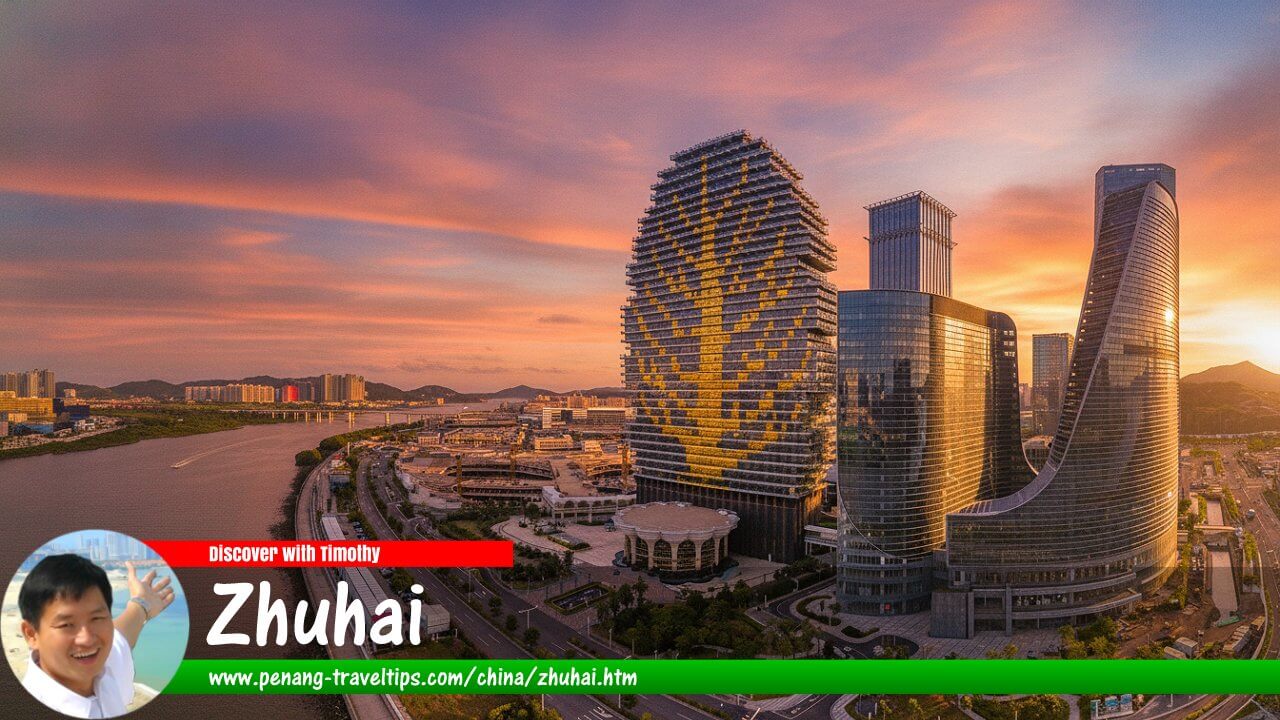 Zhuhai, China (Photo edited with AI on 16 June 2026)
Zhuhai (Chinese: 珠海; pinyin: Zhūhǎi) is a prefecture-level city in southern Guangdong Province, China, located on the western bank of the Pearl River Estuary. Facing the South China Sea and sharing a border with Macau, Zhuhai is one of China's earliest Special Economic Zones and is widely recognized for its clean environment, attractive coastline, numerous islands, and modern urban planning. Often referred to as the "City of a Hundred Islands," Zhuhai combines economic dynamism with a relaxed lifestyle, making it one of the most livable cities in China.1
The name "Zhuhai" literally means "Pearl Sea." The first character, "Zhu" (珠), means pearl, while "Hai" (海) means sea. The name reflects the city's location near the Pearl River Estuary and the South China Sea. Historically, the region was associated with pearl fishing and maritime trade, and the name symbolizes both its coastal setting and its connection to the prosperous Pearl River Delta region.2
Quick Facts
- English Name: Zhuhai
- Chinese Name: 珠海
- Pinyin: Zhūhǎi
- Province: Guangdong
- Location: Pearl River Delta, Southern China
- Status: Special Economic Zone
- Border: Adjacent to Macau
- Climate: Humid Subtropical
- Main Airport: Zhuhai Jinwan Airport
- Main Railway Station: Zhuhai Railway Station
- Known For: Islands, beaches, tourism, high-tech industries
- Nickname: City of a Hundred Islands
Geography
Zhuhai is situated on the southwestern side of the Pearl River Estuary in Guangdong Province. It borders Jiangmen to the north and Zhongshan to the northeast, while Macau lies directly to its south. Across the estuary to the east are Shenzhen and Hong Kong. The city occupies a strategic position within the Guangdong–Hong Kong–Macau Greater Bay Area, one of the world's largest urban and economic regions.3
The municipality covers both mainland territory and numerous offshore islands. More than 140 islands fall under Zhuhai's administration, including Dong'ao Island, Hebao Island, Wanshan Island, and Guishan Island. These islands contribute to the city's nickname and provide a diverse coastal landscape.
The coastline stretches for hundreds of kilometers and features beaches, bays, estuaries, wetlands, and harbors. The city's waterfront promenades and coastal parks are among its most distinctive features.
Zhuhai experiences a humid subtropical climate. Summers are hot, humid, and rainy, while winters are mild and relatively dry. Average annual temperatures range from approximately 22°C to 23°C. The city receives abundant rainfall due to monsoon influences and occasionally experiences typhoons during the summer and autumn.
Natural vegetation includes subtropical forests, mangrove wetlands, and coastal ecosystems. Environmental protection has long been a priority, and Zhuhai is frequently ranked among China's cleanest and greenest cities.
History
The area now known as Zhuhai has been inhabited for thousands of years. Archaeological discoveries indicate that early settlements existed in the Pearl River Delta during prehistoric times. During the Qin and Han dynasties, the region became incorporated into the Chinese imperial administrative system.2
Throughout the Tang and Song dynasties, coastal communities developed around fishing, salt production, agriculture, and maritime trade. The nearby Pearl River Delta became one of China's most prosperous regions due to its access to international shipping routes.
During the Ming and Qing dynasties, the region played an important role in maritime commerce. Trade connections linked local ports with Southeast Asia and other parts of the world. The nearby city of Macau, established by Portuguese traders in the sixteenth century, further increased the region's international significance.
For much of its history, Zhuhai was administered as part of Xiangshan County, which later became Zhongshan. The area remained largely rural until the late twentieth century.
A major turning point occurred in 1980 when Zhuhai was designated one of China's first four Special Economic Zones (SEZs), alongside Shenzhen, Shantou, and Xiamen.3 This designation encouraged foreign investment, economic reforms, and rapid modernization.
During the following decades, Zhuhai transformed from a collection of fishing villages and agricultural communities into a modern city with advanced infrastructure, manufacturing industries, and international business connections.
The opening of the Hong Kong–Zhuhai–Macau Bridge in 2018 further strengthened Zhuhai's role within the Greater Bay Area by significantly improving transportation links between Guangdong, Hong Kong, and Macau.4
Economy and Products
Zhuhai has one of the most diversified economies in southern China. As a Special Economic Zone, it has attracted significant domestic and foreign investment in manufacturing, technology, logistics, tourism, and financial services.
High-technology industries are particularly important. Zhuhai is home to companies involved in electronics, software development, telecommunications, semiconductors, biotechnology, and intelligent manufacturing.
The city is known for producing electronic equipment, home appliances, precision machinery, medical devices, and industrial products. Several industrial parks and economic development zones support innovation and research activities.
Tourism is another major contributor to the economy. Visitors are attracted by the city's beaches, islands, theme parks, golf courses, resorts, and waterfront scenery.
Port operations and logistics also play an important role due to Zhuhai's strategic location within the Pearl River Delta. The city's harbors facilitate trade and transportation throughout southern China.
Marine products remain significant. Local fisheries and aquaculture operations produce fish, oysters, shrimp, and other seafood that are supplied to regional markets.
The city's close economic relationship with Macau has encouraged the development of hospitality, convention services, finance, and cross-border commerce.
How to Go There
By Air
Zhuhai Jinwan Airport (ZUH) is located approximately 45 kilometers southwest of Zhuhai's city center in Jinwan District. The airport serves domestic and selected international routes and is one of the main gateways to western Guangdong.5
Airlines operating at the airport include Air China, China Eastern Airlines, China Southern Airlines, Shenzhen Airlines, Hainan Airlines, XiamenAir, Sichuan Airlines, Spring Airlines, and several regional carriers. Flights connect Zhuhai with Beijing, Shanghai, Guangzhou, Chengdu, Chongqing, Xi'an, Kunming, Hangzhou, Nanjing, Wuhan, and many other Chinese cities.
Visitors may also arrive through nearby airports such as Macau International Airport, Hong Kong International Airport, and Guangzhou Baiyun International Airport.
By Train
Zhuhai Railway Station is located in Gongbei, adjacent to the Macau border crossing. It serves as the southern terminus of the Guangzhou–Zhuhai Intercity Railway and provides convenient connections to Guangzhou, Foshan, Zhongshan, and other cities in the Pearl River Delta.6
Other stations within the municipality include Tangjiawan Station, Mingzhu Station, Qianshan Station, and Zhuhai Airport Railway Station.
By Long-Distance Bus
Major bus terminals include Gongbei Bus Station, Xiangzhou Long-Distance Bus Station, and Doumen Bus Station. These terminals offer regular services to destinations throughout Guangdong Province and neighboring regions.
By Road and Bridge
The Hong Kong–Zhuhai–Macau Bridge provides direct road access between Zhuhai, Hong Kong, and Macau, making it one of the city's most important transportation links.
How to Travel Locally
Zhuhai offers a modern and efficient transportation network.
- Public Buses: Extensive city bus routes cover urban districts, tourist attractions, and transportation hubs.
- Taxis: Metered taxis are readily available throughout the city.
- E-Hailing Services: Didi is widely used and functions similarly to Uber.
- Tourist Coaches: Available for travel to major attractions and islands.
- Ferries: Ferry services connect the mainland with offshore islands and nearby coastal destinations.
- Bicycle Sharing: Shared bicycles are popular for short-distance travel along the city's scenic boulevards.
Zhuhai does not currently operate a subway, MRT, metro, or LRT system, although urban rail projects have been proposed. Traditional transportation methods such as trishaws, rickshaws, and tuk-tuks are generally not part of the city's transportation system.
Tourist Attractions
Fisher Girl Statue
The Fisher Girl Statue is Zhuhai's most famous landmark. Located along Xianglu Bay, it depicts a young woman holding a pearl and symbolizes the city's maritime heritage.
Lovers' Road
This scenic coastal boulevard stretches along the waterfront and offers beautiful views of the sea, islands, and city skyline. It is a popular location for walking and cycling.
New Yuan Ming Palace
This cultural attraction recreates parts of Beijing's historic Old Summer Palace and features traditional Chinese architecture, gardens, and performances.
Chimelong Ocean Kingdom
Located on Hengqin Island, Chimelong Ocean Kingdom is one of the world's largest marine theme parks, featuring aquariums, roller coasters, animal exhibits, and entertainment shows.7
Hengqin Island
Hengqin is a rapidly developing district known for tourism, innovation, leisure facilities, and its close integration with Macau.
Dong'ao Island
Known for its beaches, hiking trails, clear waters, and resort facilities, Dong'ao Island is a popular destination for relaxation and outdoor activities.
Hebao Island
This island features sandy beaches, coastal scenery, and camping opportunities, making it attractive for nature enthusiasts.
Jingshan Park
Offering panoramic views of the city and coastline, Jingshan Park is a favorite destination for sightseeing and photography.
Zhuhai Opera House
Situated on Yeli Island, this distinctive modern building resembles two seashells and serves as one of the city's most recognizable architectural landmarks.
Gongbei Port of Entry
One of the busiest border crossings in the world, Gongbei connects Zhuhai directly with Macau and serves as a major gateway for travelers.
Zhuhai, China is  the Map of Cities in China
References
- Encyclopaedia Britannica – Zhuhai
- Wikipedia – Zhuhai
- China Briefing – China's Special Economic Zones
- Hong Kong–Zhuhai–Macau Bridge Authority
- Wikipedia – Zhuhai Jinwan Airport
- Wikipedia – Zhuhai Railway Station
- Chimelong Ocean Kingdom Official Website
Page Details
This page was created/modified on 14 June 2026. Hi, my name is Timothy and created it from my research, for my own entertainment, knowledge and to satisfy my curiosity. I am providing the information to you in good faith and hope it is useful. I try to get the details as accurate as possible. I also try to update the page whenever I stumble on new details. So this and all my other pages are perpetual work in progress. If you discover any error, please politely inform me, pointing out where the error lies, and I will correct it as soon as possible. Your helpfulness will keep this page accurate, relevant and helpful to those who need the information.