
Huizhou, China
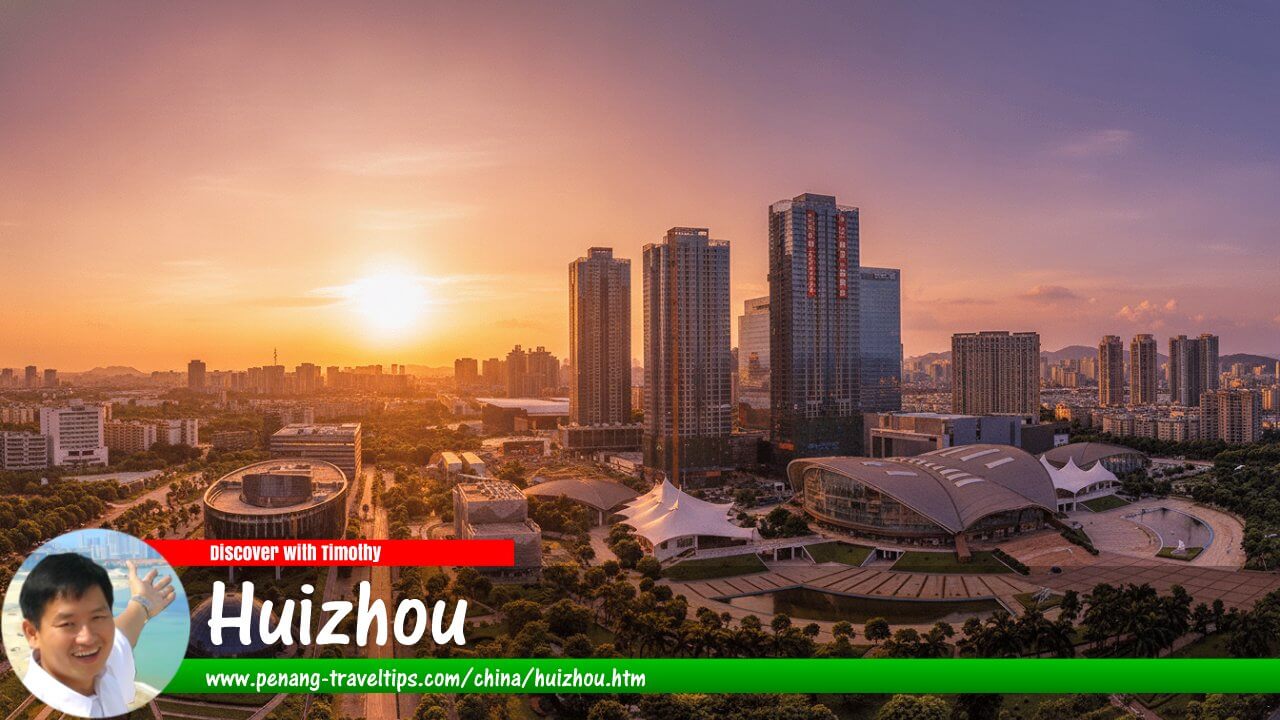 Huizhou, China (Photo edited with AI on 16 June 2026)
Huizhou (Chinese: 惠州; pinyin: Huìzhōu) is a prefecture-level city in eastern Guangdong Province, China. Situated between Guangzhou, Shenzhen, Dongguan, Shanwei, and Heyuan, the city occupies a strategic position within the Guangdong–Hong Kong–Macau Greater Bay Area. Huizhou is renowned for its picturesque landscapes, rich cultural heritage, historical significance, thriving manufacturing industries, and famous scenic areas such as West Lake and Luofu Mountain. With a history spanning more than 1,400 years, Huizhou combines traditional Chinese culture with rapid modern development, making it one of Guangdong's most attractive cities for both tourism and investment.1
The name "Huizhou" dates back to the Sui Dynasty when the region was established as an administrative prefecture. The Chinese character "惠" (Huì) can mean "benevolence," "kindness," or "favor," while "州" (Zhōu) means "prefecture" or "administrative region." Over the centuries, Huizhou became an important cultural, military, and commercial center in eastern Guangdong. The city's name has remained largely unchanged since imperial times and reflects its long administrative history within southern China.2
Quick Facts
- English Name: Huizhou
- Chinese Name: 惠州
- Pinyin: Huìzhōu
- Province: Guangdong
- Location: Eastern Guangdong Province, China
- Population: More than 6 million
- Area: Approximately 11,300 square kilometres
- Climate: Humid Subtropical
- Nearest Airport: Huizhou Pingtan Airport
- Main Railway Stations: Huizhou Station, Huizhou South Station
- Known For: West Lake, Luofu Mountain, Hakka culture, electronics manufacturing
- Economic Region: Guangdong–Hong Kong–Macau Greater Bay Area
Geography
Huizhou is located in eastern Guangdong Province along the lower reaches of the Dongjiang (East River). The municipality borders Guangzhou and Dongguan to the west, Shenzhen to the southwest, Shanwei to the east, Heyuan to the north, and the South China Sea to the south.1
The city covers approximately 11,300 square kilometres, making it one of the larger prefecture-level cities in Guangdong. Its geography is highly diverse, consisting of mountains, hills, river valleys, plains, reservoirs, forests, and coastal areas.
The Dongjiang River is one of the most important waterways in southern China and serves as a major source of drinking water for Hong Kong, Shenzhen, Dongguan, and other cities. The river has historically supported agriculture, transportation, and commerce throughout the region.
Mountainous terrain dominates much of northern Huizhou. Luofu Mountain, one of China's most famous Taoist mountains, rises prominently in the western part of the municipality. Extensive forests and nature reserves contribute to the city's reputation as one of Guangdong's greener urban areas.
The southern portion of Huizhou features a coastline along Daya Bay and the South China Sea. The region includes beaches, fishing villages, islands, and marine ecosystems that attract tourists throughout the year.
Huizhou experiences a humid subtropical climate characterized by hot, humid summers and mild winters. Average annual temperatures range from 21°C to 23°C, while annual rainfall generally exceeds 1,700 millimetres. The rainy season typically occurs between April and September.
History
The area now known as Huizhou has been inhabited for thousands of years. Archaeological discoveries indicate human settlement during prehistoric times, while the region became integrated into the Chinese imperial system during the Qin and Han dynasties.2
Huizhou officially emerged as an administrative center during the Sui Dynasty when the prefecture was established. Due to its strategic location along the Dongjiang River, the city became an important military, commercial, and cultural center linking inland Guangdong with coastal regions.
During the Tang and Song dynasties, Huizhou flourished as a center of education, trade, and literature. The city gained national prominence when several notable scholars and officials lived or worked there.
One of the most famous historical figures associated with Huizhou was the Song Dynasty scholar, poet, and statesman Su Shi, also known as Su Dongpo. During a period of political exile, he resided in Huizhou and wrote many celebrated poems about the city's scenery and culture.3
Throughout the Ming and Qing dynasties, Huizhou continued to prosper through agriculture, river trade, handicrafts, and commerce. The fertile lands surrounding the Dongjiang River supported rice cultivation and other agricultural activities.
In the nineteenth century, the region experienced social and economic changes as foreign trade expanded throughout Guangdong Province. Many residents emigrated overseas, particularly to Southeast Asia and North America.
Following the establishment of the People's Republic of China in 1949, Huizhou underwent industrialization and infrastructure development. The pace of growth accelerated significantly after China's economic reforms began in 1978.
Today, Huizhou is recognized as one of Guangdong's fastest-growing cities, balancing modern industrial development with environmental conservation and cultural preservation.
Economy and Products
Huizhou has developed into one of Guangdong Province's major economic centers. Its economy is based on manufacturing, electronics, petrochemicals, tourism, logistics, agriculture, and high-technology industries.
The city is particularly well known for electronics manufacturing. Numerous multinational and domestic companies operate factories in Huizhou, producing smartphones, computer components, displays, batteries, telecommunications equipment, and consumer electronics.4
The petrochemical industry is another major economic sector. The Daya Bay Petrochemical Industrial Zone is one of China's largest petrochemical production bases and hosts investments from major international corporations.
Manufacturing industries also include household appliances, automotive components, machinery, plastics, textiles, and renewable energy equipment.
Agricultural products include rice, lychees, longans, oranges, vegetables, tea, and seafood. Huizhou's subtropical climate and fertile river valleys support diverse agricultural production.
Tourism contributes significantly to the local economy. Visitors are attracted by Huizhou West Lake, Luofu Mountain, coastal resorts, Hakka villages, and historical sites associated with Chinese scholars and poets.
In recent years, Huizhou has increasingly emphasized innovation, green development, and advanced manufacturing. The city is becoming an important destination for technology investment within the Greater Bay Area.
How to Go There
By Air
Huizhou Pingtan Airport (HUZ) is located approximately 20 kilometres northeast of downtown Huizhou. The airport serves domestic routes connecting the city with major Chinese destinations such as Beijing, Shanghai, Chengdu, Chongqing, Xi'an, Kunming, and other cities depending on airline schedules.5
Airlines operating at Huizhou Pingtan Airport have included Air China, China Southern Airlines, China Eastern Airlines, Sichuan Airlines, Shenzhen Airlines, and several other domestic carriers.
International visitors may also use nearby airports such as Shenzhen Bao'an International Airport, Guangzhou Baiyun International Airport, or Hong Kong International Airport, all of which are connected to Huizhou by rail and highway networks.
By Train
Huizhou Railway Station is located in Huicheng District and serves conventional railway services connecting the city with destinations throughout China.
Huizhou South Railway Station, located in Huiyang District, is a major high-speed rail station on the Xiamen–Shenzhen Railway. It provides rapid connections to Shenzhen, Guangzhou, Xiamen, Fuzhou, and other cities along China's southeastern coast.6
Additional railway stations include Huizhou North Railway Station and Huizhou West Railway Station.
By Long-Distance Bus
Major long-distance bus terminals include Huizhou Bus Terminal, South Bus Station, and Huiyang Bus Station. These facilities offer services throughout Guangdong Province and neighboring regions.
By Road
Several expressways connect Huizhou with Shenzhen, Guangzhou, Dongguan, Heyuan, Shanwei, and other cities. Travel by car or coach is convenient due to the city's central location within eastern Guangdong.
How to Travel Locally
Huizhou offers a range of transportation options for visitors and residents.
- Public Buses: Extensive city and suburban bus networks serve most districts and tourist attractions.
- Taxis: Metered taxis are widely available throughout the city.
- E-Hailing Services: Didi is the dominant ride-hailing platform and functions similarly to Uber.
- High-Speed Rail: Rail services provide efficient connections to neighboring cities.
- Bicycle Sharing: Shared bicycles are available in urban districts and around scenic areas.
- Tourist Shuttle Buses: Some major attractions operate dedicated shuttle services.
Huizhou does not currently operate a metro, subway, MRT, or LRT system. Traditional transport modes such as trishaws, rickshaws, and tuk-tuks are generally not used. Most local transportation relies on buses, taxis, ride-hailing services, and private vehicles.
Tourist Attractions
Huizhou West Lake
Often compared to the famous West Lake in Hangzhou, Huizhou West Lake features scenic islands, bridges, pagodas, gardens, and historic sites. It is the city's most famous attraction and has inspired poets for centuries.7
Luofu Mountain
One of China's most important Taoist mountains, Luofu Mountain contains temples, caves, waterfalls, hiking trails, and spectacular natural scenery. It has long been a center of religious pilgrimage.
Daya Bay
This coastal area offers beaches, marine scenery, seafood restaurants, and opportunities for water recreation. The bay is one of southern China's most important coastal regions.
Nankun Mountain National Forest Park
Located in Longmen County, this protected area is known for its bamboo forests, mountain streams, waterfalls, and cool climate.
Su Dongpo Memorial
This cultural site commemorates the famous Song Dynasty poet Su Shi, who spent several years in Huizhou and produced many literary works inspired by the city.
Yongji Ecological Park
A popular recreational destination featuring gardens, lakes, family attractions, and opportunities to experience rural landscapes.
Hakka Walled Villages
Several traditional Hakka settlements can be found throughout Huizhou. These villages showcase unique architecture, communal living arrangements, and distinctive cultural traditions.
Xunliao Bay
A scenic coastal resort area known for its sandy beaches, clear waters, seafood, and modern tourism facilities.
Pinghai Ancient City
This historic coastal fortress town dates back to the Ming Dynasty and preserves ancient walls, temples, and traditional architecture.
Huizhou Museum
The museum presents the history, archaeology, culture, and economic development of Huizhou and eastern Guangdong.
Huizhou, China on  the Map of Cities in China
References
- Encyclopaedia Britannica – Huizhou
- Wikipedia – Huizhou
- Encyclopaedia Britannica – Su Shi
- Invest Guangdong – Economic Information
- Wikipedia – Huizhou Pingtan Airport
- Wikipedia – Huizhou South Railway Station
- Wikipedia – Huizhou West Lake
Page Details
This page was created/modified on 16 June 2026. Hi, my name is Timothy and created it from my research, for my own entertainment, knowledge and to satisfy my curiosity. I am providing the information to you in good faith and hope it is useful. I try to get the details as accurate as possible. I also try to update the page whenever I stumble on new details. So this and all my other pages are perpetual work in progress. If you discover any error, please politely inform me, pointing out where the error lies, and I will correct it as soon as possible. Your helpfulness will keep this page accurate, relevant and helpful to those who need the information.