
Dongguan, China
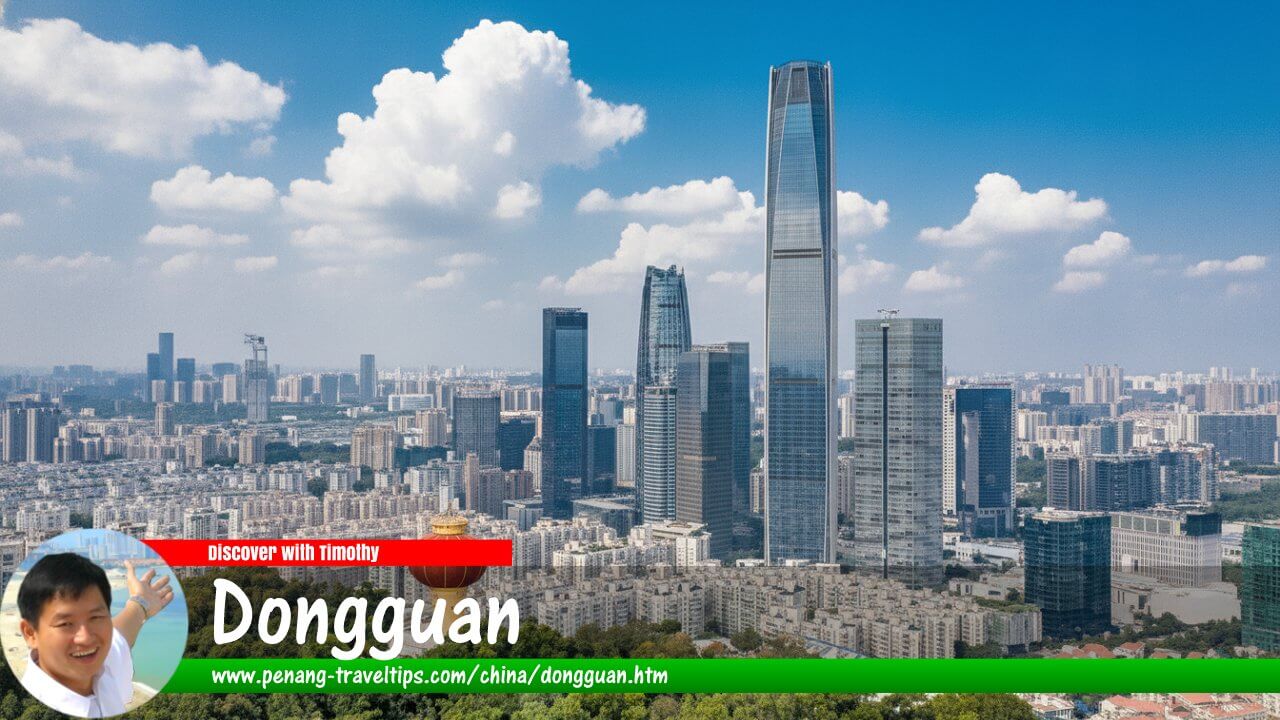 Dongguan, China (Photo edited with AI on 16 June 2026)
Dongguan (Chinese: 东莞; pinyin: Dōngguǎn) is a prefecture-level city in central Guangdong Province, China, located in the heart of the Pearl River Delta between Guangzhou and Shenzhen. Renowned as one of the world's largest manufacturing centers, Dongguan has transformed from an agricultural region into a global hub for electronics, machinery, textiles, and export-oriented industries. The city plays a crucial role in the Guangdong–Hong Kong–Macau Greater Bay Area and is one of China's most economically dynamic urban centers.1
The name "Dongguan" literally means "Eastern Guan." The character "Dong" (东) means east, while "Guan" (莞) refers to a type of rush plant that historically grew abundantly in the area. The name originated during the Tang Dynasty when the region became known for these plants and its location east of Guangzhou. Over centuries, Dongguan evolved into an important commercial and agricultural center before becoming one of China's leading industrial cities in the modern era.2
Quick Facts
- English Name: Dongguan
- Chinese Name: 东莞
- Pinyin: Dōngguǎn
- Province: Guangdong
- Location: Pearl River Delta, Southern China
- Established: County established during the Tang Dynasty
- Climate: Humid Subtropical
- Main Railway Station: Dongguan Railway Station
- Nearest Airports: Shenzhen Bao'an Airport and Guangzhou Baiyun Airport
- Known For: Manufacturing, electronics, export industries
- Economic Region: Guangdong–Hong Kong–Macau Greater Bay Area
- Nickname: World's Factory
Geography
Dongguan is situated in central Guangdong Province within the Pearl River Delta, one of the most densely populated and economically productive regions in the world. The city lies between Guangzhou to the northwest and Shenzhen to the southeast, while Hong Kong is located across Shenzhen Bay to the south.1
The municipality covers approximately 2,465 square kilometers and consists largely of low-lying plains formed by the Pearl River system. Numerous rivers, canals, and waterways traverse the city, supporting transportation, agriculture, and industrial activities.
Although much of Dongguan is relatively flat, several hills and small mountain ranges are found in the eastern and southeastern parts of the municipality. The most notable natural elevation is Yinpingshan, the highest peak in Dongguan, reaching approximately 898 meters above sea level.
Dongguan experiences a humid subtropical climate characterized by hot, humid summers and mild winters. Average annual temperatures range between 22°C and 23°C. Rainfall is abundant, especially during the monsoon season from April to September. Typhoons occasionally affect the region during late summer and autumn.
The city's strategic location in the Pearl River Delta has contributed significantly to its economic development by providing access to ports, transportation networks, and major consumer markets.
History
The area now known as Dongguan has been inhabited for thousands of years. Archaeological discoveries indicate human settlement in the region dating back to prehistoric times. During the Qin Dynasty, the area became integrated into China's imperial administrative system.2
Dongguan was formally established as a county during the Tang Dynasty in AD 757. Its favorable location along river routes encouraged agricultural development and trade. Rice cultivation, fishing, and handicrafts supported local communities for centuries.
During the Song, Yuan, Ming, and Qing dynasties, Dongguan became increasingly prosperous due to its proximity to Guangzhou, one of China's most important commercial ports. Merchants and traders frequently traveled through the region, contributing to economic growth.
The city also played a role in China's modern history. During the nineteenth century, the Opium Wars and foreign trade significantly influenced the surrounding Pearl River Delta. Dongguan's residents participated in various reform and revolutionary movements that shaped modern China.
In the twentieth century, industrialization gradually transformed the region. However, the most dramatic changes occurred after China's economic reforms began in 1978. The city's proximity to Hong Kong and Shenzhen made it an ideal location for foreign investment and export-oriented manufacturing.
During the 1980s and 1990s, thousands of factories were established throughout Dongguan. International companies outsourced production to the city, earning it the nickname "the World's Factory." Electronics, garments, toys, furniture, and consumer products manufactured in Dongguan were exported worldwide.3
In the twenty-first century, Dongguan has shifted toward higher-value industries, including advanced manufacturing, robotics, artificial intelligence, semiconductors, and research and development. The city remains one of China's most important industrial centers while increasingly emphasizing innovation and sustainability.
Economy and Products
Dongguan possesses one of the strongest economies in Guangdong Province and ranks among China's leading manufacturing cities. Its economy is heavily integrated into global supply chains and international trade networks.
Electronics manufacturing is one of the city's most important industries. Dongguan produces smartphones, computer components, telecommunications equipment, semiconductors, and consumer electronics for domestic and international markets.
Other major industries include machinery, automotive components, textiles, garments, furniture, plastics, chemicals, and precision engineering. Numerous multinational corporations maintain manufacturing facilities or supply-chain operations in the city.
The city has increasingly invested in advanced technologies, including robotics, automation, artificial intelligence, and smart manufacturing. Industrial parks and innovation centers support research and technological development.
Dongguan is also a major logistics and distribution center. Its location between Guangzhou, Shenzhen, Hong Kong, and Macau allows efficient transportation of goods throughout southern China and overseas markets.
Traditional products include furniture, ceramics, embroidery, food products, and handicrafts. While manufacturing dominates the economy, service industries such as finance, logistics, and information technology continue to grow rapidly.
How to Go There
By Air
Dongguan does not have a major commercial airport within its urban center. Most visitors use nearby airports, including Shenzhen Bao'an International Airport (SZX), approximately 50 kilometers from central Dongguan, and Guangzhou Baiyun International Airport (CAN), approximately 70 kilometers away.4
These airports are served by major airlines including Air China, China Southern Airlines, China Eastern Airlines, Shenzhen Airlines, Hainan Airlines, Cathay Pacific, Singapore Airlines, Emirates, and numerous international carriers. Flights connect the region with destinations throughout China, Asia, Europe, North America, Australia, and the Middle East.
By Train
Dongguan Railway Station is located in Shilong Town and serves both conventional and high-speed rail services. Other important stations include Humen Railway Station, Dongguan South Railway Station, and Changping Railway Station.5
High-speed rail connections link Dongguan with Guangzhou, Shenzhen, Hong Kong, Beijing, Shanghai, Wuhan, Xiamen, Hangzhou, and many other major cities.
By Long-Distance Bus
Dongguan has several major bus terminals, including Dongguan Bus Terminal, Nancheng Bus Station, and Dongguan East Bus Station. These facilities provide regular services throughout Guangdong Province and neighboring regions.
By Ferry
The nearby Humen Port and other terminals provide maritime connections within the Pearl River Delta and facilitate freight transport.
How to Travel Locally
Dongguan has a comprehensive transportation system serving residents and visitors.
- Subway (Metro): Dongguan Rail Transit operates metro services, including Line 2, connecting major districts and transportation hubs.6
- Public Buses: Extensive bus routes cover urban and suburban areas.
- Taxis: Metered taxis are widely available throughout the city.
- E-Hailing Services: Didi is the most commonly used ride-hailing platform and functions similarly to Uber.
- Intercity Rail: Rail services connect Dongguan with Guangzhou, Shenzhen, and neighboring cities.
- Bicycle Sharing: Shared bicycle systems are popular for short urban journeys.
Traditional transportation methods such as trishaws, rickshaws, and tuk-tuks are generally not used in Dongguan. Modern public transport and ride-hailing services provide efficient mobility throughout the municipality.
Tourist Attractions
Keyuan Garden
One of the four famous classical gardens of Guangdong, Keyuan Garden features elegant pavilions, ponds, bridges, and traditional Lingnan architecture. It is considered a masterpiece of nineteenth-century garden design.7
Humen Naval Battle Museum
This museum commemorates the Opium Wars and the destruction of opium led by Commissioner Lin Zexu. Exhibits provide insight into a pivotal period in Chinese history.
Weiyuan Fort
Located near Humen, this historic coastal fortification played an important role during the First Opium War and remains a significant cultural heritage site.
Yinpingshan Forest Park
Home to Dongguan's highest peak, Yinpingshan offers hiking trails, forests, scenic viewpoints, and opportunities for outdoor recreation.
Songshan Lake
This modern scenic area combines a large lake, landscaped parks, cycling paths, and technology campuses. It is one of the city's most popular leisure destinations.
Longfeng Villa Resort
A family-friendly attraction featuring gardens, themed architecture, entertainment facilities, and recreational activities.
Dongguan Exhibition Hall
This museum showcases the city's history, culture, economic development, and transformation into a global manufacturing center.
Shuilianshan Forest Park
A popular urban park with hiking trails, lakes, forests, and panoramic views of the surrounding region.
Guanyinshan National Forest Park
Known for its Buddhist statues, temples, scenic landscapes, and ecological diversity, this park attracts both pilgrims and tourists.
Humen Bridge Viewing Area
Visitors can enjoy impressive views of the Humen Bridge, one of the key transportation links across the Pearl River.
Dongguan, China on  the Map of Cities in China
References
- Encyclopaedia Britannica – Dongguan
- Wikipedia – Dongguan
- Brookings Institution – China's Manufacturing Powerhouse
- Guangzhou Baiyun International Airport
- Wikipedia – Dongguan Railway Station
- Wikipedia – Dongguan Rail Transit
- Wikipedia – Keyuan Garden
Page Details
This page was created/modified on 16 June 2026. Hi, my name is Timothy and created it from my research, for my own entertainment, knowledge and to satisfy my curiosity. I am providing the information to you in good faith and hope it is useful. I try to get the details as accurate as possible. I also try to update the page whenever I stumble on new details. So this and all my other pages are perpetual work in progress. If you discover any error, please politely inform me, pointing out where the error lies, and I will correct it as soon as possible. Your helpfulness will keep this page accurate, relevant and helpful to those who need the information.