
Foshan, China
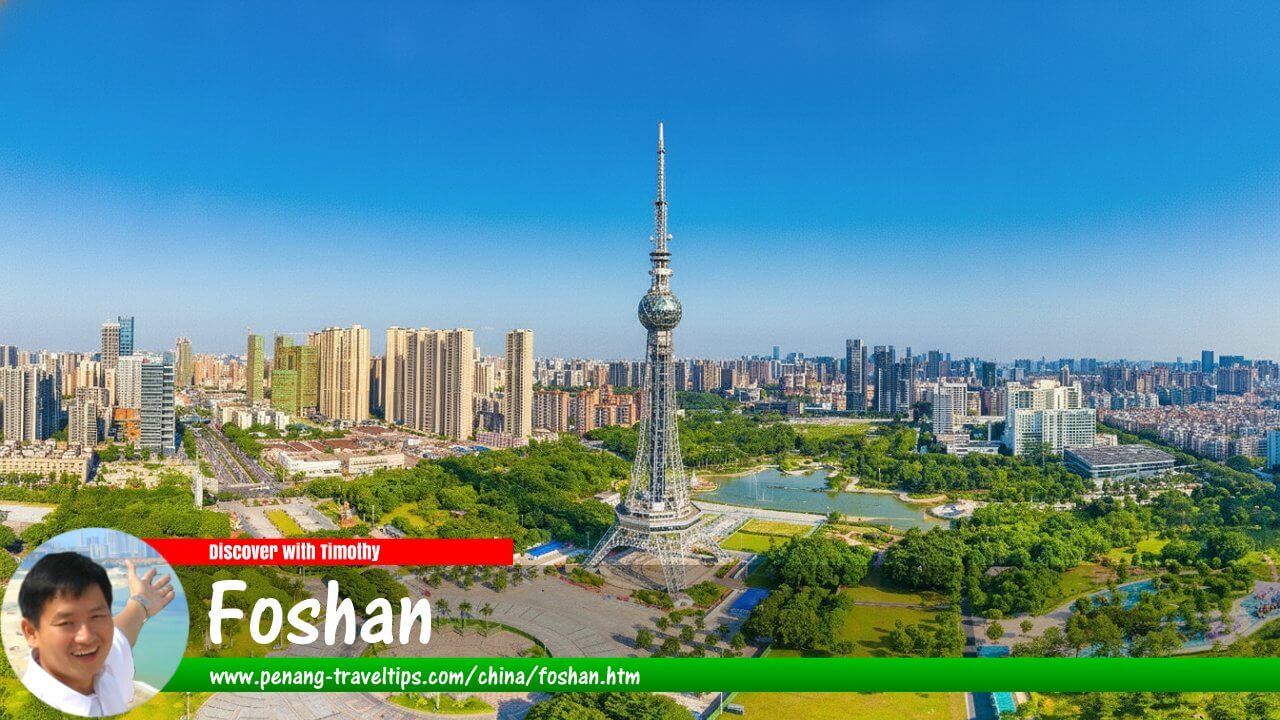 Foshan, China (Photo edited with AI on 16 June 2026)
Foshan (Chinese: 佛山; pinyin: Fóshān) is a prefecture-level city in central Guangdong Province, China, located in the heart of the Pearl River Delta. It is one of the most historically significant and economically prosperous cities in southern China, known for its rich Cantonese culture, traditional ceramics, martial arts heritage, and modern manufacturing industries. Foshan forms part of the Guangdong–Hong Kong–Macau Greater Bay Area and is closely integrated with neighboring Guangzhou. The city is particularly famous as the birthplace of several renowned martial artists, including Wong Fei-hung and Ip Man, and remains a major center of Lingnan culture.1
The name "Foshan" literally means "Buddha Mountain." According to local tradition, three bronze Buddha statues were discovered on a hill in the area during the Tang Dynasty. The discovery led to the construction of a Buddhist temple, and the settlement gradually became known as Foshan, meaning "Mountain of the Buddha." Over the centuries, the city developed into an important commercial, cultural, and manufacturing center within Guangdong Province.2
Quick Facts
- English Name: Foshan
- Chinese Name: 佛山
- Pinyin: Fóshān
- Province: Guangdong
- Location: Pearl River Delta, Southern China
- Meaning of Name: Buddha Mountain
- Climate: Humid Subtropical
- Population: More than 9 million
- Main Railway Station: Foshan Railway Station
- Nearest Major Airport: Guangzhou Baiyun International Airport
- Known For: Kung fu, ceramics, Cantonese culture, manufacturing
- Economic Region: Guangdong–Hong Kong–Macau Greater Bay Area
Geography
Foshan is situated in the central part of Guangdong Province within the Pearl River Delta, one of the most urbanized and economically productive regions in the world. The city borders Guangzhou to the northeast, Zhongshan to the southeast, Jiangmen to the southwest, and Zhaoqing to the northwest.1
The municipality covers approximately 3,800 square kilometers and consists primarily of low-lying alluvial plains formed by the Pearl River and its tributaries. The extensive river network has historically facilitated transportation, trade, agriculture, and industrial development.
Several waterways flow through Foshan, including branches of the Pearl River system. These rivers have played a vital role in shaping the city's economy and urban growth. The abundance of water resources also supported the development of traditional industries such as ceramics and agriculture.
Foshan experiences a humid subtropical climate characterized by long, hot summers and short, mild winters. Average annual temperatures are approximately 22°C to 23°C, while annual rainfall exceeds 1,600 millimeters. The city receives most of its precipitation during the monsoon season between April and September.
The relatively flat terrain and strategic location have made Foshan an ideal location for urban expansion, industrial development, and transportation infrastructure. Today, the city forms part of a continuous urban corridor extending across much of the Pearl River Delta.
History
The history of Foshan can be traced back more than 5,000 years. Archaeological discoveries indicate that prehistoric communities inhabited the region long before the establishment of formal Chinese administration. During the Qin and Han dynasties, the area became integrated into China's imperial system.2
Foshan's rise to prominence began during the Tang Dynasty. According to local records, the discovery of three bronze Buddha statues led to the establishment of a temple, from which the city's name originated. The settlement gradually developed into a regional religious and commercial center.
During the Song Dynasty, Foshan became one of southern China's most important centers for handicrafts and trade. Its location along major river routes allowed merchants to transport goods throughout Guangdong and beyond.
By the Ming and Qing dynasties, Foshan had become famous for ceramics, metalworking, textiles, and traditional medicine. The city was often described as one of the "Four Great Markets" of China due to its thriving commercial activities.3
Foshan also became an important center of Cantonese opera, lion dancing, martial arts, and folk traditions. Many cultural practices associated with Lingnan culture flourished in the city during this period.
In the nineteenth and twentieth centuries, Foshan was influenced by increasing foreign trade through nearby Guangzhou and Hong Kong. Economic modernization gradually transformed traditional industries while preserving many aspects of local culture.
Following the economic reforms initiated in the late 1970s, Foshan experienced rapid industrialization and urbanization. Manufacturing expanded dramatically, attracting investment from both domestic and international companies.
Today, Foshan is recognized as one of China's leading manufacturing cities while remaining an important center of Cantonese heritage, traditional arts, and martial arts culture.
Economy and Products
Foshan possesses one of the strongest economies in Guangdong Province and ranks among China's most important manufacturing centers. The city's economy combines advanced industrial production with a strong tradition of craftsmanship and entrepreneurship.
The city is particularly famous for its ceramic industry. Foshan has been producing ceramics for centuries and remains one of the world's leading centers for ceramic tiles, sanitary ware, porcelain products, and construction materials.4
Manufacturing industries include household appliances, machinery, electronics, metal products, automotive components, furniture, plastics, textiles, and industrial equipment. Many internationally recognized Chinese brands have operations in Foshan.
Home appliances represent another major economic sector. Products such as air conditioners, refrigerators, kitchen equipment, and small appliances are manufactured extensively in the city and exported worldwide.
Furniture production is concentrated in districts such as Shunde, which has become one of China's largest furniture manufacturing and trading centers. The region attracts buyers from around the world.
The city also emphasizes innovation and technology. Research centers, industrial parks, and advanced manufacturing facilities support sectors such as robotics, artificial intelligence, and smart manufacturing.
In addition to manufacturing, tourism contributes significantly to the local economy. Visitors are attracted by Foshan's historical sites, martial arts heritage, cultural festivals, and traditional architecture.
How to Go There
By Air
Foshan Shadi Airport (FUO) is located approximately 10 kilometers from downtown Foshan. The airport primarily serves domestic routes and provides convenient access to the city.5
Airlines operating at Foshan Shadi Airport have included China United Airlines and other domestic carriers, offering flights to cities such as Beijing, Shanghai, Hangzhou, Nanjing, and other destinations depending on seasonal schedules.
Many international visitors use Guangzhou Baiyun International Airport (CAN), located approximately 50 kilometers northeast of central Foshan. Guangzhou Baiyun Airport is one of China's busiest airports and serves destinations throughout Asia, Europe, North America, Oceania, Africa, and the Middle East.
By Train
Foshan Railway Station is located in Chancheng District and serves conventional rail services. Additional stations include Foshan West Railway Station, Shunde Railway Station, Sanshui South Railway Station, and Ronggui Railway Station.
Foshan West Railway Station is a major high-speed rail hub connecting the city with Guangzhou, Shenzhen, Hong Kong, Beijing, Shanghai, Wuhan, Chengdu, Guilin, and many other destinations across China.6
By Long-Distance Bus
Major bus terminals include Foshan Bus Station, Chancheng Bus Station, Nanhai Bus Station, and Shunde Bus Terminal. These facilities provide extensive services throughout Guangdong Province and neighboring regions.
By Road
Foshan is connected to the national expressway network and can be easily reached by highway from Guangzhou, Shenzhen, Zhuhai, Dongguan, Zhongshan, and other cities within the Greater Bay Area.
How to Travel Locally
Foshan has a modern transportation network that allows convenient travel throughout the municipality.
- Metro (Subway): Foshan Metro operates several lines, including Line 1, Line 2, and Line 3, with connections to the Guangzhou Metro system.7
- Public Buses: Extensive bus services connect urban districts, suburban towns, and major attractions.
- Taxis: Metered taxis are widely available throughout the city.
- E-Hailing Services: Didi is the primary ride-hailing platform and functions similarly to Uber.
- Intercity Rail: Rail transit provides efficient connections to Guangzhou and neighboring cities.
- Bicycle Sharing: Shared bicycles are available in many urban districts.
Traditional transportation modes such as trishaws, rickshaws, and tuk-tuks are generally not part of Foshan's public transportation system. Modern rail, bus, taxi, and ride-hailing services are the primary means of local travel.
Tourist Attractions
Ancestral Temple (Zumiao)
The Ancestral Temple is Foshan's most famous historical landmark. Originally built during the Northern Song Dynasty, it features exquisite Lingnan architecture, traditional carvings, martial arts performances, and cultural exhibitions.8
Lingnan Tiandi
This restored historic district combines traditional Cantonese architecture with modern shops, restaurants, museums, and cultural venues. It is one of the city's most popular visitor destinations.
Wong Fei-hung Memorial Hall
Dedicated to the legendary martial artist Wong Fei-hung, the museum showcases artifacts, martial arts history, and demonstrations related to traditional kung fu.
Ip Man Hall
This museum commemorates Ip Man, the renowned Wing Chun master who taught Bruce Lee. Exhibits explore his life, teachings, and influence on martial arts worldwide.
Xiqiao Mountain Scenic Area
One of Guangdong's most famous natural attractions, Xiqiao Mountain features volcanic formations, temples, forests, waterfalls, and scenic hiking trails.
Nanhai Guanyin Statue
Located within Xiqiao Mountain Scenic Area, this towering statue of Guanyin is among the largest Buddhist statues in southern China.
Qinghui Garden
Situated in Shunde District, Qinghui Garden is one of Guangdong's most celebrated classical gardens, featuring elegant pavilions, ponds, and traditional landscaping.
Shunde Museum
The museum presents the history, culture, cuisine, and economic development of Shunde, one of Foshan's most prosperous districts.
Chen Village Flower World
This large horticultural complex is famous for flowers, landscaping products, gardening exhibitions, and seasonal festivals.
Foshan Creative Industry Park
A former industrial area transformed into a cultural and entertainment district featuring restaurants, galleries, nightlife venues, and creative businesses.
Foshan, China on  the Map of Cities in China
References
- Encyclopaedia Britannica – Foshan
- Wikipedia – Foshan
- Encyclopaedia Britannica – Guangdong
- Foshan Ceramics Industry Overview
- Wikipedia – Foshan Shadi Airport
- Wikipedia – Foshan West Railway Station
- Wikipedia – Foshan Metro
- Wikipedia – Foshan Ancestral Temple
Page Details
This page was created/modified on 16 June 2026. Hi, my name is Timothy and created it from my research, for my own entertainment, knowledge and to satisfy my curiosity. I am providing the information to you in good faith and hope it is useful. I try to get the details as accurate as possible. I also try to update the page whenever I stumble on new details. So this and all my other pages are perpetual work in progress. If you discover any error, please politely inform me, pointing out where the error lies, and I will correct it as soon as possible. Your helpfulness will keep this page accurate, relevant and helpful to those who need the information.