
Canada Travel Guide
 Go Back - HOME | Latest PENANG | Travel Tips | Penang Hokkien : Dictionary | YouTube | Facebook | Contact Me
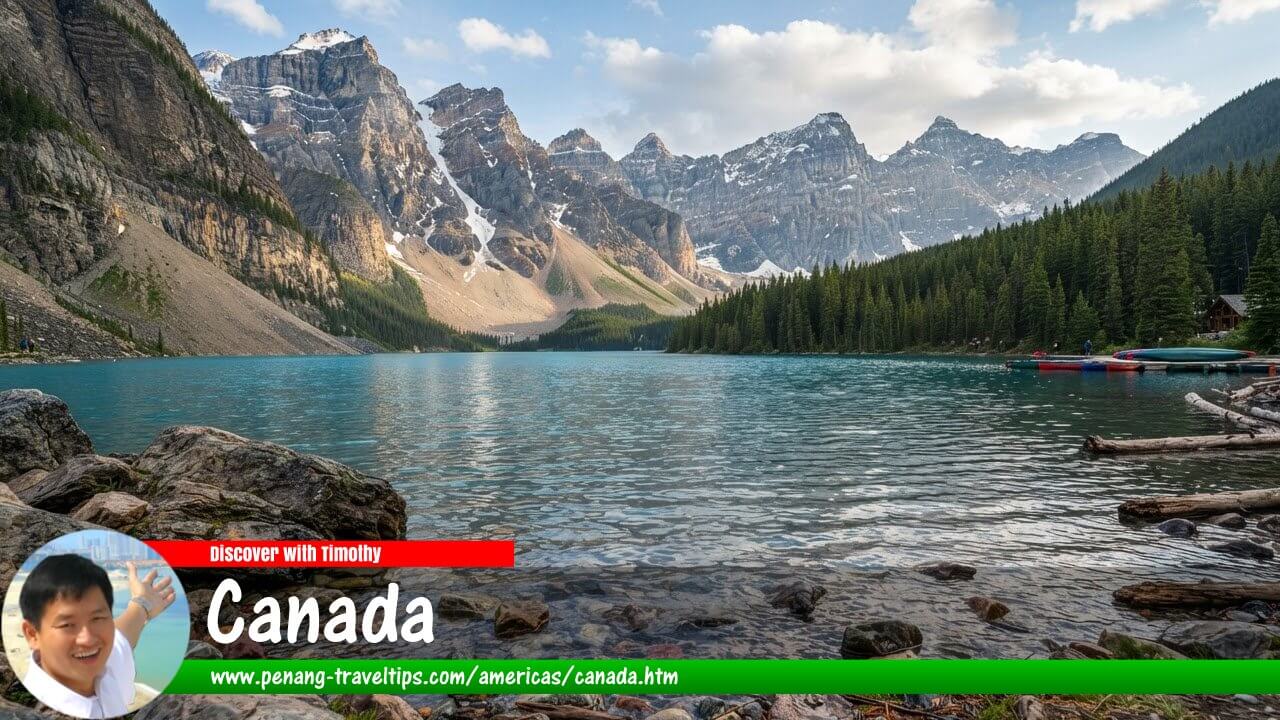 Canada Travel Guide (AI Image generated on 27 August 2026)
Also available: Panduan Melawat Kanada
Introduction to Canada
Canada is the second-largest country in the world by total area, stretching from the Atlantic Ocean in the east to the Pacific Ocean in the west and northward to the Arctic Ocean. It is known for its vast wilderness, spectacular mountains, lakes, forests and coastlines, as well as multicultural cities such as Toronto, Vancouver, Montreal and Quebec City.
For visitors, Canada offers a remarkable variety of experiences. A trip can include exploring historic neighbourhoods, visiting museums and galleries, enjoying vibrant food scenes, travelling through dramatic mountain landscapes, watching wildlife, or simply experiencing the country's immense natural spaces.
Location of Canada
Canada occupies most of the northern part of North America. It shares its southern and northwestern borders with the United States, while the Atlantic Ocean lies to the east, the Pacific Ocean to the west and the Arctic Ocean to the north.
Its enormous geographical size means that the climate, landscape and character of one part of Canada can be very different from another. The coastal regions, prairie provinces, Rocky Mountains, Great Lakes and Arctic territories each offer distinct travel experiences.
Capital of Canada
The capital of Canada is Ottawa, located in the province of Ontario near the border with Quebec. Ottawa is the country's political centre and is home to Parliament Hill, national museums and other important institutions.
Major Cities
Canada has several major cities that serve as important cultural, commercial and tourism centres.
- Toronto – Canada's largest city and a major international centre for business, culture, entertainment and food.
- Montreal – a French-speaking city known for its historic districts, festivals, food and arts scene.
- Vancouver – a Pacific coast city surrounded by mountains and ocean, popular for its scenery and outdoor activities.
- Calgary – an important city in Alberta and a gateway to the Canadian Rockies.
- Ottawa – the national capital, with major museums and historic government buildings.
- Quebec City – a historic city known for its French heritage and fortified Old Quebec.
- Edmonton – the capital of Alberta and an important gateway to northern Alberta.
- Winnipeg – the capital of Manitoba and an important cultural and transportation centre in central Canada.
- Halifax – the capital of Nova Scotia and an important Atlantic Canadian port city.
Provinces and Territories
Canada consists of 10 provinces and 3 territories. The provinces are British Columbia, Alberta, Saskatchewan, Manitoba, Ontario, Quebec, New Brunswick, Nova Scotia, Prince Edward Island and Newfoundland and Labrador.
The three territories are Yukon, Northwest Territories and Nunavut. They occupy much of Canada's northern region and are characterised by vast wilderness, Arctic landscapes and relatively small populations.
British Columbia
British Columbia occupies Canada's Pacific coast. Vancouver is its largest city, while the province is famous for mountains, forests, islands and coastal scenery.
The province is particularly attractive to visitors who enjoy outdoor activities. Hiking, skiing, kayaking, wildlife viewing and scenic road trips are among the many possibilities.
Alberta
Alberta is home to some of Canada's most famous mountain scenery. The Canadian Rockies rise along its western edge, with Banff National Park and Jasper National Park among its best-known attractions.
Calgary and Edmonton are the province's major cities. Alberta also has extensive prairie landscapes to the east of the Rockies.
Saskatchewan
Saskatchewan is known for its broad prairie landscapes, farmland, lakes and open skies. Regina is the provincial capital, while Saskatoon is its largest city.
The province offers a different experience from the mountainous landscapes of western Alberta and British Columbia.
Manitoba
Manitoba lies in central Canada. Winnipeg is its capital and largest city. The province extends northward to areas of boreal forest and tundra.
Manitoba is also well known for wildlife viewing, particularly polar bears around the northern community of Churchill.
Ontario
Ontario is Canada's most populous province and contains two of the country's most important cities, Toronto and Ottawa.
The province also contains the Great Lakes, Niagara Falls, forests, lakes and numerous historic and cultural attractions.
Quebec
Quebec is Canada's largest province by area and the centre of French-speaking Canadian culture. Montreal and Quebec City are its principal tourist destinations.
Quebec City is particularly notable for its historic architecture and Old Quebec, while Montreal combines French heritage with a cosmopolitan North American character.
New Brunswick
New Brunswick is one of Canada's Atlantic provinces. It is known for coastal scenery, forests and maritime culture. The province is officially bilingual in English and French.
Nova Scotia
Nova Scotia is a peninsula and island province on Canada's Atlantic coast. Halifax is its capital and largest city.
The province is famous for its rugged coastline, fishing communities, lighthouses and maritime heritage.
Prince Edward Island
Prince Edward Island is Canada's smallest province. It is known for its red soil, agricultural landscapes, beaches and maritime character.
Newfoundland and Labrador
Newfoundland and Labrador is Canada's easternmost province. It consists of the island of Newfoundland and the mainland region of Labrador.
The province is known for dramatic coastlines, fishing villages, icebergs, whales and distinctive local culture.
Yukon
Yukon lies in northwestern Canada. Whitehorse is its capital and largest community. The territory is known for mountains, wilderness, rivers and opportunities to experience the northern landscape.
Northwest Territories
The Northwest Territories occupy a vast area of northern Canada. Yellowknife is the territorial capital and a popular base for viewing the northern lights.
Nunavut
Nunavut is Canada's largest and most northerly territory. It encompasses a vast Arctic region containing numerous islands and remote communities.
Nunavut is particularly significant for experiencing Inuit culture, Arctic landscapes and wildlife in a remote environment.
Geography
Canada's geography is exceptionally diverse. The country contains immense forests, thousands of lakes, major rivers, fertile plains, rugged coastlines, mountain ranges and Arctic tundra.
The Canadian Shield covers a large part of the country and consists of ancient rock formations, forests and numerous lakes. The Rocky Mountains dominate parts of western Canada, while the Prairie provinces contain broad expanses of relatively flat agricultural land.
The Canadian Rockies
The Canadian Rockies form one of Canada's most spectacular landscapes. The mountain range extends through British Columbia and Alberta and contains glaciers, alpine meadows, turquoise lakes and dramatic peaks.
Banff and Jasper are two of the best-known destinations in this region.
Great Lakes
The Great Lakes are a group of five enormous freshwater lakes located along the Canada–United States border. They are Lake Superior, Lake Michigan, Lake Huron, Lake Erie and Lake Ontario.
Lake Michigan lies entirely within the United States, while the other four are shared between Canada and the United States.
Niagara Falls
Niagara Falls, on the border between Ontario and New York State, is one of Canada's most famous natural attractions. The falls consist of three major waterfalls and attract visitors throughout the year.
Arctic Canada
Northern Canada extends into the Arctic Circle and includes vast areas of tundra, islands, glaciers and sea ice. The region has a very small population compared with southern Canada.
Arctic Canada is home to wildlife such as polar bears, Arctic foxes, caribou, seals and whales.
History of Canada
The history of Canada stretches back thousands of years before the arrival of Europeans. Indigenous peoples have lived throughout the region for millennia, developing diverse cultures, languages, societies and trading networks.
European exploration began in the late 15th century, followed by French and British colonisation. The relationship between Indigenous peoples and European settlers, as well as the development of French and British colonies, has profoundly shaped modern Canada.
Indigenous Peoples
Canada recognises three broad groups of Indigenous peoples: First Nations, Inuit and Métis. Each has its own histories, cultures and traditions.
Indigenous heritage is an important part of Canada's identity and can be experienced through museums, cultural centres, historic sites, art, festivals and guided experiences throughout the country.
French Canada
French influence remains particularly strong in Quebec and parts of eastern Canada. French is one of Canada's two official languages at the federal level, alongside English.
Visitors to Quebec will encounter French as the predominant language in everyday life, while English is widely understood in major tourist destinations.
British Influence
British institutions and traditions also played a major role in the development of Canada. Canada's parliamentary system, legal traditions and many cultural practices reflect its British heritage.
Confederation
Canada became a federation on 1 July 1867, when the Province of Canada, Nova Scotia and New Brunswick joined together under the British North America Act.
The federation subsequently expanded as additional provinces and territories joined Canada.
Canada Day
Canada Day is celebrated every year on 1 July. It commemorates the formation of the Canadian Confederation and is marked by public celebrations, fireworks, concerts and other events across the country.
Modern Canada
Modern Canada is a multicultural country with a population concentrated mainly along the southern border. Immigration has played an important role in shaping Canadian society, particularly in its largest cities.
This multicultural character is reflected in Canada's food, festivals, neighbourhoods, arts and everyday life.
Multiculturalism
Canada is known for its cultural diversity. Toronto, Vancouver, Montreal and other major cities contain communities originating from many parts of the world.
For visitors, this means that it is easy to experience a wide range of international cuisines and cultures alongside distinctly Canadian traditions.
Climate
Canada experiences a wide range of climates because of its enormous geographical extent. Coastal British Columbia has relatively mild winters, while the interior and northern regions can experience extremely cold winters.
Summers can be warm or hot in many parts of southern Canada, while Arctic regions remain much cooler.
Winter in Canada
Winter is a major part of Canadian life and culture. Snow and freezing temperatures are common across much of the country, although conditions vary greatly by region.
Winter also creates opportunities for skiing, snowboarding, ice skating, snowshoeing and other seasonal activities.
Summer in Canada
Summer is an excellent time to explore Canada's cities, national parks and lakes. Longer daylight hours make it possible to enjoy hiking, camping, boating and road trips well into the evening.
Autumn in Canada
Autumn is particularly beautiful in eastern Canada, where forests turn shades of yellow, orange and red. Quebec and Ontario are popular destinations for experiencing autumn foliage.
Spring in Canada
Spring brings warmer temperatures and the gradual disappearance of winter snow. In many areas, it is a quieter travel season before the arrival of the summer crowds.
Best Time to Visit Canada
The best time to visit Canada depends on the region and activities planned. Summer is generally the most convenient season for sightseeing and outdoor activities, while winter is ideal for snow sports and experiencing Canada's winter landscapes.
Autumn can be particularly rewarding for visitors interested in scenery and cooler weather, while spring may offer lower visitor numbers in some destinations.
Why Visit Canada?
- To experience spectacular mountain scenery in the Canadian Rockies.
- To explore multicultural cities such as Toronto, Montreal and Vancouver.
- To visit famous natural attractions such as Niagara Falls.
- To explore Canada's extensive national park system.
- To experience Indigenous cultures and heritage.
- To enjoy winter sports and snowy landscapes.
- To experience Canada's lakes, forests and coastlines.
- To take long-distance scenic road trips.
- To experience autumn foliage in eastern Canada.
- To explore the remote landscapes of northern and Arctic Canada.
Canada's immense size means that no single journey can cover everything the country has to offer. The best approach is usually to choose a region based on your interests and allow enough time to appreciate it. Whether the attraction is a cosmopolitan city, a historic French-Canadian town, a mountain landscape or a remote Arctic wilderness, Canada offers an unusually broad range of travel experiences.
Regions and Provinces of Canada
Canada is divided into 10 provinces and 3 territories, spread across a vast area. For travellers, it is often more useful to think of Canada in terms of broad geographical regions, because the distances between major destinations can be enormous. Each region has its own landscape, climate, history and character.
Atlantic Canada
Atlantic Canada comprises the four eastern provinces of New Brunswick, Nova Scotia, Prince Edward Island, and Newfoundland and Labrador. The region is known for rugged coastlines, fishing villages, lighthouses, seafood and a strong maritime heritage.
Atlantic Canada is particularly appealing to visitors who enjoy coastal scenery and smaller historic communities rather than large metropolitan areas.
New Brunswick
New Brunswick is Canada's only officially bilingual province, with both English and French recognised as official languages. Its landscape includes forests, rivers, coastal areas and the Bay of Fundy.
Bay of Fundy
The Bay of Fundy lies between New Brunswick and Nova Scotia and is famous for having some of the highest tides in the world. The changing tide dramatically alters the appearance of the coastline.
The Hopewell Rocks in New Brunswick are particularly popular for seeing rock formations surrounded by water at high tide and exposed seabed at low tide.
Fundy National Park
Fundy National Park protects forests, coastline, waterfalls and hiking trails along the Bay of Fundy. It is a good destination for visitors who want to combine coastal scenery with outdoor activities.
Nova Scotia
Nova Scotia is one of Canada's most recognisable maritime provinces. Its coastline is dotted with fishing communities, coves, beaches and historic settlements.
Halifax
Halifax is the capital and largest city of Nova Scotia. It is an important Atlantic port and a convenient base for exploring the province.
The city has a waterfront promenade, historic buildings, museums, restaurants and a lively cultural scene.
Peggy's Cove
Peggy's Cove is one of Nova Scotia's most photographed coastal communities. Its lighthouse, rocky shoreline and traditional maritime setting make it a popular excursion from Halifax.
Cape Breton Island
Cape Breton Island is known for dramatic coastal scenery and the Cabot Trail, one of Canada's best-known scenic drives.
Cabot Trail
The Cabot Trail circles much of the northern part of Cape Breton Island. The route passes through mountains, forests, coastline and small communities, making it particularly attractive for road trips.
Prince Edward Island
Prince Edward Island is Canada's smallest province. It is characterised by rolling farmland, red soil, sandy beaches and a relaxed maritime atmosphere.
Charlottetown
Charlottetown is the capital of Prince Edward Island and has an important place in Canadian history. The city hosted the 1864 Charlottetown Conference, which helped set the stage for Canadian Confederation.
Newfoundland and Labrador
Newfoundland and Labrador is Canada's easternmost province. It consists of the island of Newfoundland and the mainland region of Labrador.
The province is famous for dramatic cliffs, rugged coastlines, fishing communities, whales and icebergs.
St. John's
St. John's is the capital of Newfoundland and Labrador. It is known for colourful buildings, a historic harbour and its distinctive maritime character.
Gros Morne National Park
Gros Morne National Park is one of Canada's outstanding natural areas. Located in Newfoundland, it contains mountains, fjords, forests, beaches and unusual geological formations.
Central Canada
Central Canada consists primarily of Ontario and Quebec. This is Canada's most populated region and contains its largest cities, major financial centres and many of its most important cultural attractions.
Ontario
Ontario is Canada's most populous province. It stretches from the Great Lakes in the south to vast forests and lakes in the north.
Toronto
Toronto is Canada's largest city and the capital of Ontario. It is a highly multicultural metropolis with major museums, galleries, sporting venues, shopping districts and restaurants.
The city is also a major gateway for international visitors arriving in eastern Canada.
Ottawa
Ottawa is Canada's national capital. It is located on the Ottawa River near the Ontario-Quebec border.
Parliament Hill, the Canadian Museum of History, the Canadian War Museum and the National Gallery of Canada are among its major attractions.
Niagara Falls
Niagara Falls is one of Canada's best-known natural attractions. The waterfalls are located on the Niagara River, which connects Lake Erie with Lake Ontario.
The falls can be viewed from the Canadian side and are particularly impressive when seen from close range on one of the boat excursions.
Niagara-on-the-Lake
Niagara-on-the-Lake is a historic town near Niagara Falls. It is known for its preserved buildings, gardens, wineries and relaxed atmosphere.
Algonquin Provincial Park
Algonquin Provincial Park is one of Ontario's best-known wilderness destinations. Its forests, lakes and rivers attract visitors for hiking, canoeing, camping and wildlife viewing.
Quebec
Quebec is Canada's largest province by area and the centre of French-speaking Canadian culture. French is the predominant language in everyday life.
Montreal
Montreal is Quebec's largest city. It combines French heritage with a cosmopolitan atmosphere and is known for festivals, food, architecture, museums and nightlife.
Quebec City
Quebec City is the provincial capital and one of North America's most historic cities. Its fortified historic district, Old Quebec, is recognised as a UNESCO World Heritage Site.
Charlevoix
The Charlevoix region northeast of Quebec City is known for mountains, forests, villages and the St. Lawrence River. It is a popular destination for scenic drives and outdoor activities.
Western Canada
Western Canada includes Manitoba, Saskatchewan, Alberta and British Columbia. The region encompasses vast prairie landscapes as well as the spectacular Canadian Rockies and Pacific coast.
Manitoba
Manitoba occupies a transitional zone between the Prairie provinces and the forests and lakes of northern Canada.
Winnipeg
Winnipeg is the capital and largest city of Manitoba. It is an important cultural centre with museums, historic districts and a diverse food scene.
Churchill
Churchill, on the shores of Hudson Bay, is internationally known for polar bear viewing. The bears gather in the region during part of the year while waiting for sea ice to form.
Churchill is also known for beluga whales and northern lights.
Saskatchewan
Saskatchewan is characterised by extensive prairie landscapes in the south and forests and lakes farther north.
Regina
Regina is the capital of Saskatchewan. It is known for its parks, cultural institutions and role as a centre of government and administration.
Saskatoon
Saskatoon is the largest city in Saskatchewan. It sits along the South Saskatchewan River and is known for its riverfront scenery and cultural attractions.
Alberta
Alberta is one of Canada's most popular provinces for nature tourism. The Rocky Mountains dominate the western part of the province, while the east consists largely of plains and agricultural land.
Calgary
Calgary is Alberta's largest city and an important gateway to the Canadian Rockies. It is also known for the annual Calgary Stampede, one of Canada's best-known rodeos and western-themed events.
Edmonton
Edmonton is the capital of Alberta. It is known for its festivals, river valley, museums and shopping.
Banff
Banff is a mountain resort town within Banff National Park. It is surrounded by dramatic peaks and provides access to hiking trails, lakes, ski resorts and scenic drives.
Jasper
Jasper is a smaller mountain town in Jasper National Park. It offers access to lakes, glaciers, hiking trails and wildlife viewing.
British Columbia
British Columbia occupies Canada's Pacific coast and combines ocean, islands, forests and mountains.
Vancouver
Vancouver is British Columbia's largest city and one of Canada's most scenic urban centres. Mountains rise north of the city while the Pacific Ocean surrounds it on other sides.
Stanley Park, Granville Island, the waterfront and nearby mountains are among the city's major attractions.
Victoria
Victoria is the capital of British Columbia and is located on Vancouver Island. It is known for its historic architecture, gardens, waterfront and relatively mild climate.
Vancouver Island
Vancouver Island offers beaches, forests, mountains and coastal communities. It is a popular destination for hiking, whale watching, kayaking and scenic road trips.
Whistler
Whistler is one of Canada's most famous mountain resorts. It became internationally prominent after hosting events during the 2010 Winter Olympics in Vancouver.
It is a major destination for skiing and snowboarding in winter and hiking, mountain biking and other outdoor activities in summer.
Okanagan Valley
The Okanagan Valley in British Columbia is known for lakes, orchards, vineyards and a warmer, drier climate than much of coastal British Columbia.
Northern Canada
Northern Canada comprises Yukon, the Northwest Territories and Nunavut. These territories cover an enormous area but have relatively small populations.
They offer some of Canada's most remote landscapes and are particularly attractive to travellers interested in wilderness, Indigenous cultures and the northern lights.
Yukon
Yukon lies in northwestern Canada, bordering Alaska. It is characterised by mountains, rivers, forests and vast wilderness.
Whitehorse
Whitehorse is the capital of Yukon and the territory's principal transportation and tourism centre. It is also a popular base for northern lights viewing.
Kluane National Park and Reserve
Kluane National Park and Reserve protects spectacular mountain and glacier landscapes in southwestern Yukon. It contains Mount Logan, Canada's highest mountain.
Northwest Territories
The Northwest Territories contain vast forests, lakes, rivers and Arctic landscapes. The territory is one of the best places in Canada for viewing the northern lights.
Yellowknife
Yellowknife is the capital of the Northwest Territories and a popular base for northern lights experiences, especially during the darker months.
Great Slave Lake
Great Slave Lake is one of Canada's largest lakes and lies near Yellowknife. Its extensive waterways and surrounding wilderness provide opportunities for fishing, boating and wildlife viewing.
Nunavut
Nunavut is Canada's largest territory and occupies much of the Canadian Arctic. Its population is predominantly Inuit, and many communities can only be reached by air or seasonal transportation.
Iqaluit
Iqaluit is the capital of Nunavut and is located on Baffin Island. It provides an introduction to the Arctic environment and contemporary Inuit culture.
Arctic Wildlife
The Canadian Arctic is home to polar bears, Arctic foxes, caribou, seals, walruses and numerous species of birds. Beluga and other whales can also be found in Arctic waters.
Regional Differences
Canada's regions offer very different travel experiences. Atlantic Canada is ideal for coastal scenery and maritime culture, Central Canada for major cities and history, Western Canada for the Rockies and Pacific coast, and Northern Canada for wilderness and Arctic experiences.
Choosing a Region
- For major cities: Ontario, Quebec and British Columbia.
- For French-Canadian culture: Quebec.
- For the Rocky Mountains: Alberta and British Columbia.
- For Pacific coast scenery: British Columbia.
- For maritime scenery: Atlantic Canada.
- For polar bears: Northern Manitoba.
- For northern lights: Yukon, Northwest Territories and northern provinces.
- For Arctic experiences: Nunavut and the Northwest Territories.
- For scenic road trips: British Columbia, Alberta and Atlantic Canada.
Because of Canada's enormous size, trying to visit every region in one trip is impractical. Choosing one or two regions according to your interests will usually result in a more enjoyable and manageable journey.
Major Cities and Destinations in Canada
Canada's cities offer a wide range of experiences, from cosmopolitan centres and historic districts to mountain towns and coastal communities. While Toronto, Montreal and Vancouver are the country's best-known international destinations, many smaller cities and towns are also worth visiting.
Toronto
Toronto is Canada's largest city and the capital of Ontario. Located on the northwestern shore of Lake Ontario, it is the country's principal commercial and cultural centre.
The city is highly multicultural, with communities from around the world contributing to its restaurants, neighbourhoods, festivals and cultural institutions.
CN Tower
The CN Tower is Toronto's most recognisable landmark. The observation levels provide panoramic views across the city and Lake Ontario.
Royal Ontario Museum
The Royal Ontario Museum contains extensive collections covering natural history, world cultures, art and archaeology. It is one of Canada's major museums.
Art Gallery of Ontario
The Art Gallery of Ontario houses a large collection of Canadian, European and contemporary art. The building itself is also notable for its architectural design.
Toronto Islands
The Toronto Islands are located just offshore from downtown. They offer beaches, parks, walking paths and views back towards the Toronto skyline.
Distillery District
The Distillery District is a historic neighbourhood with preserved industrial buildings that now contain restaurants, galleries, shops and cultural venues.
Montreal
Montreal is the largest city in Quebec and one of Canada's most distinctive urban destinations. French is the predominant language, while English is also widely understood.
The city combines historic architecture, North American urban life, French culture, festivals and an extensive food scene.
Old Montreal
Old Montreal contains historic streets and buildings dating from the French and British periods. Its narrow streets, churches, squares and waterfront make it one of the city's most attractive areas for walking.
Notre-Dame Basilica of Montreal
The Notre-Dame Basilica of Montreal is one of the city's best-known historic buildings. Its elaborate interior makes it a popular attraction for visitors interested in architecture and religious heritage.
Mount Royal
Mount Royal is the hill from which Montreal takes its name. The surrounding park provides walking trails and viewpoints over the city.
Quebec City
Quebec City is the capital of Quebec and one of the oldest European-founded cities in North America. Its historic core is one of Canada's most important heritage destinations.
Old Quebec
Old Quebec is a UNESCO World Heritage Site and is surrounded in part by historic fortifications. Its stone buildings, narrow streets and public squares give it a distinctly European appearance.
Château Frontenac
Fairmont Le Château Frontenac is one of the most recognisable landmarks in Quebec City. The historic hotel overlooks the St. Lawrence River and dominates the skyline of Old Quebec.
Montmorency Falls
Montmorency Falls is located just outside Quebec City. The waterfall is higher than Niagara Falls and can be viewed from several locations around the site.
Ottawa
Ottawa is Canada's national capital. It sits along the Ottawa River and contains many of the country's principal government buildings and national museums.
Parliament Hill
Parliament Hill is the political heart of Canada. Its Gothic Revival buildings overlook the Ottawa River and form one of the city's most recognisable landmarks.
Rideau Canal
The Rideau Canal connects Ottawa with Kingston on Lake Ontario. The canal is a UNESCO World Heritage Site and serves as a recreational waterway during summer.
In winter, part of the canal traditionally becomes one of the world's largest natural skating rinks when conditions permit.
Canadian Museum of History
The Canadian Museum of History is located across the Ottawa River in Gatineau, Quebec. Its exhibitions explore Canada's human history and Indigenous cultures.
Vancouver
Vancouver is the largest city in British Columbia and one of Canada's most scenic cities. It lies between the Pacific Ocean and the mountains of the Coast Mountains.
Stanley Park
Stanley Park is a large urban park adjoining downtown Vancouver. Its forested trails, seawall and views of the city and mountains make it one of Vancouver's most popular attractions.
Granville Island
Granville Island is a lively waterfront area known for its public market, restaurants, shops and arts community.
Gastown
Gastown is Vancouver's historic district. It is known for heritage buildings, cobblestone streets and the famous steam-powered clock.
Capilano Suspension Bridge
The Capilano Suspension Bridge crosses a forested canyon north of Vancouver. It is one of the region's most popular attractions and offers visitors a way to experience the area's coastal rainforest.
Victoria
Victoria is the capital of British Columbia and is located on the southern end of Vancouver Island. Its mild climate and historic architecture give it a character distinct from Vancouver.
Inner Harbour
Victoria's Inner Harbour is surrounded by historic buildings, hotels, museums and waterfront attractions. It is one of the city's principal gathering places.
Butchart Gardens
Butchart Gardens is a famous landscaped garden near Victoria. Its extensive plantings make it particularly popular during spring and summer.
Calgary
Calgary is Alberta's largest city and an important gateway to the Rocky Mountains. It combines a modern skyline with a strong western Canadian identity.
Calgary Stampede
The Calgary Stampede is an annual event featuring rodeo competitions, agricultural exhibitions, entertainment and western-themed activities. It has become one of Canada's best-known festivals.
Edmonton
Edmonton is the capital of Alberta. The city is known for its festivals, river valley and shopping facilities.
West Edmonton Mall
West Edmonton Mall is one of Canada's largest shopping and entertainment complexes. It contains shops, restaurants and numerous indoor attractions.
Winnipeg
Winnipeg is the capital of Manitoba and an important cultural centre in the Canadian Prairies.
Canadian Museum for Human Rights
The Canadian Museum for Human Rights in Winnipeg explores human rights issues through exhibitions and interactive displays. Its distinctive architecture is itself a notable feature.
Halifax
Halifax is the capital of Nova Scotia and an important port city on Canada's Atlantic coast.
The city has a historic waterfront, museums, restaurants and a strong maritime heritage.
Halifax Waterfront
The Halifax Waterfront stretches along the harbour and contains restaurants, shops, historic buildings and walking areas.
Maritime Museum of the Atlantic
The Maritime Museum of the Atlantic explores Nova Scotia's maritime history, including shipbuilding, naval history and the province's connection with the sea.
St. John's
St. John's is the capital of Newfoundland and Labrador. It is one of the oldest European-founded cities in North America and is known for its colourful houses and rugged coastal setting.
Signal Hill
Signal Hill overlooks St. John's harbour and the Atlantic Ocean. The site has played an important role in the city's military and communications history and provides excellent views.
Yellowknife
Yellowknife is the capital of the Northwest Territories and one of Canada's best-known destinations for viewing the northern lights.
The city is also a gateway to the vast wilderness and lakes of the Northwest Territories.
Whitehorse
Whitehorse is the capital of Yukon and a major centre for travel in northwestern Canada. It is a popular base for northern lights viewing and exploring Yukon's wilderness.
Iqaluit
Iqaluit is the capital of Nunavut and is located on Baffin Island. It provides an opportunity to experience Arctic landscapes and learn about contemporary Inuit culture.
Banff
Banff is a mountain resort town within Banff National Park. Surrounded by the Canadian Rockies, it is one of Canada's most popular destinations for scenery and outdoor recreation.
Lake Louise
Lake Louise is one of Canada's most famous mountain lakes. Its turquoise-coloured water is surrounded by peaks and glaciers, creating one of the country's most recognisable landscapes.
Jasper
Jasper is a mountain town in Jasper National Park. It is generally quieter than Banff and provides access to extensive wilderness and scenic attractions.
Icefields Parkway
The Icefields Parkway connects Banff and Jasper through the Canadian Rockies. The route passes glaciers, turquoise lakes, mountain peaks and valleys.
It is widely regarded as one of Canada's most spectacular scenic drives.
Whistler
Whistler is a world-famous mountain resort north of Vancouver. It hosted alpine events during the 2010 Winter Olympics.
Winter visitors come mainly for skiing and snowboarding, while summer offers hiking, mountain biking and other outdoor activities.
Kelowna
Kelowna is located in British Columbia's Okanagan Valley. It sits beside Okanagan Lake and is surrounded by vineyards, orchards and mountains.
Niagara-on-the-Lake
Niagara-on-the-Lake is a historic Ontario town near Niagara Falls. It is known for its preserved architecture, gardens, wineries and theatres.
Churchill
Churchill in northern Manitoba is one of the world's best-known destinations for observing polar bears in the wild.
The town is also a destination for beluga whale viewing during the appropriate season and for experiencing the northern lights.
Charlottetown
Charlottetown is the capital of Prince Edward Island and has an important place in Canadian history as the location of the 1864 conference that helped lead to Confederation.
Gros Morne
Gros Morne National Park in Newfoundland is one of Canada's outstanding natural and geological destinations. Its mountains, fjords, forests and unusual rock formations make it particularly attractive to nature lovers.
Quebec's Eastern Townships
The Eastern Townships south and east of Montreal are known for small towns, lakes, farms, forests and vineyards. The region offers a quieter rural experience compared with Quebec's major cities.
Prince Edward Island Beaches
Prince Edward Island is known for sandy beaches, dunes and red cliffs. Its relatively small size makes it convenient for exploring by car.
Canadian Destinations by Interest
- For city life: Toronto, Montreal and Vancouver.
- For French-Canadian culture: Montreal and Quebec City.
- For Canadian history: Ottawa, Quebec City and Halifax.
- For mountain scenery: Banff, Jasper and Whistler.
- For coastal scenery: Nova Scotia, Newfoundland and British Columbia.
- For wildlife: Churchill, British Columbia, Alberta and northern Canada.
- For northern lights: Yukon and the Northwest Territories.
- For Arctic experiences: Nunavut and the Northwest Territories.
- For scenic road trips: the Canadian Rockies, Atlantic Canada and British Columbia.
Canada's destinations vary enormously in character. A visitor interested in museums and urban culture may prefer Toronto, Montreal or Ottawa, while someone seeking dramatic scenery may choose the Rockies, Atlantic coast or Arctic north. This diversity makes it worthwhile to select destinations according to the type of experience you want rather than attempting to cover the entire country in one trip.
Getting Around Canada
Canada is a very large country, so transportation is an important part of planning a trip. The most suitable way to travel depends on the distance, the destinations and the type of experience you want. Major cities are well served by air and public transportation, while a car is often the most convenient option for exploring national parks, smaller towns and scenic areas.
Travelling to Canada
Most international visitors arrive in Canada by air. The country's major international gateways include Toronto Pearson International Airport, Vancouver International Airport, Montréal–Trudeau International Airport and Calgary International Airport.
Travellers from Malaysia will generally need to fly via another major Asian or North American hub, depending on the airline and destination.
Toronto Pearson International Airport
Toronto Pearson International Airport is Canada's busiest airport and the principal international gateway to Toronto and southern Ontario.
It is connected to downtown Toronto by the UP Express, a dedicated airport rail service. Taxis, ride-hailing services, buses and rental cars are also available.
Vancouver International Airport
Vancouver International Airport is the principal gateway to British Columbia and an important hub for flights across Canada and the Pacific region.
The airport is connected to central Vancouver by the Canada Line rapid transit service, making it relatively easy to reach the city without renting a car.
Montréal–Trudeau International Airport
Montréal–Trudeau International Airport is the principal international airport serving Montreal and Quebec.
Ground transportation includes buses, taxis, ride-hailing services and rental cars.
Calgary International Airport
Calgary International Airport is an important gateway to Alberta and the Canadian Rockies. It is particularly convenient for visitors heading to Calgary, Banff and other destinations in the Rockies.
Domestic Flights
Flying is often the most practical way to travel between distant Canadian cities. For example, travelling from Vancouver to Toronto by air is considerably faster than travelling overland.
Canada has an extensive network of domestic flights connecting major cities, although fares can vary considerably depending on the season and how far in advance you book.
Airlines
Air Canada is Canada's principal full-service airline and operates an extensive domestic and international network. Other airlines also provide domestic services, including lower-cost and regional carriers.
Travelling by Train
Canada has a national passenger rail network operated by VIA Rail Canada. Train travel can be particularly appealing when the journey itself is part of the experience.
Rail services connect several major cities in southern Canada, although Canada's enormous size means that trains are not always the fastest option.
VIA Rail Canada
VIA Rail Canada operates passenger trains across Canada. Its services range from short intercity journeys to long-distance routes crossing large sections of the country.
The train can be a comfortable alternative to flying when travelling between cities that are reasonably close together.
Rocky Mountaineer
The Rocky Mountaineer is a privately operated sightseeing train rather than ordinary public transportation. It is designed around the scenery and offers journeys through the Canadian Rockies between British Columbia and Alberta.
It is particularly suitable for visitors who want to make the railway journey itself part of their Canadian holiday.
Intercity Buses
Long-distance buses connect many Canadian cities and towns. Bus travel can be less expensive than flying, although journey times may be considerably longer.
Services and operators vary between provinces, so travellers should check the route available for their particular journey.
Driving in Canada
Driving is one of the best ways to explore Canada outside the major cities. It provides flexibility and makes it easier to visit national parks, lakes, small towns and scenic viewpoints that are not well served by public transportation.
For a road trip, allow plenty of time. Distances that look manageable on a map can involve many hours of driving.
Car Rental
Rental cars are available at major airports and in most large cities. Drivers should compare the total rental cost rather than simply the advertised daily rate.
Additional costs may include insurance, taxes, fuel, additional drivers and one-way drop-off charges.
Driving Licence
Visitors should check whether their Malaysian driving licence is accepted for the type of rental they intend to make and whether an International Driving Permit is recommended or required by the province or rental company.
Always carry your valid driving licence and the rental documents when driving.
Driving Distances
Canada's distances are often much greater than visitors from smaller countries may expect. A journey between two destinations in the same province can sometimes take several hours.
Plan fuel stops, meal breaks and overnight accommodation when undertaking long road trips.
Driving in the Rocky Mountains
Driving is particularly useful in Alberta and British Columbia because many mountain attractions are spread over large areas.
The route between Calgary, Banff and Jasper is especially popular, but visitors should check road conditions and weather before setting out.
Winter Driving
Winter driving can be challenging because of snow, ice, reduced visibility and rapidly changing weather. Mountain roads can be particularly hazardous.
If you are unfamiliar with driving in snow and ice, consider using public transportation, organised tours or experienced local drivers rather than attempting a long winter road trip yourself.
Road Rules
Traffic laws are administered by individual provinces and territories, so some rules can differ across the country.
Canada drives on the right-hand side of the road. Seat belts are compulsory, and speed limits are posted in kilometres per hour (km/h).
Fuel
Petrol is generally sold by the litre. Petrol stations are common in populated areas, but travellers entering remote regions should fill the tank when the opportunity arises.
Do not assume that a remote road will have frequent fuel stations.
Public Transportation in Canadian Cities
Major Canadian cities have public transportation systems that include buses, trains, light rail or metro services. Public transportation is generally the easiest way to explore the central areas of cities such as Toronto, Montreal and Vancouver.
Toronto Public Transportation
Toronto's public transportation network is operated by the Toronto Transit Commission (TTC). It includes subway, streetcar and bus services.
The subway and streetcars make it possible to reach many of the city's principal attractions without driving or dealing with downtown parking.
Montreal Public Transportation
Montreal has an extensive public transportation system operated by Société de transport de Montréal (STM). The network includes the Montreal Metro and buses.
The Metro is particularly useful for travelling around the central parts of the city.
Vancouver Public Transportation
Vancouver's public transportation system includes buses, the SkyTrain rapid transit network and SeaBus services across Burrard Inlet.
The network makes it possible to visit many parts of the metropolitan area without renting a car.
Ottawa Public Transportation
Ottawa's public transportation system includes buses and the O-Train light rail network. It is useful for reaching the city centre and many residential and commercial districts.
Calgary Public Transportation
Calgary operates the CTrain light rail system together with an extensive bus network. The CTrain is useful for moving around the central parts of the city.
Edmonton Public Transportation
Edmonton's public transportation network includes buses and light rail. The system can be useful for visitors staying in the central area and for reaching major attractions.
Taxis and Ride-Hailing
Taxis are available in major cities and at airports. Ride-hailing services are also widely available in many urban areas.
Availability can be more limited in smaller towns and remote destinations.
Ferries
Ferries are an important part of transportation in coastal British Columbia and parts of Atlantic Canada. They connect islands and coastal communities that cannot be reached directly by road.
BC Ferries
BC Ferries operates many of the principal ferry routes in British Columbia, including services connecting Vancouver Island with the mainland.
Ferries can carry both passengers and vehicles, making them particularly useful for road trips around Vancouver Island.
Walking
Walking is an enjoyable way to explore the central areas of many Canadian cities. Historic districts such as Old Quebec, Old Montreal and parts of downtown Toronto and Vancouver are particularly suitable for walking.
Cycling
Many Canadian cities have dedicated cycling routes and bike-sharing systems. Cycling can be a convenient way to explore parks and waterfront areas during warmer months.
Canoeing and Kayaking
In wilderness areas, boats can sometimes be a practical means of transportation as well as a recreational activity. Canada's numerous lakes and rivers provide extensive opportunities for canoeing and kayaking.
National Park Transportation
Public transportation within national parks varies considerably. Some popular attractions have shuttle services during busy periods, while other areas can only realistically be reached by private vehicle or organised tour.
Check the transportation arrangements for a national park before arriving, particularly during peak summer periods.
Travelling Between Banff and Jasper
The Icefields Parkway connects Banff and Jasper and is one of Canada's most spectacular road journeys. The route is best experienced by car or organised sightseeing tour, allowing time to stop at viewpoints and natural attractions along the way.
Travelling Around Vancouver Island
A car is generally the most convenient way to explore Vancouver Island beyond Victoria. It allows visitors to reach coastal communities, beaches, forests and remote areas at their own pace.
Travelling in Atlantic Canada
Driving is particularly useful in Atlantic Canada because many scenic attractions are spread along extensive coastlines. Road trips can combine coastal villages, national parks, beaches and historic sites.
Travelling in Northern Canada
Transportation becomes more limited in northern Canada. Many communities in Nunavut and other remote areas do not have road connections to the rest of the country and are primarily reached by air.
Travellers visiting the North should plan transportation carefully and confirm connections well in advance.
Choosing the Right Transportation
- For long distances: Flying is usually the fastest option.
- For major city centres: Public transportation is often the most convenient.
- For scenic journeys: Train travel can be part of the experience.
- For national parks: A rental car is often useful.
- For road trips: Renting a car provides the greatest flexibility.
- For Vancouver Island: Combine driving with BC Ferries.
- For remote northern destinations: Air travel is often essential.
Planning Your Journey
When planning a Canadian itinerary, consider the transportation time as part of the holiday rather than simply the time spent at attractions. A flight between distant cities can take several hours, while a road trip may require an entire day or more.
For first-time visitors, concentrating on one region is often more rewarding than attempting to cross the country in a short period. Canada is large enough that the journey between destinations can itself become a major part of the experience.
Accommodation, Food and Shopping in Canada
Canada offers a wide range of accommodation, dining and shopping experiences. Major cities have everything from international luxury hotels and modern apartments to budget hostels, while smaller towns and national park destinations provide lodges, inns, cabins and campgrounds. Canadian food culture is equally diverse, reflecting the country's Indigenous heritage, regional traditions and large immigrant communities.
Where to Stay in Canada
Accommodation is available at almost every price level, although prices can vary considerably between cities, regions and seasons. Hotels in major cities and popular national park destinations can be expensive, particularly during summer and around major events.
When choosing accommodation, consider not only the room rate but also its location, transportation access, parking charges, taxes and other additional fees.
Hotels
Hotels are widely available throughout Canada. Major cities have international hotel chains alongside independent properties and historic hotels.
Hotels are generally the most convenient option for visitors who want easy access to restaurants, attractions and public transportation.
Luxury Hotels
Canada has numerous luxury hotels, particularly in Toronto, Vancouver, Montreal, Quebec City and major resort destinations.
Some historic properties are attractions in their own right. Several grand railway hotels, originally built during Canada's railway expansion, have become famous landmarks.
Historic Railway Hotels
Hotels such as the Fairmont Château Frontenac in Quebec City and the Fairmont Banff Springs in Banff reflect Canada's railway heritage.
These grand hotels were built during an era when railway companies promoted travel across Canada and constructed impressive hotels near important railway routes.
Budget Accommodation
Budget travellers can find hostels, budget hotels, motels and other economical accommodation in many Canadian cities.
Prices and availability vary significantly. In popular destinations such as Banff, Jasper and Vancouver, booking early is particularly important during peak travel periods.
Motels
Motels are common along Canadian highways and in smaller towns. They can be particularly convenient for road trips because many provide parking close to the room.
Hostels
Hostels provide one of the more affordable accommodation options, particularly for solo travellers and backpackers. Dormitory rooms are usually the least expensive, while some hostels also offer private rooms.
Bed and Breakfasts
Bed and breakfasts can provide a more personal alternative to conventional hotels. They are especially common in historic towns, rural areas and popular scenic destinations.
Vacation Rentals
Apartments, houses and holiday homes are available for short-term rental in many parts of Canada. They can be useful for families or groups who want additional space and cooking facilities.
Visitors should check local regulations and the conditions imposed by the property or booking platform before making a reservation.
Lodges and Cabins
Lodges and cabins are popular in national park and wilderness destinations. They allow visitors to stay closer to nature and are particularly suitable for hiking, fishing, skiing and wildlife viewing.
Camping
Canada has extensive opportunities for camping in national parks, provincial parks and private campgrounds. Facilities range from basic campsites to sites with electricity, showers and other amenities.
Reservations are recommended for popular parks during summer.
Staying in National Parks
Accommodation within or near major national parks can become fully booked well in advance during peak seasons. Visitors planning to stay around Banff, Jasper or other popular parks should arrange accommodation early.
Canadian Food
Canada does not have a single national cuisine. Its food culture has been shaped by Indigenous traditions, French and British heritage, immigration and regional ingredients.
Visitors will find everything from traditional Canadian dishes to Chinese, Indian, Japanese, Korean, Middle Eastern, Italian, Mexican and many other international cuisines.
Maple Syrup
Maple syrup is one of Canada's best-known food products. It is produced mainly in eastern Canada, particularly Quebec, Ontario and New Brunswick.
Maple syrup is commonly served with pancakes and waffles, but it is also used in desserts, sauces and other dishes.
Poutine
Poutine is a popular Canadian dish originating in Quebec. It traditionally consists of French fries topped with cheese curds and gravy.
It has become widely available throughout Canada and can range from simple versions served at casual restaurants to more elaborate interpretations.
Montreal Bagels
Montreal-style bagels are distinctive for their shape, texture and preparation. They are traditionally baked in a wood-fired oven and are generally thinner and sweeter than the bagels commonly associated with New York.
Montreal Smoked Meat
Montreal smoked meat is a cured and smoked beef dish traditionally served in sandwiches. It is closely associated with Montreal's Jewish deli tradition.
Butter Tarts
Butter tarts are a traditional Canadian pastry consisting of a small pastry shell filled with a sweet buttery mixture. They are particularly associated with Ontario.
Nanaimo Bars
Nanaimo bars are a no-bake layered dessert named after the city of Nanaimo in British Columbia. They consist traditionally of a crumb base, a custard-flavoured middle layer and a chocolate topping.
Canadian Seafood
Canada's extensive coastline and freshwater resources provide a wide range of seafood. Atlantic Canada is particularly well known for lobster, scallops, mussels and other seafood.
Atlantic Lobster
Atlantic lobster is one of Canada's best-known seafood products. Nova Scotia, New Brunswick and Prince Edward Island are important lobster-producing regions.
Pacific Salmon
Pacific salmon is closely associated with British Columbia and the Pacific coast. Several species are found in the region's rivers and coastal waters.
Indigenous Food Traditions
Indigenous peoples in Canada have diverse food traditions based on locally available plants, animals and fish. Depending on the region, traditional foods can include wild game, fish, berries, corn and other native ingredients.
Visitors can learn about Indigenous food traditions through cultural centres, museums, restaurants and guided experiences.
International Cuisine
Canada's multicultural population has created an exceptionally varied restaurant scene. Toronto and Vancouver are particularly well known for their international cuisines, while Montreal has a strong reputation for both French-influenced and international food.
Halal Food
Halal food is available in Canada's larger cities, particularly in areas with significant Muslim communities. Toronto, Montreal, Vancouver, Ottawa, Calgary and Edmonton have numerous halal restaurants and food outlets.
In smaller towns and remote destinations, halal choices can be considerably more limited. Muslim travellers may therefore wish to plan meals in advance when travelling outside major urban areas.
Vegetarian and Vegan Food
Vegetarian and vegan food is widely available in Canada's major cities. Many restaurants offer plant-based dishes, and specialist vegetarian and vegan establishments can be found particularly in larger urban centres.
Supermarkets
Supermarkets and grocery stores are widely available in cities and towns. They are useful for visitors staying in apartments or other accommodation with kitchen facilities.
Large supermarkets generally carry a wide selection of fresh produce, dairy products, meat, seafood and prepared foods.
Farmers' Markets
Farmers' markets are popular in many Canadian communities, especially during the warmer months. They provide opportunities to buy locally produced vegetables, fruit, baked goods, cheese, preserves and other products.
Eating Out
Canadian restaurants range from inexpensive fast-food outlets and casual diners to sophisticated fine-dining establishments.
In major cities, visitors can choose from virtually every major international cuisine.
Fast Food
Fast-food restaurants are common throughout Canada, particularly along major roads and in shopping areas. Canadian and international chains operate alongside independent takeaway restaurants.
Coffee Culture
Coffee shops are ubiquitous in Canadian cities and towns. They are commonly used for breakfast, informal meetings and casual breaks.
Tipping
Tipping is customary in Canadian restaurants and for many personal services. Restaurant bills generally do not include the gratuity unless stated otherwise.
The expected amount can vary according to the type and quality of service. Visitors should also remember that taxes may be added separately to the displayed menu price.
Canadian Shopping
Canada has extensive shopping opportunities ranging from large shopping malls and department stores to independent boutiques, markets and specialist shops.
Shopping Malls
Large shopping malls are common in Canada's cities. They typically contain clothing stores, electronics shops, restaurants, supermarkets and entertainment facilities.
West Edmonton Mall
West Edmonton Mall in Alberta is one of Canada's most famous shopping and entertainment complexes. Besides retail outlets, it contains numerous entertainment attractions.
Pacific Centre
CF Pacific Centre is a major shopping centre in downtown Vancouver and is conveniently connected with the city's public transportation network.
Eaton Centre
CF Toronto Eaton Centre is one of Toronto's best-known shopping centres. Its central location makes it convenient for visitors exploring downtown.
Local Products
Popular Canadian souvenirs include maple products, locally produced food, Indigenous art and crafts, Canadian-made clothing and products associated with particular provinces or regions.
Indigenous Art
Indigenous art is an important part of Canada's cultural heritage. Visitors can find carvings, paintings, prints, jewellery and other artworks through galleries, museums and reputable Indigenous-owned businesses.
When purchasing Indigenous art, it is worth checking its provenance and ensuring that it is genuinely produced by Indigenous artists.
Maple Products
Maple syrup, maple candies and other maple products are popular souvenirs. They are widely available in supermarkets, specialist shops, farmers' markets and tourist destinations.
Tax on Purchases
Canadian prices generally do not include all applicable sales taxes. The final amount at the checkout may therefore be higher than the displayed price.
Sales tax arrangements vary between provinces and territories, so visitors should take this into account when budgeting.
Shopping Hours
Opening hours vary between provinces, cities and individual businesses. Shopping centres in major cities generally remain open into the evening, while smaller shops may have shorter hours.
Duty-Free Shopping
Duty-free shops are available at Canadian international airports and some border crossings. They can be useful for travellers purchasing certain goods before leaving the country.
Accommodation and Food Budget
Canada can be an expensive destination, particularly in major cities and popular national parks. Accommodation is usually the largest expense, followed by transportation and dining.
Travellers can reduce costs by staying outside expensive central areas, using public transportation, preparing some meals themselves and travelling during less busy periods.
Practical Advice
- Book accommodation early for summer travel and major festivals.
- Expect higher prices in Toronto, Vancouver and popular national park destinations.
- Consider motels and vacation rentals for road trips.
- Try regional specialities such as poutine, maple products and Atlantic seafood.
- Halal food is easiest to find in Canada's major cities.
- Remember that displayed prices generally do not include sales tax.
- Budget for restaurant tips and other service gratuities.
- Buy Indigenous art from reputable sources and support Indigenous artists where possible.
Canada's accommodation and food choices are as varied as its geography. Travellers can stay in a modern downtown hotel, a historic railway hotel, a mountain lodge or a wilderness campsite, and eat everything from traditional regional dishes to food from virtually every part of the world. Planning according to the region and season will help keep costs manageable while making the most of the country's diverse hospitality and food culture.
Nature, National Parks and Things to Do in Canada
Canada is one of the world's great destinations for nature and outdoor travel. Its enormous territory contains mountains, forests, lakes, rivers, glaciers, grasslands, wetlands and Arctic landscapes. The country has an extensive network of national parks and other protected areas, providing opportunities for hiking, wildlife watching, skiing, canoeing, camping and scenic road trips.
National Parks
Canada has a large system of national parks administered by Parks Canada. These protected areas preserve some of the country's most important natural and cultural landscapes.
National parks range from the mountains of Alberta and British Columbia to the forests and coastlines of Atlantic Canada and the remote Arctic wilderness of Nunavut and the Northwest Territories.
Banff National Park
Banff National Park in Alberta is Canada's oldest national park and one of its most famous. It is renowned for spectacular mountain scenery, glaciers, turquoise lakes and abundant wildlife.
Lake Louise, Moraine Lake, the town of Banff and the surrounding Rocky Mountain landscapes are among its principal attractions.
Lake Louise
Lake Louise is one of Canada's most recognisable natural attractions. Its distinctive turquoise water is surrounded by mountains and glaciers.
During summer, visitors can hike around the lake and into the surrounding mountains. In winter, the area becomes a popular destination for skiing and other snow activities.
Moraine Lake
Moraine Lake is another famous mountain lake in Banff National Park. It is surrounded by the peaks of the Valley of the Ten Peaks and is particularly well known for its intense blue-green water.
Access arrangements can vary by season, so visitors should check current transportation requirements before visiting.
Jasper National Park
Jasper National Park is the largest national park in the Canadian Rockies. It offers extensive wilderness, mountain scenery, glaciers, lakes and opportunities for wildlife viewing.
Maligne Lake
Maligne Lake is one of Jasper's most famous attractions. The lake is surrounded by mountains and is known for its scenic boat trips and views of Spirit Island.
Columbia Icefield
The Columbia Icefield lies in the Canadian Rockies between Banff and Jasper. It feeds several major glaciers and is one of the most significant icefields in the Canadian Rockies.
Athabasca Glacier
Athabasca Glacier is one of the most accessible glaciers in the Canadian Rockies. Visitors can view the glacier from designated areas or join organised glacier experiences.
Yoho National Park
Yoho National Park is located in British Columbia, immediately west of Banff National Park. It contains mountains, waterfalls, lakes and glaciers.
Emerald Lake
Emerald Lake is the largest lake in Yoho National Park and is known for its striking colour and surrounding mountain scenery.
Kootenay National Park
Kootenay National Park in British Columbia forms part of the Canadian Rocky Mountain Parks World Heritage Site. It contains dramatic mountains, forests, rivers and mineral springs.
Pacific Rim National Park Reserve
Pacific Rim National Park Reserve on Vancouver Island protects a combination of temperate rainforest, sandy beaches and rugged Pacific coastline.
The area is popular for hiking, surfing, kayaking and observing marine wildlife.
Gulf Islands National Park Reserve
Gulf Islands National Park Reserve in British Columbia protects parts of several islands and islets between Vancouver Island and the mainland. It is known for coastal scenery, beaches, forests and marine environments.
Fundy National Park
Fundy National Park in New Brunswick combines forested landscapes with the dramatic coastline of the Bay of Fundy.
Visitors can hike, camp, explore waterfalls and observe the changing tides.
Cape Breton Highlands National Park
Cape Breton Highlands National Park in Nova Scotia protects rugged highlands, forests and Atlantic coastline. The Cabot Trail passes through the park and provides access to many scenic viewpoints.
Gros Morne National Park
Gros Morne National Park in Newfoundland is recognised as a UNESCO World Heritage Site for its outstanding geological features and scenery.
Its landscapes include mountains, fjords, forests, beaches and unusual rock formations.
Terra Nova National Park
Terra Nova National Park in Newfoundland protects forests, wetlands, lakes and coastal environments. It offers opportunities for hiking, kayaking, camping and wildlife viewing.
Prince Edward Island National Park
Prince Edward Island National Park protects beaches, dunes, forests and coastal ecosystems along the island's northern shore.
Wood Buffalo National Park
Wood Buffalo National Park, spanning parts of Alberta and the Northwest Territories, is Canada's largest national park and one of the world's largest protected areas.
It protects boreal forests, wetlands, rivers and large populations of wildlife, including wood bison.
Riding Mountain National Park
Riding Mountain National Park in Manitoba protects forests, lakes and grasslands and provides opportunities for hiking, camping and wildlife viewing.
Wapusk National Park
Wapusk National Park in northern Manitoba protects important polar bear habitat. It is located near Churchill, one of the world's best-known destinations for observing polar bears.
Kluane National Park and Reserve
Kluane National Park and Reserve in Yukon contains some of Canada's most dramatic mountain and glacier landscapes. It includes Mount Logan, Canada's highest mountain.
Nahanni National Park Reserve
Nahanni National Park Reserve in the Northwest Territories protects spectacular wilderness along the South Nahanni River. Its landscapes include deep canyons, waterfalls, mountains and hot springs.
Auyuittuq National Park
Auyuittuq National Park on Baffin Island in Nunavut protects a dramatic Arctic landscape of mountains, glaciers, fjords and ice-covered terrain.
Hiking
Hiking is one of the most popular outdoor activities in Canada. Trails range from short walks suitable for casual visitors to demanding multi-day wilderness routes.
Popular hiking destinations include the Canadian Rockies, Vancouver Island, Quebec, Nova Scotia and Newfoundland.
Hiking in the Rockies
The Rocky Mountains offer trails through valleys, forests, alpine meadows and high mountain terrain. Conditions can change rapidly, particularly at higher elevations.
Hikers should check trail conditions and weather forecasts and carry sufficient water, food and appropriate clothing.
Canoeing and Kayaking
Canada's abundance of lakes and rivers makes canoeing and kayaking particularly popular. Visitors can enjoy everything from calm recreational paddling to multi-day wilderness expeditions.
Camping
Camping provides an opportunity to experience Canada's natural environment at close range. National and provincial parks offer a variety of campsites, from basic wilderness sites to developed campgrounds with modern facilities.
Wildlife Watching
Canada is home to a remarkable variety of wildlife. Depending on the region, visitors may encounter bears, moose, elk, caribou, bison, wolves, whales, seals, eagles and many other species.
Wildlife sightings are never guaranteed, and visitors should maintain a safe distance from wild animals.
Bear Watching
Canada has populations of black bears and, in some regions, grizzly bears. British Columbia and Alberta are particularly well known for bear habitat.
Visitors should follow park regulations regarding food storage and wildlife encounters.
Polar Bears
Churchill in northern Manitoba is one of the world's best-known places for observing polar bears in the wild. The bears gather in the region while waiting for sea ice to form on Hudson Bay.
Whale Watching
Whale watching is possible in several parts of Canada. The Atlantic provinces are particularly well known for sightings of humpback whales and other marine species, while British Columbia provides opportunities to see orcas and other whales.
Beluga Whales
Beluga whales can be found in northern Canadian waters. Churchill is one of the better-known locations for seasonal beluga whale viewing.
Orca Watching
British Columbia's coastal waters provide opportunities to observe orcas, also known as killer whales. Vancouver Island and the surrounding waterways are popular locations for whale-watching excursions.
Northern Lights
The aurora borealis, or northern lights, is one of Canada's most spectacular natural phenomena. The best viewing opportunities are generally in northern regions away from artificial light.
Yukon, the Northwest Territories and parts of northern Canada are particularly well known for aurora viewing.
Best Time for Northern Lights
The northern lights are generally visible during the darker months of the year. Clear skies and low levels of light pollution improve the chances of seeing them.
Because the aurora is a natural phenomenon, sightings cannot be guaranteed.
Skiing and Snowboarding
Canada is one of the world's leading destinations for skiing and snowboarding. Major resorts can be found in British Columbia, Alberta and Quebec.
Whistler Blackcomb
Whistler Blackcomb in British Columbia is one of Canada's most famous ski resorts. Its extensive terrain and proximity to Vancouver make it particularly popular with international visitors.
Banff and Lake Louise Ski Areas
The Banff region contains several major ski areas, including Lake Louise Ski Resort and Sunshine Village. The surrounding Rocky Mountain scenery is an important part of the experience.
Skating
Ice skating is deeply associated with Canadian winter culture. During winter, outdoor skating rinks appear in many communities.
The Rideau Canal in Ottawa can become a particularly spectacular skating destination when conditions allow.
Snowshoeing
Snowshoeing provides an accessible way to explore snowy forests and trails during winter. It is available in many national and provincial parks.
Dog Sledding
Dog sledding is offered as a recreational experience in several Canadian winter destinations. It provides visitors with an opportunity to experience a traditional form of northern transportation.
Fishing
Canada's lakes, rivers and coastal waters provide extensive opportunities for recreational fishing. Species vary by region and may include salmon, trout, pike, walleye and bass.
Fishing licences are generally required and are administered by the relevant province or territory.
Golf
Golf is popular during the warmer months. Courses range from urban clubs to spectacular resort courses surrounded by mountains, forests or coastline.
Scenic Road Trips
Canada is particularly well suited to road trips. Some of the country's most memorable landscapes can be experienced along long-distance highways and scenic routes.
Icefields Parkway
The Icefields Parkway between Banff and Jasper is one of Canada's most famous scenic drives. The route passes mountain lakes, glaciers, valleys and towering peaks.
Cabot Trail
The Cabot Trail in Nova Scotia provides spectacular coastal and mountain scenery around Cape Breton Island.
Sea-to-Sky Highway
The Sea-to-Sky Highway connects Vancouver with Whistler and passes through coastal mountains, forests, waterfalls and viewpoints overlooking Howe Sound.
Trans-Canada Highway
The Trans-Canada Highway is one of the world's longest national road routes. It crosses the country from the Atlantic coast to the Pacific coast.
Driving the entire route is a major undertaking and requires considerable time, but sections of it can form part of regional road trips.
Beaches
Canada may be better known for mountains and forests, but it also has thousands of kilometres of coastline and numerous freshwater beaches.
Popular beach destinations include Prince Edward Island, Nova Scotia, British Columbia and the shores of the Great Lakes.
Stargazing
Canada's vast wilderness provides excellent opportunities for observing the night sky away from urban light pollution. Some protected areas have particularly dark skies and are suitable for stargazing.
Photography
Canada offers exceptional opportunities for landscape and wildlife photography. The Rockies, Atlantic coastline, northern lights, forests and Arctic landscapes are particularly popular subjects.
Outdoor Safety
Canada's wilderness should be treated with respect. Weather can change rapidly, distances can be considerable and mobile phone coverage may be unavailable in remote areas.
Before heading into the wilderness, check weather and trail conditions, tell someone about your plans and carry appropriate equipment.
Wildlife Safety
Never approach wild animals or attempt to feed them. Bears, moose, bison and other large animals can be dangerous when approached too closely.
Follow posted warnings and instructions from park authorities, and store food securely when camping.
Leave No Trace
Visitors should help protect Canada's natural environment by staying on designated trails, disposing of waste properly, respecting wildlife and avoiding damage to vegetation.
In remote areas, the principle of leaving the environment as you found it is particularly important.
Choosing Outdoor Activities
- For mountain scenery: Banff, Jasper, Yoho and Kootenay.
- For hiking: the Rockies, Vancouver Island and Newfoundland.
- For skiing: British Columbia and Alberta.
- For whale watching: British Columbia and Atlantic Canada.
- For polar bears: Churchill and northern Manitoba.
- For northern lights: Yukon and the Northwest Territories.
- For canoeing: Ontario, Quebec and Canada's wilderness regions.
- For coastal scenery: Atlantic Canada and British Columbia.
- For scenic drives: the Icefields Parkway, Cabot Trail and Sea-to-Sky Highway.
Canada's natural environment is one of its greatest attractions, but it also requires sensible preparation. Whether hiking in the Rockies, watching whales on the Atlantic coast, viewing polar bears in Manitoba or searching for the northern lights in Yukon, visitors should respect the environment and follow local safety regulations. The rewards can be extraordinary, with some of Canada's most memorable travel experiences found far beyond its cities.
Practical Information and Travel Tips for Canada
Canada is generally an easy country for international visitors to travel around, but its enormous size, varied climate and regional differences require some planning. Visitors should check entry requirements before travelling, allow sufficient time for long distances and prepare appropriately for the season and destination.
Entry Requirements
Entry requirements depend on the visitor's nationality, travel document and purpose of travel. Visitors should check the latest requirements with the Government of Canada before making travel arrangements.
Travellers arriving by air may need either a visa or an Electronic Travel Authorization (eTA), depending on their nationality and circumstances.
For Malaysian Travellers
Malaysian passport holders should check Canada's current entry requirements before travelling. A Malaysian citizen travelling to Canada by air generally needs a valid Canadian visitor visa rather than an eTA.
Entry requirements can change, so Malaysian travellers should verify the latest information with the Government of Canada before their trip.
Passport
Visitors should travel with a valid passport. The passport should remain valid for the duration required by Canadian immigration authorities and by any countries through which the traveller transits.
It is advisable to have a copy of important travel documents stored separately from the originals.
Visa
A Canadian visitor visa, officially known as a Temporary Resident Visa (TRV), may be required depending on nationality and circumstances.
Travellers who require a visa should apply sufficiently early because processing times can vary.
Electronic Travel Authorization
An eTA is an electronic travel authorization required for certain visa-exempt foreign nationals travelling to Canada by air. It is not itself a visitor visa.
Travellers should determine which authorization applies to them before purchasing a flight.
Customs and Immigration
All visitors must meet Canadian immigration requirements when entering the country. Travellers may be asked about the purpose of their visit, their accommodation and their plans in Canada.
Canada also has strict rules concerning the importation of food, plants, animals and other goods. Declare items when required.
Currency
The official currency is the Canadian dollar, commonly abbreviated as CAD or written as $. Canadian banknotes and coins are used throughout the country.
Because the US dollar is also commonly represented by the $ symbol, prices in Canada may sometimes be written as C$ to distinguish them.
Credit Cards
Credit and debit cards are widely accepted in Canadian cities, hotels, restaurants and shops. Contactless payment is also common.
Nevertheless, carrying a small amount of Canadian cash can be useful for smaller purchases, rural areas and situations where card payment is unavailable.
ATMs
ATMs are widely available in cities and towns. They can be found at banks, shopping centres, airports and other locations.
Travellers should check the fees charged by their Malaysian bank and the Canadian ATM operator before withdrawing cash.
Cost of Travel
Canada can be an expensive destination, particularly in major cities such as Toronto and Vancouver and in popular national park areas such as Banff and Jasper.
Accommodation, domestic flights, car rentals and restaurant meals can add up quickly, so it is advisable to prepare a realistic budget before travelling.
Taxes
Sales taxes are generally added to the displayed price rather than included in it. The exact tax structure varies between provinces and territories.
Visitors should therefore expect the amount paid at the checkout to be higher than the advertised price.
Tipping
Tipping is customary in Canada for restaurant service and many other services. The amount varies according to the type of service and the quality of service received.
Visitors should check their bill before paying because some establishments may add a service charge, particularly for large groups.
Language
Canada has two official languages at the federal level: English and French.
English is predominant in most provinces, while French is predominant in Quebec. Both languages are widely used in federal government services.
French in Quebec
French is the principal language of everyday life in Quebec. Visitors to Montreal and Quebec City will encounter French on signs, menus and in ordinary conversation.
English is also widely understood in major tourist areas, although making an effort to use a few French words can be appreciated.
Useful French Expressions
- Bonjour – Hello / Good day
- Merci – Thank you
- S'il vous plaît – Please
- Au revoir – Goodbye
- Parlez-vous anglais? – Do you speak English?
Time Zones
Canada spans several time zones. From east to west, the country's principal time zones are Atlantic, Eastern, Central, Mountain and Pacific, with additional zones and regional variations in the far north.
This is important when arranging flights, trains, tours and communications between different parts of the country.
Daylight Saving Time
Most of Canada observes daylight saving time, although there are regional exceptions. The dates and practices can also differ between provinces and territories.
Travellers crossing time zones should check the local time rather than relying solely on the time shown on their home devices.
Electricity
Canada uses electricity at approximately 120 volts and 60 Hz. The standard plug has two flat parallel pins, with some plugs also having a grounding pin.
Travellers from Malaysia will generally need a suitable plug adapter, and appliances designed only for Malaysia's 240-volt supply may require a voltage converter if they are not dual-voltage.
Internet and Mobile Phones
Wi-Fi is widely available in hotels, restaurants, shopping centres, airports and other public places.
Mobile coverage is generally good in populated areas but can become limited or completely unavailable in remote wilderness regions.
SIM Cards and eSIMs
Visitors can use Canadian SIM cards or eSIM services where their phone supports them. Travellers should check whether their Malaysian mobile provider offers an affordable international roaming package before purchasing a local service.
Emergency Services
The emergency telephone number in Canada is 911. It can be used to contact police, fire and ambulance services in an emergency.
Healthcare
Canada has a modern healthcare system, but visitors are generally responsible for paying for medical treatment they receive unless covered by appropriate insurance or another arrangement.
Comprehensive travel insurance is strongly recommended for international visitors.
Travel Insurance
Travel insurance should ideally cover medical treatment, hospitalisation, emergency evacuation, trip interruption and other significant travel risks.
Medical expenses in Canada can be substantial, so visitors should not assume that their normal Malaysian medical coverage will apply.
Weather and Clothing
Canada's climate varies enormously. Clothing suitable for Vancouver in winter may be inadequate for a winter trip to the Canadian Prairies or Arctic.
Check the forecast for each destination and pack according to the activities planned.
Winter Clothing
Visitors travelling to Canada during winter may need a proper insulated coat, warm footwear, gloves, a hat and other cold-weather clothing.
In very cold regions, ordinary tropical clothing is not sufficient. Travellers from Malaysia should be especially prepared for the dramatic difference in temperature.
Summer Clothing
Summer can be warm or hot in many parts of Canada. Lightweight clothing is suitable during the day, although a jacket or sweater may be useful in the evening and in cooler regions.
When to Visit
Canada can be visited throughout the year, but the best season depends on the region and activities.
- Summer: generally the best season for sightseeing, hiking and road trips.
- Autumn: excellent for colourful foliage, especially in eastern Canada.
- Winter: ideal for skiing, snowboarding and winter activities.
- Spring: a quieter season in many destinations, although conditions can be wet or changeable.
Peak Travel Season
Summer is generally Canada's busiest travel season. Popular national parks and cities can become crowded, and accommodation prices may rise.
Book hotels, rental cars and popular activities early if travelling during the summer holidays.
National Park Reservations
Popular national parks can reach capacity during busy periods. Some attractions may require advance reservations or operate with controlled access.
Visitors should check current arrangements before travelling to places such as Banff, Jasper and other heavily visited parks.
Wildlife Safety
Wild animals are an important part of the Canadian experience, but they should always be observed from a safe distance.
Never feed wildlife or approach animals for photographs. Follow instructions from park authorities and keep food properly stored when camping.
Driving Safety
Visitors driving in Canada should be aware that road conditions can vary dramatically according to the season. Snow and ice can make winter driving hazardous.
Check weather and road conditions before long journeys and allow extra travel time when conditions are poor.
Long-Distance Travel
Do not underestimate Canada's size. A journey that appears relatively short on a map may take many hours by car.
When planning a road trip, allow time for rest, meals, fuel stops and unexpected delays.
Remote Areas
Some parts of Canada are extremely remote. Mobile phone coverage may be unavailable, and assistance may be far away.
Visitors exploring remote areas should carry appropriate supplies, tell someone about their itinerary and avoid travelling beyond their level of experience.
National Parks and Conservation
Canada's national parks are protected environments. Visitors are expected to follow park regulations, remain on designated trails where required and dispose of waste properly.
Do not remove plants, rocks, fossils or other natural objects from protected areas.
Food Restrictions
Canada has regulations governing the importation of food, plants and animal products. International visitors should declare food and agricultural products when required.
If you are unsure whether an item is permitted, declare it and ask a border officer rather than attempting to bring it into the country without declaration.
Alcohol
The legal drinking age is determined by each province and territory and is generally either 18 or 19. Alcohol regulations also vary between jurisdictions.
Visitors should follow local laws and avoid drinking and driving.
Smoking and Vaping
Smoking and vaping are subject to restrictions that vary by province, territory and municipality. They are commonly prohibited inside public buildings and many enclosed public spaces.
Follow posted signs and local regulations.
Public Holidays
Canada observes several national and provincial holidays. Businesses, government offices and attractions may operate on reduced schedules or close on public holidays.
Canada Day, celebrated on 1 July, is a particularly important national holiday and is marked by celebrations and fireworks across the country.
Canadian Etiquette
Canadians are generally accustomed to multicultural visitors. Basic courtesy, queuing patiently and respecting personal space are appreciated.
In restaurants and shops, polite greetings and expressions such as "please" and "thank you" are customary.
Queuing
Queuing is common in Canada, particularly at public transportation stops, attractions and shops. Visitors should wait their turn rather than attempting to move ahead of others.
Personal Space
Canadians generally maintain a reasonable amount of personal space when interacting with strangers. Loud or confrontational behaviour in public is generally discouraged.
Accessibility
Many Canadian public buildings, hotels, transportation systems and attractions provide accessibility features for people with disabilities.
Visitors with specific accessibility requirements should confirm arrangements with hotels, airlines and attractions before travelling.
Travelling with Children
Canada is generally family-friendly, with numerous museums, parks, attractions and outdoor activities suitable for children.
Families should pay particular attention to weather, distances and travel times when planning an itinerary.
For Malaysian Visitors
Visitors from Malaysia will find Canada culturally diverse and generally easy to navigate in major cities. English is widely used, and Malaysian travellers can find Southeast Asian, Chinese, Indian and halal food in larger urban centres.
The main adjustment is likely to be Canada's scale and climate. Travelling between destinations can take considerably longer than expected, while winter temperatures can be dramatically colder than those in Malaysia.
Canada for First-Time Visitors
First-time visitors should resist the temptation to cover too much of the country in a single trip. Canada is too large for a short holiday to encompass everything.
A regional itinerary is usually more enjoyable. For example, a first trip could concentrate on Toronto and Niagara Falls, Vancouver and the Rockies, Montreal and Quebec City, or the Atlantic provinces.
Suggested First-Time Itineraries
- Toronto and Niagara Falls: suitable for visitors interested in city attractions and one of Canada's most famous natural landmarks.
- Vancouver and the Rockies: ideal for combining a Pacific coast city with mountain scenery.
- Montreal and Quebec City: ideal for French-Canadian culture, history and food.
- Calgary, Banff and Jasper: ideal for experiencing the Canadian Rockies.
- Atlantic Canada: ideal for coastal scenery, seafood and maritime culture.
Travel Planning Checklist
- Check passport validity.
- Confirm whether you need a Canadian visitor visa or eTA.
- Arrange travel insurance.
- Book international and domestic flights.
- Choose a region rather than attempting to cover the whole country.
- Reserve accommodation early during peak periods.
- Check national park access and reservation requirements.
- Check weather conditions before travelling.
- Plan transportation between destinations carefully.
- Budget for taxes and tipping.
- Prepare appropriate clothing for the season.
- Check food and agricultural import regulations.
Final Advice
Canada rewards travellers who allow themselves enough time. Its greatest attractions are often separated by considerable distances, and rushing from one destination to another can turn an otherwise enjoyable holiday into a tiring exercise in transportation.
Choose a region that matches your interests, plan around the season, and leave some flexibility in your itinerary. Whether your journey focuses on Canada's great cities, the Rocky Mountains, Atlantic coast, forests, lakes or Arctic wilderness, taking the time to experience each destination properly will make the trip much more rewarding.
Conclusion
Canada combines sophisticated cities with some of the world's most spectacular natural landscapes. Its multicultural society, Indigenous heritage, French and British influences, varied cuisine and enormous wilderness make it a destination with something for many different types of travellers.
For Malaysian visitors, the key to a successful trip is preparation: understand the entry requirements, choose destinations realistically, prepare for the climate and remember that distances within Canada are vast. With these considerations in mind, Canada can provide an exceptionally varied and memorable travel experience.
Page Details
This page was created on 25 August 2026. Hi, my name is Timothy and created it from my research, for my own entertainment, knowledge and to satisfy my curiosity. I am providing the information to you in good faith and hope it is useful. I try to get the details as accurate as possible. I also try to update the page whenever I stumble on new details. So this and all my other pages are perpetual work in progress. If you discover any error, please politely inform me, pointing out where the error lies, and I will correct it as soon as possible. Your helpfulness will keep this page accurate, relevant and helpful to those who need the information.Buy Me A Coffee
If you enjoy the information I provide and want to support the work I do, please buy me a coffee! I appreciate it immensely, thank you so much!
