
South Africa Travel Guide
 Go Back - HOME | Latest PENANG | Travel Tips | Penang Hokkien : Dictionary | YouTube | Facebook | Contact Me
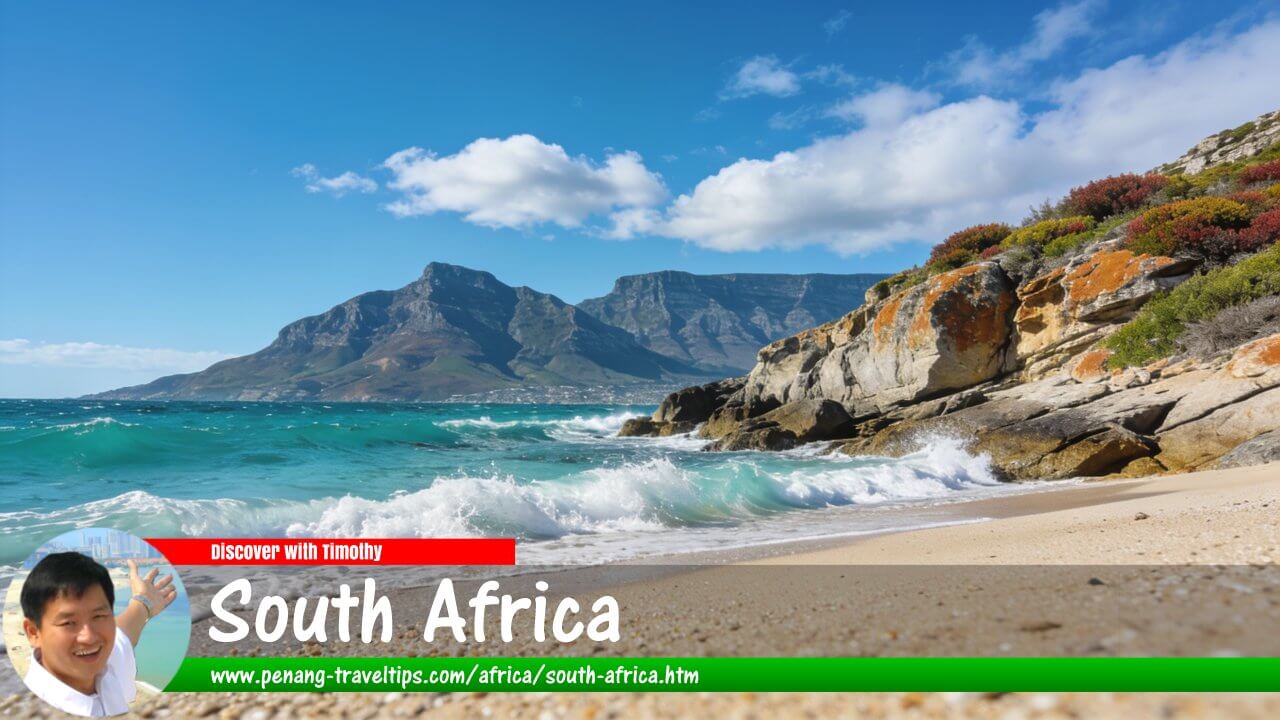 South Africa Travel Guide (AI Image generated on 2 September 2026)
Also available: Panduan Melawat Afrika Selatan
South Africa is one of the most diverse travel destinations in Africa. Located at the southern tip of the continent, it offers dramatic coastlines, major cities, wildlife reserves, mountains, vineyards, deserts and a complex history that has shaped the country into what it is today.
For many international visitors, South Africa is best known for Cape Town, Kruger National Park and the country's famous wildlife safaris. However, there is much more to explore, including the Garden Route, the wine regions around Stellenbosch and Franschhoek, the beaches of KwaZulu-Natal, the Drakensberg Mountains and historic cities such as Johannesburg and Pretoria.
Where Is South Africa?
South Africa occupies the southernmost part of the African continent. It has a long coastline stretching along both the Atlantic Ocean and the Indian Ocean.
The country shares land borders with Namibia, Botswana, Zimbabwe, Mozambique and Eswatini. It also completely surrounds the independent Kingdom of Lesotho.
South Africa covers an area of more than 1.2 million square kilometres, making it considerably larger than many European countries. Because of its size, climate and landscapes vary greatly from one region to another.
The Three Capitals of South Africa
South Africa has an unusual arrangement in which government functions are divided among three capital cities.
- Pretoria is the administrative capital and the seat of the executive branch of government.
- Cape Town is the legislative capital and home to Parliament.
- Bloemfontein is traditionally regarded as the judicial capital and is an important centre of the country's judicial system.
For travellers, Cape Town is by far the most internationally famous of the three and is one of the country's leading tourist destinations.
A Country of Remarkable Diversity
South Africa is often described as a country of remarkable diversity. Its landscapes range from Mediterranean-style coastal scenery around Cape Town to subtropical beaches in KwaZulu-Natal and semi-desert regions in the interior.
The country also has some of Africa's best-known wildlife areas. Visitors can go on safari to see lions, elephants, rhinoceroses, leopards and buffaloes, collectively known as the Big Five.
At the same time, South Africa has highly developed cities, modern highways, international airports, shopping centres and a tourism industry that caters to a wide range of travellers.
The Rainbow Nation
South Africa is often called the Rainbow Nation, a term associated with the country's diversity of people, languages and cultures.
The country has 12 official languages, including English, Afrikaans, isiZulu, isiXhosa and South African Sign Language. English is widely used in business, government and tourism, making it relatively easy for international visitors to communicate in major cities and tourist areas.
South Africa's population includes people from many different cultural and ethnic backgrounds, including African communities, descendants of European settlers, people of Asian heritage and communities of mixed ancestry.
A Brief History of South Africa
The history of South Africa stretches back thousands of years. The region was originally inhabited by indigenous peoples, including the San and Khoikhoi, while Bantu-speaking communities later established themselves across much of southern Africa.
European involvement began when Portuguese sailors travelled around the southern tip of Africa in the late 15th century. However, permanent European settlement began in 1652, when the Dutch East India Company established a settlement at the Cape of Good Hope.
Over time, the region came under increasing British influence. Conflicts between British authorities, Dutch-speaking settlers known as Boers, and African communities played an important role in shaping the country.
The Union of South Africa
The Union of South Africa was formed in 1910, bringing several British colonies and former Boer republics together under one government.
Although South Africa developed economically during the 20th century, political power remained heavily controlled by the white minority population, while Black South Africans faced increasing restrictions and discrimination.
Apartheid
In 1948, the South African government formally introduced the system known as apartheid. Under apartheid, people were classified according to racial categories, and laws enforced racial segregation in housing, education, employment and many other aspects of daily life.
The apartheid system caused enormous suffering and became one of the most widely condemned systems of racial discrimination in modern history.
Resistance came from many organisations and individuals, including the African National Congress (ANC) and leaders such as Nelson Mandela.
Nelson Mandela
Nelson Mandela became one of the most important figures in South African history. He spent 27 years in prison because of his involvement in the struggle against apartheid.
Following negotiations that brought apartheid to an end, South Africa held its first democratic election in 1994, in which citizens of all racial backgrounds were able to vote.
Mandela became the country's first democratically elected president and became an international symbol of reconciliation and the struggle for freedom.
South Africa Today
Modern South Africa is a democratic country with a diverse society and one of the largest economies in Africa. It remains an important regional centre for business, finance, tourism and transport.
However, South Africa also faces significant social and economic challenges, including inequality, unemployment and crime. These issues form part of the country's continuing story and are important considerations for both residents and travellers.
Geography and Landscapes
South Africa's geography is one of its greatest attractions. The country has mountains, grasslands, forests, deserts and long stretches of coastline.
The south-western part of the country is dominated by the Cape Mountains and the famous Table Mountain, which overlooks Cape Town.
The interior contains a large elevated plateau known as the Highveld, where Johannesburg and Pretoria are located.
Further east are greener landscapes and mountain regions, including the spectacular Drakensberg Mountains.
The Atlantic and Indian Oceans
South Africa is unusual in having coastlines facing two major oceans.
The western coast faces the Atlantic Ocean, where the water is generally colder. The eastern coast faces the Indian Ocean, which has warmer waters and many popular beach destinations.
The meeting of these two ocean systems contributes to the country's rich marine environment and makes South Africa a destination for whale watching, shark diving, penguin viewing and other marine activities.
Wildlife and National Parks
Wildlife is one of the main reasons visitors travel to South Africa. The country has numerous national parks, private game reserves and protected areas.
The most famous is Kruger National Park, one of Africa's largest and best-known wildlife reserves. It provides opportunities to see a wide range of animals in their natural environment.
Other important wildlife destinations include Addo Elephant National Park, Hluhluwe–iMfolozi Park and several private game reserves.
The Big Five
The term Big Five refers to five African animals that are particularly famous among safari travellers:
- Lion
- Leopard
- Elephant
- Rhinoceros
- Buffalo
Although the Big Five are major attractions, South Africa's wildlife is far more diverse. Visitors may also encounter giraffes, zebras, hippopotamuses, cheetahs, hyenas, antelope and hundreds of bird species.
Major Tourist Regions
South Africa can be divided into several major travel regions, each offering a different experience.
Cape Town and the Western Cape are famous for mountains, beaches, vineyards and scenic coastal drives.
Johannesburg and Gauteng offer important historical sites, museums and urban experiences.
Mpumalanga is the gateway to Kruger National Park and contains spectacular natural scenery such as the Blyde River Canyon region.
KwaZulu-Natal offers beaches, wildlife reserves, mountains and important historical sites.
The Garden Route is one of South Africa's most famous road-trip destinations, combining forests, beaches, lagoons and small coastal towns.
Why Visit South Africa?
South Africa appeals to many different types of travellers. Wildlife enthusiasts can go on safari, history lovers can explore sites connected with apartheid and colonial history, while nature lovers can enjoy mountains, coastlines and national parks.
Food and wine enthusiasts can explore the Cape Winelands, while adventure travellers can enjoy hiking, diving, surfing, whale watching and other outdoor activities.
The country can also be visited as part of a longer journey through southern Africa.
A Destination That Requires Planning
Because South Africa is large, travellers should plan their itinerary carefully. It is not realistic to visit Cape Town, Kruger National Park, Durban and the Garden Route in a few days without spending much of the trip travelling.
For a first visit, many travellers choose two or three main regions. A common combination is Cape Town and the surrounding Western Cape, followed by a safari in or near Kruger National Park.
Those with more time can add the Garden Route, Johannesburg or KwaZulu-Natal.
South Africa for Malaysian Travellers
For travellers from Malaysia, South Africa offers an opportunity to experience landscapes and wildlife that are very different from Southeast Asia. Safaris, vineyards, dramatic coastlines and encounters with African wildlife are among the experiences that make the country especially memorable.
English is widely used, which makes independent travel relatively manageable. However, visitors should plan their transport carefully and remain aware of personal safety, particularly in major cities.
South Africa is also home to Muslim communities, particularly in Cape Town and some other cities, and travellers can find mosques and halal food in many urban areas.
In the following parts of this South Africa Travel Guide, we will explore the country's major destinations, attractions, food, transport, accommodation and practical advice for planning a memorable journey.
Major Destinations and Cities in South Africa
South Africa is a large country with destinations that offer very different experiences. Cape Town is famous for mountains, beaches and vineyards, Johannesburg is an important economic and historical centre, while Kruger National Park offers some of Africa's best wildlife viewing.
Rather than trying to see the entire country in one trip, most visitors should choose destinations according to their interests and the amount of time available.
Cape Town
Cape Town is South Africa's best-known tourist city and one of the most visually spectacular cities in the world. It lies between mountains and the Atlantic Ocean, with the distinctive flat-topped Table Mountain dominating the skyline.
The city is an excellent starting point for a first visit to South Africa. It offers history, beaches, museums, restaurants, shopping, wine regions and some of the country's most famous scenic drives.
Major attractions include Table Mountain, the Victoria & Alfred Waterfront, the Cape Peninsula, Robben Island and the colourful Bo-Kaap neighbourhood.
Table Mountain
Table Mountain is Cape Town's most famous landmark. Its flat summit rises above the city and offers panoramic views of Cape Town, the coastline and the surrounding mountains.
Visitors can reach the top by cableway when weather conditions permit, while experienced hikers can use one of several walking routes.
The weather on the mountain can change quickly, so visitors should check conditions before travelling to the summit.
Victoria & Alfred Waterfront
The Victoria & Alfred Waterfront, often called the V&A Waterfront, is one of Cape Town's most popular visitor areas.
It contains restaurants, shops, hotels, museums and entertainment venues, with views of the harbour and Table Mountain.
The Waterfront is also a convenient departure point for some tours and activities, including ferries to Robben Island.
Robben Island
Robben Island lies off the coast of Cape Town and is internationally known for the prison where Nelson Mandela spent many years of his imprisonment.
The island has a much longer history and was used for various purposes over the centuries, including as a place of isolation and imprisonment.
Today, Robben Island is a UNESCO World Heritage Site and one of South Africa's most important historical attractions.
Bo-Kaap
Bo-Kaap is one of Cape Town's most recognisable neighbourhoods, known for its brightly painted houses and Cape Malay cultural heritage.
The area's history is closely connected with descendants of enslaved people and other communities brought to the Cape during the colonial period.
Bo-Kaap is also important to the history of Islam in South Africa and remains associated with Cape Town's Muslim community.
The Cape Peninsula
The Cape Peninsula is one of the most scenic areas around Cape Town. A journey around the peninsula can include dramatic coastal roads, beaches, fishing villages and mountain scenery.
Popular stops include Hout Bay, Chapman's Peak Drive, Simon's Town and the Cape of Good Hope.
Cape Point and the Cape of Good Hope
The Cape of Good Hope is one of South Africa's most famous geographical landmarks. It forms part of the Cape Point section of Table Mountain National Park.
Although it is often mistakenly described as the southernmost point of Africa, the actual southernmost point is Cape Agulhas, located further southeast.
The Cape Point area offers dramatic coastal scenery, hiking opportunities and views over the ocean.
Boulders Beach
Boulders Beach, near Simon's Town, is famous for its colony of African penguins.
Visitors can observe penguins from designated boardwalks and beaches. The colony is one of the best-known wildlife attractions near Cape Town.
Because African penguins are a protected species, visitors should follow local rules and avoid disturbing the animals.
The Cape Winelands
The Cape Winelands lie within easy reach of Cape Town and are famous for vineyards, mountain scenery and historic towns.
The best-known destinations include Stellenbosch, Franschhoek and Paarl.
Even visitors who do not drink alcohol can enjoy the scenery, restaurants, architecture, gardens and food experiences of the region.
Stellenbosch
Stellenbosch is one of South Africa's oldest towns and is known for its Cape Dutch architecture, oak-lined streets and surrounding vineyards.
The town has restaurants, cafés and cultural attractions, making it suitable for a day trip or overnight stay from Cape Town.
Franschhoek
Franschhoek is another important destination in the Cape Winelands. It is known for its restaurants, scenic surroundings and history connected with French Huguenot settlers.
The town has a reputation as one of South Africa's leading food destinations.
Johannesburg
Johannesburg, often called Joburg or Jo'burg, is South Africa's largest city and its main economic centre.
Unlike Cape Town, Johannesburg is not primarily known for beaches or dramatic coastal scenery. Instead, it is important for understanding South Africa's modern history, economy and urban development.
The city grew rapidly following the discovery of gold in the late 19th century and became one of the most important centres of the mining industry.
The Apartheid Museum
The Apartheid Museum in Johannesburg is one of the country's most important museums. It documents the history of apartheid and the struggle that eventually led to democratic rule.
A visit provides valuable context for understanding modern South Africa and the country's continuing social challenges.
Soweto
Soweto, short for South Western Townships, is one of South Africa's most historically significant urban areas.
It played an important role in the struggle against apartheid and is associated with the Soweto Uprising of 1976.
Visitors can explore historical sites and learn about the lives of people who played important roles in South Africa's political history.
Vilakazi Street
Vilakazi Street in Soweto is internationally famous because it has been associated with both Nelson Mandela and Archbishop Desmond Tutu.
It has become an important stop for visitors interested in South African history and the anti-apartheid movement.
Pretoria
Pretoria, officially part of the City of Tshwane metropolitan area, is South Africa's administrative capital.
The city contains government buildings, museums and monuments. It is also known for its jacaranda trees, which produce purple flowers during the flowering season.
The Union Buildings
The Union Buildings in Pretoria house important government offices and overlook the city from a prominent hill.
The surrounding gardens and the statue of Nelson Mandela make the area a popular visitor attraction.
Durban
Durban lies on South Africa's eastern coast along the Indian Ocean. It is known for its warm climate, beaches and strong Indian cultural influence.
The city has one of the largest populations of people of Indian descent outside India, and this influence is particularly visible in Durban's food and culture.
Durban is a good destination for travellers who enjoy beaches and warm weather.
KwaZulu-Natal
The province of KwaZulu-Natal offers much more than Durban. It contains beaches, wildlife reserves, historic battlefields and mountain scenery.
The province is also associated with the Zulu people and has an important place in South African history.
The Drakensberg Mountains
The Drakensberg Mountains form one of southern Africa's most spectacular mountain regions.
The area offers hiking, scenic landscapes and opportunities to see ancient San rock art.
Parts of the region are included within the uKhahlamba-Drakensberg Park UNESCO World Heritage Site.
Kruger National Park
Kruger National Park is South Africa's best-known wildlife destination and one of Africa's great safari parks.
The park covers a vast area in the north-eastern part of the country and supports a remarkable variety of wildlife.
Visitors can see the Big Five as well as giraffes, zebras, hippopotamuses, cheetahs, wild dogs and many species of birds.
Safari Experiences in Kruger
Kruger offers different ways to experience wildlife. Visitors can join guided game drives, stay at camps inside or near the park, or travel independently in permitted areas.
Wildlife sightings can never be guaranteed, and this is part of the safari experience. Animals move freely through large natural areas, so patience is often rewarded.
Private Game Reserves
South Africa also has many private game reserves, particularly in areas near Kruger National Park.
Private reserves often provide guided safari experiences and accommodation ranging from comfortable lodges to luxury safari camps.
They can be a convenient choice for visitors who want organised game drives and accommodation as part of one package.
The Garden Route
The Garden Route is one of South Africa's most famous scenic travel routes. It generally follows part of the southern coast and is known for forests, beaches, mountains, lagoons and small towns.
Popular stops include Mossel Bay, Knysna, Plettenberg Bay and Tsitsikamma.
The Garden Route is particularly suitable for travellers who enjoy road trips and outdoor activities.
Knysna
Knysna is known for its lagoon, forests and scenic coastline. It is one of the best-known towns along the Garden Route.
The Knysna Heads, two dramatic headlands at the entrance to the lagoon, are among the area's best-known natural features.
Plettenberg Bay
Plettenberg Bay, often called Plett, is a coastal resort town with beaches and scenic surroundings.
It is popular for beach holidays and outdoor activities and can also be a base for exploring the Garden Route.
Tsitsikamma National Park
Tsitsikamma is known for its dramatic meeting of forest and coastline. The area offers hiking trails, suspension bridges and spectacular views of the Indian Ocean.
It is particularly attractive to travellers who enjoy nature and outdoor activities.
Port Elizabeth and Gqeberha
Gqeberha, formerly known as Port Elizabeth, is an important coastal city in the Eastern Cape.
It can serve as a gateway to the Garden Route and wildlife destinations in the Eastern Cape.
The city is also conveniently located for visitors travelling to Addo Elephant National Park.
Addo Elephant National Park
Addo Elephant National Park is one of South Africa's major wildlife reserves and is particularly famous for its elephants.
The park protects a wide range of habitats and wildlife and provides an alternative safari destination for travellers exploring the Eastern Cape.
The Eastern Cape
The Eastern Cape offers a mixture of wildlife, coastline and cultural history.
It is also associated with several important figures in South African history, including Nelson Mandela, who was born in the region.
Bloemfontein
Bloemfontein is an important city in central South Africa and is traditionally regarded as the country's judicial capital.
It is less visited by international tourists than Cape Town or Johannesburg but can be included in a broader exploration of South Africa.
Other Destinations
South Africa has many other destinations that may appeal to travellers with more time.
The Kalahari region offers desert landscapes and unique wildlife, while the West Coast is known for coastal scenery and spectacular displays of wildflowers during the flowering season.
The country's northern regions also offer important cultural and natural attractions, including the dramatic landscapes around the Blyde River Canyon.
Choosing Your Destinations
The best destinations depend on your interests.
- For first-time visitors: Cape Town and a safari near Kruger National Park.
- For history: Johannesburg, Soweto and Cape Town.
- For wildlife: Kruger National Park, private reserves or Addo Elephant National Park.
- For beaches: Cape Town, Durban, KwaZulu-Natal and the Garden Route.
- For scenic road trips: The Garden Route and the Western Cape.
- For mountains and hiking: The Drakensberg and the Cape mountain regions.
South Africa's greatest advantage as a travel destination is the variety of experiences available within one country. The next parts of this guide will explore its major attractions, wildlife, culture, food and practical information for planning your journey.
Wildlife, Nature and Natural Attractions
South Africa is one of the world's great destinations for wildlife and nature. Within a single country, travellers can experience African safaris, dramatic mountains, deserts, forests, beaches and rich marine ecosystems.
For many visitors, seeing wild animals in their natural environment is the highlight of a journey to South Africa. However, the country's natural attractions extend far beyond the famous Big Five.
Going on Safari in South Africa
A safari is one of the most memorable experiences available to visitors to South Africa. The country has an extensive network of national parks, provincial reserves and private game reserves.
Unlike a zoo, animals on safari live in large natural environments. There are no guarantees about what you will see on a particular day. A successful safari often requires patience, observation and a little luck.
Early morning and late afternoon are often particularly rewarding times for wildlife viewing because many animals are more active when temperatures are cooler.
Kruger National Park
Kruger National Park is South Africa's most famous safari destination and one of the largest protected wildlife areas in Africa.
The park is located in north-eastern South Africa and covers an enormous area of bushveld, grassland and woodland. It supports a remarkable diversity of mammals, birds, reptiles and other wildlife.
Kruger is especially famous for the opportunity to see the Big Five: lion, leopard, elephant, rhinoceros and buffalo.
The Big Five
The term Big Five originally came from big-game hunting terminology, referring to five animals that were considered particularly difficult and dangerous to hunt on foot.
Today, the term is primarily used in wildlife tourism and photography.
- Lion – South Africa's most famous large predator.
- Leopard – Elusive and often difficult to spot.
- Elephant – The world's largest land animal.
- Rhinoceros – Both white and black rhinoceroses occur in protected areas.
- Buffalo – Large and powerful animals commonly seen in herds.
Seeing all five animals during one safari is possible but never guaranteed.
Other Animals to Look For
South Africa's wildlife is far more diverse than the Big Five. Visitors may also encounter:
- Giraffes
- Zebras
- Hippopotamuses
- Cheetahs
- Spotted hyenas
- African wild dogs
- Warthogs
- Impalas and other antelope
- Baboons and other primates
- Crocodiles
The country is also an excellent destination for birdwatching, with a remarkable variety of bird species found across different habitats.
Self-Drive Safari
One of the advantages of Kruger National Park is that visitors can experience parts of the park in their own vehicle.
A self-drive safari gives travellers the freedom to move at their own pace and spend more time observing animals they discover.
Visitors must follow park rules carefully, remain inside their vehicles except in designated areas and never approach wild animals.
Guided Game Drives
Guided game drives are another popular way to experience wildlife. Professional guides understand animal behaviour and may be able to spot wildlife that visitors would otherwise miss.
Many guided drives take place in open safari vehicles, providing excellent views and opportunities for photography.
Night drives and early morning drives can provide opportunities to observe animals that are more active outside the hottest hours of the day.
Private Game Reserves
Private game reserves provide another type of safari experience. Many offer accommodation together with guided game drives and meals.
Some private reserves are located next to major national parks, allowing wildlife to move across large areas without being confined to a small enclosure.
Private reserves can provide a more organised and sometimes more luxurious experience, although prices vary considerably.
Addo Elephant National Park
Addo Elephant National Park, located in the Eastern Cape, is one of South Africa's most important wildlife destinations.
As its name suggests, the park is particularly famous for elephants, but it also protects many other species and habitats.
Addo is a convenient safari option for travellers exploring the Garden Route or the Eastern Cape.
Hluhluwe–iMfolozi Park
Hluhluwe–iMfolozi Park in KwaZulu-Natal is another important wildlife reserve.
The park is particularly significant in the history of rhinoceros conservation and remains an excellent destination for wildlife viewing.
Its landscapes and ecosystems differ from those of Kruger, giving travellers another perspective on South Africa's natural environment.
Rhino Conservation
Rhinoceroses are among the most threatened animals in Africa because of illegal poaching.
South Africa plays an important role in rhino conservation, but the protection of these animals remains a major challenge.
Visitors should follow park regulations and avoid sharing detailed real-time information about the location of vulnerable wildlife on social media.
The Drakensberg Mountains
The Drakensberg Mountains form one of southern Africa's most spectacular natural regions.
The mountains contain dramatic cliffs, valleys, waterfalls and high-altitude landscapes. They are popular for hiking, photography and outdoor recreation.
The region also contains important examples of ancient San rock art, providing a connection between natural beauty and human history.
uKhahlamba-Drakensberg Park
Parts of the Drakensberg are protected within uKhahlamba-Drakensberg Park, a UNESCO World Heritage Site.
The area is recognised for both its natural importance and its cultural heritage, particularly its extensive collection of San rock paintings.
Table Mountain National Park
Table Mountain National Park protects one of the most famous landscapes in South Africa.
The park includes Table Mountain, parts of the Cape Peninsula and other important natural areas around Cape Town.
It is home to an extraordinary diversity of plants, including species associated with the Cape Floral Region.
The Cape Floral Region
The south-western Cape is internationally important for its unique plant life. The region is associated with fynbos, a distinctive type of vegetation found in the Cape.
Despite covering a relatively small area, the Cape Floral Region contains an exceptionally high diversity of plant species, many of which occur nowhere else in the world.
Parts of the region are recognised as a UNESCO World Heritage Site.
The Garden Route
The Garden Route is one of South Africa's best-known scenic regions. It combines forests, mountains, rivers, lagoons and beaches along the country's southern coast.
The route is particularly attractive for travellers who enjoy driving, hiking and spending time in nature.
Tsitsikamma
Tsitsikamma is famous for its dramatic meeting of indigenous forests and the Indian Ocean.
The area offers hiking trails, coastal scenery and the well-known suspension bridge crossing the Storms River mouth.
It is an excellent destination for travellers who want to experience South Africa's coastline beyond the major cities.
Knysna Forests and Lagoons
The region around Knysna contains forests, lagoons and coastal landscapes.
Knysna is particularly associated with the Knysna Heads, dramatic cliffs marking the entrance to the lagoon.
The wider region provides opportunities for hiking, boating and nature exploration.
Blyde River Canyon
The Blyde River Canyon region in Mpumalanga is one of South Africa's most spectacular natural landscapes.
The canyon is surrounded by dramatic cliffs and mountain scenery and forms part of the broader Panorama Route.
Popular viewpoints in the region include the Three Rondavels and God's Window.
God's Window
God's Window is a famous viewpoint along the Panorama Route.
On clear days, visitors can enjoy extensive views over forests and the Lowveld landscape.
Weather conditions can change quickly, and cloud or mist may sometimes limit visibility.
The Three Rondavels
The Three Rondavels are three distinctive rock formations overlooking the Blyde River Canyon.
Their shape resembles traditional African round houses known as rondavels, giving the formations their name.
The Kalahari
The Kalahari extends across parts of southern Africa, including northern South Africa.
The region is associated with dry landscapes, red sand dunes and specialised wildlife adapted to semi-arid conditions.
The Kgalagadi Transfrontier Park is one of the major protected areas associated with this environment.
Kgalagadi Transfrontier Park
Kgalagadi Transfrontier Park is shared by South Africa and Botswana and protects a vast desert and semi-desert environment.
It is particularly famous for predators, including lions with distinctive dark manes, as well as cheetahs and other wildlife adapted to the dry environment.
The West Coast
South Africa's West Coast offers a very different landscape from the lush Garden Route or subtropical east coast.
The region is influenced by the cold Atlantic Ocean and can appear dry for much of the year.
However, during the spring flowering season, parts of the landscape can become covered with spectacular displays of wildflowers.
Cape Agulhas
Cape Agulhas is the southernmost point of the African continent.
It is an important geographical destination for travellers interested in visiting the southern tip of Africa.
The area is also known for its winds, rugged coastline and maritime history.
Whale Watching
South Africa is one of the world's important destinations for whale watching.
Different whale species can be seen along parts of the coast at different times of the year.
Hermanus, east of Cape Town, is internationally famous for land-based whale watching during the appropriate season.
African Penguins
The colony at Boulders Beach near Cape Town provides one of the best opportunities to see African penguins.
These distinctive birds are found along the southern African coast and face significant conservation challenges.
Visitors should observe penguins from appropriate distances and follow all regulations designed to protect the colony.
Shark and Marine Wildlife Experiences
South Africa's coast supports a rich variety of marine life, including sharks, seals, dolphins and whales.
Some coastal destinations offer organised marine wildlife experiences, including cage diving and boat tours.
Visitors should choose operators that follow responsible wildlife practices and avoid activities that unnecessarily disturb animals.
Hiking and Outdoor Activities
South Africa offers hiking opportunities ranging from short walks to demanding mountain trails.
Popular hiking areas include Table Mountain, the Drakensberg, Tsitsikamma and various national parks.
Hikers should prepare for changing weather, carry sufficient water and avoid isolated routes without proper planning.
Nature and Responsible Tourism
South Africa's wildlife and natural landscapes are among its greatest treasures. Visitors can help protect them by following park rules, avoiding littering and respecting animals and their habitats.
Wild animals should never be fed, touched or approached. Keeping a safe distance protects both visitors and wildlife.
When choosing wildlife activities, look for operators and accommodation providers that support responsible conservation practices.
Choosing a Nature Experience
The best natural attractions depend on the type of experience you want.
- For the Big Five: Kruger National Park and major private game reserves.
- For elephants: Addo Elephant National Park.
- For mountains: The Drakensberg and Table Mountain.
- For forests and coastline: The Garden Route and Tsitsikamma.
- For dramatic canyons: The Blyde River Canyon region.
- For desert wildlife: Kgalagadi Transfrontier Park.
- For whales and marine wildlife: The Cape coast and destinations such as Hermanus.
South Africa's extraordinary natural diversity means that wildlife and scenery can form the central theme of an entire journey. In the next part of this guide, we will explore the country's history, culture and some of the experiences that help visitors understand the people and heritage of South Africa.
History, Culture and Heritage
South Africa has one of the most complex and fascinating histories of any country in Africa. Its modern identity has been shaped by indigenous African societies, European colonisation, slavery, migration, conflict, apartheid and the transition to democracy.
For travellers, understanding at least some of this history makes a journey through South Africa far more meaningful. Museums, historic neighbourhoods, former prisons, townships and cultural sites provide important insights into the country and its people.
The First Peoples
Southern Africa has been inhabited for thousands of years. Among the region's earliest known peoples are the San, traditionally associated with hunting and gathering, and the Khoikhoi, who traditionally practised pastoralism.
The San are particularly important to the cultural heritage of southern Africa because of their extraordinary rock art, examples of which can still be found in protected areas and mountain regions.
Over time, Bantu-speaking communities also settled across much of southern Africa, developing agricultural and pastoral societies and forming the ancestors of many modern South African communities.
European Exploration and the Cape
European sailors began travelling around the southern tip of Africa during the Age of Exploration. Portuguese navigators played an important role in establishing sea routes around the continent.
However, permanent European settlement at the Cape began in 1652, when the Dutch East India Company established a settlement at what is now Cape Town.
The Cape initially served as a refreshment station for ships travelling between Europe and Asia, but the settlement gradually expanded.
Slavery and the Cape Colony
The history of Cape Town cannot be understood without recognising the role of slavery.
Enslaved people were brought to the Cape from various parts of Africa and Asia, including regions connected with present-day Indonesia, Malaysia, India and other parts of the Indian Ocean world.
These communities contributed greatly to the development of Cape Town's culture, language, cuisine and religious traditions.
The descendants of these communities form an important part of the Cape's cultural heritage today.
Cape Malay Culture
Cape Malay culture is one of the most distinctive cultural traditions in South Africa.
The term is associated with a Muslim community whose history is connected with enslaved people, political exiles and other individuals brought to the Cape from Southeast Asia, South Asia and other parts of the Indian Ocean world during the colonial period.
Visitors can learn about this heritage in areas such as Bo-Kaap in Cape Town.
Islam in South Africa
Islam has a long history in South Africa, particularly in the Western Cape.
The Muslim community at the Cape developed under difficult circumstances during the colonial period, when enslaved people and political prisoners played important roles in preserving and developing Islamic traditions.
Today, South Africa has mosques and Muslim communities in many cities, and Islam forms an important part of the country's religious diversity.
British Rule and the Boer Communities
British influence at the Cape increased during the late 18th and early 19th centuries.
Many Dutch-speaking settlers, later known as Boers or Afrikaners, moved inland and established communities away from British-controlled areas.
This movement, known as the Great Trek, contributed to the establishment of Boer republics in the interior of southern Africa.
The Anglo-Boer Wars
Conflicts between the British Empire and the Boer republics became increasingly important during the 19th century.
The most famous of these conflicts were the Anglo-Boer Wars, particularly the Second Anglo-Boer War from 1899 to 1902.
The British eventually defeated the Boer republics, and the political map of southern Africa changed significantly.
The Discovery of Diamonds and Gold
The discovery of diamonds and gold transformed South Africa.
Diamonds were discovered in the Kimberley area during the 19th century, while major gold discoveries in the Witwatersrand region contributed to the rapid growth of Johannesburg.
Mining became one of the foundations of South Africa's economy and attracted workers and investment from many parts of the region and the world.
The Union of South Africa
In 1910, the Union of South Africa was established by bringing together former British colonies and Boer territories.
However, political power remained largely controlled by the white minority population, while Black South Africans were excluded from full political participation.
Discriminatory laws existed before apartheid became official policy, and racial inequality was already deeply embedded in the country's political system.
The Beginning of Apartheid
In 1948, the National Party came to power and formally introduced the system of apartheid.
Apartheid was a system of racial segregation and discrimination enforced through law. South Africans were classified into racial groups, and laws controlled where people could live, work, study and travel.
Families were sometimes separated, communities were forcibly removed from their homes, and the majority of South Africans were denied equal political rights.
Forced Removals
One of the most painful aspects of apartheid was the policy of forced removals.
People were removed from neighbourhoods where they had lived for generations because the government designated those areas for another racial group.
District Six in Cape Town is one of the best-known examples. Thousands of residents were forcibly removed after the area was declared a whites-only zone.
Today, the District Six Museum helps preserve the memories of the community and documents the human impact of forced removals.
Resistance to Apartheid
Resistance to apartheid came from many organisations, communities and individuals.
The African National Congress (ANC) became one of the most important organisations in the struggle, alongside other political and community movements.
Many people protested peacefully, while others became involved in strikes, civil disobedience and other forms of resistance.
Nelson Mandela
Nelson Mandela became the most internationally recognised figure in the struggle against apartheid.
He was involved in the ANC and the broader anti-apartheid movement and was imprisoned for 27 years.
Much of his imprisonment was spent on Robben Island, off the coast of Cape Town.
Mandela was released in 1990 as negotiations began to dismantle apartheid and establish a democratic political system.
The Soweto Uprising
The Soweto Uprising of 1976 was a major turning point in the struggle against apartheid.
Students protested against government policies affecting education, and the protests were met with violence.
The events attracted international attention and became one of the defining moments of resistance against apartheid.
Visitors to Soweto can learn more about this history through museums, memorials and guided tours.
Desmond Tutu
Archbishop Desmond Tutu was another important figure in the struggle against apartheid.
He became internationally known for his opposition to racial discrimination and later played a major role in promoting reconciliation in democratic South Africa.
The expression Rainbow Nation became closely associated with Tutu's vision of a country in which people from different backgrounds could live together as one nation.
The End of Apartheid
During the late 1980s and early 1990s, South Africa entered a period of major political change.
Negotiations between the government and anti-apartheid organisations eventually led to the dismantling of apartheid laws.
In 1994, South Africa held its first democratic national election in which citizens of all racial backgrounds could participate.
Democratic South Africa
Nelson Mandela became South Africa's first democratically elected president in 1994.
The transition was internationally celebrated because South Africa moved away from apartheid without descending into the large-scale civil conflict that many people had feared.
However, the transition did not immediately solve all of the country's problems. Inequality, poverty and the legacy of apartheid remain important issues in South Africa today.
The Truth and Reconciliation Commission
After apartheid ended, South Africa established the Truth and Reconciliation Commission, commonly known as the TRC.
The commission investigated serious human rights violations committed during the apartheid period and provided a platform for victims and perpetrators to give testimony.
Its work became internationally significant as an attempt to address a painful past through truth-telling and reconciliation.
Languages of South Africa
South Africa is a multilingual country with 12 official languages.
These include:
- Afrikaans
- English
- isiNdebele
- isiXhosa
- isiZulu
- Sepedi
- Sesotho
- Setswana
- siSwati
- Tshivenda
- Xitsonga
- South African Sign Language
English is widely used in tourism and business, particularly in major cities.
Afrikaans
Afrikaans developed from Dutch and evolved in southern Africa.
Although historically associated with Afrikaners, Afrikaans is spoken by people from different communities and backgrounds.
It remains an important part of South Africa's linguistic and cultural landscape.
isiZulu and isiXhosa
isiZulu is associated with the Zulu people and is widely spoken in KwaZulu-Natal and other parts of South Africa.
isiXhosa is associated with the Xhosa people and is widely spoken in the Eastern Cape and other regions.
Both languages are part of the Nguni language group and are important elements of South Africa's cultural heritage.
The Zulu People
The Zulu are one of the largest cultural groups in South Africa.
Zulu history is closely associated with the Kingdom of the Zulu and important historical figures such as King Shaka.
KwaZulu-Natal remains an important centre of Zulu culture, and visitors can learn about traditional customs, music and history in the region.
The Xhosa People
The Xhosa are another major cultural group in South Africa, particularly associated with the Eastern Cape.
Several important South African leaders, including Nelson Mandela and Desmond Tutu, came from Xhosa-speaking communities.
Xhosa culture has made important contributions to South Africa's language, music and political history.
Music and Dance
Music plays an important role in South African culture.
Traditional African music exists alongside styles influenced by European, Asian and international musical traditions.
South Africa has contributed internationally recognised music styles and performers, while local music remains an important part of celebrations and community life.
Art and Craft
South Africa has a rich tradition of visual art and craft.
Visitors can find beadwork, textiles, woodcarving, ceramics and contemporary art in markets, galleries and cultural centres.
When buying souvenirs, travellers can support local artists and craftspeople by purchasing authentic locally made products.
Architecture
South Africa's architecture reflects its complex history.
In the Western Cape, visitors can see examples of Cape Dutch architecture, characterised by distinctive decorative gables and whitewashed buildings.
Major cities also contain colonial buildings, modern skyscrapers and contemporary architecture.
South African Museums
Museums are among the best places to understand the country's history.
Important institutions include the Apartheid Museum in Johannesburg, the District Six Museum in Cape Town and museums associated with Nelson Mandela and other historical figures.
Visitors interested in history should allow enough time for these museums rather than treating them as quick stops between sightseeing activities.
World Heritage Sites
South Africa has several UNESCO World Heritage Sites that represent both natural and cultural heritage.
These include Robben Island, the Cape Floral Region, the iSimangaliso Wetland Park, uKhahlamba-Drakensberg Park and the Fossil Hominid Sites of South Africa.
These places demonstrate the remarkable range of South Africa's history, from early human development to political history and biodiversity.
The Cradle of Humankind
The Cradle of Humankind, located near Johannesburg, is internationally important for its fossil sites.
Fossils discovered in the region have contributed greatly to scientific understanding of early human ancestors and human evolution.
It is a fascinating destination for travellers interested in archaeology, anthropology and the story of humanity.
Respecting Cultural Diversity
South Africa is a country with many identities and traditions. Visitors should avoid assuming that all South Africans share the same culture, language or way of life.
The country's diversity is one of its greatest strengths, but its history also means that subjects such as race and inequality can be sensitive.
Travellers should approach cultural experiences with respect and curiosity rather than treating communities merely as tourist attractions.
Why History Matters to Travellers
A visit to South Africa can be much more meaningful when travellers understand the history behind the places they see.
Robben Island is not simply an island, Soweto is not simply a neighbourhood, and District Six is not simply a former residential district. Each represents an important part of the story of South Africa.
The country's history is sometimes painful, but it is also a story of resilience, cultural creativity and the continuing effort to build a more inclusive society.
In the next part of this South Africa Travel Guide, we will explore South African food, drinks and culinary experiences, including the country's distinctive regional influences and useful information for travellers looking for halal food.
South African Food and Dining
South African cuisine reflects the country's extraordinary diversity of people and history. Indigenous African traditions have blended with influences from Dutch, British, Malay, Indian and other communities to create a food culture that is distinctly South African.
Travellers will find everything from traditional home-style dishes and street food to international restaurants and fine dining. The food also varies considerably between regions, with Cape Town, Durban and Johannesburg each offering different culinary experiences.
Braai: South Africa's Famous Barbecue Tradition
One of the best-known South African food traditions is the braai, which is similar to a barbecue but has a particularly important place in South African social life.
A braai usually involves cooking food over an open fire or hot coals. Meat is often the centrepiece, although vegetables and other foods may also be prepared.
For many South Africans, a braai is more than simply a way of cooking. It is a social occasion where family and friends gather together.
Boerewors
Boerewors is a traditional South African sausage that is commonly prepared during a braai.
The name comes from Afrikaans and is associated with the country's Boer and Afrikaner culinary traditions.
Traditional boerewors is usually made with meat and spices, so Muslim travellers should check whether halal-certified versions are available.
Biltong
Biltong is one of South Africa's most famous snacks. It consists of cured and dried meat that has been seasoned with spices.
It is often compared with beef jerky, although the preparation method and flavour are different.
Biltong can be made from beef or other meats, so Muslim travellers should check the ingredients and halal status before purchasing it.
Bobotie
Bobotie is one of South Africa's most famous traditional dishes and is strongly associated with Cape Malay cuisine.
It usually consists of seasoned minced meat baked with an egg-based topping. The dish may contain spices such as curry powder, turmeric and other aromatic ingredients.
Recipes vary from household to household, and some versions include dried fruit or other ingredients that create a distinctive combination of sweet and savoury flavours.
Cape Malay Cuisine
Cape Malay cuisine is one of the most distinctive food traditions in South Africa.
Its flavours reflect historical connections between the Cape and communities from Southeast Asia, South Asia and other parts of the Indian Ocean world.
Spices play an important role, and visitors may find curries, rice dishes, samosas and other foods that show these historical influences.
Denningvleis
Denningvleis is another Cape Malay-influenced dish. It is generally a slow-cooked meat dish prepared with aromatic spices and a distinctive sweet-and-sour flavour.
Like many traditional dishes, recipes can vary considerably.
Samoosas
Samoosas are widely enjoyed in South Africa, particularly within communities influenced by Indian and Cape Malay food traditions.
They are similar to samosas found in South Asia and elsewhere and usually consist of pastry filled with ingredients such as vegetables, potatoes or meat.
Vegetarian versions can be particularly convenient for travellers looking for meat-free food.
Bunny Chow
Bunny chow is one of Durban's most famous dishes.
Despite its name, it does not traditionally contain rabbit. It usually consists of a hollowed-out loaf of bread filled with curry.
The dish developed within Durban's Indian community and has become an iconic part of the city's food culture.
Different versions may contain different meats or vegetarian fillings.
Durban Curry
Durban is famous for its strong Indian culinary influence and is an excellent destination for travellers who enjoy curry.
Durban curries are often known for their rich and spicy flavours. Visitors can find restaurants serving dishes influenced by Indian traditions alongside distinctly South African interpretations.
The large Muslim community in and around Durban also means that halal food is relatively easy to find in many parts of the city.
Potjiekos
Potjiekos is a traditional South African stew cooked slowly in a round cast-iron pot, often over an outdoor fire.
The dish may contain meat and vegetables and is associated with outdoor cooking and communal meals.
As recipes vary, the ingredients and preparation method can differ from one cook to another.
Pap
Pap is a staple food made from maize meal. It is eaten in various forms and can be served soft or firm, depending on the preparation.
Pap is an important part of many South African meals and is often served with meat, vegetables or sauces.
It may be compared in some ways with other maize-based staple foods found across Africa.
Chakalaka
Chakalaka is a spicy vegetable relish that is commonly served as a side dish.
Recipes vary, but ingredients may include tomatoes, onions, peppers, carrots and spices.
It can be served with pap, bread or grilled food and is one of the most recognisable side dishes in South African cuisine.
Morogo and Traditional Vegetables
Morogo is a general term used for leafy green vegetables that form part of traditional food cultures in southern Africa.
Different types of edible greens may be prepared in different communities and regions.
Travellers interested in traditional African cuisine should look for restaurants or cultural experiences that serve locally prepared dishes.
Vetkoek
Vetkoek is a traditional fried dough bread associated with Afrikaans cuisine.
It can be served with savoury fillings such as minced meat or with sweet toppings.
The name literally refers to a type of fried cake, although the food is closer to a deep-fried bread.
Gatsby
The Gatsby is a large sandwich associated particularly with Cape Town.
It is often filled with a combination of ingredients such as meat, chips and sauces, making it a substantial and popular sharing meal.
Ingredients vary widely, so visitors can choose versions according to their dietary preferences.
Koeksisters
Koeksisters are a popular South African sweet treat.
There are different styles, including a braided dough version associated with Afrikaans cooking and a spiced syrup-soaked version associated with Cape Malay traditions.
They are generally sweet, sticky and best enjoyed as an occasional treat.
Milk Tart
Milk tart, known in Afrikaans as melktert, is a popular South African dessert.
It typically consists of a pastry crust filled with a creamy milk-based custard and is often flavoured with cinnamon.
It reflects the influence of European baking traditions on South African cuisine.
Malva Pudding
Malva pudding is a warm and sweet South African dessert with a soft, sponge-like texture.
It is often served with a sweet sauce and may be accompanied by custard, cream or ice cream.
It is commonly found on restaurant menus and is a popular choice for visitors wanting to try a traditional South African dessert.
Rusks
Rusks are hard, dry biscuits or twice-baked bread pieces that are commonly eaten with tea or coffee.
South Africans often dip rusks into a hot drink to soften them before eating.
They are particularly popular as a simple breakfast or snack.
South African Breakfast
Breakfast in South Africa varies considerably.
Hotels often serve international breakfasts, while cafés may offer eggs, bread, fruit, cereals and other familiar choices.
Traditional South African breakfast items can also be found, particularly in guesthouses and smaller establishments.
Fresh Seafood
With long coastlines along the Atlantic and Indian Oceans, South Africa has access to a wide variety of seafood.
Coastal destinations may offer fresh fish, calamari and other seafood dishes.
The type of seafood available varies by region and season.
South African Street Food
Street food and casual takeaway meals are part of everyday life in many South African cities.
Popular choices may include grilled food, sandwiches, samosas, fried snacks and locally influenced fast food.
As with street food anywhere, visitors should choose busy and reputable vendors where food appears to be freshly prepared and handled hygienically.
Wine Regions
South Africa is internationally known for its wine industry, particularly in the Western Cape.
The Cape Winelands around Stellenbosch, Franschhoek and Paarl attract visitors interested in vineyards, scenic landscapes and food.
However, travellers who do not drink alcohol can still enjoy the restaurants, historic towns and beautiful surroundings of the region.
Non-Alcoholic Drinks
South Africa offers a variety of non-alcoholic drinks, including fruit juices, soft drinks and locally popular beverages.
Rooibos tea is one of the country's best-known products. It is made from a plant native to South Africa and naturally contains no caffeine.
Rooibos can be enjoyed hot or cold and is widely available in cafés, restaurants and shops.
South African Coffee Culture
Coffee culture has grown strongly in South Africa, particularly in Cape Town and Johannesburg.
Visitors can find modern cafés serving espresso-based coffee alongside traditional local drinks.
Speciality coffee shops are common in major cities and popular tourist areas.
Halal Food in South Africa
Halal food is available in many parts of South Africa, particularly in cities with significant Muslim communities.
Cape Town and Durban are among the easiest places for Muslim travellers to find halal restaurants and Muslim-friendly food options.
Cape Town's Cape Malay community and Durban's large Muslim and Indian communities have contributed greatly to the availability and diversity of halal cuisine.
Finding Halal Food in Cape Town
In Cape Town, visitors can find halal restaurants and food outlets in areas associated with the Muslim community, including neighbourhoods near Bo-Kaap and other parts of the city.
Cape Malay restaurants may provide suitable options, although travellers should still check the halal status of individual establishments.
Large shopping centres and food courts may also contain halal-certified outlets.
Finding Halal Food in Durban
Durban is particularly convenient for Muslim travellers because of its large Indian and Muslim communities.
Halal restaurants are widely available, and visitors can enjoy curries, grilled food, Indian cuisine and other South African dishes prepared according to halal requirements.
Halal Food in Johannesburg
Johannesburg also has Muslim communities and a range of halal restaurants.
However, because the city is large, it is useful to check restaurant locations and halal certification before travelling across the city.
What Muslim Travellers Should Check
Although halal food is widely available in certain areas, travellers should not assume that every restaurant or traditional dish is halal.
- Look for recognised halal certification where appropriate.
- Ask restaurant staff about the source and preparation of meat.
- Check whether alcohol or non-halal ingredients are used in sauces or cooking.
- Be especially careful when buying processed meat products such as sausages and biltong.
Vegetarian and Vegan Food
Vegetarian and vegan options are increasingly available in major cities and tourist destinations.
Indian restaurants, cafés and modern restaurants often provide suitable choices.
However, visitors should still check ingredients in traditional dishes, as vegetable-based foods may sometimes be prepared with meat stock or animal products.
Dining Etiquette and Tipping
South Africa has a wide range of dining experiences, from informal cafés and takeaway outlets to fine-dining restaurants.
Table service is common in restaurants, and tipping is customary when service is not already included in the bill.
The amount depends on the quality of service and local expectations, so travellers should check current practices when visiting.
Food Safety
Food safety standards vary between establishments, as they do in any country.
Travellers should choose restaurants and food vendors that appear clean and busy and where food is prepared and stored properly.
When travelling in remote areas, it is sensible to carry drinking water and basic snacks, especially on long road journeys.
A Culinary Journey Through South Africa
South African food tells the story of the country itself. Indigenous ingredients, African traditions, European cooking, Cape Malay flavours and Indian influences have all contributed to a diverse national food culture.
A traveller can enjoy Cape Malay food in Cape Town, spicy curries in Durban, a braai with friends, traditional maize dishes in rural areas and modern international cuisine in major cities.
In the next part of this South Africa Travel Guide, we will look at the best time to visit, weather and climate, and how these factors can influence your travel plans.
Accommodation, When to Visit and Practical Information
South Africa is well equipped for tourists, with accommodation ranging from international hotels and luxury safari lodges to guesthouses, backpacker hostels, self-catering apartments and campsites. The best choice depends on your destination, budget and the type of experience you want.
Types of Accommodation
Hotels are widely available in major cities and tourist destinations. International hotel chains can be found in Cape Town, Johannesburg, Durban and other large cities, while independent hotels provide additional choices.
Guesthouses and bed-and-breakfasts are particularly popular in smaller towns and tourist areas. They can provide a more personal experience and are often a good choice for road trips.
Self-catering accommodation is useful for families or travellers who prefer to prepare some of their own meals. Apartments and holiday homes are available in many coastal destinations.
Hostels and backpacker lodges provide economical accommodation, particularly in Cape Town, Johannesburg and popular tourist areas.
Safari lodges and camps are an important part of the South African travel experience. They range from basic camps to luxurious private lodges where game drives, meals and other activities may be included.
Where to Stay in Cape Town
Cape Town has a wide choice of neighbourhoods, each offering a different experience.
City Centre
The City Bowl and central Cape Town provide convenient access to restaurants, museums and public transport. The area is particularly useful for visitors who want to explore the city without hiring a car.
V&A Waterfront
The Victoria & Alfred Waterfront is one of the most convenient areas for visitors seeking hotels, restaurants, shopping and entertainment in one location.
Bo-Kaap
Bo-Kaap is a historic neighbourhood known for its colourful houses and Cape Malay heritage. Accommodation here can provide a different perspective on Cape Town and places visitors closer to the city's Muslim cultural heritage.
Sea Point and Camps Bay
Sea Point and Camps Bay are popular coastal areas. They offer restaurants, sea views and access to beaches, although accommodation can be relatively expensive in popular periods.
Where to Stay in Johannesburg
Johannesburg is a large metropolitan area, so choosing accommodation based on location is especially important.
Areas such as Sandton are known for hotels, shopping and business facilities. Other neighbourhoods offer restaurants, cultural attractions and different styles of accommodation.
Travellers should consider how they will move around the city rather than choosing a hotel solely because of its room rate.
Where to Stay in Kruger National Park
Visitors to Kruger National Park can choose between camps inside the national park and accommodation in private reserves or towns outside the park.
Staying inside the park can reduce the amount of driving required to reach wildlife-viewing areas and allows visitors to experience the atmosphere of the reserve after the main gates close.
Private game reserves can provide more structured safari experiences, often including guided game drives and meals.
Where to Stay Along the Garden Route
The Garden Route has a wide range of accommodation, including hotels, guesthouses, holiday homes and lodges.
Knysna and Plettenberg Bay are popular bases, while smaller towns can provide quieter alternatives.
For a road trip, staying in different towns along the route may be more enjoyable than choosing one base for the entire journey.
Where to Stay in Durban and KwaZulu-Natal
Durban has hotels and apartments along and near the coast, making it convenient for beach holidays.
Travellers interested in wildlife can stay near reserves such as Hluhluwe–iMfolozi, while those interested in mountains can choose accommodation closer to the Drakensberg.
When Is the Best Time to Visit South Africa?
There is no single best time to visit the whole country. South Africa covers a large area, and weather conditions vary considerably between regions.
In general, May to September is an excellent period for wildlife viewing in many parts of the country because the cooler, drier conditions cause vegetation to thin and animals are often easier to spot around water sources.
The summer months can be particularly attractive for Cape Town and the Western Cape, where the weather is generally warmer and drier.
Spring: September to November
Spring brings warmer temperatures and changing landscapes. It is an attractive period for travelling through much of the country.
The Western Cape can experience spectacular wildflower displays during the spring flowering season, particularly in the West Coast and Northern Cape regions.
Summer: December to February
Summer is a popular holiday period. Cape Town and the Western Cape generally experience warm, relatively dry weather, while much of the eastern and northern parts of the country experience a wetter season.
December and January can be particularly busy because of the South African summer holiday period, so accommodation and transport should be booked early.
Autumn: March to May
Autumn generally brings more moderate temperatures in many regions.
It can be a pleasant time for road trips, city sightseeing and outdoor activities, although conditions vary from one part of the country to another.
Winter: June to August
Winter is generally dry in much of the interior and northeastern parts of South Africa.
This makes winter an excellent season for safari in destinations such as Kruger National Park. Days can be pleasant while nights and early mornings can become surprisingly cold.
Cape Town has a different climate, with cooler temperatures and more frequent rainfall during winter.
Climate Differences Across South Africa
One of the most important things to understand about South Africa is that the seasons do not affect every region in the same way.
Cape Town has a Mediterranean-type climate, with dry summers and wetter winters. Johannesburg and much of the interior have summer rainfall and dry winters. KwaZulu-Natal has a warmer, more humid coastal climate.
Therefore, clothing should be selected according to the regions you intend to visit rather than assuming that the entire country will have the same weather.
Currency
The currency of South Africa is the South African rand (ZAR), usually written as R.
Credit and debit cards are widely accepted in cities, hotels, shopping centres and established restaurants.
It is nevertheless useful to carry some cash for small purchases, markets, tips and places where card facilities may be unavailable.
ATMs and Banking
ATMs are widely available in urban areas and major shopping centres.
Travellers should use ATMs in secure locations such as banks or shopping centres where possible and avoid displaying large amounts of cash in public.
Before travelling, check with your Malaysian bank regarding overseas transaction fees and whether your cards are enabled for international use.
Language
South Africa has 12 official languages, including English, Afrikaans, isiZulu and isiXhosa.
English is widely spoken and is the main language encountered by most international tourists in hotels, restaurants, airports and tourist attractions.
A few local words and greetings can nevertheless be a pleasant way to engage with people.
Internet and Mobile Connectivity
Mobile networks and internet services are widely available in cities and populated areas.
Travellers can use international roaming, purchase a local SIM card or use an eSIM if their phone supports it.
Connectivity can be less reliable in remote rural areas and some wildlife reserves, so do not depend entirely on mobile internet when travelling in the wilderness.
Electricity
South Africa uses approximately 230 volts, 50 hertz. The country commonly uses Type D, M and N plugs.
Because Malaysian travellers normally use Type G plugs, a travel adaptor may be required.
Travellers should check the plug configuration of their accommodation before departure, particularly when visiting smaller lodges or rural areas.
Time Zone
South Africa uses South Africa Standard Time (SAST), which is UTC+2 throughout the year and does not observe daylight saving time.
South Africa is generally six hours behind Malaysia.
Safety in South Africa
Safety deserves particular attention when travelling in South Africa. The country has many safe and well-developed tourist areas, but crime is a significant concern in some cities and neighbourhoods.
Travellers should remain alert, especially in unfamiliar urban areas, and follow local advice regarding where and when to walk.
- Avoid displaying expensive jewellery, cameras or large amounts of cash unnecessarily.
- Keep valuables secure and avoid leaving them visible inside vehicles.
- Use reputable transport services.
- Be cautious when walking alone at night.
- Ask hotel staff about areas that should be avoided.
- Take extra care at isolated viewpoints, beaches and parking areas.
Safety conditions can vary considerably even within the same city, so generalisations about an entire destination can be misleading.
Driving in South Africa
South Africa drives on the left-hand side of the road, which is familiar to Malaysian drivers.
This makes self-driving relatively straightforward for Malaysian visitors, although road conditions, distances and local driving habits still require attention.
Major highways can be excellent, but rural roads may vary in quality. Long-distance journeys should not be underestimated because South Africa is a large country.
Car Rental
Hiring a car can be an excellent option for the Garden Route, Cape Peninsula and some other regions.
For a safari in Kruger National Park, a rental car can also be useful for self-drive wildlife viewing, provided visitors understand and follow park rules.
Check rental requirements carefully, including driver's licence requirements, insurance, deposits and any restrictions on where the vehicle may be driven.
Travel Insurance
Travel insurance is recommended for an international trip to South Africa.
Depending on the policy, useful coverage may include medical expenses, emergency evacuation, trip cancellation, lost luggage and delays.
Travellers planning adventure activities should check that their policy covers those activities.
Health and Medical Care
South Africa has modern medical facilities in major cities, although access can be more limited in remote areas.
Travellers should carry necessary medicines in their original packaging and keep important medical information accessible.
Those travelling to wildlife areas or regions where particular health precautions may apply should obtain appropriate professional travel-health advice before departure.
Emergency Number
South Africa uses 112 as a general emergency number from mobile phones. Other emergency services also have dedicated numbers.
Travellers should save the contact details of their accommodation and keep their passport and important travel documents secure.
Muslim Travellers
South Africa has established Muslim communities, particularly in Cape Town, Durban and Johannesburg.
Mosques and halal restaurants can be found in many urban areas. Cape Town's Cape Malay heritage and Durban's large Indian Muslim community are particularly important parts of the country's Islamic cultural landscape.
Outside major urban centres, halal food and prayer facilities may be less readily available, so Muslim travellers should plan ahead.
Dress and Cultural Etiquette
South Africa is culturally diverse and generally accustomed to international visitors.
Normal respectful dress is appropriate. Visitors to mosques and other religious sites should follow the specific dress and behaviour requirements of the place.
When visiting traditional communities or cultural attractions, ask before taking photographs of people.
Wildlife Etiquette
Never approach, feed or attempt to touch wild animals.
When on safari, follow the instructions of guides and park authorities. Remain inside vehicles where required and maintain an appropriate distance from wildlife.
Even apparently calm animals can be dangerous when approached too closely.
Photography
South Africa is an outstanding destination for photography, from Table Mountain and the Cape coastline to wildlife in national parks.
When photographing wildlife, avoid actions that disturb animals merely to obtain a better photograph.
When photographing people, particularly in cultural or residential areas, it is courteous to ask permission first.
Travelling with Children
South Africa can be a rewarding family destination, with wildlife, beaches, outdoor activities and attractions suitable for children.
Families should choose accommodation carefully and check age restrictions for safari activities, hiking trails and other excursions.
Long driving distances should also be taken into account when planning a family itinerary.
What to Pack
What you pack should depend on the season and regions you intend to visit.
- Comfortable walking shoes
- Lightweight clothing for warm weather
- A warm jacket for cool mornings and evenings
- Sun protection, including sunscreen, sunglasses and a hat
- Insect repellent for suitable destinations
- Travel adaptor
- Personal medicines and basic medical supplies
- Binoculars for wildlife viewing
- Camera and spare batteries or power bank
For a safari, neutral-coloured comfortable clothing can be practical, particularly for early morning and evening game drives.
Booking Accommodation and Activities
Popular hotels, safari lodges and activities can fill quickly during peak travel periods.
Safari accommodation in particular should be booked early if you have a specific lodge or park camp in mind.
For road trips, it is often better to reserve accommodation in advance while retaining some flexibility in the itinerary.
Practical Advice for First-Time Visitors
- Do not underestimate the distances between destinations.
- Choose two or three regions rather than trying to see the entire country.
- Allow extra time for long road journeys.
- Plan safari activities around the location of your accommodation.
- Check seasonal weather for each region.
- Use reputable accommodation and transport providers.
- Follow local safety advice.
- Keep copies of important travel documents.
- Allow some flexibility for weather and transport delays.
With sensible planning, South Africa can offer an unusually varied holiday combining city sightseeing, wildlife, mountains, beaches, food, history and outdoor adventure.
Planning Your Trip to South Africa
South Africa is a destination where careful planning can make a big difference. The country is large, its attractions are spread across several regions, and different parts of the country offer very different experiences. Rather than trying to see everything, travellers should choose destinations that match their interests and allow sufficient time for travelling between them.
How Long Should You Spend in South Africa?
A first visit of 10 to 14 days can provide a good introduction to South Africa. This is enough time to combine a major city, natural attractions and a safari without making the itinerary excessively rushed.
With one week, it is better to concentrate on one region. With two weeks, travellers can comfortably combine Cape Town with a safari and perhaps another destination. Three weeks or more allows for a broader journey incorporating the Garden Route, Johannesburg, KwaZulu-Natal or additional wildlife areas.
Seven-Day Itinerary
If you have only seven days, avoid trying to cover the entire country.
- Days 1–3: Cape Town, including Table Mountain, the V&A Waterfront and the Cape Peninsula.
- Day 4: Cape Winelands or another Cape Town day trip.
- Days 5–6: Fly to a safari destination and go on game drives.
- Day 7: Return to the departure city and fly home.
This itinerary provides a taste of South Africa without spending most of the holiday in transit.
Ten-Day Itinerary
A 10-day trip allows a little more variety.
- Days 1–3: Cape Town.
- Day 4: Cape Peninsula or Cape Winelands.
- Days 5–6: Garden Route or another Western Cape destination.
- Days 7–9: Safari in a national park or private game reserve.
- Day 10: Return and depart.
An alternative is to replace the Garden Route with Johannesburg and Soweto if history is more important to you than scenery.
Two-Week Itinerary
Two weeks is a particularly useful length for a first visit because it allows travellers to combine several major experiences.
- Days 1–4: Cape Town and the Cape Peninsula.
- Day 5: Cape Winelands.
- Days 6–8: Garden Route or another coastal destination.
- Days 9–11: Safari in or near Kruger National Park.
- Days 12–13: Johannesburg and Soweto.
- Day 14: Departure.
This itinerary involves domestic travel, but gives a balanced introduction to the country's scenery, wildlife, history and urban life.
Three-Week Itinerary
With three weeks, travellers can explore South Africa at a more relaxed pace and include additional regions.
One possible route is Cape Town, the Winelands, the Garden Route, the Eastern Cape, Johannesburg, Kruger National Park and either KwaZulu-Natal or the Drakensberg.
Another option is to spend more time in the Western Cape and concentrate on scenic drives, hiking, food and wildlife rather than trying to cover every major city.
For First-Time Visitors
For a first trip, the combination of Cape Town and a safari is difficult to beat.
Cape Town provides mountains, beaches, history, food and urban attractions, while a safari offers an entirely different experience. Adding Johannesburg can provide a deeper understanding of South Africa's political and social history.
For Wildlife Enthusiasts
If wildlife is your main reason for visiting, devote several days to a national park or private game reserve rather than treating the safari as a one-day excursion.
Kruger National Park is the obvious choice, but Addo Elephant National Park and Hluhluwe–iMfolozi Park provide alternatives.
Private reserves may be preferable for travellers seeking guided game drives and lodge-based experiences.
For History Lovers
South Africa's history can form the central theme of a journey.
Cape Town provides access to Robben Island, District Six and the Cape's colonial and Cape Malay heritage. Johannesburg and Soweto offer important sites connected with apartheid and the struggle for democracy.
The KwaZulu-Natal battlefields and the Cradle of Humankind can add further historical and archaeological perspectives.
For Nature Lovers
Travellers interested in nature can choose from several different environments.
- Table Mountain and the Cape Peninsula
- The Cape Floral Region
- The Garden Route
- The Drakensberg Mountains
- The Blyde River Canyon region
- Kruger National Park
- The Kalahari and Kgalagadi region
Because these destinations are widely separated, choose a few rather than attempting to visit them all on one trip.
For Beach Holidays
South Africa can provide a beach holiday, although the country's coastal waters vary considerably in temperature.
The Western Cape has beautiful Atlantic beaches but relatively cold ocean water. The KwaZulu-Natal coast generally offers warmer Indian Ocean waters and a more subtropical atmosphere.
Cape Town is particularly attractive for travellers who want to combine beaches with mountains, restaurants and sightseeing.
For Food Lovers
Food enthusiasts should give themselves time to explore regional cuisine rather than relying exclusively on hotel restaurants.
Cape Town is particularly interesting for Cape Malay cuisine and contemporary dining, while Durban is famous for Indian-influenced food and curry.
A road trip through the Western Cape can also combine food with the scenery and restaurants of the Cape Winelands.
For Muslim Travellers
South Africa can be a rewarding destination for Muslim travellers, particularly in Cape Town, Durban and Johannesburg.
Cape Town has a long-established Muslim community and distinctive Cape Malay heritage. Durban has a large Indian Muslim community and many halal restaurants. Johannesburg also has mosques and halal food outlets, although they may be more dispersed across the metropolitan area.
When travelling outside the major cities, plan ahead for prayer facilities and halal food. Carrying suitable snacks can be useful when travelling through rural areas or on long road journeys.
For Families
South Africa can be an exciting family destination because children can experience wildlife, beaches, mountains and cultural attractions in one trip.
Families should consider the ages of their children when selecting safari activities. Some lodges have minimum age requirements for particular activities.
Long-distance driving should also be considered. Younger children may find frequent changes of hotel tiring, so a slower itinerary with several nights in each destination can be more enjoyable.
For Couples
South Africa is well suited to couples looking for a mixture of scenery, food, wildlife and relaxation.
A combination of Cape Town, the Cape Winelands, a scenic coastal destination and a private safari lodge can create a varied holiday without requiring a large number of destinations.
For Senior Travellers
Senior travellers may prefer an itinerary with fewer hotel changes and shorter periods of continuous driving.
Comfortable hotels, guided excursions and domestic flights can reduce the physical demands of travelling across such a large country.
When selecting a safari lodge, consider the distance from the airport, accessibility of rooms and the amount of walking required for activities.
Independent Travel or Organised Tour?
Independent travel offers flexibility and is particularly practical in Cape Town, the Garden Route and other regions where car rental is convenient.
Organised tours can be useful for travellers who prefer not to drive or who want a guide to explain the history and culture of the places they visit.
A combination can also work well. For example, you could explore Cape Town independently and then join a guided safari.
Planning a Road Trip
South Africa is an excellent road-trip destination, but distances can be deceptive when looking at a map.
The Garden Route is particularly suitable for a self-drive holiday. The Cape Peninsula and parts of the Western Cape are also easy to explore by car.
Plan driving days realistically and avoid scheduling a major sightseeing activity immediately after a very long journey.
Driving and Fuel Stops
When travelling through rural areas, do not assume that another fuel station or restaurant will be just around the corner.
Keep the vehicle reasonably fuelled and carry drinking water and some food for longer journeys.
Before setting off, check the road conditions and allow extra time for stops, photography and unexpected delays.
Domestic Flights
Domestic flights can save considerable time because South Africa is so large.
Flying is particularly useful when combining Cape Town with Johannesburg, Kruger or Durban.
However, remember to allow time for airport transfers, check-in, security and baggage collection. A flight that appears short on the map can still consume several hours of the day.
Combining Cities and Safari
A common mistake is to plan a safari at the very end of a tightly scheduled trip.
If possible, leave some flexibility around your safari and international departure. Delays, weather and changes in domestic transport can affect your schedule.
If your international flight departs from Johannesburg or Cape Town, consider returning to that city at least a day before the long-haul flight.
Booking Safari Accommodation
Safari lodges and camps can have limited capacity, particularly during popular travel periods.
Book early if you have a particular national park camp or private lodge in mind.
Compare what is included in the price. Some packages include meals and game drives, while others charge separately for activities and transfers.
Choosing a Safari
When comparing safari options, consider more than the price of the room.
- Location of the lodge or camp
- Distance from the nearest airport
- Number and type of game drives included
- Whether meals are included
- Age restrictions for children
- Type of accommodation
- Group size during game drives
- Conservation practices
A cheaper lodge can sometimes require additional transport costs or offer fewer activities, so compare the complete experience.
Managing Your Budget
The cost of travelling in South Africa varies considerably according to accommodation, season and activities.
Safari accommodation can be one of the most expensive parts of the journey, particularly at luxury private lodges. City hotels, guesthouses and self-catering accommodation provide more economical alternatives.
Travellers can also reduce costs by using public transport where practical, eating at local restaurants and choosing accommodation outside the most expensive tourist districts.
Peak and Off-Peak Travel
Peak periods can affect both prices and availability.
The South African summer holiday period around December and January is particularly busy in popular coastal destinations. Cape Town and the Garden Route can become crowded during this period.
Travelling outside the busiest periods can provide better accommodation availability and, in some cases, lower prices.
Plan Around the Weather
Because different regions have different climates, the ideal itinerary depends partly on the season.
For example, a winter trip can be excellent for safari in the northeastern parts of the country but cooler and wetter in Cape Town.
If you want both Cape Town and a safari, check the seasonal conditions for both regions before choosing your travel dates.
Allow Time for Unexpected Delays
Do not make every hour of the holiday dependent on a precise schedule.
Road conditions, weather, domestic flights and other circumstances can cause delays. Leaving some empty space in the itinerary makes it easier to adjust without losing an important reservation.
Travel Documents and Money
Before leaving Malaysia, check your passport validity, visa or entry requirements and any other conditions that apply to your nationality and travel dates.
Keep copies of important documents separately from the originals. It is also useful to have access to more than one payment method in case a card is lost or does not work.
Health Preparations
Health considerations can vary according to the regions you visit and the activities you undertake.
Travellers planning to visit wildlife areas or remote regions should seek appropriate travel-health advice before departure. Bring sufficient personal medication and keep it in clearly labelled original packaging.
Travel Insurance
Travel insurance is strongly recommended for an international trip to South Africa.
Consider coverage for medical treatment, emergency evacuation, trip cancellation, baggage loss and delays. If you plan to take part in activities such as hiking, diving or adventure sports, check that they are covered by the policy.
Responsible Tourism
South Africa's wildlife and natural environments are valuable resources that deserve protection.
Do not feed wild animals, disturb wildlife or remove plants, rocks or other natural materials from protected areas.
When visiting communities, cultural attractions or historic sites, respect local customs and ask permission before photographing people where appropriate.
Supporting Local Communities
Travellers can contribute to local communities by choosing locally owned accommodation, restaurants, guides and craft businesses where possible.
Buying locally produced handicrafts and using local guides can help ensure that tourism benefits the communities living in and around popular destinations.
Do Not Try to See Everything
South Africa rewards slow travel. A traveller who spends three or four days exploring Cape Town can experience much more than someone who spends only one day there before rushing to the next destination.
The same principle applies to safari. Spending several days in a wildlife reserve gives you more opportunities to observe different animals and experience the changing rhythms of the natural environment.
A Good First Trip from Malaysia
For a Malaysian traveller visiting South Africa for the first time, a practical itinerary is to spend several days in Cape Town, followed by a few days on safari and, if time permits, a visit to Johannesburg.
Those with two weeks or more can add the Garden Route or another region. Travellers who are particularly interested in beaches may instead choose KwaZulu-Natal, while history enthusiasts can devote additional time to Cape Town, Johannesburg and Soweto.
Making the Most of South Africa
South Africa is not simply a safari destination. Its greatest appeal lies in the combination of experiences available in one country: spectacular scenery, African wildlife, vibrant cities, diverse cultures, fascinating history, distinctive food and long coastlines.
A well-planned trip should therefore leave room for both the famous attractions and the unexpected experiences that occur along the way.
Final Thoughts
South Africa is a destination that can be approached in many different ways. A short visit can focus on Cape Town and a safari, while a longer journey can explore the Garden Route, Johannesburg, KwaZulu-Natal, the Drakensberg and other regions.
The key is to recognise the country's size and avoid packing too many destinations into one itinerary. Choose a manageable route, allow enough time between places, book important activities in advance and remain flexible where possible.
For travellers from Malaysia, South Africa offers an especially rewarding combination of experiences that are very different from those found in Southeast Asia. From the summit of Table Mountain and the beaches of the Cape to the wildlife of Kruger and the historical sites of Johannesburg and Soweto, the country can provide a memorable journey that combines nature, culture and history.
References
- South African Tourism – Official South African Travel Website
- South African Government
- South African National Parks
- UNESCO World Heritage Centre – South Africa
- South African Revenue Service
Page Details
This page was created on 25 August 2026. Hi, my name is Timothy and created it from my research, for my own entertainment, knowledge and to satisfy my curiosity. I am providing the information to you in good faith and hope it is useful. I try to get the details as accurate as possible. I also try to update the page whenever I stumble on new details. So this and all my other pages are perpetual work in progress. If you discover any error, please politely inform me, pointing out where the error lies, and I will correct it as soon as possible. Your helpfulness will keep this page accurate, relevant and helpful to those who need the information.Buy Me A Coffee
If you enjoy the information I provide and want to support the work I do, please buy me a coffee! I appreciate it immensely, thank you so much!
