

Penang Tamils
 Go Back - Latest PENANG Sights/Streets/New Properties > Malaysia > World | Hokkien : Lessons : Dictionary | YouTube | Facebook | About Me : Contact Me
Many of the Tamils in Penang arrived within a short time after the island was established by Captain Francis Light. However, it is possible that Tamil traders have also already arrived in Penang before Francis Light. Some of them are Hindus and some Tamil Muslims. They inhabited the bank of the Sungai Pinang, living harmoniously with other ethnic groups such as the Sumatrans and Acheenese, along with the Malays.
The Tamil legacy at Sungai Pinang can be seen today in their Hindu temples as well as Indian Muslim mosque, among them the Rawana Jamek Mosque near the Counter Hall intersection.
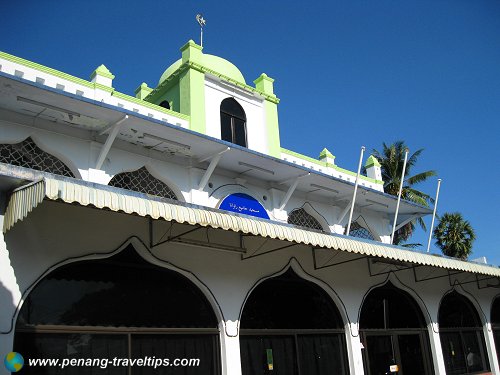 Masjid Jamek Rawana entrance arch (15 December 2008)
The Tamils have a glorious history. This is reflected in the stylized Temple architecture you can see in the various Hindu temples that they build. Although not much is known about the Tamils outside their own community, their history goes back to the time of the Chola Empire (which gives us the name Chulia also employed to call the Tamils), the Kalinga Kingdom (from which the term "keling" in Malay and "kelinga" in Hokkien trace its origin), and the Pallava Dynasty.
(It should be pointed out that the exact geographical location of the Kalinga Kingdom, now in present-day Odisha and Andhra Pradesh, does not overlap present-day Tamil Nadu. Nevertheless, it has become a generic term used by the locals in Penang to refer to South Indians, as opposed to another term, "Banggali", which is used locally to denote North Indians, including the Sikhs and Punjabis, who are in fact not from anywhere near Bengal.)
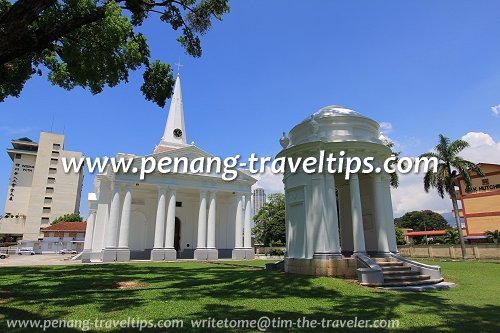 St George's Church was built using convict labourers from Madras (17 April 2011)
The Tamils arrived in Penang via various avenues. Many were traders who have been plying the region, not just Penang but the entire Malay archipelago, for centuries. When Penang was established, there was an influx of Tamils, the earliest groups included convicts brought through the port of Madras (now called Chennai) by the British. Fort Cornwallis, in its earlier incarnation, was erected using convict labour. The same is true of other historic buildings built by the British in George Town.
(The British East India Company's rule over the Madras area goes back to 1639, when the British bought a strip of land on the Coromandel Coast from the local ruler, Damarla Venkatadri Nayakudu. By the time Penang was founded, the British was already well established in the Madras area.)
Subsequent waves of Tamil migrants to Penang took on menial labour. They were the earlier water cart bearers and road builders. Indeed, early George Town would not function without the hardworking labourers, many of whom were Tamils.
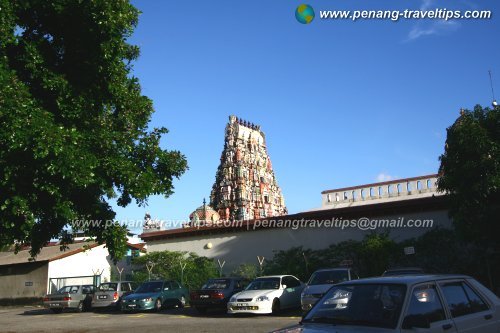 Nagarathar Sivan Temple (8 August 2006)
However, the Tamils are not confined to the labourer class. There were also waves of merchants, particularly the Chettiars, who became the chief money-lenders, not only in Penang but also in Singapore. The term Chettiar may refer to various castes of South Indians. Within Tamil Nadu itself, the Chettiars include the Nagarathar, the Saliya, Senaithalaivar, the Devanga, the Pattariyar, and so on.
Some of the biggest Hindu temples in Penang were financed and supported by the Chettiar group, the most noteworthy being the Nattukkottai Chettiar Temple and the Nagarathar Sivan Temple.
Today the Tamils form an integral part of the rich fabric of communities in Penang, and their festivals continue to be enjoyed by all.
 Buy, rent or sell properties in Penang
Do you have a property for sale or to rent out? Are you looking to buy or rent a property? Get in touch with me. WhatsApp me (Timothy Tye) at 012 429 9844, and I will assign one of my property agents to serve you. I will choose the agent for you, according to your property needs. So when you message me, provide me some details of what you need, whether to sell, to buy, to rent or to rent out, and what type of property, is it condo, apartment, house, shop, office or land.Adakah anda mempunyai hartanah untuk dijual atau disewakan? Adakah anda ingin membeli atau menyewa hartanah? Hubungi saya. WhatsApp saya (Timothy Tye) di 012 429 9844, dan saya akan menugaskan salah seorang ejen hartanah saya untuk berkhidmat kepada anda. Saya akan pilih ejen untuk anda, mengikut keperluan hartanah anda. Oleh itu, apabila anda menghantar mesej kepada saya, berikan saya beberapa butiran tentang apa yang anda perlukan, sama ada untuk menjual, untuk membeli, untuk disewakan atau untuk disewakan, dan jenis hartanah apakah itu kondo, pangsapuri, rumah, kedai, pejabat atau tanah.
您有待出售或出租的房产吗? 您想购买或租赁房产吗? 与我联系。 WhatsApp 我 (Timothy Tye) 012 429 9844,我将指派一名房地产经纪人为您服务。 我会根据您的房产需求,为您选择代理。 因此,当您给我发消息时,请向我提供一些您需要的详细信息,无论是出售、购买、出租还是出租,以及房产类型,是公寓、公寓、房屋、商店、办公室还是土地。
New Properties in Penang
Looking to buy property in Penang? Get the e-brochures right here without having to visit or contact individual developers.- Anggun Residences E-Brochure, Batu Kawan
- Aston Acacia E-Brochure, Bukit Mertajam
- Beacon Executive Suites E-Brochure, George Town
- Beverly Heights @ Bukit Gambir E-Brochure, Gelugor
- BM Highland E-Brochure, Bukit Mertajam
- Cypress Villa E-Brochure, Sungai Ara
- D'Zone Condominium E-Brochure, Teluk Kumbar
- Elements Garden E-Brochure, Butterworth
- Ferringhi Residence 2 E-Brochure, Batu Ferringhi
- GEM Residences E-Brochure, Prai
- Golden Triangle 2 E-Brochure, Sungai Ara/Relau
- Grace Residence E-Brochure, Jelutong
- Granito @ Permai E-Brochure, Tanjong Bungah
- Green City Residence E-Brochure, Jelutong
- Havana Beach Residences E-Brochure, Bayan Lepas
- Imperial Residences E-Brochure, Sungai Ara/Relau
- Imperial Grande E-Brochure, Sungai Ara/Relau
- Lucerne Residence E-Brochure, Bayan Lepas
- Mezzo @ The Light City E-Brochure, Gelugor
- Middleton E-Brochure, Gelugor
- Orchard Villa 3 E-Brochure, Simpang Ampat
- Primero Heights E-Brochure, Permatang Pauh
- Queens Waterfront Q2 E-Brochure, Bayan Lepas
- Royale Heights @ Tambun Royale City E-Brochure, Simpang Ampat
- Royale Infinity @ Tambun Royale City E-Brochure, Simpang Ampat
- Rubica @ Harbour Place E-Brochure, Butterworth
- Sensasi Commercial Suites E-Brochure, Batu Kawan
- Setia Sky Ville E-Brochure, Jelutong
- Setia Sky Vista E-Brochure, Sungai Ara/Relau
- Setia V Residence E-Brochure, Gurney Drive
- Sinaran Residence E-Brochure, Batu Kawan
- Sky @ TriPark E-Brochure, Bukit Mertajam
- Skyridge Garden E-Brochure, Tanjong Tokong
- Starhill Luxury Residences E-Brochure, Gelugor
- Straits Residences E-Brochure, Tanjong Tokong
- Taman Nuri Emas E-Brochure, Nibong Tebal
- The Light Collection IV E-Brochure, Gelugor
- The Loft @ Southbay E-Brochure, Batu Maung
- The Terraces Condominium E-Brochure, Bukit Jambul
- Trehaus Condo Villas E-Brochure, Bukit Jambul
- Triuni Residences E-Brochure, Batu Uban
- Urban Suites E-Brochure, Tanjong Tokong
- Valencia Residence E-Brochure, Bayan Lepas
- Vertu Resort E-Brochure, Batu Kawan
- Vivo Executive Apartment E-Brochure, Batu Kawan
- Viluxe E-Brochure, Batu Kawan
- Waterside Residence E-Brochure, Gelugor
Latest updates on Penang Travel Tips
Discover with Timothy YouTube Channel
PG Food Channel
Learn Penang Hokkien YouTube Channel
SojiMart Videos
Share your travels and/or ask a travel-related question
Join the Penang Travel Tips Facebook Group to share photos, tips and anything related to your travels, or ask travel-related questions.
 Map of Roads in Penang
Looking for information on Penang? Use this Map of Roads in Penang to zoom in on information about Penang, brought to you road by road. Discover with Timothy
Let me take you to explore and discover Penang through my series of walking tours on YouTube. You may use these videos as your virtual tour guide. At the beginning of each video, I provide the starting point coordinates which you may key into your GPS, Google Maps or Waze, to be navigated to where I start the walk, and use the video as your virtual tour guide.Disclaimer
Please use the information on this page as guidance only. The author endeavours to update the information on this page from time to time, but regrets any inaccuracies if there be any.Latest from Discover with Timothy: Gurney Bay - what to see and do there
About this website

Hello and thanks for reading this page. My name is Timothy and my hobby is in describing places so that I can share the information with the general public. My website has become the go to site for a lot of people including students, teachers, journalists, etc. whenever they seek information on places, particularly those in Malaysia and Singapore. I have been doing this since 5 January 2003, for over twenty years already. You can read about me at Discover Timothy. By now I have compiled information on thousands of places, mostly in Peninsular Malaysia and Singapore, and I continue to add more almost every day. My goal is to describe every street in every town in Malaysia and Singapore.
Robbie's Roadmap
- Episode 1: Robbie's Journey to Financial Freedom
- Episode 2: Lost in America
- Episode 3: The Value of Money
- Episode 4: The Mentor
- Episode 5: The Thing that Makes Money
- Episode 6: The walk with a Billionaire
- Episode 7: The Financial Freedom Awakening
- Episode 8: Meet Mr Washington
- Episode 9: The Pizzeria Incident
Copyright © 2003-2024 Timothy Tye. All Rights Reserved.