
South Korea Travel Guide
 Go Back
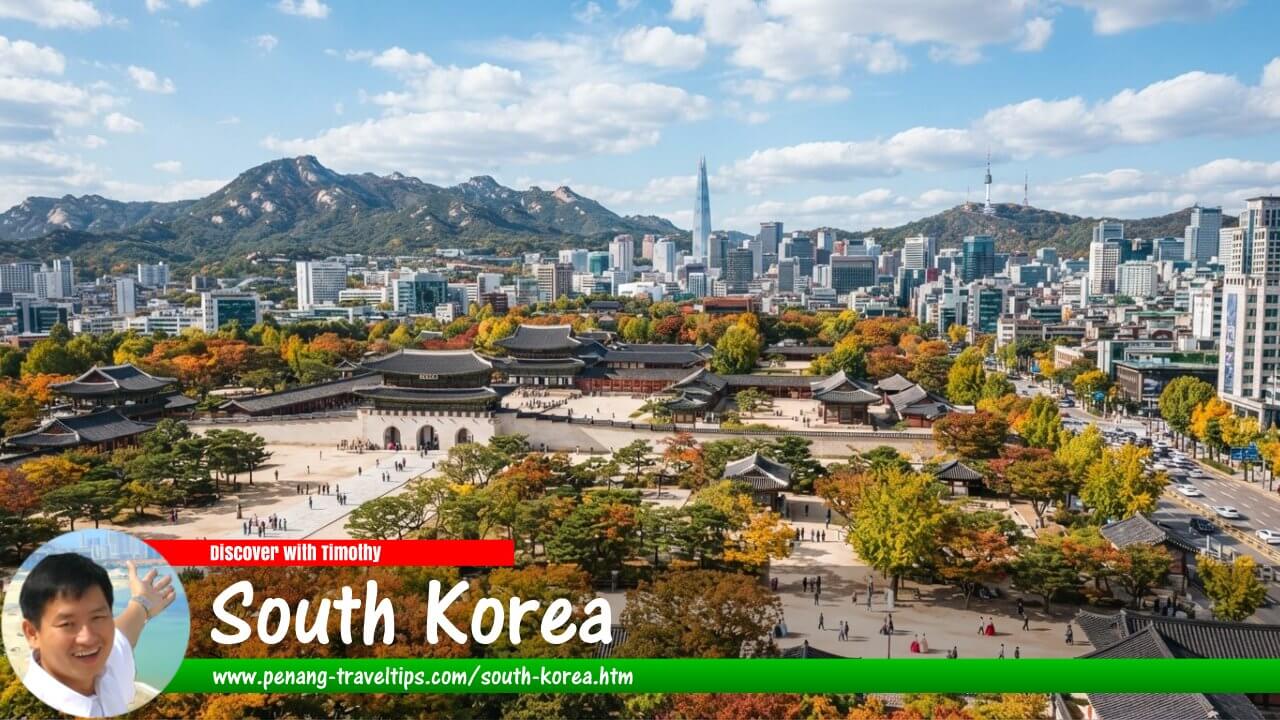 South Korea Travel Guide (AI Image generated on 25 August 2026)
Also available: Panduan Melawat Korea Selatan
Introduction to South Korea
South Korea, officially the Republic of Korea, is a country in East Asia occupying the southern part of the Korean Peninsula. It is known for its combination of ancient traditions and modern urban life, with historic palaces and Buddhist temples standing alongside skyscrapers, high-speed trains and advanced technology.
South Korea has become increasingly popular with international visitors, partly because of the global popularity of Korean culture. Korean food, music, television dramas, films, fashion and cosmetics have introduced people around the world to the country, while its historic heritage and natural landscapes provide many more reasons to visit.
Seoul
Seoul is the capital and largest city of South Korea. It is the country's main political, economic and cultural centre, and the principal gateway for many international visitors.
The city offers an unusual combination of modern and traditional attractions. Historic palaces, traditional neighbourhoods and ancient city gates can be found within a short distance of modern shopping districts, skyscrapers and entertainment areas.
Busan
Busan is South Korea's second-largest city and an important port on the country's southeastern coast. It is known for its beaches, seafood, mountains, temples and lively markets.
Among its best-known attractions are Haeundae Beach, Jagalchi Fish Market, Gamcheon Culture Village and Haedong Yonggungsa Temple.
Jeju Island
Jeju Island is South Korea's best-known island destination. Located south of the Korean Peninsula, it is famous for volcanic landscapes, waterfalls, beaches, forests and distinctive local culture.
Hallasan, the highest mountain in South Korea, is located in the centre of the island. Jeju is particularly popular among domestic tourists as well as visitors from other countries in East Asia.
Incheon
Incheon is a major port city located west of Seoul. It is home to Incheon International Airport, the principal international gateway to South Korea.
The city itself has attractions including Chinatown, Wolmido Island and Songdo, a modern planned district with distinctive contemporary architecture.
Gyeongju
Gyeongju was the capital of the ancient Silla Kingdom and is one of the most important historical destinations in South Korea. The city and its surrounding area contain numerous temples, tombs, palaces and archaeological sites.
Because of its concentration of historical remains, Gyeongju is sometimes described as a museum without walls.
Andong
Andong is known for its traditional Korean culture and is an important destination for visitors interested in Korea's historical customs. Hahoe Folk Village, a UNESCO World Heritage Site, is located here.
The area provides an opportunity to see traditional houses, Confucian heritage and cultural practices that are less visible in modern Korean cities.
Gangneung
Gangneung is a coastal city on South Korea's east coast. It is known for beaches, coffee culture, traditional houses and its proximity to the mountains.
The city also became internationally recognised when it hosted events during the 2018 Winter Olympics, which were held in nearby Pyeongchang.
Pyeongchang
Pyeongchang is a mountainous county in Gangwon Province. It hosted the 2018 Winter Olympics and is known for winter sports and mountain scenery.
The area is particularly attractive during winter, when visitors can enjoy skiing and other snow-related activities.
South Korea's Geography
South Korea occupies the southern portion of the Korean Peninsula. It shares its only land border with North Korea, while the Yellow Sea lies to the west, the Korea Strait to the south and the East Sea, also known internationally as the Sea of Japan, to the east.
Much of the country is mountainous or hilly, although there are also fertile plains and coastal areas. This varied geography contributes to the country's diverse landscapes.
Mountains in South Korea
Mountains cover a large part of South Korea and are an important feature of the country's landscape and culture. Hiking is a popular activity among South Koreans, and many mountains can be reached from the major cities.
Hallasan on Jeju Island is the highest mountain in the country, while Jirisan and Seoraksan are among the other famous mountain areas.
Seoraksan National Park
Seoraksan National Park is one of South Korea's most celebrated natural areas. It is known for dramatic mountain scenery, forests, waterfalls and hiking trails.
Autumn is particularly popular because the changing foliage creates spectacular colours across the mountain slopes.
South Korea's History
The Korean Peninsula has a long history extending back thousands of years. Several ancient kingdoms emerged on the peninsula, followed by periods of political consolidation and cultural development.
The three kingdoms of Goguryeo, Baekje and Silla played particularly important roles in the development of Korean history and culture.
Silla Kingdom
The Silla Kingdom eventually unified much of the Korean Peninsula in the seventh century. Its former capital, Gyeongju, remains one of the most important historical destinations in South Korea.
Many Buddhist temples, royal tombs and other archaeological remains from the Silla period can still be seen in and around Gyeongju.
Goryeo Dynasty
The Goryeo Dynasty ruled much of the Korean Peninsula from the tenth to the fourteenth century. The name "Korea" is derived from Goryeo.
The period was notable for developments in Buddhism, ceramics, printing and other aspects of Korean culture.
Joseon Dynasty
The Joseon Dynasty ruled Korea for more than five centuries, from 1392 until 1910. It had a profound influence on Korean culture, government, architecture and social traditions.
Many of Seoul's most important historic palaces, including Gyeongbokgung, date from the Joseon period.
King Sejong
King Sejong the Great, who ruled during the Joseon Dynasty, is one of the most celebrated figures in Korean history. He is particularly remembered for the creation and promotion of Hangul, the Korean writing system.
Hangul was designed to make reading and writing more accessible and remains one of the defining features of Korean culture.
Japanese Rule
Korea was annexed by Japan in 1910 and remained under Japanese colonial rule until the end of the Second World War in 1945. This period had a profound and often traumatic impact on Korean society.
Modern South Korea continues to remember this period through museums, memorials and historic sites.
The Korean War
Following the end of Japanese rule, the Korean Peninsula was divided into northern and southern zones. The Korean War began in 1950 when North Korean forces crossed into South Korea.
The war ended with an armistice in 1953 rather than a formal peace treaty. The Korean Peninsula therefore remains technically in a state of war, although active fighting has ceased.
Demilitarized Zone
The Demilitarized Zone (DMZ) separates North and South Korea. It is one of the world's most heavily guarded borders and has become a distinctive destination for visitors interested in Korean history and geopolitics.
Several organised tours allow visitors to see parts of the DMZ and learn about the history of the Korean Peninsula.
Modern South Korea
South Korea underwent rapid economic development during the second half of the twentieth century and emerged as one of Asia's major economies. Seoul and other cities have developed into modern centres of technology, finance, manufacturing and culture.
The country is now home to globally recognised companies and has become an important centre for electronics, automobiles, shipbuilding, entertainment and other industries.
Korean Culture
South Korea has a distinctive cultural identity shaped by its long history, Confucian traditions, Buddhism and other influences. Traditional customs continue to coexist with an increasingly modern and globalised lifestyle.
Visitors can experience Korean culture through food, architecture, festivals, clothing, performing arts and everyday life.
Korean Traditional Clothing
Hanbok is the traditional clothing of Korea. Although it is not normally worn as everyday clothing today, it remains important during festivals, weddings, celebrations and cultural events.
Visitors can also rent hanbok in areas such as Seoul's historic districts and wear it while visiting traditional palaces.
Korean Language
The official language of South Korea is Korean. It is written primarily using Hangul, a distinctive alphabetic writing system.
English is taught widely in schools, but the level of spoken English varies. In major tourist areas, hotels and transportation hubs, visitors can generally find people who can communicate in English.
Hangul
Hangul consists of letters representing consonants and vowels, which are combined into syllable blocks. Once visitors understand how the system works, Korean signs can be surprisingly approachable to read even without knowing the meaning of the words.
Learning a few basic Korean expressions can nevertheless make travelling more enjoyable.
Religion in South Korea
South Korea has a mixture of religious and non-religious communities. Christianity and Buddhism have significant historical and contemporary influences, while many South Koreans do not formally identify with a religion.
Buddhist temples, Christian churches and traditional religious sites can be found throughout the country.
South Korea for International Visitors
South Korea is relatively easy to explore because of its efficient transportation system, extensive high-speed rail network and modern infrastructure. The combination of historic attractions and contemporary city life also makes it suitable for different types of travellers.
For first-time visitors, a journey combining Seoul with one or two destinations such as Busan, Gyeongju or Jeju provides a good introduction to the country.
Places to Visit in South Korea
South Korea offers a remarkable variety of attractions, ranging from royal palaces and ancient temples to modern cities, coastal landscapes and mountain parks. Seoul is the main centre for first-time visitors, but travelling beyond the capital reveals a very different side of the country.
Gyeongbokgung Palace
Gyeongbokgung Palace is the largest and arguably the most famous of Seoul's five grand palaces. Built during the Joseon Dynasty, it served as the main royal palace for much of that period.
The palace grounds contain grand halls, courtyards, gardens and traditional buildings. Visitors can also watch the changing of the royal guard ceremony at the main gate.
Changdeokgung Palace
Changdeokgung Palace was another major Joseon royal palace and is particularly famous for its beautiful gardens. The palace and its Secret Garden are recognised as a UNESCO World Heritage Site.
The architecture was designed to blend naturally with the surrounding landscape rather than imposing a rigid geometric arrangement.
Deoksugung Palace
Deoksugung Palace is located in central Seoul and is distinctive because traditional Korean palace buildings stand alongside Western-style architecture.
Its convenient location makes it easy to combine with a visit to Seoul's City Hall and surrounding downtown districts.
Changgyeonggung Palace
Changgyeonggung Palace was originally built as a residence for members of the Joseon royal family. It is smaller and generally quieter than Gyeongbokgung, making it an appealing destination for visitors who prefer a less crowded historic site.
Gyeonghuigung Palace
Gyeonghuigung Palace was another Joseon royal palace in Seoul. Much of the original complex was lost over time, but surviving and reconstructed buildings provide an indication of its former importance.
Bukchon Hanok Village
Bukchon Hanok Village is a historic neighbourhood in Seoul containing hundreds of traditional Korean houses known as hanok.
The neighbourhood is situated between Gyeongbokgung and Changdeokgung palaces. Its narrow lanes and traditional architecture make it a popular place to explore on foot.
Bukchon is still a residential neighbourhood, so visitors should keep noise levels low and respect the privacy of residents.
Insadong
Insadong is one of Seoul's best-known traditional cultural districts. Its streets contain shops selling traditional crafts, artwork, souvenirs, tea and Korean cultural products.
It is a convenient area to visit after exploring the nearby royal palaces and Bukchon.
Ikseon-dong
Ikseon-dong is a historic neighbourhood where traditional hanok buildings have been transformed into cafés, restaurants, boutiques and small shops.
The area illustrates how traditional Korean architecture can be incorporated into contemporary urban life.
Myeongdong
Myeongdong is one of Seoul's most popular shopping and dining districts. It is particularly well known for Korean cosmetics, fashion, restaurants and street food.
The area is especially lively in the evening and is convenient for visitors staying in central Seoul.
Namdaemun Market
Namdaemun Market is one of Seoul's oldest and largest traditional markets. It offers clothing, household goods, souvenirs, food and many other products.
It provides a contrast to the modern shopping malls and department stores found elsewhere in Seoul.
Gwangjang Market
Gwangjang Market is one of Seoul's most famous traditional food markets. Visitors can sample Korean dishes and snacks while experiencing the lively atmosphere of a traditional market.
Popular foods include bindaetteok, mayak gimbap and various noodle and dumpling dishes.
N Seoul Tower
N Seoul Tower, also known as Namsan Seoul Tower, stands on Namsan Mountain in the centre of Seoul. The observation areas provide panoramic views across the city.
The tower is particularly attractive after dark, when Seoul's extensive city lights can be seen from above.
Namsan Mountain
Namsan is a mountain in central Seoul and one of the city's most accessible natural spaces. Walking trails lead through wooded areas towards N Seoul Tower.
It is possible to reach the tower by walking, bus or cable car.
Cheonggyecheon Stream
Cheonggyecheon is an urban stream running through central Seoul. The area was restored as a public space and is now lined with walking paths, bridges and landscaped areas.
It provides a pleasant place for a walk, particularly in the evening.
Han River
The Han River runs through Seoul and divides much of the city into northern and southern areas. Parks along the river are popular with local residents for cycling, walking, picnics and recreation.
A river cruise can also provide a different perspective of Seoul's skyline and bridges.
Gangnam
Gangnam is one of Seoul's best-known modern districts. It became internationally famous through the global popularity of the song "Gangnam Style".
The area is known for shopping, restaurants, offices, entertainment and modern architecture.
COEX
COEX is a major convention, shopping and entertainment complex in Gangnam. It is home to a large shopping mall, exhibitions, restaurants and the famous Starfield Library.
Starfield Library
Starfield Library is a striking public library located inside COEX Mall. Its enormous bookshelves extending several storeys high have made it one of Seoul's most photographed modern interiors.
Lotte World Tower
Lotte World Tower is one of the tallest buildings in South Korea. The tower forms part of a large complex containing shops, restaurants, entertainment facilities and an observation deck.
From the observation deck, visitors can enjoy extensive views over Seoul and the surrounding region.
Dongdaemun
Dongdaemun is a major shopping and fashion district in Seoul. It is known for markets, shopping centres and contemporary architecture.
The area remains active late into the night, reflecting Seoul's reputation as a city that rarely seems to sleep.
Dongdaemun Design Plaza
Dongdaemun Design Plaza (DDP) is one of Seoul's most distinctive modern buildings. Designed by architect Zaha Hadid, its flowing metallic forms contrast sharply with the traditional architecture found elsewhere in the city.
It hosts exhibitions, design events and cultural activities.
War Memorial of Korea
The War Memorial of Korea in Seoul documents Korea's military history, including the Korean War. Exhibits include military equipment, historical displays and memorials.
It can help visitors understand the events that shaped the modern Korean Peninsula.
National Museum of Korea
The National Museum of Korea in Seoul houses an extensive collection covering Korean history, art and archaeology.
The museum is one of the best places to gain an overview of Korean civilisation before visiting historical sites elsewhere in the country.
Seoul Forest
Seoul Forest is a large urban park providing green space within the city. It contains walking paths, gardens and recreational areas.
The park is particularly pleasant during spring and autumn.
Lotte World
Lotte World is a large entertainment complex in Seoul containing an indoor theme park, an outdoor amusement park and other attractions.
It can be a good option for families travelling with children.
DMZ
The Demilitarized Zone is one of the most unusual destinations in South Korea. The area separating North and South Korea is heavily guarded and contains numerous military installations.
Visitors cannot simply enter the DMZ independently. Tours are normally conducted under controlled arrangements and the areas accessible to visitors can change according to security conditions.
Imjingak
Imjingak is a tourist and memorial area near the DMZ. It contains monuments and exhibits relating to the division of Korea and the Korean War.
The area is accessible on some organised tours and provides an introduction to the history of the divided peninsula.
Third Infiltration Tunnel
The Third Infiltration Tunnel is one of several tunnels discovered beneath the border that were dug from North Korea towards the south. Visitors can enter part of the tunnel as part of certain DMZ tours.
The descent and underground walk can be physically demanding, so comfortable footwear is recommended.
Gyeongju Historic Areas
Gyeongju contains an extraordinary concentration of archaeological and historical sites dating from the Silla period. The historic areas of Gyeongju are collectively recognised as a UNESCO World Heritage Site.
Among the highlights are Bulguksa Temple, Seokguram Grotto, Daereungwon Tomb Complex and Cheomseongdae Observatory.
Bulguksa Temple
Bulguksa Temple is one of Korea's most important Buddhist temples. Originally constructed during the Silla period, it contains several important examples of Korean Buddhist architecture.
The temple is located on the slopes of Mount Toham near Gyeongju.
Seokguram Grotto
Seokguram Grotto is a Buddhist sanctuary associated with Bulguksa Temple. Its principal image is a large seated Buddha carved from stone.
The grotto and Bulguksa together form a UNESCO World Heritage Site and represent the artistic achievements of the Silla period.
Daereungwon Tomb Complex
Daereungwon contains large grass-covered burial mounds belonging to members of the Silla royal family and aristocracy.
The tombs provide an unusual landscape within the modern city of Gyeongju and illustrate the burial traditions of ancient Korea.
Cheomseongdae
Cheomseongdae is an ancient astronomical observatory dating from the Silla period. It is one of the oldest surviving astronomical observatories in East Asia.
Donggung Palace and Wolji Pond
Donggung Palace and Wolji Pond was part of the Silla royal complex in Gyeongju. The pond and reconstructed buildings are especially attractive after sunset when they are illuminated.
Busan
Busan combines beaches, mountains, markets, temples and a major port. Its coastal setting gives the city a distinctly different atmosphere from Seoul.
Haeundae Beach
Haeundae Beach is one of South Korea's most famous beaches. It is surrounded by hotels, restaurants and entertainment facilities.
During summer, the beach becomes particularly busy with domestic and international visitors.
Gwangalli Beach
Gwangalli Beach is another popular Busan beach and is known for its views of Gwangan Bridge.
The bridge is illuminated at night, making the waterfront particularly attractive after sunset.
Jagalchi Fish Market
Jagalchi Fish Market is one of Korea's best-known seafood markets. Visitors can see a wide variety of fresh seafood and, at some establishments, have their purchases prepared as a meal.
For visitors who do not eat seafood, the market is still an interesting place to experience Busan's traditional commercial culture.
Gamcheon Culture Village
Gamcheon Culture Village is a colourful hillside neighbourhood in Busan. Its tightly packed houses, narrow lanes, murals and viewpoints have made it one of the city's most recognisable attractions.
The area is still home to residents, so visitors should respect the neighbourhood and avoid excessive noise.
Haedong Yonggungsa Temple
Haedong Yonggungsa Temple is a Buddhist temple dramatically situated beside the sea. Its coastal setting distinguishes it from many Korean temples located in mountain valleys.
The temple is especially popular for sunrise and offers impressive views of the coastline.
Taejongdae
Taejongdae is a natural park on the southern coast of Busan. It is known for cliffs, forests and views over the sea.
A small sightseeing train operates within the park, making it easier to explore without walking the entire route.
Jeju Island Attractions
Jeju Island offers a different experience from mainland South Korea, with volcanic landscapes, coastal scenery and distinctive local traditions.
Hallasan
Hallasan rises in the centre of Jeju Island and is the highest mountain in South Korea. It is located within Hallasan National Park.
Several hiking routes lead into the mountain, but access and route conditions can vary according to weather and seasonal restrictions.
Seongsan Ilchulbong
Seongsan Ilchulbong, also known as Sunrise Peak, is a volcanic tuff cone on the eastern side of Jeju Island. It is one of the island's most recognisable natural landmarks.
The summit provides views over the surrounding coastline and is particularly popular around sunrise.
Manjanggul Cave
Manjanggul Cave is part of Jeju's extensive volcanic cave system. The lava tube contains unusual geological formations created by ancient volcanic activity.
Access can be affected by conservation or maintenance work, so visitors should check current conditions before visiting.
Jeju Waterfalls
Jeju has several scenic waterfalls, including Jeongbang Falls, which is notable because its water falls directly into the sea.
Cheonjiyeon Falls and Cheonjeyeon Falls are other popular waterfall destinations on the island.
Jeju Folk Village
Jeju's traditional villages and cultural attractions provide insight into the island's distinctive history. Traditional stone walls, houses and agricultural practices reflect the island's volcanic environment and local customs.
Andong Hahoe Folk Village
Hahoe Folk Village near Andong is a historic settlement associated with the Ryu clan. Traditional houses and Confucian traditions have been preserved here.
The village is recognised as part of the UNESCO World Heritage listing for Historic Villages of Korea.
Seoraksan National Park
Seoraksan is one of the best destinations in South Korea for mountain scenery. Its granite peaks, forests and valleys attract hikers throughout the year.
Autumn is especially popular for its colourful foliage, while winter can transform the mountains into a snowy landscape.
Nami Island
Nami Island, located near Seoul, is a popular leisure destination known for tree-lined paths and seasonal scenery. It became particularly famous among international visitors because of its association with Korean television drama.
The island can be visited as a day trip from Seoul.
South Korean Countryside
Travelling beyond the major cities provides opportunities to see a quieter side of South Korea. Traditional villages, agricultural areas, coastal communities and mountain towns reveal aspects of Korean life that can be missed when visiting only Seoul and Busan.
UNESCO World Heritage Sites
South Korea has numerous UNESCO World Heritage Sites, covering palaces, temples, historic villages, fortresses, tombs and natural landscapes.
For visitors interested in Korean history and culture, these sites provide a useful framework for understanding the country's long and varied heritage.
Choosing Where to Go
For a first visit, Seoul is the natural starting point. Add Gyeongju if you are interested in history, Busan for beaches and coastal scenery, or Jeju Island for volcanic landscapes and nature.
With more time, destinations such as Andong, Gangneung, Seoraksan and Jeonju can be added to create a broader picture of South Korea.
Food and Drink in South Korea
Food is an important part of Korean culture, and eating in South Korea is an experience in itself. Korean cuisine is known for its strong flavours, fermented ingredients, vegetables, rice, noodles, soups and grilled meats. Meals are often accompanied by several small side dishes called banchan.
Kimchi
Kimchi is probably the food most closely associated with Korea. It usually consists of fermented vegetables, most commonly napa cabbage or Korean radish, seasoned with chilli, garlic, ginger and other ingredients.
There are many varieties of kimchi, and it is commonly served as a side dish with Korean meals. Its sour, salty and spicy flavours are an important part of Korean cuisine.
Banchan
Banchan refers to the small side dishes served alongside a Korean meal. They can include seasoned vegetables, kimchi, tofu, fish, seaweed and other ingredients.
At many traditional Korean restaurants, several banchan are served automatically with the main dish, and additional portions may be available upon request.
Bibimbap
Bibimbap is a bowl of rice topped with various vegetables, meat or other ingredients, usually accompanied by a fried egg and Korean chilli paste known as gochujang.
The ingredients are mixed together before eating. Jeonju is particularly famous for its version of bibimbap.
Bulgogi
Bulgogi consists of thinly sliced beef marinated in a sweet and savoury mixture before being grilled or cooked. The marinade commonly includes soy sauce, sugar, garlic and sesame oil.
It is one of the best-known Korean meat dishes and is widely available throughout the country.
Galbi
Galbi refers to Korean-style grilled ribs, usually beef or pork. The meat may be marinated before being grilled at the table.
Korean barbecue restaurants commonly serve galbi together with lettuce leaves, sauces, garlic, kimchi and other side dishes.
Korean Barbecue
Korean barbecue is one of the most popular dining experiences for visitors. At many restaurants, diners grill meat themselves on a built-in grill at the centre of the table.
Popular choices include beef, pork belly and marinated ribs. The meat can be wrapped in lettuce with garlic, sauces and other accompaniments.
Samgyeopsal
Samgyeopsal is thickly sliced pork belly grilled at the table. It is one of the most popular Korean barbecue dishes.
The cooked meat is commonly wrapped in lettuce or perilla leaves and eaten with dipping sauces and side dishes.
Samgyetang
Samgyetang is a traditional Korean soup consisting of a whole young chicken stuffed with glutinous rice, ginseng, jujube and other ingredients.
It is particularly associated with summer, when some Koreans eat nourishing hot dishes to help maintain their strength during the hottest period of the year.
Ginseng
Korean ginseng has a long history in Korean culture and traditional medicine. It is used in foods and drinks as well as being sold as a dried root or processed into various products.
Visitors will encounter ginseng in dishes such as samgyetang and in specialised shops and markets.
Tteokbokki
Tteokbokki consists of chewy rice cakes cooked in a spicy and slightly sweet red sauce. It is one of Korea's most popular street foods.
It is inexpensive, filling and commonly found at street stalls and casual restaurants.
Gimbap
Gimbap consists of rice and various fillings rolled in dried seaweed and sliced into bite-sized pieces. Fillings can include vegetables, egg, pickled radish and meat or seafood.
It is a convenient food for travellers because it is easy to carry and eat.
Japchae
Japchae is a dish of glass noodles made from sweet potato starch, stir-fried with vegetables and often beef. Sesame oil gives the dish its characteristic flavour.
It is commonly served at celebrations and family gatherings as well as in restaurants.
Jajangmyeon
Jajangmyeon consists of thick wheat noodles topped with a savoury black bean sauce, usually accompanied by diced pork and vegetables.
Although it originated from Chinese-influenced cuisine, it has become firmly established as a popular Korean dish.
Naengmyeon
Naengmyeon is a cold noodle dish traditionally associated with northern Korean cuisine. The noodles are served in a chilled broth or with a spicy sauce.
It is particularly refreshing during the warmer months.
Kimchi Jjigae
Kimchi jjigae is a spicy Korean stew made with kimchi and often tofu, pork, seafood or other ingredients.
It is a common home-style dish and is widely available in Korean restaurants.
Doenjang Jjigae
Doenjang jjigae is a hearty stew made with doenjang, a fermented soybean paste. It commonly contains tofu, vegetables and sometimes meat or seafood.
Its flavour is savoury and deeply fermented rather than primarily spicy.
Sundubu Jjigae
Sundubu jjigae is a spicy stew made with very soft tofu. It may contain seafood, meat, vegetables and an egg.
The stew is usually served bubbling hot in a stone or earthenware pot.
Galbitang
Galbitang is a clear Korean soup made with beef short ribs. It has a relatively mild flavour compared with many spicy Korean dishes.
Seolleongtang
Seolleongtang is a milky-white soup made by simmering beef bones for many hours. It is usually served with rice and kimchi.
The soup itself is relatively mild, with diners adding salt, pepper or other seasonings according to taste.
Haemul Pajeon
Haemul pajeon is a savoury Korean pancake containing green onions and seafood. It is commonly served as an appetiser or shared dish.
Mandu
Mandu are Korean dumplings that can be steamed, boiled, fried or added to soups. Fillings vary and may include meat, tofu, vegetables or kimchi.
They are a common and inexpensive food that can be found in restaurants and markets.
Hotteok
Hotteok is a popular Korean street snack consisting of a sweet filled pancake. The filling commonly contains brown sugar, cinnamon and nuts or seeds.
It is especially popular during the colder months.
Bingsu
Bingsu is a Korean shaved-ice dessert. Traditional versions are topped with sweet red beans, while modern versions may contain fruit, condensed milk, chocolate, ice cream or other toppings.
It is particularly refreshing during summer.
Yakgwa
Yakgwa is a traditional Korean sweet made from wheat flour, honey, sesame oil and other ingredients. It has been enjoyed in Korea for centuries and is associated with traditional celebrations.
Korean Tea
Tea has a long history in Korea, although coffee has become extremely popular in modern Korean society. Traditional teas may be made from green tea leaves, roasted grains, fruits, flowers or roots.
Traditional tea houses in Seoul and other cities provide an opportunity to experience Korean tea culture in a more relaxed setting.
Korean Coffee Culture
South Korea has developed an exceptionally strong coffee culture. Seoul in particular has countless cafés ranging from small independent establishments to large international chains.
Café culture is not limited to coffee itself. Many cafés are designed around distinctive themes, interiors or views, making them destinations in their own right.
Street Food
Street food is an important part of Korean urban life. In markets and busy shopping districts, visitors can find tteokbokki, gimbap, hotteok, eomuk and many other snacks.
Myeongdong, Gwangjang Market and other traditional markets are good places to sample a variety of Korean street foods.
Eomuk
Eomuk, sometimes called Korean fish cake, is made from processed fish and is commonly served on skewers in a hot broth.
It is especially popular as a warming street food during winter.
Korean Fried Chicken
Korean fried chicken has become internationally popular. The chicken is usually fried until very crisp and may be coated with sauces ranging from sweet and spicy to soy-garlic.
It is commonly eaten with pickled radish and is often paired with beer in a combination known as chimaek.
Chimaek
Chimaek is a combination of Korean fried chicken and beer. The word combines chicken with maekju, the Korean word for beer.
It has become part of contemporary Korean food culture and is particularly popular for social gatherings and casual evenings.
Muslim-Friendly Food in South Korea
South Korea has a growing number of restaurants catering to Muslim visitors, particularly in Seoul and other major tourist destinations. However, halal food is not as widely available as in some Muslim-majority countries.
Muslim travellers should distinguish between halal-certified restaurants, Muslim-friendly establishments and restaurants that simply offer seafood or vegetarian dishes. Ingredients such as pork, alcohol and non-halal meat are common in Korean cuisine, so it is important to ask about ingredients when necessary.
Halal Food in Seoul
Seoul has the greatest concentration of halal and Muslim-friendly dining options in South Korea. The area around Itaewon is particularly well known for restaurants serving halal Korean food, Turkish, Middle Eastern, Indian, Pakistani and other cuisines.
Muslim travellers who require strictly halal food will generally find Seoul easier to navigate than smaller Korean cities.
Seoul Central Mosque
Seoul Central Mosque in Itaewon is the most prominent mosque in South Korea. The surrounding area has a number of Muslim-owned businesses and restaurants.
For Muslim travellers, staying or spending some time around Itaewon can make it easier to find halal food and prayer facilities.
Halal Korean Food
Some Korean dishes can be prepared in halal-friendly ways, but visitors should not automatically assume that a dish is halal simply because it does not visibly contain pork.
Ingredients such as cooking wine, alcohol-based sauces, non-halal meat and shared cooking equipment may also be relevant. When halal certification is important, it is best to choose a restaurant that clearly identifies itself as halal.
Vegetarian Food
Vegetarian travellers can find suitable food in South Korea, particularly in larger cities. Buddhist temple cuisine is especially interesting because it traditionally makes extensive use of vegetables and plant-based ingredients.
However, some apparently vegetarian Korean dishes may contain fish sauce, shrimp paste or other seafood ingredients, so travellers following a strict vegetarian or vegan diet should ask carefully about preparation.
Temple Cuisine
Korean temple cuisine developed within Buddhist monasteries and places emphasis on vegetables, grains, legumes and seasonal ingredients. Traditionally, certain strong-flavoured ingredients such as garlic and onions are avoided in temple cuisine.
It offers a very different experience from the spicy meat-heavy dishes often associated with Korean food.
Dining Etiquette
Korean dining has its own customs. Meals are often shared, with dishes placed in the middle of the table. Metal chopsticks and a spoon are commonly used.
When eating with older people, traditional etiquette places importance on showing respect, although modern dining habits are generally more relaxed.
Korean Chopsticks
Korean chopsticks are traditionally made of metal and are usually flatter than the wooden or bamboo chopsticks commonly found in China and Japan.
They can take some practice for visitors who are accustomed to wooden chopsticks, particularly when picking up slippery foods.
Rice and Soup
Rice is a fundamental part of Korean meals, while soup or stew is also commonly served. Unlike some other East Asian dining traditions, Korean meals are typically eaten with both a spoon and chopsticks.
Drinking Culture
Alcohol has an important role in South Korean social culture. Soju, a clear distilled spirit, is particularly popular and is often consumed with meals or during social gatherings.
Visitors who do not drink alcohol will generally have no difficulty finding non-alcoholic drinks, including soft drinks, tea and coffee.
Soju
Soju is South Korea's best-known alcoholic drink. Traditional soju was made from rice, but modern commercial varieties may use other starches.
It is usually served in small glasses and is commonly shared among friends or colleagues.
Makgeolli
Makgeolli is a traditional Korean rice wine with a cloudy appearance and mildly sweet, tangy flavour. It is often served in traditional-style restaurants and can be paired with dishes such as haemul pajeon.
Convenience Stores
Convenience stores are extremely common in South Korea and can be surprisingly useful for travellers. They sell drinks, snacks, instant noodles, prepared meals, fruit and many other inexpensive foods.
Major chains include CU, GS25, 7-Eleven and Emart24.
Food Markets
Traditional markets provide some of the best opportunities to experience everyday Korean food culture. In addition to eating prepared dishes, visitors can see fresh produce, seafood, meat and other ingredients used in Korean cooking.
Food Delivery
South Korea has an advanced food-delivery culture, particularly in major cities. Restaurants and delivery services can bring a wide variety of meals directly to hotels and accommodation.
However, foreign visitors may sometimes find Korean-language apps and payment systems difficult to navigate, so ordering through a hotel or using an English-friendly service can be easier.
What Should Visitors Eat?
First-time visitors should try a mixture of traditional dishes and everyday Korean foods rather than limiting themselves to the most famous dishes.
A simple introduction might include bibimbap, bulgogi, Korean barbecue, kimchi jjigae, gimbap, tteokbokki and Korean fried chicken. Visiting a traditional market can then provide an opportunity to discover less familiar foods.
Getting Around South Korea
South Korea has one of the most efficient transportation systems in Asia. Modern trains, extensive metro networks, express buses and domestic flights make it relatively easy to travel between cities and regions.
For most visitors, public transportation is sufficient. In Seoul, the subway is usually the easiest way to move around, while the high-speed rail network is particularly useful for travelling between major cities.
Arriving in South Korea
Most international visitors arrive at Incheon International Airport, located west of Seoul. It is one of the major international aviation hubs in East Asia and is well connected to Seoul and other parts of the country.
Gimhae International Airport serves Busan, while Jeju International Airport is the main gateway to Jeju Island.
Incheon International Airport
Incheon International Airport is the main international airport serving Seoul and the surrounding region. It has extensive connections to cities throughout Asia and many destinations around the world.
For travellers staying in Seoul, there are several convenient ways to reach the city centre.
Airport Railroad
The AREX Airport Railroad connects Incheon International Airport with Seoul Station. The express service provides a direct connection, while all-stop trains serve additional stations along the route.
For visitors staying near Seoul Station or using the city's subway network, AREX is one of the most convenient options.
Airport Limousine Buses
Airport limousine buses connect Incheon Airport with many districts and hotels in Seoul. They can be particularly convenient when travelling with large luggage because passengers do not have to transfer between trains.
Journey times depend on traffic and the destination.
Taxi from Incheon Airport
Taxis are available at Incheon Airport and can take visitors directly to their accommodation. This is convenient but considerably more expensive than public transportation.
Visitors should use the official taxi stands and confirm the fare arrangement before beginning the journey.
High-Speed Rail
South Korea has an extensive high-speed railway system. The best-known service is KTX, which connects Seoul with major cities including Busan, Daejeon, Daegu and Gwangju.
High-speed trains are an excellent choice for travelling between major destinations because they are generally much faster than conventional trains or long-distance buses.
KTX
KTX is South Korea's high-speed rail service. The trains can travel at speeds of up to around 300 kilometres per hour on suitable sections of track.
A KTX journey from Seoul to Busan takes roughly two and a half to three hours, depending on the service and route.
SRT
SRT is another high-speed rail service operating from Suseo Station in southeastern Seoul. It serves destinations including Busan, Daegu and Gwangju.
Depending on where you are staying in Seoul, SRT may be more convenient than travelling to Seoul Station for KTX.
Korail
Korea Railroad Corporation (Korail) operates much of South Korea's conventional and high-speed railway network. Its services include KTX and other intercity trains.
Rail is particularly useful when travelling between major cities and tourist destinations connected to the national railway network.
Train Tickets
Train tickets can be purchased online, through railway stations and, depending on the service, through official mobile applications. During major holidays and popular travel periods, trains can become heavily booked.
It is therefore advisable to reserve seats in advance when your itinerary depends on a particular departure.
Seoul Subway
The Seoul Metropolitan Subway is one of the easiest ways to travel around Seoul. The network covers a huge area and extends into neighbouring cities and provinces.
Stations are generally well signposted, and information is commonly provided in Korean and English, with additional languages at many major stations.
Busan Subway
Busan Metro provides convenient transportation around much of Busan. It connects major areas including the city centre, beaches and transport hubs.
For destinations outside the metro network, buses and taxis can be used in combination with the subway.
Other City Metro Systems
Other South Korean cities, including Daegu, Daejeon and Gwangju, also have metro systems. These networks are smaller than Seoul's but can be useful for exploring the respective cities.
Using Public Buses
Public buses are an important part of transportation in South Korea. They reach many neighbourhoods and destinations that are not directly served by the subway.
Bus routes can initially seem complicated to foreign visitors, but navigation apps make it much easier to identify the correct route and stop.
Express Buses
Express buses connect Seoul with cities and towns throughout South Korea. They are often a good alternative when a destination is not conveniently served by rail.
Long-distance buses are generally comfortable and can be considerably cheaper than high-speed trains.
Intercity Buses
Intercity buses serve an even wider network of destinations, including smaller towns. They can be especially useful for reaching areas in the countryside or regions where railway connections are limited.
Express Bus Terminals
Major cities have large bus terminals. In Seoul, the Seoul Express Bus Terminal is one of the principal departure points for long-distance buses to destinations throughout the country.
Other major terminals include Dong Seoul Bus Terminal and Central City Terminal.
Transportation Cards
A rechargeable transportation card makes travelling on public transportation much easier. The best-known card is the T-money card, which can be used on buses and subways in Seoul and many other parts of South Korea.
The card can also be used for certain other purchases and transportation services.
T-money Card
T-money is widely used by local residents and is particularly convenient for visitors who plan to use public transportation frequently.
Cards can be purchased and topped up at convenience stores and transportation facilities. The exact availability of top-up methods can vary.
Climate Card
Seoul also offers a Climate Card designed for unlimited use of certain public transportation services within its coverage area for a specified period.
It can be useful for visitors spending several days travelling extensively around Seoul, although the coverage and conditions should be checked before purchase.
Using a Taxi
Taxis are widely available in South Korean cities and are generally convenient for short journeys or places that are difficult to reach by public transportation.
Standard taxis are usually reasonably priced compared with taxis in many major international cities, although fares increase with distance and time.
International Taxi
South Korea has taxi services designed specifically to assist foreign visitors. These can be useful when language is a concern, especially for airport transfers and sightseeing.
Taxi Apps
Taxi-hailing applications are widely used in South Korea. Kakao T is one of the country's most widely used transportation applications.
Foreign visitors may encounter limitations with registration or payment, so it is useful to have an alternative method for arranging transportation.
Driving in South Korea
Renting a car can be useful for exploring areas outside the major cities, particularly Jeju Island and parts of the countryside.
In Seoul and other large cities, however, driving is usually less convenient than using public transportation because of traffic, parking difficulties and the excellent subway and bus networks.
International Driving Permit
Foreign visitors who intend to drive should check South Korea's current requirements for an International Driving Permit and ensure that their driving licence and other documents meet the requirements of the rental company.
Driving rules and rental requirements should be confirmed before travelling because regulations can change.
Driving on Jeju Island
A rental car can be particularly useful on Jeju Island. Although buses serve many tourist destinations, the island is relatively large and some scenic areas are easier to reach by car.
Visitors should allow sufficient time for driving because distances can appear short on a map but take longer due to road conditions and traffic.
Domestic Flights
Domestic flights are useful when travelling between Seoul and Jeju Island or other destinations where flying saves considerable time.
The Seoul–Jeju route is one of the world's busiest air routes, with frequent flights operated by several airlines.
Ferries
Ferries connect mainland South Korea with several islands, including Jeju and smaller coastal islands. They can be useful when travelling with a vehicle or when visiting destinations without convenient air connections.
Ferry schedules can be affected by weather, especially during periods of strong winds or storms.
Walking in South Korea
Walking is an enjoyable way to explore many Korean neighbourhoods. Historic districts such as Bukchon, Insadong and the areas around Seoul's royal palaces are best experienced on foot.
Major cities also have extensive pedestrian areas, parks and riverside walking paths.
Navigation Apps
Visitors should be aware that international mapping services do not always work in South Korea in the same way that they do in other countries. Local navigation services can be more useful for detailed directions.
Naver Map and KakaoMap are widely used by people in South Korea and are particularly useful for public transportation and walking directions.
Naver Map
Naver Map provides detailed maps, public transportation information, walking directions and information about businesses and attractions.
It is worth installing the application before travelling and becoming familiar with its basic functions.
KakaoMap
KakaoMap is another widely used navigation service. It provides similar functions, including public transportation routes and directions.
Having both Naver Map and KakaoMap available can be useful if information is easier to find on one service than the other.
Translation Apps
Translation applications can be helpful when travelling outside major tourist areas. Although many signs at major transportation facilities include English, communication can become more difficult in smaller towns.
Keeping the Korean name of your destination available on your phone can also make it easier to show a driver or ask for directions.
Travelling During Rush Hour
Seoul and other major cities can become extremely crowded during weekday rush hours. The morning and evening commuting periods are particularly busy on trains and buses.
Travellers with flexible schedules may find it more comfortable to avoid the busiest periods.
Travelling During Korean Holidays
Major Korean holidays can create enormous increases in domestic travel. Seollal, the Korean Lunar New Year, and Chuseok, the Korean harvest festival, are particularly important.
Trains, buses and roads can become extremely crowded during these periods, so advance planning is essential.
Seollal
Seollal is the Korean Lunar New Year. Families traditionally gather together, and millions of people travel across the country to visit relatives.
Public transportation tickets can sell out quickly, while roads may experience severe congestion.
Chuseok
Chuseok is one of Korea's major traditional holidays. It is a time for families to gather and honour their ancestors.
Like Seollal, Chuseok creates a huge amount of domestic travel, making it one of the least convenient times for an independent traveller to move between cities.
Best Way to Travel Around South Korea
For most visitors, a combination of subway, bus and high-speed train is the most efficient way to travel around South Korea.
A typical first-time itinerary might use the subway in Seoul, KTX to Busan or Gyeongju, and a domestic flight or ferry to Jeju Island. A rental car can then be considered for exploring Jeju or less accessible rural areas.
Accommodation and Practical Information for South Korea
South Korea has a wide range of accommodation, from international luxury hotels and modern business hotels to traditional guesthouses, hostels and unique Korean-style stays. Major cities offer the greatest choice, while smaller towns and rural destinations may have fewer options.
Hotels in South Korea
Hotels are widely available in Seoul, Busan, Jeju and other major tourist destinations. International hotel groups operate alongside well-established Korean hotel brands and independent properties.
In Seoul, choosing the right neighbourhood can be more important than choosing a particular hotel. Staying near a subway station can make sightseeing considerably easier.
Luxury Hotels
Seoul and Busan have numerous five-star hotels offering extensive facilities, restaurants, spas and concierge services. Luxury resorts are also available on Jeju Island.
These hotels can be particularly attractive to travellers who prefer convenient access to major attractions while enjoying a high level of comfort.
Business Hotels
Business hotels are a popular accommodation choice in South Korea. They are generally smaller and more practical than luxury hotels, while offering private rooms, Wi-Fi and other essential facilities.
They can provide good value for travellers who expect to spend most of their time sightseeing rather than inside the hotel.
Guesthouses
Guesthouses are common in areas popular with younger travellers and backpackers. Some offer private rooms, while others provide dormitory accommodation.
They can also be a good way to meet other international travellers.
Hostels
Hostels are available in Seoul, Busan, Jeju and other tourist destinations. Dormitory beds are usually the cheapest option, while private rooms may also be available.
When choosing a hostel, check whether the room has a private bathroom and whether the property provides luggage storage if you arrive before check-in.
Hanok Stay
A hanok stay allows visitors to spend the night in a traditional Korean house. These accommodations are particularly common in historic areas such as Bukchon, Jeonju and Gyeongju.
Sleeping on a traditional Korean-style floor can be an interesting cultural experience, although it may not be comfortable for everyone.
Jeonju Hanok Village
Jeonju Hanok Village is one of the best-known places for experiencing traditional Korean architecture and accommodation. The village contains hundreds of traditional houses, many of which have been converted into guesthouses.
Jeonju is also famous for its food, particularly its traditional version of bibimbap.
Temple Stay
A temple stay offers visitors an opportunity to spend time at a Korean Buddhist temple and learn about aspects of monastic life. Activities may include meditation, tea ceremonies, temple meals and Buddhist practices.
It is a cultural experience rather than simply another type of accommodation, and programmes vary from one temple to another.
Motels
Motels are common throughout South Korea and can provide relatively inexpensive private accommodation. Despite the word "motel", many are modern and comfortable establishments.
However, visitors who are unfamiliar with the Korean accommodation market may prefer hotels or guesthouses with clear international reviews and descriptions.
Where to Stay in Seoul
Seoul is enormous, so choosing a convenient neighbourhood can save considerable travel time.
Myeongdong is convenient for first-time visitors and shopping. Insadong is attractive for those interested in traditional culture. Hongdae is lively and popular with younger travellers, while Gangnam offers modern shopping, restaurants and business facilities.
Myeongdong
Myeongdong is one of the most convenient areas for first-time visitors. It has numerous hotels, restaurants, shops and easy access to public transportation.
Its central location makes it a practical base for exploring Seoul.
Hongdae
Hongdae is known for its youthful atmosphere, cafés, restaurants, independent shops, nightlife and street performances.
It is particularly popular with younger visitors, although there are accommodation options suitable for travellers of different ages.
Itaewon
Itaewon is one of Seoul's most international neighbourhoods. It has restaurants serving cuisines from around the world and is home to Seoul Central Mosque.
For Muslim travellers, Itaewon can be a particularly convenient area because of its concentration of Muslim-owned businesses and halal restaurants.
Insadong
Insadong is a good choice for visitors who want to stay close to Seoul's traditional attractions. It is within walking distance of several palaces, Bukchon and other historic areas.
Gangnam
Gangnam is a modern and affluent district with high-end hotels, shopping centres, restaurants and entertainment.
It is particularly convenient for visitors whose activities are concentrated in southern Seoul.
Where to Stay in Busan
Busan's best-known accommodation areas include Haeundae, Seomyeon and the area around Gwangalli Beach.
Haeundae is ideal for visitors who want to be near the beach, while Seomyeon is a convenient urban base with extensive shopping, dining and transportation connections.
Where to Stay in Jeju
On Jeju Island, accommodation can be divided broadly between Jeju City, Seogwipo and the surrounding resort areas.
Jeju City is convenient for the airport and transportation, while Seogwipo provides easier access to many of the island's southern attractions.
Booking Accommodation
Accommodation can be booked through international hotel booking platforms, Korean travel websites or directly through hotel websites.
When comparing properties, look beyond the room rate. Check the location, distance to public transportation, cancellation policy, breakfast arrangements and whether the room is suitable for the number of people travelling.
Check-in and Check-out
Hotel check-in and check-out times vary by property, but many hotels follow a standard afternoon check-in and late-morning or early-afternoon check-out schedule.
If you arrive early, ask whether the hotel can store your luggage before check-in.
Wi-Fi and Internet
South Korea has excellent internet infrastructure. Wi-Fi is commonly available in hotels, cafés, restaurants and other public places.
Travellers who require constant connectivity can rent a portable Wi-Fi device or purchase a local SIM or eSIM, depending on their phone and travel requirements.
SIM Cards and eSIM
International visitors can obtain tourist SIM cards and eSIM plans from major telecommunications providers. These are available at airports and through online services.
Before purchasing an eSIM, check that your phone supports eSIM functionality and is not locked to another mobile network.
Mobile Network
South Korea has extensive 4G and 5G coverage in populated areas. Coverage is generally excellent in Seoul and other cities, although reception can be weaker in remote mountain areas.
Electricity
South Korea uses a 220-volt electrical system with round two-pin plugs, similar to those used in many European countries.
Travellers from Malaysia should check whether their devices can accept the voltage and whether they need a suitable plug adapter.
Currency
The currency of South Korea is the South Korean won (KRW). Banknotes and coins are in circulation, although cards and mobile payments are widely used in urban areas.
It is nevertheless advisable to carry some cash, particularly when visiting traditional markets, smaller establishments or rural areas.
Credit Cards
Credit and debit cards are widely accepted in South Korea, especially in hotels, department stores, restaurants and larger shops.
Visa and Mastercard are generally convenient for international visitors, although smaller businesses may occasionally accept only certain payment methods.
Cash
Cash remains useful despite South Korea's highly developed digital payment infrastructure. Traditional markets, street stalls and some smaller businesses may be more convenient for cash payments.
ATMs
ATMs are widely available, particularly in convenience stores, banks, shopping centres and transportation hubs. However, not every ATM accepts foreign cards.
Look for machines displaying international card network logos, and be aware that withdrawal fees and exchange rates may vary.
Tipping
Tipping is generally not part of ordinary Korean dining culture. Restaurants and cafés do not normally expect customers to leave a tip.
Visitors should therefore not feel obliged to tip simply because tipping is customary in their home country.
Opening Hours
Opening hours vary considerably between businesses. Major shopping centres and attractions generally have predictable schedules, while small restaurants may close on particular days of the week.
Always check current opening hours before making a special trip.
Public Holidays
South Korea has several national public holidays, including Seollal, Chuseok, Independence Movement Day, Children's Day, Memorial Day and National Liberation Day.
Some attractions and businesses may close or operate on reduced schedules during public holidays.
Travel During Winter
South Korean winters can be very cold, particularly in Seoul and the northern and mountainous regions. Temperatures can fall below freezing, and snowfall is possible.
Visitors travelling from tropical countries such as Malaysia should prepare for temperatures that may be dramatically lower than those at home.
Travel During Summer
Summer in South Korea is generally hot and humid. The country also experiences a rainy season, particularly around June and July, while typhoons can affect the peninsula later in the summer and early autumn.
Light clothing, an umbrella and comfortable shoes are useful during this period.
Spring in South Korea
Spring is one of the most popular seasons to visit South Korea. Temperatures are generally comfortable, and flowers begin to bloom across the country.
Cherry blossoms are particularly popular, attracting large crowds to parks, riversides and historic sites.
Autumn in South Korea
Autumn is another excellent season for travel. The weather is generally pleasant, while mountains and parks become covered in colourful foliage.
Seoraksan, Nami Island, Seoul's parks and many historic sites are particularly attractive during the autumn foliage season.
Cherry Blossom Season
Cherry blossoms generally appear from south to north as spring progresses, but the exact timing varies each year according to weather conditions.
Visitors hoping to see the blossoms should check the latest forecasts rather than relying on a fixed annual date.
South Korean Weather
South Korea experiences four distinct seasons. This is an important difference for travellers from tropical countries, because the appropriate clothing can vary dramatically between seasons.
Spring and autumn are generally the easiest seasons for sightseeing, while summer and winter each have their own attractions for visitors prepared for the conditions.
Safety in South Korea
South Korea is generally considered a safe destination for international visitors. Violent crime against tourists is relatively uncommon, although normal precautions should still be taken.
Keep valuable belongings secure in crowded areas and take particular care of your possessions in busy markets, transportation hubs and nightlife districts.
Emergency Number
South Korea uses 112 for police emergencies and 119 for fire and medical emergencies.
Foreign visitors who require assistance can also contact tourist information services where available.
Tourist Information
The 1330 Korea Travel Hotline provides tourism-related information and assistance to visitors. Services and language availability can change, so travellers should check the latest information before relying on the service.
Medical Care
South Korea has modern hospitals and medical facilities, particularly in Seoul and other major cities. Travellers should have appropriate travel insurance that covers medical treatment.
Visitors taking prescription medication should carry sufficient supplies and keep medicines in their original packaging where possible.
Travel Insurance
Travel insurance is strongly recommended for a trip to South Korea. A suitable policy can provide protection against medical expenses, trip cancellation, lost luggage, delays and other unforeseen problems.
Travellers participating in skiing, trekking, paragliding or other adventure activities should check that their policy specifically covers those activities.
Accessibility
Major South Korean cities have made considerable improvements in accessibility, particularly on newer subway systems and at major transportation facilities. However, older buildings, narrow streets and some traditional attractions may present challenges for people with limited mobility.
Visitors with specific accessibility requirements should check individual attractions and accommodation before travelling.
Travelling with Children
South Korea can be a good destination for families. Public transportation is extensive, restaurants are plentiful and attractions such as Lotte World, aquariums, museums and parks provide activities for children.
Parents should nevertheless be prepared for crowded public transportation in major cities.
Travelling as a Senior
South Korea is accessible to many older travellers, particularly when using trains, taxis and hotels with good facilities. However, some historic neighbourhoods and mountain attractions involve stairs, slopes or uneven surfaces.
Choosing accommodation near a subway station and planning fewer attractions per day can make the journey more comfortable.
Language Barrier
English is commonly encountered in major tourist areas, but visitors should not expect everyone to speak English fluently. Learning a few basic Korean expressions can be helpful.
Translation applications are particularly useful when communicating with taxi drivers, small restaurants and businesses outside tourist districts.
Basic Korean Expressions
Annyeonghaseyo means "hello", while gamsahamnida means "thank you". Joesonghamnida is a polite way of saying "I'm sorry" or "excuse me".
Even a few simple expressions can make interactions with local people more pleasant.
Photography
South Korea is an excellent destination for photography, with historic palaces, traditional villages, modern architecture, mountains and colourful markets providing a wide variety of subjects.
When photographing people, particularly in traditional neighbourhoods and religious settings, be respectful and ask permission when appropriate.
Respecting Local Customs
South Korean society places considerable importance on courtesy and respect, particularly towards older people. Visitors should behave politely in public places and avoid causing unnecessary disturbance.
At temples and other religious sites, follow posted instructions regarding footwear, photography and appropriate behaviour.
What to Pack
What you need to pack depends strongly on the season. Comfortable walking shoes are useful throughout the year because sightseeing often involves considerable walking.
Winter visitors need a proper coat, warm layers, gloves and other cold-weather clothing, while summer visitors should prepare for heat, humidity and rain.
Travel Budget
South Korea can accommodate different travel budgets. Hostels, guesthouses and convenience-store meals make budget travel possible, while luxury hotels, fine dining and private tours can make a trip considerably more expensive.
Transportation is generally good value, particularly when using the subway, buses and standard intercity trains.
Planning a South Korea Trip
A first-time visitor should avoid trying to see the entire country in a short trip. Seoul alone can occupy several days, while travelling to Busan, Gyeongju or Jeju adds considerable travel time.
For a one-week trip, concentrating on Seoul and one additional destination is usually more comfortable than attempting to visit several distant regions.
South Korean Culture and Travel Experience
South Korea offers visitors much more than modern cities and famous tourist attractions. Its long history, distinctive customs, traditional arts and contemporary popular culture have created a society where old and new exist side by side.
Korean Traditional Culture
Traditional Korean culture has been shaped by Confucianism, Buddhism and the country's long agricultural and dynastic history. Many customs that developed centuries ago continue to influence family life, food, architecture and social behaviour.
Visitors can experience this heritage through palaces, temples, traditional villages, museums, festivals and cultural performances.
Confucian Heritage
Confucianism has had a particularly strong influence on Korean society. Concepts such as respect for elders, family responsibility, education and social harmony have played an important role in Korean history.
Confucian academies, ancestral shrines and traditional ceremonies can still be found in various parts of the country.
Seowon
Seowon were Confucian academies where scholars studied and taught during the Joseon Dynasty. Several historic seowon are recognised collectively as a UNESCO World Heritage Site.
They are often located in scenic settings and provide an insight into the educational and philosophical traditions of Joseon Korea.
Korean Buddhist Temples
Buddhism has played an important role in Korean history for more than a thousand years. Many historic Buddhist temples are located in mountainous areas, surrounded by forests and dramatic scenery.
Temples such as Bulguksa, Haeinsa and Tongdosa are among the country's most important Buddhist heritage sites.
Haeinsa Temple
Haeinsa Temple in South Gyeongsang Province is one of the most important Buddhist temples in South Korea. It is famous for housing the Tripitaka Koreana, a vast collection of Buddhist scriptures carved onto more than 80,000 wooden printing blocks.
The temple is recognised as a UNESCO World Heritage Site.
Tripitaka Koreana
The Tripitaka Koreana is one of the world's most remarkable collections of Buddhist woodblocks. The blocks were carved during the Goryeo Dynasty and have been preserved for centuries.
The collection demonstrates the extraordinary craftsmanship and dedication involved in traditional Korean woodblock printing.
Traditional Korean Architecture
Korean traditional architecture is characterised by the hanok, a style of house designed to harmonise with its surroundings. Natural materials, wooden structures and tiled roofs are among its distinctive features.
Traditional architecture can be seen in historic neighbourhoods, villages, palaces and temples throughout South Korea.
Ondol
Ondol is the traditional Korean underfloor heating system. Heat was historically channelled beneath the floor, warming the living space from below.
Modern homes continue to use forms of underfloor heating, making ondol one of the most enduring features of traditional Korean architecture.
Korean Festivals
South Korea celebrates both traditional and modern festivals throughout the year. Lunar-calendar traditions remain particularly important, while cities also host festivals devoted to flowers, food, music and local culture.
Lotus Lantern Festival
The Lotus Lantern Festival is associated with the celebration of Buddha's Birthday. Colourful lanterns are displayed in temples and public spaces, particularly in Seoul.
Lantern parades and cultural performances can create spectacular scenes for visitors.
Buddha's Birthday
Buddha's Birthday is an important Buddhist occasion in South Korea. Temples are often decorated with colourful lanterns, and special ceremonies and cultural activities take place.
Chuseok Traditions
Chuseok is one of Korea's most important traditional holidays. Families traditionally gather together, prepare special foods and pay respect to their ancestors.
Songpyeon, a type of rice cake, is among the foods traditionally associated with Chuseok.
Seollal Traditions
During Seollal, families gather to celebrate the Lunar New Year. Younger members of the family traditionally perform a formal bow called sebae to their elders and receive New Year blessings.
Traditional foods such as tteokguk, a rice-cake soup, are associated with the occasion.
Korean Traditional Games
Traditional Korean games include yutnori, a board game played with four wooden sticks, as well as games such as jegichagi and tuho.
Some cultural villages and festivals allow visitors to try these traditional activities themselves.
Taekwondo
Taekwondo is Korea's most internationally recognised martial art. It emphasises kicking techniques, discipline, physical fitness and controlled movement.
Taekwondo is practised throughout South Korea and is also an Olympic sport.
Traditional Korean Music
Traditional Korean music, known collectively as gugak, includes court music, folk music and vocal traditions. Korean traditional instruments include the gayageum, geomungo, haegeum and janggu.
Visitors can experience gugak performances at cultural centres and traditional performance venues.
Gayageum
The gayageum is a traditional Korean stringed instrument with a distinctive long wooden body and multiple strings. It is one of the best-known instruments in Korean traditional music.
Samulnori
Samulnori is a dynamic form of Korean percussion performance involving four traditional instruments. It developed from Korea's older folk percussion traditions and is now performed both in Korea and internationally.
Korean Traditional Dance
Korean traditional dance includes court dances, religious dances and folk dances. Movements are often characterised by controlled gestures and flowing costumes.
Traditional performances can be seen at cultural festivals, palaces and performing arts centres.
Pansori
Pansori is a traditional Korean form of musical storytelling performed by a singer accompanied by a drummer. A single performance can tell a long and dramatic story through singing, narration and expressive gestures.
Pansori is recognised by UNESCO as an important element of the intangible cultural heritage of humanity.
Talchum
Talchum is a Korean mask dance tradition combining dance, music, humour and theatrical performance. Different regional traditions developed their own characters and styles.
Mask dances historically provided entertainment while sometimes satirising social behaviour and the established order.
Korean Calligraphy
Korean calligraphy, or seoye, is a traditional art involving the expressive writing of Korean characters with a brush and ink.
Visitors can encounter calligraphy in museums, cultural centres and traditional craft workshops.
Korean Ceramics
Korea has a long tradition of ceramic production. Goryeo celadon is particularly famous for its refined green colour and delicate decoration, while Joseon white porcelain became another important expression of Korean ceramic art.
Celadon
Goryeo celadon is considered one of the great achievements of Korean ceramic art. The distinctive jade-green glaze and sophisticated decorative techniques made Goryeo ceramics highly prized.
White Porcelain
Joseon white porcelain became an important form of Korean ceramics during the Joseon Dynasty. Its simple forms and restrained decoration reflected aesthetic ideals associated with the period.
Korean Literature
Korea has a long literary tradition extending from classical Chinese-language texts to modern Korean literature written in Hangul. Contemporary Korean authors have increasingly gained international recognition through translated novels, poetry and other works.
Korean Cinema
South Korean cinema has developed into one of Asia's most respected film industries. Korean filmmakers have produced films across many genres, including historical drama, thriller, comedy, horror and social commentary.
The international success of Korean films has introduced audiences around the world to Korean storytelling and society.
Parasite
Parasite, directed by Bong Joon Ho, became an international landmark for South Korean cinema. It won the Academy Award for Best Picture, becoming the first non-English-language film to win that award.
Korean Drama
Korean dramas, often called K-dramas, have become a major part of South Korea's cultural influence. They range from historical dramas and romantic series to thrillers, crime stories and contemporary family dramas.
The popularity of Korean dramas has also encouraged international interest in Korean locations, food, fashion and language.
Korean Wave
The global popularity of Korean popular culture is often described as the Korean Wave, or Hallyu. It encompasses music, television, films, food, fashion, cosmetics and other aspects of contemporary Korean culture.
Hallyu has transformed South Korea into one of the world's most influential exporters of popular culture.
K-Pop
K-pop is South Korea's globally successful popular music industry. Groups and solo performers have developed large international fan bases, with performances combining music, choreography, fashion and highly produced visual elements.
Visitors to Seoul can encounter K-pop-related attractions, shops, exhibitions and entertainment venues.
BTS
BTS is one of the most internationally successful South Korean music groups. Its global popularity has contributed significantly to the international visibility of Korean music and culture.
BLACKPINK
BLACKPINK is another South Korean group with a major international following. Its success has helped strengthen the global profile of K-pop and Korean popular culture.
Korean Fashion
South Korea has become an influential centre for contemporary fashion. Seoul combines international luxury brands with independent designers, street fashion and distinctive Korean styles.
Areas such as Myeongdong, Hongdae, Gangnam and Dongdaemun offer different shopping experiences.
Korean Beauty
Korean beauty products, often referred to internationally as K-beauty, have become popular around the world. Korean skincare is particularly well known for its emphasis on multiple stages of cleansing, moisturising and skin care.
Myeongdong is one of Seoul's best-known shopping areas for Korean cosmetics.
Korean Technology
South Korea is one of the world's leading technology-oriented economies. Electronics, telecommunications, semiconductors and digital services play major roles in the country's economy.
This technological environment is visible in everyday life through high-speed internet, widespread smartphone use, digital payments and modern public transportation.
Smart Cities
South Korean cities have invested heavily in technology and digital infrastructure. Seoul in particular uses technology extensively in transportation, public services and urban management.
Songdo in Incheon is an example of a modern planned district designed around advanced infrastructure and smart-city concepts.
Shopping in South Korea
Shopping is a major part of the travel experience in South Korea. Visitors can choose between traditional markets, department stores, shopping streets, underground malls and modern shopping complexes.
Traditional Markets
Traditional markets such as Gwangjang Market and Namdaemun Market offer food, clothing, household goods and souvenirs. They provide a more local shopping experience than large department stores.
Department Stores
South Korea has large department stores offering fashion, cosmetics, electronics, food and luxury goods. Some department stores are destinations in their own right, with restaurants, cultural spaces and extensive food halls.
Underground Shopping
Seoul has numerous underground shopping areas connected to subway stations. These can be particularly useful during hot summers or cold winters because shoppers can move between shops without spending much time outdoors.
Souvenirs from South Korea
Popular souvenirs include Korean snacks, tea, ceramics, traditional crafts, cosmetics, stationery, clothing and items featuring Hangul designs.
Visitors interested in traditional crafts can look for handmade products rather than mass-produced souvenirs.
Korean Tea Houses
Traditional tea houses provide a quieter alternative to South Korea's modern café culture. Some are located in historic hanok buildings and serve traditional teas together with Korean sweets and snacks.
Café Culture
South Korea's café culture is particularly visible in Seoul. Cafés can be found almost everywhere, from ordinary neighbourhood coffee shops to elaborate themed establishments.
Some cafés are designed around books, animals, art, music or particular visual themes, making them attractions as much as places to drink coffee.
Nightlife in South Korea
Seoul and Busan have active nightlife scenes, particularly in districts such as Hongdae, Itaewon and Gangnam. Restaurants, cafés, karaoke rooms and entertainment venues remain open late.
Visitors should remain aware of their surroundings, particularly in crowded nightlife districts, and arrange transportation back to their accommodation in advance.
Noraebang
Noraebang is the Korean version of karaoke. Private singing rooms can be rented by groups for a specified period, making it a popular form of social entertainment.
Unlike some Western karaoke establishments, noraebang usually provides a private room rather than a stage in front of a large audience.
PC Bang
PC bangs are gaming cafés equipped with powerful computers and high-speed internet. They became an important part of South Korea's gaming culture and remain popular among young people and gaming enthusiasts.
Esports
South Korea is one of the world's leading countries in esports. Competitive video gaming has developed into a major spectator activity, with professional leagues, teams and tournaments.
Korean Baseball
Baseball is one of South Korea's most popular spectator sports. Professional games are known for enthusiastic supporters, organised chants, music and lively stadium atmospheres.
Watching a baseball game can be an entertaining way to experience contemporary Korean popular culture.
Korean Football
Football is also popular in South Korea. The country co-hosted the 2002 FIFA World Cup with Japan, and the national team's run to the semi-finals became one of the most significant sporting moments in modern Korean history.
Winter Sports
South Korea's mountainous terrain and cold winters make winter sports possible in several regions. Ski resorts are particularly popular with domestic travellers during the winter season.
Pyeongchang and the surrounding Gangwon region are among the country's best-known winter sports destinations.
Hiking Culture
Hiking is deeply embedded in South Korean leisure culture. Even large cities have accessible mountains and trails, and it is common to see people of all ages hiking during weekends.
Seoraksan, Bukhansan and Jirisan are among the most famous hiking destinations.
Bukhansan National Park
Bukhansan National Park lies immediately north of central Seoul and provides an unusual opportunity to escape the city without travelling far.
The park contains numerous hiking trails and granite peaks, including Baegundae, the highest point of the Bukhansan range.
South Korea's Coastal Landscapes
South Korea has a long coastline with beaches, fishing villages, islands and rocky cliffs. The east coast is particularly known for beaches and mountain scenery, while the southern coast contains numerous islands and sheltered bays.
Fishing Villages
Coastal fishing villages provide a glimpse of traditional livelihoods that remain important in parts of South Korea. Fresh seafood is often sold directly at local markets or restaurants.
Islands of South Korea
South Korea has numerous islands beyond the much larger Jeju Island. Some are accessible by ferry from coastal cities and offer beaches, hiking trails and quieter surroundings.
Island travel is particularly attractive during the warmer months, although ferry schedules can be affected by weather.
Rural South Korea
Travelling through the countryside provides a different perspective on South Korea. Rice fields, mountains, small towns and traditional villages contrast with the dense urban environment of Seoul.
Visitors with more time may find that a short journey into rural Korea adds considerable depth to their understanding of the country.
Experiencing South Korea
The most rewarding South Korean journeys usually combine several different experiences rather than concentrating exclusively on famous attractions. A visitor might spend several days exploring Seoul, visit a historic city such as Gyeongju, enjoy the coast in Busan and then experience the natural landscapes of Jeju.
Combining traditional culture with modern Korean life is one of the best ways to appreciate what makes South Korea distinctive.
Practical Travel Tips for South Korea
South Korea is a relatively easy country to travel around, particularly for visitors who are comfortable using public transportation and smartphone applications. Nevertheless, a little preparation can make the journey considerably smoother.
Plan Your Itinerary by Region
South Korea may appear compact on a map, but travelling between different regions can take considerable time. It is better to explore a few destinations thoroughly than to spend much of the trip moving from one city to another.
For a first visit, Seoul can be combined with Busan, Gyeongju or Jeju Island. Travellers with more time can add destinations such as Jeonju, Andong, Gangneung or Seoraksan.
Book Popular Attractions in Advance
Some attractions, performances and special experiences require advance reservations. This is particularly true during weekends, public holidays and peak tourist seasons.
If a particular attraction is an important part of your itinerary, check its booking requirements before travelling.
Reserve Long-Distance Trains
KTX and other popular intercity trains can become fully booked during weekends and holiday periods. Travellers who have fixed schedules should reserve their seats in advance.
This is especially important around Seollal and Chuseok, when millions of South Koreans travel to visit family.
Use a Transportation Card
A rechargeable transportation card such as T-money makes it easier to use buses and subways without buying an individual ticket for every journey.
It is particularly convenient for visitors spending several days in Seoul or another major city.
Download Navigation Apps
Install Naver Map or KakaoMap before travelling. These local mapping services are generally more useful in South Korea than relying exclusively on international mapping applications.
They can provide detailed information about walking routes, subway connections, bus routes and estimated journey times.
Download a Translation App
A translation application can be extremely useful when communicating with people who do not speak English. It can also help with menus, signs and information written only in Korean.
Downloading Korean language data for offline use can be helpful if you expect to travel without a constant internet connection.
Learn to Recognise Hangul
Even if you cannot speak Korean, learning the basics of Hangul can be surprisingly useful. The writing system is logical and can be learned much more quickly than many visitors expect.
Being able to read place names can make it easier to recognise stations, restaurants and destinations.
Keep Your Destination in Korean
When taking a taxi, it can be useful to have the name and address of your destination displayed in Korean on your phone. This reduces the possibility of misunderstanding the pronunciation of a place name.
Carry Some Cash
Cards are widely accepted in South Korea, but carrying some Korean won remains useful for traditional markets, street food stalls, smaller businesses and unexpected situations.
Check Your Mobile Phone
Before travelling, make sure your phone is unlocked if you intend to use a Korean SIM card or eSIM. Check that your device supports the necessary mobile networks and that you have enough data for navigation and translation.
Bring the Correct Power Adapter
South Korea uses 220-volt electricity and round two-pin outlets. Travellers should bring an appropriate adapter if their devices use a different plug type.
Dress for the Season
South Korea experiences four distinct seasons. Clothing suitable for a tropical climate will not be sufficient during the Korean winter, when temperatures can fall below freezing.
Spring and autumn can have significant temperature differences between day and night, so layers are useful.
Prepare for Rain
Summer can be hot, humid and rainy. An umbrella or lightweight rain jacket can be useful, particularly when spending long periods outdoors.
Wear Comfortable Shoes
Visitors can expect to do a great deal of walking. Even when using public transportation, reaching stations, attractions and restaurants can involve considerable distances.
Comfortable shoes are particularly important when exploring palaces, traditional neighbourhoods, markets and mountain trails.
Respect Residential Neighbourhoods
Some of South Korea's most photographed attractions, such as Bukchon Hanok Village and Gamcheon Culture Village, are living residential communities.
Visitors should avoid making excessive noise, entering private property or blocking narrow streets while taking photographs.
Observe Temple Etiquette
When visiting Buddhist temples, visitors should behave respectfully and follow signs regarding photography, footwear and access to religious areas.
Some buildings may be active places of worship rather than simply tourist attractions.
Be Considerate on Public Transportation
South Koreans generally value orderly behaviour on public transportation. Visitors should avoid speaking loudly, blocking doors or taking up more seats than necessary.
Priority seating is clearly marked and should be left available for people who need it.
Escalators and Station Etiquette
Follow the behaviour of local commuters when using escalators and station facilities. Avoid standing in the middle of busy passageways, particularly in large subway stations.
Do Not Eat on Public Transportation
Eating and drinking are generally discouraged on city buses and subway trains. It is better to finish food and drinks before boarding.
Take Off Your Shoes When Required
Visitors may be expected to remove their shoes when entering certain traditional houses, restaurants, temples or accommodation. Look for a designated shoe-removal area or follow the example of local visitors.
Use Both Hands When Appropriate
In more formal situations, using both hands when giving or receiving something can be a sign of respect. This is particularly relevant when interacting with older people or in traditional settings.
Age and Respect
Age remains an important social consideration in Korean culture. Visitors may notice that people sometimes ask about age because it helps determine the appropriate level of speech and social etiquette.
Foreign visitors are not expected to follow every aspect of Korean social etiquette perfectly, but showing general courtesy and respect is appreciated.
Dining Etiquette
Korean meals are often shared, with several dishes placed in the centre of the table. Wait until everyone is ready before beginning a shared meal in a formal setting.
When eating with older people, it is polite to allow them to begin eating first.
Using Chopsticks
Do not stick chopsticks vertically into a bowl of rice, as this resembles a ritual associated with funerals. Place chopsticks horizontally across the bowl or on the provided chopstick rest instead.
Sharing Food
Many Korean dishes are designed to be shared. Grilled meat, pancakes, stews and side dishes are often placed in the middle of the table.
If you have dietary restrictions, explain them clearly before ordering because sauces and seasonings may contain ingredients that are not immediately obvious.
Halal Food Considerations
Muslim visitors should be particularly careful about Korean food ingredients. Pork, seafood, alcohol and fermented sauces are commonly used in Korean cooking, and a dish that appears suitable may not necessarily be halal.
Where strict halal requirements apply, look for halal-certified establishments or restaurants clearly identified as Muslim-friendly, and ask about ingredients and preparation methods.
Prayer Facilities
Seoul has the greatest availability of Muslim prayer facilities, particularly around Itaewon and Seoul Central Mosque. Other major cities have some mosques and prayer facilities, but availability is more limited.
Muslim travellers should plan their daily prayer arrangements in advance when travelling outside Seoul.
Vegetarian and Vegan Travellers
Vegetarian and vegan travellers can find suitable food in South Korea, particularly in Seoul. However, fish sauce, shrimp paste and other seafood ingredients can occur in dishes that otherwise appear vegetarian.
It is therefore useful to explain your dietary requirements clearly or use a Korean-language dietary card.
Food Allergies
Travellers with serious food allergies should take extra care because Korean cuisine commonly uses ingredients such as seafood, sesame, soy, eggs and nuts.
A written explanation of your allergy in Korean can be useful when communicating with restaurants.
Photography Etiquette
South Korea is highly photogenic, but visitors should remember that attractive streets and traditional neighbourhoods are often people's homes. Avoid photographing individuals without permission, particularly in intimate or private situations.
Social Media and Filming
South Korea is an attractive destination for photography and video creation, but visitors should be mindful of privacy. Avoid filming people prominently without their consent, especially in private or sensitive situations.
Commercial filming and professional photography at certain attractions may require permission.
Wi-Fi and Connectivity
Internet access is generally excellent, but travellers should not rely entirely on free Wi-Fi. A local SIM, eSIM or portable Wi-Fi device can make navigation and translation much easier.
Using Public Wi-Fi
When using public Wi-Fi, avoid carrying out sensitive banking or financial transactions on unsecured networks whenever possible. Using your mobile data connection can be a safer alternative.
Money and Payments
Credit cards are widely accepted, particularly in urban areas. Nevertheless, keep some cash available for small purchases and places that do not accept foreign cards.
Notify your bank before travelling if necessary and check international transaction fees on your cards.
Tax Refunds
Foreign visitors may be eligible for tax refunds on qualifying purchases at participating retailers. The procedures vary according to the retailer and purchase amount.
If shopping is an important part of your trip, keep receipts and check the current tax-refund requirements before leaving South Korea.
Shopping for Cosmetics
Korean cosmetics are popular souvenirs, and major shopping districts such as Myeongdong have many beauty stores.
Visitors should check product ingredients and expiry dates, particularly when purchasing large quantities.
Buying Medicine
Pharmacies are common in South Korean cities, but the names and availability of medicines may differ from those in other countries.
Travellers who regularly take prescription medication should bring enough for the trip rather than relying on finding an identical product locally.
Travelling with Prescription Medication
Keep prescription medicines in their original packaging and carry documentation from your doctor where appropriate. Some medicines that are ordinary prescription drugs elsewhere may be subject to additional restrictions in South Korea.
Travellers carrying controlled or restricted medicines should check the current requirements with the relevant Korean authorities before departure.
Emergency Preparedness
South Korea is exposed to natural hazards including typhoons, heavy rainfall, flooding and occasional earthquakes. Visitors should pay attention to official weather and emergency notifications.
During severe weather, follow instructions from local authorities and avoid unnecessary travel.
Typhoons
Typhoons can affect the Korean Peninsula, particularly during the later summer and early autumn. Strong winds and heavy rain can disrupt flights, trains, ferries and other transportation.
Travellers should check weather forecasts before making coastal or island journeys during this period.
Air Quality
South Korea can experience periods of elevated fine-particle pollution, particularly during certain seasons and weather conditions.
Visitors who are sensitive to air pollution may wish to check air-quality forecasts and carry a suitable mask when necessary.
Travelling During Peak Seasons
Spring cherry blossom season, autumn foliage season and major Korean holidays can be particularly busy. Popular attractions may have long queues and accommodation prices can rise.
Travelling slightly outside the peak period can provide a quieter and sometimes more affordable experience.
Visiting During Winter
Winter is a good season for visitors interested in snow, skiing and winter scenery. However, sightseeing in Seoul and northern Korea can be very cold.
Warm clothing, suitable footwear and protection against wind are essential.
Visiting During Summer
Summer is suitable for beaches, islands and certain outdoor activities, but high humidity and heavy rain can make sightseeing uncomfortable.
Build some flexibility into your itinerary in case bad weather affects outdoor plans.
Visiting During Spring
Spring is an excellent time for sightseeing, particularly when flowers are in bloom. Temperatures are generally comfortable, although weather can change quickly.
Book accommodation early if travelling specifically to see cherry blossoms.
Visiting During Autumn
Autumn combines comfortable temperatures with spectacular foliage. Mountain destinations such as Seoraksan are especially popular during this season.
As with cherry blossom season, popular destinations can become crowded during the peak foliage period.
How Long to Spend in South Korea
A week is enough for a useful introduction to South Korea, but two weeks allows for a much more varied experience.
A seven-day itinerary could focus on Seoul and one other destination, while a two-week trip could include Seoul, Gyeongju, Busan and Jeju Island.
One-Week Itinerary
A practical one-week itinerary could begin with several days in Seoul, followed by Gyeongju and Busan. Another option is to spend most of the week in Seoul and make one or two day trips to nearby attractions.
Two-Week Itinerary
With two weeks, visitors can explore Seoul, travel south to Gyeongju and Busan, and then continue to Jeju Island. Alternatively, they can add destinations such as Jeonju, Andong or Seoraksan.
Longer Trips
Travellers spending three weeks or more can explore South Korea at a slower pace, including smaller cities, national parks, coastal areas and traditional villages.
Slowing down also allows more time to experience everyday Korean life rather than simply visiting famous attractions.
Responsible Tourism
Visitors can contribute positively to South Korea by supporting local businesses, respecting residential neighbourhoods, avoiding litter and following environmental rules in national parks and other natural areas.
When visiting traditional communities, remember that these are living places rather than open-air museums.
Protecting Nature
South Korea's national parks and coastal areas are important natural environments. Visitors should stay on designated trails, take their rubbish with them and avoid disturbing wildlife or vegetation.
Supporting Local Businesses
Eating at local restaurants, shopping at traditional markets and staying at locally operated accommodation can help spread tourism income beyond large international businesses.
South Korea as a Travel Destination
South Korea offers a distinctive combination of ancient heritage, natural scenery, modern technology and globally influential popular culture. A visitor can explore a centuries-old palace in the morning, eat traditional Korean food for lunch and spend the evening in one of Asia's most technologically advanced cities.
Final Travel Advice
Before travelling, check the latest information on visa requirements, entry regulations, transportation schedules, attraction opening hours, weather and any other requirements that may affect your journey.
South Korea is a country that rewards curiosity. Beyond Seoul's famous attractions and the images familiar from Korean dramas and K-pop, there are historic cities, mountain trails, traditional villages, coastal communities and everyday experiences waiting to be discovered.
Page Details
This page was created on 25 August 2026. Hi, my name is Timothy and created it from my research, for my own entertainment, knowledge and to satisfy my curiosity. I am providing the information to you in good faith and hope it is useful. I try to get the details as accurate as possible. I also try to update the page whenever I stumble on new details. So this and all my other pages are perpetual work in progress. If you discover any error, please politely inform me, pointing out where the error lies, and I will correct it as soon as possible. Your helpfulness will keep this page accurate, relevant and helpful to those who need the information.Buy Me A Coffee
If you enjoy the information I provide and want to support the work I do, please buy me a coffee! I appreciate it immensely, thank you so much!
