
Australia Travel Guide
 Go Back
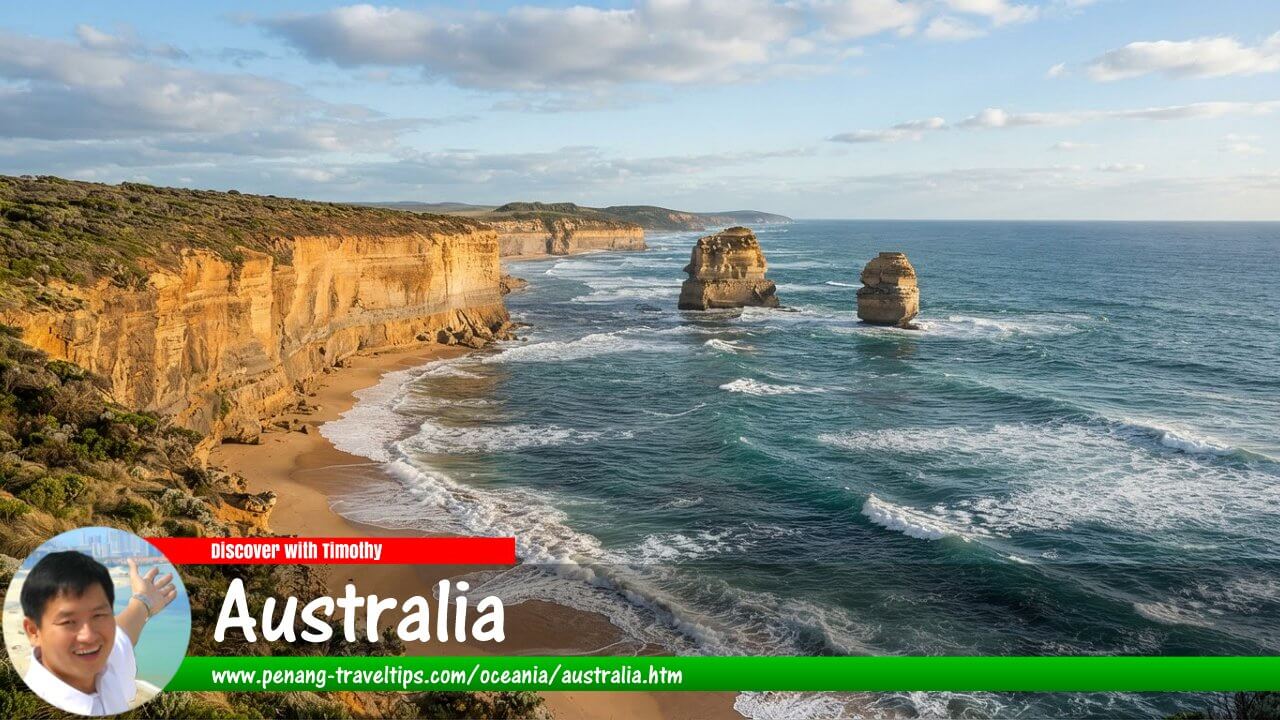 Australia Travel Guide (AI Image generated on 25 August 2026)
Also available: Panduan Melawat Australia
Introduction to Australia
Australia is a vast country and island continent in the Southern Hemisphere. It is known for its distinctive wildlife, spectacular natural landscapes, Aboriginal heritage, multicultural cities and long coastline. For visitors, Australia offers a remarkable variety of experiences, from exploring modern cities and beaches to travelling through tropical rainforests, deserts and remote outback landscapes.
Geography of Australia
Australia lies between the Indian Ocean and the Pacific Ocean. It is the world's sixth-largest country by land area and is geographically separated from Asia by seas and straits.
The country has a great diversity of landscapes. Along its eastern and southeastern coast are major cities, fertile agricultural regions and mountain ranges. The centre of the continent is much drier and includes extensive desert and semi-desert areas, while the northern part has tropical landscapes.
The Australian Continent
Australia is unusual because the country occupies an entire continent. In addition to the mainland, the country includes the island of Tasmania and numerous smaller islands.
The enormous size of Australia means that distances between major destinations can be considerable. A journey that looks relatively short on a map may take many hours by road, while travelling between major cities by air is often much faster.
States and Territories
Australia consists of six states and two major mainland territories. The states are New South Wales, Queensland, South Australia, Tasmania, Victoria and Western Australia.
The two major territories are the Australian Capital Territory and the Northern Territory.
Australian Capital
Canberra is the capital of Australia. Unlike Sydney and Melbourne, which are much larger and more internationally prominent cities, Canberra was specifically planned as the national capital.
The city is located in the Australian Capital Territory between Sydney and Melbourne. It is home to Parliament House, national museums, galleries and important institutions of the Australian government.
Australia's Major Cities
Australia's largest and best-known cities are located mainly along the eastern and southeastern coasts. Sydney, Melbourne, Brisbane, Perth, Adelaide and Canberra are among the most important destinations for international visitors.
Each city has a distinct character. Sydney is famous for its harbour and beaches, Melbourne for its arts and café culture, Brisbane for its subtropical climate, Perth for its isolation and beaches, Adelaide for its food and wine, and Canberra for its national institutions.
Sydney
Sydney is Australia's largest city and one of its most recognisable destinations. Its natural harbour, beaches and waterfront landmarks make it particularly attractive to international visitors.
The Sydney Opera House and Sydney Harbour Bridge are among the country's most famous landmarks. Sydney is also a convenient base for visiting beaches, national parks and the Blue Mountains.
Melbourne
Melbourne is the capital of Victoria and is widely known for its arts, culture, sporting events, architecture, cafés and restaurants.
The city has a strong multicultural character and is often considered one of Australia's major food and cultural centres. It is also a useful base for exploring Victoria, including the Great Ocean Road and regional wine areas.
Brisbane
Brisbane is the capital of Queensland and lies along the Brisbane River. It has a warm subtropical climate and is an important gateway to destinations in southeastern Queensland.
Visitors to Brisbane can combine a city stay with trips to the Gold Coast, Sunshine Coast, hinterland areas and nearby national parks.
Perth
Perth is the capital of Western Australia and one of the most geographically isolated major cities in the world.
The city is known for its beaches, parks, sunny climate and proximity to the Swan Valley and other attractions in southwestern Western Australia. It also serves as a gateway to destinations such as Margaret River and the Pinnacles.
Adelaide
Adelaide is the capital of South Australia. It is known for its food and wine, festivals, parks and relatively relaxed atmosphere.
The city provides convenient access to wine regions such as the Barossa Valley and McLaren Vale, as well as natural areas and coastal destinations.
Hobart
Hobart is the capital of Tasmania and one of Australia's oldest cities. It lies beside the River Derwent and beneath Mount Wellington, now known as kunanyi/Mount Wellington.
Hobart is an important starting point for exploring Tasmania's mountains, forests, coastline and historic towns.
Darwin
Darwin is the capital of the Northern Territory and the country's main tropical city. It has a strong connection with northern Australian Aboriginal cultures and is also influenced by its proximity to Southeast Asia.
Darwin is an important gateway to national parks such as Kakadu and Litchfield.
Gold Coast
Gold Coast is a major tourism destination in Queensland, famous for its long sandy beaches, surfing, theme parks and high-rise coastal skyline.
It is particularly popular with families and visitors looking for a combination of beaches and entertainment.
Australian Outback
The Australian Outback refers broadly to the remote inland areas of the country. It is characterised by vast distances, dry landscapes, sparse settlements and distinctive Australian wildlife.
The Outback is an important part of Australia's identity, but travelling through remote areas requires considerably more preparation than visiting the major cities.
Uluru
Uluru, formerly widely known as Ayers Rock, is one of Australia's most recognisable natural landmarks. The enormous sandstone formation rises dramatically from the surrounding landscape in the Northern Territory.
Uluru is also a place of deep cultural significance to the Anangu, the Traditional Owners of the area. Visitors are expected to respect Aboriginal cultural practices and the rules of the national park.
Great Barrier Reef
The Great Barrier Reef lies off the coast of Queensland and is one of Australia's most famous natural attractions. It is the world's largest coral reef system and supports an extraordinary variety of marine life.
Popular gateways include Cairns and Port Douglas, from where visitors can join boat trips and other reef experiences.
Australian Wildlife
Australia is famous for animals that are found naturally nowhere else in the world. Kangaroos, koalas, wombats, platypuses, echidnas and many distinctive birds are among the country's best-known wildlife.
Visitors can encounter Australian animals in the wild, in wildlife sanctuaries and in national parks. Seeing wildlife in its natural habitat is one of the memorable experiences Australia can offer.
Kangaroo
The kangaroo is one of Australia's best-known animals and has become an international symbol of the country. Several species of kangaroo and related macropods live in different parts of Australia.
They can sometimes be seen in the wild, particularly in grassland and rural areas, although visitors should never approach or feed wild animals unless specifically permitted.
Koala
The koala is another iconic Australian animal. It lives mainly in eucalyptus forests and woodlands in eastern and southeastern Australia.
Although koalas resemble bears, they are marsupials and are not related to bears.
Aboriginal Australia
Australia has one of the world's oldest continuous living cultures. Aboriginal peoples have lived on the Australian continent for tens of thousands of years, developing diverse languages, traditions, knowledge systems and connections to Country.
Australia's Aboriginal peoples are not a single homogeneous group. There are many different nations and language groups, each with their own histories and cultural traditions.
Torres Strait Islander Peoples
Torres Strait Islander peoples are the Indigenous peoples of the Torres Strait islands between northern Australia and Papua New Guinea. Their cultures and histories are distinct from those of Australia's Aboriginal peoples, although both are recognised as the Indigenous peoples of Australia.
Country and Culture
The concept of Country is important in many Aboriginal Australian cultures. It refers not simply to land but to a broader relationship between people, place, ancestors, animals, plants, waterways and cultural responsibilities.
Visitors may encounter Aboriginal cultural interpretation at museums, national parks, galleries and guided tours throughout Australia.
European History
European exploration of Australia took place over several centuries. Dutch navigators reached parts of the Australian coastline in the seventeenth century, while British exploration and settlement later played a decisive role in the country's modern history.
British settlement began in 1788 with the establishment of a penal colony at Sydney Cove. The arrival of Europeans had profound and often devastating consequences for Indigenous peoples and their communities.
Federation of Australia
The Australian colonies were united in 1901 to form the Commonwealth of Australia. This process is known as Federation.
Australia subsequently developed as a federal parliamentary democracy, with powers divided between the national government and the state and territory governments.
Multicultural Australia
Modern Australia is highly multicultural. People from many parts of Europe, Asia, the Middle East and other regions have settled in the country, particularly since the Second World War.
This diversity is especially visible in Australia's major cities, where visitors can find restaurants, cultural centres and communities representing many different parts of the world.
Australian English
English is the main language used in Australia, but Australian English has its own vocabulary, pronunciation and expressions.
Visitors may encounter words such as arvo for afternoon, brekkie for breakfast and servo for service station. Some Australian expressions can sound unfamiliar even to visitors who speak English fluently.
Climate of Australia
Australia's enormous size means that its climate varies considerably from one region to another. The tropical north has a wet and dry season, while the southern regions experience more recognisable spring, summer, autumn and winter patterns.
The interior is generally much drier, while Tasmania has a cooler climate than most of mainland Australia.
Seasons in Australia
Because Australia is in the Southern Hemisphere, its seasons are opposite to those in the Northern Hemisphere. Summer generally occurs from December to February, autumn from March to May, winter from June to August, and spring from September to November.
For visitors from Malaysia, the Australian winter can feel particularly cold, especially in the southern states and mountainous areas.
Australia's Coastline
Australia has an exceptionally long coastline with thousands of beaches, bays, cliffs and islands. Beaches are an important part of Australian life and are popular for swimming, surfing, fishing and other recreational activities.
Australian Beaches
Among Australia's famous beaches are Bondi Beach in Sydney, Manly Beach, Surfers Paradise on the Gold Coast and numerous beaches along the coast of Western Australia.
Beach conditions can change quickly, so visitors should follow local safety signs and swim between the flags at patrolled beaches.
National Parks
Australia has an extensive network of national parks protecting forests, deserts, wetlands, mountains, reefs and coastal environments.
National parks provide opportunities for hiking, wildlife watching, camping, scenic drives and Aboriginal cultural experiences.
Australia as a Travel Destination
Australia is particularly well suited to travellers who enjoy combining urban experiences with nature. A single trip can include museums and restaurants in Melbourne, beaches in Sydney, tropical reefs in Queensland and desert landscapes around Uluru.
However, Australia's size means that seeing the entire country in one visit is unrealistic. A more practical approach is to choose one region or a small number of destinations and explore them properly.
Major Cities and Regions of Australia
Australia's major cities are concentrated along the coast, while vast inland areas contain smaller settlements and remote landscapes. Each state and territory has its own character, attractions and travel experiences.
New South Wales
New South Wales is Australia's most populous state and is home to Sydney, the country's largest city. It combines a long coastline with mountains, forests, wine regions, agricultural areas and historic towns.
Sydney is the main international gateway, but the state has many other destinations worth visiting, including the Blue Mountains, Byron Bay, the Hunter Valley and the South Coast.
Sydney
Sydney is built around one of the world's great natural harbours. The city is famous for the Sydney Opera House, Sydney Harbour Bridge, beaches, parks and waterfront neighbourhoods.
The central area is compact enough for visitors to explore several major attractions on foot, while the extensive public transport network makes it possible to travel to beaches and outer suburbs.
Sydney Harbour
Sydney Harbour is the geographical centrepiece of the city. Ferries provide an enjoyable way to see the harbour while travelling between destinations such as Circular Quay, Manly and Taronga Zoo.
Bondi Beach
Bondi Beach is one of Australia's most famous beaches. It is popular for swimming, surfing, sunbathing and walking.
The coastal walk from Bondi to Coogee is one of Sydney's most popular walking routes, passing several beaches and coastal viewpoints.
Blue Mountains
The Blue Mountains lie west of Sydney and are known for dramatic sandstone cliffs, eucalyptus forests, waterfalls and walking trails.
Echo Point near Katoomba provides a famous view of the Three Sisters and the surrounding Jamison Valley.
Hunter Valley
The Hunter Valley is one of Australia's best-known wine regions. It is particularly associated with Semillon and Shiraz, as well as restaurants, cellar doors and scenic countryside.
Byron Bay
Byron Bay is a coastal town in northern New South Wales known for beaches, surfing, a relaxed atmosphere and its alternative lifestyle culture.
The nearby lighthouse area provides excellent coastal views.
Queensland
Queensland occupies much of Australia's northeastern region and is known for its warm climate, tropical landscapes, beaches, islands and the Great Barrier Reef.
Brisbane, the Gold Coast, Cairns and the Whitsunday Islands are among its best-known destinations.
Brisbane
Brisbane is a modern riverside city with parks, museums, galleries, restaurants and a growing cultural scene.
The city's subtropical climate makes outdoor activities popular throughout much of the year.
South Bank
South Bank is a riverside precinct in Brisbane containing parks, restaurants, cultural institutions and a public swimming area known as Streets Beach.
Gold Coast
The Gold Coast combines beaches, shopping, entertainment, theme parks and a high-rise coastal cityscape.
Surfers Paradise is the best-known part of the Gold Coast and is particularly popular with visitors looking for beaches and nightlife.
Sunshine Coast
The Sunshine Coast lies north of Brisbane and offers beaches, coastal towns, national parks and hinterland scenery.
It tends to have a more relaxed atmosphere than the Gold Coast and is popular with families and visitors seeking a quieter coastal holiday.
Cairns
Cairns is one of Australia's most important tropical tourism centres. It is a major gateway to the Great Barrier Reef and the Wet Tropics rainforest.
Although Cairns itself is relatively small, it provides access to many of northern Queensland's major attractions.
Port Douglas
Port Douglas is an attractive coastal town north of Cairns. It is a popular base for visiting the Great Barrier Reef and the Daintree Rainforest.
Great Barrier Reef
The Great Barrier Reef stretches along the Queensland coast and contains thousands of individual reefs and islands. Visitors can experience it through snorkelling, scuba diving, glass-bottom boat tours and scenic flights.
Marine conditions vary by season and location, so visitors should follow local safety and environmental guidelines.
Whitsunday Islands
The Whitsunday Islands are a group of tropical islands off the Queensland coast. They are famous for white-sand beaches, clear waters and sailing opportunities.
Whitehaven Beach
Whitehaven Beach is one of the best-known beaches in the Whitsundays. It is famous for its exceptionally white silica sand and turquoise waters.
Daintree Rainforest
The Daintree Rainforest in northern Queensland is one of the world's oldest tropical rainforest systems. It contains remarkable biodiversity and is part of the Wet Tropics of Queensland World Heritage Area.
Victoria
Victoria is Australia's smallest mainland state by area and is centred on Melbourne. It is known for its food and wine, historic towns, coastal scenery and diverse landscapes.
Melbourne
Melbourne is often regarded as Australia's cultural capital. It has a strong café culture, extensive arts scene, sporting traditions and multicultural food scene.
The city's central grid is relatively easy to explore on foot, while trams provide convenient transport around many central areas.
Federation Square
Federation Square is a major public space in central Melbourne, located beside the Yarra River and opposite Flinders Street Station.
It hosts cultural events and provides access to museums, galleries, restaurants and other attractions.
Flinders Street Station
Flinders Street Station is one of Melbourne's most recognisable landmarks. Its distinctive historic façade overlooks the Yarra River and Federation Square.
Great Ocean Road
The Great Ocean Road is one of Australia's most famous scenic drives. It follows the coastline west of Melbourne, passing beaches, cliffs, forests and dramatic rock formations.
Twelve Apostles
The Twelve Apostles are limestone stacks rising from the Southern Ocean along the Great Ocean Road. They are among Victoria's most photographed natural attractions.
Yarra Valley
The Yarra Valley is a wine-producing region northeast of Melbourne. It is known for vineyards, restaurants, countryside and cool-climate wines.
Phillip Island
Phillip Island is famous for its wildlife, particularly the nightly arrival of little penguins at the Penguin Parade.
The island also has beaches, coastal landscapes and other wildlife attractions.
South Australia
South Australia is centred on Adelaide and is known for wine regions, food, coastline, outback landscapes and cultural attractions.
Adelaide
Adelaide has a compact city centre surrounded by parklands. It is known for festivals, food, wine and a relaxed urban atmosphere.
Barossa Valley
The Barossa Valley is one of Australia's most famous wine regions. It is particularly associated with Shiraz and has numerous wineries and cellar doors.
McLaren Vale
McLaren Vale is another important wine region near Adelaide. Its location between the Mount Lofty Ranges and the coast provides attractive scenery as well as vineyards.
Kangaroo Island
Kangaroo Island lies off the coast of South Australia and is known for its wildlife and relatively untouched natural landscapes.
Visitors may see kangaroos, koalas, seals and other native animals, depending on the location and season.
Flinders Ranges
The Flinders Ranges extend through South Australia's interior and provide dramatic mountain scenery, walking trails and opportunities to experience the Australian Outback.
Western Australia
Western Australia is Australia's largest state by area. Its enormous size means that the landscapes vary from the temperate southwest to tropical regions in the north and arid deserts inland.
Perth
Perth is situated on the Swan Coastal Plain beside the Swan River. It has a sunny climate, extensive beaches and large areas of parkland.
Kings Park
Kings Park and Botanic Garden overlooks central Perth and the Swan River. It is one of the city's most popular places for walking, picnics and viewing the skyline.
Fremantle
Fremantle is a historic port city near Perth. It is known for its nineteenth-century architecture, markets, cafés, maritime heritage and lively atmosphere.
Rottnest Island
Rottnest Island, often called Rottnest, lies off the coast of Perth and is famous for its beaches and quokkas.
Cars are restricted on much of the island, making cycling one of the most popular ways to explore it.
Margaret River
Margaret River is one of Western Australia's best-known wine regions. It is also famous for beaches, forests, caves and surfing.
Pinnacles
The Pinnacles are unusual limestone formations within Nambung National Park north of Perth. The formations rise from a sandy landscape and create a distinctive desert scene.
Broome
Broome lies in the Kimberley region of northern Western Australia. It is known for Cable Beach, tropical landscapes and its historical connection with the pearling industry.
Kimberley
The Kimberley is one of Australia's most remote and spectacular regions. It contains rugged ranges, gorges, waterfalls, rivers and extensive wilderness areas.
Tasmania
Tasmania is Australia's island state, separated from mainland Australia by Bass Strait. It is known for mountains, forests, lakes, coastline, wildlife and historic settlements.
Hobart
Hobart is Tasmania's capital and a major cultural and culinary centre. The city combines historic buildings with a waterfront setting and easy access to surrounding mountains.
kunanyi/Mount Wellington
kunanyi/Mount Wellington rises above Hobart and provides panoramic views over the city and surrounding region.
MONA
The Museum of Old and New Art, commonly known as MONA, is a major attraction near Hobart. Its unconventional collection and presentation have made it internationally known.
Cradle Mountain
Cradle Mountain is one of Tasmania's most famous natural landmarks and forms part of the Tasmanian Wilderness World Heritage Area.
The region offers hiking, wildlife watching and dramatic mountain scenery.
Freycinet National Park
Freycinet National Park is famous for its pink granite mountains, beaches and coastal scenery.
Wineglass Bay
Wineglass Bay is one of Tasmania's most photographed beaches. It forms a sweeping curve of white sand surrounded by forested hills and clear water.
Northern Territory
The Northern Territory covers a vast area of northern and central Australia. It is known for Aboriginal cultural heritage, tropical wetlands, desert landscapes and some of Australia's most iconic natural landmarks.
Darwin
Darwin is a tropical city with strong connections to northern Australia's Indigenous cultures and to Southeast Asia.
It is also an important gateway for exploring Kakadu National Park, Litchfield National Park and other attractions in the Top End.
Kakadu National Park
Kakadu National Park is one of Australia's most important protected areas. It contains wetlands, escarpments, wildlife and Aboriginal rock art sites.
Litchfield National Park
Litchfield National Park is known for waterfalls, swimming holes, monsoon forests and sandstone formations. It is a popular excursion from Darwin.
Uluru-Kata Tjuta National Park
Uluru-Kata Tjuta National Park protects Uluru and Kata Tjuta, two of Australia's most significant natural and cultural landmarks.
The park is jointly managed with the Anangu Traditional Owners, and visitors are expected to respect cultural restrictions and park regulations.
Kata Tjuta
Kata Tjuta, also known as the Olgas, is a group of large rounded rock formations located west of Uluru.
The Valley of the Winds walk offers an opportunity to experience the formations from within the landscape.
Australian Capital Territory
The Australian Capital Territory surrounds Canberra and was created to provide a separate territory for Australia's national capital.
Canberra
Canberra is a planned city with broad avenues, parks, lakes and national institutions. It is an especially good destination for visitors interested in Australian history, politics, art and culture.
Parliament House
Parliament House is the seat of Australia's federal Parliament. Visitors can explore parts of the building and learn about the country's political system.
Australian War Memorial
The Australian War Memorial combines a museum, memorial and archive documenting Australia's military history and the experiences of Australians in wars and conflicts.
National Gallery of Australia
The National Gallery of Australia in Canberra houses an extensive collection of Australian and international art.
Australian Alps
The Australian Alps stretch across parts of Victoria, New South Wales and the Australian Capital Territory. They contain Australia's highest mountains and are important for hiking, skiing and other outdoor activities.
Mount Kosciuszko
Mount Kosciuszko is Australia's highest mountain at 2,228 metres above sea level. It is located in Kosciuszko National Park in New South Wales.
Australian Islands
Australia has numerous islands ranging from large inhabited islands to tiny offshore islands. Tasmania is by far the largest, while destinations such as Kangaroo Island, Phillip Island, Rottnest Island and the Whitsunday Islands are particularly popular with tourists.
Choosing a Region
First-time visitors should consider the amount of time available before deciding how much of Australia to cover. Sydney and Melbourne can easily occupy several days each, while Queensland, Western Australia and Tasmania can justify much longer trips.
For a short holiday, it is generally better to concentrate on one region rather than attempt to cross the entire country.
Australia for Nature Lovers
Visitors interested in nature have an enormous range of choices, from coral reefs and tropical rainforests to alpine mountains, eucalyptus forests and desert landscapes.
Australia for City Travellers
Sydney, Melbourne, Brisbane, Perth and Adelaide offer museums, galleries, restaurants, shopping, nightlife and cultural events. They are also generally easier to explore without a car than remote parts of Australia.
Australia for Road Trips
Australia is particularly well suited to road trips because of its extensive road network and spectacular scenic routes. However, long-distance driving in remote areas requires careful planning, sufficient fuel, water and knowledge of road conditions.
Australia for Families
Families can choose from beaches, wildlife parks, aquariums, museums, theme parks and outdoor activities. The Gold Coast, Sydney, Melbourne and Queensland's tropical coast are particularly popular with families.
Australia for Adventure
Australia offers activities such as surfing, diving, snorkelling, hiking, kayaking, camping and wildlife watching. More specialised activities, including multi-day hikes and remote-area adventures, require appropriate preparation and equipment.
Australia for Food and Wine
Australia has a highly developed food and wine culture. Major cities have restaurants representing cuisines from around the world, while regional destinations offer vineyards, farmers' markets, seafood and local produce.
Wine regions such as the Barossa Valley, Hunter Valley, Yarra Valley and Margaret River are particularly popular with food and wine travellers.
Getting to Australia
Australia is well connected to the rest of the world by air, with major international airports in Sydney, Melbourne, Brisbane, Perth, Adelaide, Cairns and Darwin. For most international visitors, flying is the most practical way to reach the country.
International Airports
Sydney Airport is Australia's busiest international gateway and serves as the main entry point for many visitors. It is relatively close to the city centre and is connected to the city by train.
Melbourne Airport is another major international gateway and serves Victoria as well as travellers heading to other parts of southeastern Australia.
Brisbane Airport is the main international gateway to Queensland, while Perth Airport is particularly important for travellers arriving from Asia and the Indian Ocean region.
Flights from Malaysia
Malaysia has direct air connections with several Australian cities. Kuala Lumpur International Airport is the main departure point for Malaysians travelling to Australia, with flights available to major Australian destinations.
Depending on the airline and season, direct services may connect Kuala Lumpur with cities such as Sydney, Melbourne, Brisbane, Perth and Adelaide. Other Australian destinations can usually be reached by connecting flights.
Flights from Singapore
Singapore is another major aviation hub for travel to Australia. Travellers can often find frequent flights from Singapore to Sydney, Melbourne, Brisbane, Perth, Adelaide, Darwin and other Australian cities.
Flights from Other Asian Cities
Australia has extensive air connections with cities throughout Asia, including Bangkok, Jakarta, Manila, Hong Kong, Seoul, Tokyo and various cities in mainland China.
This makes Australia relatively accessible from Southeast Asia and East Asia, even when a direct flight from the traveller's home city is not available.
Airlines
Australia is served by its national carrier, Qantas, as well as numerous international airlines. The choice of airline depends on the departure city, destination and season.
Low-cost and full-service airlines both operate on routes between Australia and Asia, providing a range of fares and service levels.
Visa Requirements
Most visitors who are not Australian or New Zealand citizens need permission to enter Australia before travelling. The type of visa or travel authority required depends on nationality, purpose of travel and length of stay.
Travellers should check the latest requirements with the Australian Government before booking a trip, as immigration requirements can change.
Australian Border Controls
Australia has strict border and biosecurity controls. Visitors must declare certain food, plant material, animal products and other restricted items when entering the country.
Do not assume that an item that can be carried freely into Malaysia or another country can also be brought into Australia.
Biosecurity
Australia's strict biosecurity system is intended to protect its agriculture, environment and native wildlife from pests and diseases.
Food, seeds, plant material, animal products, wooden items and outdoor equipment may be subject to restrictions or inspection.
Declaring Items
If you are uncertain whether an item needs to be declared, it is safer to declare it. Australian border authorities can inspect luggage and impose penalties for undeclared restricted goods.
Arriving in Australia
After landing, international passengers normally proceed through immigration, collect their luggage and pass through customs and biosecurity inspection before entering the public arrivals area.
Allow extra time for these procedures, particularly when arriving during busy periods.
Domestic Flights
Because Australia is so large, domestic flights are often the most practical way to travel between distant cities. A flight between Sydney and Perth, for example, covers a distance that would take several days to drive.
Domestic aviation is particularly useful when an itinerary includes cities in different regions of the country.
Domestic Airports
Major cities generally have airports with frequent domestic services. Some airports, such as Sydney and Brisbane, have separate or distinct international and domestic facilities.
Check the terminal carefully when connecting between international and domestic flights.
Connecting Flights
If you arrive in Australia on an international flight and continue to another city, allow sufficient time for immigration, baggage collection, customs and transfer to the domestic terminal.
Do not assume that checked baggage will automatically be transferred on every itinerary, especially when separate tickets are involved.
Travelling by Train
Australia has extensive passenger rail services, but the country's enormous size means that trains do not provide a practical alternative to flying for every journey.
Rail travel is particularly useful within and between some major cities, while long-distance trains can provide memorable journeys through Australia's landscapes.
Intercity Trains
Several states operate rail services connecting their major cities and regional centres. New South Wales, Victoria and Queensland have particularly useful intercity rail networks.
Long-Distance Train Journeys
Australia is famous for long-distance rail journeys such as the Indian Pacific, which crosses the continent between Sydney and Perth, and The Ghan, which travels between Adelaide and Darwin via Alice Springs.
These journeys are experiences in their own right rather than simply methods of getting from one city to another.
Indian Pacific
The Indian Pacific crosses Australia from east to west, passing through a variety of landscapes including agricultural regions, the Nullarbor Plain and the interior.
The Ghan
The Ghan connects Adelaide in the south with Darwin in the north. The journey passes through the heart of Australia and provides an unusual way to experience the changing landscapes of the continent.
Driving in Australia
Driving is one of the best ways to explore Australia outside its major cities. It provides access to national parks, beaches, small towns and remote areas that may not be easily reached by public transport.
However, distances can be enormous, and travellers should plan fuel stops, accommodation and rest periods carefully.
Driving on the Left
Australia drives on the left-hand side of the road. Vehicles generally have the steering wheel on the right-hand side.
Visitors accustomed to driving on the left, such as travellers from Malaysia, will generally find this familiar.
Australian Driving Rules
Road rules vary slightly between Australian states and territories. Drivers must obey local speed limits, traffic signs and parking regulations.
Seat belts are compulsory, and driving under the influence of alcohol or drugs is strictly prohibited.
International Driving Permit
Visitors who intend to drive should check whether their driving licence is accepted in the state or territory they plan to visit and whether an International Driving Permit is required.
Car rental companies may also have their own requirements, so check these before collecting a vehicle.
Car Rental
Rental cars are widely available at airports and in major cities. A car can be especially useful for exploring regional areas where public transport is limited.
Before accepting a rental vehicle, check the rental agreement, insurance coverage, fuel policy, mileage restrictions and any additional fees.
Motorhomes and Campervans
Australia is a popular destination for campervan and motorhome travel. These vehicles provide both transportation and accommodation, making them particularly useful for longer road trips.
However, travellers must use designated camping areas and comply with local regulations.
Road Trips
Australia offers many famous road-trip routes. Some follow the coastline, while others cross mountains, forests, agricultural regions or the Outback.
Popular routes include the Great Ocean Road, the Pacific Coast between Sydney and Brisbane, and routes through Tasmania and Western Australia.
Driving in the Outback
Driving through remote parts of Australia requires considerably more preparation than driving between cities. Some roads are isolated for hundreds of kilometres, and mobile phone coverage may be limited.
Carry sufficient drinking water, fuel and food, check road conditions before departure and inform someone of your travel plans when entering particularly remote areas.
Road Trains
Large trucks known as road trains are common on remote Australian highways. They can be extremely long and require considerable distance to stop.
Drivers should maintain a safe following distance and exercise particular caution when overtaking.
Wildlife on Roads
Wild animals can wander onto roads, particularly in rural and remote areas. Kangaroos and other animals may be more active around dawn, dusk and during the night.
Slow down when driving through areas marked with wildlife warning signs.
Public Transport in Sydney
Sydney has an extensive public transport network consisting of trains, buses, ferries, light rail and metro services.
Its ferries are particularly useful for visitors because they combine transportation with excellent views of Sydney Harbour.
Public Transport in Melbourne
Melbourne has an extensive network of trains, trams and buses. Its tram system is one of the most recognisable features of the city.
The central area has a Free Tram Zone, within which tram travel is free under the applicable rules.
Public Transport in Brisbane
Brisbane's public transport network includes trains, buses and ferries. The CityCat ferry service provides a scenic way to travel along the Brisbane River.
Public Transport in Perth
Perth has trains, buses and ferries serving the metropolitan area. The city's public transport system is useful for reaching central Perth, Fremantle and surrounding suburbs.
Public Transport in Adelaide
Adelaide has trains, buses and trams. The tram network is particularly useful for travelling between the city centre and several nearby destinations.
Public Transport in Canberra
Canberra has an extensive bus network and a light rail service. However, visitors exploring destinations outside the central areas may find a car more convenient.
Public Transport in Hobart
Hobart's public transport is primarily based on buses. A rental car is generally more convenient for visitors who want to explore destinations throughout Tasmania.
Public Transport in Darwin
Darwin has a bus network, but its attractions are spread across a relatively large area. A rental car or organised tour can therefore be useful for exploring the surrounding region.
Ferries
Ferries are an important part of transportation in some Australian cities. Sydney has one of the country's most extensive ferry networks, while Brisbane and Perth also have useful river ferry services.
Taxis
Taxis are available in Australia's major cities and at airports. They can be useful when travelling with luggage or when public transport is inconvenient.
Ride-Hailing Services
Ride-hailing services are available in many Australian cities. Availability and operating conditions can vary between locations.
Walking
Walking is an excellent way to explore the central areas of Australia's major cities. Sydney, Melbourne, Adelaide and many other cities have pedestrian-friendly districts containing shops, restaurants, museums and historic buildings.
Cycling
Cycling is popular in many Australian cities and regional destinations. Dedicated cycling paths can be found in parks and along some waterfronts.
Rottnest Island in Western Australia is particularly well known as a cycling destination.
Ferries to Islands
Many Australian islands can be reached by ferry or boat. Popular examples include Rottnest Island, Phillip Island and islands in Queensland.
Check ferry schedules carefully, particularly when planning a day trip, because services may be less frequent outside peak periods.
Accommodation in Australia
Australia offers a wide range of accommodation, from luxury hotels and international chains to hostels, motels, holiday apartments, cabins and campsites.
Hotels
Major cities have hotels covering a wide range of price levels. International hotel chains are particularly common in central business districts and near major airports.
Motels
Motels are common along Australian highways and in regional towns. They can be convenient for road trips because many provide parking directly outside or close to the room.
Hostels
Hostels are popular among younger travellers and backpackers. Many offer shared dormitories as well as private rooms and communal kitchens.
Holiday Apartments
Serviced apartments and holiday apartments can be useful for families or longer stays because they often include kitchen and laundry facilities.
Resorts
Resorts are particularly common in Queensland and other coastal destinations. They may offer swimming pools, restaurants, recreational facilities and organised activities.
Camping
Australia has numerous campsites, ranging from basic sites in national parks to well-equipped holiday parks with kitchens, bathrooms, swimming pools and powered sites.
Caravan Parks
Caravan parks are common throughout Australia and cater to travellers using caravans, campervans and motorhomes. Many also offer cabins for visitors without camping vehicles.
Booking Accommodation
Accommodation should be booked in advance during school holidays, major sporting events, festivals and other busy periods.
In remote destinations, accommodation can be limited, so early booking is particularly important.
Choosing Where to Stay
In major cities, staying near public transport can make sightseeing much easier. In remote or rural destinations, the location of the accommodation should be considered in relation to fuel, food supplies and the attractions you intend to visit.
Staying in the City Centre
Central accommodation is convenient for visitors who want to explore museums, restaurants, shopping areas and landmarks on foot or by public transport.
Staying Near the Airport
Airport hotels can be useful when arriving late, departing early or connecting between flights. They are generally less convenient for sightseeing than accommodation in the city centre.
Choosing a Base
Australia's major cities can serve as bases for exploring surrounding regions. For example, Sydney can be used as a base for the Blue Mountains, Melbourne for the Great Ocean Road and Brisbane for parts of southeastern Queensland.
Things to See and Do in Australia
Australia offers an enormous variety of attractions, from famous landmarks and ancient Aboriginal cultural sites to beaches, coral reefs, rainforests, mountains and vast desert landscapes. Because the country is so large, it is best to choose attractions according to the region you are visiting.
Australian Landmarks
Some Australian landmarks are recognised around the world. The Sydney Opera House, Sydney Harbour Bridge, Uluru and the Great Barrier Reef are among the places most strongly associated with the country.
Sydney Opera House
The Sydney Opera House is Australia's most recognisable building. Its distinctive roof structures stand on Bennelong Point beside Sydney Harbour.
Visitors can admire the building from the harbour, take a guided tour or attend a performance. The surrounding area at Circular Quay is also one of the best places to appreciate Sydney Harbour.
Sydney Harbour Bridge
The Sydney Harbour Bridge spans Sydney Harbour and connects the central business district with the North Shore.
Visitors can cross the bridge on foot, by bicycle or by vehicle. There are also organised bridge-climbing experiences for those who want a different perspective of the harbour.
Royal Botanic Garden Sydney
The Royal Botanic Garden Sydney occupies a large area beside Sydney Harbour. It is an excellent place to walk among plants while enjoying views of the Opera House and harbour.
Darling Harbour
Darling Harbour is a waterfront precinct containing restaurants, museums, entertainment venues and public spaces.
It is particularly popular with families because of attractions such as the SEA LIFE Sydney Aquarium and WILD LIFE Sydney Zoo.
Taronga Zoo
Taronga Zoo Sydney occupies a hillside overlooking Sydney Harbour. The zoo houses Australian wildlife as well as animals from other parts of the world.
Its elevated location also provides attractive views of the harbour and city skyline.
Blue Mountains National Park
Blue Mountains National Park offers dramatic sandstone cliffs, eucalyptus forests, waterfalls and walking trails.
The area can be visited as a day trip from Sydney, although staying overnight allows visitors to explore the region at a more relaxed pace.
Three Sisters
The Three Sisters are three distinctive sandstone rock formations overlooking the Jamison Valley near Katoomba. They are one of the most photographed landmarks in the Blue Mountains.
Australian Beaches
Australia's long coastline provides an enormous choice of beaches. Some are located within major cities, while others are found along remote coastlines and islands.
Surfing
Surfing is an important part of Australian coastal culture. Beaches around Sydney, the Gold Coast, Margaret River and many other areas offer opportunities for experienced surfers.
Beginners can take lessons at beaches with established surf schools and appropriate safety facilities.
Beach Safety
Ocean conditions can be unpredictable. Visitors should swim at patrolled beaches and stay between the red and yellow flags.
Do not assume that a beautiful or empty beach is safe for swimming. Rip currents can be difficult to see and can be extremely dangerous.
Snorkelling
Australia has many excellent snorkelling locations, particularly around the Great Barrier Reef, Ningaloo Reef and tropical islands.
Snorkellers should follow local instructions and avoid touching coral or marine animals.
Scuba Diving
Australia is an important international destination for scuba diving. The Great Barrier Reef and Ningaloo Reef are among the best-known locations, while temperate waters around Tasmania and southern Australia offer very different marine environments.
Great Barrier Reef Experiences
Visitors can experience the Great Barrier Reef through day cruises, snorkelling trips, scuba diving, semi-submersible vessels, glass-bottom boats and scenic flights.
The experience chosen depends on the visitor's interests, swimming ability, budget and available time.
Ningaloo Reef
Ningaloo Reef lies off the coast of Western Australia and is known for its marine life and relatively accessible coral reef.
The area is particularly famous for opportunities to encounter whale sharks and manta rays under appropriate conditions and with authorised operators.
Whale Watching
Several parts of Australia's coastline offer seasonal whale-watching opportunities. Humpback whales migrate along parts of the Australian coast during their annual journeys.
Whale-watching cruises are available from various coastal cities and towns during the appropriate season.
Wildlife Watching
Australia's wildlife can be encountered in national parks, wildlife sanctuaries and, sometimes, directly in the wild.
Visitors should observe animals from a safe distance and never feed wild animals unless feeding is specifically permitted.
Kangaroo Watching
Kangaroos can be seen in many parts of Australia, including grasslands, national parks and rural areas. Some populations are accustomed to people, but they remain wild animals and should be treated accordingly.
Koala Watching
Koalas live mainly in eucalyptus forests and woodlands in eastern and southeastern Australia. They can be difficult to spot in the wild because they spend much of their time resting in trees.
Wildlife parks and sanctuaries provide another opportunity to learn about koalas.
Penguin Parade
The Penguin Parade on Phillip Island is one of Australia's best-known wildlife experiences. Each evening, little penguins return from the sea to their nesting areas.
Visitors should follow the rules governing photography and maintain a respectful distance from the animals.
Quokkas
Quokkas are small marsupials found mainly in Western Australia. Rottnest Island is particularly famous for its quokka population.
Although quokkas may appear approachable, visitors should not feed or handle them.
Tasmanian Wildlife
Tasmania has several distinctive species, including the Tasmanian devil. Wildlife encounters are one of the highlights of exploring the island's national parks and wilderness areas.
Birdwatching
Australia has a remarkable variety of birds, including parrots, cockatoos, kookaburras, emus and many species found nowhere else.
National parks, wetlands and coastal areas are particularly good places for birdwatching.
Australian National Parks
National parks cover large areas of Australia and protect ecosystems ranging from tropical rainforest and coral reef to desert and alpine environments.
Many parks offer walking trails, picnic areas and scenic viewpoints, while remote parks may require more extensive preparation.
Hiking
Australia has hiking opportunities for all levels of experience. Short walks around city parks and coastal areas are suitable for casual visitors, while long-distance trails can take several days.
Coastal Walks
Coastal walks are an excellent way to experience Australia's scenery without travelling far from the cities. The Bondi to Coogee walk in Sydney is particularly popular.
Overland Track
The Overland Track in Tasmania is one of Australia's most famous multi-day hiking routes. It passes through the spectacular wilderness of Cradle Mountain–Lake St Clair National Park.
Hikers should make appropriate preparations and check current conditions and access requirements before setting out.
Australian Alps
The Australian Alps provide opportunities for hiking, camping and winter sports. The region includes Mount Kosciuszko and several national parks.
Skiing in Australia
Australia has several ski resorts in the alpine regions of New South Wales and Victoria. The ski season generally occurs during the Southern Hemisphere winter.
Visitors from Malaysia who want to experience snow may find Australia's ski resorts a convenient introduction to winter sports.
Uluru
Uluru is one of Australia's most important natural and cultural landmarks. The enormous sandstone formation changes appearance throughout the day as sunlight affects its surface.
Sunrise and sunset are particularly popular times to view Uluru.
Kata Tjuta
Kata Tjuta consists of large rounded rock formations rising from the surrounding desert landscape. Several walking opportunities allow visitors to experience the formations from different viewpoints.
Aboriginal Rock Art
Australia contains many Aboriginal rock-art sites. Some are thousands of years old and provide evidence of long-established cultural traditions.
Important sites can be found in places such as Kakadu, the Kimberley and the Northern Territory.
Aboriginal Cultural Tours
Guided Aboriginal cultural tours provide opportunities to learn about traditional knowledge, stories, food, landscapes and relationships with Country.
Participating in tours led by Aboriginal guides can provide a deeper understanding of the places being visited.
Museums
Australia's major cities have museums covering natural history, science, art, migration, Aboriginal cultures and Australian history.
Museums in Sydney
Sydney has institutions such as the Australian Museum, the Museum of Sydney and the Art Gallery of New South Wales.
Museums in Melbourne
Melbourne is home to the Melbourne Museum, the National Gallery of Victoria and numerous smaller galleries and cultural institutions.
Museums in Canberra
Canberra has an unusually high concentration of national cultural institutions, including the National Museum of Australia, National Gallery of Australia and Australian War Memorial.
Art Galleries
Australia has a strong visual arts tradition. Major galleries display Australian, Aboriginal, Asian and European works alongside contemporary art.
National Gallery of Victoria
The National Gallery of Victoria in Melbourne is Australia's oldest and most visited public art museum. Its collections cover Australian and international art.
National Gallery of Australia
The National Gallery of Australia in Canberra holds important collections of Australian, Aboriginal and international art.
Australian Architecture
Australian cities contain buildings from many periods, including colonial structures, Victorian architecture, Art Deco buildings and contemporary architecture.
Melbourne and Sydney are particularly interesting destinations for visitors interested in architecture.
Historic Buildings
Historic buildings can be found throughout Australia's cities and regional towns. Some date from the colonial period, while others reflect later developments in Australia's history.
Historic Villages
Some regional areas preserve historic villages and buildings that provide insight into Australia's colonial and early modern history.
Australian Food
Australian food culture reflects the country's multicultural population and access to high-quality local produce.
Visitors can find everything from traditional Australian dishes to Chinese, Indian, Japanese, Italian, Greek, Vietnamese, Middle Eastern and many other cuisines.
Australian Breakfast
Breakfast in Australia commonly includes bread, eggs, cereal, fruit, coffee and other familiar foods. Cafés are an important part of the urban food culture.
Australian Coffee Culture
Australia has a strong café culture, particularly in Melbourne and Sydney. Australian cafés are known for espresso-based drinks such as flat whites, long blacks and cappuccinos.
Flat White
The flat white is an espresso-based coffee with steamed milk and a relatively thin layer of microfoam. It has become one of Australia's most internationally recognised café drinks.
Meat Pies
The Australian meat pie is a popular savoury pastry filled traditionally with minced meat and gravy. It is commonly sold at bakeries, cafés and sporting venues.
Fish and Chips
Fish and chips are popular in Australian coastal towns and cities. Fresh local seafood is widely available, although the species served vary according to location.
Barbecue
The Australian barbecue is a familiar part of outdoor social life. Meat, sausages, seafood and vegetables may all be cooked on a barbecue.
Australian Wine
Australia is one of the world's major wine-producing countries. Wine regions can be found in several states and produce a wide range of grape varieties.
Beer
Beer has traditionally been an important part of Australian social culture, although Australia's beverage scene now includes a much wider range of craft beers, wines, spirits and non-alcoholic drinks.
Farmers' Markets
Farmers' markets are found in many Australian cities and regional towns. They provide opportunities to sample local produce, baked goods, cheese, fruit and other products.
Food Festivals
Australia hosts numerous food and wine festivals throughout the year. Major cities and wine regions are particularly active in organising culinary events.
Shopping in Australia
Australia offers modern shopping centres, department stores, independent boutiques, markets and specialty shops.
Australian Souvenirs
Popular souvenirs include Aboriginal artworks, boomerangs, Australian-made food products, tea, coffee, wine, clothing and items featuring Australian wildlife.
Aboriginal Art
Aboriginal art is an important part of Australia's cultural heritage. Visitors interested in purchasing Aboriginal artwork should buy from reputable galleries, artists or organisations that can provide information about the work's origin and authenticity.
Australian Opals
Opal is Australia's national gemstone and has been mined in several parts of the country. Australian opals are popular souvenirs and jewellery items.
Australian Fashion
Australia has a growing fashion industry, with designers and brands offering everything from casual beachwear to contemporary fashion.
Markets
Markets are popular attractions in many Australian cities. They may sell food, clothing, crafts, antiques, souvenirs and local products.
Queen Victoria Market
Queen Victoria Market in Melbourne is one of Australia's best-known markets. It has operated for more than a century and sells fresh produce, food, clothing and various other goods.
The Rocks
The Rocks in Sydney is a historic area near Sydney Harbour. It contains old buildings, restaurants, shops, galleries and weekend markets.
Australian Festivals
Australia hosts festivals celebrating music, film, food, art, sport and cultural traditions. The country's multicultural population also contributes festivals representing communities from around the world.
Vivid Sydney
Vivid Sydney is an annual festival featuring light installations, projections, music and creative events around Sydney.
Australian Sporting Culture
Sport is deeply embedded in Australian culture. Australian rules football, cricket, rugby, tennis, swimming and horse racing all have large followings.
Australian Rules Football
Australian rules football, commonly known as AFL, is particularly popular in Victoria and several other southern states.
Cricket
Cricket is one of Australia's most popular sports. Major international matches are played at famous grounds such as the Melbourne Cricket Ground.
Melbourne Cricket Ground
The Melbourne Cricket Ground, commonly known as the MCG, is one of the world's most famous sporting stadiums. It hosts cricket, Australian rules football and major sporting events.
Australian Open
The Australian Open is one of tennis's four Grand Slam tournaments. It is held annually in Melbourne during the Australian summer.
Horse Racing
Horse racing has a long history in Australia. The Melbourne Cup is the country's most famous horse race and attracts enormous national attention.
Family Attractions
Australia has many attractions suitable for families, including zoos, aquariums, science museums, theme parks and interactive cultural centres.
Theme Parks
Queensland's Gold Coast is Australia's main theme-park destination. Visitors can choose from several large parks offering rides, water attractions and entertainment.
Australia Zoo
Australia Zoo in Queensland was established by the late conservationist Steve Irwin's family and is known for its focus on Australian wildlife and conservation.
Science Museums
Science museums and discovery centres in major cities provide interactive exhibits for children and adults. They are useful alternatives when outdoor activities are affected by rain or extreme weather.
Nightlife
Australia's major cities have a wide range of evening entertainment, including restaurants, theatres, live music venues, bars and cultural performances.
Melbourne and Sydney are particularly well known for their diverse nightlife and entertainment scenes.
Australian Food and Dining
Food is an important part of the Australian experience. Australian cuisine has been shaped by Indigenous traditions, British heritage and, more recently, immigration from Europe, Asia, the Middle East and other parts of the world.
Australian Cuisine
There is no single style of food that represents all of Australia. Instead, Australian cuisine is a mixture of local ingredients, international influences and modern culinary traditions.
Visitors can enjoy anything from a simple meat pie or fish and chips to sophisticated restaurants serving Australian produce with contemporary techniques.
Indigenous Australian Food
Traditional Aboriginal and Torres Strait Islander food cultures make use of native plants, fruits, seeds, seafood and animals. In recent decades, some of these ingredients have become increasingly popular in modern Australian cuisine.
Bush Tucker
Bush tucker is a broad term commonly used for foods traditionally gathered or hunted by Aboriginal Australians. The term can include native fruits, seeds, herbs, nuts, seafood and meats.
Some modern Australian restaurants incorporate native ingredients such as lemon myrtle, wattleseed, finger lime and macadamia nuts into contemporary dishes.
Macadamia Nuts
Macadamia nuts are native to Australia and are now widely cultivated commercially. They are commonly used in desserts, snacks, baked goods and savoury dishes.
Finger Lime
Finger lime is a native Australian citrus fruit containing small, pearl-like vesicles of juice. It has become popular among chefs as a garnish and ingredient in contemporary Australian cooking.
Lemon Myrtle
Lemon myrtle is a native Australian plant with intensely aromatic leaves. Its citrus-like flavour is used in teas, desserts, sauces and other dishes.
Wattleseed
Wattleseed comes from selected species of Australian acacia. Roasted wattleseed has a distinctive nutty, coffee-like flavour and is used in breads, desserts, drinks and savoury dishes.
Australian Meat
Australia is well known for producing beef, lamb and other meats. Australian beef and lamb are widely available in restaurants and supermarkets.
Australian Beef
Beef is an important part of Australian agriculture and food culture. Visitors will find steaks, burgers, pies and other beef dishes throughout the country.
Australian Lamb
Lamb is another popular meat in Australia. It may be grilled, roasted or incorporated into dishes influenced by Mediterranean and Middle Eastern cuisines.
Chicken and Pork
Chicken and pork are also widely consumed. Australia's multicultural food scene means that these meats appear in a wide variety of Asian, European and Middle Eastern dishes.
Seafood
With its enormous coastline, Australia has access to a wide variety of seafood. Depending on the region, visitors may encounter prawns, oysters, lobster, barramundi, snapper, tuna and many other species.
Australian Oysters
Australia produces oysters in several coastal regions. Fresh oysters are particularly associated with Tasmania, South Australia, New South Wales and other coastal areas.
Barramundi
Barramundi is a popular Australian fish, particularly in northern Australia. It is commonly grilled, fried or served with contemporary Australian accompaniments.
Australian Breakfast
Breakfast in Australia can be simple or elaborate. Toast, eggs, cereals, fruit and yoghurt are common, while cafés often offer more substantial dishes.
Avocado Toast
Avocado toast has become strongly associated with modern Australian café culture. It is commonly served with bread, avocado and ingredients such as eggs, tomatoes, herbs or feta cheese.
Vegemite
Vegemite is a dark, salty yeast extract spread that is strongly associated with Australian food culture. It is usually spread thinly on toast or bread.
Its strong flavour can be unfamiliar to visitors, so it is best to start with a small amount.
Meat Pie
The meat pie is one of Australia's best-known everyday foods. It normally consists of pastry filled with minced meat and gravy, although many variations are available.
Sausage Roll
A sausage roll consists of seasoned sausage meat wrapped in flaky pastry. It is a common bakery item and convenient takeaway food.
Chicken Parmigiana
Chicken parmigiana, often called chicken parma, is a popular pub meal consisting of a breaded chicken fillet topped with tomato sauce and melted cheese.
Fish and Chips
Fish and chips remain a popular casual meal, particularly in coastal communities. The type of fish used varies according to location and availability.
Australian Barbecue
The barbecue is an important part of Australian outdoor culture. Barbecues may include sausages, steaks, chicken, seafood, vegetables and other foods.
Sausages
Sausages are common at Australian barbecues. A sausage served in bread with onions and sauce is sometimes known as a sausage sizzle.
Sausage Sizzle
A sausage sizzle is a simple Australian food tradition often associated with community events, markets, sporting activities and charity fundraisers.
Australian Desserts
Australia has several desserts that have become closely associated with the country. Some have British origins, while others developed locally.
Pavlova
Pavlova is a meringue-based dessert with a crisp exterior and soft centre, usually topped with cream and fruit. Australia and New Zealand both claim an important place in its history.
Lamington
A lamington is a square of sponge cake coated in chocolate icing and desiccated coconut. It is a classic Australian cake and is widely available in bakeries.
Anzac Biscuits
Anzac biscuits are made traditionally with rolled oats, flour, sugar, butter and golden syrup. They are associated with Australia's military history and the Anzac tradition.
Tim Tams
Tim Tams are chocolate-coated biscuits that have become one of Australia's most recognisable packaged snacks.
Australian Coffee Culture
Coffee is an important part of everyday life in Australia's cities. Melbourne in particular has a strong reputation for its cafés and coffee culture.
Flat White
The flat white is one of the coffee drinks most closely associated with Australian and New Zealand café culture. It consists of espresso combined with steamed milk and a fine layer of microfoam.
Long Black
A long black is made by pouring espresso over hot water. It is similar to an Americano but is prepared differently and is a common coffee order in Australia.
Piccolo
A piccolo is a small milk coffee made with espresso and steamed milk. It is popular in Australian specialty coffee shops.
Café Culture
Australian cafés are not simply places to drink coffee. They are important social spaces where people meet for breakfast, brunch, lunch or informal meetings.
Australian Wine
Australia is one of the world's major wine-producing countries. Its wine regions span several states and produce a wide variety of styles.
Barossa Valley
The Barossa Valley in South Australia is particularly famous for Shiraz. Visitors can visit wineries, cellar doors and restaurants throughout the region.
Hunter Valley
The Hunter Valley in New South Wales is known particularly for Semillon and Shiraz. It is one of the most accessible wine regions from Sydney.
Yarra Valley
The Yarra Valley near Melbourne is known for cool-climate wines, especially Chardonnay and Pinot Noir.
Margaret River
Margaret River in Western Australia is famous for premium wines, particularly Cabernet Sauvignon and Chardonnay.
Adelaide Hills
The Adelaide Hills wine region lies close to Adelaide and is known for its cool climate, vineyards and scenic countryside.
Australian Beer
Beer has long been part of Australian social culture. In addition to traditional commercial beers, the country has developed a substantial craft-beer industry.
Craft Beer
Independent breweries operate throughout Australia, producing a wide range of beers. Many breweries also have restaurants or tasting rooms where visitors can sample local products.
Non-Alcoholic Drinks
Australia has a growing range of non-alcoholic beverages, including specialty coffee, tea, fruit juices, sparkling water and alcohol-free beers and wines.
Australian Tea
Tea remains a familiar beverage in Australia, although coffee has become particularly prominent in modern urban culture.
Dining in Australia
Restaurants range from inexpensive takeaway outlets and casual cafés to fine-dining establishments. Major cities provide particularly broad choices because of their multicultural populations.
Restaurants in Sydney
Sydney offers restaurants specialising in Australian, Asian, Mediterranean, Middle Eastern and many other cuisines. Seafood is especially popular because of the city's coastal location.
Restaurants in Melbourne
Melbourne is one of Australia's strongest food destinations. Its restaurants and cafés reflect the city's large migrant communities and diverse cultural influences.
Restaurants in Brisbane
Brisbane has a growing restaurant scene with strong influences from Queensland produce, seafood and Asian cuisines.
Restaurants in Perth
Perth's food scene benefits from Western Australia's seafood, agricultural produce and proximity to Asia.
Restaurants in Adelaide
Adelaide is closely connected with South Australia's wine regions and agricultural areas, making local produce an important part of its food culture.
Restaurants in Hobart
Hobart has developed a strong reputation for seafood, Tasmanian produce, cheese, wine and craft beverages.
Restaurants in Darwin
Darwin's cuisine reflects its tropical environment and proximity to Southeast Asia. Asian influences are particularly noticeable in the city's restaurants and markets.
Australian Food Markets
Food markets are an enjoyable way to experience local produce and casual Australian dining. Many markets offer fresh fruit, vegetables, baked goods, coffee, prepared meals and specialty products.
Queen Victoria Market
Melbourne's Queen Victoria Market is one of the country's most famous food markets. Visitors can browse fresh produce, meat, seafood, cheeses, baked goods and prepared foods.
Adelaide Central Market
The Adelaide Central Market is one of Australia's best-known indoor food markets. It reflects Adelaide's multicultural population and offers produce and foods from many different traditions.
Fremantle Markets
Fremantle Markets in Western Australia combine fresh produce, food stalls, crafts, souvenirs and entertainment in a historic market building.
Halal Food in Australia
Australia has a significant Muslim population, particularly in major cities, and halal food is widely available in many urban areas.
Travellers looking for halal food should have relatively little difficulty in areas with large Muslim communities, although availability is naturally more limited in remote regions.
Halal Food in Sydney
Sydney has a large and diverse Muslim community. Halal restaurants and food outlets can be found in several suburbs, including areas with substantial Lebanese, Turkish, South Asian and other Muslim communities.
Halal Food in Melbourne
Melbourne also has numerous halal restaurants, particularly in suburbs with established Muslim communities. Visitors can find halal Malaysian, Indonesian, Turkish, Lebanese, Indian and other cuisines.
Halal Food in Brisbane
Halal food is available in Brisbane, especially around areas with Muslim communities and near some universities.
Halal Food in Perth
Perth has halal restaurants and food outlets serving Middle Eastern, South Asian, Southeast Asian and other cuisines.
Halal Food in Regional Australia
Halal options become less predictable outside the major cities. Travellers visiting rural or remote areas should research restaurants in advance and consider carrying suitable food supplies.
Muslim-Friendly Travel
Australia is a multicultural country and Muslim visitors are generally able to practise their religion openly. Major cities have mosques, Islamic centres, halal restaurants and Muslim communities.
Mosques in Australia
Mosques can be found in all major Australian cities and in some regional centres. Sydney and Melbourne have particularly large and diverse Muslim communities.
Prayer Facilities
Muslim visitors can generally find prayer facilities at mosques and Islamic centres. Some universities, airports, shopping centres and other institutions may also provide prayer rooms.
Ramadan in Australia
Muslims travelling during Ramadan can find halal food and mosques in major cities. However, the length of fasting varies considerably according to the season because Australia extends across a large range of latitudes.
Visitors should check local prayer and fasting times for their destination.
Friday Prayer
Visitors wishing to attend Friday prayers can do so at mosques and Islamic centres. In large cities there are usually several options, while regional areas may have fewer facilities.
Vegetarian Food
Vegetarian food is widely available in Australian cities. Indian, Southeast Asian, Middle Eastern and contemporary restaurants often have vegetarian choices.
Vegan Food
Vegan food has become increasingly common, particularly in Melbourne, Sydney and other large cities. Many cafés and restaurants clearly identify vegan dishes on their menus.
Food Allergies
Australian restaurants are generally accustomed to customers asking about food allergies. Visitors should inform restaurant staff clearly about any serious allergy before ordering.
Drinking Water
Tap water is generally safe to drink in Australia's cities and towns. Carrying a reusable water bottle can therefore be convenient and can reduce the need to buy bottled water.
Dining Etiquette
Australian dining etiquette is generally informal. In restaurants, customers normally wait to be seated when required and pay after the meal.
Tipping
Tipping is not generally compulsory in Australia in the way it is in some countries. However, customers may leave a tip for particularly good service, especially in restaurants and cafés.
Service Charges
Some restaurants may apply additional charges on public holidays, weekends or for large groups. Check the menu or ask staff if you are uncertain.
Supermarkets
Supermarkets are widespread throughout Australia and can be useful for travellers who want to prepare their own meals or buy snacks and drinks.
Eating on a Road Trip
On long road trips, food and water should be planned carefully. Remote stretches may have few shops, petrol stations or restaurants.
Always check the distance to the next town before leaving a populated area.
Regional Produce
Different parts of Australia are known for different agricultural products. Tasmania is known for seafood and cool-climate produce, Queensland for tropical fruits, South Australia for wine, and Western Australia for seafood and agricultural products.
Food as Part of the Australian Experience
For many visitors, Australian food is less about discovering a single national cuisine and more about experiencing the country's multicultural society and high-quality local produce.
Trying a traditional meat pie, visiting a farmers' market, enjoying Australian coffee, eating fresh seafood or exploring a regional wine area can all form part of the Australian travel experience.
Practical Information for Travelling in Australia
Australia is generally an easy country for international visitors to travel around, particularly in the major cities. However, its enormous size, variable climate and remote areas mean that some preparation is important.
Best Time to Visit Australia
There is no single best time to visit the whole of Australia. The country covers a large area and experiences different climates from tropical in the north to temperate and alpine in the south.
The best time therefore depends on the regions and activities included in your itinerary.
Summer in Australia
Summer runs approximately from December to February. It is a popular season for visiting southern cities such as Sydney, Melbourne and Adelaide, as well as Australia's beaches.
However, summer can be very hot in inland areas, while northern Australia experiences its tropical wet season.
Autumn in Australia
Autumn runs approximately from March to May. Temperatures become more comfortable in many southern parts of the country, making this a good period for city sightseeing and road trips.
Winter in Australia
Winter runs approximately from June to August. Southern Australia can be cool or cold, and the alpine regions receive snow.
At the same time, northern Australia experiences its dry season, which is generally one of the most favourable periods for visiting destinations such as Darwin, Kakadu and the tropical north.
Spring in Australia
Spring runs approximately from September to November. Temperatures gradually rise in the south, while many parts of the country experience colourful wildflowers and renewed vegetation.
Visiting Sydney
Sydney can be visited throughout the year, although summer is particularly popular for beach activities. Spring and autumn often provide comfortable conditions for sightseeing and walking.
Visiting Melbourne
Melbourne has a variable climate and can experience several different types of weather in a single day. Spring and autumn are generally comfortable for sightseeing, while summer is popular for outdoor events.
Visiting Queensland
Queensland covers a large area and its climate varies considerably. The tropical north has a wet and dry season, while the southeast has a more temperate climate.
For the Great Barrier Reef and tropical north, the dry season is generally more comfortable for outdoor activities.
Visiting Western Australia
Southwestern Western Australia has a Mediterranean-style climate, while northern Western Australia is tropical. The best time to visit therefore depends strongly on whether you are travelling around Perth and the southwest or exploring the Kimberley and tropical north.
Visiting Tasmania
Tasmania can be visited throughout the year, but summer provides the longest daylight hours and generally the most favourable conditions for hiking and outdoor activities.
Visiting the Outback
Conditions in the Australian Outback can be extreme. Summer temperatures can become dangerously high, particularly during the middle of the day.
Visitors planning an Outback trip should consider the season carefully and obtain reliable information about local conditions before travelling.
Australian Climate
Australia has a wide range of climates. Tropical conditions occur in the north, temperate conditions in much of the southeast and southwest, and arid or semi-arid conditions across much of the interior.
Tropical Climate
Northern Australia has distinct wet and dry seasons rather than the four seasons familiar in southern Australia.
The wet season can bring heavy rainfall, high humidity and tropical storms, while the dry season is generally cooler and less humid.
Extreme Heat
Heatwaves can occur in several parts of Australia, particularly during summer. Visitors should drink sufficient water, limit strenuous activities during the hottest part of the day and follow local weather warnings.
Bushfires
Bushfires are a natural part of some Australian ecosystems but can become dangerous during periods of hot, dry and windy weather.
Travellers should check local fire warnings and restrictions, particularly when visiting forests, national parks or rural areas during the warmer months.
Floods
Heavy rainfall can cause flooding in various parts of Australia. Flooded roads can be dangerous, particularly in remote areas.
Never drive through floodwater unless authorities have specifically confirmed that the road is safe.
Cyclones
Tropical cyclones can affect northern Australia, particularly during the warmer months. Travellers visiting northern Queensland, the Northern Territory or northern Western Australia should monitor local weather information when appropriate.
Sun Protection
Australia experiences high levels of ultraviolet radiation. Visitors should use sunscreen, wear a hat and sunglasses, seek shade and avoid prolonged exposure to the midday sun.
Swimming Safety
Visitors should follow local warnings when swimming in the sea, rivers, lakes or other natural waterways.
Some waterways may contain strong currents, crocodiles, jellyfish or other hazards depending on the location and season.
Jellyfish
Some tropical waters in northern Australia contain potentially dangerous jellyfish. Local authorities provide seasonal warnings and may recommend protective clothing or avoiding the water at certain times.
Crocodiles
Saltwater crocodiles inhabit parts of northern Australia. Visitors should observe warning signs and never swim in waterways where crocodiles may be present.
Australian Wildlife Safety
Australia has many animals that can be dangerous if approached or disturbed. Visitors should not attempt to touch, feed or handle wild animals.
Snakes
Australia has numerous species of snakes, including venomous species. Most visitors will never encounter a snake, but hikers should remain on established paths where possible and avoid disturbing vegetation or rocks unnecessarily.
Spiders
Australia is famous for its spiders, but serious spider encounters are uncommon for ordinary visitors. Do not handle unfamiliar spiders, and seek local advice if you are concerned about a bite.
National Park Safety
Conditions in national parks can change quickly. Before setting out, check weather forecasts, track conditions, park closures and any safety warnings.
Carry enough water for the planned activity and do not underestimate walking distances.
Emergency Services
Australia has established emergency services throughout the country. Visitors should know how to contact emergency services and should provide their location as accurately as possible when assistance is required.
Mobile Phone Coverage
Mobile phone coverage is generally good in populated areas but can be limited or unavailable in remote parts of Australia.
Do not rely entirely on a mobile phone when travelling through isolated areas.
Internet Access
Wi-Fi is widely available in hotels, cafés, airports, libraries and other public places in cities and towns.
Remote areas may have limited internet connectivity.
Australian Time Zones
Australia has several time zones because of its large east-west extent. The mainland states and territories do not all use the same time throughout the year.
Australian Eastern Time
New South Wales, Victoria, Tasmania, the Australian Capital Territory and Queensland generally use Australian Eastern Time, although daylight saving arrangements differ between states.
Australian Central Time
South Australia and the Northern Territory use Australian Central Time. The Northern Territory does not observe daylight saving time.
Australian Western Time
Western Australia uses Australian Western Standard Time.
Daylight Saving Time
Daylight saving is observed in New South Wales, Victoria, Tasmania, South Australia and the Australian Capital Territory during part of the year. Queensland, the Northern Territory and Western Australia do not generally observe daylight saving.
Travellers crossing state borders should check the local time, particularly when catching flights, trains or other transport.
Australian Currency
The currency of Australia is the Australian dollar, abbreviated as AUD and commonly represented by the dollar sign.
Australian Banknotes
Australian banknotes are polymer notes and come in several denominations. They are designed to be durable and include security features to reduce counterfeiting.
Australian Coins
Australian coins include denominations of 5, 10, 20 and 50 cents, as well as one-dollar and two-dollar coins.
Credit Cards
Credit and debit cards are widely accepted throughout Australia's cities and towns. Contactless payment is common in shops, restaurants and public transport systems.
Cash
Cash is still accepted by many businesses, but Australia is increasingly a card-based economy. Travellers should nevertheless carry a small amount of cash for situations where electronic payment is unavailable.
ATMs
ATMs are widely available in cities and towns. In remote areas, however, access to cash may be limited.
Foreign Exchange
Foreign currency can be exchanged at banks, airports and specialised currency-exchange businesses. Exchange rates and fees vary, so compare the total cost before exchanging large amounts of money.
Cost of Travel
Australia is generally an expensive destination compared with many countries in Asia. Accommodation, restaurant meals, domestic flights and some attractions can be costly.
Travellers can reduce expenses by using public transport, staying in apartments or hostels, preparing some meals themselves and travelling outside peak periods.
Budget Travel
Budget travellers can use hostels, budget hotels, supermarkets, public transport and free attractions. Australia's cities also offer many free museums, parks, beaches and walking routes.
Free Attractions
Many of Australia's best-known experiences are free or inexpensive. Beaches, parks, public gardens, coastal walks and some museums can be enjoyed without paying an admission fee.
Shopping Hours
Shopping hours vary between states, cities and individual businesses. Major shopping centres generally remain open for long hours, while smaller shops may close earlier.
Public Holidays
Australia has national public holidays as well as state and territory holidays. Businesses, attractions and public transport services may operate on reduced schedules during these periods.
School Holidays
Australian school holidays occur several times a year and can significantly increase demand for accommodation and attractions.
Travellers should book early if visiting popular destinations during school holiday periods.
Australian Plug and Electricity
Australia uses a 230-volt electrical system with Type I plugs. The same plug type is also commonly used in Malaysia, so Malaysian visitors generally do not need a plug adapter.
Driving Licence
Visitors intending to drive should check the requirements of the relevant state or territory before travelling. Carry your valid driving licence and any additional documentation required for international visitors.
Road Tolls
Some Australian cities, particularly Sydney and Melbourne, have toll roads. Rental vehicles may use electronic tolling systems, with charges handled according to the rental company's terms.
Public Transport Fares
Major cities use electronic or contactless ticketing systems for public transport. The exact system differs between cities, so visitors should check the local transport authority before travelling.
Accessibility
Australia has accessibility standards covering many public buildings, transport systems and tourist attractions. Major cities generally provide accessible public transport and facilities.
Travelling with Children
Australian cities and tourist destinations are generally well equipped for families. Baby-changing facilities, children's menus and family accommodation are available in many places.
Driving with Children
Australian laws require appropriate child restraints for young children. The exact requirements vary according to the child's age and the state or territory.
Families renting cars should request the appropriate child restraint when making the reservation.
Language
English is the main language used in Australia. Australian English has its own vocabulary, pronunciation and expressions, although visitors from other English-speaking countries will generally have little difficulty communicating.
Australian English
Australian English includes distinctive informal expressions. Words such as arvo for afternoon, brekkie for breakfast and servo for service station are commonly understood in everyday Australian speech.
Communication Style
Australian communication is often informal and direct. First names are commonly used, and everyday interactions tend to be relatively relaxed.
Religion
Australia is religiously diverse and also has a large proportion of people who identify as having no religion. Christianity has historically been the country's largest religious tradition, while Islam, Buddhism, Hinduism, Judaism and other religions are also represented.
Churches
Christian churches of various denominations can be found throughout Australian cities and towns.
Mosques
Mosques and Islamic centres are present in major Australian cities and in some regional communities. Muslim visitors can generally find facilities for daily prayers and Friday prayers in areas with established Muslim populations.
Temples and Places of Worship
Australia's multicultural population has resulted in Hindu temples, Buddhist temples, Sikh gurdwaras, synagogues and other places of worship throughout the country.
Australian Culture
Australian society combines Indigenous Australian traditions with cultural influences brought by generations of immigrants. This diversity is particularly visible in the country's food, festivals, languages and neighbourhoods.
Aboriginal and Torres Strait Islander Peoples
Aboriginal and Torres Strait Islander peoples are the First Peoples of Australia. Their cultures are among the oldest continuing cultural traditions in the world.
Visitors should treat Indigenous cultural sites with respect and observe any restrictions governing photography, access and behaviour.
Respecting Indigenous Culture
Some places have deep spiritual or cultural significance to Traditional Owners. Visitors should follow signs, instructions from guides and local authorities, and avoid entering restricted areas.
Photography
Photography is generally permitted at major tourist attractions, but restrictions may apply at certain Indigenous cultural sites, museums, galleries and wildlife facilities.
Always follow posted instructions and ask permission before photographing people in situations where permission would be appropriate.
Australian National Parks
National parks may charge entrance fees, camping fees or other charges depending on the park and state or territory. Some parks are free to enter.
Park Passes
Some states and territories offer park passes that can provide better value for visitors planning to visit several national parks.
Camping Regulations
Camping is not permitted everywhere in Australian national parks. Visitors should use designated campsites and follow local fire, waste and wildlife regulations.
Travel Insurance
Travel insurance is advisable for international visitors to Australia. Medical treatment can be expensive, particularly when hospitalisation or specialised care is required.
A comprehensive policy may also cover trip cancellation, baggage problems, travel delays and other unexpected expenses.
Medical Care
Australia has a high standard of medical care, with hospitals, clinics, pharmacies and medical centres in populated areas.
Prescription Medicines
Travellers who take prescription medicines should carry sufficient medication for the trip and keep it in its original packaging where possible.
Check Australian rules before bringing medicines into the country, particularly for controlled or restricted medicines.
Pharmacies
Pharmacies, commonly called chemists in Australia, are widely available in cities and towns. They sell prescription medicines as well as many over-the-counter products.
Drinking Alcohol
The legal drinking age in Australia is 18. Alcohol can be purchased from licensed businesses subject to Australian laws.
Smoking
Smoking is prohibited in many indoor public places and other designated areas. Rules vary between states and territories, so visitors should observe local signs.
Vaping
Australia has strict regulations governing vaping products and nicotine. Visitors should check the current Australian regulations before bringing vaping products or nicotine-containing products into the country.
Personal Safety
Australia is generally a safe destination for tourists. As in any country, visitors should take ordinary precautions with valuables, especially in crowded tourist areas and on public transport.
Beach Safety
Beach visitors should pay attention to flags, warning signs, weather conditions and lifeguard instructions. Swimming between the red and yellow flags at patrolled beaches is strongly recommended.
Bushwalking Safety
Before beginning a hike, check the weather, distance, difficulty and track conditions. Carry sufficient water and tell someone about your plans when undertaking longer or more remote walks.
Remote Travel
Travelling in remote Australia requires more preparation than travelling between the major cities. Fuel, water, food, communications and accommodation may all be limited.
Respect for the Environment
Australia's natural environments are fragile. Visitors should take rubbish with them, remain on designated tracks, avoid disturbing wildlife and follow the principles of responsible travel.
Leave No Trace
Travellers should leave natural areas as they found them. Do not remove rocks, plants, shells or other natural materials from protected areas unless local rules explicitly permit it.
Responsible Wildlife Tourism
Choose wildlife experiences that prioritise animal welfare and conservation. Avoid attractions that allow inappropriate handling, feeding or interaction with wild animals.
Useful Australian Terms
Visitors may encounter several Australian terms that differ from those used elsewhere. A servo is a petrol station, a chemist is a pharmacy, a thongs are flip-flops, and an esky is a portable cooler.
Petrol Stations
Petrol stations are commonly called servos in Australia. Fuel is generally sold as unleaded petrol or diesel, with prices displayed per litre.
Service Stations in Remote Areas
Distances between petrol stations can be very large in remote regions. Drivers should fill the tank whenever practical and never assume that the next service station is close by.
Australian Travel Apps
Travel apps can be useful for navigation, public transport, weather forecasts, accommodation and road conditions. Visitors should download important maps or information before entering areas where mobile coverage may be limited.
Maps and Navigation
Digital maps are useful in cities and along major highways, but travellers entering remote areas should consider carrying offline maps and additional navigation information.
Weather Information
Weather conditions can change quickly, particularly in mountainous, tropical and remote areas. Check reliable local forecasts before outdoor activities and long-distance drives.
Australian Travel Style
Australia rewards travellers who allow enough time to explore. The country's attractions are spread over enormous distances, and rushing between several regions can result in spending more time travelling than experiencing the destinations.
Planning a First Trip
First-time visitors should choose one or two regions rather than attempting to see the entire country. Sydney and Melbourne are good choices for a first introduction to Australian cities, while Queensland offers beaches, tropical scenery and the Great Barrier Reef.
Planning a Road Trip
Road trips require careful consideration of driving distances, fuel availability, accommodation and weather. Plan realistic daily driving distances and allow time for unexpected delays.
Planning an Australian Holiday
A successful Australian holiday usually combines realistic distances with a manageable number of destinations. Whether the focus is cities, beaches, wildlife, Aboriginal culture, food, wine or the Outback, Australia has enough variety to support many different types of travel.
Suggested Itineraries for Australia
Australia is so large that it is difficult to see the entire country in a single trip. A better approach is to choose one region or combine a few destinations that are reasonably well connected. The following itineraries provide examples for different lengths of stay and travel interests.
Australia in 5 Days: Sydney
A five-day trip can focus entirely on Sydney and its surroundings. This allows enough time to see the city's major landmarks without spending too much time travelling between destinations.
Day 1: Sydney Harbour
Begin at Circular Quay and explore the Sydney Opera House and Sydney Harbour Bridge. Walk through the Royal Botanic Garden and continue towards the waterfront.
In the evening, enjoy dinner overlooking the harbour or take an evening ferry for views of the illuminated city.
Day 2: Sydney City
Explore the central business district, The Rocks, Darling Harbour and the city's museums and galleries.
Spend some time exploring the historic streets of The Rocks before continuing to Darling Harbour.
Day 3: Bondi and the Eastern Beaches
Visit Bondi Beach and walk part or all of the coastal route towards Coogee. Allow time to enjoy the beaches and coastal scenery.
Day 4: Blue Mountains
Take a day trip to the Blue Mountains. Visit Echo Point and the Three Sisters, and explore one or more of the area's walking trails.
Day 5: Free Day in Sydney
Use the final day for attractions that were missed earlier, shopping, museums, or a visit to Taronga Zoo.
Australia in 7 Days: Sydney and Melbourne
A week allows visitors to experience two of Australia's most important cities. Domestic flights make the journey between Sydney and Melbourne relatively straightforward.
Days 1–3: Sydney
Spend three days exploring Sydney Harbour, the Opera House, Harbour Bridge, The Rocks, Bondi Beach and other attractions.
Day 4: Travel to Melbourne
Fly from Sydney to Melbourne. After checking into your accommodation, explore the city centre, Federation Square and the Yarra River.
Day 5: Melbourne
Explore Melbourne's laneways, cafés, markets, galleries and museums. Visit the National Gallery of Victoria if you are interested in art.
Day 6: Great Ocean Road
Take a day trip along the Great Ocean Road, including the Twelve Apostles and other coastal viewpoints.
Day 7: Melbourne
Use the final day for shopping, museums, food experiences or a visit to one of Melbourne's surrounding neighbourhoods.
Australia in 10 Days: Sydney, Melbourne and Brisbane
A ten-day itinerary can combine three major cities with a taste of Queensland.
Days 1–3: Sydney
Explore Sydney Harbour, the Opera House, Harbour Bridge, The Rocks, Bondi Beach and the Blue Mountains.
Days 4–6: Melbourne
Fly to Melbourne and explore the city centre, markets, museums and cafés. Include a day trip along the Great Ocean Road if time permits.
Days 7–10: Brisbane and Gold Coast
Fly to Brisbane and explore South Bank, the Brisbane River and the city centre.
Spend another day or two on the Gold Coast for beaches and other attractions, before departing from Brisbane.
Australia in 10 Days: Queensland
Travellers interested primarily in tropical scenery and beaches can spend ten days exploring Queensland rather than crossing the country.
Days 1–2: Brisbane
Explore Brisbane's South Bank, riverfront and cultural attractions.
Days 3–4: Gold Coast
Travel to the Gold Coast for beaches, shopping and entertainment.
Days 5–7: Cairns
Fly to Cairns and use the city as a base for exploring the Great Barrier Reef and surrounding tropical areas.
Days 8–9: Daintree and Port Douglas
Explore Port Douglas and the Daintree Rainforest. Consider joining a guided tour if you do not want to drive.
Day 10: Cairns
Return to Cairns for a final day and depart from Cairns Airport.
Australia in 14 Days: Sydney, Melbourne and Queensland
Two weeks provides enough time to combine Australia's southeastern cities with a shorter visit to Queensland.
Days 1–4: Sydney
Explore the harbour, beaches, city centre and Blue Mountains.
Days 5–8: Melbourne
Explore Melbourne's cultural attractions, food scene and surrounding areas. Include the Great Ocean Road if desired.
Days 9–13: Queensland
Fly north to Queensland. Spend time in Cairns and visit the Great Barrier Reef, then explore Port Douglas or the Daintree Rainforest.
Day 14: Departure
Depart from Cairns or connect through Brisbane or another Australian airport depending on your international flight.
Australia in 14 Days: Western Australia
Western Australia is so large that it can justify a two-week itinerary on its own. A practical route is to concentrate on the southwest around Perth and Margaret River.
Days 1–3: Perth
Explore Perth, Kings Park, the Swan River and nearby beaches.
Day 4: Fremantle
Visit Fremantle's historic centre, markets and waterfront.
Day 5: Rottnest Island
Take a ferry to Rottnest Island. Explore its beaches and see quokkas.
Days 6–8: Margaret River
Drive south through the southwest region and spend several days around Margaret River. Visit wineries, beaches, forests and caves.
Days 9–10: Southern Coast
Continue towards destinations such as Augusta and Denmark, depending on your interests and available time.
Days 11–13: Return to Perth
Travel back towards Perth, allowing time for scenic stops along the way.
Day 14: Departure
Depart from Perth International Airport.
Australia in 14 Days: Tasmania
Tasmania is a good choice for travellers who enjoy nature, hiking, wildlife, food and scenic drives.
Days 1–3: Hobart
Explore Hobart, the waterfront, Salamanca Place and MONA. If weather permits, visit kunanyi/Mount Wellington.
Days 4–5: Freycinet
Travel to Freycinet National Park and visit Wineglass Bay. Enjoy coastal walks and scenic viewpoints.
Days 6–7: East Coast
Explore Tasmania's east coast, stopping at beaches, viewpoints and small coastal towns.
Days 8–10: Cradle Mountain
Travel towards Cradle Mountain and explore the national park. Allow sufficient time for walking and wildlife watching.
Days 11–12: Western Tasmania
Explore Tasmania's rugged western landscapes, forests and historic mining areas.
Days 13–14: Return to Hobart
Return to Hobart, allowing time for any final sightseeing before departure.
Australia in 14 Days: Outback Experience
Travellers particularly interested in Australia's interior can create an itinerary around the Northern Territory and central Australia.
Days 1–2: Darwin
Explore Darwin and learn about the history and cultures of Australia's Top End.
Days 3–4: Kakadu
Travel to Kakadu National Park and explore its wetlands, landscapes and Aboriginal cultural sites.
Day 5: Litchfield
Visit Litchfield National Park for waterfalls, swimming areas and tropical scenery where conditions permit.
Days 6–7: Alice Springs
Fly to Alice Springs and explore the town and surrounding desert landscapes.
Days 8–10: Uluru
Travel to Uluru-Kata Tjuta National Park. Visit Uluru at different times of day and explore Kata Tjuta.
Days 11–13: Central Australia
Explore additional attractions in the Red Centre or return towards Alice Springs depending on the chosen transport arrangements.
Day 14: Departure
Depart from Alice Springs, Uluru or another suitable airport according to the itinerary.
Australia for First-Time Visitors
First-time visitors who have never been to Australia may want to begin with Sydney and Melbourne. These cities provide a broad introduction to Australian urban life, food, culture, history and architecture.
Queensland can then be added for beaches, tropical scenery and the Great Barrier Reef.
Australia for Nature Lovers
Nature lovers can choose between tropical rainforests, coral reefs, deserts, mountains and coastal wilderness.
A combination such as Cairns, the Daintree Rainforest and the Great Barrier Reef provides a very different experience from Tasmania or Western Australia.
Australia for Wildlife Lovers
Wildlife enthusiasts can plan a journey around places such as Phillip Island, Kangaroo Island, Tasmania, Kakadu, Rottnest Island and the Great Barrier Reef.
Australia for Beach Lovers
Beach lovers have an enormous choice. Sydney, the Gold Coast, the Whitsunday Islands, Western Australia and Tasmania all offer distinctive coastal experiences.
Australia for Food Lovers
A food-focused itinerary could combine Melbourne, Sydney, Adelaide and one or more wine regions.
Melbourne is particularly strong in café culture and multicultural dining, while Adelaide and surrounding wine regions offer excellent opportunities to experience local produce and wine.
Australia for Wine Lovers
Wine enthusiasts can choose from major wine regions such as Barossa Valley, Hunter Valley, Yarra Valley and Margaret River.
Each region has its own climate, grape varieties and character.
Australia for History Lovers
Visitors interested in history can explore Australia's Indigenous heritage, colonial architecture, convict history, migration and military history.
Sydney, Hobart, Canberra and Fremantle are particularly useful bases for exploring different aspects of Australia's history.
Australia for Art and Culture
Melbourne and Sydney have extensive collections of galleries, museums, theatres and cultural institutions. Canberra is particularly important for visitors interested in Australia's national collections.
Australia for Families
Families can combine beaches, wildlife parks, aquariums, museums and theme parks.
The Gold Coast is particularly attractive to families looking for theme parks, while Sydney and Melbourne offer a wider mixture of cultural and educational attractions.
Australia for Senior Travellers
Senior travellers may prefer itineraries with fewer long driving days and more time in each destination. Major cities are particularly convenient because they offer good accommodation, medical facilities, restaurants and public transport.
Australia for Muslim Travellers
Muslim visitors can travel comfortably in Australia's major cities, where halal food, mosques and prayer facilities are relatively easy to find.
When travelling through rural or remote regions, it is advisable to research halal food and prayer facilities in advance.
Australia for Malaysian Travellers
Australia is a popular destination for Malaysians because of its relatively short flight time compared with destinations in Europe or North America, widespread use of English and availability of halal food in major cities.
Popular first trips from Malaysia often focus on Sydney, Melbourne, Brisbane, Perth or Adelaide.
Australia from Malaysia
Travellers from Malaysia can usually choose among several Australian cities when planning a trip. The best arrival airport depends on the itinerary.
For example, Sydney is convenient for New South Wales, Melbourne for Victoria, Brisbane for southeastern Queensland and Perth for Western Australia.
Australia with Children
Families travelling from Malaysia should take Australia's climate into account. Australian summer occurs during Malaysia's year-end school holiday period, making December and January popular but also busy and sometimes expensive.
Australia During Malaysian School Holidays
Malaysian school holidays can coincide with popular Australian travel periods. Flights and accommodation can therefore become more expensive during these periods.
Advance booking is advisable when travelling during major holiday seasons.
Australia on a Budget
Australia can be expensive, but budget travel is possible with careful planning. Staying in hostels or apartments, using public transport and preparing some meals can substantially reduce costs.
Free beaches, parks, walking trails and public attractions also provide many opportunities to enjoy Australia without spending heavily.
Australia for Luxury Travellers
Luxury travellers can choose from five-star hotels, private island resorts, premium train journeys, fine-dining restaurants, private tours and scenic flights.
Australia by Campervan
Campervan travel is popular among visitors who want to experience Australia's landscapes at their own pace.
However, travellers should not assume that they can camp anywhere. Use designated camping areas and follow local regulations.
Australia by Train
Train travel can be either a practical way to travel between certain cities or a major attraction in itself. Long-distance journeys such as the Indian Pacific and The Ghan are particularly memorable.
Australia by Car
Driving is ideal for exploring regional destinations that are not well served by public transport. The Great Ocean Road, Tasmania and parts of Western Australia are particularly suitable for road trips.
Australia by Domestic Flight
Domestic flights are the most efficient way to cover large distances. Travellers combining Sydney, Melbourne, Queensland and Western Australia should consider flying between regions rather than driving.
How Long Should You Spend in Australia?
A minimum of five to seven days is enough for a first introduction to one Australian city and its surroundings. Ten to fourteen days provides much more flexibility and allows visitors to combine two or three regions.
Travellers with three weeks or more can consider a larger itinerary, although even then it is unrealistic to see the entire country.
One Week or Two Weeks?
With one week, choose one major region. With two weeks, two or perhaps three regions can be combined if domestic flights are used efficiently.
Three Weeks or More
A three-week trip allows a more extensive itinerary, such as Sydney, Melbourne and Queensland, or a dedicated road trip through a particular state.
Planning Around Distances
Australia's size is one of the most important factors to consider when planning a trip. A map can make two destinations look close together when they are actually separated by many hours of driving.
Always calculate actual travel time rather than estimating distances visually.
Allowing Extra Time
Allow some flexibility in your itinerary. Weather, road conditions, flight delays and unexpected discoveries can all affect travel plans.
Australia as a Repeat Destination
Australia is well suited to repeat visits because its regions are so different from one another. A traveller who has visited Sydney and Melbourne can return for Queensland, Tasmania, Western Australia or the Outback.
Final Travel Advice
The most important principle when planning an Australian holiday is to avoid trying to do too much. Choose destinations that fit naturally together, allow enough time for travel and leave some space for unexpected experiences.
Australia rewards travellers who slow down and appreciate its landscapes, wildlife, cities and cultures rather than treating the country as a checklist of attractions.
References
- Australian Government — Department of Home Affairs
- Australian Government — Department of Agriculture, Fisheries and Forestry
- Tourism Australia
- Australian Bureau of Statistics
- Australian Government — Bureau of Meteorology
- Australian Government — Parks Australia
- State and territory tourism authorities
- State and territory national park authorities
Page Details
This page was created on 25 August 2026. Hi, my name is Timothy and created it from my research, for my own entertainment, knowledge and to satisfy my curiosity. I am providing the information to you in good faith and hope it is useful. I try to get the details as accurate as possible. I also try to update the page whenever I stumble on new details. So this and all my other pages are perpetual work in progress. If you discover any error, please politely inform me, pointing out where the error lies, and I will correct it as soon as possible. Your helpfulness will keep this page accurate, relevant and helpful to those who need the information.Buy Me A Coffee
If you enjoy the information I provide and want to support the work I do, please buy me a coffee! I appreciate it immensely, thank you so much!
