
 Go Back
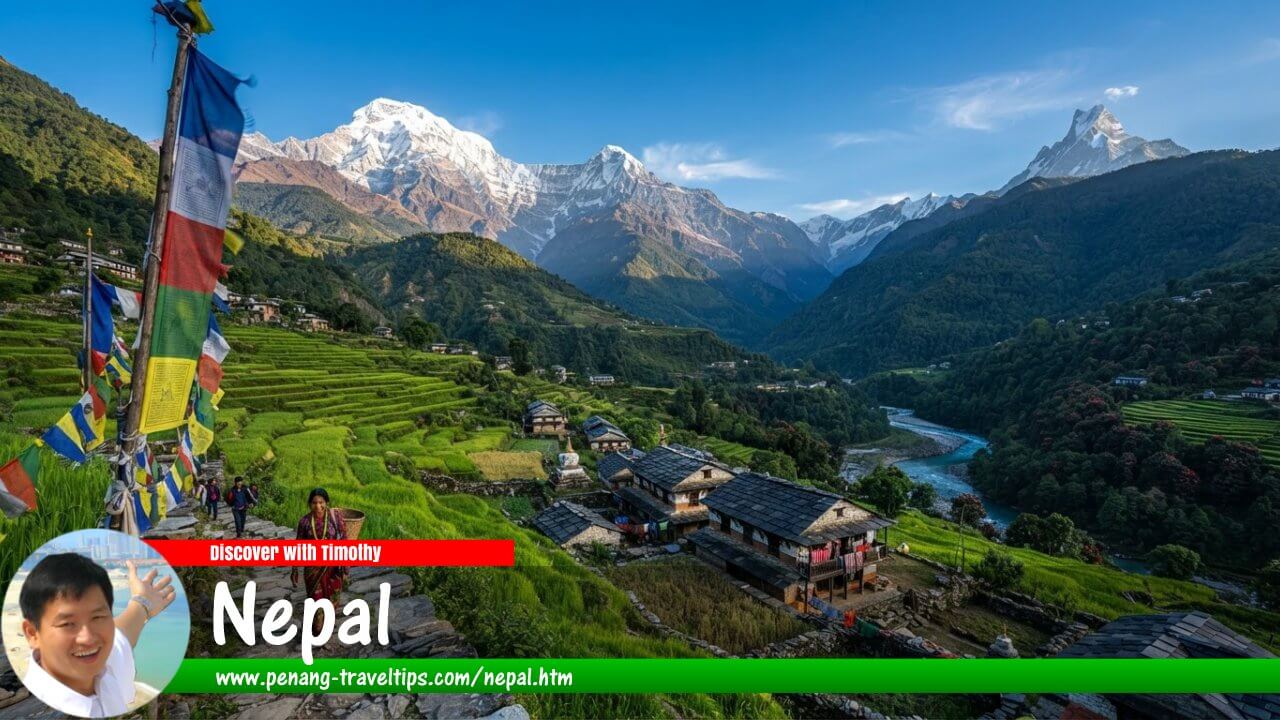 Nepal Travel Guide (AI Image generated on 25 August 2026)
Also available: Panduan Melawat Nepal
Introduction to Nepal
Nepal is a small landlocked country in South Asia, best known for the Himalayas, Mount Everest, ancient temples and a rich mixture of Hindu and Buddhist cultures. Despite its relatively small size, Nepal has an extraordinary range of landscapes, from the lowland plains of the Terai to some of the highest mountains on Earth.
For travellers, Nepal offers much more than mountaineering. You can explore historic cities, visit sacred temples and Buddhist stupas, enjoy the lakeside atmosphere of Pokhara, go on a wildlife safari in Chitwan, visit the birthplace of Buddha at Lumbini, or embark on a Himalayan trek.
Where is Nepal?
Nepal is situated between India to the south, east and west, and China to the north. It has no coastline and is dominated by hills and mountains.
Its position between the Indian subcontinent and the Tibetan Plateau has given Nepal a distinctive cultural character. Indian influences are particularly evident in Hindu traditions, while Tibetan and Himalayan influences are prominent in the northern parts of the country.
Geography of Nepal
Nepal stretches for roughly 800 kilometres from east to west but is relatively narrow from north to south. Within a comparatively short distance, the land rises from the lowlands to the high Himalayas.
The country is commonly divided into three broad geographical regions: the Terai in the south, the Hill region in the middle, and the Himalayan region in the north.
The Terai
The Terai is the lowland region along Nepal's southern border with India. It has a warmer climate and contains some of Nepal's most important agricultural areas.
Chitwan and Lumbini are among the best-known destinations in or near this region, and both provide an experience very different from the mountains.
The Hill Region
Between the Terai and the Himalayas lies Nepal's extensive hill region. It contains numerous valleys, forests, terraced fields and settlements.
The Kathmandu Valley and Pokhara Valley are two of the country's most important tourist areas. Both are surrounded by hills and mountains but offer very different experiences.
The Himalayas
Northern Nepal contains some of the highest mountains in the world. Mount Everest, known as Sagarmatha in Nepali, stands on the border between Nepal and China and is the world's highest mountain above sea level.
Mount Everest has an official elevation of 8,848.86 metres. The mountain lies within the Everest region, part of which is protected by Sagarmatha National Park, a UNESCO World Heritage Site. 1
Mount Everest
Mount Everest is Nepal's most famous natural landmark, but you do not have to climb it to experience the Everest region.
Many visitors undertake trekking routes that lead into the Everest region and provide spectacular views of the mountain and surrounding peaks. Others simply want to see Everest from a distance, while scenic mountain flights from Kathmandu provide another way to experience the Himalayas.
Other Great Himalayan Mountains
Everest is only one of Nepal's many spectacular mountains. Other famous peaks include Annapurna, Dhaulagiri, Manaslu, Makalu and Cho Oyu.
The Annapurna region in particular is famous for its trekking routes and dramatic mountain scenery. Nepal's many trekking regions mean that visitors can choose routes ranging from relatively short walks to demanding high-altitude expeditions. 2
Kathmandu
Kathmandu is the capital and largest city of Nepal. It is also the country's principal international gateway and the starting point for many journeys into the rest of Nepal.
Kathmandu is much more than a place to spend the night before heading into the mountains. The city and surrounding valley contain ancient temples, Buddhist stupas, palace squares, courtyards and traditional neighbourhoods.
Kathmandu Valley
The Kathmandu Valley is one of Nepal's most important cultural regions. It encompasses the historic cities of Kathmandu, Patan and Bhaktapur.
The valley is particularly famous for Newar architecture, intricately carved wooden buildings, Hindu temples, Buddhist stupas and historic palace squares. Seven groups of monuments and buildings in the Kathmandu Valley are collectively listed as a UNESCO World Heritage Site. 3
Pokhara
Pokhara is Nepal's best-known resort city and a major base for trekking in the Annapurna region. It is famous for Phewa Lake, mountain views and its comparatively relaxed atmosphere.
Visitors can go boating on the lake, enjoy mountain views, take part in adventure activities such as paragliding, or simply relax in the lakeside area. The Annapurna range provides an impressive backdrop to the city. 4
Chitwan
Chitwan offers an experience very different from Kathmandu and the Himalayas. Its principal attraction is Chitwan National Park, a protected area in the lowlands of southern Nepal.
The park is famous for its one-horned rhinoceros and other wildlife. Visitors can take part in jungle safaris, birdwatching, canoe trips and cultural experiences involving the local Tharu community. Chitwan National Park is also a UNESCO World Heritage Site. 5
Lumbini
Lumbini is one of the most important Buddhist pilgrimage sites in the world. It is traditionally regarded as the birthplace of Siddhartha Gautama, who became known as the Buddha.
The Sacred Garden and archaeological remains at Lumbini form a UNESCO World Heritage Site. The wider Lumbini area contains monasteries and temples established by Buddhist communities from different countries, making it an interesting place to observe the diversity of Buddhist traditions. 6
A Brief History of Nepal
Nepal has a long and complex history involving numerous kingdoms, dynasties and ethnic communities. The Kathmandu Valley became an important centre of trade, religion and culture, and its historic cities developed some of the finest traditional architecture in the Himalayas.
One particularly important period was the Malla era, when several Malla kingdoms flourished in the Kathmandu Valley. The rulers and craftsmen of this period contributed greatly to the temples, palaces, courtyards and artistic traditions that visitors can still see today.
The Unification of Nepal
Modern Nepal emerged from the unification of numerous smaller kingdoms and principalities. A key figure in this process was Prithvi Narayan Shah, the king of Gorkha who began expanding his kingdom in the 18th century.
His campaigns eventually brought Kathmandu and neighbouring territories under Gorkha rule, laying the foundations of the modern Nepalese state.
The Shah Dynasty
The Shah dynasty ruled Nepal for more than two centuries. Nepal remained a monarchy until 2008, when the monarchy was formally abolished and the country became a republic.
The transition followed years of political change, including a civil conflict, democratic movements and the eventual establishment of a federal democratic republic.
Modern Nepal
Today, Nepal is a federal democratic republic divided into seven provinces. The country continues to combine modern political institutions with cultural traditions that have developed over centuries.
The legacy of the former monarchy, ancient kingdoms and traditional communities remains visible in Nepal's historic cities, festivals, religious practices and architecture.
The 2015 Earthquake
On 25 April 2015, a devastating earthquake struck Nepal, causing extensive loss of life and widespread destruction. Numerous homes and historic buildings were damaged, particularly in the Kathmandu Valley.
Reconstruction and restoration have continued since then, and many important heritage monuments have been restored. Visitors may still encounter evidence of the earthquake and subsequent reconstruction in some historic areas.
The People of Nepal
Nepal is home to a remarkable variety of ethnic and cultural communities. Among the better-known groups are the Newar, Gurung, Magar, Tamang, Sherpa and Tharu, although the country's population includes many other communities as well.
This diversity can be seen in Nepal's languages, traditional clothing, food, architecture, festivals and religious practices.
The Sherpa
The Sherpa are among Nepal's best-known ethnic communities, particularly because of their historical connection with the high Himalayas and mountaineering expeditions.
Many Sherpa communities live in the Khumbu region near Everest. They have their own language, culture and traditions, which have developed over generations in the high-altitude environment.
The Newar
The Newar are an important indigenous community of the Kathmandu Valley. They are particularly renowned for their architecture, woodcarving, metalwork, festivals and religious traditions.
Much of the traditional architecture found in Kathmandu, Patan and Bhaktapur reflects Newar craftsmanship and cultural heritage.
The Tharu
The Tharu are one of the major communities of the Terai. Their culture can be experienced particularly around Chitwan, where visitors can learn about traditional village life, architecture, music and dance.
Religion in Nepal
Hinduism and Buddhism have had a profound influence on Nepal's history and culture. The two traditions have also interacted closely over the centuries, particularly in the Kathmandu Valley.
Nepal is also home to Muslim, Kirat, Christian and other religious communities. This religious diversity is an important part of the country's cultural identity.
Hinduism in Nepal
Hinduism is the largest religious tradition in Nepal. One of the country's most important Hindu sites is Pashupatinath Temple in Kathmandu, one of the most significant Hindu temples dedicated to Lord Shiva.
Hindu temples and shrines can be found throughout Nepal, from major cities to villages and remote mountain communities.
Buddhism in Nepal
Nepal has an especially important place in Buddhist history because Lumbini is regarded as the birthplace of the Buddha.
Buddhist traditions are particularly prominent in the Kathmandu Valley and Himalayan regions. Swayambhunath and Boudhanath are among the best-known Buddhist sites in Kathmandu.
Languages of Nepal
Nepali is the official language of Nepal, but the country has many other languages spoken by different ethnic and regional communities.
English is widely used in the tourism industry, particularly in hotels, restaurants, trekking agencies and areas frequently visited by international travellers.
Currency of Nepal
The currency of Nepal is the Nepalese Rupee (NPR). Cash remains useful, especially outside the major cities and during trekking trips.
Cards and digital payments are increasingly accepted in tourist areas, but travellers should still carry sufficient cash for small purchases, local transport and places where electronic payment is unavailable.
Time in Nepal
Nepal uses Nepal Time (NPT), which is 2 hours and 15 minutes behind Malaysia. When it is 10.00am in Malaysia, it is 7.45am in Nepal.
Nepal uses a single official time zone despite the considerable geographical differences between its eastern and western regions.
Climate of Nepal
Nepal's climate varies greatly according to altitude. Kathmandu and Pokhara have relatively moderate climates, while the high Himalayan regions can be extremely cold.
Nepal generally experiences four seasons: spring, summer/monsoon, autumn and winter. The best time to visit depends greatly on what you intend to do.
Spring
Spring generally runs from March to May. Temperatures become warmer and rhododendrons, Nepal's national flower, bloom in many mountain areas.
This is also a popular period for trekking, particularly towards the higher Himalayan regions.
Monsoon Season
The monsoon generally affects Nepal from June to September. Heavy rainfall can make some trekking routes muddy or difficult and may also slow road journeys.
However, some areas north of the main Himalayan range, such as Mustang, lie in the rain shadow and can remain relatively dry during the monsoon.
Autumn
Autumn, particularly October and November, is widely regarded as one of the best periods for visiting Nepal. After the monsoon, skies are often clearer and mountain visibility can be excellent.
This is also one of the busiest trekking seasons, so popular trekking routes and accommodation can become crowded.
Winter
Winter lasts roughly from December to February. Kathmandu and Pokhara can be chilly, especially in the mornings and evenings, while temperatures in the high mountains can fall far below freezing.
For travellers who are not planning high-altitude trekking, winter can still be an enjoyable time to explore Nepal's cities and cultural attractions.
Is Nepal Suitable for Malaysian Travellers?
Yes. Nepal is particularly appealing to Malaysian travellers because it offers a very different experience from Southeast Asia while remaining relatively accessible.
You can visit historic cities, enjoy the mountain scenery around Pokhara, explore Chitwan, visit Lumbini or undertake a trek without having to climb Mount Everest.
Visa for Malaysian Travellers
Malaysian passport holders require a visa to enter Nepal. Nepal offers Visa on Arrival to eligible travellers at designated entry points, including Tribhuvan International Airport in Kathmandu. Tourist visas are available for different periods, including 15, 30 and 90 days. 7
Travellers can complete the visa application process online before arrival or use the immigration facilities at the airport. The Department of Immigration recommends checking its official visa information before travelling because visa fees, procedures and entry requirements may change. 8
Do You Need to Trek to Enjoy Nepal?
Not at all. Trekking is one of Nepal's greatest attractions, but it is only one part of the country's tourism experience.
Travellers who are not interested in strenuous hiking can spend their time exploring Kathmandu, Patan and Bhaktapur, relaxing in Pokhara, going on a wildlife safari in Chitwan or visiting the Buddhist pilgrimage site of Lumbini.
Nepal and the Himalayas
Although Nepal is strongly associated with Mount Everest, the country's appeal extends far beyond the world's highest mountain.
The Kathmandu Valley offers centuries of cultural heritage, Pokhara provides lakes and mountain scenery, Chitwan offers wildlife and Lumbini provides an important Buddhist pilgrimage experience.
Why Visit Nepal?
Nepal is an excellent destination for travellers looking for something different. Few countries combine towering mountains, ancient cities, Hindu and Buddhist traditions, diverse ethnic communities, wildlife and spectacular landscapes in such a compact area.
For Malaysian travellers, Nepal can be a particularly memorable journey. You might explore ancient temples in the morning, see the Himalayas in the afternoon and enjoy traditional Nepalese food in the evening.
And for those seeking adventure, Nepal offers some of the world's most famous trekking routes.
Places to Visit in Nepal
Nepal may be best known for Mount Everest, but the country offers a remarkable variety of attractions. Historic cities, Hindu temples, Buddhist stupas, mountain valleys, national parks and traditional villages can all be included in a Nepal itinerary.
For a first visit, most travellers combine several of the country's major destinations, such as Kathmandu, Pokhara, Chitwan and Lumbini. Those interested in trekking can then add the Everest, Annapurna or Langtang regions.
Kathmandu
Kathmandu is the natural starting point for most trips to Nepal. The capital is crowded and energetic, but its historic neighbourhoods contain an extraordinary concentration of temples, shrines, courtyards and traditional architecture.
The city is also a convenient base for visiting the other historic cities and religious sites of the Kathmandu Valley.
Kathmandu Durbar Square
Kathmandu Durbar Square, also known as Hanuman Dhoka Durbar Square, was once the royal centre of Kathmandu. The square contains palaces, courtyards, temples and other historic buildings reflecting the architectural traditions of the Kathmandu Valley.
It forms one of the seven monument zones that make up the UNESCO World Heritage property known as the Kathmandu Valley. 9
Swayambhunath
Swayambhunath, often called the Monkey Temple, is one of Kathmandu's best-known landmarks. The Buddhist stupa stands on a hill overlooking the city and is reached by a long flight of steps.
The site is one of the seven monument zones within the Kathmandu Valley UNESCO World Heritage property. Its elevated position also provides impressive views across Kathmandu. 10
Boudhanath
Boudhanath Stupa is one of the largest and most important Buddhist stupas in Nepal. Its enormous white dome and distinctive Buddha eyes make it one of the most recognisable sights in Kathmandu.
The area around the stupa has numerous monasteries, shops and restaurants, and it remains an important centre of Tibetan Buddhist culture. Boudhanath is also one of the seven monument zones of the Kathmandu Valley UNESCO World Heritage property. 11
Pashupatinath Temple
Pashupatinath Temple is one of the most important Hindu temples in Nepal and one of the country's major pilgrimage sites. The temple complex stands beside the Bagmati River in Kathmandu.
Non-Hindus are not permitted to enter the main temple, but visitors can explore parts of the surrounding complex and observe the religious activities along the river. Pashupatinath forms one of the seven monument zones of the Kathmandu Valley World Heritage property. 12
Garden of Dreams
Garden of Dreams is a peaceful historic garden in central Kathmandu, close to the busy Thamel district. It provides a welcome contrast to the noise and traffic of the surrounding city.
The landscaped garden contains lawns, pavilions, ponds and fountains and is a pleasant place to take a break between sightseeing activities.
Thamel
Thamel is Kathmandu's best-known tourist district. Its narrow streets are filled with hotels, restaurants, cafés, trekking agencies, souvenir shops and outdoor-equipment stores.
It is particularly convenient for travellers preparing for a trek because trekking equipment, guides and travel services are readily available in the area.
Patan
Patan, also known as Lalitpur, lies immediately south of Kathmandu. It is one of the three historic cities of the Kathmandu Valley and is particularly renowned for its traditional Newar architecture and metalwork.
The city's historic centre is considerably more compact than Kathmandu and can be rewarding to explore on foot.
Patan Durbar Square
Patan Durbar Square is the historic heart of the city. Its temples, courtyards and palace buildings demonstrate the extraordinary craftsmanship of the Newar builders of the Kathmandu Valley.
Patan Durbar Square is one of the seven monument zones included in the Kathmandu Valley UNESCO World Heritage property. 13
Bhaktapur
Bhaktapur is another historic city in the Kathmandu Valley. Compared with central Kathmandu, it has retained a particularly strong traditional character, with brick-paved streets, courtyards, temples and traditional Newar buildings.
Its historic centre forms another of the seven monument zones of the Kathmandu Valley World Heritage property. 14
Bhaktapur Durbar Square
Bhaktapur Durbar Square contains some of the finest traditional architecture in Nepal. Among its best-known landmarks are the Golden Gate, the 55-Window Palace and the Nyatapola Temple.
Allow several hours to explore the square and surrounding streets rather than treating it as a quick photo stop.
Changu Narayan
Changu Narayan Temple stands on a hill to the east of Kathmandu Valley and is dedicated to the Hindu god Vishnu.
The temple complex is particularly significant for its ancient inscriptions and traditional architecture. Changu Narayan is the seventh monument zone within the Kathmandu Valley UNESCO World Heritage property. 15
Pokhara
Pokhara is one of the most popular destinations in Nepal and the principal gateway to the Annapurna region. The city is surrounded by green hills and spectacular Himalayan peaks.
Pokhara is suitable both for adventurous travellers and for those who simply want to relax beside the lake and enjoy the mountain scenery. The Nepal Tourism Board lists boating, hiking, birdwatching, mountain biking, paragliding and other activities among the attractions of Pokhara. 16
Phewa Lake
Phewa Lake is the centrepiece of Pokhara. The lakeside area is lined with hotels, restaurants, cafés and shops, while boats can be hired to explore the lake.
On a clear day, the reflection of the surrounding mountains on the lake provides one of Nepal's most memorable photographic scenes.
World Peace Pagoda
The World Peace Pagoda, also known as the Shanti Stupa, stands on a hill overlooking Phewa Lake. The Buddhist monument provides panoramic views of Pokhara, the lake and the surrounding mountains.
The pagoda can be reached by road or by hiking, and it can be combined with a boat trip across Phewa Lake.
Devi's Fall and Gupteshwar Mahadev Cave
Devi's Fall is a waterfall near Pokhara where water disappears into an underground channel. Across the road is Gupteshwar Mahadev Cave, a cave associated with the Hindu god Shiva.
The two attractions can conveniently be visited together during a sightseeing trip around Pokhara.
Sarangkot
Sarangkot is a hilltop viewpoint above Pokhara and is particularly popular for sunrise views of the Himalayas. On a clear morning, the panorama can include Annapurna, Dhaulagiri and the distinctive Machhapuchhre, or Fish Tail, mountain.
Sarangkot is also one of the main launching areas for paragliding in the Pokhara region.
Everest Region
The Everest region is one of the world's most famous trekking destinations. The journey takes visitors through mountain villages, Buddhist monasteries and dramatic Himalayan landscapes towards the area surrounding Mount Everest.
The region lies within and around Sagarmatha National Park, where glaciers, deep valleys and high mountain peaks dominate the landscape. The park is also home to the Sherpa people and was inscribed as a UNESCO World Heritage Site in 1979. 17
Namche Bazaar
Namche Bazaar is one of the best-known settlements on the route to Everest Base Camp. Situated at high altitude, it serves as an important trading centre and acclimatisation stop for trekkers.
The town is surrounded by mountains and provides an opportunity to experience Sherpa culture before continuing towards higher elevations.
Everest Base Camp Trek
The Everest Base Camp Trek is one of Nepal's most famous trekking adventures. It does not involve climbing Mount Everest itself; instead, trekkers follow established trails through the Khumbu region to reach the base camp area.
The trek requires good physical preparation and acclimatisation because much of the route is at high altitude. It should not be approached as an ordinary sightseeing excursion.
Annapurna Region
The Annapurna region is another major trekking destination and offers a wide variety of routes. Some treks are relatively short and moderate, while others involve long journeys through high mountain passes.
The scenery changes dramatically along the way, from subtropical valleys and terraced fields to high-altitude landscapes dominated by snow-covered peaks.
Annapurna Circuit
The Annapurna Circuit is one of Nepal's classic long-distance treks. The route passes through villages and landscapes on different sides of the Annapurna massif and crosses high mountain terrain.
Because roads and other infrastructure have changed sections of the traditional route, the exact trekking experience can vary. Travellers should obtain current route information before setting out.
Langtang Region
The Langtang region is another popular trekking area that can be reached relatively easily from Kathmandu. It offers mountain scenery, villages, forests and opportunities to experience the culture of the local communities.
Langtang can be an attractive alternative for travellers who want a Himalayan trekking experience without choosing the Everest route.
Chitwan National Park
Chitwan National Park is one of Nepal's most important wildlife destinations. Located in the lowlands of southern Nepal, the park protects forests, grasslands and wetlands supporting a variety of wildlife.
Among the animals found in the park are the greater one-horned rhinoceros, Bengal tiger, wild elephant, leopard, sloth bear and numerous bird species. Visitors can explore the area through jeep safaris, canoe trips, birdwatching and guided nature activities. 18
Tharu Villages
A visit to Chitwan can be combined with an introduction to Tharu culture. The Tharu are one of the major indigenous communities of the Terai, and their traditional culture is an important part of the Chitwan experience.
Cultural programmes may include traditional music and dance, although visitors should choose responsible operators that respect local communities.
Lumbini
Lumbini is one of the most important Buddhist pilgrimage destinations in the world and is traditionally recognised as the birthplace of Siddhartha Gautama, the Buddha.
The sacred area includes the Maya Devi Temple, the Ashoka Pillar and archaeological remains associated with the early Buddhist pilgrimage site. Lumbini is a UNESCO World Heritage Site. 19
Maya Devi Temple
Maya Devi Temple is the principal sacred building at Lumbini. It marks the traditional birthplace of the Buddha and stands within the Sacred Garden.
The archaeological remains inside the temple complex are particularly important to Buddhist pilgrims and visitors interested in the early history of Buddhism.
Janakpur
Janakpur, in southeastern Nepal, is an important Hindu pilgrimage destination associated with the Hindu epic Ramayana. It is traditionally regarded as the birthplace of Sita and the place where she married Rama.
The city's most famous landmark is Janaki Mandir, an elaborate temple that attracts Hindu pilgrims from Nepal and India.
Bandipur
Bandipur is a historic hilltop settlement between Kathmandu and Pokhara. Its traditional Newar architecture, pedestrian-friendly main street and mountain views have made it increasingly popular with travellers.
Bandipur is a good choice for those who want to experience a smaller traditional settlement rather than spending the entire trip in Nepal's major tourist cities.
Nagarkot
Nagarkot is a hill station on the eastern edge of the Kathmandu Valley. It is popular for sunrise and sunset views over the Himalayan range.
On a clear day, the views can stretch across a broad section of the Himalayas. Nagarkot is often visited as an overnight excursion from Kathmandu.
Mustang
Mustang is a remote Himalayan region with a landscape and culture markedly different from the greener valleys of central Nepal. The region contains barren mountains, deep valleys, ancient settlements and strong Tibetan cultural influences.
Upper Mustang in particular is known for its distinctive landscape and historic villages. Access is more regulated than in many other parts of Nepal, and travellers should check current permit and trekking requirements before visiting.
Gosaikunda
Gosaikunda is a high-altitude lake in the Langtang region and an important Hindu pilgrimage site. It is surrounded by mountains and can be reached through trekking routes.
The area is particularly significant during the Janai Purnima festival, when Hindu pilgrims travel to the lake for religious observances.
Rara Lake
Rara Lake is Nepal's largest lake and lies in the remote northwest of the country. It is surrounded by mountains and forests within Rara National Park.
Because it is much more difficult to reach than Kathmandu, Pokhara or Chitwan, Rara is better suited to travellers who have more time and want to explore a less-visited part of Nepal.
Bardia National Park
Bardia National Park, also known as Bardiya National Park, is another important wildlife destination in Nepal. It is located in the western Terai and is considerably less visited than Chitwan.
The park offers opportunities to see rhinoceroses, deer, crocodiles, wild elephants and, with luck, Bengal tigers. It can be an appealing choice for travellers who prefer a quieter wildlife experience.
Choosing Where to Go
For a first trip to Nepal, Kathmandu and Pokhara make a natural combination. They provide a mixture of cultural attractions, mountain scenery, restaurants and tourist facilities.
If you have additional time, add Chitwan for wildlife or Lumbini for Buddhist history. If mountains and trekking are your main interests, consider replacing some of the city sightseeing with the Everest, Annapurna or Langtang regions.
Nepal's Greatest Attraction
Ultimately, Nepal's greatest attraction is the combination of its people, landscapes and cultures. You can visit a centuries-old temple in Kathmandu, watch the sun rise over the Himalayas in Pokhara, walk through a jungle in Chitwan and explore a Buddhist pilgrimage site in Lumbini—all within the same country.
That variety is what makes Nepal much more than simply a destination for people who want to climb mountains.
Getting to Nepal and Getting Around
For most international visitors, the easiest way to reach Nepal is by air, arriving at Tribhuvan International Airport (TIA) in Kathmandu. From Kathmandu, you can continue by domestic flight, tourist bus, private car or other local transport depending on your destination.
Flying to Nepal
Tribhuvan International Airport in Kathmandu is Nepal's principal international gateway. Nepal Tourism Board lists international connections from Kathmandu to a number of Asian and Middle Eastern cities, including Kuala Lumpur, Bangkok, Delhi, Dubai, Doha, Hong Kong and Narita. 20
For travellers from Malaysia, flying from Kuala Lumpur to Kathmandu is particularly convenient because Kathmandu has direct air connections with Kuala Lumpur. Nepal Tourism Board currently lists Nepal Airlines and other carriers operating services between the two cities. 21
Flights from Malaysia
When searching for flights from Malaysia, compare both direct services and one-stop itineraries. Depending on the dates and airline schedules, connecting through another Asian city may sometimes offer a better fare or more convenient departure time.
Flight schedules change, so it is advisable to check the airline's current timetable before making your travel arrangements.
Arriving at Kathmandu Airport
Most international visitors arrive at Tribhuvan International Airport in Kathmandu. After immigration and baggage collection, you can continue to your hotel by taxi or other available transport.
The airport is relatively close to central Kathmandu, but traffic can make the journey considerably longer than the distance on a map might suggest.
Visa on Arrival
Eligible visitors can obtain a Visa on Arrival at Tribhuvan International Airport. Nepal's Department of Immigration currently lists tourist visa fees of US$30 for 15 days, US$50 for 30 days and US$125 for 90 days. 22
You can complete the online tourist visa form before arriving or use the kiosks at the airport. The immigration authorities advise travellers to keep the submission receipt with its barcode and present it during the visa process. 23
Getting from Kathmandu Airport to Your Hotel
A taxi is generally the simplest option for first-time visitors. Many hotels can also arrange an airport transfer, which can be worthwhile if you are arriving late at night or carrying substantial luggage.
Nepal Tourism Board has also published information on airport shuttle services serving several hotel areas in Kathmandu, including Thamel and other central districts. 24
Taxi in Kathmandu
Metered taxis are widely available in Kathmandu. Nepal Tourism Board advises travellers to look for taxis with the appropriate taxi sign and black licence plate. 25
In practice, some taxis may quote a negotiated fare rather than use the meter. If you are unsure of the fare, ask your hotel to help arrange a taxi or agree on the price before starting the journey.
Ride-Hailing and Digital Transport
App-based transport services have become increasingly useful in Kathmandu. Availability can vary, however, so do not rely entirely on a single app throughout your trip.
For longer journeys or sightseeing days, hiring a private car with a driver can be more convenient than arranging individual rides.
Getting Around Kathmandu
Kathmandu has buses, minibuses, microbuses, taxis, three-wheelers and other forms of local transport. Public buses are inexpensive but can be crowded and may not be particularly convenient for first-time visitors. 26
For tourists, walking, taxis and hired cars are generally the easiest ways to explore the central attractions.
Walking in Kathmandu
Many of Kathmandu's most interesting areas are best explored on foot. Thamel, the historic centre and several temple areas can be visited by walking.
However, sidewalks can be uneven or crowded, and traffic can be challenging. Pay close attention when crossing roads and allow extra time for short journeys.
Travelling Between Cities
Nepal does not have a railway network connecting its major tourist cities. Long-distance travel is mainly by road or air. Nepal Tourism Board lists buses as the principal long-distance land transport and domestic flights as the faster alternative for many destinations. 27
For the major tourist routes, you can choose between ordinary buses, tourist buses, private cars and domestic flights.
Kathmandu to Pokhara
The journey between Kathmandu and Pokhara is one of the most common routes for tourists. You can travel by domestic flight or by road.
A flight is considerably faster, while a road journey allows you to see more of the countryside. However, road conditions, traffic and weather can make the journey take considerably longer than the distance might suggest.
Flying to Pokhara
Domestic flights connect Kathmandu with Pokhara International Airport. Flying is the most time-efficient option if you have a short holiday.
Mountain weather can sometimes affect flights, so avoid scheduling an important international connection immediately after a domestic flight.
Bus to Pokhara
Tourist buses operate between Kathmandu and Pokhara. They are a popular option for travellers who want to save money or enjoy the scenery along the route.
Tourist buses generally offer a more comfortable experience than ordinary public buses, although the journey can still be tiring because of traffic and road conditions.
Kathmandu to Chitwan
Chitwan can be reached from Kathmandu by road or by air. Tourist buses and other long-distance services operate towards the Chitwan area.
A private car can be a convenient option if you are travelling as a family or group and want to combine Chitwan with other stops along the way.
Kathmandu to Lumbini
Lumbini is considerably farther from Kathmandu than Pokhara. It can be reached by road or by flying to the nearby airport and continuing by road.
If your itinerary includes Kathmandu, Pokhara and Lumbini, consider the order of your destinations carefully so that you do not spend too much of your holiday travelling overland.
Domestic Flights
Domestic flights are an important part of travel in Nepal because mountainous terrain makes some destinations difficult to reach by road. Nepal has several domestic airlines serving destinations throughout the country. 28
Flights are particularly useful for destinations such as Pokhara and mountain airfields serving trekking regions.
Mountain Flights
If you want to see the Himalayas but do not want to undertake a trek, a mountain flight from Kathmandu is an option.
These flights are designed to provide views of the Himalayan peaks and can be an excellent alternative for travellers with limited time or limited mobility.
Flying to Lukla
Lukla is one of the principal gateways to the Everest trekking region. Flights from Kathmandu to Lukla are short, but operations can be affected by weather.
Because mountain weather can change rapidly, anyone planning an Everest trek should allow some flexibility in the itinerary rather than arranging a tight international flight connection immediately after returning from the mountains.
Domestic Flight Delays
Weather is an important consideration when travelling by air in Nepal. Fog, cloud, wind and other mountain-weather conditions can cause delays or cancellations.
If you are trekking, build a spare day into your itinerary before your international departure whenever possible. This small amount of extra time can save you considerable stress if your domestic flight is disrupted.
Private Car with Driver
For sightseeing around the Kathmandu Valley or travelling between several destinations, hiring a private car with a driver can be one of the most comfortable options.
This is particularly useful for families, older travellers and groups carrying luggage. A private vehicle also allows you to stop at viewpoints and smaller attractions along the route.
Driving Yourself
Self-driving is generally not the first choice for international visitors to Nepal. Traffic, road conditions, unfamiliar driving practices and mountainous terrain can make driving more demanding than many travellers expect.
For most visitors, hiring a car with a local driver is a more practical solution.
Tourist Buses
Tourist buses are widely used for journeys between Kathmandu and major tourist destinations such as Pokhara, Chitwan and Lumbini. They are generally more comfortable than ordinary local buses and are designed with tourists in mind.
Even so, road journeys in Nepal can be slow. A journey that looks short on a map can take many hours.
Ordinary Buses
Ordinary buses are the cheapest way to travel around Nepal, but they can be crowded and less comfortable. They are more suitable for experienced travellers who are comfortable navigating local transport.
If comfort and reliability are more important than saving a small amount of money, a tourist bus or private vehicle is usually preferable.
Road Conditions
Nepal is a mountainous country, and road conditions vary considerably. Some major roads have been upgraded, while others can be narrow, winding or affected by landslides and weather.
During the monsoon, heavy rain can cause delays and temporary road closures. Check the latest local conditions before beginning a long road journey.
Travelling During the Monsoon
If you travel during the monsoon season, allow extra time for road journeys. Heavy rainfall can affect traffic and road conditions, particularly in mountainous areas.
Domestic flights can also be affected by poor visibility, so travellers should avoid building an itinerary with connections that leave no margin for delay.
Getting Around Pokhara
Pokhara is relatively easy to explore. Taxis, private cars and other local transport are available, while many attractions around the city can also be reached through organised tours.
The Lakeside area is particularly convenient for visitors because hotels, restaurants, shops and tour operators are concentrated within a relatively small area.
Getting Around Chitwan
Most visitors to Chitwan stay in or near the tourist areas around Sauraha or other gateways to the national park. Hotels and lodges can generally arrange transport and safari activities.
Once you are staying in the area, you are unlikely to need complicated public transport arrangements.
Trekking Transport
Transport for a trekking trip is usually arranged as part of the overall itinerary. Depending on the trekking region, you may combine a domestic flight, road transfer and walking.
For independent trekkers, it is important to understand where the trail begins, how to reach the trailhead and whether permits or other documentation are required.
Trekkers and Permits
Some trekking regions require permits or other official documentation. Requirements vary according to the trekking area and can change over time.
Before leaving Kathmandu or another gateway, check the current requirements with the relevant authorities or a reputable trekking agency.
Hiring a Guide
A local guide can make a Himalayan trek considerably easier. Besides navigation, a good guide can help with accommodation, meals, weather changes and local customs.
For difficult or remote routes, travelling with an experienced guide is strongly advisable rather than relying entirely on a smartphone map.
Porters
Porters are commonly employed on longer treks in Nepal. If you hire a porter, agree clearly on the responsibilities, weight of luggage and payment arrangements before starting the trek.
Responsible trekking companies should follow appropriate standards for porter welfare and avoid asking porters to carry excessive loads.
Travel Insurance for Trekking
If you are planning a trek, make sure your travel insurance specifically covers the activities and altitude involved. Ordinary travel insurance may not cover high-altitude trekking, helicopter evacuation or other adventure activities.
Check the policy carefully rather than assuming that all trekking-related expenses are automatically covered.
Helicopter Rescue
Helicopter evacuation is sometimes required in the Himalayas because of altitude sickness, injury or other emergencies. The cost can be substantial.
This is one reason why comprehensive travel insurance is particularly important for trekkers. Keep the insurer's emergency contact information easily accessible during the trek.
Altitude and Transport
Reaching a high-altitude destination quickly by aircraft can present a greater acclimatisation challenge than gradually walking upwards. This is particularly relevant when flying directly into mountain regions for trekking.
Do not treat altitude sickness as simply being tired. If symptoms become serious, descend to a lower altitude and seek medical assistance.
Choosing the Right Transport
For a first visit, a combination of transport usually works best: walk or use taxis around Kathmandu, fly or take a tourist bus to Pokhara, use organised transport for Chitwan, and arrange appropriate flights and ground transfers for trekking regions.
The best choice depends on how much time you have. If your holiday is short, spending a little more on domestic flights can give you considerably more time at your destination.
Allow Extra Time
One of the most important rules when travelling around Nepal is to avoid overly tight schedules. Road delays, weather, flight cancellations and unexpected changes can happen.
In particular, leave at least one buffer day before an important international flight if your itinerary includes mountain travel.
Travelling Overland from India
Nepal can also be reached overland from India through several official border crossings. This can be useful for travellers combining Nepal with an Indian itinerary.
However, for a holiday beginning in Malaysia, flying directly to Kathmandu will usually be considerably more convenient than travelling overland from India.
Travelling from China
Nepal also shares a border with China, but overland travel between Tibet and Nepal is more complicated than ordinary international travel because of border controls and the requirements for visiting Tibet.
Travellers considering this route should check the latest entry and permit requirements for both countries before making arrangements.
Which Transport Should Malaysian Travellers Choose?
For most Malaysian visitors, the simplest approach is to fly from Kuala Lumpur to Kathmandu, use taxis or private transport within the Kathmandu Valley, fly or take a tourist bus to Pokhara, and use organised transport for trekking and wildlife destinations.
This gives you a good balance between convenience, cost and the opportunity to see Nepal's countryside.
Where to Stay and What to Eat in Nepal
Nepal offers a wide range of accommodation, from inexpensive guesthouses and family-run lodges to comfortable international hotels and luxury resorts. The choice depends largely on where you are travelling and whether your trip is focused on sightseeing, relaxation or trekking.
Where to Stay in Kathmandu
For first-time visitors, Thamel is one of the most convenient areas to stay in Kathmandu. It has a large concentration of hotels, restaurants, cafés, shops and trekking agencies, making it easy to arrange transport and excursions.
Other areas, including Lazimpat, Durbar Marg and Boudha, offer a quieter environment and a different selection of hotels and restaurants.
Thamel
Thamel is particularly popular with independent travellers and trekkers. Budget accommodation is plentiful, but there are also boutique hotels and more upscale properties.
The area is lively throughout the day and evening, although its narrow streets can become crowded. If you prefer peace and quiet, a hotel slightly away from the busiest streets may be a better choice.
Boudha
Boudha, around Boudhanath Stupa, is another attractive area for visitors. It has a strong Tibetan Buddhist character and numerous monasteries, cafés, restaurants and guesthouses.
It can be particularly appealing to travellers interested in Buddhist culture or those who prefer a more relaxed atmosphere than central Thamel.
Hotels in Kathmandu
Kathmandu has everything from basic rooms to five-star hotels. International hotel chains are represented alongside locally owned properties.
When choosing a hotel, consider its location as much as its facilities. Kathmandu traffic can make a short distance take considerably longer during busy periods.
Where to Stay in Pokhara
Most visitors to Pokhara choose accommodation around Lakeside, beside Phewa Lake. This is the main tourist district and has hotels, guesthouses, restaurants, cafés, shops and tour operators.
Accommodation ranges from simple backpacker rooms to boutique hotels and luxury resorts. Staying near the lake makes it particularly easy to walk to restaurants and arrange excursions.
Hotels in Pokhara
Pokhara has a good selection of hotels at different price levels. Some properties offer balconies or rooftop terraces with views towards the mountains.
If mountain views are important to you, check carefully whether the room actually faces the mountains. Weather and clouds can also mean that even a room with a good view does not guarantee clear mountain scenery.
Where to Stay in Chitwan
Most tourists visiting Chitwan stay around Sauraha or another gateway to Chitwan National Park. Lodges and hotels in these areas can usually arrange jungle safaris, canoe trips and other activities.
Many properties offer packages that combine accommodation, meals and activities, which can be convenient when visiting Chitwan.
Where to Stay in Lumbini
Lumbini has hotels and guesthouses catering to both pilgrims and tourists. Accommodation is generally simpler than in Kathmandu and Pokhara, although there are several comfortable hotels near the main pilgrimage area.
If Lumbini is an important part of your itinerary, staying overnight allows you to explore the site without rushing through it as a day trip.
Accommodation During Trekking
Accommodation on many of Nepal's established trekking routes is provided by teahouses or mountain lodges. These are simple establishments offering basic rooms and meals to trekkers.
Facilities become more basic as you climb higher. In some places, rooms may be unheated and bathrooms may be shared.
Teahouses
A typical teahouse may provide a simple bedroom, dining room, shared bathroom facilities and meals. Some have hot showers and Wi-Fi, although these services cannot always be expected, especially at high altitude.
During the busiest trekking seasons, it is advisable to plan your day's walk so that you arrive early enough to secure accommodation.
Luxury Lodges
Some trekking regions also have higher-end lodges offering more comfortable rooms, better food and additional facilities. These can be an attractive option for travellers who want to experience the Himalayas without sacrificing too much comfort.
However, even luxury accommodation in remote mountain areas cannot be compared directly with a five-star city hotel because supplies and infrastructure are limited.
What to Eat in Nepal
Nepalese food is influenced by the country's geography and its cultural connections with India and Tibet. Rice, lentils, vegetables, noodles, breads and dumplings are all common components of the local diet.
The food is generally less heavily spiced than some Indian cuisines, although chilli and other spices are still widely used.
Dal Bhat
Dal bhat is perhaps the most characteristic everyday meal in Nepal. It usually consists of rice, lentil soup, vegetables and other accompaniments.
For trekkers, dal bhat is particularly practical because it is filling and widely available along popular trekking routes.
Momos
Momos are steamed dumplings that have become one of Nepal's most popular foods. They can be filled with vegetables, chicken, buffalo meat or other ingredients.
They are widely available in restaurants, cafés and street-food establishments and are an easy food for visitors to try.
Thukpa
Thukpa is a Tibetan-style noodle soup commonly found in Nepal, particularly in areas influenced by Tibetan culture.
The warm soup can be especially welcome in the cooler mountain regions.
Sel Roti
Sel roti is a traditional ring-shaped rice bread that is commonly associated with Nepali festivals and celebrations.
It is particularly interesting for visitors who want to try something beyond the more familiar rice and curry dishes.
Newari Food
The Newar community of the Kathmandu Valley has a distinctive culinary tradition. Newari cuisine includes a wide range of dishes made with grains, vegetables, meat and spices.
Visitors can find Newari restaurants in Kathmandu, Patan and Bhaktapur, providing an opportunity to experience one of the country's richest regional food traditions.
Food in the Mountains
Food becomes more expensive and the selection becomes more limited as you travel deeper into the Himalayas. Almost everything has to be transported from lower elevations.
Rice, noodles, potatoes, soups, eggs and dal bhat are common trekking foods. Higher-altitude lodges generally offer a surprisingly varied menu, but availability depends on the location and season.
Is Nepalese Food Spicy?
Nepalese food can be spicy, but not every dish is hot. If you do not eat chilli, simply ask the restaurant to prepare the food without or with less chilli.
Indian, Tibetan and international dishes are also widely available in the main tourist areas.
Vegetarian Food
Vegetarian food is relatively easy to find in Nepal. Dal, vegetables, rice, noodles, breads and vegetarian momos are common.
However, travellers should still clarify ingredients if they have strict dietary requirements, particularly when eating in smaller establishments.
Halal Food in Nepal
Muslim travellers can find halal food in Nepal, particularly in Kathmandu and other major tourist centres. However, halal food is not as widely available as it is in Malaysia.
Kathmandu has a Muslim community and a number of restaurants serving South Asian and Middle Eastern food. Some restaurants specifically identify themselves as halal, while others may use halal meat without prominently advertising it.
Muslim Community in Nepal
Nepal has a long-established Muslim community, particularly in the Terai region and in parts of Kathmandu. Islam is one of the officially recognised religions of the country.
Travellers looking for halal food or a mosque should therefore have more options in Kathmandu than they might initially expect.
Mosques in Kathmandu
There are mosques in Kathmandu serving the local Muslim community. The Nepal Jame Masjid, located in the central Kathmandu area, is one of the better-known mosques in the capital.
Muslim travellers should nevertheless check the location and prayer arrangements before travelling, especially if they are staying far from the central Muslim areas.
Finding Halal Food
When looking for halal food, ask specifically whether the meat is halal and whether the restaurant prepares it separately from non-halal meat.
Travellers who follow strict halal requirements should not assume that a restaurant serving vegetarian food or food labelled "Muslim" is necessarily fully halal. Asking the staff directly is the safest approach.
Indian and Middle Eastern Food
Indian restaurants are particularly common in Kathmandu and Pokhara. Middle Eastern restaurants can also be found in the main tourist areas.
These restaurants can provide convenient options for Muslim travellers, although it is still wise to verify the halal status of meat and other ingredients.
Eating in Hotels
Large international hotels may be able to accommodate special dietary requests. If you require halal food, contact the hotel before arrival and explain exactly what you require.
This is especially useful during breakfast, when some foods may contain meat or cooking ingredients that are not immediately obvious.
Drinking Water
Travellers should be careful about drinking untreated tap water in Nepal. Use bottled, filtered or otherwise properly treated water.
When trekking, carry sufficient drinking water and use reliable purification methods if you are obtaining water from local sources.
Bottled Water
Bottled water is widely available in Kathmandu, Pokhara and other tourist areas. During trekking, however, buying bottled water can become expensive and contributes to plastic waste.
Many trekking lodges offer filtered or treated water, making a reusable bottle and suitable purification method a more environmentally responsible choice.
Food Hygiene
Food hygiene standards vary considerably. In busy tourist areas, you will find everything from modern restaurants to simple local eateries.
Choose establishments that appear clean and busy, make sure food is properly cooked, and exercise extra caution with raw vegetables, salads and food that has been sitting unrefrigerated.
Street Food
Street food can be an enjoyable part of the Nepal experience, particularly in Kathmandu and other cities. Popular snacks include momos, samosas, sel roti and various fried foods.
If you have a sensitive stomach, start cautiously and choose food that is freshly cooked and served hot.
Tea and Coffee
Tea is widely consumed in Nepal, reflecting both South Asian and Himalayan traditions. In tourist areas, coffee shops are also common, particularly in Kathmandu and Pokhara.
In the mountains, hot tea can be one of the simplest pleasures after a long day of walking.
Nepalese Tea
Nepal produces tea, particularly in the eastern part of the country. Some Nepalese teas are similar in style to teas produced in neighbouring India and have become popular among visitors.
Tea can also be purchased as a souvenir, although travellers should compare prices and quality before buying large quantities.
Eating in Kathmandu
Kathmandu has Nepal's widest range of restaurants. You can find traditional Nepali cuisine alongside Indian, Tibetan, Chinese, Japanese, Korean, Italian, Middle Eastern and other international food.
This makes Kathmandu particularly easy for travellers with different dietary preferences.
Eating in Pokhara
Pokhara's Lakeside district has a similarly broad selection of restaurants. Because it caters to trekkers and international tourists, it is possible to find both local dishes and familiar Western meals.
Prices are generally higher in the main tourist areas than in local neighbourhoods.
Food During a Trek
Food is an important part of the trekking experience. Most teahouses offer a standard menu including dal bhat, noodles, soups, pasta, rice, potatoes, eggs, pancakes and momos.
At higher elevations, choices may become more limited and prices rise because food has to be transported long distances.
Altitude and Appetite
At high altitude, some travellers experience a reduced appetite, nausea or digestive discomfort. Do not force yourself to eat large meals if you feel unwell.
Staying hydrated and eating light, nutritious meals can be more comfortable while your body adjusts to the altitude.
Accommodation for Malaysian Families
Families travelling with children may prefer hotels in Kathmandu and Pokhara that offer private bathrooms, reliable hot water and easy access to restaurants.
For family trips involving trekking, choose a route appropriate to the children's age and physical ability rather than assuming that a famous trek is suitable for everyone.
Accommodation for Older Travellers
Older travellers can enjoy Nepal without undertaking difficult treks. Comfortable hotels in Kathmandu and Pokhara provide a good base for sightseeing, while private vehicles can reduce the physical demands of travelling between destinations.
If visiting high-altitude areas, however, age is not the only consideration. Altitude affects people differently, so medical and travel advice should be considered before undertaking a high-altitude journey.
Booking Accommodation
Hotels in Kathmandu and Pokhara can generally be booked online. During peak trekking and festival periods, popular properties can become busy.
For trekking routes, accommodation is more limited. During the busiest seasons, it is wise to plan your daily walking distances and overnight stops carefully.
What Malaysian Travellers Should Expect
Visitors from Malaysia may find Nepalese accommodation and food noticeably different from what they are accustomed to at home. Hot water may not always be available, heating can be limited, and air-conditioning is generally unnecessary in many mountain areas.
In return, Nepal offers a chance to experience a distinctive culture, dramatic landscapes and some of the world's most remarkable mountain scenery.
A Comfortable Nepal Trip
If comfort is your priority, focus your itinerary on Kathmandu, Pokhara and Chitwan, and choose good-quality hotels and private transport. If adventure is your priority, allocate more time to trekking and accept that accommodation and food will become simpler as you go higher.
Either way, a little preparation goes a long way towards making a Nepal trip enjoyable.
Practical Information for Travelling in Nepal
Travelling in Nepal is generally straightforward, but the country has some practical considerations that visitors should understand before arriving. Altitude, weather, road conditions, electricity, internet access and local customs can all affect the travel experience.
Safety in Nepal
Nepal is generally a welcoming destination for tourists, but visitors should take normal precautions against theft, scams and other petty crime, particularly in crowded tourist areas.
The greater practical risks often come from road travel, mountain terrain, altitude and changing weather rather than from serious crime.
Pickpocketing and Petty Theft
Keep your passport, money, mobile phone and other valuables secure when walking through crowded markets, bus stations and busy tourist areas.
Avoid carrying large amounts of cash and keep copies of important travel documents separately from the originals.
Scams
As in many popular tourist destinations, visitors may encounter people offering tours, transport, souvenirs or other services at inflated prices. Be particularly cautious about unsolicited offers.
When booking trekking, transport or sightseeing services, use established companies and clarify exactly what is included in the price.
Road Safety
Road travel can be one of the more challenging aspects of visiting Nepal. Traffic in Kathmandu can be chaotic, while mountain roads may be narrow, winding and subject to landslides or other disruptions.
If travelling by vehicle, use a reputable operator and avoid taking unnecessary risks simply to save a small amount of money.
Crossing the Road
Take extra care when crossing roads in Kathmandu and other cities. Traffic can come from several directions and motorcycles frequently pass through narrow gaps.
Do not assume that vehicles will stop simply because you are on a pedestrian crossing.
Altitude Sickness
Altitude sickness is one of the most important health concerns for visitors travelling into the Himalayas. It can affect anyone, regardless of age or fitness level.
Symptoms can include headache, dizziness, nausea, tiredness and difficulty sleeping. More serious forms can be life-threatening.
Acclimatisation
The best protection against altitude sickness is to ascend gradually and allow your body time to acclimatise. Trekking itineraries should include appropriate acclimatisation days rather than attempting to reach high elevations too quickly.
If symptoms worsen, do not simply continue upwards. Descending to a lower elevation can be essential.
High-Altitude Trekking
Treks reaching high elevations require more preparation than ordinary hiking. Travellers should understand the route, weather, accommodation, evacuation arrangements and altitude profile before setting out.
For difficult or remote treks, using an experienced guide can substantially improve both safety and convenience.
Travel Insurance
Travel insurance is strongly recommended for Nepal, particularly if your itinerary includes trekking, mountain flights or other adventure activities.
Check whether the policy covers medical treatment, emergency evacuation, trekking at the altitude you intend to reach, trip interruption and flight delays or cancellations.
Medical Facilities
Medical facilities are most readily available in Kathmandu and other major cities. Facilities become increasingly limited as you travel into remote mountain regions.
Travellers taking regular medication should bring enough for the entire trip and keep the medicine in its original packaging.
Vaccinations
Travellers should consult a doctor or travel-health clinic before visiting Nepal to determine which vaccinations or other preventive measures are appropriate for their individual circumstances.
The recommendations can depend on the season, itinerary, activities and areas visited.
Sun Protection
Sun exposure can be surprisingly intense at high altitude. Even when the air feels cold, ultraviolet exposure can be strong.
Trekkers should carry sunscreen, sunglasses and appropriate clothing, particularly when walking on snow or at high elevations.
Dehydration
Staying hydrated is important in Nepal, especially during trekking and at high altitude. Carry drinking water with you and drink regularly rather than waiting until you feel thirsty.
Alcohol can contribute to dehydration and may also be particularly unhelpful while acclimatising to altitude.
Electricity in Nepal
Nepal uses 230 volts electricity and a frequency of 50 Hz. Power sockets can vary, so a universal travel adaptor is useful.
Power cuts can occur, particularly outside major hotels and cities, although many hotels and businesses have backup systems.
Charging Electronic Devices
Bring a power bank if you are travelling into the mountains. Charging opportunities can become limited as you move farther from major towns.
A power bank is also useful during long road journeys and in the event of unexpected power interruptions.
Internet Access
Wi-Fi is widely available in hotels, cafés and restaurants in Kathmandu and Pokhara. Internet access becomes less reliable as you travel into remote areas.
Many trekking lodges offer Wi-Fi, but the connection can be slow or intermittent and may involve an additional charge.
Mobile Phone and SIM Cards
Travellers can obtain a local Nepalese SIM card or use an international roaming service. Local SIM cards can be useful for longer stays and generally provide more affordable local data.
Bring your passport when purchasing a SIM card because identification is normally required for registration.
Internet in the Mountains
Mobile coverage is available in parts of the major trekking regions, but it should not be taken for granted. Valleys, high passes and remote areas may have little or no signal.
Trekkers should therefore avoid relying entirely on mobile internet for navigation or emergency communication.
Money in Nepal
The Nepalese Rupee is the country's official currency. Cash remains important, especially outside the major cities.
Major hotels, restaurants and shops in tourist areas may accept international credit and debit cards, but smaller establishments often prefer cash.
ATMs
ATMs are readily available in Kathmandu and Pokhara and can also be found in other tourist centres. However, availability becomes much more limited in remote mountain regions.
It is therefore sensible to withdraw sufficient cash before beginning a trek or travelling to a remote destination.
Credit Cards
Credit cards are increasingly accepted in Nepal's tourist industry, particularly at larger hotels and restaurants.
Nevertheless, carry some cash as a backup. A card payment may not be possible during a power or network failure.
Using Malaysian Ringgit
Malaysian Ringgit is not a practical currency for everyday spending in Nepal. It is better to carry an international currency such as US dollars and exchange it into Nepalese Rupees, or use ATMs where convenient.
Keep some small-denomination Nepalese notes for taxis, snacks, tips and other small purchases.
Language
Nepali is the official language, but Nepal is linguistically diverse and many other languages are spoken throughout the country.
English is widely understood in tourist areas, hotels and trekking centres. Visitors who learn a few simple Nepali expressions will generally find that locals appreciate the effort.
Useful Nepali Words
Namaste is the familiar Nepali greeting and can be used when meeting people. Dhanyabad means "thank you", while ho means "yes" and hoina means "no".
Even a few words of Nepali can make everyday interactions more pleasant.
Religion and Respect
Nepal's temples, stupas and monasteries are living religious sites rather than simply tourist attractions. Visitors should behave respectfully when entering them.
Dress modestly at religious sites, avoid disturbing worshippers and follow signs or instructions regarding photography.
Removing Shoes
Visitors are often expected to remove their shoes before entering certain temples, monasteries and religious buildings.
If you are unsure, look at what other visitors are doing or ask someone nearby.
Photography
Photography is permitted at many tourist attractions, but restrictions may apply inside religious buildings. Some sites also charge a separate photography fee.
Always ask permission before photographing people closely, particularly monks, worshippers and children.
Temples and Religious Sites
When visiting a Hindu temple or Buddhist monastery, avoid touching religious objects unless invited to do so. Do not climb onto statues, shrines or other sacred structures for photographs.
At Buddhist sites, walking clockwise around a stupa or shrine is generally customary.
Festivals in Nepal
Nepal has a remarkable calendar of Hindu and Buddhist festivals. Major celebrations include Dashain, Tihar, Holi and Buddha Jayanti, while individual communities have their own local festivals.
Festivals can make a visit particularly memorable, but they can also mean crowded streets, changes to opening hours and more difficult transport.
Dashain
Dashain is Nepal's largest Hindu festival and is celebrated over several weeks. It is a major family occasion and has an important place in Nepalese culture.
Travellers visiting during Dashain may experience a quieter Kathmandu as many residents travel to their family homes, while transport and accommodation can become busy around the holiday period.
Tihar
Tihar, also known as the festival of lights, is another major Nepalese festival. Homes are decorated with lights and colourful designs, and different days of the festival honour various animals and deities.
The festival creates a particularly lively atmosphere in Kathmandu and other cities.
Holi
Holi is the colourful Hindu festival celebrated with coloured powders and water. It is particularly lively in urban areas and can be an entertaining cultural experience for visitors.
If you do not want to participate, keep your camera and electronic devices protected and avoid wearing clothes that you do not want stained.
Public Holidays
Nepal has numerous public holidays and religious observances. Government offices, banks, museums and other attractions may have different opening arrangements on holidays.
Check the local calendar when planning your itinerary, particularly if visiting during a major festival.
Time Zone
Nepal uses a unique time zone of UTC+5:45. This means Nepal is 2 hours and 15 minutes behind Malaysia.
The 45-minute difference from Coordinated Universal Time can be easy to overlook when arranging calls or flights.
Weather and Clothing
Clothing requirements depend greatly on the altitude and season. Kathmandu can be pleasantly warm during the day but cool at night, while mountain destinations can be extremely cold.
Travellers visiting several regions should dress in layers so that clothing can be adjusted as temperatures change.
What to Pack
For a general sightseeing trip, comfortable walking shoes, lightweight clothing, a warm layer, rain protection, sunscreen and a reusable water bottle are useful.
Trekkers require considerably more specialised equipment, including suitable footwear, warm layers, a sleeping bag where necessary and appropriate protection against cold, rain and snow.
Rainy Season
If visiting between June and September, bring reliable rain protection. Roads can become muddy and slippery, while sudden downpours can occur.
A waterproof bag or dry bag is useful for protecting cameras, phones, passports and other electronic equipment.
Winter
Winter visitors should not underestimate the cold, particularly at night. Kathmandu does not have the tropical climate that Malaysian travellers may be accustomed to.
Many buildings are designed for relatively mild daytime conditions and may not have the same level of indoor heating found in colder countries.
Shopping in Nepal
Nepal offers a variety of traditional handicrafts and souvenirs. Popular purchases include pashmina products, handmade paper, prayer flags, Buddhist handicrafts, singing bowls, carpets and traditional textiles.
Thamel and the historic cities of the Kathmandu Valley have numerous shops selling souvenirs, although prices are often negotiable.
Pashmina
Pashmina products are among Nepal's best-known souvenirs. However, quality varies considerably, and travellers should be cautious about products that are labelled as genuine pashmina without adequate information about their composition.
Buy from a reputable shop if quality and authenticity are important to you.
Singing Bowls
Tibetan singing bowls are popular souvenirs associated with Himalayan Buddhist culture. They are available in tourist markets throughout Kathmandu and other destinations.
Because there are many different qualities and sizes, compare several products before buying.
Bargaining
Bargaining is common in many tourist markets, particularly for souvenirs and handicrafts. It is less appropriate in established shops, restaurants and hotels with clearly displayed prices.
Keep the process friendly. The objective should be to agree on a price that both sides consider reasonable rather than simply obtaining the lowest possible price.
Tipping in Nepal
Tipping is common in Nepal's tourism industry, particularly for guides, porters, drivers and hotel staff.
There is no single amount that applies to every situation. The appropriate tip depends on the service, length of the trip and number of people involved.
Guides and Porters
If you undertake a trek with a guide and porter, tipping is generally expected when the service has been satisfactory.
It is best to clarify beforehand whether tips are included in the package price and how they are normally handled.
Photography and Drones
Travellers who intend to use a drone in Nepal should check the current regulations before bringing one into the country or flying it.
Drone use can be restricted around airports, protected areas, heritage sites and other sensitive locations. Do not assume that a scenic landscape is automatically a legal place to fly.
Environmental Responsibility
Nepal's natural environment is one of its greatest attractions, but tourism also places pressure on mountain ecosystems.
Travellers should minimise plastic waste, use refillable water bottles where safe, avoid littering and follow local environmental rules.
Leave No Trace
When trekking, take rubbish with you if there is no appropriate disposal facility. Do not remove stones, plants, archaeological objects or other natural or cultural materials.
The Himalayas may appear vast and untouched, but even remote trails can be affected by increasing tourism.
Toilets During Trekking
Toilet facilities become increasingly basic as you climb higher. Some lodges have Western-style toilets, while others use squat toilets or simple outdoor facilities.
Carry toilet paper and hand sanitiser with you because these may not always be provided.
Using the Toilet on the Trail
If you need to use the toilet while walking, do so well away from water sources and established trails, and follow the instructions provided by your trekking guide or local authorities.
In environmentally sensitive areas, proper waste disposal is especially important.
Communication During a Trek
Tell someone your planned trekking route and expected return date before leaving. If you are travelling independently, leave your itinerary with your hotel or a trusted contact.
This is particularly important on less-travelled routes where mobile coverage may be unreliable.
Emergency Numbers
Keep a record of important emergency contacts, your travel insurance details and the contact information of your trekking agency or guide.
Rather than relying on a single number saved in your phone, keep important information written down as well in case your phone is lost or has no battery.
Customs and Etiquette
Nepalese people are generally friendly and welcoming towards visitors. A respectful attitude and awareness of local customs will go a long way.
Dress appropriately at religious sites, avoid loud behaviour around places of worship and ask permission before photographing people.
The Namaste Greeting
The traditional greeting namaste, often accompanied by bringing the palms together in front of the chest, is widely understood and appreciated.
A simple namaste can be used when greeting hotel staff, guides, shopkeepers and local residents.
Food and Drinking Etiquette
When eating with Nepalese people, follow the customs of your hosts. In traditional settings, eating with the right hand may be customary.
If you are unsure about local etiquette, simply observe what others are doing and follow their example.
Travelling with Children
Nepal can be an enjoyable destination for families, particularly if the itinerary focuses on Kathmandu, Pokhara and Chitwan rather than demanding high-altitude trekking.
Allow plenty of time for rest and avoid packing too many activities into each day.
Travelling as an Older Visitor
Older visitors can enjoy Nepal comfortably by choosing suitable accommodation, using private transport and avoiding unnecessarily strenuous itineraries.
High altitude deserves particular attention. A holiday in Kathmandu, Pokhara and Chitwan can provide a rich Nepalese experience without requiring a high-altitude trek.
Accessibility
Accessibility can be challenging in Nepal. Historic sites often have uneven surfaces, steps and narrow passages, while mountain destinations naturally present significant physical challenges.
Travellers with mobility limitations should discuss their requirements with hotels and tour operators before arrival.
Travelling Responsibly
Responsible tourism is particularly important in Nepal because many communities depend on tourism while living in environmentally fragile areas.
Support locally owned businesses where possible, treat cultural sites respectfully, minimise waste and choose trekking operators that treat guides and porters fairly.
Is Nepal Expensive?
Nepal can be a relatively affordable destination, particularly for food, local transport and budget accommodation. However, the cost can rise considerably if you choose luxury hotels, private vehicles, domestic flights, organised trekking and high-end mountain lodges.
A traveller can therefore experience Nepal on a modest budget or create a considerably more comfortable luxury itinerary.
Budget Travel
Budget travellers can stay in guesthouses, eat at local restaurants and use public or tourist buses. Trekking can also be relatively affordable when using basic teahouses and travelling with a small group.
However, do not cut costs on safety equipment, appropriate clothing, travel insurance or necessary permits.
Mid-Range Travel
A mid-range Nepal trip can combine comfortable hotels, selected domestic flights, tourist buses, good restaurants and organised sightseeing.
This is likely to be the most comfortable option for many first-time visitors from Malaysia.
Luxury Travel
Luxury travellers can choose five-star hotels in Kathmandu, upscale resorts in Pokhara and luxury lodges in selected trekking areas. Private vehicles and guides can also be arranged for much of the itinerary.
Luxury travel does not eliminate the effects of weather, traffic or altitude, however. Nepal's geography remains part of the experience.
Best Time for a General Holiday
For a general sightseeing holiday, October to November and March to April are particularly attractive periods. Weather conditions are generally favourable and mountain visibility can be excellent.
December to February can also be enjoyable for lower-altitude sightseeing, although mornings and nights can be cold.
Best Time for Trekking
For many of Nepal's classic trekking routes, spring and autumn are the most popular seasons. October and November are particularly favoured because of clearer skies following the monsoon.
March to May can also provide excellent trekking conditions and the opportunity to see rhododendrons in bloom.
Travelling During the Off-Season
Travelling outside the peak seasons can mean fewer tourists and lower prices. However, the trade-off may be less predictable weather, particularly during the monsoon.
If you are mainly interested in cultural attractions rather than trekking, an off-season visit can still be rewarding.
Suggested Itineraries for Nepal
Nepal can be visited in many different ways. A first-time visitor who has about a week may prefer to concentrate on Kathmandu and Pokhara, while travellers with more time can add Chitwan, Lumbini or a Himalayan trek.
7-Day Nepal Itinerary
A week is enough to experience some of Nepal's principal attractions, although you will need to keep the itinerary relatively focused.
Day 1: Arrive in Kathmandu
Arrive in Kathmandu and settle into your hotel. Spend the remainder of the day resting or taking a gentle walk around Thamel.
Day 2: Kathmandu
Explore the historic Kathmandu Valley, including Kathmandu Durbar Square, Swayambhunath and Boudhanath. Depending on your interests and available time, you can also visit Pashupatinath Temple.
Day 3: Bhaktapur and Patan
Visit Bhaktapur Durbar Square in the morning and continue to Patan, also known as Lalitpur. The two cities offer some of the finest traditional architecture in the Kathmandu Valley.
Day 4: Kathmandu to Pokhara
Travel to Pokhara by domestic flight or tourist bus. After checking into your hotel, spend the afternoon exploring the Lakeside area and enjoying the views of Phewa Lake.
Day 5: Pokhara
Visit Sarangkot for mountain views and explore attractions around Pokhara such as Devi's Fall, Gupteshwor Mahadev Cave and the International Mountain Museum.
Day 6: Pokhara
Spend another day in Pokhara. You can take a boat on Phewa Lake, visit the World Peace Pagoda or simply enjoy the relaxed atmosphere around Lakeside.
Day 7: Return to Kathmandu
Return to Kathmandu by air or road. If your international flight departs later in the day, use the remaining time for shopping or visiting an attraction you missed earlier.
8-Day Nepal Itinerary
With eight days, you can add a little more flexibility to the itinerary or include Chitwan National Park.
Days 1–3: Kathmandu Valley
Spend the first three days exploring Kathmandu, Swayambhunath, Boudhanath, Pashupatinath, Patan and Bhaktapur.
Day 4: Kathmandu to Chitwan
Travel by road to the Chitwan area and check into your lodge. Depending on your arrival time, you may have time for a village walk or another short activity.
Day 5: Chitwan
Spend the day exploring the natural environment around Chitwan National Park. Activities can include a jungle safari, canoe ride, birdwatching and a guided nature walk.
Day 6: Chitwan to Pokhara
Continue to Pokhara by road. The journey can take several hours, so keep the evening relatively free.
Day 7: Pokhara
Explore Pokhara and its surrounding attractions. If the weather is clear, consider an early-morning visit to Sarangkot for Himalayan views.
Day 8: Return to Kathmandu
Return to Kathmandu and prepare for your international departure.
10-Day Nepal Itinerary
Ten days gives you a more comfortable opportunity to combine Nepal's cultural attractions, mountains and wildlife.
Days 1–3: Kathmandu Valley
Use three days to explore Kathmandu, Patan and Bhaktapur. This allows you to visit the major heritage sites without rushing from one attraction to another.
Days 4–5: Chitwan
Travel to Chitwan and spend two nights there. Allow enough time for a safari and other activities before continuing your journey.
Days 6–8: Pokhara
Travel to Pokhara and spend three nights exploring the city and surrounding area. This gives you time to enjoy Phewa Lake, Sarangkot and several of Pokhara's other attractions.
Days 9–10: Kathmandu
Return to Kathmandu. Use the final day for shopping, additional sightseeing or simply relaxing before your international flight.
14-Day Nepal Itinerary
Two weeks allows you to travel at a much more comfortable pace and include a short trek or another Himalayan experience.
Days 1–3: Kathmandu Valley
Explore Kathmandu, Patan, Bhaktapur, Boudhanath, Swayambhunath and Pashupatinath. You can also use one of these days for a less crowded local neighbourhood or cultural experience.
Days 4–5: Chitwan
Travel to Chitwan and spend two nights exploring the national park and its surroundings.
Days 6–9: Pokhara
Spend four nights in Pokhara. In addition to sightseeing, you can take a short hike or day excursion into the surrounding hills.
Days 10–13: Trekking or Mountain Experience
Use four days for a suitable short trek or another mountain experience. The exact route should be chosen according to your fitness, altitude tolerance and the season.
Day 14: Kathmandu
Return to Kathmandu and keep the final day as a buffer before your international departure.
Nepal for First-Time Visitors
If this is your first trip to Nepal, there is no need to attempt to see the entire country. Kathmandu, Pokhara and Chitwan already provide a good introduction to Nepal's history, religion, scenery and wildlife.
Adding too many destinations can result in spending a large proportion of your holiday sitting in vehicles or waiting at airports.
Nepal for Nature Lovers
Nature lovers should consider combining Pokhara with Chitwan National Park. Pokhara provides access to the Himalayan landscape, while Chitwan offers a completely different environment of forests, rivers and wildlife.
If you have additional time, a trek can become the centrepiece of the trip.
Nepal for Culture Lovers
Travellers interested in history and culture should devote more time to the Kathmandu Valley. Kathmandu, Patan and Bhaktapur contain a remarkable concentration of temples, stupas, palaces and traditional architecture.
Adding Lumbini provides another important dimension because of its association with the birth of the Buddha.
Nepal for Adventure Travellers
Adventure travellers can build their itinerary around trekking, rafting, mountain flights, paragliding and other outdoor activities.
However, adventure activities should be selected according to the season and your experience level. Mountain conditions can change quickly.
Nepal for Families
Families may prefer a relatively relaxed itinerary centred on Kathmandu, Pokhara and Chitwan. These destinations provide cultural attractions, scenery and wildlife without requiring a demanding trek.
Pokhara is particularly suitable for families because the Lakeside area has many restaurants and accommodation options within easy reach.
Nepal for Older Travellers
Older travellers do not need to trek to enjoy Nepal. A private vehicle, comfortable hotels and a carefully planned itinerary can provide an excellent experience.
Consider spending more nights in fewer places rather than trying to cover too much ground.
Nepal for Muslim Travellers
Muslim visitors can travel comfortably in Nepal, particularly in Kathmandu and other major tourist centres. Halal restaurants and mosques are available, although they are less common than in Malaysia.
Travellers following strict halal requirements should identify suitable restaurants and prayer facilities in advance, particularly before travelling to smaller towns or remote trekking areas.
Nepal for Vegetarian Travellers
Vegetarian travellers generally have plenty of options. Dal, vegetables, rice, noodles, soups and vegetarian momos are widely available.
When trekking, it is still worth checking the ingredients of individual dishes because menus and preparation methods vary from one teahouse to another.
Nepal and India Combined
Nepal can be combined with India in a longer South Asian itinerary. Kathmandu can be paired with destinations such as Delhi, Varanasi or other northern Indian cities.
Lumbini is also particularly interesting for travellers who are already visiting Buddhist sites in India.
Nepal and Bhutan Combined
Nepal can also be combined with Bhutan for a Himalayan cultural journey. Both countries offer mountain scenery and Buddhist heritage, although their cultures and travel experiences are quite different.
Because flight schedules between Himalayan destinations can be limited, plan the connections carefully.
Nepal and Tibet Combined
A trip combining Nepal with Tibet can provide an extraordinary Himalayan experience. Kathmandu is one of the principal gateways for travellers continuing overland or by air towards Tibet.
However, Tibet has its own entry requirements and travel restrictions, so arrangements should be made through an authorised travel operator and checked against the latest regulations.
Short Trip from Malaysia
For Malaysians with only a week of annual leave, a focused Kathmandu and Pokhara itinerary is probably the most practical choice.
A seven-day trip can provide a good introduction to Nepal without requiring a great deal of internal travel.
Longer Trip from Malaysia
If you have two weeks or more, consider adding Chitwan, Lumbini or a short trek. A longer trip also allows you to build in buffer days for weather and transport delays.
Suggested Itinerary for Malaysian Travellers
A particularly balanced first visit could look like this:
- Days 1–3: Kathmandu Valley
- Days 4–5: Chitwan National Park
- Days 6–9: Pokhara
- Days 10–12: Short trek or mountain experience
- Days 13–14: Kathmandu and departure
This itinerary provides a mixture of culture, wildlife, mountains and relaxation without making every day a long-distance travel day.
Suggested Itinerary Without Trekking
If you are not interested in trekking, you can still experience much of Nepal. A two-week itinerary could include Kathmandu, Bhaktapur, Patan, Chitwan, Lumbini and Pokhara.
This is a good option for travellers who prefer sightseeing and cultural experiences to physically demanding activities.
Suggested Itinerary for Mountain Views
If your main objective is to see the Himalayas, spend more time around Pokhara and consider visiting Sarangkot, taking a mountain flight or joining a suitable short trek.
Early mornings generally offer the best chance of seeing clear mountain views, although weather conditions can never be guaranteed.
Suggested Itinerary for Buddhist Heritage
Travellers interested in Buddhism can focus on Kathmandu's Boudhanath and Swayambhunath, visit monasteries around the Kathmandu Valley, and continue to Lumbini.
A trip that combines Lumbini with other Buddhist destinations in northern India can make an especially meaningful pilgrimage itinerary.
Suggested Itinerary for Wildlife
Chitwan National Park is the obvious choice for a wildlife-focused Nepal trip. Spend at least two nights in the area so that you have enough time for several activities.
Depending on the season and destination, you may encounter rhinoceroses, crocodiles, deer, monkeys and a wide variety of birds. The Bengal tiger also occurs in Chitwan, although seeing one is never guaranteed.
Suggested Itinerary for Photography
Nepal is exceptionally rewarding for photographers. Kathmandu's temples and old streets provide architectural subjects, while Pokhara offers mountain and lake scenery.
Photographers should carry extra batteries or a power bank, particularly when travelling into areas where electricity may be unreliable.
When to Avoid a Tight Itinerary
Avoid planning a tightly packed schedule if your trip includes domestic flights, mountain roads or trekking. A cancelled flight or delayed road journey can otherwise cause the entire itinerary to unravel.
It is better to see slightly fewer places and enjoy them properly than to spend your holiday constantly worrying about the next connection.
Building in a Buffer Day
A buffer day is particularly valuable at the end of a trek or mountain trip. If bad weather delays a flight, you can use the spare day without missing your international flight home.
This is one of the most useful pieces of practical advice for anyone planning a Himalayan itinerary.
How Many Days Do You Need in Nepal?
Seven days is enough for a brief introduction. Ten days provides a more balanced experience, while two weeks allows you to combine cultural attractions, wildlife and mountains at a more relaxed pace.
For a substantial trek, however, you should add the time required by the particular route rather than trying to squeeze it into an already crowded itinerary.
Planning Your Nepal Trip
The best Nepal itinerary is not necessarily the one that includes the greatest number of destinations. Nepal's mountains, roads and weather make slow travel worthwhile.
Choose a few destinations that match your interests, allow enough time for transport and acclimatisation, and leave some flexibility for unexpected changes. That approach will allow you to enjoy Nepal rather than simply passing through it.
Travel Tips and Advice for Nepal
Nepal is a country where good preparation can make a significant difference to the quality of your trip. The major tourist destinations are accessible, but travelling through a mountainous country requires some flexibility. Weather, road conditions, altitude and local festivals can all affect your plans.
Choose Your Season Carefully
For most first-time visitors, October to November and March to April are among the best periods to visit Nepal. The weather is generally pleasant and the skies can be clear enough to reveal the Himalayan mountains.
If trekking is your main objective, check the conditions for the specific trekking region rather than relying only on Nepal's general seasonal pattern.
Allow Extra Time for Transport
Do not judge travelling time in Nepal solely by the distance shown on a map. Mountain roads can be slow, and traffic around Kathmandu can add considerably to journey times.
Domestic flights can also be delayed by weather. Build some flexibility into your itinerary, particularly if you are travelling to or from a trekking destination.
Keep a Buffer Before Your International Flight
If you are returning from a mountain region, avoid arranging your international departure immediately after your final domestic flight. A spare day in Kathmandu can be extremely useful if weather or other circumstances cause a delay.
This is especially important if your international flight home is not easily replaceable.
Do Not Underestimate Altitude
You do not need to be elderly or unfit to suffer from altitude sickness. Even physically fit travellers can become ill when ascending too quickly.
If your itinerary takes you above 2,500 metres, learn about altitude sickness beforehand and follow an itinerary that allows appropriate acclimatisation.
Listen to Your Body
Headache, nausea, dizziness, unusual tiredness and difficulty sleeping can be symptoms of altitude sickness. Do not simply assume that you are experiencing ordinary fatigue.
If symptoms become worse, inform your guide or travelling companions and descend to a lower elevation when appropriate.
Do Not Rush a Trek
One of the most common mistakes made by inexperienced trekkers is trying to cover too much distance each day.
A slower itinerary gives your body more time to adjust to altitude and also allows you to enjoy the scenery rather than treating the trail as a race.
Hire a Reputable Trekking Agency
If you are undertaking a serious trek, choose an established trekking agency with experienced guides and a good safety record.
Check exactly what the package includes, including permits, accommodation, meals, guide and porter services, transport and emergency arrangements.
Check Your Insurance
Before leaving Malaysia, check that your travel insurance covers the activities you intend to undertake. Some policies exclude trekking above a particular altitude or exclude adventure activities altogether.
If helicopter evacuation is relevant to your itinerary, make sure the policy explicitly covers it and understand any conditions attached to the coverage.
Bring the Right Shoes
Comfortable walking shoes are sufficient for sightseeing in Kathmandu and Pokhara, but trekking requires footwear appropriate for the terrain.
Do not start a demanding trek with brand-new shoes. Wear them beforehand so that you know they fit properly and do not cause blisters.
Dress in Layers
Nepal's temperatures can vary considerably between day and night and between lowland and high-altitude destinations.
Layering allows you to add or remove clothing as conditions change. This is generally more practical than bringing one extremely thick item of clothing.
Bring a Light Rain Jacket
A lightweight waterproof jacket is useful even outside the monsoon season. Weather in the mountains can change rapidly.
A waterproof outer layer is also useful for protecting yourself and your belongings during unexpected showers in the cities.
Protect Your Electronics
Keep your phone, camera and other electronic devices protected from rain, dust and accidental drops.
A simple waterproof pouch or dry bag can be particularly useful during trekking and long road journeys.
Carry a Power Bank
A power bank is one of the more useful items to pack for Nepal. It provides backup power during long journeys and in areas where electricity is unreliable.
Trekkers should charge their devices whenever an opportunity is available rather than waiting until the battery is almost empty.
Download Maps Before You Travel
Mobile internet can be unreliable in remote areas. Download offline maps and save important addresses before leaving Kathmandu or another major town.
For trekking, do not rely solely on a smartphone. A paper map, guidebook or experienced guide can provide valuable backup.
Keep Important Documents Accessible
Keep your passport, visa information, travel insurance details, flight bookings and emergency contacts somewhere secure and easily accessible.
It is also useful to keep electronic copies of important documents in secure cloud storage or another location that you can access if the originals are lost.
Carry Some Cash
Credit cards and digital payments are increasingly common in Nepal's tourist areas, but cash remains important.
Carry enough Nepalese Rupees for taxis, small restaurants, tips and unexpected expenses, especially when travelling outside Kathmandu.
Carry Small Notes
Small-denomination notes are useful for taxis, snacks, drinks, tips and small purchases. Large notes can sometimes be inconvenient when a small shop has little change.
Use Bottled or Treated Water
Do not assume that tap water is safe to drink everywhere. Use bottled, filtered or appropriately treated water.
During trekking, consider using refill stations and reliable purification methods to reduce the amount of plastic waste generated by bottled water.
Be Careful with Food
Enjoying Nepalese food is one of the pleasures of travelling in the country, but travellers should use sensible food-hygiene precautions.
Choose freshly prepared food, particularly in smaller establishments, and be cautious with raw salads and food that has been sitting out for long periods.
Try Local Food
Do not restrict yourself to familiar international food. Nepal has a distinctive culinary tradition, and dishes such as dal bhat, momos, thukpa and Newari specialities are worth trying.
Even if you normally prefer familiar food, trying local dishes is one of the easiest ways to experience another culture.
For Muslim Travellers
Muslim travellers can find halal food and mosques in Kathmandu, but these facilities become less common outside the main cities.
If you require strictly halal meals and regular access to prayer facilities, plan ahead before travelling into smaller towns or trekking areas.
Ask About Halal Meat
Do not assume that meat served at a restaurant is halal simply because the restaurant serves South Asian or Muslim-style food. Ask the staff directly if halal certification or preparation is important to you.
Vegetarian dishes can provide an easy alternative when suitable halal meat is unavailable.
Respect Religious Sites
Nepal's temples, stupas and monasteries are active places of worship. Dress appropriately and behave respectfully.
Follow instructions about where visitors may walk, whether shoes must be removed and whether photography is permitted.
Ask Before Photographing People
Many Nepalese people are accustomed to tourists, but that does not mean everyone wants to be photographed.
When photographing monks, religious ceremonies or individuals at close range, ask permission whenever practical.
Do Not Touch Religious Objects
Avoid touching statues, offerings, prayer objects or other sacred items unless you are invited to do so.
At Buddhist sites, observe local customs and follow the direction in which worshippers are walking around stupas and shrines.
Beware of Overcrowding During Festivals
Nepal's festivals can be an excellent time to experience local culture, but they can also make transport and accommodation more difficult.
Book accommodation early if you intend to travel during major festivals and check whether attractions will have altered opening arrangements.
Learn a Few Nepali Words
A few simple Nepali expressions can make interactions more enjoyable. Namaste is the familiar greeting, while dhanyabad means thank you.
You do not need to speak Nepali fluently. Even a small effort is usually appreciated.
Do Not Compare Nepal Too Closely with Malaysia
Malaysian travellers may initially find some aspects of Nepal unfamiliar. Infrastructure, road conditions, heating, public transport and sanitation can be different from what you are accustomed to at home.
Approach these differences as part of the travel experience, while taking sensible precautions where necessary.
Expect Traffic in Kathmandu
Kathmandu traffic can be busy, particularly during peak hours. A journey that appears to take only a few minutes on a map can take much longer.
Allow extra time when travelling to the airport or when catching a bus or domestic flight.
Do Not Plan Too Many Attractions in One Day
Kathmandu's historic attractions are close enough to appear easy to combine, but traffic, crowds and the time needed to appreciate each site can make an ambitious itinerary exhausting.
It is usually better to visit fewer places properly than to spend the entire day rushing between them.
Use Early Mornings
Early mornings can be particularly rewarding in Nepal. Mountain views are often clearest early in the day, while popular attractions may be less crowded.
Photographers should also take advantage of the softer morning light.
Be Patient
Travelling in Nepal sometimes requires patience. Vehicles can be delayed, flights can be rescheduled and plans can change because of weather.
Accepting this as part of the journey will make your holiday considerably less stressful.
Be Flexible
Keep alternative plans in mind when possible. If bad weather prevents a mountain flight or road conditions delay a journey, use the opportunity to explore another attraction rather than allowing the disruption to spoil the entire day.
Respect Local Communities
Tourism provides an important source of income for many Nepalese communities, particularly those along trekking routes. Spend money with local businesses where possible and treat residents with respect.
When trekking, consider using locally owned accommodation and services rather than relying exclusively on large international operators.
Respect Porters
Porters play an essential role in Nepal's trekking industry. If you use a porter, make sure the load is reasonable and that the person has appropriate clothing and equipment for the conditions.
Responsible tourism means considering the welfare of the people who make your trek possible.
Reduce Plastic Waste
Plastic waste is a significant concern in heavily visited mountain regions. Carry a reusable bottle and refill it with properly treated water where possible.
Avoid leaving packaging, bottles or other rubbish behind on trekking trails.
Do Not Take Souvenirs from Heritage Sites
Never remove stones, fragments, carvings, religious objects or other materials from archaeological and heritage sites.
Purchase legitimate handicrafts from local shops instead of taking anything from the historic environment.
Be Careful with Wildlife
When visiting Chitwan National Park or other wildlife areas, follow the instructions of your guide. Do not approach wild animals, feed them or attempt to attract them for photographs.
Wild animals are unpredictable even when they appear accustomed to human presence.
Do Not Feed Monkeys
Monkeys are common around several tourist and religious sites in Nepal. Feeding them encourages aggressive behaviour and can create problems for both animals and visitors.
Keep food securely stored and do not attempt to touch wild monkeys.
Photography Etiquette at Swayambhunath and Boudhanath
Both Swayambhunath and Boudhanath are important Buddhist sites as well as tourist attractions. Walk respectfully around the stupas and avoid blocking worshippers simply to obtain a photograph.
Take particular care during religious ceremonies.
Shopping Advice
Tourist shops offer many attractive handicrafts, but quality and authenticity vary. Compare products at several shops before making an expensive purchase.
For valuable items such as carpets, jewellery or high-quality pashmina, request appropriate documentation and buy from an established retailer.
Bargain Politely
Bargaining is part of shopping in many Nepalese tourist markets. However, there is no need to turn it into an aggressive negotiation.
If the final price is reasonable, remember that the difference may mean considerably more to the seller than it does to a tourist.
Keep an Eye on Your Belongings
Use hotel safes where available and avoid leaving valuables unattended in vehicles, guesthouses or public places.
When trekking, keep passports, money and other important items secure even when staying in simple teahouses.
Prepare for Simple Accommodation
If you are trekking, be prepared for accommodation that is considerably simpler than what you may experience in Kathmandu or Pokhara.
Hot showers, reliable electricity, private bathrooms and fast Wi-Fi should be regarded as conveniences rather than necessities at higher elevations.
Bring Toilet Paper
A small roll of toilet paper or packet of tissues is useful when travelling around Nepal, especially on long road journeys and treks.
Hand sanitiser is another useful item to keep in your daypack.
Carry Snacks
Carry a few energy-rich snacks when travelling long distances or trekking. Nuts, dried fruit, biscuits and energy bars can be useful when you are hungry between meals.
On trekking routes, prices increase with altitude, so carrying a small supply from lower elevations can also save money.
Keep Your Daypack Light
For day excursions, carry only what you need: water, phone, camera, sunscreen, rain protection, medication and a small amount of cash.
A lightweight daypack is much more comfortable when walking around historic cities or hiking up hills.
Check the Weather Daily
Weather conditions can change quickly in Nepal, especially in the mountains. Check the forecast before setting out each day.
If you are trekking, also ask your guide or lodge staff about local conditions because a general city forecast may not reflect conditions on the trail.
Do Not Depend Entirely on Weather Apps
Weather forecasts are useful but not infallible in mountainous terrain. Local observations can be equally important.
If a guide or local operator advises against travelling because of conditions, take the warning seriously.
Keep Your Passport Safe
Your passport is one of the most important items you carry. Keep it protected from rain, moisture and accidental damage.
When trekking, store it in a waterproof pouch rather than in an easily accessible outer pocket of your backpack.
Make Copies of Important Documents
Keep copies of your passport, visa, insurance policy and important bookings separately from the originals.
Electronic copies can also be useful if you lose your documents while travelling.
Register Your Travel Details
Before travelling, check the latest travel advisories and entry requirements issued by the Malaysian authorities. Requirements and recommendations can change.
Travellers should also keep their family or travel companions informed of their itinerary, especially if travelling independently into remote areas.
Travel with a Good Attitude
Nepal rewards travellers who are willing to slow down and accept a little unpredictability. Not every road is smooth, every flight operates on schedule or every mountain view appears exactly when you expect it.
The reward is a destination with extraordinary scenery, ancient cities, living religious traditions and some of the most memorable landscapes in Asia.
Is Nepal Worth Visiting?
Yes. Nepal offers an unusually wide range of experiences in a relatively compact country: historic cities, Hindu and Buddhist heritage, Himalayan scenery, wildlife, trekking and distinctive cuisine.
You do not have to be an experienced trekker to enjoy Nepal. A comfortable trip centred on Kathmandu, Pokhara and Chitwan can already provide an excellent introduction to the country.
Final Advice
Plan your route carefully, but leave room for flexibility. Choose accommodation and transport according to your comfort level, take altitude seriously, respect local culture and prepare for changing weather.
Most importantly, do not try to rush Nepal. Give yourself time to sit beside a Himalayan lake, wander through an ancient square, watch pilgrims circle a stupa or simply enjoy a cup of tea while looking at the mountains.
Nepal is not merely a destination to tick off a list. It is a country best experienced slowly, with curiosity and an open mind.
Page Details
This page was created on 25 August 2026. Hi, my name is Timothy and created it from my research, for my own entertainment, knowledge and to satisfy my curiosity. I am providing the information to you in good faith and hope it is useful. I try to get the details as accurate as possible. I also try to update the page whenever I stumble on new details. So this and all my other pages are perpetual work in progress. If you discover any error, please politely inform me, pointing out where the error lies, and I will correct it as soon as possible. Your helpfulness will keep this page accurate, relevant and helpful to those who need the information.Buy Me A Coffee
If you enjoy the information I provide and want to support the work I do, please buy me a coffee! I appreciate it immensely, thank you so much!
