
Mingun Travel Guide
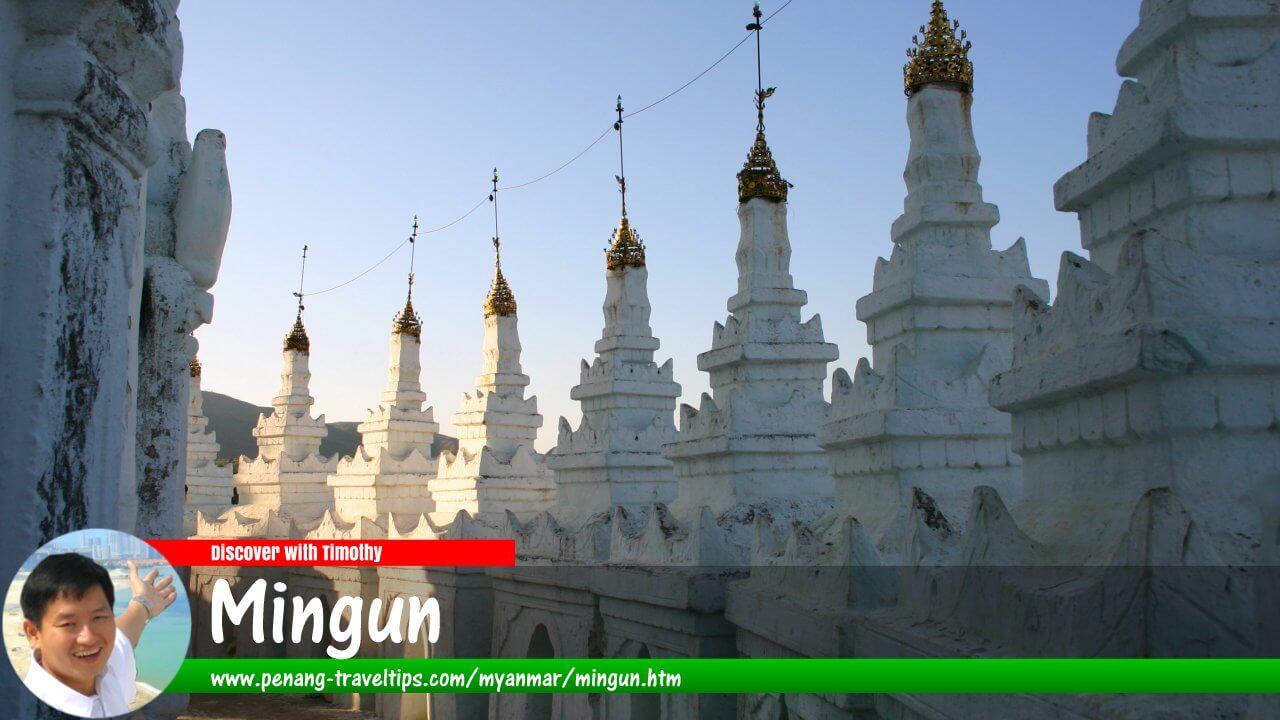 Mingun (23 November 2003)
Also available: Mingun (Malay Edition)
Mingun is a historic town on the western bank of the Ayeyarwady River in central Myanmar, best known for its monumental unfinished pagoda, enormous bell and striking white pagoda. Located upriver from Mandalay, Mingun makes a fascinating day trip for visitors interested in Myanmar's history, architecture and royal heritage.
The town lies across the river from Mandalay and is separated from the city by the broad waters of the Ayeyarwady. Its relative isolation has helped preserve a quieter atmosphere compared with the busy streets of Mandalay, while its collection of monumental religious structures makes it one of the most memorable places to visit in the region.
Where Is Mingun?
Mingun is situated on the western bank of the Ayeyarwady River, approximately 11 kilometres upriver from Mandalay by river route. It forms part of the Sagaing Region and is commonly visited as a day trip from Mandalay.
The town is best known for a small group of remarkable monuments built during the reign of King Bodawpaya of the Konbaung Dynasty. These include Mingun Pahtodawgyi, the enormous unfinished pagoda that dominates the town, and the gigantic Mingun Bell.
The Meaning and Origin of the Name Mingun
The name Mingun is written in Burmese as မင်းကွန်း. The name is associated with the area's historical connection with the Burmese monarchy and the royal projects undertaken here during the Konbaung period.
Mingun became particularly important during the reign of King Bodawpaya, who selected the area as the site for an ambitious royal religious project. His plan was to construct a colossal pagoda that would have been one of the largest Buddhist monuments in the world.
Although the project was never completed, the massive base of the pagoda remains standing today and has become the defining landmark of Mingun.
A Royal Project Under King Bodawpaya
The history of modern Mingun is closely linked to King Bodawpaya, the sixth king of the Konbaung Dynasty, who ruled from 1782 to 1819.
In 1790, the king ordered the construction of a gigantic pagoda at Mingun. According to the original plan, the monument was intended to rise to an extraordinary height and become a major expression of royal power and Buddhist devotion.
The project was never completed. Construction stopped after the death of King Bodawpaya in 1819, leaving behind the enormous brick structure now known as Mingun Pahtodawgyi.
Despite being unfinished, the monument demonstrates the enormous resources and ambition of the Konbaung court.
Mingun's Historic Monuments
Mingun's principal attractions are concentrated within a relatively small area, making it possible to visit several important sites during a single day trip.
The main sights include:
- Mingun Pahtodawgyi — the enormous unfinished pagoda commissioned by King Bodawpaya.
- Mingun Bell — one of the world's largest functioning bells.
- Hsinbyume Pagoda — the distinctive white pagoda built by King Bagyidaw in memory of his wife.
- Mingun Settawya Pagoda — a pagoda associated with a sacred footprint of the Buddha.
Together, these monuments make Mingun one of the most interesting historical excursions from Mandalay.
Mingun and the Ayeyarwady River
The Ayeyarwady River is an essential part of the Mingun experience. For many visitors, the journey by boat from Mandalay is as memorable as the monuments themselves.
The river has played a central role in the history and development of Myanmar, serving for centuries as an important route for transporting people and goods between the country's major settlements.
Approaching Mingun from the river also provides a different perspective of the town. The enormous brick mass of Mingun Pahtodawgyi becomes visible from a considerable distance, rising above the surrounding landscape.
Why Visit Mingun?
Mingun is worth visiting because it combines monumental architecture, royal history and river scenery in a compact destination.
The unfinished Mingun Pahtodawgyi is particularly fascinating because its incomplete state allows visitors to imagine what the monument might have looked like had King Bodawpaya's ambitious plans been realised.
The nearby Mingun Bell and Hsinbyume Pagoda add very different architectural and cultural experiences, making Mingun considerably more than a visit to a single monument.
For travellers staying in Mandalay, a day trip to Mingun provides an opportunity to leave the city behind and experience one of the most remarkable historic landscapes along the Ayeyarwady River.
History of Mingun
The history of Mingun is closely connected with the ambitions of the Konbaung Dynasty and the reign of King Bodawpaya. Although the town itself is relatively small, it became the setting for one of the most ambitious religious construction projects in Myanmar's history.
The monuments at Mingun were intended not merely as places of worship, but also as expressions of royal authority, Buddhist devotion and the king's aspiration to leave a lasting legacy.
King Bodawpaya and the Mingun Project
King Bodawpaya became king of Myanmar in 1782 and ruled until his death in 1819. He was the sixth king of the Konbaung Dynasty and one of the most powerful rulers of his era.
During his reign, he ordered the development of Mingun as an important religious centre on the Ayeyarwady River. His most ambitious undertaking was the construction of a gigantic pagoda that would have surpassed virtually every existing Buddhist monument in scale.
Construction of the monument, now known as Mingun Pahtodawgyi, began in 1790.
The Ambition Behind Mingun Pahtodawgyi
King Bodawpaya's original plan was extraordinarily ambitious. The pagoda was intended to rise to approximately 150 metres, making it one of the tallest religious structures in the world at the time.
Only the enormous base was completed before construction came to an end. Even in its unfinished condition, Mingun Pahtodawgyi remains an imposing structure and dominates the landscape around the town.
The scale of the project required enormous quantities of bricks, labour and resources. The construction effort placed a considerable burden on the kingdom, and the monument was never completed.
The unfinished structure therefore provides an unusual historical record: rather than seeing a completed royal monument, visitors can see the physical remains of an extraordinary ambition that was abandoned before reaching its intended form.
Why Was Mingun Pahtodawgyi Never Completed?
Several explanations have been given for why construction stopped.
The most straightforward explanation is that the project was simply too ambitious and consumed enormous amounts of resources. Construction continued for many years but remained far from completion when King Bodawpaya died in 1819.
Traditional accounts also describe an astrologer's prophecy concerning the king and the future of the kingdom if the pagoda were completed. Such stories form part of the traditional history surrounding Mingun, although they should be understood as legends rather than established historical fact.
Whatever the precise reason, the death of King Bodawpaya brought the great construction project to an end.
The Earthquake of 1838
Mingun Pahtodawgyi suffered major damage during a powerful earthquake on 23 March 1839, when a major earthquake struck the region around Sagaing and Ava.
Large cracks appeared in the enormous brick structure, giving it much of the dramatic appearance that visitors see today.
The earthquake also damaged other monuments in the region. Because Mingun Pahtodawgyi was never completed, the damage was not followed by a full reconstruction of the original structure.
The enormous cracks and weathered brick surfaces have consequently become part of the monument's distinctive character.
The Mingun Bell
King Bodawpaya's ambition at Mingun extended beyond the great pagoda. He also commissioned an enormous bronze bell to accompany the religious complex.
The Mingun Bell was cast in 1808 and is generally described as one of the largest functioning bells in the world.
The bell weighs more than 90 tonnes and measures approximately four metres in height. Its sheer size makes it one of the most remarkable objects in Mingun.
Unlike many historic monuments that can only be viewed from a distance, visitors can approach the Mingun Bell and see its massive bronze body at close range.
Hsinbyume Pagoda
Another important monument in Mingun is Hsinbyume Pagoda, the striking white pagoda situated near the Mingun Bell.
The pagoda was commissioned by King Bagyidaw, grandson and successor of King Bodawpaya, and completed in 1816.
It was built in memory of Princess Hsinbyume, who died in childbirth. The princess was the king's first wife, and the pagoda was constructed near the site associated with her death.
Its unusual architecture represents the Buddhist cosmological model of Mount Meru, the sacred mountain at the centre of the Buddhist universe.
The 1839 Earthquake and Hsinbyume Pagoda
Hsinbyume Pagoda was also badly damaged by the 1839 earthquake.
The monument was subsequently restored, preserving the distinctive white terraces and wave-like walls that surround its central stupa.
Today, Hsinbyume Pagoda is one of the most photographed monuments in Myanmar because of its unusual appearance and striking contrast with the massive brick structure of Mingun Pahtodawgyi nearby.
Mingun After the Konbaung Period
After the great royal construction projects ended, Mingun remained a relatively quiet settlement along the Ayeyarwady River.
Unlike Mandalay, which continued to develop as an important political and commercial centre, Mingun did not become a major urban centre. Its importance gradually became associated with its historic monuments rather than political power.
The town's relative quietness has helped preserve its character as a small riverside community surrounded by monumental religious structures.
Mingun as a Historic Destination
Over time, Mingun became increasingly recognised as an important heritage destination. Its proximity to Mandalay made it particularly suitable for day trips, while the unusual combination of an unfinished pagoda, gigantic bell and distinctive white pagoda gave it a unique identity.
Today, visitors can still see the results of the ambitious royal projects begun more than two centuries ago. The unfinished state of Mingun Pahtodawgyi, the enormous Mingun Bell and the restored Hsinbyume Pagoda together provide a fascinating glimpse into the religious and political ambitions of Myanmar's Konbaung kings.
Geography, Climate and Best Time to Visit Mingun
Mingun is a small riverside town in central Myanmar, situated on the western bank of the Ayeyarwady River. Its location across the river from Mandalay gives it a distinctly different atmosphere from the city, with open countryside, traditional villages and the broad river forming much of its landscape.
The town's most famous monuments stand close to the river, making the Ayeyarwady an important part of the Mingun experience. Visitors arriving by boat gradually see the monumental structures rising above the surrounding settlement as they approach the riverbank.
Where Is Mingun?
Mingun is located in Sagaing Region, on the western bank of the Ayeyarwady River, approximately 11 kilometres upriver from Mandalay by river route.
Although it is geographically close to Mandalay, the river separates the two destinations. This gives Mingun a quieter and more rural character than the busy streets of Mandalay.
The town is also relatively close to Sagaing, another important historic destination in central Myanmar. A visit to Mingun can therefore be combined with other attractions around Mandalay and Sagaing as part of a wider itinerary.
The Ayeyarwady River
The Ayeyarwady River is central to the geography and history of Mingun.
The river has traditionally been one of Myanmar's most important transportation routes, connecting communities in the interior with major cities and trading centres.
For visitors, the river provides both transportation and scenery. The journey from Mandalay to Mingun offers views of river traffic, riverbank settlements and the changing landscape along one of Myanmar's great waterways.
Arriving by boat also provides a particularly memorable introduction to Mingun because the enormous Mingun Pahtodawgyi becomes visible as the boat approaches the town.
The Landscape Around Mingun
Unlike the dense urban environment of Mandalay, Mingun is surrounded by open land and low hills.
The area around the monuments includes:
- Traditional houses and village settlements.
- Agricultural land.
- Dry-zone vegetation.
- The Ayeyarwady River and its sandy banks.
- Low hills and open countryside.
The relatively open landscape makes the enormous Mingun Pahtodawgyi particularly impressive, as there are few modern buildings competing with the monument for attention.
Climate of Mingun
Mingun has a tropical monsoon climate, but its location in central Myanmar means that it is generally hotter and drier than many parts of the country.
Temperatures can become particularly high during the hottest months, while the monsoon season brings more frequent rain and cloud cover.
Because most visitors explore Mingun outdoors and on foot, the weather can have a significant effect on the comfort of a day trip.
Cool and Dry Season: November to February
The period from approximately November to February is generally the most comfortable time to visit Mingun.
During these months:
- Rainfall is relatively low.
- The weather is generally dry.
- Mornings and late afternoons are more comfortable.
- The skies are often clearer for photography.
This is also the main tourist season, so popular attractions can be busier than at other times of the year.
Hot Season: March to May
Mingun can become extremely hot during the months leading up to the monsoon.
Daytime temperatures can be uncomfortable, particularly when walking around the exposed terraces of Mingun Pahtodawgyi or moving between the different monuments.
If visiting during the hot season, it is advisable to begin the excursion early in the day, drink plenty of water and take regular breaks in the shade.
Rainy Season: June to October
The monsoon season brings more rain to the region, although rainfall patterns can vary from year to year.
Rain does not necessarily make Mingun impossible to visit, but wet conditions can make walking around the monuments less convenient.
Travellers visiting during this period should bring an umbrella or raincoat and allow some flexibility in their itinerary in case weather conditions affect river transportation.
Best Time of Day to Visit Mingun
For most visitors, the best time to visit Mingun is in the morning.
An early start offers several advantages:
- The temperature is more comfortable.
- There is more time to explore the monuments without rushing.
- The light is generally good for photography.
- The return journey to Mandalay can be completed comfortably later in the day.
The middle of the day can become very hot, particularly during the hot season, so visitors should avoid spending too much time exposed to the sun.
How Long Should You Spend in Mingun?
Most visitors explore Mingun as a half-day or full-day excursion from Mandalay.
A typical visit can include:
- Mingun Pahtodawgyi.
- Mingun Bell.
- Hsinbyume Pagoda.
- Mingun Settawya Pagoda.
- Walking around the riverside settlement.
Several hours are usually sufficient to see the principal monuments. However, visitors who enjoy photography, history or exploring local communities may prefer to spend a full day in the area.
What to Wear and Bring
Because Mingun is an outdoor destination, comfortable clothing and sensible preparation are important.
Visitors should consider bringing:
- Comfortable walking shoes.
- A hat or other protection from the sun.
- Sunscreen.
- Sunglasses.
- Sufficient drinking water.
- An umbrella or raincoat during the monsoon season.
- A camera or smartphone for photography.
Modest clothing is also appropriate because Mingun's principal attractions are Buddhist religious sites. Shoes and socks must generally be removed before entering certain sacred areas.
Best Time for Photography
Mingun offers excellent opportunities for architectural and landscape photography.
The large scale of Mingun Pahtodawgyi is particularly impressive when photographed from different distances, while Hsinbyume Pagoda provides a striking contrast with its bright white terraces and elaborate curved walls.
Morning light is generally favourable for photographing the monuments, while the late afternoon can produce warmer tones across the brick structures and surrounding landscape.
Is Mingun Worth Visiting During a Mandalay Trip?
For travellers with enough time in Mandalay, Mingun is well worth considering.
Its proximity to Mandalay makes it relatively easy to visit, yet the journey across the Ayeyarwady provides a clear change of scenery. The combination of river travel, royal history, monumental architecture and rural surroundings makes Mingun feel quite different from exploring Mandalay itself.
For many visitors, the journey to Mingun becomes as memorable as the monuments they came to see.
How to Get to Mingun and Get Around
Mingun is most commonly visited as a day trip from Mandalay. Because the town is situated on the opposite bank of the Ayeyarwady River, travelling by boat has traditionally been the most memorable way to reach it.
Visitors can also reach Mingun by road, although the journey is less scenic than travelling along the river. Once in Mingun, the main monuments are close enough to explore on foot.
From Mandalay to Mingun by Boat
The most enjoyable way to travel from Mandalay to Mingun is by boat along the Ayeyarwady River.
Boats generally depart from the Mingun Jetty area in Mandalay. The journey upstream takes roughly one to one and a half hours, depending on river conditions and the type of boat.
The trip provides an opportunity to see the Ayeyarwady River at close range, including river traffic, fishing boats, sandy banks and settlements along the river.
As the boat approaches Mingun, the enormous bulk of Mingun Pahtodawgyi gradually becomes visible. This dramatic arrival is one of the highlights of the excursion.
Boat Excursions to Mingun
Boat services to Mingun are traditionally associated with day trips from Mandalay. The journey is usually arranged as a return trip, allowing visitors several hours to explore the monuments before returning to Mandalay.
Travellers should confirm the current departure and return schedule before setting out, as river services can change according to season, weather, river conditions and local circumstances.
Private boat arrangements may also be available, particularly for visitors travelling as a group or wanting greater flexibility.
From Mandalay to Mingun by Road
Mingun can also be reached by road from Mandalay, using a route that crosses the river upstream before continuing towards the town.
Road travel can be useful when:
- The river boat schedule is inconvenient.
- River conditions are unsuitable.
- Travellers prefer private transportation.
- Visitors want to combine Mingun with other destinations in the surrounding area.
However, road travel does not provide the same experience as approaching Mingun by boat along the Ayeyarwady.
Combining Mingun With Sagaing
Mingun can be combined with a wider exploration of the area around Mandalay and Sagaing.
However, travellers should plan the route carefully because Mingun and the major attractions around Sagaing are situated on different sides of the Ayeyarwady and require different approaches.
A private car and driver can provide greater flexibility for travellers who want to combine several destinations in one day.
Getting Around Mingun
Mingun is relatively compact, and the main monuments are located close to one another.
The principal attractions can generally be explored on foot.
A typical walking route can include:
- Mingun Pahtodawgyi.
- Mingun Settawya Pagoda.
- Mingun Bell.
- Hsinbyume Pagoda.
The exact order may vary depending on where the boat arrives and the current local arrangements.
Walking Around Mingun
Walking is the best way to appreciate the historic monuments and the village atmosphere.
The area between the monuments includes local houses, small shops and paths used by residents. Walking between the attractions allows visitors to see aspects of everyday life that are easily missed when travelling directly from one monument to another.
Because the climate can be hot, particularly from March to May, visitors should walk at a comfortable pace and take breaks when necessary.
Transport Within Mingun
Depending on current local arrangements, visitors may also encounter local transport such as bicycles, bicycles with carts or other small vehicles used to transport visitors and goods.
However, most visitors do not need motorised transportation because the principal monuments are concentrated within a relatively small area.
Tips for Taking the Boat
Travellers taking a boat from Mandalay should make a few simple preparations.
- Arrive at the jetty early.
- Confirm the return departure time before leaving Mandalay.
- Bring drinking water.
- Use sunscreen and wear a hat.
- Bring a light jacket if travelling during the cooler months.
- Keep cameras and electronic equipment protected from water.
The river can be surprisingly bright and windy, so sunglasses and sun protection are particularly useful.
Accessibility Considerations
Mingun can be visited by travellers of different ages, but some parts of the site require walking on uneven surfaces.
The approach to Mingun Pahtodawgyi can involve slopes and rough ground, while the terraces and surrounding areas may be challenging for visitors with limited mobility.
Older travellers or anyone with mobility difficulties should discuss their requirements with their guide or boat operator before beginning the excursion.
Visiting Mingun Independently or With a Guide
Mingun can be explored independently, particularly by visitors who are comfortable arranging their own boat transportation and navigating the relatively compact site.
A local guide can nevertheless add considerable value by explaining the history of King Bodawpaya, the unfinished Mingun Pahtodawgyi, the earthquake damage and the stories associated with Hsinbyume Pagoda.
For first-time visitors who have a particular interest in Myanmar history, a knowledgeable guide can make the monuments much more meaningful.
How Much Time Is Needed?
A typical day trip from Mandalay provides sufficient time to visit the principal monuments of Mingun.
Allowing several hours in the town gives visitors enough time to:
- Explore Mingun Pahtodawgyi.
- See the Mingun Bell.
- Visit Hsinbyume Pagoda.
- See Mingun Settawya Pagoda.
- Walk through the local settlement.
- Have a meal or refreshments before returning to Mandalay.
Travellers who want to take photographs or explore more slowly should avoid trying to fit the excursion into an overly tight schedule.
Practical Travel Advice
Because Mingun is a smaller settlement than Mandalay, visitors should not expect the same range of facilities available in the city.
It is advisable to carry sufficient cash, drinking water, sun protection and any personal medication needed for the day.
Most importantly, confirm the return transportation arrangements before beginning the sightseeing. Missing the final boat or other planned transport can make returning to Mandalay considerably more complicated.
Where to Stay in Mingun
Most visitors to Mingun do not stay overnight. The town is usually visited as a day trip from Mandalay, which offers a much wider choice of hotels, guesthouses, restaurants and other tourist facilities.
Staying in Mandalay is therefore the most practical option for most travellers. It also makes it easier to combine Mingun with other attractions in the Mandalay area.
Staying Overnight in Mingun
Although overnight accommodation in Mingun is limited compared with Mandalay, travellers who want a slower and more local experience may find simple guesthouses or small accommodation establishments in and around the town.
Staying overnight can provide a different experience from the typical day trip, particularly for visitors interested in photography, local life or the quieter atmosphere after the daytime visitors have departed.
However, accommodation options and availability can change, so travellers planning to stay overnight should check current arrangements before travelling.
Where to Eat in Mingun
Mingun has a modest selection of local eateries, tea shops and small food stalls serving simple Myanmar food.
Visitors should not expect the extensive restaurant selection found in Mandalay. For most travellers, having a meal or refreshments in Mingun is simply part of the day trip rather than a major culinary experience.
Commonly available food may include rice dishes, noodles, curries, soups, snacks and traditional Myanmar tea.
Food for Muslim Visitors
Muslim travellers should be aware that halal food options in Mingun are considerably more limited than in Mandalay.
Mingun is a small historic settlement rather than a major tourist city, and visitors should not assume that restaurants are halal-certified simply because they serve familiar rice or noodle dishes.
Muslim travellers who require halal food may therefore find it more convenient to eat in Mandalay before travelling to Mingun, or to bring suitable food and snacks for the excursion.
Those who are particular about halal preparation should ask local vendors about the ingredients and cooking methods rather than relying on the appearance of a dish.
Drinking Water and Refreshments
Drinking water and basic refreshments are available from small shops and stalls around the tourist areas, but visitors should not rely entirely on finding supplies whenever they need them.
It is advisable to bring sufficient bottled drinking water from Mandalay, particularly when visiting during the hot season.
Tea shops and small local establishments may also provide Myanmar tea, coffee, soft drinks and simple snacks.
Shopping in Mingun
Mingun has a small local market for visitors, with vendors selling souvenirs, handicrafts, clothing and other items associated with Myanmar culture.
Visitors may encounter traditional handicrafts and locally produced souvenirs that are more closely connected with everyday life in central Myanmar than the mass-produced merchandise found in larger tourist centres.
As in other parts of Myanmar, travellers should compare prices and negotiate politely when purchasing items where prices are not fixed.
Mobile Phone and Internet Access
Mobile phone coverage is available in Mingun, although the quality and reliability of the connection can vary.
Travellers should not expect internet access to be as reliable as in hotels and restaurants in central Mandalay.
It is therefore sensible to download important information, maps and travel details before leaving Mandalay.
Cash and Payments
Visitors should carry sufficient Myanmar kyat in cash when travelling to Mingun.
Small shops, food stalls, transport providers and local vendors may not accept international bank cards or digital payment methods.
Because Mingun has fewer banking and financial facilities than Mandalay, it is better to obtain the cash needed for the excursion before leaving the city.
Toilets and Other Facilities
Basic public facilities are available around the main tourist areas, although they are more limited than those found in Mandalay.
Visitors should take the opportunity to use suitable facilities when available, particularly before beginning longer walks around the monuments.
Travellers with specific accessibility or personal requirements should plan ahead because Mingun does not have the extensive tourist infrastructure of a major city.
Shopping and Supporting Local Communities
Buying locally made products and using local services can provide a modest contribution to the economy of the Mingun community.
Visitors can support local residents by purchasing appropriate handicrafts, eating at local establishments and using local guides or transport services where suitable.
As Mingun is also a living community rather than simply an archaeological site, visitors should be respectful of residents and avoid treating homes and private areas as tourist attractions.
What to Bring for a Day Trip
A little preparation can make a Mingun excursion considerably more comfortable.
A useful day-trip bag should contain:
- Drinking water.
- Sun protection such as sunscreen, sunglasses and a hat.
- Comfortable walking shoes.
- A small amount of food or snacks.
- Sufficient Myanmar kyat in cash.
- Personal medication.
- A raincoat or umbrella during the monsoon season.
- A camera or smartphone.
- A power bank if photography and navigation will involve heavy phone use.
Respecting Local Customs
Mingun's principal attractions are Buddhist religious monuments, and visitors should dress and behave respectfully.
Clothing that covers the shoulders and knees is appropriate when visiting religious sites. Shoes and socks may need to be removed when entering certain sacred areas.
Visitors should also avoid climbing on fragile monuments or entering restricted areas. The historic structures have already suffered considerable damage from earthquakes, weather and age, and responsible tourism is important for their preservation.
Is It Better to Stay in Mingun or Mandalay?
For most travellers, Mandalay is the better base.
Mandalay offers a much greater choice of accommodation, restaurants, shops, transport and other services, while Mingun can be comfortably explored during a day trip.
Staying in Mingun makes more sense for travellers who specifically want a quieter rural experience or who wish to spend more time photographing and exploring the monuments.
For a first visit, however, staying in Mandalay and making a dedicated excursion to Mingun is the simplest and most practical arrangement.
Places to Visit in Mingun
The principal attractions of Mingun are concentrated within a relatively small area along the Ayeyarwady River. Most visitors come to see four remarkable monuments: Mingun Pahtodawgyi, Mingun Bell, Hsinbyume Pagoda and Mingun Settawya Pagoda.
Although these monuments were constructed at different times and have very different appearances, together they tell the story of Mingun's importance as a royal Buddhist centre during the Konbaung period.
Mingun Pahtodawgyi
Mingun Pahtodawgyi is the most spectacular monument in Mingun and the reason many visitors make the journey from Mandalay.
Construction began in 1790 on the orders of King Bodawpaya, who intended to build an enormous Buddhist pagoda that would have been approximately 150 metres high when completed.
The project was never finished, but the massive brick base that remains today is still one of the largest masonry structures in Myanmar. Its enormous scale gives visitors an impression of the extraordinary resources that the king was prepared to devote to the project.
The monument was severely damaged by the 1839 earthquake, which produced large cracks across its surface. These cracks remain visible today and contribute to the dramatic appearance of the unfinished structure.
Visitors can approach the monument and appreciate its enormous proportions from ground level. The surrounding area also provides excellent opportunities for photography.
Mingun Bell
Located a short distance from Mingun Pahtodawgyi is the enormous Mingun Bell, another ambitious project commissioned by King Bodawpaya.
The bell was cast in 1808 and weighs more than 90 tonnes. It measures approximately four metres in height and is one of the world's largest bells that can still be rung.
The sheer size of the bell is difficult to appreciate from photographs alone. Visitors can walk beneath it and around its massive bronze body, gaining a sense of its extraordinary scale.
The Mingun Bell was intended to complement the great pagoda project and reflects the same combination of religious devotion and royal ambition that characterises much of Mingun's heritage.
Hsinbyume Pagoda
Hsinbyume Pagoda is perhaps the most visually striking monument in Mingun. Unlike the weathered brick mass of Mingun Pahtodawgyi, Hsinbyume is painted almost entirely white and consists of a series of undulating terraces surrounding a central stupa.
The pagoda was built in 1816 by King Bagyidaw, the grandson and successor of King Bodawpaya. It was constructed in memory of Princess Hsinbyume, the king's first wife, who died during childbirth.
Its unusual design represents the Buddhist cosmological concept of Mount Meru, the sacred mountain regarded as the centre of the universe. The seven concentric terraces symbolise the mountain ranges surrounding Mount Meru.
The curved walls are designed to resemble waves, creating a remarkable contrast with the straight lines and massive proportions of Mingun Pahtodawgyi nearby.
Hsinbyume Pagoda was damaged by the 1839 earthquake but was later restored. Today, it is one of the most photographed monuments in Myanmar.
Mingun Settawya Pagoda
Mingun Settawya Pagoda is another important religious monument in the Mingun area. It was built by King Bodawpaya and is traditionally associated with a sacred footprint of the Buddha.
The name Settawya is associated with a Buddha footprint, and the pagoda was intended to commemorate this sacred Buddhist symbol.
Although it is less spectacular in appearance than Mingun Pahtodawgyi or Hsinbyume Pagoda, Mingun Settawya is historically significant because it forms part of King Bodawpaya's wider plan to establish Mingun as an important Buddhist religious centre.
The monument is also useful for understanding that Mingun was not simply the site of one gigantic unfinished pagoda. The royal project encompassed a wider collection of religious structures.
The Mingun Archaeological Area
The four principal monuments are situated relatively close together, making it possible to visit them during a walking tour.
The contrast between them is particularly interesting:
- Mingun Pahtodawgyi demonstrates enormous scale and royal ambition.
- Mingun Bell demonstrates the technical achievement involved in casting an enormous bronze bell.
- Hsinbyume Pagoda represents Buddhist cosmology through an elaborate white architectural design.
- Mingun Settawya Pagoda reflects the religious purpose behind the royal development of Mingun.
Together, they make Mingun one of the most unusual heritage destinations in central Myanmar.
Walking Between the Monuments
One of the pleasures of visiting Mingun is that the principal sights can be explored on foot.
The relatively short distances between the monuments allow visitors to move at a leisurely pace, stopping to photograph the structures and observe the surrounding village.
The area is particularly atmospheric during the quieter periods of the day, when visitors can appreciate the contrast between the monumental religious buildings and the small local community surrounding them.
Photography in Mingun
Mingun offers some of the best architectural photography opportunities around Mandalay.
The enormous scale of Mingun Pahtodawgyi is best conveyed by including people or other objects in photographs for a sense of scale. Hsinbyume Pagoda, meanwhile, is particularly photogenic because of its white colour, symmetrical terraces and flowing walls.
The Ayeyarwady River also provides a natural backdrop for photographs, particularly when viewed from the riverbank or from the boat approaching Mingun.
Exploring Beyond the Main Monuments
Visitors with additional time should not rush between the four principal sights. Mingun is also a living community, and walking through the surrounding area provides glimpses of traditional houses, local shops and everyday life along the Ayeyarwady.
The smaller religious structures and quiet paths around the main monuments can also be interesting for travellers who prefer exploring away from the main tourist route.
The combination of monumental architecture and ordinary village life is one of the qualities that makes Mingun different from the larger archaeological sites of Bagan.
Practical Tips for Visiting Mingun
A visit to Mingun is relatively straightforward, particularly when planned as a day trip from Mandalay. Nevertheless, a little preparation will make the experience more comfortable and enjoyable.
Start Early
Starting the excursion early is recommended, particularly during the hotter months. The morning is generally more comfortable for walking and provides good light for photographing the monuments.
Bring Sun Protection
Much of Mingun's historic area is exposed to the sun. A hat, sunglasses, sunscreen and sufficient drinking water are useful, especially during the hot season.
Wear Comfortable Shoes
Visitors should wear comfortable footwear suitable for walking on uneven ground. Some areas around the monuments can be dusty, sandy or uneven.
Dress Respectfully
Mingun's principal attractions are Buddhist religious sites. Visitors should dress modestly, covering the shoulders and knees where appropriate. Shoes and socks may need to be removed when entering certain sacred areas.
Carry Cash
It is advisable to carry sufficient Myanmar kyat for food, drinks, souvenirs and local services. Visitors should not assume that small establishments will accept international cards or digital payments.
Protect Your Belongings
When travelling by boat, keep cameras, phones and other electronic equipment protected from splashes and moisture. A waterproof bag or pouch can be useful.
Suggested Mingun Day Trip
Mingun can be comfortably visited as a half-day or full-day excursion from Mandalay. The following itinerary provides a practical way to see the principal monuments without rushing.
Morning
- Travel from Mandalay to Mingun, preferably by boat along the Ayeyarwady River.
- Begin with Mingun Pahtodawgyi and take time to appreciate the enormous unfinished structure.
- Continue to the Mingun Bell and explore the massive bronze bell.
Late Morning
- Walk to Hsinbyume Pagoda and explore its distinctive white terraces.
- Visit Mingun Settawya Pagoda.
Afternoon
- Have lunch or refreshments at a local establishment.
- Take some time to walk through the surrounding settlement and observe local life.
- Return to the jetty for the journey back to Mandalay.
The itinerary can be adjusted according to the boat schedule, weather conditions and the amount of time visitors wish to spend photographing or exploring each monument.
Responsible Tourism in Mingun
Mingun is both a historic heritage site and a living community. Visitors should therefore take care to respect both the monuments and the people who live around them.
- Do not climb on fragile or restricted monuments.
- Do not remove bricks, stones or other materials from historic structures.
- Avoid touching or damaging ancient carvings and surfaces.
- Dispose of rubbish properly.
- Respect Buddhist religious practices and sacred areas.
- Ask permission before photographing local residents, particularly children.
- Respect private homes and property.
- Support local businesses where practical.
Responsible behaviour is particularly important at Mingun because several of its monuments have already suffered significant damage from earthquakes, weather and age.
Mingun for Different Types of Travellers
For History Enthusiasts
Mingun is an excellent destination for travellers interested in Myanmar's royal history. The monuments provide a direct connection with the Konbaung Dynasty and the reigns of King Bodawpaya and King Bagyidaw.
For Photographers
The contrast between the massive brick Mingun Pahtodawgyi, the enormous bronze Mingun Bell and the brilliant white Hsinbyume Pagoda provides exceptional variety for architectural photography.
For Families
Mingun can be an interesting family excursion, particularly for children who enjoy large monuments and unusual historical sites. However, parents should take extra care around uneven ground, steep areas and hot weather.
For Older Travellers
The main attractions are relatively close together, but the site involves walking on uneven surfaces and exposed ground. Travellers with mobility difficulties should plan the route carefully and discuss transportation requirements in advance.
For Muslim Travellers
Muslim travellers should plan their food arrangements in advance because halal food choices in Mingun are much more limited than in Mandalay. Bringing suitable food or eating before leaving Mandalay can make the excursion easier.
How Mingun Compares With Other Myanmar Heritage Sites
Mingun has a very different character from Bagan, Mandalay and Sagaing.
Bagan is famous for its enormous concentration of ancient temples and pagodas, while Mandalay offers a combination of royal history, religious monuments and urban life. Sagaing is known for its numerous monasteries and hilltop pagodas.
Mingun, by contrast, is centred around a small group of extraordinary monuments created through royal ambition, surrounded by a relatively quiet riverside community.
For travellers exploring central Myanmar, visiting all four destinations provides a much broader understanding of the region's history and culture.
Conclusion
Mingun is one of the most fascinating day trips from Mandalay. Its extraordinary monuments tell the story of the ambitions of Myanmar's Konbaung kings, while the Ayeyarwady River and surrounding village give the destination a peaceful atmosphere that contrasts with the busy city.
The unfinished Mingun Pahtodawgyi is the town's defining landmark, but the experience is made richer by the enormous Mingun Bell, the elegant Hsinbyume Pagoda and the historic Mingun Settawya Pagoda. Travelling to Mingun by boat also makes the journey itself part of the attraction.
For visitors staying in Mandalay, Mingun offers an opportunity to experience Myanmar's royal heritage on a different scale — not through a completed palace or temple complex, but through monuments that preserve the extraordinary ambitions of a bygone dynasty.
References
- UNESCO World Heritage Centre — Bagan and related cultural heritage information.
- Myanmar Ministry of Religious Affairs and Culture — information on Myanmar's cultural heritage and archaeological sites.
- Encyclopaedia Britannica — historical information on Myanmar, the Konbaung Dynasty and Mandalay.
- Asia Society — background information on Myanmar's history and culture.
- Myanmar travel and cultural heritage publications — historical and visitor information on Mingun and its monuments.
