
Dungun Travel Guide
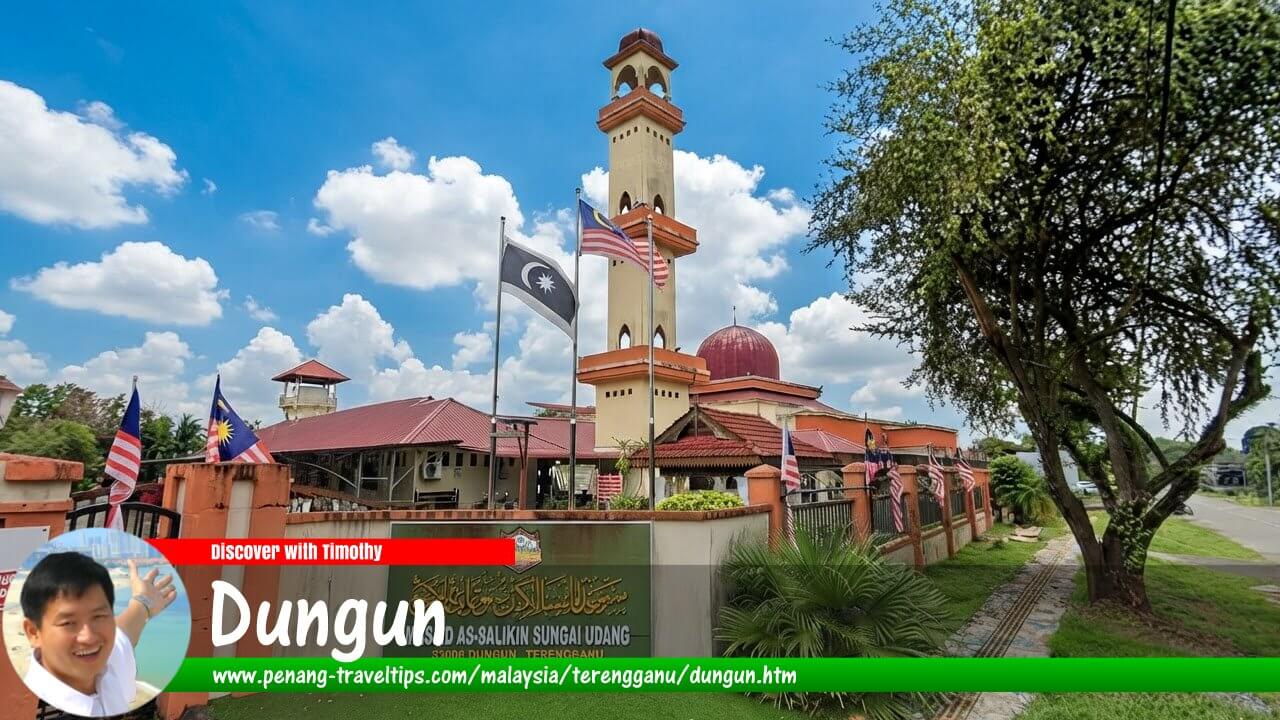 Dungun Travel Guide (AI generated on 10 September 2026)
Also available: Panduan Melawat Dungun
Dungun is a coastal town and district centre in Terengganu, on the east coast of Peninsular Malaysia. Facing the South China Sea, Dungun is known for its long beaches, fishing communities, nearby islands, forested hinterland and the historic iron-mining town of Bukit Besi. It is also a useful base for exploring attractions along the central Terengganu coast, including Rantau Abang, Tanjung Jara and Pulau Tenggol. The town itself has a long association with the sea and river, while the wider district has a more recent industrial history shaped by iron mining and the petroleum industry of neighbouring Paka and Kerteh.1
Quick Facts
- Town: Dungun
- State: Terengganu
- District: Dungun
- Local authority: Dungun Municipal Council
- Location: Central-eastern Terengganu, on the South China Sea coast
- Name origin: Named after the dungun tree, Heritiera littoralis
- Best known for: Beaches, Pulau Tenggol, Rantau Abang, Tanjung Jara and the historic iron-mining town of Bukit Besi
- Historic industry: Iron-ore mining at Bukit Besi
- Major mining period: Approximately 1929 to the 1960s, with mining operations ending in 1970
- Nearest major cities: Kuala Terengganu to the north and Chukai/Kemaman to the south
- Transport: Road, express buses, local buses, taxis and passenger vans; an ECRL station is planned
- Notable local food: Terengganu-style dishes, seafood and local snacks; Dungun Yong Tau Fuu is among the foods listed by the local council
About Dungun
Dungun is one of the principal towns of southern-central Terengganu and serves as the administrative centre of Dungun District. The district stretches from the South China Sea inland towards forested and mountainous areas, making it considerably larger than the urban area around Kuala Dungun. The Dungun Municipal Council describes the district as one of the largest in Terengganu, covering about 2,735 square kilometres and extending along the coast.2
The town is sometimes referred to as Kuala Dungun, particularly when distinguishing the coastal town from the wider district. The name is closely associated with the Dungun River and the coastal settlement around its mouth. The town's location has historically connected river transport, fishing and coastal trade with the inland settlements of the district.
For travellers, Dungun is less densely developed than Kuala Terengganu and has a quieter atmosphere. Its appeal lies partly in this contrast. A visitor can combine a town visit with beaches, traditional villages, islands, forests and historic industrial sites without having to travel to a major city.
Geography and Setting
Dungun lies on the east coast of Peninsular Malaysia, with the South China Sea forming its eastern boundary. The coastal plain around the town contains beaches, settlements, roads and agricultural land, while the western part of the district becomes increasingly forested and hilly.
The district is divided into a number of mukim, including Sura, Kuala Dungun, Kuala Abang, Kumpal, Kuala Paka, Rasau, Hulu Paka, Besol, Jerangau, Jengai and Pasir Raja.1 This broad administrative area explains why places such as Paka, Bukit Besi, Rantau Abang and the Pasir Raja forest area are associated with Dungun District even though they are not part of the central town.
The coastline is one of Dungun's most distinctive geographical features. Beaches such as Teluk Lipat, Teluk Bidara, Batu Pelanduk, Teluk Gadong and Paka form part of a long coastal landscape facing the open sea.3
Offshore, Pulau Tenggol is one of the district's most important natural attractions. The island lies off the Dungun coast and is surrounded by smaller rocky islets and marine habitats. Its relatively isolated position and underwater environment have made it particularly well known among scuba divers and snorkellers.
History of Dungun
Early settlement
The early history of Dungun is not as extensively documented as the history of some of the older royal centres of Terengganu. According to the Dungun Municipal Council, the district was believed to have been opened by immigrants from Pagar Ruyung in Sumatra. The council associates this tradition with the presence of communities believed to have originated from the Indonesian islands and with village names that resemble names found in Indonesia.1
Such traditions should be understood as part of the local historical narrative rather than as a complete account of the settlement of Dungun. Like many places along the Terengganu coast, the area would have developed through successive movements of people, coastal trade, fishing, agriculture and connections with neighbouring settlements.
The coastal location was particularly important. Before modern roads, rivers and coastal waters provided practical routes for transporting people and goods. The Dungun River therefore helped shape the development of the settlement that eventually became the town.
Dungun and the iron-mining era
The most dramatic chapter in modern Dungun's history came with the discovery and exploitation of iron ore at Bukit Besi. Bukit Besi lies inland from the coastal town and became one of the major iron-mining centres of Southeast Asia during the twentieth century.
According to the Dungun Municipal Council, Bukit Besi covered about 1,618 hectares and operated as the largest open-cast iron-ore mine in Southeast Asia from around 1929 through the 1960s. Companies associated with the operation included the Nippon Mining Company, Kuhara Mining Company and Eastern Mining & Metal Company. Mining operations eventually ended on 1 October 1970.1
The mining industry transformed Dungun from a relatively small coastal settlement into an important industrial and transport centre. Iron ore extracted at Bukit Besi had to be transported to the coast before being exported, creating a railway connection between the mining area and the port facilities around Dungun.
The railway and Bukit Tebuk
One of the surviving reminders of the mining period is Bukit Tebuk at Kampung Nibong. A tunnel was constructed through the hill by the Nippon Mining Company between 1932 and 1936 to shorten the railway route used to transport iron ore from Bukit Besi towards the coast.4
Before the tunnel was completed, the railway journey was interrupted by the hill, and iron ore had to reach the river at Pangkalan Che Lijah before being transferred to barges and subsequently to ships. The tunnel allowed the railway to continue towards Kampung Nibong and improved the movement of ore.
The former mining railway is significant because it demonstrates how the landscape around Dungun was physically reshaped by industrial activity. What may appear today as a quiet coastal district was once connected to an extensive mining and export network.
The end of mining
The closure of the Bukit Besi mine in 1970 marked the end of an important industrial era. Some mining structures and equipment have survived, including the remains of the crushing plant, washing or tin plant, stockpile, chimney, railway alignment and former workers' quarters.5
Parts of the former mining landscape have subsequently been incorporated into tourism and recreational development. Tasik Puteri, for example, is a man-made lake associated with the former mining area, while a historical gallery has been established to interpret Bukit Besi's industrial heritage.5
Dungun in the modern era
After the decline of iron mining, Dungun continued to develop as an administrative and service centre. The economy of the wider district later became connected with the growth of petroleum and gas activities in Paka and neighbouring Kerteh and Kemaman.
The local authority itself has also developed over time. The Dungun Municipal Council was established on 1 January 1981, initially emerging from the former Dungun Local Council and Paka Local Meeting Council. The municipal area was later expanded to cover the wider district, and Dungun was upgraded to municipal status in 2008.6
How Dungun Got Its Name
The name Dungun is derived from the dungun tree, a species scientifically known as Heritiera littoralis. The tree grows naturally in coastal and freshwater-swamp environments and was once found in abundance in the area.1
The Dungun Municipal Council explains that the name of the district came from this tree, which was sufficiently prominent in the local landscape for the settlement and district to take its name from it. The tree is also known locally by several related names, while its English common name is sometimes given as the looking-glass tree.1
The name therefore has a straightforward geographical origin: Dungun was named after a plant that was once characteristic of the local environment. This is similar to the way many settlements in Malaysia acquired their names from prominent trees, plants, animals or physical features.
Things to See and Do in Dungun
Pantai Teluk Lipat
Pantai Teluk Lipat is one of the best-known recreational areas near central Dungun. It forms part of the coastal landscape immediately east of the town and is easily combined with a visit to the town centre.
The local council is currently undertaking a special area planning study for Teluk Lipat, with the stated aim of balancing tourism development, environmental conservation and the needs of the local community.7
The waterfront is also being incorporated into a broader urban landscape improvement programme covering the Kuala Dungun riverside, the area around the fish market and the Teluk Lipat coastline.8
Tanjung Jara
Pantai Tanjung Jara is one of the most attractive beaches in the Dungun area. It is known for its fine golden sand and open views towards the South China Sea. The beach also supports recreational activities such as kayaking, boating, surfing and diving, subject to weather and sea conditions.9
Tanjung Jara is also an appropriate place for travellers who want a quieter beach experience away from a busy urban centre. It can be visited as a day trip from Dungun or combined with an overnight stay at one of the nearby resorts.
Rantau Abang
Rantau Abang is one of the most famous coastal settlements in the Dungun district. It became internationally known for the arrival of nesting leatherback turtles on its beaches. The number of leatherback turtles nesting there has declined dramatically from the levels recorded in the past, but the area remains associated with turtle conservation.
Rantau Abang continues to have conservation facilities, including the Turtle Conservation and Information Centre and other fisheries-related institutions. Recent programmes have included the release of turtle hatchlings at the beach, demonstrating that conservation remains an important part of the area's identity.10
Visitors should not assume that they can simply arrive at night and see nesting turtles. Turtle activity is seasonal and unpredictable, and conservation rules are intended to minimise disturbance. Where turtle-watching programmes are offered, visitors should follow the instructions of the conservation authorities and operators.
Pulau Tenggol
Pulau Tenggol is one of the principal marine attractions associated with Dungun. The island is relatively small, measuring about 3 kilometres long and 2 kilometres wide, and has a largely rocky coastline apart from a beach on the side facing the mainland.11
The waters around the island form part of a marine park and are particularly well known for scuba diving and snorkelling. Divers may encounter coral communities and a range of marine life, including reef fish and sea turtles. The island is also visited by specialist divers interested in its underwater topography and marine habitats.
Pulau Tenggol is reached by boat from the Dungun coast. A speedboat journey can take around 45 minutes, although travel times vary according to the type of boat and sea conditions.11
Because the island is primarily a diving and marine destination, arrangements should normally be made in advance with a licensed or established boat operator or dive resort. Sea conditions can also affect departures, particularly outside the more favourable months.
Bukit Besi
Bukit Besi is essential for anyone interested in the industrial history of Dungun. Located about 33 kilometres from Dungun town, the former mining settlement contains remnants of the large iron-ore operation that once dominated the local economy.5
Among the surviving features are industrial structures, a chimney, stockpile, sections of the former processing facilities, railway remains and former accommodation areas. The landscape provides an opportunity to understand how iron ore was extracted, processed and transported during the mining era.
Tasik Puteri, a man-made lake created from the former mining landscape, is another attraction in Bukit Besi. The area has been developed for recreation, while a historical gallery provides additional context about the mining industry.5
Bukit Tebuk
Bukit Tebuk at Kampung Nibong is another surviving reminder of the iron-mining railway. The tunnel through the hill was completed in 1936 to allow trains carrying ore from Bukit Besi to continue towards the coast without having to terminate at the earlier river-transfer point.4
The site is particularly interesting when combined with a visit to Bukit Besi because together they help explain the railway system that once connected the inland mine with the coastal export facilities.
Bukit Bauk and the forest environment
Bukit Bauk is a recreational forest area within Dungun. It provides a contrast to the beaches and coastal settlements and is suitable for visitors who want to experience the greener side of the district.
The area has also been used for community recreation and local environmental initiatives. Dungun Municipal Council has, for example, managed a cat park at Bukit Bauk as part of its recreational facilities.12
Hutan Simpan Pasir Raja
For visitors interested in forests and large trees, the Pasir Raja Forest Reserve in inland Dungun is notable for its mature forest environment. The municipal council highlights a large cengal tree, Neobalanocarpus heimii, discovered in the forest reserve in 1999. The tree was reported to measure about 65 metres in height and more than 16 metres in circumference.13
Access to forest reserves should be planned carefully. Visitors should follow forestry regulations, use recognised routes and avoid entering restricted areas without permission.
Food to Try in Dungun
Dungun's food culture reflects its location on the Terengganu coast. Seafood, fish-based dishes, rice dishes and traditional Malay snacks are readily associated with the wider coastal region.
Dungun Yong Tau Fuu
One food specifically listed by the Dungun Municipal Council is Dungun Yong Tau Fuu, located along Jalan Balai Besar. The dish offers a selection of stuffed and prepared ingredients served with a special sauce and is a useful option for visitors looking for something different from the more familiar Terengganu dishes.14
Terengganu dishes and seafood
Visitors should also look for familiar Terengganu dishes such as nasi dagang, nasi kerabu, fish dishes, keropok and traditional kuih. Seafood is particularly appropriate in a coastal district such as Dungun, although the exact selection depends on the season and the daily catch.
For a casual local meal, food courts and roadside eateries can be useful choices. Medan Selera Sura Gate, for example, is one of the food courts under the management of the Dungun Municipal Council and continues to serve as a local eating area.15
Where to Stay in Dungun
Dungun offers accommodation ranging from simple town hotels and guesthouses to beach resorts and nature-oriented lodges. The choice of area should depend on the purpose of the trip.
For visitors concentrating on the town, a hotel around central Dungun or Kuala Dungun is convenient for restaurants, shops and transport. The municipal council lists several accommodation options in and around the district, including Teluk Lipat Seaview Inn, located near Sura Jetty, and accommodation in the Paka and Rantau Abang areas.16
For a beach holiday, Tanjung Jara provides resort-style accommodation close to the beach. For travellers interested in Rantau Abang and the surrounding countryside, smaller lodges and guesthouses provide a more rural base.
Those planning to visit Pulau Tenggol should consider staying as part of a diving or island package. The municipal council notes that accommodation on the island is available, but visitors are generally advised to arrange accommodation and diving activities together in advance.11
How to Get to Dungun
By car
Driving is one of the most convenient ways to reach Dungun and explore the district. The town lies on the main coastal road connecting Kuala Terengganu in the north with Kemaman and the Pahang border in the south.
From Kuala Terengganu, the journey follows the coastal route southwards. From Chukai and Kemaman, travellers head north through the coastal settlements of southern Dungun. From Kuantan, Dungun can be reached by travelling north through Cherating and Kemaman before continuing along the Terengganu coast.
Driving is particularly useful because many of Dungun's attractions are spread over a large district. Bukit Besi, Rantau Abang, Tanjung Jara, Bukit Tebuk and the various beaches are not concentrated within the town centre.
By express bus
Express buses are a practical option for travellers who do not wish to drive. The Dungun express bus terminal is located at Jalan Baru Pak Sabah in the town. The municipal council lists operators including Utama Express, Mutiara Express, Mara Liner and Transnasional among the services operating to and from Dungun.17
Local buses also operate between Dungun and Kuala Terengganu and between Dungun and Kemaman, including routes that use village roads. Passenger vans serve some more remote parts of the district.17
By train in the future
Dungun will become more accessible by rail when the East Coast Rail Link (ECRL) enters passenger service. Dungun is planned as one of the six ECRL stations in Terengganu and, unlike the passenger-only stations at Jerteh, Bandar Permaisuri, Kuala Terengganu and Kemasik, Dungun and Chukai are planned as combined passenger-and-freight stations.18
The first ECRL section from Kota Bharu to the Gombak Integrated Terminal is scheduled for completion in December 2026 and operation from January 2027. As of 2026, therefore, the Dungun station should be regarded as a forthcoming transport facility rather than an operating passenger railway station.19
By air
Dungun does not have a major commercial airport. Visitors arriving by air will generally need to use an airport serving the wider region and continue by road.
Sultan Mahmud Airport in Kuala Terengganu is the most natural airport for visitors approaching from the north, while Sultan Haji Ahmad Shah Airport in Kuantan can be considered by travellers approaching from the south, depending on available flight schedules.
Getting Around Dungun
A private or rental car is the most convenient choice for most visitors who want to see more than the town centre. The attractions of Dungun District are geographically dispersed, and some beaches, forests and historic sites require travel along local roads.
Within the town, taxis can be used for point-to-point journeys. The municipal council also lists local buses and passenger vans as public transport options. Passenger vans are particularly useful for some inland communities where conventional public transport is limited.17
For Pulau Tenggol, transport is different. Visitors need to reach a suitable jetty on the Dungun coast and continue by boat. Because departure times depend on the operator, tides and sea conditions, island trips should be arranged before arriving at the jetty.
How Long to Stay in Dungun
One day is enough for a brief introduction to Dungun, especially if the visit focuses on the town, Teluk Lipat and one nearby beach.
Two days and one night provides a better introduction to the area. Visitors can explore Dungun town and the coast on the first day, then visit Bukit Besi or Rantau Abang on the second day.
Three days or more is recommended for travellers who want to combine beaches, Bukit Besi and an organised trip to Pulau Tenggol. Divers should allow additional time because island excursions are dependent on weather and sea conditions.
Suggested Dungun Itinerary
One-day itinerary
- Have breakfast in Dungun town.
- Explore the central town and Kuala Dungun riverside.
- Visit Pantai Teluk Lipat.
- Have lunch at a local restaurant or food court.
- Continue to Tanjung Jara or another nearby beach.
- Return to Dungun for dinner.
Two-day itinerary
- Spend the first morning exploring Dungun town and Teluk Lipat.
- Have lunch and continue along the coast towards Tanjung Jara and Rantau Abang.
- Stay overnight in Dungun, Tanjung Jara or Rantau Abang.
- On the second day, travel inland to Bukit Besi.
- Visit the former mining area and Tasik Puteri.
- Stop at Bukit Tebuk if conditions and access allow.
- Return to Dungun or continue north or south to the next destination.
Three-day itinerary with Pulau Tenggol
- Use the first day to explore Dungun town and the nearby beaches.
- Stay overnight near the coast.
- Depart early for a pre-arranged Pulau Tenggol excursion.
- Spend the day diving or snorkelling around the island.
- Return to the mainland and stay another night if required.
- Use the third day for Bukit Besi, Rantau Abang or another inland or coastal attraction.
Best Time to Visit Dungun
Dungun can be visited throughout the year, but weather and sea conditions should be considered carefully. The east coast of Peninsular Malaysia is affected by the northeast monsoon, which can bring rough seas and heavier rainfall to the exposed coastline.
For beach activities, island trips and scuba diving, the drier months are generally more suitable. The municipal council's information for Pulau Tenggol identifies approximately April to October as the preferred period for visiting the island, although actual conditions can vary from year to year.11
Visitors interested in turtle conservation at Rantau Abang should check current information before travelling because turtle nesting activity is seasonal and conservation programmes can change. Sightings should never be guaranteed.
During school holidays and long weekends, coastal accommodation can become busier. Booking ahead is advisable, particularly for popular beach resorts and island packages.
Dungun's Natural Environment
One of Dungun's greatest strengths is the variety of environments within a relatively accessible area. The district combines open beaches and coastal waters with river systems, lowland vegetation, inland forests and former mining landscapes.
The coastline supports marine ecosystems and is associated with turtle conservation, while Pulau Tenggol provides a different type of marine environment centred on coral reefs and diving. Inland, the Pasir Raja forest area contains mature trees including the large cengal highlighted by the local authority.13
Visitors should treat these environments as living ecosystems rather than simply scenic backdrops. On beaches, do not leave rubbish behind; around turtle-nesting areas, avoid bright lights and unnecessary disturbance; and in forests, stay on appropriate trails and follow local regulations.
Dungun as a Historic Industrial Landscape
One of the most interesting aspects of Dungun is the contrast between its image as a beach destination and its industrial past. The district was once at the centre of a major iron-ore industry whose effects extended from the mine at Bukit Besi through the railway system to the coastal export facilities.
Remains such as Bukit Tebuk, the former railway alignments, industrial structures and Tasik Puteri allow visitors to see traces of this history in the landscape. These sites are particularly worthwhile for travellers who want to understand how natural resources influenced the development of towns and transport networks in Malaysia.
The story of Dungun is therefore not simply a story of beaches and tourism. It is also a story of mining, railways, river transport, coastal trade and the economic transformation of Terengganu during the twentieth century.
Practical Travel Tips
- Rent a car if exploring beyond the town. The district is large and many attractions are spread across considerable distances.
- Check sea conditions before going to Pulau Tenggol. Boat departures and diving activities can be affected by weather and waves.
- Book island trips in advance. Pulau Tenggol is not an attraction where visitors should simply turn up without arranging transport.
- Check turtle information before visiting Rantau Abang. Nesting is seasonal and sightings cannot be guaranteed.
- Allow extra time for Bukit Besi. The former mining area is inland and is best treated as a separate excursion from the town.
- Try local food. Seafood, Terengganu rice dishes, traditional snacks and local specialities such as Dungun Yong Tau Fuu are worth exploring.
- Travel with appropriate sun protection. The coastal climate can be hot and bright, particularly around midday.
- Respect conservation areas. Do not disturb turtles, marine life, coral reefs or forest wildlife.
- Check transport schedules before travelling. Bus routes and operating times can change, particularly during holidays.
Why Visit Dungun?
Dungun is one of Terengganu's more varied travel destinations because its attractions extend well beyond the town itself. A visitor can spend the morning beside the South China Sea, explore the remains of a twentieth-century iron mine in the afternoon and finish the day with local food in town.
The district also offers a useful combination of beaches, islands, wildlife, forests and industrial heritage. Tanjung Jara and Teluk Lipat provide easy access to the coast, Rantau Abang introduces the history of turtle conservation, Pulau Tenggol caters to divers and snorkellers, while Bukit Besi and Bukit Tebuk reveal a very different chapter of Dungun's past.
For travellers driving along the east coast, Dungun makes an especially useful stop between Kuala Terengganu and Kemaman. Rather than treating it simply as a place to pass through, spending a couple of days here allows visitors to appreciate the relationship between the town, its coastline, its rivers and the inland landscapes that have shaped its history.
Conclusion
Dungun is a coastal town with a history that extends from early settlement and river-based life to the industrial expansion brought by the Bukit Besi iron mines. Although the mining industry ended decades ago, its physical remains continue to form an important part of the district's heritage.
Today, Dungun is better known to many visitors for its beaches, Tanjung Jara, Rantau Abang and Pulau Tenggol. Yet its appeal lies precisely in the combination of these natural attractions with its historical landscape. The result is a destination that offers more than a conventional beach holiday.
Whether visited as a short stop along the Terengganu coast, a base for a Pulau Tenggol diving trip or a longer exploration of Dungun District, the town provides an opportunity to experience a quieter and geographically diverse part of the east coast of Peninsular Malaysia.
References
- Dungun Municipal Council, Dungun Background, covering the origin of the name, early settlement traditions and history of Bukit Besi. https://mpd.terengganu.gov.my/index.php/en/visitors/dungun-background
- Dungun Municipal Council, Info Dungun, covering the geography, mukim and history of Dungun District. https://mpd.terengganu.gov.my/ms/pelawat/info-dungun
- Dungun Municipal Council, Destinasi Menarik, listing beaches and attractions in Dungun District. https://mpd.terengganu.gov.my/ms/pelawat/destinasi-menarik
- Dungun Municipal Council, Bukit Tebuk, describing the construction of the railway tunnel and its role in transporting iron ore from Bukit Besi. https://mpd.terengganu.gov.my/index.php/ms/pelawat/destinasi-menarik/bukit-tebuk
- Dungun Municipal Council, Bukit Besi, covering the former iron mine, railway remains, industrial structures and Tasik Puteri. https://mpd.terengganu.gov.my/index.php/en/visitors/places-of-interest/bukit-besi
- Dungun Municipal Council, Background, covering the establishment and development of the Dungun Municipal Council. https://mpd.terengganu.gov.my/index.php/en/dmc/profile/background
- Dungun Municipal Council, Program Rancangan Kawasan Khas Pantai Teluk Lipat, concerning current planning and conservation efforts at Teluk Lipat. https://mpd.terengganu.gov.my/index.php/ms/mpd/pusat-media/berita/program-rancangan-kawasan-khas-pantai-teluk-lipat
- Dungun Municipal Council, Pembangunan Landskap Perbandaran Dungun, covering the town, Kuala Dungun riverside and Teluk Lipat landscape improvement programme. https://mpd.terengganu.gov.my/index.php/en/dmc/media-centre/news/pembangunan-landskap-perbandaran-dungun
- Dungun Municipal Council, Destinasi Menarik, entry for Pantai Tanjung Jara and its recreational activities. https://mpd.terengganu.gov.my/ms/pelawat/destinasi-menarik
- Dungun Municipal Council, Rantau Abang and related turtle conservation information. https://mpd.terengganu.gov.my/index.php/ms/pelawat/destinasi-menarik/rantau-abang
- Dungun Municipal Council, Pulau Tenggol, covering the island, marine environment, diving, snorkelling and access from Dungun. https://mpd.terengganu.gov.my/index.php/en/visitors/places-of-interest/pulau-tenggol
- Dungun Municipal Council, information on the Taman Kucing at Bukit Bauk. https://mpd.terengganu.gov.my/index.php/en/dmc/media-centre/news/lawatan-bermaklumat-majlis-perbandaran-ampang-jaya-ke-taman-kucing-bukit-bauk-dungun
- Dungun Municipal Council, entry on the large cengal tree in the Pasir Raja Forest Reserve. https://mpd.terengganu.gov.my/ms/pelawat/destinasi-menarik
- Dungun Municipal Council, Food & Dining, listing Dungun Yong Tau Fuu. https://mpd.terengganu.gov.my/index.php/en/visitors/food
- Dungun Municipal Council, information on Medan Selera Sura Gate and its food-premises management. https://mpd.terengganu.gov.my/index.php/en/dmc/media-centre/news/pertandingan-program-kempen-medan-selera-bersih-2026-peringkat-negeri-terengganu
- Dungun Municipal Council, Penginapan, current list of hotels and accommodation in Dungun District. https://mpd.terengganu.gov.my/index.php/ms/pelawat/penginapan
- Dungun Municipal Council, Transportation, covering express buses, local buses, taxis and passenger vans. https://mpd.terengganu.gov.my/index.php/en/visitors/transportation
- Malaysia Rail Link, information on the six ECRL stations in Terengganu and Dungun's role as a combined passenger-and-freight station. https://www.mrl.com.my/wp-content/uploads/2024/10/Siaran-Media-EPIC-Berhad-dan-Malaysia-Rail-Link-Sdn-Bhd-Jalin-Kerjasama-Strategik-Perkasakan-Ketersambungan-Pantai-Timur-.pdf
- Malaysia Rail Link, ECRL project reaches 89% completion, on track for 2027 launch, concerning the planned January 2027 start of the first operational section. https://www.mrl.com.my/en/ecrl-project-reaches-89-completion-on-track-for-2027-launch/
Page Details
This page was created on 10 September 2026. Hi, my name is Timothy and created it from my research, for my own entertainment, knowledge and to satisfy my curiosity. I am providing the information to you in good faith and hope it is useful. I try to get the details as accurate as possible. I also try to update the page whenever I stumble on new details. So this and all my other pages are perpetual work in progress. If you discover any error, please politely inform me, pointing out where the error lies, and I will correct it as soon as possible. Your helpfulness will keep this page accurate, relevant and helpful to those who need the information.Buy Me A Coffee
If you enjoy the information I provide and want to support the work I do, please buy me a coffee! I appreciate it immensely, thank you so much!
