
Kuala Besut Travel Guide
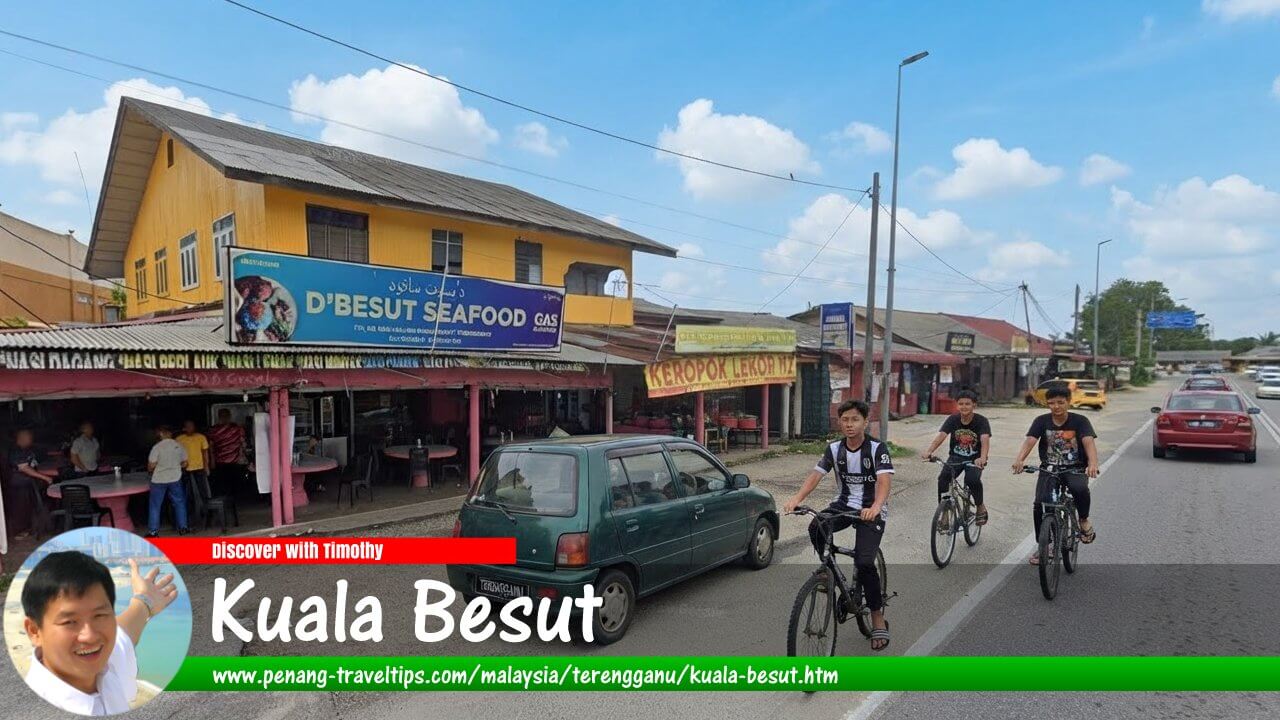 Kuala Besut Travel Guide (AI generated on 10 September 2026)
Also available: Panduan Melawat Kuala Besut
Kuala Besut is a coastal town and mukim in Besut District, Terengganu, in the northeastern part of Peninsular Malaysia. It is best known internationally as the principal mainland departure point for Pulau Perhentian Kecil and Pulau Perhentian Besar, but the town itself has a history and character that extend well beyond its role as an island-transfer point.1
Quick Facts
- Location: Besut District, Terengganu, Malaysia
- Setting: Coastal town at the mouth of the Besut River
- Administrative area: Kuala Besut is one of the mukim of Besut District
- Character: Fishing and trading town, tourism gateway and local service centre
- Main tourism role: Mainland departure point for Pulau Perhentian Kecil and Pulau Perhentian Besar
- Nearest major airport: Sultan Ismail Petra Airport in Kota Bharu, Kelantan
- Alternative airport: Sultan Mahmud Airport in Kuala Terengganu
- Nearby attractions: Kuala Besut Jetty, Besut fishing harbour, Pantai Air Tawar, Bukit Keluang, Pantai Dendong and Pulau Perhentian
- Local foods: Nasi dagang, nasi kerabu, keropok lekor, sata, seafood and other east-coast Malay dishes
- Best suited for: Travellers going to the Perhentian Islands, beach holidays, seafood, coastal scenery and exploring northern Terengganu
About Kuala Besut
Kuala Besut occupies a particularly interesting position in Terengganu. It is a small coastal town, yet its name is known by travellers from around the world because of the nearby Perhentian Islands. Boats to the islands leave from the Kuala Besut tourism jetty, making the town the principal gateway to one of Malaysia's best-known marine destinations.2
At the same time, Kuala Besut is not simply a transport terminal for island tourists. It is an established local settlement associated historically with fishing, fish trading and coastal commerce. The town developed around the Sungai Besut estuary, where the river meets the South China Sea. This location explains both its name and its traditional economic activities.
Today, Kuala Besut has a mixture of ordinary town life and tourism infrastructure. Shops, restaurants, small hotels, guesthouses, travel agencies and boat operators are concentrated around the town centre and jetty, while fishing-related activities remain part of the local economy. The result is a town where travellers can experience a more everyday side of the Terengganu coast before or after visiting the islands.
Geography and Location
Kuala Besut is situated in the northern part of Terengganu, close to the border with Kelantan. Besut District is bounded by Kelantan to the north and west and by the South China Sea to the east. The district extends inland towards the foothills of the Titiwangsa Range, while its eastern side consists of a long coastal plain and a series of beaches and fishing settlements.3
The town itself lies at the mouth of the Besut River. The Malay word kuala commonly refers to a river mouth, estuary or place where waterways meet. Thus, Kuala Besut may be understood straightforwardly as the kuala, or river mouth, of Besut.
The position of Kuala Besut gives it a strong connection with both land and sea. Inland, roads lead towards Jerteh and the rest of Besut District. Along the coast, beaches and fishing settlements extend southward towards Kampung Raja and Bukit Keluang. Offshore, the Perhentian Islands lie in the South China Sea and are reached by boat from the Kuala Besut jetty.
Besut is also geographically closer to Kota Bharu in Kelantan than to Kuala Terengganu. This is important for travellers because Sultan Ismail Petra Airport in Kota Bharu is generally the most convenient airport for reaching Kuala Besut, even though Kuala Besut and the Perhentian Islands are in Terengganu.4
History of Kuala Besut
The early history of Besut is difficult to reconstruct with certainty. The Besut District Council notes that written evidence about the early district is limited, although Besut was mentioned in accounts associated with Munshi Abdullah's Pelayaran Abdullah ke Kelantan and Raja Ali Haji's Tuhfat al-Nafis. Because the documentary record is relatively sparse, a number of oral traditions and historical narratives have survived alongside the written sources.5
One tradition associates the early settlement of Besut with people from Pattani and Sumatra. Historical accounts and later local traditions describe the arrival of a group led by Che Latif, who is said to have originated from Palembang in Sumatra. The settlement established along the Besut River was known as Palembang, reflecting the settlers' place of origin. This tradition forms part of the wider history of migration and cultural exchange between the Malay Peninsula, southern Thailand and Sumatra.
Another local tradition tells of an earlier ruler called Raja Sang Nyanya, described in local accounts as a powerful and cruel pirate chief. According to the story, settlement increased after his death and the area became more suitable for traders and other communities. These stories should be regarded as local historical traditions rather than established facts, because the surviving documentary evidence does not allow all aspects of the narratives to be independently verified.5
Besut subsequently developed its own political history and was associated with the Kingdom of Besut. The settlement around the Besut River was important enough to serve as an early centre before administrative prominence later shifted to Kampung Raja. The history of Besut therefore predates the modern district boundaries and administrative structures of Terengganu.
For Kuala Besut specifically, the river and sea remained fundamental to its development. Its position beside a navigable estuary made it suitable for fishing, landing marine products and coastal trading. In the modern period, the town became increasingly connected with the fishing industry, while tourism subsequently added another major economic function.
Kuala Besut and the Fishing Industry
Fishing was historically one of the defining activities of Kuala Besut. The town became known as a fishing centre, with the river mouth and harbour providing access to the South China Sea. Fishing boats, fish landings, traders and markets formed an important part of the town's economic life.
Over time, however, changes in the fishing industry altered the role of the town. A 2013 report described Kuala Besut's fishing facilities as increasingly important for fish marketing rather than simply for the landing of catches by local fishermen. The report also noted the effects of competition from larger modern fishing operations and changes in the local fishing economy.6
Today, the fishing heritage remains visible around the harbour and fish-market areas. Visitors who arrive early in the morning may see a more active side of the town than is apparent around the tourist jetty later in the day.
How Kuala Besut Got Its Name
The name Kuala Besut is relatively straightforward in its first component. In Malay geographical terminology, kuala means the mouth or estuary of a river. Kuala Besut therefore refers to the river mouth of Besut.
The origin of the word Besut, however, is less certain. The Besut District Council records several local explanations and explicitly notes that the lack of early written evidence has resulted in different versions of the story.5
One traditional explanation connects the name with the period when the area was under Siamese influence. According to this story, Be was interpreted as meaning a district, while sut was associated with a distant or faraway place. The explanation is presented by the district authority as one possible tradition, rather than as a proven linguistic derivation.
Another story says that the area was associated with a group of people known as Orang Pangan, whose leader was named Besut. The place subsequently became known by his name. Again, this is a traditional account and cannot be regarded as conclusively established because of the limited early documentary evidence.
For a traveller, the most useful distinction is therefore between what is reasonably clear and what remains uncertain: Kuala refers to the river mouth, while the deeper origin of Besut remains the subject of competing historical traditions.
Kuala Besut Jetty and the Perhentian Islands
The Kuala Besut tourism jetty is the town's most important tourism facility. It is the principal mainland departure point for boats to Pulau Perhentian Kecil and Pulau Perhentian Besar. Tourism Malaysia identifies Kuala Besut Jetty as the jumping-off point for the two Perhentian islands.7
The present tourism terminal was established to provide facilities for passengers waiting for and boarding boats to the islands. According to the Besut District Council, the terminal began operating in 1998 and includes ticket counters, food stalls and other visitor facilities.8
For most travellers heading to the Perhentians, the normal procedure is to arrive in Kuala Besut, confirm the boat arrangement with the relevant operator, and then proceed to the jetty. Boat schedules are affected by weather, sea conditions and seasonal operations, so travellers should avoid arranging a tightly timed connection between an arriving flight or long-distance bus and a boat departure.
The Perhentian Islands themselves form part of Malaysia's marine-park system. Pulau Perhentian Besar and Pulau Perhentian Kecil are protected marine areas, with surrounding waters gazetted under the national marine-park framework.9 Their clear waters, coral reefs and beaches make snorkelling and diving the principal activities.
Things to See and Do in and Around Kuala Besut
Explore Kuala Besut Town
Allow some time to explore the town rather than treating it merely as a place to board a boat. The streets around the jetty contain small shops, restaurants, accommodation and travel businesses. The atmosphere is distinctly more local than that of the resort areas on the Perhentian Islands.
The town is particularly interesting in the morning, when fishing-related activities and local commerce are more apparent. Visitors interested in the everyday life of a Terengganu coastal town can combine a short walk around the riverfront and harbour area with breakfast at a local restaurant.
Visit the Fishing Harbour
The fishing harbour and fish-market areas provide an opportunity to see the economic activity that historically sustained Kuala Besut. The local fishing industry has changed considerably over the years, but fish trading remains part of the town's identity.6
Visitors should be respectful around working areas, particularly where boats are unloading or fish are being transported. These are places of business rather than tourist attractions, and photography should not interfere with the activities of fishermen and traders.
Pantai Air Tawar
Pantai Air Tawar is one of Besut's principal coastal recreational areas. The beach is known for its sandy shoreline and is used by local residents for swimming, picnicking, walking and family recreation. The district authority lists hotels, chalets, food stalls, children's facilities and other amenities at the beach.10
Pantai Air Tawar is a useful choice for travellers who want a mainland beach experience without immediately going to an island. It can also be combined with a stay near Kuala Besut or with a trip to Bukit Keluang.
Bukit Keluang
Bukit Keluang is one of the most scenic places near Kuala Besut. The district authority places it at about 4 kilometres from Kuala Besut town. The area combines a sandy beach with rocky and forested hills overlooking the sea.11
A flight of steps leads up the hill, providing views over the coastline and offshore islands. The summit area is particularly worthwhile for visitors who enjoy coastal scenery and photography. Bukit Keluang also has facilities including rest areas, restaurants, public toilets and shelters.
Because it is close to Kuala Besut, Bukit Keluang can be visited even by travellers who are only staying one night on the mainland before taking a boat to the Perhentians.
Pantai Dendong and the Besut Coast
Other beaches along the Besut coast, including Pantai Dendong, offer quieter alternatives to the more prominent beaches. The district's coastal attractions are generally oriented towards swimming, picnicking, walking, fishing and enjoying the scenery rather than the intensive resort development found on some island destinations.10
Explore Greater Besut
Kuala Besut can also serve as a base for exploring other parts of Besut District. Attractions promoted by the district and state tourism authorities include Lata Belatan, La Hot Spring, Gunung Tebu, Masjid Ulul Albab and other natural and cultural destinations.12
Travellers with a car have considerably more flexibility to explore these places. Without private transport, Kuala Besut is better treated as a compact coastal stop or as the mainland gateway to the Perhentian Islands.
How to Get to Kuala Besut
By Air
The most convenient airport for many international and domestic travellers is Sultan Ismail Petra Airport (KBR) in Kota Bharu, Kelantan. Despite being in another state, the airport is relatively close to Kuala Besut. Tourism Malaysia identifies Kota Bharu as the nearest and most convenient airport for the Perhentian gateway, while Sultan Mahmud Airport in Kuala Terengganu provides an alternative.7
From Kota Bharu Airport, travellers can continue by taxi, private transfer or other pre-arranged ground transport. A road journey of roughly an hour is a reasonable planning estimate, although actual travel time depends on traffic and the precise destination.
From Sultan Mahmud Airport (TGG) in Kuala Terengganu, Kuala Besut is farther away, with the road journey generally taking around one and a half to two hours depending on traffic and route.
By Bus
Long-distance buses connect Kuala Besut and the wider Besut area with other parts of Peninsular Malaysia. Travellers coming from Kuala Lumpur and other major cities can use express buses, while local services connect Kuala Besut with towns such as Jerteh and Kota Bharu.
The Kuala Besut bus terminal is conveniently located near the tourism jetty. This makes the town relatively easy to navigate for travellers arriving by public transport and transferring to the Perhentian Islands.13
By Car
Driving is a practical option for travellers touring the east coast of Peninsular Malaysia. Kuala Besut is connected by the road network to Jerteh, Kota Bharu and the coastal settlements of northern Terengganu.
Driving is particularly useful if Kuala Besut is only one stop on a wider road trip. It allows visitors to combine the town with destinations such as Pantai Air Tawar, Bukit Keluang, Kampung Raja and other parts of Besut.
If you are travelling to the Perhentian Islands, however, remember that your car cannot accompany you onto the islands. Travellers who drive to Kuala Besut should make arrangements for parking near the jetty for the duration of their island stay.
Where to Stay in Kuala Besut
Kuala Besut offers a mixture of small hotels, guesthouses, homestays and budget accommodation. The Besut District Council lists accommodation in and around the town, including Nan Hotel, Samudera Hotel, guesthouses and accommodation associated with the tourism terminal.14
For travellers catching an early boat to the Perhentians, staying within or close to Kuala Besut town is often the most practical choice. Accommodation near the jetty reduces the need for an early-morning transfer and allows you to walk or make a short local journey to the terminal.
Travellers who prefer a beach setting can instead stay farther south around Pantai Air Tawar or Bukit Keluang. This provides a more relaxed coastal environment but means allowing additional time to reach the jetty.
There is also a much wider choice of accommodation throughout Besut District, including larger beach properties and resorts. Current accommodation listings should be checked directly before booking because hotels, room categories and operating arrangements can change.
What to Eat in Kuala Besut
Kuala Besut is a good place to sample the food of the Terengganu coast. The local cuisine is predominantly Malay and makes extensive use of rice, fish, coconut milk, herbs, fermented sauces and seafood.
Nasi Dagang
Nasi dagang is one of the signature dishes of the east coast. It consists of rice cooked with coconut milk, traditionally accompanied by a fish-based curry and pickled vegetables. Terengganu-style nasi dagang is an especially appropriate breakfast choice when exploring the coast.
Nasi Kerabu
Nasi kerabu is another popular east-coast rice dish. The rice is traditionally blue or blue-tinged from the use of butterfly-pea flowers and is served with herbs, vegetables, coconut-based accompaniments and a variety of side dishes.
Keropok Lekor
Keropok lekor is one of Terengganu's best-known foods. Made principally from fish and sago or tapioca, it is available in both boiled and fried forms. Freshly fried keropok lekor makes a convenient snack while travelling around the coast.
Seafood
As a traditional fishing town, Kuala Besut is also a natural place to look for seafood. Fish, prawns, squid and other marine products feature prominently in local cooking. Availability varies according to the daily catch and season, so the best seafood choices may not be the same every day.
Other Terengganu Specialities
Other foods worth looking for include sata, a spiced fish mixture wrapped in banana leaf and grilled, as well as budu, the fermented fish sauce strongly associated with the east coast of Peninsular Malaysia. Visitors who enjoy regional Malay food should make an effort to eat at local restaurants rather than relying entirely on food outlets around the jetty.
Getting Around Kuala Besut
The central part of Kuala Besut is compact enough to explore on foot, particularly around the town centre, shops and jetty. Walking is the simplest option for travellers staying close to the tourism terminal.
For beaches and attractions outside the town centre, however, a car or hired vehicle is more convenient. Bukit Keluang, for example, is only a short distance from Kuala Besut but is not within practical walking distance for most visitors carrying luggage or travelling during the heat of the day.11
Taxis and locally arranged transfers can be useful for journeys between the bus terminal, hotels, beaches and jetty. Availability may be more limited than in larger Malaysian cities, so travellers should not assume that a ride-hailing vehicle will always be immediately available.
For the Perhentian Islands, boats are the principal form of transport. There are no conventional roads connecting the island resorts, and small boats also operate as water taxis between different beaches and settlements.8
Best Time to Visit Kuala Besut
Kuala Besut has a tropical climate and can be visited throughout the year, but the experience differs considerably according to the season.
The dry and comparatively calmer period is generally the more attractive time for beach activities and trips to the Perhentian Islands. Sea conditions become more important during the Northeast Monsoon, when strong winds and rough seas can affect boat services and island activities.
Travellers planning a Perhentian Islands holiday should therefore check the seasonal operating period of their accommodation and boat operator before travelling. Even during the main tourism season, boat departures remain subject to weather and sea conditions.
For mainland sightseeing, Kuala Besut can be visited outside the peak island season as well. Beaches such as Pantai Air Tawar and Bukit Keluang remain local recreational destinations, although weather conditions should always be considered when planning outdoor activities.
How Long to Spend in Kuala Besut
For travellers using Kuala Besut solely as the gateway to the Perhentian Islands, one night on the mainland is often sufficient, especially if the onward boat departs early in the morning.
However, allowing two nights gives a more relaxed experience. One day can be used to explore Kuala Besut, visit the fishing harbour, eat local food and visit Pantai Air Tawar or Bukit Keluang, while the following morning can be devoted to the boat transfer to the islands.
Travellers with a car and an interest in northern Terengganu could stay longer and use Kuala Besut as a base for exploring other parts of Besut District.
Suggested Kuala Besut Itinerary
One-Day Mainland Stop
- Morning: Arrive in Kuala Besut and have breakfast at a local restaurant.
- Late morning: Explore the town centre, riverfront and fishing-related areas.
- Lunch: Try nasi dagang, nasi kerabu or a local seafood dish.
- Afternoon: Visit Pantai Air Tawar or Bukit Keluang.
- Evening: Return to Kuala Besut for dinner and prepare for the following day's boat trip.
Two-Day Kuala Besut and Perhentian Trip
- Day 1: Arrive in Kuala Besut, explore the town and fishing harbour, then visit Bukit Keluang or Pantai Air Tawar.
- Day 1 evening: Stay overnight near the town or jetty.
- Day 2 morning: Proceed to Kuala Besut Jetty and take the boat to Pulau Perhentian Kecil or Pulau Perhentian Besar.
- Following days: Explore the Perhentian Islands by foot and boat, with snorkelling and diving among the principal activities.
Practical Travel Tips
- Plan the boat connection carefully: Allow extra time between your arrival in Kuala Besut and your island boat departure.
- Check weather conditions: Sea conditions can affect boat operations, especially during periods of unsettled weather.
- Carry some cash: Small restaurants, shops and local transport services may not always accept cards.
- Book accommodation ahead: Kuala Besut becomes particularly busy when travellers are transferring to the Perhentian Islands during the main holiday season.
- Arrive early for island transfers: Boat arrangements and boarding procedures can take time, particularly during busy periods.
- If driving, arrange parking: Do not assume that your accommodation automatically includes long-term parking while you are on the islands.
- Eat locally: Breakfast is an especially good opportunity to try nasi dagang and other east-coast dishes.
- Respect working harbour areas: Fishing boats, fish traders and loading activities are part of the working town and should not be obstructed.
- Protect the marine environment: When visiting the Perhentian Islands, avoid touching coral, do not collect marine life and follow marine-park rules.
- Dress appropriately: Kuala Besut is a predominantly Malay and Muslim community. Beachwear is appropriate at beaches and resorts, but more modest clothing is advisable in town and around villages and religious sites.
Kuala Besut as a Gateway to Northern Terengganu
Kuala Besut is sometimes overlooked because travellers associate it almost entirely with the Perhentian Islands. Yet the town is worth understanding in its own right. Its location at the mouth of the Besut River, its fishing heritage, its connections with the history of Besut and its position close to the Kelantan border give it a distinctive identity within Terengganu.
The town also provides an interesting transition between mainland Malaysia and the islands. On one side is the everyday world of fishing boats, markets, local restaurants and small-town commerce; on the other is the clear water, coral reefs and resort beaches of Pulau Perhentian. Kuala Besut is the point where these two worlds meet.
For travellers, the most rewarding approach is therefore not to regard Kuala Besut simply as a place to catch a boat. Spend a little time exploring the town, taste the local food, visit one of the nearby beaches and observe the fishing heritage. Even a short stay can provide a useful introduction to the culture and landscape of northern Terengganu before continuing to the Perhentian Islands.
References
- Besut District Council — Besut Info and History of Besut
- Tourism Malaysia — Pulau Perhentian
- Majlis Daerah Besut — Info Besut and Location of Besut District
- Tourism Malaysia — Malaysia Travel Information
- Besut District Council — The History of Besut District
- Malay Mail — Once a fishing icon, Kuala Besut now a shadow of its old self
- Tourism Malaysia — Malaysia Travel Guide: Terengganu
- Besut District Council — Transportation
- Malaysia Biodiversity Information System — Pulau Perhentian Besar Marine Park
- Besut District Council — Pantai Air Tawar
- Besut District Council — Bukit Keluang
- Tourism Malaysia — There's Much More in Terengganu
- Wikivoyage — Kuala Besut Travel Guide
- Besut District Council — Accommodation
Page Details
This page was created on 12 September 2026. Hi, my name is Timothy and created it from my research, for my own entertainment, knowledge and to satisfy my curiosity. I am providing the information to you in good faith and hope it is useful. I try to get the details as accurate as possible. I also try to update the page whenever I stumble on new details. So this and all my other pages are perpetual work in progress. If you discover any error, please politely inform me, pointing out where the error lies, and I will correct it as soon as possible. Your helpfulness will keep this page accurate, relevant and helpful to those who need the information.Buy Me A Coffee
If you enjoy the information I provide and want to support the work I do, please buy me a coffee! I appreciate it immensely, thank you so much!
