
Hulu Langat Travel Guide
 Hulu Langat Travel Guide (AI generated on 30 September 2026 based on a mosque near Hulu Langat)

Also available: Panduan Melawat Hulu Langat
Hulu Langat is a district in the southeastern part of Selangor, forming part of the wider Klang Valley. It lies immediately southeast of Kuala Lumpur and extends from heavily urbanised areas such as Cheras and Kajang into greener landscapes of hills, forests, rivers, orchards and villages. The district is therefore a place of considerable contrasts: its northern and western portions are closely integrated with the metropolitan area, while its interior contains some of Selangor's best-known nature and recreational destinations. The district is particularly suitable for travellers looking for a short escape from Kuala Lumpur, with opportunities for hiking, river recreation, waterfalls, picnicking, camping and rural sightseeing. 1
Quick Facts
- Destination: Hulu Langat, Selangor, Malaysia
- Type: District
- State: Selangor
- District headquarters: Bandar Baru Bangi
- Administrative centre: Pejabat Daerah dan Tanah Hulu Langat in Bandar Baru Bangi
- Mukim: Ampang, Beranang, Cheras, Hulu Langat, Hulu Semenyih, Kajang and Semenyih
- Area: Approximately 829 km²
- Major urban centres: Kajang, Cheras, Ampang, Semenyih and Beranang
- Character: Urban, suburban, rural and forested areas
- Best known for: Kajang satay, rivers, waterfalls, forests, hills, durians and weekend recreation
- Major natural attractions: Sungai Congkak, Sungai Gabai, Sungai Tekala, Broga Hill and Gunung Nuang
- Major road: Jalan Hulu Langat (Selangor Route B52)
- Nearest major city: Kuala Lumpur
Where Is Hulu Langat?
Hulu Langat is one of the nine administrative districts of Selangor. It occupies the southeastern part of the state and shares boundaries with the Federal Territory of Kuala Lumpur and Gombak District to the northwest, Petaling District to the west, Sepang District to the southwest, Pahang to the northeast, and Negeri Sembilan to the south and southeast. 1
The district has seven officially recognised mukim: Ampang, Beranang, Cheras, Hulu Langat, Hulu Semenyih, Kajang and Semenyih. Together they cover about 82,944 hectares, or roughly 829 square kilometres. 1 This makes Hulu Langat the fifth-largest district in Selangor by area.
For visitors, however, the administrative boundaries are not always obvious. The urban parts of Cheras, Ampang and Kajang are strongly connected to Kuala Lumpur and the wider Klang Valley, whereas the Hulu Langat and Hulu Semenyih areas have a much more rural appearance. Villages, plantations, fruit orchards and forest reserves remain prominent in the interior.
The district is traversed by several rivers and streams, most notably the Langat River and its tributaries. The combination of rivers and hilly terrain has helped shape the location of settlements and agricultural areas, while also making Hulu Langat a popular destination for recreational activities involving rivers and waterfalls.
Geography and Landscape
Hulu Langat occupies a transition between the built-up Klang Valley and the forested hills of the interior of Peninsular Malaysia. The western and northern portions have undergone extensive urbanisation, with residential neighbourhoods, commercial centres, industrial areas and major transportation corridors.
Further east and southeast, the landscape becomes considerably greener. The district contains hills, valleys, streams and forest reserves associated with the Titiwangsa Range. Gunung Nuang, on the eastern side of the district, rises to about 1,493 metres and is the highest mountain in Selangor. One of the established approaches to the mountain is from Pangsun in Hulu Langat. 2
The natural landscape has also given Hulu Langat an important recreational role. Sungai Congkak, Sungai Gabai and Sungai Tekala are among the better-known destinations where visitors can experience forest, streams, waterfalls and river pools without travelling far from the Klang Valley. 3
History of Hulu Langat
The history of Hulu Langat is closely connected with the development of the Langat River valley and the wider history of Selangor. Long before modern towns were established, the forests and river valleys were inhabited and used by Orang Asli communities, including the Temuan. Later settlement involved Malay communities as well as people of Minangkabau, Javanese, Mandailing and other backgrounds. 4
River valleys were particularly important because rivers served as natural routes through the forest. The relatively fertile land beside rivers also provided suitable conditions for agriculture and settlement. The early history of Kajang, one of the district's principal towns, reflects this pattern of settlement along the Langat and associated river systems.
The administrative history of the district can be traced to the nineteenth century. The Pejabat Daerah dan Tanah Hulu Langat was established in Kajang in 1884. It remained there for more than a century before the district administration was transferred to Bandar Baru Bangi on 1 January 1992. 5
During the twentieth century, roads, railways, plantations and expanding settlements gradually connected Hulu Langat more closely with Kuala Lumpur and other parts of Selangor. The growth of Kajang, Cheras and Ampang accelerated particularly strongly as the Klang Valley expanded.
Today, Hulu Langat is one of Selangor's most urbanised districts by population while still retaining extensive rural and forested landscapes. Its development illustrates the rapid outward expansion of the Klang Valley: residential and commercial areas can be found surprisingly close to villages, orchards and forest recreation areas.
How Did Hulu Langat Get Its Name?
The name Hulu Langat is generally understood as referring to the upper or upstream part of the Langat River. The Malay word hulu, also written ulu in older usage, refers to the upstream or inland part of a river, while Langat is the name of the river flowing through the region. Tourism Selangor describes the name as being derived from “Langat” with hulu or ulu added because of the area's inland position. 4
The name therefore describes the geographical character of the district rather than referring specifically to one settlement. This is important for visitors because Hulu Langat can mean both the district and the town or locality of Hulu Langat, depending on the context.
The Town of Hulu Langat
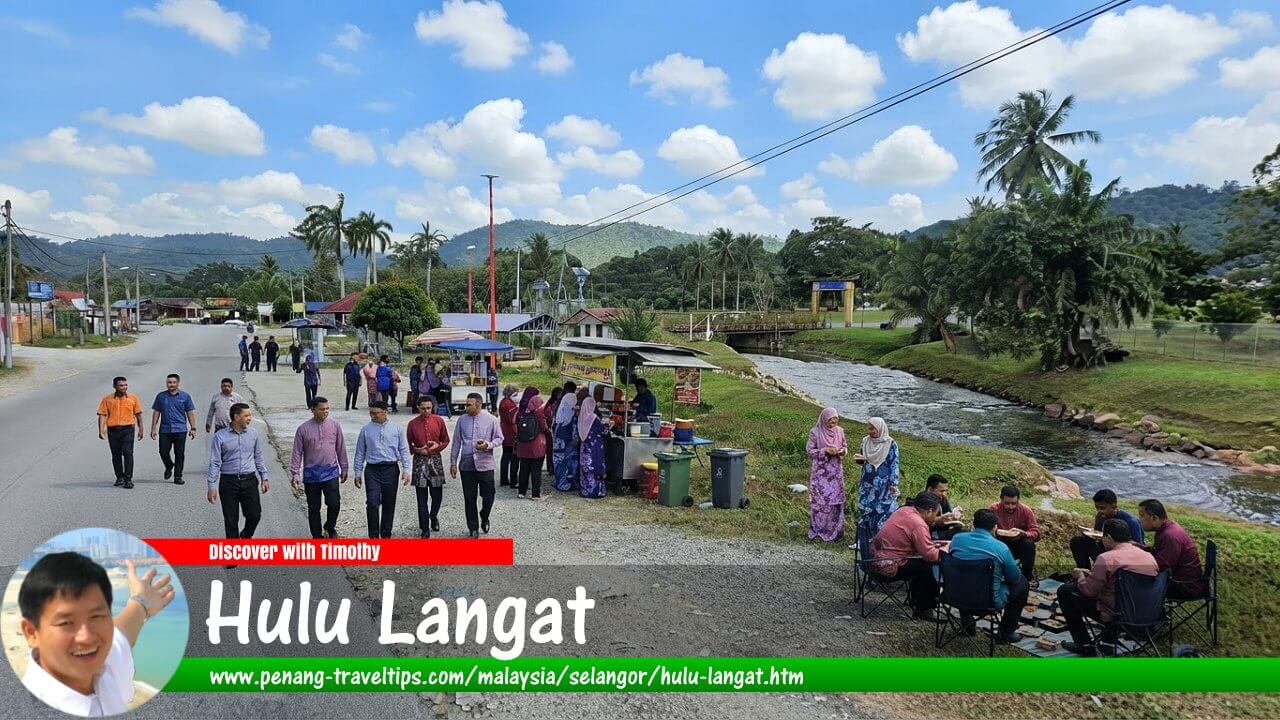
The settlement commonly referred to as Hulu Langat town is located along Jalan Hulu Langat, around Batu 14 and the surrounding villages. It is considerably smaller and more rural in character than Kajang or Cheras.
The town and its surrounding villages provide a useful base for exploring the eastern part of the district. Along the road are Malay villages, small businesses, food stalls, fruit orchards and entrances to recreational areas. Travellers heading towards Sungai Congkak, Sungai Gabai, Dusun Tua, Pangsun and Sungai Lui pass through or near this rural corridor.
Things to See and Do in Hulu Langat
Sungai Congkak
Chongkak Park & Resort is one of the best-known recreational destinations in Hulu Langat. It is situated along Sungai Congkak in a forested valley and is particularly popular for picnicking, camping, river activities and family outings. The park has facilities including campsites, picnic areas, gazebos, changing rooms, toilets and other visitor amenities. 6
The river itself is one of the principal attractions. Sections of the stream are relatively shallow and flow over rocks and boulders beneath the surrounding forest, making the area popular for cooling off in the water. Visitors should nevertheless exercise caution because rocks can be slippery and river conditions can change after heavy rain.
SKYTREX Adventure Sungai Congkak
For visitors seeking a more active experience, SKYTREX Adventure Sungai Congkak provides treetop adventure courses in the forest. Participants move through elevated obstacles and aerial elements suspended above the rainforest. The attraction offers several difficulty levels and has minimum height and maximum weight requirements, so visitors should check the latest conditions before travelling. 7
Sungai Gabai Waterfall
Sungai Gabai Waterfall, near Kampung Sungai Lui, is one of Hulu Langat's most recognisable waterfall destinations. The waterfall consists of a series of levels, with a staircase of 336 steps leading towards the upper sections. Basic visitor facilities include toilets, changing rooms and a musalla. 8
Sungai Gabai is also significant from a geological perspective. It is one of the geosites within the Gombak-Hulu Langat Geopark, reflecting the geological history of the area's granite formations. 9
Sungai Tekala Recreational Forest
Sungai Tekala Recreational Forest is situated in the Semenyih part of Hulu Langat. The recreational forest was established in 1982 and provides a relatively accessible forest-and-water experience. A short trail leads from the entrance towards the waterfall, while the river contains shallow sections suitable for recreational bathing when conditions permit. 10
The site is also recognised as a geosite of the Gombak-Hulu Langat Geopark. The waterfall is associated with the granite geology of the Semenyih area and has scientific, recreational and aesthetic value. 11
Broga Hill
Broga Hill, near Semenyih, is one of Selangor's most popular short hiking destinations. The hill rises to roughly 400 metres and is characterised by open grassy sections on the upper slopes, providing broad views over the surrounding countryside. It is commonly known as Bukit Lalang because of the lalang grass found around its summit. 12
The hike is considerably shorter and less demanding than a mountain expedition, although the trail can still be steep and slippery in places. Sunrise hikes are particularly popular, but visitors should check access conditions and weather before setting out.
Gunung Nuang
At approximately 1,493 metres, Gunung Nuang is the highest mountain in Selangor. The Pangsun route in Hulu Langat is one of the recognised approaches to the mountain. Unlike the shorter recreational hikes at Broga Hill, an ascent of Gunung Nuang requires considerably more preparation and should be treated as a serious mountain hike. 2
Dusun Tua Hot Springs
Dusun Tua Hot Springs is one of the natural hot-spring sites associated with Hulu Langat. Tourism Selangor identifies hot springs around Dusun Tua and Sungai Serai, providing another type of nature-based experience besides waterfalls and rivers. 4
Facilities and operating arrangements at natural hot springs can change, so travellers should check current local information before visiting. Some sites have specific arrangements for bathing and visitor access.
Hulu Langat and the Gombak-Hulu Langat Geopark
Parts of Hulu Langat form an important component of the Gombak-Hulu Langat Geopark, which highlights geological, ecological and cultural features across the two districts. Geosites in Hulu Langat include the Sungai Gabai porphyry, Dusun Tua Hot Spring Complex, Sungai Tekala Waterfall, Sungai Lalang Hot Spring and geological features around Semenyih. 9
This makes the district interesting not only for recreational tourism but also for visitors interested in geology, landscapes and the relationship between natural features and human settlement.
Kajang and Its Connection with Hulu Langat
Kajang is one of the most important urban centres in Hulu Langat. It is sometimes described simply as a town in its own right, but administratively it lies within the district. Kajang developed along the Langat River system and became an important centre of settlement, commerce and transportation.
The town is particularly famous for satay. Sate Kajang has become a nationally recognised food associated with the town, and satay restaurants remain an important part of Kajang's identity. The Kajang Municipal Council itself identifies Sate Kajang as a commercial brand known nationally and internationally. 13
Kajang also has a more complicated history of settlement involving Malay, Chinese and Indian communities, as well as the earlier presence of Temuan Orang Asli communities. Local accounts of the origin of the name “Kajang” include several different explanations, including associations with mengkuang and the traditional lipat kajang style of roof. These explanations should be regarded as competing historical traditions rather than a single definitively established etymology. 14
What to Eat in Hulu Langat
Satay Kajang
The food most strongly associated with the district is undoubtedly Satay Kajang. Traditionally consisting of seasoned pieces of meat grilled over charcoal and served with a peanut-based sauce, Kajang satay has become a culinary institution in Malaysia.
Travellers staying in Kajang should take the opportunity to sample satay from one of the town's established satay restaurants. Satay is normally available in chicken, beef and other varieties, although individual restaurants may offer different selections.
Malay Food and Rural Dishes
Beyond satay, the villages of Hulu Langat contain numerous Malay food stalls and small restaurants serving everyday Malaysian dishes. Depending on the locality, visitors may find nasi campur, grilled fish, fried noodles, rice dishes, traditional kuih and other local favourites.
Durian and Local Fruit
Hulu Langat is also known for its fruit-growing areas, particularly around the rural interior. Durian is one of the district's seasonal attractions. During the fruit season, roadside stalls and orchards may sell locally grown durians and other tropical fruits. 15
Because fruit availability is seasonal, travellers should not expect durian stalls or orchard experiences to operate at the same level throughout the year.
Where to Stay in Hulu Langat
Accommodation in Hulu Langat ranges from conventional hotels in the more urban parts of the district to resorts, chalets, campsites and nature-oriented accommodation in the rural areas.
Kajang and Bandar Baru Bangi
Kajang and Bandar Baru Bangi are practical choices for travellers who want conventional hotel accommodation, restaurants, shops and easy access to major roads. They are particularly suitable for visitors who plan to combine Hulu Langat with trips into Kuala Lumpur, Putrajaya or other parts of the Klang Valley.
Bandar Baru Bangi is also the location of the present Pejabat Daerah dan Tanah Hulu Langat, although it is at the western edge of the district rather than in the rural Hulu Langat area itself. 5
Nature Resorts and Rural Accommodation
For a more immersive experience, visitors can stay at resorts and nature-oriented accommodation around Hulu Langat, Semenyih and Broga. Some properties provide chalets, camping or glamping facilities, while others cater more towards families and weekend groups.
Tourism Selangor currently lists accommodation options in Hulu Langat including Monkeys Canopy, LeVenue Hotel, Flamingo Hotel by The Lake, Paradise Valley Broga Resort, Bangi Resort Hotel and Tenera Hotel, among others. 16
Travellers intending to stay close to a river or forest should check the exact location of their accommodation. A property described as being in Hulu Langat may still be several kilometres from the particular waterfall, recreational forest or village that they intend to visit.
How to Get to Hulu Langat
By Car
Driving is the most convenient way to explore Hulu Langat. This is particularly true if your itinerary includes waterfalls, river recreation areas, villages, orchards or hiking trailheads, many of which are not directly accessible by rail.
From Kuala Lumpur and Cheras, one of the principal approaches is via Jalan Hulu Langat, also designated Selangor Route B52. The road runs from the Cheras area through Batu 9 and Batu 14 Hulu Langat towards the interior, providing access to places such as Dusun Tua, Sungai Congkak and the Pangsun area. 17
From the Kajang and Semenyih side, roads connect to the eastern and southeastern portions of the district. Travellers coming from Kuala Lumpur, Putrajaya or other parts of the Klang Valley can also use the surrounding expressway network before continuing on local roads.
Road conditions vary considerably. Major urban roads may be busy and multilane, while roads approaching rural attractions can become narrower. Allow additional time on weekends and public holidays, when popular river and waterfall destinations can become congested.
By MRT and Bus
Hulu Langat does not have an MRT or LRT station in its rural interior. However, the MRT Kajang Line provides rail access to the western side of the district and to neighbouring Cheras and Kajang. 18
From the MRT Sri Raya area in Cheras, Rapid KL's T406 bus service continues along Jalan Hulu Langat through places including Bukit Raya, Sungai Serai, Kampung Nanding, Batu 14 Hulu Langat, Dusun Tua and onward towards Pangsun and Sungai Lui. 19
This provides a useful public-transport connection for travellers without a car, although visitors should check the latest bus timetable and route before setting out. Services to rural areas are less frequent than urban rail services, and travelling by bus may require considerably more planning.
By Train
Kajang is also served by the national railway network, giving the district a further rail connection to Kuala Lumpur and other destinations. For travellers staying in Kajang, the combination of rail and local buses or e-hailing services can be practical.
For sightseeing in the more rural parts of Hulu Langat, however, public transport is less convenient than having a private car or arranging an e-hailing or hired vehicle.
From Kuala Lumpur International Airport
Travellers arriving at Kuala Lumpur International Airport (KLIA) can reach Hulu Langat by road, generally using the expressway network towards the Klang Valley before continuing on local roads. The most appropriate route depends on the particular destination because Hulu Langat is a large district rather than a single town.
For visitors staying in Kajang or Bandar Baru Bangi, road and rail connections are generally more straightforward than for visitors heading directly to the rural interior. Those travelling to remote recreational areas should consider arranging their onward transport before leaving the airport.
How to Move Around Hulu Langat
A car is the best option for most sightseeing itineraries. The district is geographically large and its attractions are spread over a considerable area. A typical nature-oriented day may involve several separate roads and villages, making self-driving substantially easier than relying on public transport.
Motorcycles can also be practical for experienced riders, particularly on the rural roads. However, caution is necessary around bends, wet surfaces, heavy vehicles and roads passing through villages.
E-hailing services can be useful in Kajang, Cheras, Ampang, Semenyih and other urbanised areas. Availability becomes less predictable in rural Hulu Langat, particularly when returning from a forest or waterfall after dark.
For hiking destinations such as Gunung Nuang or remote waterfalls, visitors should plan both the journey to the trailhead and the return journey. Do not assume that an e-hailing vehicle will be available for collection from a rural trailhead.
When to Visit Hulu Langat
Hulu Langat can be visited throughout the year, but the best time depends on the activities planned. The dry or relatively drier periods can be more comfortable for hiking, sightseeing and picnicking, although rainfall remains possible at any time in tropical Malaysia.
For waterfalls and rivers, weather conditions are particularly important. Heavy rain upstream can cause river levels to rise rapidly. Visitors should avoid entering rivers when the water is discoloured, fast-flowing or rising, and should obey closure notices issued by the authorities.
Weekends and public holidays are the busiest periods at popular attractions such as Sungai Congkak, Sungai Gabai and Sungai Tekala. Travelling on weekdays generally provides a quieter experience.
How Long to Spend in Hulu Langat
A one-day trip is sufficient for a simple outing from Kuala Lumpur. For example, a traveller could combine a morning hike or forest visit with a riverside picnic and an evening meal in Kajang.
A two-day trip is more suitable if you want to explore several nature attractions without rushing. One possible itinerary is to stay around Kajang, Semenyih or rural Hulu Langat, visit Sungai Congkak or Sungai Tekala on the first day, and explore Broga Hill, Sungai Gabai or another attraction on the second day.
Hikers intending to climb Gunung Nuang should allocate considerably more time and prepare according to the requirements of the particular route and current access arrangements.
Suggested Hulu Langat Itineraries
One-Day Nature Escape
- Travel from Kuala Lumpur to Hulu Langat in the morning.
- Visit Sungai Congkak or another riverside recreation area.
- Have lunch at a local restaurant or village food stall.
- Continue towards Dusun Tua or another nearby attraction.
- Return towards Kajang for an evening meal.
- Try Kajang satay before returning to Kuala Lumpur.
Two-Day Outdoor Trip
- Arrive in Hulu Langat or Semenyih and check into your accommodation.
- Spend the afternoon at Sungai Tekala or Sungai Congkak.
- Stay overnight at a hotel, resort or nature-oriented accommodation.
- Begin the following morning with a hike at Broga Hill or another suitable trail.
- Visit a waterfall or rural attraction after the hike.
- End the trip with a meal in Kajang before returning home.
Practical Travel Tips
- Bring drinking water. Outdoor activities in Hulu Langat can be physically demanding, particularly in hot and humid weather.
- Wear suitable footwear. Trails and rocks around waterfalls and rivers can be slippery.
- Check the weather. Heavy rain can affect river safety, hiking trails and road conditions.
- Bring cash. Some rural food stalls and small businesses may not accept cards or electronic payments.
- Do not rely completely on mobile navigation. Mobile coverage can be weaker in forested and rural areas.
- Respect village communities. Many recreational sites are close to traditional villages and residential areas.
- Keep the rivers and forests clean. Take rubbish with you and use designated facilities.
- Check current opening hours. Recreation forests, waterfalls and private attractions can close temporarily for maintenance, weather or safety reasons.
- Be careful in rivers. Never enter a river during or immediately after heavy rainfall if conditions appear unsafe.
- Plan your return journey. Public transport becomes less practical the farther you travel into rural Hulu Langat.
Why Visit Hulu Langat?
Hulu Langat is unusual in that it combines the conveniences of the Klang Valley with relatively easy access to rural landscapes. A traveller can have breakfast in a highly urbanised part of Kajang or Cheras, drive through traditional villages and orchards, and within a short time find themselves beside a forest stream or at the foot of a waterfall.
The district is therefore particularly suitable for short nature escapes from Kuala Lumpur. Its attractions are not limited to one major landmark: rather, they consist of a network of rivers, forests, hills, waterfalls, villages, food destinations and outdoor activities.
For first-time visitors, Kajang provides the easiest introduction to the district through its food and urban heritage, while the Hulu Langat and Pangsun corridors offer the strongest contrast with the city. Semenyih and Broga provide another combination of nature, recreation and expanding suburban development.
Whether the purpose is a family picnic at Sungai Congkak, a waterfall visit at Sungai Gabai, a hike up Broga Hill, an attempt on Gunung Nuang, a taste of Kajang satay or simply a drive through the countryside, Hulu Langat offers one of the most accessible rural escapes from the Klang Valley.
Hulu Langat is  on the Map of Towns in Selangor
References
- Pejabat Daerah dan Tanah Hulu Langat – Latar Belakang
- Tourism Selangor – Discover Hulu Langat
- Tourism Selangor – Eco & Nature Attractions
- Tourism Selangor – Discover Hulu Langat: Geography, Name and Attractions
- Pejabat Daerah dan Tanah Hulu Langat – Sejarah Pejabat Daerah / Tanah Hulu Langat
- Tourism Selangor – Chongkak Park & Resort
- Tourism Selangor – SKYTREX Adventure Sg Congkak
- Tourism Selangor – Gabai River Waterfall
- Tourism Selangor – Gombak-Hulu Langat Geopark
- Tourism Selangor – Sungai Tekala Amenity Forest
- Tourism Selangor – Gombak-Hulu Langat Geopark Geosites
- Tourism Selangor – Broga Hill
- Majlis Perbandaran Kajang – Latar Belakang
- Majlis Perbandaran Kajang – Pelan Strategik: Asal Usul Nama Kajang
- Tourism Selangor – Hulu Langat: Nature and Local Attractions
- Tourism Selangor – Accommodation Listings
- Tourism Selangor – Chongkak Park & Resort: Directions and Visitor Information
- Rapid KL – Public Transport Network
- T406 Rapid KL Bus Route Information
Page Details
This page was created on 6 October 2026. Hi, my name is Timothy and created it from my research, for my own entertainment, knowledge and to satisfy my curiosity. I am providing the information to you in good faith and hope it is useful. I try to get the details as accurate as possible. I also try to update the page whenever I stumble on new details. So this and all my other pages are perpetual work in progress. If you discover any error, please politely inform me, pointing out where the error lies, and I will correct it as soon as possible. Your helpfulness will keep this page accurate, relevant and helpful to those who need the information.List of Towns in Selangor
Living in Selangor
 Latest Pages & Updates
Buy Me A Coffee
If you enjoy the information I provide and want to support the work I do, please buy me a coffee! I appreciate it immensely, thank you so much!
