
Papan Travel Guide
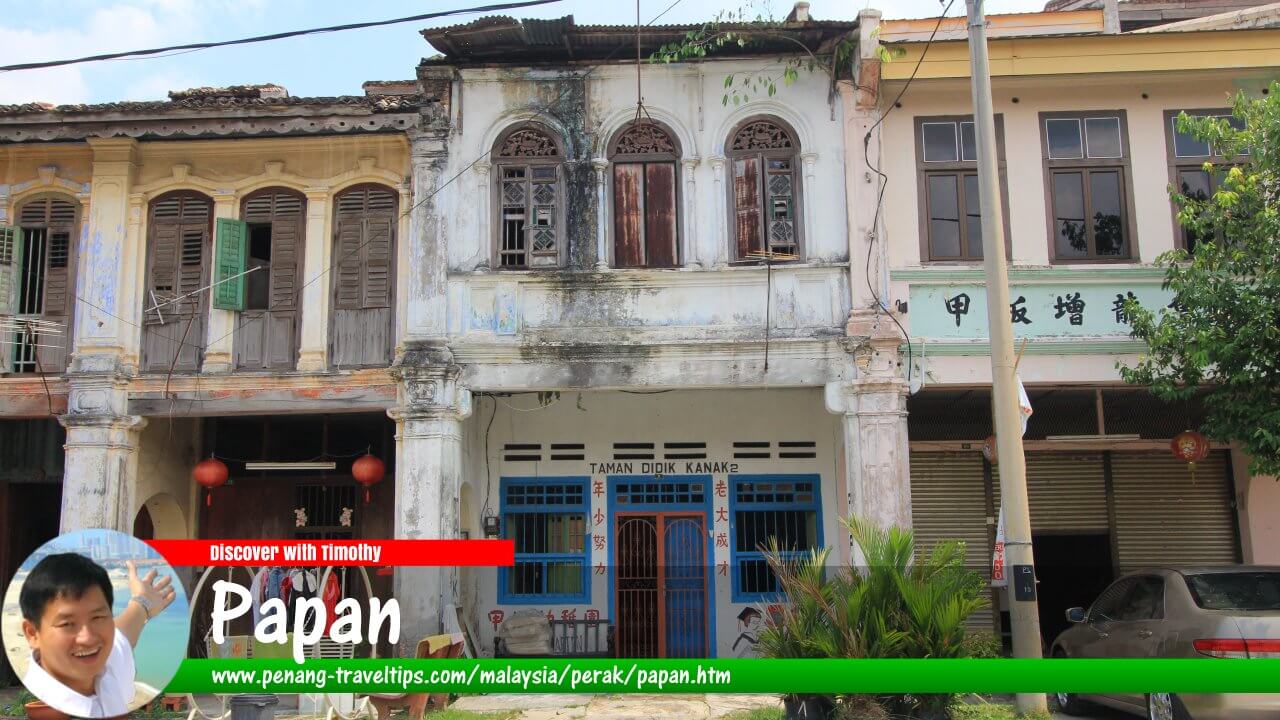 Papan Travel Guide (18 June 2011)
Also available: Panduan Melawat Papan
Papan is a small historic settlement in the Batu Gajah area of Perak, located south of Ipoh. Today, it is a quiet place with a remarkably well-preserved sense of its past. Its rows of old shophouses, wooden houses, historic mosque and the former residence of Raja Bilah recall the period when Papan was one of the important tin-mining settlements of the Kinta Valley.
Papan is particularly interesting because its present-day appearance is very different from its former importance. During the late 19th and early 20th centuries, it had a market, police station, post offices, schools, temples, a Chinese opera theatre, magistrate's office, prison and other facilities. At its height, thousands of people lived in the settlement.
Today, Papan is a small and quiet community, but its historic buildings and surrounding landscape make it an unusual destination for travellers interested in Perak's mining history, Mandailing heritage and places that have retained the atmosphere of an earlier era.
Quick Facts
Location: Papan, Batu Gajah District, Perak, Malaysia
District: Batu Gajah
Local authority: Majlis Daerah Batu Gajah
Distance from Ipoh: About 16–20 km south
Historical importance: Former timber and tin-mining settlement of the Kinta Valley
Best known for: Raja Bilah's heritage complex, old shophouses, Papan's historic mosque and Papan Eco-Rimba
Major heritage figure: Raja Bilah, a prominent Mandailing leader and tin miner
Nearest major towns: Batu Gajah, Pusing and Ipoh
Main access: Local roads connecting Papan with Batu Gajah, Pusing and Ipoh
Where is Papan?
Papan is located in the Batu Gajah District of Perak, to the south of Ipoh. It lies in the historic Kinta Valley, an area that became one of the world's major tin-producing regions during the late 19th and early 20th centuries.
The settlement is reached by local roads from the Batu Gajah and Pusing areas. Unlike Ipoh or Batu Gajah, Papan is not situated along a major modern highway. This relative isolation has contributed to the survival of its old streetscape.
The surrounding landscape contains former mining areas, ponds, streams, limestone and forested hills. The combination of old buildings and rural surroundings gives Papan a character quite different from the larger towns of the Kinta Valley.
Geography of Papan
There are presently the Papan Old Town and Papan New Town. Papan Old Town is located near the old mining lakes, on Perak State Route A188, which is known simply as Jalan Besar, or Main Road. Papan New Town is located on Federal Route 5, on the way to Pusing.
What Does the Name Papan Mean?
Papan is a Malay word meaning plank or piece of timber. The settlement is traditionally associated with timber activities before it developed into a major tin-mining centre.
Timber from the surrounding forest, including valuable chengal, was brought down waterways and processed for use in houses, boats and furniture. The development of tin mining subsequently transformed Papan into a much larger settlement.
Some historical accounts associate the name closely with the timber trade, although the precise circumstances surrounding the origin of the place name have also been discussed by local historians.
A Brief History of Papan
Papan developed before the great tin-mining boom of the Kinta Valley. The early settlement was strongly associated with the Mandailing, a people originating from the Mandailing region of Sumatra.
Raja Asal was an important early Mandailing leader in the area. His nephew, Raja Bilah, subsequently became the most prominent Mandailing leader associated with Papan.
Raja Bilah moved to Papan in the late 1870s and became its penghulu, or local headman. He was also involved in tin mining and developed what became a substantial Malay-owned mining enterprise.
The discovery and exploitation of tin deposits transformed Papan. Chinese miners and traders arrived in large numbers, and the settlement developed into a busy mining town. By the late 19th century, Papan had acquired many of the institutions normally associated with a substantial town.
Historical records from the 1890s indicate that Papan had a sizeable population and was considered one of the important towns of the Kinta Valley. Its facilities included a market, post office, police barracks, magistrate's office, schools, temples, stables and a Chinese theatre.
A prison and hospital were subsequently established, while Papan was also connected to the railway network serving the Kinta Valley. A railway station was completed in 1908 as part of the Ipoh–Tronoh railway system.
The Rise and Decline of Papan
Papan reached an important stage of development during the 1890s. By this time, it was regarded as a substantial town alongside other Kinta Valley settlements such as Ipoh, Gopeng and Batu Gajah.
However, its prosperity did not last indefinitely. A major fire in 1911 caused extensive damage to the town. The development of other urban and mining centres, particularly Ipoh, also reduced Papan's relative importance.
During the 20th century, changes in the tin-mining industry gradually reduced the economic importance of the settlement. The decline accelerated when tin mining became less profitable and many residents moved elsewhere.
By the late 20th century, Papan had become a much smaller settlement. The collapse of tin prices in the 1980s was particularly significant for former mining communities throughout the Kinta Valley.
Papan's Historic Shophouses
The most immediately striking feature of Papan is its row of old shophouses along the main street.
Many of these buildings have deteriorated considerably. Some are partly occupied, while others have become overgrown with vegetation. Their condition is very different from the restored heritage buildings of central Ipoh or George Town.
This is precisely what makes Papan interesting from a heritage perspective. The buildings provide an unusually direct impression of a former mining town that has not been extensively redeveloped.
Visitors should remember that these are not simply abandoned buildings. Papan remains a living settlement, and some houses and premises are occupied. Travellers should therefore explore respectfully and avoid entering private property or unstable structures.
Raja Bilah and the Mandailing Heritage
The history of Papan cannot be separated from the story of the Mandailing community in Perak.
The Mandailing originated in Sumatra and established settlements in various parts of the Malay Peninsula during the 19th century. In Perak, Mandailing leaders became involved in local administration, mining and commerce.
Raja Bilah was one of the most prominent of these leaders. He became penghulu of Papan and played an important role in developing the settlement during the British colonial period.
His story is particularly significant because it demonstrates that the development of the Kinta Valley's mining economy involved not only European companies and Chinese miners, but also Malay and Mandailing entrepreneurs.
Rumah Besar Raja Bilah
Rumah Besar Raja Bilah is Papan's most important surviving heritage building. It was completed in 1896 and is an example of Mandailing architectural tradition.
The building is associated with the Bagas Godang tradition, in which a large house or hall served an important social and communal role within Mandailing society. Rather than functioning solely as a private residence, the building provided a place for meetings, celebrations and community activities.
The structure combines timber and masonry and contains distinctive architectural details associated with Mandailing traditions. Its entrance gateway bears the date 1896.
The house also illustrates the role Raja Bilah played in the wider Mandailing community of Perak. Mandailing communities were established in several parts of the Kinta Valley and elsewhere in Perak, and Rumah Besar Raja Bilah became an important symbol of this heritage.
Visitors should not assume that the building is a conventional museum that can always be entered without prior arrangement. Access arrangements may vary, so it is advisable to check locally before planning an interior visit.
Rumah Asal Raja Bilah
Near Rumah Besar is Rumah Asal, the earlier residence associated with Raja Bilah and his family.
The timber house dates to 1882, making it older than Rumah Besar. Together, the two buildings provide an unusual surviving group of Mandailing heritage architecture in the Kinta Valley.
The presence of Rumah Asal, Rumah Besar and the historic mosque in the same area helps visitors understand how Raja Bilah's settlement developed as both a residential and communal centre.
Masjid Kampung Papan
Masjid Kampung Papan is an important part of the history of the settlement and the Mandailing community.
The mosque was built in 1888, during the period when Papan was developing rapidly as a mining town. Historical research records that the land was associated with a Chinese miner who provided it to Raja Bilah for the construction of the mosque.
The mosque is significant because it demonstrates the long-established presence of Islam in the Mandailing community of Papan. It also provides an example of how different communities were connected within the developing mining settlement.
The original mosque was built in a traditional style and is associated with the early Mandailing settlement. For Muslim visitors, it is particularly meaningful because it connects the present-day landscape with the history of the Muslim community that developed alongside Papan's mining industry.
Visitors should observe the usual etiquette when approaching or visiting a mosque, including dressing appropriately and avoiding disruption to worshippers.
Sybil Kathigasu and Papan During the Japanese Occupation
Papan also has a connection with one of the best-known Malaysian figures associated with resistance and humanitarian work during the Japanese occupation of Malaya.
Sybil Kathigasu, a trained nurse, moved with her family to Papan during the Second World War. She operated a medical dispensary and acted as a midwife, providing medical assistance to local people.
She and her husband, Dr. A. C. Kathigasu, became involved in clandestine assistance to people resisting the Japanese occupation. Sybil secretly treated members of the Perak People's Anti-Japanese Army and maintained contact with resistance activities.
She also used shortwave radios to obtain and relay information. In 1943, the Japanese authorities arrested her. She was subjected to prolonged interrogation and torture and remained imprisoned for the rest of the occupation.
The former clinic associated with Sybil Kathigasu is therefore one of the most historically significant places in Papan, although visitors should distinguish between the historical site and a formally operating museum or visitor centre.
Papan and the Radioactive Waste Controversy
Papan also became associated with an important environmental protest in the 1980s.
In 1985, a site near the Kledang Range was selected for the disposal of radioactive waste associated with the Asian Rare Earth processing plant at Bukit Merah. Local residents and communities in the surrounding area expressed serious concerns about the potential health and environmental effects.
Thousands of people from Papan and neighbouring communities participated in protests against the proposed waste disposal arrangements. The issue became one of Malaysia's best-known environmental controversies and contributed to public awareness of industrial pollution and radioactive waste management.
For visitors interested in modern Malaysian history, this episode adds another layer to Papan's story. The settlement's history therefore extends beyond mining and colonial-era architecture into the environmental and social history of modern Malaysia.
Taman Eko-Rimba Papan
Taman Eko-Rimba Papan is the principal nature attraction associated with the settlement. It is a forest recreation area on the edge of Papan and provides a contrast to the historic town centre.
The site includes forest trails and facilities such as a multipurpose hall, a gallery of non-timber forest products, camping grounds, toilets, changing rooms, a surau and rest shelters.
The Batu Gajah District Council currently lists visiting hours as 8:00am to 5:30pm. Its published admission rates include RM2 for adults aged 18 and above, RM1 for children and senior citizens, and RM5 for foreign visitors. Children below three years old are listed as free of charge.
Because operating hours and admission charges can change, visitors should check the latest information before travelling.
Exploring Papan on Foot
Papan is particularly suitable for slow exploration on foot. The historic centre is small, so visitors can walk along the main street and then explore the lanes behind the shophouses.
A short walking visit can include:
- The old shophouses along the main street
- Rumah Besar Raja Bilah
- Rumah Asal
- Masjid Kampung Papan
- Former sites associated with the old town institutions
- Nearby mining ponds and rural scenery
- The surrounding village streets
Visitors should be cautious around abandoned or deteriorating structures. Some buildings may have weakened floors, roofs or walls, and entering them without permission can be dangerous.
Food in Papan
Papan is not a conventional tourist town with a large selection of restaurants. Its small population means that food choices are limited compared with nearby Batu Gajah and Ipoh.
Visitors may find simple local food and drinks in the settlement, but should not expect extensive opening hours. For a larger choice of restaurants, cafés and supermarkets, Batu Gajah, Pusing or Ipoh are more convenient.
A good approach is to have breakfast or lunch in a nearby town and treat Papan primarily as a heritage and nature excursion.
Food for Muslim Travellers
Muslim travellers should be aware that Papan's historic centre is a small mixed community and does not have the extensive halal dining infrastructure found in larger Malaysian towns.
For travellers who require certified halal food, it is advisable to eat at a known halal establishment in Batu Gajah, Pusing or Ipoh before or after visiting Papan. Alternatively, check with individual food operators regarding their ingredients and preparation methods.
Muslim visitors should also remember that a small village or heritage site may have limited food outlets, so carrying drinking water and a small amount of food or snacks is practical.
Accommodation
Papan itself has very limited accommodation. It is therefore more practical for most visitors to stay in Ipoh, Batu Gajah or nearby Gopeng.
Ipoh offers the widest range of hotels, guesthouses and restaurants. Batu Gajah is closer to Papan and can be more convenient for visitors who want to explore several attractions in the Batu Gajah area.
Gopeng is another useful base for travellers combining Papan with Gua Tempurung, rafting and other outdoor activities.
Getting to Papan
By Car
A car is the most convenient way to reach Papan. From Ipoh, travel south towards Batu Gajah and continue towards Pusing and Papan using local roads.
From Kuala Lumpur, use the North-South Expressway and leave the expressway in the Batu Gajah or nearby area before continuing along local roads.
Because Papan is a small settlement, navigation apps are useful for the final part of the journey.
By Train
Papan does not have a passenger railway station. Travellers using KTM ETS can travel to nearby Batu Gajah and continue by taxi or e-hailing service.
Public transport becomes less convenient once you leave Batu Gajah, particularly if you intend to visit Papan Eco-Rimba or several rural sites in the same trip.
By E-Hailing
An e-hailing vehicle may be practical for travelling from Ipoh or Batu Gajah to Papan, but visitors should consider how they will return. Availability in a small settlement may be limited, especially later in the day.
If travelling without a car, arranging a return journey in advance is advisable.
Getting Around Papan
The historic centre of Papan is small enough to explore on foot. Walking is the best way to appreciate the old shophouses and residential lanes.
A car is necessary or highly desirable if you intend to combine the town with Papan Eco-Rimba and attractions elsewhere in the Batu Gajah and Kinta Valley area.
Papan for Local Travellers
For Malaysians, Papan is particularly suitable as a short heritage excursion. It does not have the large-scale attractions of Ipoh, but its unusual streetscape makes it worthwhile for visitors interested in Perak history.
The town can be combined with Batu Gajah, Kellie's Castle, Tanjung Tualang and Gopeng to create a full day of sightseeing in the southern Kinta Valley.
Photography enthusiasts may find Papan especially interesting, but should remember that the town remains a residential community. Photographs of private homes and residents should be taken respectfully.
Papan for Foreign Travellers
For foreign visitors, Papan offers a different perspective on the history of Malaysia's tin-mining economy. Instead of seeing the grand commercial buildings of Ipoh, visitors can observe a much smaller mining settlement where many of the old structures have remained in place.
The story of Raja Bilah also introduces visitors to the history of the Mandailing people from Sumatra and their contribution to the development of Perak.
The connection with Sybil Kathigasu provides another historical dimension, linking Papan to the Japanese occupation and the wartime resistance movement in Malaya.
Visitors interested in heritage should allow time to explore slowly rather than treating Papan as a conventional attraction with a long list of facilities.
Papan for Muslim Travellers
Papan has particular significance for Muslim visitors because of its historic Mandailing Muslim heritage. The presence of Masjid Kampung Papan dates back to the 19th century and is closely connected with Raja Bilah and the early Muslim community.
The story of the Mandailing community also illustrates the diversity of Islam in the historical development of Perak. Muslim communities were not separate from the mining economy; they participated directly in the settlement, administration and economic development of the Kinta Valley.
Visitors should plan their prayer times around their itinerary, especially if spending several hours at Papan Eco-Rimba or other rural attractions. The availability of a surau at Papan Eco-Rimba is useful for Muslim visitors undertaking a longer nature visit.
Suggested One-Day Itinerary
- Morning: Travel from Ipoh or Batu Gajah to Papan.
- Morning: Walk along the old main street and examine the historic shophouses from public areas.
- Morning: Visit the Rumah Besar Raja Bilah and Rumah Asal area, subject to access arrangements.
- Late morning: See Masjid Kampung Papan and learn about its connection with Raja Bilah and the Mandailing community.
- Lunch: Have lunch in Batu Gajah, Pusing or another nearby town.
- Afternoon: Visit Taman Eko-Rimba Papan for a forest walk and nature experience.
- Late afternoon: Continue to another nearby attraction such as Kellie's Castle or return to Ipoh.
Suggested Two-Day Itinerary
Day 1 – Papan Heritage
- Travel to Papan in the morning.
- Explore the old shophouses and lanes.
- Learn about the history of Raja Bilah and the Mandailing community.
- Visit the Rumah Besar Raja Bilah area.
- See Masjid Kampung Papan.
- Have lunch in Batu Gajah or Pusing.
- Visit Kellie's Castle or another nearby heritage attraction.
- Return to Ipoh or Batu Gajah for the night.
Day 2 – Nature and Southern Kinta Valley
- Return to Papan in the morning.
- Spend several hours at Taman Eko-Rimba Papan.
- Have lunch nearby.
- Continue to Tanjung Tualang or Gopeng.
- Return to Ipoh or continue south towards Kampar.
Best Time to Visit Papan
The historic town is best explored during the morning or late afternoon, when the weather is generally more comfortable for walking.
For Papan Eco-Rimba, daytime visits are more appropriate because the attraction operates during daylight hours. Rain should also be taken into consideration when planning forest activities.
Weekdays can provide a quieter experience, although some small businesses and heritage-related facilities may have more limited opening arrangements than during weekends.
How Long Should You Spend in Papan?
A two- to four-hour visit is sufficient to walk through the historic town, see the main heritage buildings from accessible areas and learn about its history.
Allow a full day if you intend to include Papan Eco-Rimba and one or two nearby attractions.
There is little need to spend several days in Papan itself because accommodation, restaurants and visitor facilities are limited. Instead, use Ipoh, Batu Gajah or Gopeng as a base for exploring the wider region.
Practical Tips
- Wear comfortable shoes because the best way to experience the old town is on foot.
- Bring drinking water, especially when visiting during hot weather.
- Do not enter abandoned buildings because some structures may be unstable.
- Respect private property and the privacy of local residents.
- Ask permission before photographing people or private homes.
- Check access arrangements for Rumah Besar Raja Bilah before planning an interior visit.
- Check current opening hours and admission fees for Taman Eko-Rimba Papan before travelling.
- Bring some cash because small businesses in rural areas may not accept cards.
- Muslim travellers should plan prayer times, particularly when combining Papan with forest activities.
- For certified halal food, consider eating in Batu Gajah, Pusing or Ipoh where there are more choices.
- Foreign visitors should carry appropriate identification and travel documents.
- Do not describe Papan simply as an abandoned or "ghost town"; it remains a living community.
Nearby Attractions
Papan is well positioned for exploring the southern part of the Kinta Valley. Several attractions can be combined with a visit to the historic settlement.
- Batu Gajah: A historic former administrative and mining town with heritage buildings and local attractions.
- Kellie's Castle: An unfinished mansion associated with Scottish planter William Kellie Smith.
- Tanjung Tualang Tin Dredge: A preserved reminder of the large-scale tin-dredging industry that once dominated the Kinta Valley.
- Gopeng: A former mining town known for Gua Tempurung, rafting, caving, rainforest activities and heritage buildings.
- Ipoh: The main urban centre of the Kinta Valley, with extensive food, heritage, accommodation and shopping facilities.
- Kampar: A former tin-mining town south of Papan with its own mining heritage and modern education institutions.
- Lubuk Timah: A recreational area associated with hot springs and outdoor activities.
Why Papan is Important
Papan is important not because of its present size, but because of the historical record that survives in a relatively small area.
The settlement brings together several strands of Perak's history: the Mandailing migration from Sumatra, Malay participation in tin mining, Chinese migration and commerce, British colonial administration, the development of transport infrastructure, the Japanese occupation, the wartime resistance movement and the environmental politics of the late 20th century.
Few small settlements in Malaysia present these different historical layers so closely together.
Papan and the History of Perak's Tin Industry
The story of Papan is part of the much larger transformation of Perak brought about by tin. During the late 19th century, the Kinta Valley became one of the world's principal tin-producing regions.
Mining attracted people and capital from different parts of Southeast Asia and beyond. New towns developed around the mines, roads and railways were constructed, and commercial institutions emerged to support the industry.
Papan was one of the early centres of this transformation. Its eventual decline illustrates the other side of the mining story: when deposits became less profitable and the economic centre shifted elsewhere, towns that had depended heavily on mining could shrink dramatically.
Conclusion
Papan is one of the more unusual heritage destinations in Perak. It was once a busy tin-mining town with thousands of residents and a wide range of civic and commercial institutions. Today, only a small community remains, surrounded by old buildings, former mining landscapes and forest.
The surviving Rumah Besar Raja Bilah, Rumah Asal and Masjid Kampung Papan are especially important for understanding the history of the Mandailing community and the role of Malay and Muslim communities in the development of the Kinta Valley.
The story of Sybil Kathigasu adds an important Second World War dimension, while Taman Eko-Rimba Papan provides a natural attraction that can be combined with the heritage visit.
For local travellers, Papan makes an interesting half-day or full-day excursion from Ipoh or Batu Gajah. For foreign visitors, it provides a glimpse of a lesser-known side of Malaysia's tin-mining history. Papan is best approached not as a conventional tourist attraction, but as a living historic settlement whose surviving buildings and stories reward slow and respectful exploration.
Map of Papan, Perak
Categories of sights in Papan
Sights in Papan
- House of Sybil Kathigasu (GPS: 4.51491, 101.01213)

- Masjid Kampung Papan (GPS: 4.51542, 101.0133)

- Papan Chinese Temple (GPS: 4.5134, 101.01474)

- Rumah Besar Raja Bilah (GPS: 4.51534, 101.0129)

- Rumah Asal (GPS: 4.51551, 101.01278)

- SJK (C) Papan
(GPS: 4.51524, 101.01202)

References
- Majlis Daerah Batu Gajah, Taman Eko-Rimba Papan: https://www.mdbg.gov.my/index.php/pelawat?catid=38&id=237%3Ataman-eko-rimba-papan&view=article
- Majlis Daerah Batu Gajah, Tarikan Pelancong: https://www.mdbg.gov.my/index.php/pelancongan/tarikan-pelancong
- Majlis Daerah Batu Gajah, Istana Raja Billah: https://ww.kualakangsar.gov.my/index.php/en/pelancongan/tarikan-pelancong?catid=38&id=236%3Aistana-raja-billah&view=article
- Perak Heritage Society, Remembering Raja Bilah of Papan: https://perakheritage.wordpress.com/2011/07/13/remembering-raja-bilah-of-papan/
- Universiti Pendidikan Sultan Idris, Rumah Besar Penghulu Raja Bilah di Papan dan Hubungannya dengan Masyarakat Mandailing di Perak 1896–1940: https://ejournal.upsi.edu.my/index.php/PERS/article/view/8871
- Perak Heritage Society / Ipoh Echo, Tourism News – Papan heritage tour: https://www.ipohecho.com.my/pdf/125-PTN.pdf
- Jabatan Pengurusan Masjid Negeri Perak, Masjid Papan: https://e-masjid.perak.my/profil-masjid/AmyMem
- National Heritage Department, Malaysia, Heritage Sites: https://www.heritage.gov.my/ms/tapak-warisan
- Tourism Perak Malaysia, The Tin Mining Story: https://www.tourismperakmalaysia.com/wp-content/uploads/2021/12/TPR-1909-0060_TinMiningStory_Booklet_010720.pdf
- WARMAP, Sybil Kathigasu's Clinic, Papan, Perak: https://warmapapp.com/sybil-kathigasus-clinic-papan-perak
- Penang Travel Tips, Rumah Besar Raja Bilah: https://www.penang-traveltips.com/malaysia/perak/papan/rumah-besar-raja-bilah.htm
Page Details
This page was created on 15 September 2026. Hi, my name is Timothy and created it from my research, for my own entertainment, knowledge and to satisfy my curiosity. I am providing the information to you in good faith and hope it is useful. I try to get the details as accurate as possible. I also try to update the page whenever I stumble on new details. So this and all my other pages are perpetual work in progress. If you discover any error, please politely inform me, pointing out where the error lies, and I will correct it as soon as possible. Your helpfulness will keep this page accurate, relevant and helpful to those who need the information.Buy Me A Coffee
If you enjoy the information I provide and want to support the work I do, please buy me a coffee! I appreciate it immensely, thank you so much!
