
Is Penang Safe?
Short answer: Yes—Penang is safe for most visitors and residents. The longer answer is even better: official statistics and global indices consistently place Malaysia among the world’s most peaceful nations, while Penang itself benefits from visible policing, efficient public services, and a welcoming, community-oriented culture.1,3,4
What the numbers say
When evaluating safety, the most reliable way is to look at data. Malaysia’s Department of Statistics (DOSM), using police-reported figures from the Royal Malaysia Police (PDRM), publishes annual crime statistics by state and district. The latest release shows that while cyber-enabled and commercial fraud have risen nationwide, Penang’s on-the-ground violent incidents remain comparatively low in frequency for a densely populated urban state.1,2
Two points stand out from the official data:
- Penang’s overall crime levels are managed in the context of a busy, compact state. DOSM’s most recent national report details crime index ratios by state and confirms Penang’s figures within the broader national pattern—useful for apples-to-apples comparison with other major urban states in Malaysia.1
- Trends are closely monitored down to district level. OpenDOSM provides district-by-district breakdowns and categories, allowing researchers to see that Penang’s police and authorities track patterns in real time, a strong indicator of institutional capacity and responsiveness.2
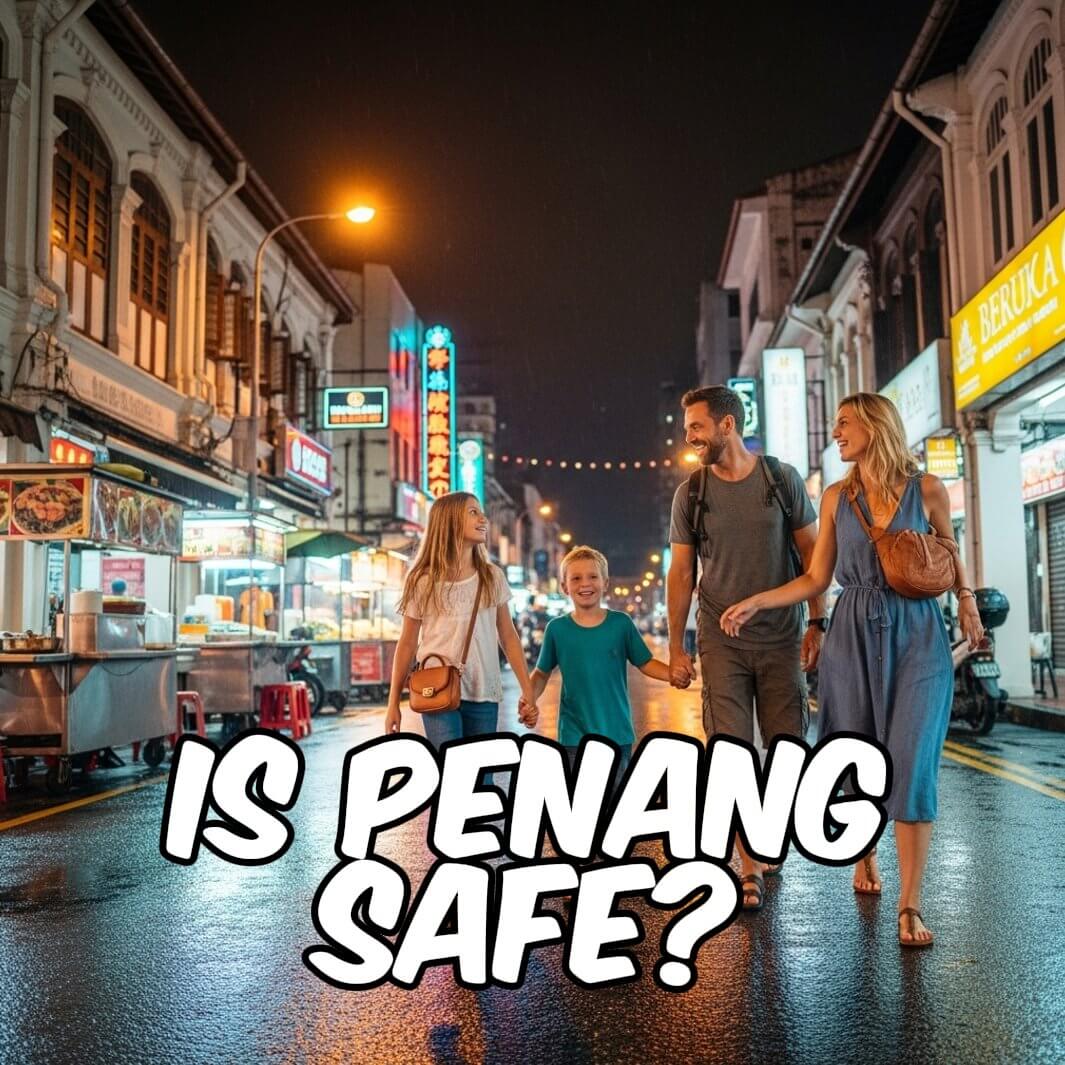
Is Penang Safe?
Global context: Malaysia ranks among the world’s most peaceful
Safety is also about the overall security environment, not just street crime. On the Global Peace Index (GPI)—a composite measure of societal safety and security, ongoing domestic and international conflict, and militarisation—Malaysia placed 10th globally in 2024, then remained highly ranked in 2025 at 13th. This positions Malaysia among the safest and most peaceful countries worldwide, and Penang—being one of its most visited and cosmopolitan states—benefits directly from that stability.4,5
Independent travel guidance
Government travel advisories are a useful cross-check. The United States’ country information page currently advises travellers to exercise normal precautions in Malaysia, with elevated caution specifically for the far eastern coast of Sabah (a different region entirely from Penang on the northwest coast of Peninsular Malaysia). This means Penang’s popular areas—George Town, Batu Ferringhi, Balik Pulau, and the mainland—fall within standard, routine travel practice.3
What local police say
Penang’s police leadership has publicly reiterated that the state remains peaceful, noting continued focus on suppressing conventional crime and tackling online scams—precisely the kinds of crimes that spike in many developed urban regions globally. This emphasis reflects an active policing strategy rather than a deterioration in street safety.6
Reality check: What risks are most relevant in Penang?
No destination is risk-free, but understanding which risks are most relevant helps you stay comfortable and confident:
- Petty theft and opportunistic crime: Like any lively city, crowded areas (markets, bus terminals, tourist streets) can attract pickpockets. Standard common-sense precautions—zippered bags, keeping phones secure, and avoiding leaving items on café tables—go a long way.1
- Online and commercial scams: Nationwide, reported online crime increased in recent years, following a global pattern. These scams typically happen before you arrive (e.g., fraudulent online bookings) or entirely online, not on the street. Use reputable platforms, verify vendors, and be wary of “too good to be true” offers.7
- Road safety: Penang’s roads are busy and compact. Use pedestrian crossings where possible, keep an eye for motorbikes, and consider ride-hailing for late-night journeys.
Myth vs. fact
- Myth: “Southeast Asian cities are dangerous after dark.”
Fact: In Penang, nightlife areas are generally relaxed and social, with families, students, and travellers out late—especially on weekends. Normal urban awareness (sticking to well-lit streets and licensed transport) is sufficient.3 - Myth: “If national news mentions crime, the streets must be unsafe.”
Fact: Headlines often reflect online fraud trends, not street violence. Penang’s visible policing and community reporting help keep public spaces orderly.1,6 - Myth: “I should avoid Penang because of regional advisories.”
Fact: International advisories that flag specific concerns for eastern Sabah do not apply to Penang, which lies a thousand kilometres away on the peninsula and is rated for normal precautions.3
Street-smart tips to feel even safer
- Choose central, well-reviewed accommodation. George Town, Gurney Drive, Tanjung Tokong, and Batu Ferringhi are established visitor areas with good lighting and frequent patrols.
- Use licensed transport and ride-hailing. Grab and traditional taxis are widely available. Confirm the driver and vehicle plate in the app before you get in.
- Secure your belongings. Use cross-body bags that zip, keep wallets in front pockets, and avoid displaying high-value items in crowded places.
- Pay digitally where possible. Many cafés and attractions accept cards or e-wallets; this reduces the need to carry large amounts of cash.
- Verify bookings. For tours and rentals, use known operators or platforms with buyer protection. Be cautious with direct bank transfers to unknown parties.7
- Stay hydrated and alert. Penang is tropical; heat can make anyone less attentive. Carry water and take regular breaks, especially when exploring on foot.
Community safety you can feel
One of Penang’s greatest strengths is its community fabric. Streets are active at most hours, heritage zones have steady footfall, and food culture keeps public spaces lively. Crime tends to avoid busy, well-lit areas, and the state invests in festivals, public art, and walkability improvements that keep neighbourhoods vibrant and naturally surveilled by the community. Add Malaysia’s high placement on global peace rankings, and you get a destination where safety is the norm, not the exception.4,5
Practical scenarios (and how Penang handles them)
- Lost passport or emergency: Police stations are accessible and courteous, with clear procedures. Your consulate’s guidance plus local authorities will typically resolve documentation issues efficiently.3
- Medical care: Penang has reputable public and private hospitals. For travellers, standard travel insurance suffices; pharmacies are widespread and well stocked.
- Walking at night: Popular areas like Armenian Street, Chulia Street, and seafront promenades remain lively. As with any city, stick to illuminated routes and avoid deserted back alleys late at night.
Bottom line
Is Penang safe? Yes. The combination of low violent crime in daily public life, responsive policing, robust national peace indicators, and a friendly, community-minded culture makes Penang one of the most comfortable places to live and travel in Southeast Asia. Stay street-smart, take normal precautions, and you’ll find that Penang’s safety lets you focus on what truly matters here: world-class street food, layered heritage, and island sunsets over the Straits of Malacca.1,2,3,4,5,6,7
References
- Department of Statistics Malaysia (DOSM). Crime Statistics, Malaysia 2024 (latest release covering 2023 data).
- OpenDOSM. Crimes by District & Crime Type (PDRM-reported dataset with state/district breakdowns).
- U.S. Department of State. Malaysia – International Travel Information (Level 1: Exercise Normal Precautions; eastern Sabah noted separately).
- Institute for Economics & Peace (Vision of Humanity). 10 Most Peaceful Countries in the World – 2024 (Malaysia ranked 10th).
- Institute for Economics & Peace. Global Peace Index 2025 (Malaysia remains highly ranked; see country table).
- The Vibes. New Penang top cop: keep state peaceful; focus on reducing crime and eradicating scams (report, August 2025).
- BERNAMA / DOSM. Online crime cases up 35.5% in 2023 (national trend; reinforces vigilance online).
Page Details
This page was created on 14 August 2025. Hi, my name is Timothy and created it from my research, for my own entertainment, knowledge and to satisfy my curiosity. I am providing the information to you in good faith and hope it is useful. I try to get the details as accurate as possible. I also try to update the page whenever I stumble on new details. So this and all my other pages are perpetual work in progress. If you discover any error, please politely inform me, pointing out where the error lies, and I will correct it as soon as possible. Your helpfulness will keep this page accurate, relevant and helpful to those who need the information.Taking the bus in Penang

