
Foreigners' Guide to Property Taxes in Malaysia
Thinking of making Penang your home under MM2H? Here’s exactly what you’ll pay (and to whom) for local property taxes. We’ll keep it simple, practical, and Penang-specific.
Key Terms You’ll See in Penang
- Cukai Taksiran — also called Cukai Pintu (Assessment Tax / “Door Tax”). A local-council tax based on the property’s Annual Value (an estimate of yearly rent), multiplied by a council-set rate.1,2,3
- Cukai Tanah — commonly called Quit Rent. A state land tax payable to the State Land and Mines Office (Pejabat Tanah dan Galian, PTG). Collected annually.4,5,6

Foreigners' Guide to Property Taxes in Malaysia
What Each Tax Pays For
- Cukai Taksiran / Cukai Pintu funds day-to-day local services such as garbage collection, road/drain maintenance, street lighting, parks and public spaces.2,7,8
- Cukai Tanah (Quit Rent) is a state land tax (not tied to local services) administered by the State Land Office (PTG).5,6
Who Collects What in Penang?
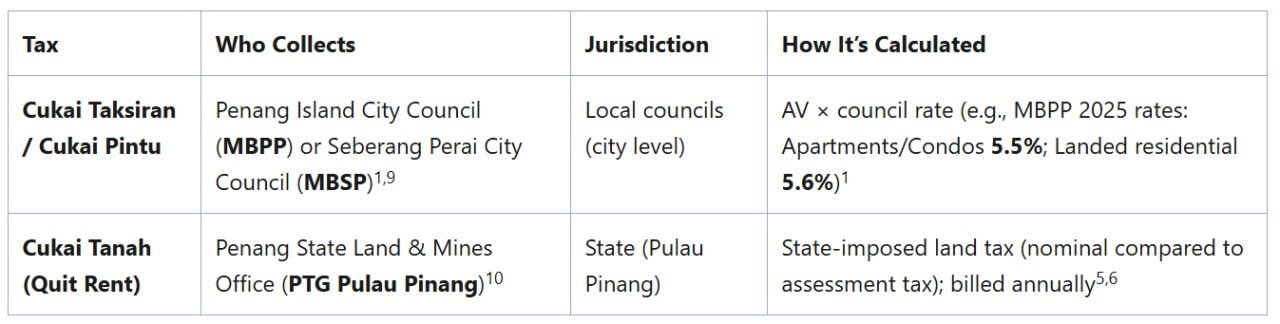
How Often You Pay
- Cukai Taksiran / Cukai Pintu: typically billed twice a year (e.g., January & July cycles in many councils).8
- Cukai Tanah (Quit Rent): annually (common payment window Jan–May).6
How Much Might You Pay?
Because assessment tax is based on Annual Value (rent), not the sales price, two RM2.3 million homes can pay different amounts if their realistic rents differ. As a rule of thumb for Penang owner-occupied homes, AV often falls well below 10% of market value. For illustration:
- Example (MBPP, apartment/condo): Suppose a RM2.35 million home (~US$500,000) could rent for RM6,500/month ⇒ AV ≈ RM78,000/year. With the 2025 MBPP apartment/condo rate of 5.5%, assessment tax ≈ RM4,290/year (~US$900).1,2
- Quit Rent (Cukai Tanah): Usually a small, fixed state land tax relative to property value (often a few hundred ringgit per year, varies by land title and lot size).5,6
Note: AV estimates vary by location, building type, size, age, and market conditions. Councils may revise AV and rates periodically (Penang announced revised rates effective 1 Jan 2025).1,11
Where & How to Pay
- Cukai Taksiran (MBPP/MBSP): Pay online via the state/council portals (e.g., MBPP e-bayar / PBTPay) or at council counters and post offices.12,9
- Cukai Tanah (PTG Penang): Pay via the PTG Pulau Pinang platform (PgLAND) or at Land Office branches; many PTGs support online and internet-banking payments.10,6,13
FAQs for MM2H Residents
Do I pay these even if I don’t rent out the property?
Yes. Assessment tax uses potential annual rent (AV), not actual rent received.2,3
Are strata owners still charged quit rent?
Yes—payable to the state; administrative arrangements may differ by state and title issuance, but payments are to (or via) the State Land Office system.4,6,14
What if I didn’t receive a bill?
You’re still responsible for payment—ensure ownership records are updated with the Land Office and your local council after purchase.7
References
- MBPP: Property Assessment (official rates & categories, 2025)
- SAYS: How to Pay Cukai Taksiran / Cukai Pintu (AV basis explained)
- Malaysia Valuers: Assessment (AV concept & typical rates)
- PropertyGuru: Guide to Quit Rent & Assessment
- MyPropertyPlaces: Guide to Quit Rent (where/how to pay)
- Properly: Quick Guide to Quit Rent (annual billing window)
- PropertyGenie: What Is Quit Rent and Assessment Tax (online payment & responsibilities)
- EasyLaw: Assessment Tax (purpose & twice-yearly cycle)
- MBSP: Assessment Tax FAQ (what it is; who pays)
- PTG Pulau Pinang: PgLAND portal (state land & quit rent)
- BusinessToday: Penang assessment rate changes effective 1 Jan 2025
- GoodyMY: Guide to Paying Cukai Taksiran Online (MBPP/PBTPay)
- iProperty: How to Pay Quit Rent Online
- UEM Sunrise: Cukai Tanah (background & parcel tax note)
Page Details
This page was created on 14 August 2025. Hi, my name is Timothy and created it from my research, for my own entertainment, knowledge and to satisfy my curiosity. I am providing the information to you in good faith and hope it is useful. I try to get the details as accurate as possible. I also try to update the page whenever I stumble on new details. So this and all my other pages are perpetual work in progress. If you discover any error, please politely inform me, pointing out where the error lies, and I will correct it as soon as possible. Your helpfulness will keep this page accurate, relevant and helpful to those who need the information.Taking the bus in Penang

