
Bentong Travel Guide
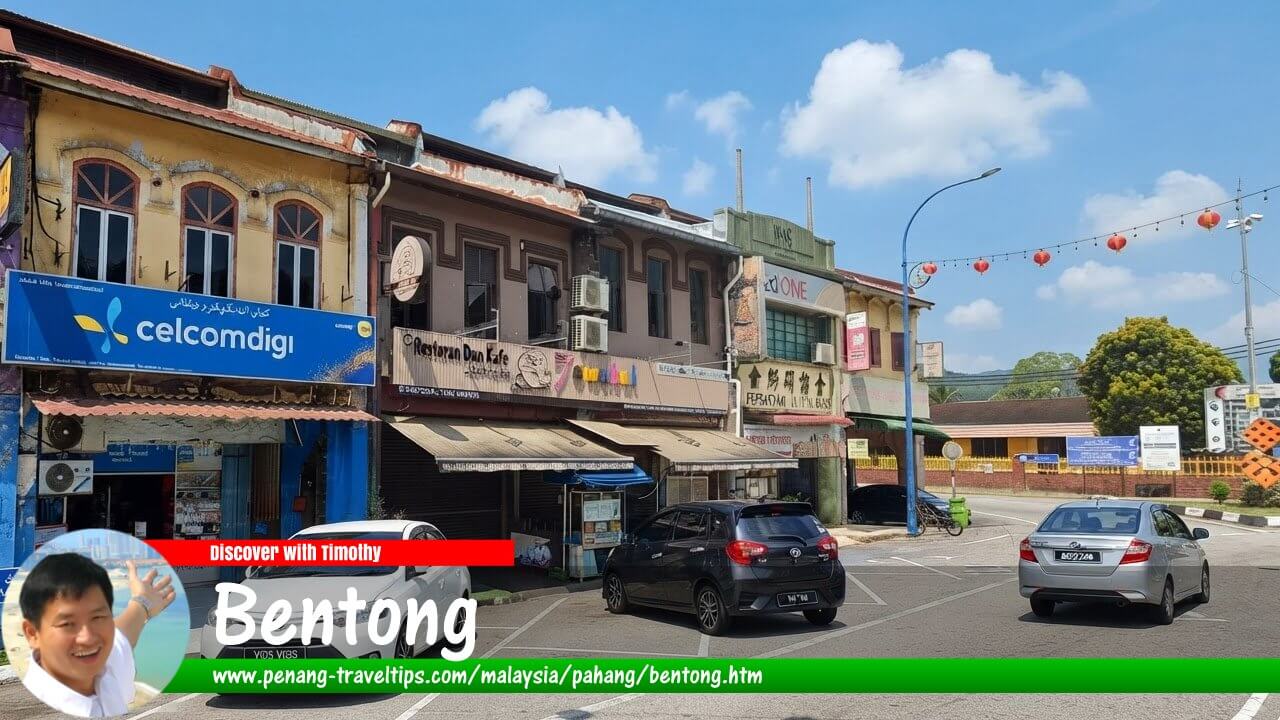 Bentong Travel Guide (AI generated on 9 September 2026)
Also available: Panduan Melawat Bentong
Introduction to Bentong
Bentong is a town and district in Pahang, Malaysia, located on the western side of the state near the border with Selangor. Surrounded by mountains, forests and agricultural land, Bentong serves as an important commercial centre for the surrounding rural areas and as a gateway to several popular highland destinations.
The town's history is closely associated with tin mining. Bentong was settled in the late 19th century following the discovery of tin, and mining helped stimulate the growth of the settlement as a trading and service centre. Today, traces of its past can still be seen in the old town, where traditional shophouses stand alongside newer buildings and contemporary street art.
Bentong is also known for its natural surroundings. Rivers flowing down from the Titiwangsa Range pass through the district, while forests, waterfalls and hot springs provide opportunities for recreation. Chamang Waterfall is one of the best-known natural attractions near the town, while Bentong Hot Springs attracts visitors seeking a relaxing soak in mineral-rich water.
The wider Bentong district includes several well-known highland destinations. Janda Baik is a tranquil forested retreat with streams, waterfalls, fruit orchards, resorts and private villas. Bukit Tinggi is another popular highland area, while Genting Highlands, with its major entertainment and resort developments, lies within the wider district.
Bentong has an important agricultural economy. The surrounding countryside is known for producing durian, ginger and other agricultural products. During the durian season, the town and its surrounding villages become popular with visitors looking for locally grown fruit. The agricultural landscape also contributes to the rural character of the district.
Food is another attraction. Bentong has developed a reputation as a food town, with local specialities and long-established eateries attracting visitors from Kuala Lumpur and other parts of the Klang Valley. Lemang, grilled chicken, noodles, yong tau foo, coffee and traditional desserts are among the foods associated with the town and its surrounding communities.
The town's morning market and Saturday night market provide opportunities to experience local life and sample fresh produce and prepared food. The old town, market areas and riverside surroundings can be explored at a leisurely pace, giving visitors a different experience from the larger resort destinations elsewhere in the district.
Bentong's location also makes it a convenient destination for short trips from Kuala Lumpur. The town is connected to the capital by the Karak Highway, while the East Coast Expressway continues towards other parts of Pahang and the east coast. This accessibility has helped Bentong develop both as a destination and as a stopping point for travellers heading into the interior of Pahang.
With its combination of historic streets, mountain scenery, waterfalls, hot springs, agricultural areas, highland retreats and distinctive local food, Bentong offers much more than a simple roadside stop. The town provides an introduction to the western gateway of Pahang, while the surrounding district offers a wide range of experiences from quiet nature retreats to major hill resorts.
History of Bentong
The history of Bentong is closely associated with the development of the tin-mining industry in western Pahang. According to local tradition, the area was formerly known as Kapong and was centred around the market at the meeting point of the Repas River and Perting River.
Bentong began to attract attention in the late 19th century when tin deposits were discovered in the rivers around the settlement. Miners constructed earthworks known as ban to improve their mining operations. The resulting prosperity led people from outside the area to refer to the place as Ban Untung, meaning a profitable ridge or embankment. Over time, the name was shortened and became Bentong. :contentReference[oaicite:0]{index=0}
The discovery of tin transformed Bentong from a small settlement into a growing mining town. Chinese miners and merchants played an important role in the development of the mining industry and the town's commercial life. The arrival of large numbers of workers and entrepreneurs helped establish a permanent community, with shops and other businesses developing around the mining areas.
By the end of the 19th century and into the early 20th century, tin mining had become the main economic activity in Bentong. Roads were constructed to connect the mining areas with the town and surrounding settlements, while increasing commercial activity encouraged the development of the town centre. Bentong consequently became an important trading and service centre for western Pahang. :contentReference[oaicite:1]{index=1}
The growth of Bentong also produced a diverse population. Malay communities continued to live in the surrounding villages, while Chinese communities became strongly established in the town through mining, commerce and other businesses. This multicultural heritage remains visible in the town's old streets, traditional shophouses and places of worship.
As the importance of tin mining declined, the economy of Bentong gradually became more diversified. Rubber cultivation, agriculture, forestry, manufacturing and commerce became increasingly important. The fertile surroundings of the district also supported the cultivation of fruit and other agricultural products, eventually giving Bentong a reputation for products such as durian and ginger.
During the 20th century, improvements in roads and transport strengthened Bentong's connection with Kuala Lumpur and other parts of the peninsula. Its position at the western gateway to Pahang allowed the town to continue functioning as an important commercial and service centre even after the decline of the mining industry.
Today, the legacy of Bentong's mining past can still be seen in the old town, traditional shophouses and the stories associated with the early mining community. At the same time, the district has developed a new identity based on agriculture, food, nature and highland tourism.
The transformation from a tin-mining settlement into an agricultural, commercial and tourism centre is an important part of Bentong's character. Its history explains why the town developed where the Repas and Perting rivers meet and why Bentong remains one of the significant towns in western Pahang.
Getting to Bentong
Bentong is one of the more accessible towns in Pahang, particularly for visitors travelling from Kuala Lumpur and the Klang Valley. Its location near the western edge of Pahang and its connection to the East Coast Expressway make it a convenient gateway to the interior and highland areas of the state.
By car, Bentong can be reached from Kuala Lumpur via the Karak Highway, which forms part of the main road connection between the Klang Valley and Pahang. The journey normally takes about an hour or more, depending on traffic and the starting point in Kuala Lumpur. Several highway exits provide access to Bentong and its surrounding attractions. Driving is the most convenient option for visitors who intend to explore places such as Janda Baik, Bukit Tinggi and Chamang Waterfall.
By bus, bus services connect Bentong with Kuala Lumpur and other towns in Pahang. Buses are suitable for visitors travelling directly to the town, although public transport becomes less convenient when visiting attractions in the surrounding countryside. Check the latest schedules before travelling because services and frequencies may change.
By train, Bentong does not have a major railway station serving regular long-distance passenger services. Travellers using the East Coast Railway can use stations elsewhere in Pahang and continue their journey to Bentong by road. For most visitors from Kuala Lumpur, travelling by road is more straightforward.
By air, Bentong has no commercial airport. Travellers arriving by air can use Kuala Lumpur International Airport and continue to Bentong by road. For international visitors, this is generally the most practical air gateway to the district.
Getting around Bentong is easiest by private car. The town centre itself is relatively compact and many shops, restaurants and markets are within a manageable area, but the district's major attractions are spread across mountainous and rural areas. A car provides considerably greater flexibility for visiting waterfalls, hot springs, farms and highland destinations.
Janda Baik, Bukit Tinggi and Genting Highlands can all be reached by road from the Bentong area, although each requires travelling into the surrounding hills. Visitors should allow additional time for winding roads and heavier traffic during weekends and public holidays.
For visitors interested mainly in the old town, markets and local food, travelling directly to Bentong town is sufficient. Those intending to combine the town with nature attractions or highland resorts should plan their route in advance, as the attractions are spread over a considerable area of the district.
Bentong's excellent road connections make it suitable both as a short-trip destination from Kuala Lumpur and as a gateway to western Pahang. Its accessibility is one of the reasons the town continues to attract visitors seeking food, nature and a change of scenery from the Klang Valley.
Food in Bentong
Food is one of the attractions that has given Bentong a reputation beyond its role as a commercial town. The town's long-established Chinese-Malaysian food culture, traditional markets and agricultural surroundings have produced a variety of local specialities that are worth seeking out. Bentong is particularly associated with ginger, durian, traditional tofu products, noodles, coffee and lemang.
Bentong ginger is one of the district's best-known agricultural products. The surrounding farms produce aromatic ginger with a strong, distinctive flavour. Fresh ginger and processed products such as ginger tea and ginger-based drinks are commonly sold in shops and markets, making them popular purchases for visitors to take home.
Durian is another important product of the Bentong district. During the durian season, orchards and roadside stalls around Bentong become particularly lively. Visitors may encounter several varieties of durian, including premium varieties such as Musang King, as well as other locally grown fruits. Some farms also offer opportunities to sample durians and other seasonal fruit.
Traditional Chinese-Malaysian food is particularly prominent in Bentong's old town. Long-established coffee shops serve dishes such as wanton noodles, yong tau foo and other noodle and rice dishes. A visit to an old-style kopitiam is a good way to experience the town's food heritage while observing everyday local life.
Lemang is another food associated with Bentong, with Lemang To'ki being particularly well known among visitors. Lemang is glutinous rice cooked in bamboo over a fire and is traditionally eaten with rendang or other savoury accompaniments. Grilled chicken and other dishes are also available at establishments specialising in this traditional food.
Tofu and tofu puffs are popular local products, reflecting the town's long-established food-making traditions. They may be eaten as part of yong tau foo or purchased as a snack or ingredient. Visitors can also find a variety of traditional Chinese-Malaysian snacks and desserts in the town's food shops.
Kopitiam coffee and traditional desserts provide another part of Bentong's food experience. Old-fashioned coffee shops serve locally familiar drinks and simple breakfasts, while ice cream, cendol, shaved ice and other desserts provide refreshing choices in the town's warm climate.
The morning market is a good place to see the variety of agricultural produce and prepared foods available locally. The Saturday night market provides a different experience, with cooked food, snacks and other goods attracting local residents and visitors.
Because Bentong has a sizeable Chinese community, many traditional eateries serve food containing pork or lard. Muslim visitors should therefore check the ingredients and halal status of individual premises rather than assuming that all food in the town is halal. At the same time, Malay restaurants and halal eateries are available for visitors seeking Muslim-friendly meals.
For visitors who want to take something home, Bentong ginger, ginger products, local fruits and traditional food products make practical souvenirs. During the durian season, fresh durian and other seasonal fruits are also among the most popular purchases.
Bentong's food culture is best experienced by combining a visit to the old town and morning market with a meal at a traditional eatery. Whether trying local noodles and coffee, sampling lemang or buying Bentong ginger and seasonal fruit, food provides an important way to appreciate the town's multicultural heritage and agricultural surroundings.
Places to Visit in Bentong
Bentong offers a mixture of historic town attractions, markets, waterfalls, hot springs and mountain retreats. The wider district is particularly rich in natural attractions, while several well-known highland destinations can be reached from Bentong by road.
Bentong Old Town is a good place to begin exploring the town. The older streets contain traditional shophouses and buildings that reflect Bentong's development as a tin-mining and trading centre. Contemporary street art has also added a more recent layer to the historic townscape.
Bentong Gallery provides an introduction to the town's history and heritage. A visit can be combined with a walk through the old town and surrounding streets, allowing visitors to appreciate how the former mining settlement developed into the modern commercial centre.
Bentong Morning Market is one of the best places to experience everyday local life. Fresh produce, food and other goods are sold here, reflecting the agricultural character of the surrounding district. The Saturday Night Market provides a different atmosphere, with cooked food, snacks and other items attracting local residents and visitors.
Chamang Recreational Forest, formerly known as Chamang Waterfall, is located about 8 kilometres from Bentong town. The forest reserve is known for its waterfall, fast-flowing rapids and unusual rock formations, as well as its variety of plants and wildlife. It is one of the most popular nature attractions near Bentong. :contentReference[oaicite:0]{index=0}
Bentong Hot Spring is another popular attraction in the district. The hot spring is located in a forested setting along the road between Bentong and Kuala Lumpur and is associated with naturally warm mineral water. Facilities at the site have been undergoing improvement, so visitors should check the latest conditions before travelling. :contentReference[oaicite:1]{index=1}
Janda Baik is a peaceful highland retreat surrounded by rainforest, streams, farms and small-scale resorts. The Benus River flows through the area, providing opportunities for riverside recreation, while activities include swimming, tubing, cycling, horse riding, ATV riding and jungle exploration. The area is particularly suitable for visitors looking for a cooler and quieter escape from Kuala Lumpur. :contentReference[oaicite:2]{index=2}
Bukit Tinggi is another popular highland destination in the Bentong district. Its cooler climate and mountain setting have made it a long-established retreat, with attractions and resorts spread across the surrounding hills. It can be visited as a day trip from Bentong or combined with other attractions in the highlands.
Genting Highlands occupies the higher elevations of the wider Bentong district and is one of Malaysia's best-known mountain resort destinations. It offers hotels, entertainment, shopping and other attractions, making it quite different in character from the quieter rural and forest destinations elsewhere around Bentong.
Lentang Recreation Forest provides another opportunity to experience the forests and mountain streams of the Bentong area. Located near the Karak Highway, it is accessible to visitors travelling between Kuala Lumpur and Pahang and is suitable for outdoor recreation and enjoying the natural surroundings.
Visitors interested in the district's agricultural landscape can also explore farms and fruit-growing areas around Bentong. The district is particularly associated with durian and ginger, and seasonal visits can provide opportunities to sample locally grown produce.
With its combination of old-town heritage, markets, waterfalls, hot springs, forests and highland retreats, Bentong offers attractions for both short visits and longer stays. Visitors concentrating on the town can explore its heritage and food culture in a day, while those wishing to experience Janda Baik, Bukit Tinggi or the surrounding forests should allow additional time.
Where to Stay in Bentong
Bentong offers a wide range of accommodation, from simple town hotels and guesthouses to resorts, homestays and highland retreats. The best place to stay depends largely on whether you want to explore the town itself or use Bentong as a base for visiting the surrounding mountains and nature attractions.
Bentong town centre is the most practical area for visitors who want easy access to restaurants, shops, markets and everyday facilities. There are several budget and mid-range hotels around the old town and commercial areas. Staying here is particularly convenient for visitors interested in Bentong's food, markets and historic streets.
Near the old town is a good choice for visitors who prefer to explore on foot. Traditional shophouses, coffee shops, food outlets and market areas are concentrated around the older part of Bentong. The town centre is also convenient for travellers making a short overnight stop between Kuala Lumpur and other parts of Pahang.
Janda Baik offers a very different accommodation experience. The forested highland area has eco-resorts, chalets, homestays and private retreats, many of which are located beside streams or surrounded by greenery. It is particularly suitable for visitors seeking a quiet weekend away from the city. The Bentong Municipal Council lists a number of resorts and homestay properties in the Janda Baik area. ([mpbentong.gov.my](https://mpbentong.gov.my/en/visitors/accomodation))
Bukit Tinggi is another option for visitors who prefer a cooler mountain environment. Accommodation here ranges from resort-style properties to smaller retreats. Staying in the highlands is convenient for visitors who intend to spend most of their time exploring Bukit Tinggi and the surrounding mountain attractions.
Genting Highlands has by far the largest concentration of accommodation in the wider Bentong district. Hotels and resorts cater to visitors seeking entertainment, shopping and the attractions of the highland resort. Because of the altitude and distance from Bentong town, it is better regarded as a separate base rather than simply another place to stay in town.
Chalets and nature resorts are available in several rural parts of the district. These can be suitable for families, groups and visitors interested in rivers, forests and outdoor activities. Some properties offer camping areas, recreational facilities and access to streams or surrounding natural areas.
Visitors planning to explore Chamang Waterfall and Bentong Hot Spring can stay in Bentong town and make day trips by car. This is generally more convenient than changing accommodation, particularly for travellers who also want to experience the town's food and markets.
For visitors who are primarily interested in local food, heritage and markets, staying in Bentong town is the most practical choice. Those seeking nature, cooler weather and a more secluded environment should consider Janda Baik or Bukit Tinggi instead.
The Bentong district has accommodation to suit both short stopovers and weekend retreats. When choosing where to stay, consider the location carefully: the district covers a large mountainous area, and accommodation that appears close on a map may still require a considerable drive to reach particular attractions.
Practical Information for Visiting Bentong
Best time to visit: Bentong can be visited throughout the year. The period from March to September is generally drier and is suitable for outdoor activities, although rain can still occur. The wetter months from October to February can bring heavier rainfall, so visitors planning trips to waterfalls, forests and other outdoor attractions should check the weather conditions beforehand.
Climate: Bentong town has a hot and humid tropical climate, while the higher areas such as Janda Baik, Bukit Tinggi and Genting Highlands are cooler. Lightweight clothing is suitable for the town, while a light jacket may be useful when staying overnight in the highlands. An umbrella or raincoat is advisable throughout the year.
How long to stay: One day is sufficient for a brief visit to Bentong town, including the old town, market and local food. A two- or three-day stay is more suitable for visitors who want to combine the town with Chamang Waterfall, Bentong Hot Spring, Janda Baik or Bukit Tinggi.
Getting around: A private car is the most convenient way to explore Bentong and its surrounding district. The town centre is relatively compact, but attractions in the surrounding countryside and highlands are spread over a large area. Roads into the hills can be winding, so drive carefully, particularly in wet weather.
Markets: The morning market is a good place to experience local life and see agricultural produce from the surrounding district. The Saturday night market provides another opportunity to sample local food and browse stalls. Arriving early is advisable for visitors who want to see the morning market at its liveliest.
Money: The currency used is the Malaysian ringgit (RM). Cards are accepted at many hotels, resorts and larger businesses, but cash remains useful for markets, small eateries, roadside stalls and rural attractions. It is advisable to carry some cash when travelling into the countryside.
For Muslim visitors: Bentong has a Muslim community and halal food is available, particularly at Malay restaurants and Muslim-owned eateries. However, the town also has a long-established Chinese food culture, and some traditional eateries may use pork or lard. Muslim visitors should therefore check the halal status of individual premises when choosing where to eat. Mosques are available in Bentong and surrounding communities.
Outdoor activities: Visitors heading to Chamang Waterfall, Bentong Hot Spring, Janda Baik or other forested areas should wear suitable footwear and carry drinking water. Conditions at waterfalls and streams can change quickly after heavy rain, so visitors should follow local instructions and avoid entering dangerous water conditions.
Language: Bahasa Melayu is the main language used in Bentong. English is widely understood in hotels, resorts and tourism-related businesses, while Chinese languages are also commonly heard in the town's Chinese community and traditional eateries.
What to bring: Bring comfortable walking shoes, lightweight clothing, sun protection, insect repellent and an umbrella or raincoat. Visitors staying in the highlands should also bring a light jacket. For nature excursions, carry sufficient drinking water and appropriate outdoor equipment.
Bentong is best experienced by combining the historic town and food culture with one or more excursions into the surrounding hills. Its convenient location near Kuala Lumpur makes it suitable for a short getaway, while the wider district provides enough attractions for a longer stay.
References
- Tourism Pahang, Bentong – Head for the Hills. https://www.pahangtourism.org.my/destination/nature-adventure/bentong
- Bentong Municipal Council, Places of Interest. https://www.mpbentong.gov.my/en/visitors/places-interest
- Bentong Municipal Council, Transportation. https://www.mpbentong.gov.my/en/visitors/transportation
- Bentong Municipal Council, Accommodation. https://mpbentong.gov.my/en/visitors/accomodation
- Bentong Municipal Council, Food & Dining. https://mpbentong.gov.my/en/visitors/food-dining
- Tourism Pahang, Weather. https://pahangtourism.org.my/index.php?Itemid=111&catid=2&id=4%3Aweather&option=com_content&view=article
Page Details
This page was created on 9 September 2026. Hi, my name is Timothy and created it from my research, for my own entertainment, knowledge and to satisfy my curiosity. I am providing the information to you in good faith and hope it is useful. I try to get the details as accurate as possible. I also try to update the page whenever I stumble on new details. So this and all my other pages are perpetual work in progress. If you discover any error, please politely inform me, pointing out where the error lies, and I will correct it as soon as possible. Your helpfulness will keep this page accurate, relevant and helpful to those who need the information.Buy Me A Coffee
If you enjoy the information I provide and want to support the work I do, please buy me a coffee! I appreciate it immensely, thank you so much!
