
Lorong Raja Muda Abdul Aziz, Kuala Lumpur
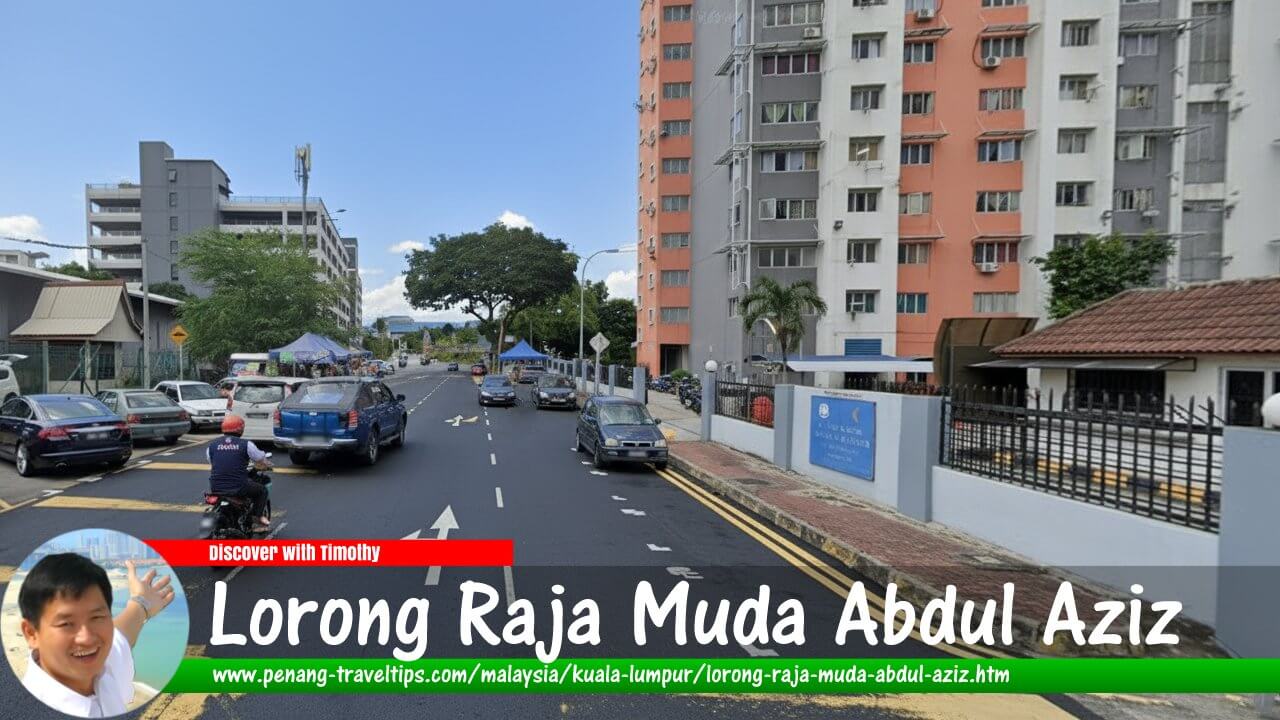 Lorong Raja Muda Abdul Aziz, Kuala Lumpur (AI generated on 27 December 2025)
Lorong Raja Muda Abdul Aziz is a short but strategically placed connector road in central Kuala Lumpur, bridging older neighbourhoods with some of the city’s most important medical, residential, and arterial corridors. Measuring just 572 metres in length, the road links Jalan Raja Muda Abdul Aziz in the south to Jalan Tun Razak in the north, placing it firmly within the wider Titiwangsa–Kampung Baru–Hospital Kuala Lumpur zone 1.
Quick Facts
- Road name: Lorong Raja Muda Abdul Aziz
- Road length: 572 metres
- Orientation: South–north
- Southern terminus: Jalan Raja Muda Abdul Aziz
- Northern terminus: Jalan Tun Razak
- Nearest rail station: Hospital Kuala Lumpur MRT Station
- Area: Central Kuala Lumpur / Titiwangsa–HKL vicinity
Location and Surrounding Streets
Lorong Raja Muda Abdul Aziz functions primarily as a feeder and access road rather than a destination street. Its southern end connects into Jalan Raja Muda Abdul Aziz, a well-established urban road serving residential enclaves and institutions. To the north, it meets Jalan Tun Razak, one of Kuala Lumpur’s most important arterial roads that forms part of the city’s inner ring 2.
The streetscape reflects this transitional role. Low-rise residential buildings, institutional facilities, and pockets of greenery dominate much of the road, with traffic volume increasing closer to Jalan Tun Razak. The area sits roughly 2.5 km north of Dataran Merdeka, making it close enough to the city centre while still feeling removed from the densest commercial zones.
What the Road Is Like Today
In daily use, Lorong Raja Muda Abdul Aziz is calm compared to the main roads it links. It serves residents, hospital visitors, and commuters using it as a shortcut between neighbourhood streets and the Tun Razak corridor. Sidewalks are present along parts of the road, though the environment remains more utilitarian than pedestrian-oriented 3.
Architecturally, the road is a mix of older government quarters, modest apartment blocks, and institutional buildings. Mature trees line certain stretches, giving the street a quieter, almost suburban feel despite its central location.
Historical Background and Name Origin
According to Kuala Lumpur Street Names by Mariana Isa and Maganjeet Kaur, Lorong Raja Muda Abdul Aziz is named after Sultan Salahuddin Abdul Aziz Shah, the ninth Yang di-Pertuan Agong of Malaysia, during the period when he was still the Raja Muda (Crown Prince) of Selangor 1.
He was appointed Raja Muda Selangor on 13 May 1950, and several roads in this part of Kuala Lumpur commemorate members of Selangor’s royal lineage. The naming reflects a broader mid-20th-century pattern, when roads were formally designated as the city expanded northward from its colonial core.
Development Timeline
While the exact construction date of Lorong Raja Muda Abdul Aziz is not clearly documented, the road likely took shape during the post-war expansion of Kuala Lumpur in the 1950s and 1960s. This was a period marked by the growth of government institutions, public housing, and healthcare facilities, particularly around Hospital Kuala Lumpur 4.
Nearby Sights and Institutions
The most prominent landmark nearby is Hospital Kuala Lumpur (HKL), Malaysia’s largest public hospital and a major healthcare and teaching institution. Its presence defines much of the surrounding urban fabric, with hostels, clinics, and ancillary services clustered nearby 5.
Within a short walking or driving distance are Titiwangsa Lake Gardens, one of Kuala Lumpur’s most popular recreational parks, and the Kampung Baru area, known for its traditional Malay houses and food culture. These contrasting environments highlight the area’s blend of heritage, healthcare, and modern infrastructure.
Public Transport and Connectivity
The nearest rail access point is Hospital Kuala Lumpur MRT Station, located along the MRT Putrajaya Line. The station provides direct rail connectivity to central districts such as Bukit Bintang and emerging nodes like Kwasa Damansara 6.
Other nearby stations include Titiwangsa LRT Station on the Ampang/Sri Petaling Line, Titiwangsa Monorail Station, and Sentul West LRT Station, all reachable within a short drive or a longer walk. Bus services operated by Rapid KL further enhance last-mile connectivity in the area.
Residential Property and Real Estate Snapshot
Lorong Raja Muda Abdul Aziz itself has limited frontage for private residential development, but nearby areas provide a useful indication of local property values. As of early 2025, apartments and flats in the broader Titiwangsa and Jalan Raja Muda Abdul Aziz area typically range from 650 to 1,000 sq ft (60–93 sq metres) 7.
Sale prices in this part of central Kuala Lumpur generally average between RM500 and RM750 per sq ft as of 2025, placing them below premium districts like KLCC but broadly in line with other inner-city residential zones. Rental rates for a 700 sq ft (65 sq metres) unit commonly fall between RM1,800 and RM2,800 per month, depending on proximity to rail stations and building condition 7.
Fun Facts and Local Interest
A small but interesting detail about Lorong Raja Muda Abdul Aziz is how its “lorong” designation contrasts with its importance. In Malay, lorong typically refers to a lane or minor road, yet this short connector plays a vital role in linking residential streets to one of Kuala Lumpur’s busiest arteries. Its royal-linked name also quietly preserves a chapter of Selangor’s royal history in everyday urban navigation 1.
Lorong Raja Muda Abdul Aziz on the Map of Roads in Kuala Lumpur
References
- Isa, Mariana & Kaur, Maganjeet. Kuala Lumpur Street Names.
- Kuala Lumpur City Hall – Road Network and Planning.
- OpenStreetMap – Lorong Raja Muda Abdul Aziz Area.
- National Library Board – Urban Development of Kuala Lumpur.
- Hospital Kuala Lumpur – Institutional Overview.
- Rapid KL – MRT Putrajaya Line Stations.
- PropertyGuru Malaysia – Kuala Lumpur Residential Market Data (2025).
Page Details
This page was created on 27 December 2025. Hi, my name is Timothy and created it from my research, for my own entertainment, knowledge and to satisfy my curiosity. I am providing the information to you in good faith and hope it is useful. I try to get the details as accurate as possible. I also try to update the page whenever I stumble on new details. So this and all my other pages are perpetual work in progress. If you discover any error, please politely inform me, pointing out where the error lies, and I will correct it as soon as possible. Your helpfulness will keep this page accurate, relevant and helpful to those who need the information.More Streets of Kuala Lumpur here
Want to share your Kuala Lumpur travel experiences or get tips from fellow travellers?
Join the Kuala Lumpur Travel Tips Facebook GroupMore information for visiting and living in Kuala Lumpur
Here are some related articles to help you get to know Kuala Lumpur better. Latest Pages & Updates
Buy Me A Coffee
If you enjoy the information I provide and want to support the work I do, please buy me a coffee! I appreciate it immensely, thank you so much!
