
Taman Tunku Habsah, Alor Setar
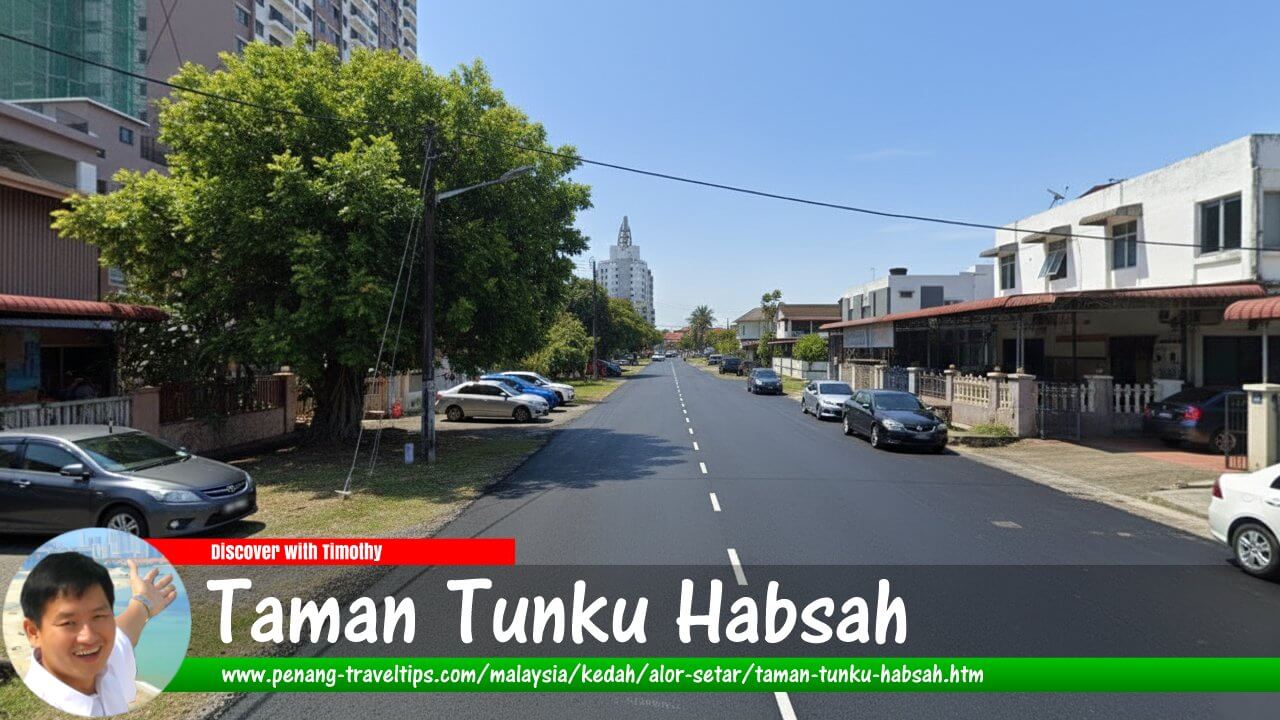 Taman Tunku Habsah, Alor Setar (AI generated on 21 January 2026)
Taman Tunku Habsah is a minor yet well-positioned road in Alor Setar, Kedah, forming a short connection between two important routes: Lebuhraya Darul Aman to the west and Jalan Tunku Abdul Halim to the east. With a length of about 230 metres, this street is not designed for heavy traffic but instead serves its surrounding neighbourhood as a quiet connector that supports daily movement, residential life, and local accessibility.
Quick Facts
Road name: Taman Tunku Habsah
Location: Alor Setar, Kedah
Road type: Minor residential road
Length: 230 metres
Connects: Lebuhraya Darul Aman (west) and Jalan Tunku Abdul Halim (east)
General character: Calm neighbourhood street with local access
Street Overview and Character
Taman Tunku Habsah is best understood as a neighbourhood street rather than a major thoroughfare. Its modest length and minor-road status mean that traffic tends to consist mainly of residents, visitors, and vehicles using it as a short cut between the two larger connecting roads. This gives the street a generally peaceful and residential atmosphere.
The built environment along the road is characterised by low-rise houses, modest boundary walls, and mature roadside trees that soften the streetscape. Unlike commercial streets in central Alor Setar, there are no rows of shophouses or constant pedestrian flows. Instead, the area feels intimate and community-oriented, with daily life unfolding at a slower pace.
Connectivity and Surrounding Roads
On its western end, Taman Tunku Habsah links directly to Lebuhraya Darul Aman, an important urban corridor that facilitates movement across parts of Alor Setar. This connection allows residents of the area to reach other districts efficiently while still enjoying the quieter environment of a smaller street.
At the eastern end, the road meets Jalan Tunku Abdul Halim, another established road that serves both residential and institutional functions in its vicinity. This east–west linkage, though short in physical distance, plays a useful role in local circulation by distributing traffic away from busier intersections.
Because of this positioning, Taman Tunku Habsah functions as a subtle connector: not prominent on city maps, but important in the everyday routines of those who live nearby.
Historical Development
The development of Taman Tunku Habsah is closely tied to the broader suburban expansion of Alor Setar during the late 20th century. As the city grew beyond its traditional core, new housing areas were established to accommodate civil servants, professionals, and families seeking more spacious living environments. Many such neighbourhoods emerged from the 1970s through the 1990s, shaped by planned residential layouts and improved road infrastructure1.
The name “Taman” itself reflects this era of urban growth, as it is commonly used in Malaysia to denote planned housing estates. “Tunku Habsah” refers to a respected royal figure associated with Kedah, and the use of such names for residential areas reflects the cultural practice of honouring royalty and heritage within urban toponymy.
Evolution of the Neighbourhood
In its earlier years, the surroundings of Taman Tunku Habsah would have been less densely built, with more open land and newer houses. Over time, the neighbourhood has matured. Gardens have grown, trees have become taller, and properties have been renovated to meet changing family needs.
Today, the road presents a blend of older houses that retain their original design features and newer renovations that introduce modern façades, extended porches, and upgraded security features. This mix gives the street a lived-in character rather than the uniform appearance of a newly completed housing project.
Residential Properties and Housing Market
Properties along Taman Tunku Habsah are primarily residential, with most homes being terrace houses, semi-detached units, or occasionally detached houses. Typical built-up sizes range from around 1,200 to 2,500 square feet (approximately 111–232 sq metres), depending on the type of house and the era in which it was constructed.
As of 2023–2024, terrace houses in established residential areas of Alor Setar with similar characteristics have commonly been marketed in the range of RM280,000 to RM450,000, with larger semi-detached or detached houses potentially exceeding RM600,000 depending on land size and condition2. Rental values for such homes often fall between RM1,000 and RM2,000 per month, making the area attractive to both local families and tenants seeking a central but calm location.
The appeal of Taman Tunku Habsah in property terms lies in its balance: it offers reasonable proximity to main roads while maintaining a quieter living environment, which continues to support steady demand rather than speculative price spikes.
Nearby Amenities and Points of Interest
Although Taman Tunku Habsah itself does not host major landmarks, its location near larger roads means that everyday amenities are easily accessible. Residents are typically within short driving distance of grocery shops, eateries, schools, and places of worship scattered along Jalan Tunku Abdul Halim and the broader road network connected to Lebuhraya Darul Aman.
The area is also convenient for accessing central Alor Setar, including administrative offices, healthcare facilities, and commercial centres. This proximity enhances the practical value of living near Taman Tunku Habsah, even though the street itself remains modest and residential in nature.
Daily Life and Atmosphere
The rhythm of daily life along Taman Tunku Habsah reflects that of a typical mature Malaysian neighbourhood. Mornings often begin with residents leaving for work and school, while afternoons are quieter, punctuated by occasional deliveries or neighbours exchanging greetings.
Evenings tend to bring a gentle revival of activity, with families returning home, children playing near their houses, and the subtle sounds of community life. This atmosphere fosters familiarity among neighbours and contributes to the sense of safety and belonging that long-term residents often value highly.
Fun Facts and Local Interest
An interesting detail about Taman Tunku Habsah is how its short length of just 230 metres means that many residents know almost everyone else living along the street. Locals sometimes remark that it feels less like a road and more like an extended shared space, where people recognise each other’s routines and vehicles.
Another point of interest is the way the street’s name preserves a connection to Kedah’s royal heritage. Even for those who may not think about it daily, the name “Tunku Habsah” subtly embeds cultural memory into the everyday geography of Alor Setar, reminding residents that even ordinary streets can carry historical meaning3.
Why Taman Tunku Habsah Matters
While it may never appear in tourist brochures, Taman Tunku Habsah represents an important aspect of urban life in Alor Setar: the small, connective streets that make neighbourhoods functional and liveable. Without such roads, larger arteries like Lebuhraya Darul Aman and Jalan Tunku Abdul Halim would be less effective in serving local communities.
The street’s value lies in its role as everyday infrastructure. It supports homes, routines, relationships, and quiet continuity, all of which are essential components of a healthy urban environment.
Conclusion
Taman Tunku Habsah is a short, minor road, but it plays a meaningful role in the fabric of its neighbourhood. By linking two more prominent roads, it enhances connectivity while preserving a calm residential character. Its history is intertwined with Alor Setar’s suburban growth, and its present-day identity reflects stability, familiarity, and understated importance.
For residents, it offers comfort and convenience. For observers of urban development, it illustrates how even a 230-metre street can embody layers of planning, culture, and community life within the evolving story of Alor Setar.
Taman Tunku Habsah on the Map of Alor Setar, Kedah
References
- Alor Setar Municipal Council – Urban Growth and Housing Development
- PropertyGuru Malaysia – Kedah Residential Property Market Trends (2023–2024)
- Oral History Resources on Malaysian Place Names and Urban Memory
Page Details
This page was created on 21 January 2026. Hi, my name is Timothy and created it from my research, for my own entertainment, knowledge and to satisfy my curiosity. I am providing the information to you in good faith and hope it is useful. I try to get the details as accurate as possible. I also try to update the page whenever I stumble on new details. So this and all my other pages are perpetual work in progress. If you discover any error, please politely inform me, pointing out where the error lies, and I will correct it as soon as possible. Your helpfulness will keep this page accurate, relevant and helpful to those who need the information.Useful information on the Condominiums in Kuala Lumpur
- Residential Properties in Kuala Lumpur
- Affordable Housing in Kuala Lumpur
- Get to know the Neighbourhoods of Kuala Lumpur
- Get to know the Properties in the Klang Valley
- Find out about Property Taxes and Stamp Duties in Kuala Lumpur
- What to expect from Real Estate Agents in Kuala Lumpur
- The Sale & Purchase Agreement
- Understanding the Memorandum of Transfer (MOT)
- Understand what "subsale" means in Malaysian real estate
Want to share your Kuala Lumpur travel experiences or get tips from fellow travellers?
Join the Kuala Lumpur Travel Tips Facebook GroupMore information for visiting and living in Kuala Lumpur
Here are some related articles to help you get to know Kuala Lumpur better. Latest Pages & Updates
Buy Me A Coffee
If you enjoy the information I provide and want to support the work I do, please buy me a coffee! I appreciate it immensely, thank you so much!
