
Jalan Pintu Sepuluh, Alor Setar
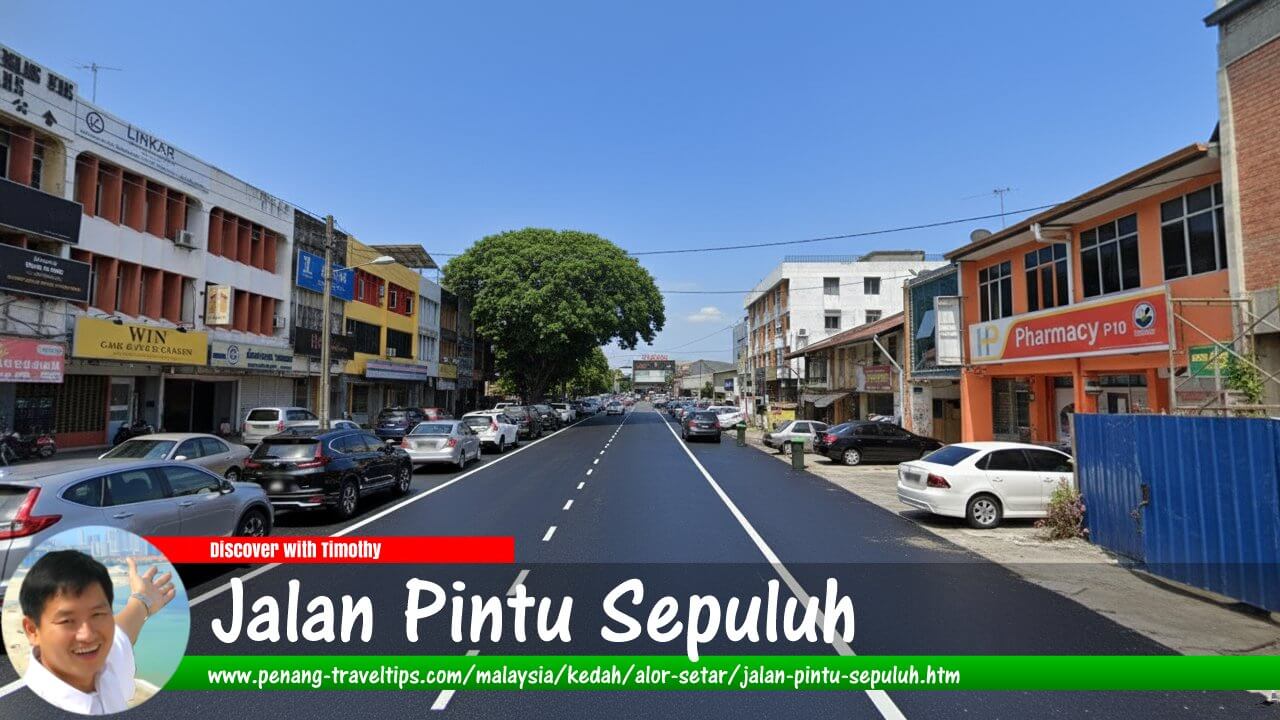 Jalan Pintu Sepuluh, Alor Setar (AI generated on 27 December 2025)
Jalan Pintu Sepuluh is a historically significant street in Alor Setar, the capital city of Kedah. Stretching approximately 525 metres, the road runs from Jalan Tambang Badak in the north to Jalan Tunku Abdul Rahman Putra in the south, placing it firmly within the city’s older urban core. Though relatively short, Jalan Pintu Sepuluh carries cultural weight as part of Alor Setar’s early street network and remains an everyday route for residents navigating the central districts.
Quick Facts
Road name: Jalan Pintu Sepuluh
Location: Alor Setar, Kedah
Length: 525 metres
Orientation: North–south
Connects: Jalan Tambang Badak to Jalan Tunku Abdul Rahman Putra
Primary character: Older residential and mixed-use street
Street Overview and Atmosphere
Jalan Pintu Sepuluh presents itself as a calm, utilitarian street shaped more by daily routines than by commercial spectacle. Traffic volumes are generally moderate, with a steady flow of local vehicles, motorcycles, and pedestrians throughout the day. The street’s scale is intimate, lined mostly with low-rise buildings that reinforce a sense of neighbourhood continuity.
The atmosphere along the road reflects everyday Alor Setar life. Residents step out to nearby shops, small food outlets cater to regular customers, and older houses sit comfortably beside modest commercial premises. Unlike newer parts of the city, Jalan Pintu Sepuluh has retained a slower pace that appeals to those familiar with the area.
Road Connections and Surroundings
At its northern end, Jalan Pintu Sepuluh connects to Jalan Tambang Badak, a road associated with long-established neighbourhoods and local trade. This junction situates Jalan Pintu Sepuluh close to residential clusters that have existed for generations, reinforcing its role as a feeder road rather than a transit corridor.
Heading south, the street meets Jalan Tunku Abdul Rahman Putra, one of Alor Setar’s important urban arteries. This connection allows residents and visitors to transition quickly from a quieter local street into busier civic and commercial zones, highlighting Jalan Pintu Sepuluh’s role as a bridge between scales of urban activity.
Several smaller lanes branch off Jalan Pintu Sepuluh, providing access to interior residential plots. These side connections contribute to the street’s function as a spine for the surrounding community.
Historical Background
The name “Pintu Sepuluh,” which translates to “Tenth Gate,” is widely believed to reference Alor Setar’s historical layout, when the town was organised around defensive and administrative gateways. Jalan Pintu Sepuluh likely marked or led toward one such access point during the late 19th or early 20th century, when the town was consolidating its status as Kedah’s administrative centre1.
The road took clearer shape during the colonial and early post-independence periods, as residential development expanded outward from the palace and river areas. By the mid-20th century, Jalan Pintu Sepuluh had become a recognised local street serving civil servants, traders, and families living near the town centre.
Development Through the Decades
Architecturally, buildings along Jalan Pintu Sepuluh reflect several eras. Older timber houses once dominated the area, though many have since been replaced or reinforced with concrete structures. Shophouses built between the 1950s and 1970s remain prominent, often featuring simple facades, narrow frontages, and practical layouts.
While some properties have undergone renovations, large-scale redevelopment has been limited. This has allowed Jalan Pintu Sepuluh to preserve much of its original alignment and character, making it one of the streets where Alor Setar’s urban evolution can still be read in layers2.
Nearby Attractions and Points of Interest
Although Jalan Pintu Sepuluh itself is not lined with major landmarks, its location places it close to several points of interest within central Alor Setar. Heritage buildings, traditional markets, and civic institutions along Jalan Tunku Abdul Rahman Putra are all within easy reach on foot.
Food lovers may find modest but rewarding options nearby. Small eateries around Jalan Pintu Sepuluh serve breakfast staples and local Kedahan dishes, catering primarily to residents and office workers rather than tourists. These establishments offer an authentic glimpse into everyday dining habits in the city.
Residential Properties and Housing Market
Residential properties along Jalan Pintu Sepuluh mainly consist of older terrace houses and mixed-use shophouses. Typical residential units range from about 1,100 to 1,700 square feet (approximately 102–158 sq metres), often configured over one or two storeys.
As of 2024, sale prices for terrace houses in this part of central Alor Setar generally fall between RM320,000 and RM500,000, depending on factors such as renovation condition, land tenure, and proximity to main junctions3. Shophouses with commercial frontage may command higher values due to their business potential.
Rental rates remain relatively accessible compared to larger Malaysian cities. Residential rentals typically range from RM1,100 to RM1,800 per month, while ground-floor commercial spaces can attract rents of RM2,000 to RM3,000 monthly, reflecting steady local demand.
Community Life and Daily Rhythm
Life along Jalan Pintu Sepuluh follows a predictable and comforting rhythm. Mornings are the busiest, with residents heading to work and nearby food stalls opening for breakfast. Afternoons quiet down, while evenings bring renewed activity as families return home.
This consistency contributes to the street’s appeal among long-term residents. Many families have lived along or near Jalan Pintu Sepuluh for decades, creating strong social ties that define the area’s character.
Fun Facts and Local Lore
A commonly shared local anecdote is that Jalan Pintu Sepuluh was once used as a reference point in town directions, with elders instructing newcomers to “look for the tenth gate road” when navigating Alor Setar before formal street signage became widespread4.
Another interesting detail is how the road’s name has remained unchanged despite urban modernisation, preserving a linguistic link to Alor Setar’s early town planning traditions.
Conclusion
Jalan Pintu Sepuluh may be modest in length, but it holds a meaningful place in Alor Setar’s urban story. As a connector between Jalan Tambang Badak and Jalan Tunku Abdul Rahman Putra, it links past and present, neighbourhood and city, tradition and routine.
For those interested in understanding how Alor Setar grew and continues to function at a human scale, Jalan Pintu Sepuluh offers quiet insights into the city’s enduring character.
Jalan Pintu Sepuluh on the Map of Alor Setar, Kedah
References
- Alor Setar Municipal Council – Historical Street Development Records
- Studies on Urban Form in Northern Malaysian Towns
- PropertyGuru Malaysia – Kedah Residential Market Data (2024)
- Oral History Accounts of Early Alor Setar
Page Details
This page was created on 27 December 2025. Hi, my name is Timothy and created it from my research, for my own entertainment, knowledge and to satisfy my curiosity. I am providing the information to you in good faith and hope it is useful. I try to get the details as accurate as possible. I also try to update the page whenever I stumble on new details. So this and all my other pages are perpetual work in progress. If you discover any error, please politely inform me, pointing out where the error lies, and I will correct it as soon as possible. Your helpfulness will keep this page accurate, relevant and helpful to those who need the information.Useful information on the Condominiums in Kuala Lumpur
- Residential Properties in Kuala Lumpur
- Affordable Housing in Kuala Lumpur
- Get to know the Neighbourhoods of Kuala Lumpur
- Get to know the Properties in the Klang Valley
- Find out about Property Taxes and Stamp Duties in Kuala Lumpur
- What to expect from Real Estate Agents in Kuala Lumpur
- The Sale & Purchase Agreement
- Understanding the Memorandum of Transfer (MOT)
- Understand what "subsale" means in Malaysian real estate
Want to share your Kuala Lumpur travel experiences or get tips from fellow travellers?
Join the Kuala Lumpur Travel Tips Facebook GroupMore information for visiting and living in Kuala Lumpur
Here are some related articles to help you get to know Kuala Lumpur better. Latest Pages & Updates
Buy Me A Coffee
If you enjoy the information I provide and want to support the work I do, please buy me a coffee! I appreciate it immensely, thank you so much!
