
Jalan Md Noor, Johor Bahru
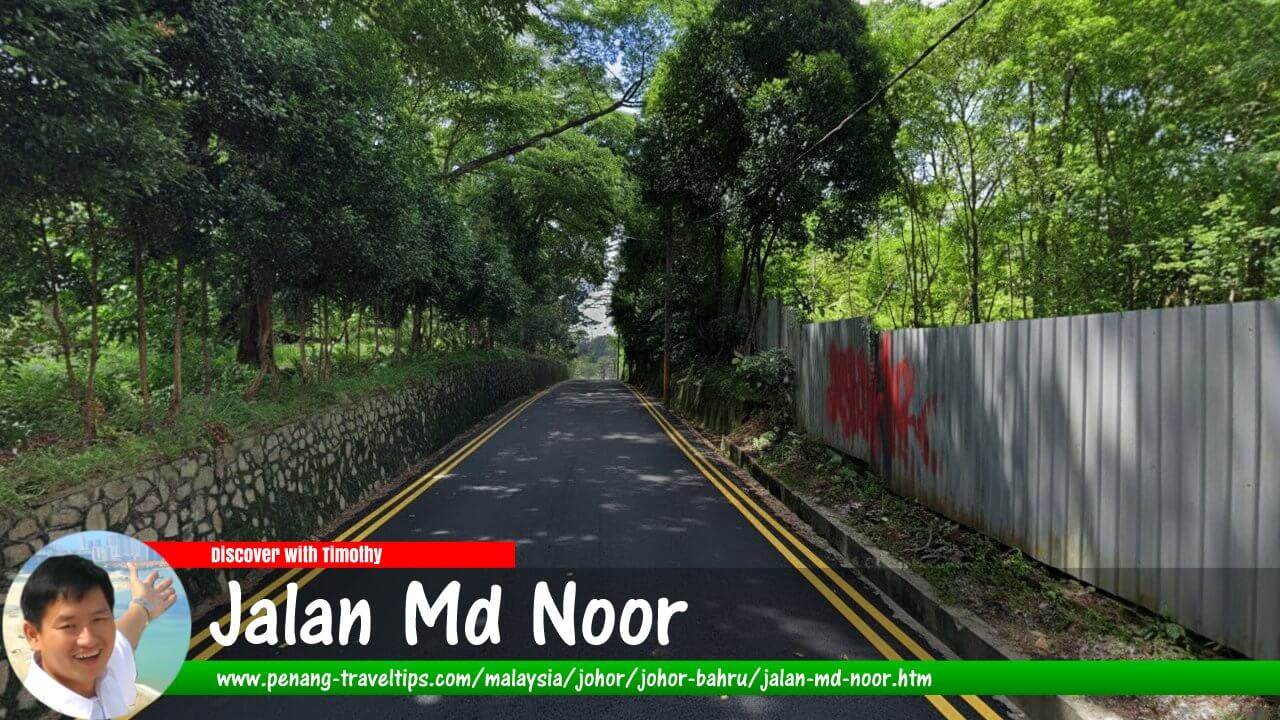 Jalan Md Noor, Johor Bahru (AI generated on 21 January 2026)
Jalan Md Noor is a short, one-way road in central Johor Bahru, extending for approximately 211 metres and running from Jalan Khalid Abdullah in the southwest to Jalan Gereja in the northeast.1 Though brief in length, the street occupies a strategic position within the historic city core, guiding traffic in a single direction through an area shaped by administration, commerce, and heritage.
Quick Facts
- Road name: Jalan Md Noor
- Location: Central Johor Bahru, Johor, Malaysia
- Length: 211 metres
- Traffic flow: One-way (southwest to northeast)
- Connects: Jalan Khalid Abdullah and Jalan Gereja
- Primary character: Civic and mixed-use urban street
- Estimated period of development: Mid-20th century
Historical Development
The history of Jalan Md Noor is closely linked to the post-war transformation of Johor Bahru into a modern administrative centre. Following the Second World War, the city experienced steady growth as government departments expanded and supporting commercial activities clustered around the historic core.2 During this period, several short connector roads were laid out or formalised to improve circulation and manage increasing vehicular traffic.
Historical maps and planning records indicate that Jalan Md Noor was already in existence by the 1950s or early 1960s, a time when municipal authorities were reorganising inner-city streets to accommodate cars and buses more efficiently.3 Its designation as a one-way street likely came later, reflecting traffic management strategies introduced as congestion increased in central Johor Bahru.
Name and Etymology
The name Md Noor follows a common naming convention in Johor Bahru, where roads are named after individuals associated with public service or local administration. While detailed archival information on the specific individual honoured remains limited, it is generally believed that Md Noor was a figure of some standing during the period when the street was named.4
Such naming practices serve as quiet markers of institutional memory, preserving personal names within the urban landscape even as the city around them evolves. Jalan Md Noor thus forms part of a wider network of streets whose names collectively reflect Johor Bahru’s administrative heritage.
Street Character and Urban Setting
Physically, Jalan Md Noor is narrow and functional, with a streetscape dominated by low-rise buildings. These include older office blocks, small commercial premises, and occasional residential units, many of which date back several decades. The one-way traffic arrangement contributes to a calmer atmosphere compared to nearby two-way streets, making the road feel orderly and predictable.
The street’s character is shaped less by destination activity and more by movement. Office workers, delivery vehicles, and local residents use it as part of their daily routines, giving the road a distinctly utilitarian identity.
Surrounding Streets and Connectivity
Jalan Md Noor’s importance is best understood through its connections. To the southwest, Jalan Khalid Abdullah links the area to other administrative streets and inner-city connectors. To the northeast, Jalan Gereja is a historically significant road known for its proximity to heritage buildings and long-established institutions.5
Nearby streets form a compact grid typical of older Southeast Asian city centres. This layout encourages short walking distances and allows traffic to be distributed across multiple minor roads rather than concentrated on a single artery.
Nearby Sights and Points of Interest
While Jalan Md Noor itself is understated, its vicinity includes several notable points of interest. Jalan Gereja, at the northeastern end, is associated with historic religious and civic buildings that reflect Johor Bahru’s multicultural past.6 A short walk away are rows of traditional shophouses, some of which have been adapted for modern commercial use.
The area also features small local eateries and service businesses catering to office workers and nearby residents. These establishments offer an authentic glimpse into everyday life in central Johor Bahru, away from more heavily promoted tourist zones.
Real Estate and Property Market
Property values around Jalan Md Noor reflect its central location and administrative surroundings. Residential units in nearby low-rise apartments and mixed-use buildings typically range from about 550 to 1,000 square feet (51–93 sq metres). As of late 2024, sale prices in this part of central Johor Bahru commonly range between MYR 320,000 and MYR 680,000, depending on building age, maintenance, and proximity to major roads.7
Rental rates are comparatively moderate, often falling between MYR 1,100 and MYR 2,400 per month for units of similar size. When compared with Singapore, the difference is substantial: central Singapore apartments of equivalent size frequently exceed SGD 1.5 million in purchase price and command monthly rents above SGD 3,300.8 This contrast underscores Johor Bahru’s appeal to cross-border commuters and investors seeking affordability.
Public Transport Access
Public transport access is readily available, with bus stops located along Jalan Gereja and nearby connecting roads, generally within a three- to five-minute walk from Jalan Md Noor.9 These stops are served by local bus routes that connect the city centre to Johor Bahru Sentral, residential districts, and other key destinations.
Fun Facts and Local Insights
A small but intriguing local detail is that Jalan Md Noor’s one-way designation has made it a favourite example in local driving lessons, where instructors use it to teach new drivers about navigating inner-city traffic rules. Many locals remember encountering the street for the first time while learning to drive.
Its short length also means that pedestrians can traverse the entire road in just a few minutes, making it one of those places that people often pass through without much thought, yet which quietly supports the flow and function of Johor Bahru’s historic core.
Jalan Md Noor on the Map of Johor Bahru, Johor
References
- OpenStreetMap – Johor Bahru street data
- National Library Board Singapore – Johor Bahru urban history
- Academic literature on post-war Malayan urban planning
- Dewan Bahasa dan Pustaka – Malay naming conventions
- Johor Bahru City Council – Road and planning information
- Visit Southern Johor – Heritage sites in Johor Bahru
- iProperty Malaysia – Johor Bahru property prices (2024)
- Urban Redevelopment Authority Singapore – Residential market statistics
- Causeway Link – Johor Bahru bus routes and stops
Page Details
This page was created on 4 February 2026. Hi, my name is Timothy and created it from my research, for my own entertainment, knowledge and to satisfy my curiosity. I am providing the information to you in good faith and hope it is useful. I try to get the details as accurate as possible. I also try to update the page whenever I stumble on new details. So this and all my other pages are perpetual work in progress. If you discover any error, please politely inform me, pointing out where the error lies, and I will correct it as soon as possible. Your helpfulness will keep this page accurate, relevant and helpful to those who need the information.More information for visiting and living in Johor Bahru
Here are some related articles to help you get to know Johor Bahru better. Latest Pages & Updates
Buy Me A Coffee
If you enjoy the information I provide and want to support the work I do, please buy me a coffee! I appreciate it immensely, thank you so much!
