
Federal Route 1
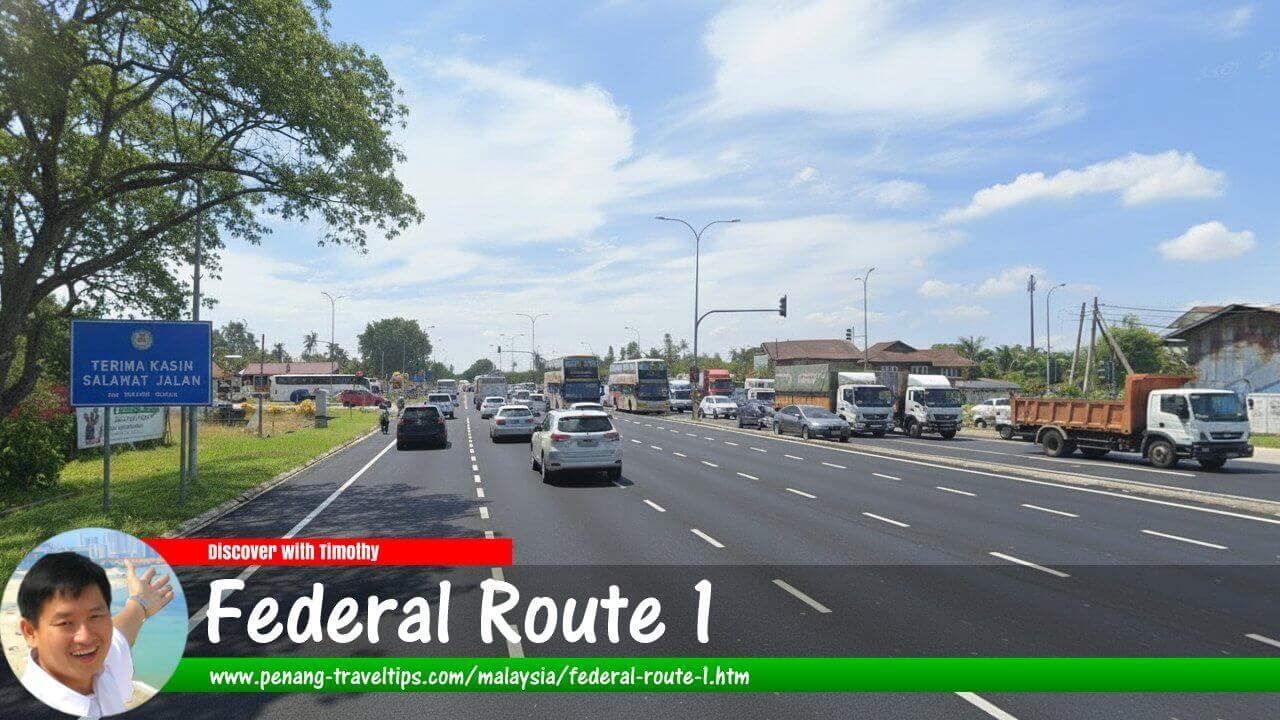 Federal Route 1 (AI generated on 31 December 2025)
Federal Route 1 is one of the most historically significant roads in Peninsular Malaysia, forming the original north–south trunk road along the west coast of the peninsula. Long before the construction of modern expressways, this route served as the primary land connection linking major cities, regional towns, and countless villages from the Thai border in the north to Johor in the south. Today, Federal Route 1 is often referred to as the Old Trunk Road, reflecting its legacy role after much long-distance traffic shifted to the North–South Expressway. Despite this, it remains indispensable as the main road serving many communities that lie beyond the reach of high-speed highways.1
Quick Facts
- Road name: Federal Route 1
- Alternative name: Old Trunk Road
- Region: West Coast of Peninsular Malaysia
- Function: Historic north–south trunk road
- Key role today: Access to towns, villages, and local centres
- Replaced in part by: North–South Expressway
- Road type: Federal road
Geographic Scope and Role
Federal Route 1 runs broadly along the west coast of Peninsular Malaysia, closely following the corridor where early settlements, ports, plantations, and later towns developed. The road passes through or near major urban centres while also threading together smaller towns and rural districts that grew around it. This alignment made it the backbone of land transport for decades, shaping settlement patterns and economic development along the west coast.2
Unlike modern expressways designed to bypass towns, Federal Route 1 typically runs directly through town centres or established commercial strips. This characteristic allows it to function not only as a transport corridor but also as a main street in many locations, supporting local businesses, markets, and daily social interaction. As a result, the road continues to play a vital role in everyday life despite the presence of faster alternatives.2
Origins and Early Development
The origins of Federal Route 1 can be traced back to the colonial era, when early road-building efforts focused on linking ports, administrative centres, and economically productive areas such as tin mines and rubber estates. Initially, these roads existed as separate segments connecting individual towns rather than a single continuous highway. Over time, improvements and extensions gradually linked these segments into a more coherent north–south route.3
Construction was carried out in stages, often driven by economic priorities. Roads were extended to serve plantations, mining areas, and growing settlements, with alignment influenced by terrain, rivers, and existing villages. By the mid-20th century, these incremental developments had effectively created a continuous trunk road along the west coast, forming what would later be designated as Federal Route 1.3
Post-Independence Expansion and Standardisation
Following independence, the Malaysian government placed greater emphasis on developing a unified national road network. Federal Route 1 was formally recognised as a federal road and became a priority for upgrading and standardisation. Improvements included better road surfaces, clearer alignments, and the replacement of older, narrower sections to accommodate increasing vehicle ownership and traffic volumes.4
During this period, the road became the primary long-distance route for buses, lorries, and private vehicles travelling between major west coast cities. Intercity bus services relied heavily on Federal Route 1, while roadside towns flourished as stopover points offering food, accommodation, and services to travellers. This era cemented the road’s reputation as the main artery of the west coast.4
The Rise of the North–South Expressway
The construction of the North–South Expressway marked a major shift in Malaysia’s transport landscape. Designed for high-speed, long-distance travel, the expressway provided a faster and more direct alternative to Federal Route 1 for intercity movement. As expressway sections opened in stages from the late 20th century onward, much through traffic gradually migrated away from the old trunk road.5
This transition led to Federal Route 1 being commonly referred to as the Old Trunk Road. While its role as the primary long-distance route diminished, the road did not lose relevance. Instead, it assumed a complementary function, serving local traffic, providing redundancy to the expressway, and ensuring access to towns and villages that the expressway bypassed entirely.5
Continuing Importance for Towns and Villages
One of the defining characteristics of Federal Route 1 today is its role as the main access road for many small towns and rural communities along the west coast. These settlements often developed around the road itself, making it central to local identity and economic life. For residents, Federal Route 1 remains the most direct route to schools, markets, workplaces, and public services.2
The road also supports local commerce by providing visibility and accessibility to roadside businesses. Unlike expressways, where access is controlled and limited, Federal Route 1 allows frequent entry and exit, making it well suited for local trade and daily travel. This accessibility ensures its continued relevance even in an era dominated by high-speed highways.2
Recent Upgrading and Widening Works
In recent decades, various sections of Federal Route 1 have undergone upgrading and widening to improve safety and capacity. These works typically include lane widening, improved drainage, better road markings, and upgraded junctions. Such enhancements reflect the road’s ongoing importance as a heavily used local and regional route, even if it no longer serves as the primary intercity highway.6
Upgrading efforts often focus on urban and semi-urban stretches where traffic volumes remain high. In these areas, improvements aim to balance the needs of motorists, pedestrians, and local businesses, recognising the road’s dual role as both a transport corridor and a town street.6
Replacement of At-Grade Railway Crossings
A notable aspect of recent improvements along Federal Route 1 is the replacement of former at-grade railway crossings. Historically, the road intersected railway lines at ground level in several towns, leading to traffic delays and safety concerns. As train frequencies increased and road traffic grew, these crossings became significant bottlenecks.7
To address these issues, flyovers and underpasses have been constructed at key railway crossing points. These grade-separated solutions improve traffic flow, enhance safety, and reduce congestion, particularly in town centres where both road and rail traffic are heavy. Such projects demonstrate continued investment in modernising the old trunk road while respecting its existing alignment.7
Traffic Characteristics Today
Traffic on Federal Route 1 today is predominantly local and regional rather than long-distance. Motorcycles, private cars, buses, and light commercial vehicles make up the majority of road users. In many towns, the road also accommodates pedestrians and cyclists, reflecting its integration into the urban fabric rather than functioning solely as a through route.6
During festive seasons or when incidents occur on the expressway, Federal Route 1 often serves as an alternative route, highlighting its continued strategic value. This redundancy is an important feature of resilient transport networks, ensuring continuity of movement even when primary routes are disrupted.5
Cultural and Historical Significance
Beyond its functional role, Federal Route 1 holds cultural and historical significance. It represents the evolution of land transport in Peninsular Malaysia, from early colonial roads to a modern federal highway. Many roadside towns owe their existence and growth to the road, making it a shared thread in the history of west coast communities.3
For generations of Malaysians, the old trunk road evokes memories of long journeys, roadside stalls, and town centres bustling with travellers. Even as transport infrastructure continues to evolve, Federal Route 1 remains a tangible link to the past and a living part of the present road network.3
Future Outlook
Looking ahead, Federal Route 1 is likely to remain an essential component of Malaysia’s transport system. While it may never regain its former status as the primary long-distance route, its role in serving local communities, supporting regional mobility, and providing redundancy will continue to be important. Ongoing upgrades and safety improvements will help ensure that the road remains fit for purpose in the decades to come.6
In this way, Federal Route 1 stands as both a historical artifact and a functional roadway, bridging Malaysia’s transport past with its present needs. Its enduring relevance underscores the value of infrastructure that adapts over time while continuing to serve the communities that depend on it.1
References
- Federal Route 1 (Malaysia) – Wikipedia
- Transportation in Malaysia – Wikipedia
- History of transport in Malaysia – Wikipedia
- Roads in Malaysia – Wikipedia
- North–South Expressway – Wikipedia
- Public Works Department of Malaysia
- Keretapi Tanah Melayu Berhad
Page Details
This page was created on 31 December 2025. Hi, my name is Timothy and created it from my research, for my own entertainment, knowledge and to satisfy my curiosity. I am providing the information to you in good faith and hope it is useful. I try to get the details as accurate as possible. I also try to update the page whenever I stumble on new details. So this and all my other pages are perpetual work in progress. If you discover any error, please politely inform me, pointing out where the error lies, and I will correct it as soon as possible. Your helpfulness will keep this page accurate, relevant and helpful to those who need the information.My Videos of Malaysia
 Latest Pages & Updates
Buy Me A Coffee
If you enjoy the information I provide and want to support the work I do, please buy me a coffee! I appreciate it immensely, thank you so much!
