
 Go Back
 Laos Travel Guide (25 December 2005)
Also available: Panduan Melawat Laos
Laos is a landlocked country in mainland Southeast Asia, known for its tranquil atmosphere, Buddhist heritage, mountainous landscapes and the mighty Mekong River. For Malaysian travellers, Laos offers a very different experience from neighbouring Thailand and Vietnam, with a slower pace of life and a strong sense of traditional culture.
The country is officially known as the Lao People's Democratic Republic and shares borders with Thailand, Myanmar, China, Vietnam and Cambodia. Its position at the heart of mainland Southeast Asia has made Laos an important crossroads of cultures, peoples and trade routes throughout history.
Laos is particularly appealing to travellers who enjoy history, temples, nature, rivers, traditional communities and a more relaxed style of travel. Its most famous destinations include Vientiane, the national capital; Luang Prabang, a UNESCO World Heritage city; Vang Vieng, known for its dramatic limestone landscape; and the southern region around Pakse, Champasak and Si Phan Don, commonly known as the 4,000 Islands.
For Malaysian travellers, Laos is also becoming easier to explore because of improving regional air connections and the Laos-China Railway, which has transformed travel between several important destinations in the north and central parts of the country.
About Laos
Laos covers approximately 236,800 square kilometres and stretches for more than 1,000 kilometres from north to south. Much of the country consists of mountains, forested uplands, plateaus and river valleys.
Unlike most of its Southeast Asian neighbours, Laos has no coastline. Instead, its geography is dominated by the Mekong River, which flows through or along much of the country and has shaped its history, agriculture, settlements and culture.
The capital, Vientiane, lies on the Mekong opposite Thailand. Further north, Luang Prabang occupies a scenic position where the Mekong meets the Nam Khan River, while Vang Vieng is surrounded by spectacular limestone karst mountains.
In southern Laos, the Mekong becomes increasingly important as it spreads into a broad network of channels and islands known as Si Phan Don. The region also contains the Bolaven Plateau, famous for coffee plantations, waterfalls and cool highland scenery.
What Makes Laos Different?
Laos is sometimes overshadowed by its larger and more heavily visited neighbours, but this is precisely part of its attraction. The country has retained a comparatively relaxed atmosphere, particularly outside the capital and major tourist centres.
The official Lao tourism authority describes the country through its natural landscapes, cultural diversity, history and slower pace of life. Laos is home to numerous ethnic communities with their own languages, customs and traditions, giving the country considerable cultural diversity.
For Malaysian travellers accustomed to the fast pace and dense development of many Southeast Asian cities, Laos can feel refreshingly unhurried.
The Meaning of the Name Laos
The name Laos is derived from the name of the Lao people, the country's largest ethnic group. In the Lao language, the country is called ລາວ (Lao).
The modern country traces much of its historical identity to the kingdom of Lan Xang, whose name is commonly translated as the Land of a Million Elephants. Lan Xang was established in the 14th century and became one of the major kingdoms of mainland Southeast Asia.
The history of Lan Xang remains particularly visible in Luang Prabang and other parts of northern Laos, where ancient temples, royal buildings and Buddhist traditions continue to form an important part of the country's cultural identity.
People and Ethnic Diversity
Laos has a remarkably diverse population. The Lao people form the largest ethnic group, but numerous other communities live throughout the country, particularly in mountainous and upland areas.
Different ethnic communities have their own languages, traditions, clothing, architecture, religious practices and ways of life. This diversity is particularly noticeable when travelling beyond the major cities.
Traditional Lao society has also been strongly influenced by Buddhism, agriculture and life along the country's rivers. In many communities, Buddhist temples remain important centres of religious and social life.
Religion in Laos
Theravada Buddhism is the predominant religion in Laos and has had a profound influence on Lao culture, architecture, festivals and daily life.
Buddhist temples, known locally as wat, can be found throughout the country. They range from elaborate historic temples in Luang Prabang and Vientiane to small village monasteries.
At the same time, Laos is religiously diverse. Traditional beliefs involving spirits and ancestors continue to exist alongside Buddhism, particularly among some ethnic communities.
For Malaysian travellers visiting Buddhist temples, respectful behaviour is important. Visitors should dress appropriately, remove shoes where required and avoid disturbing people who are praying or participating in religious ceremonies.
Language
The official language of Laos is Lao, which belongs to the Tai-Kadai language family and is closely related to Thai.
Thai television, music and popular culture are widely understood in parts of Laos because of the close geographical and cultural relationship between the two countries. However, Lao remains the national language and is used throughout government, education and everyday life.
English is understood in many hotels, restaurants and tourist businesses in the main destinations, although its use becomes less common in rural areas.
Malaysian travellers should not expect English to be as widely spoken as it is in Singapore or many major tourist areas of Thailand. A translation app and a few useful Lao phrases can therefore be helpful.
Laos for Malaysian Travellers
Laos is a relatively accessible destination for Malaysians, particularly for travellers who are already familiar with Southeast Asian food, tropical weather and Buddhist cultures.
The country can be visited as a short holiday focusing on one or two destinations, or as part of a longer overland journey through mainland Southeast Asia.
Malaysians can also combine Laos with neighbouring Thailand, Vietnam or Cambodia. The Laos-China Railway has further expanded the possibilities for regional travel, particularly between destinations in northern Laos and China.
For a first visit, Vientiane and Luang Prabang provide a good introduction to the country's history and culture, while Vang Vieng adds spectacular natural scenery and outdoor activities.
Why Visit Laos?
There are many reasons for Malaysian travellers to consider Laos as a holiday destination.
- Historic Buddhist heritage — particularly in Luang Prabang and Vientiane.
- Spectacular natural scenery — including mountains, limestone karsts, waterfalls, caves and the Mekong River.
- A slower pace of travel — ideal for travellers who prefer a more relaxed holiday.
- Rich cultural diversity — with numerous ethnic communities and traditional ways of life.
- Lao cuisine — featuring sticky rice, grilled meats, herbs, vegetables, noodles and distinctive regional flavours.
- Adventure and outdoor activities — including kayaking, trekking, cycling, caving and river excursions.
- Affordable travel — with accommodation, food and local transportation generally offering good value compared with many major tourist destinations in the region.
Laos as a Developing Tourism Destination
Laos has traditionally received fewer international visitors than Thailand and Vietnam, but tourism has been growing rapidly. The country welcomed almost 4.6 million international visitors in 2025, and the Lao government is targeting between 5 and 6 million international visitors in 2026.
The development of the Laos-China Railway has been particularly significant. It has improved connections between Vientiane, Vang Vieng, Luang Prabang and destinations further north, making it easier for travellers to explore the country without relying entirely on long road journeys.
For Malaysian travellers, this means Laos is becoming easier to explore while still retaining much of the character that has made it attractive to travellers seeking a less hectic Southeast Asian experience.
Planning a Trip to Laos
A trip to Laos can be planned in several different ways depending on the interests and available time of the traveller.
A short trip could focus on Vientiane and Luang Prabang, while a longer journey could add Vang Vieng and destinations in southern Laos. Travellers with more time may also use Laos as part of a wider Southeast Asian itinerary involving Thailand, Vietnam or Cambodia.
The best choice depends on whether your priority is history and culture, nature and adventure, food, relaxation or exploring Laos by train and road.
The following sections of this Laos Travel Guide will look at the country's history and culture, geography and climate, transport, accommodation and food, major destinations, and practical advice specifically for Malaysian travellers.
History and Culture of Laos
The history of Laos is closely connected with the wider history of mainland Southeast Asia. Over the centuries, the region has been influenced by neighbouring kingdoms in present-day Thailand, Myanmar, Cambodia, Vietnam and China, while the Mekong River served as an important route for movement, trade and cultural exchange.
The country's historical identity is strongly associated with the ancient kingdom of Lan Xang, Buddhism and the city of Luang Prabang. Later, Laos became part of French Indochina before gaining independence and eventually becoming the Lao People's Democratic Republic in 1975.
Early History
Before the emergence of a unified Lao kingdom, the territory of present-day Laos was inhabited by various communities and was influenced by neighbouring civilizations. Different Tai-speaking peoples gradually migrated into mainland Southeast Asia, joining communities that had already established settlements in the region.
The geography of Laos, dominated by mountains and river valleys, contributed to the development of numerous local political centres rather than a single centralized state.
The region was also influenced by powerful neighbouring kingdoms, including the Khmer Empire and various states in northern and central mainland Southeast Asia. Archaeological remains and religious monuments provide evidence of these early cultural connections.
The Kingdom of Lan Xang
The most important early kingdom in Lao history was Lan Xang, founded in 1353 by King Fa Ngum.
The name Lan Xang is traditionally translated as "Land of a Million Elephants", reflecting the importance of elephants in warfare, transportation and royal symbolism.
Lan Xang grew into a powerful kingdom covering much of present-day Laos and at various times exerting influence over neighbouring territories. Its political and cultural centre was initially based at Muang Sua, the settlement that later became known as Luang Prabang.
The kingdom played a major role in establishing Theravada Buddhism as a central part of Lao culture. Buddhist monasteries and temples became important centres of religious, educational and artistic activity.
Luang Prabang and Lao Buddhism
Luang Prabang occupies a special place in Lao history. The city served as a royal capital for centuries and became one of the country's most important centres of Buddhism.
Its temples display a distinctive Lao architectural tradition influenced by centuries of religious and cultural exchange. Among the best known are Wat Xieng Thong, Wat Mai and Wat Visoun.
The historic centre of Luang Prabang has been preserved remarkably well and was inscribed as a UNESCO World Heritage Site in 1995.
For visitors, the importance of Luang Prabang is not limited to individual monuments. The entire historic town, with its temples, traditional houses, former royal buildings and position between the Mekong and Nam Khan rivers, provides a window into Laos's cultural past.
The Spread of Theravada Buddhism
Theravada Buddhism became deeply embedded in Lao society and remains the country's dominant religious tradition.
Buddhist monasteries, known locally as wat, can be found in cities, towns and villages throughout Laos. They have traditionally served not only as places of worship but also as centres of education and community life.
The influence of Buddhism can be seen in Lao architecture, sculpture, painting, festivals and daily customs. The rhythm of life in many communities continues to follow the Buddhist calendar, with religious festivals attracting both local residents and visitors.
Malaysian travellers visiting temples should remember that these are functioning religious sites rather than simply historical attractions. Modest dress, quiet behaviour and respect for religious practices are therefore important.
The Division of Lan Xang
Lan Xang remained an important regional kingdom for several centuries, but internal disputes and succession struggles eventually weakened the state.
In the early 18th century, the kingdom divided into several smaller Lao kingdoms, including Luang Prabang, Vientiane and Champasak.
These kingdoms frequently came under the influence of more powerful neighbouring states. Siam, corresponding largely to present-day Thailand, became particularly influential in Lao affairs.
This period helps explain why many historical and cultural connections can be found between Laos and Thailand today, including similarities between the Lao and Thai languages and Buddhist traditions.
The Rise of Vientiane
Vientiane became an important political centre of the Lao kingdoms and eventually served as the capital of the Kingdom of Vientiane.
One of the city's most important monuments is Pha That Luang, the large golden stupa that has become the national symbol of Laos.
The city also contains Wat Si Saket, one of the oldest surviving temples in Vientiane, as well as Haw Phra Kaew, which was originally built to house the Emerald Buddha before the image was taken to Siam.
The Siamese-Lao War of 1827–1828
The history of Vientiane took a dramatic turn during the reign of King Anouvong, the last king of the Kingdom of Vientiane.
Anouvong attempted to challenge Siamese dominance, but the rebellion failed. Vientiane was subsequently captured and largely destroyed, and much of its population was forcibly relocated to areas west of the Mekong.
The destruction of the old city profoundly changed Vientiane. Many structures disappeared, while others survived and were later rebuilt or restored.
The events of this period remain an important part of the historical relationship between Laos and Thailand.
French Rule
During the late 19th century, European colonial powers expanded their influence throughout Southeast Asia. France established control over Laos and incorporated it into French Indochina, together with Vietnam and Cambodia.
French rule began in the 1890s and continued until the middle of the 20th century, although the precise political status of Laos changed during this period.
The French helped establish modern administrative boundaries and developed Vientiane as the administrative capital. French influence can still be seen in parts of the country's architecture, particularly in Vientiane and Luang Prabang.
Traditional Lao buildings stand alongside colonial-era villas, creating a distinctive architectural character that is particularly noticeable in Luang Prabang.
Laos During the Second World War
The Second World War brought further political upheaval to French Indochina. Japan occupied the region during the war, while French colonial administration continued under increasingly difficult circumstances until Japan took direct control in 1945.
Following Japan's defeat, Lao nationalists declared independence. However, French control was subsequently restored as the post-war political situation developed.
Independence
Laos gradually moved towards full independence during the post-war period. The country achieved complete independence from France in 1953.
However, independence did not bring political stability. Laos became increasingly affected by the wider Cold War and the conflict taking place in neighbouring Vietnam.
The country eventually became one of the main theatres of the wider conflict in Indochina, with different political factions supported by competing international powers.
Laos During the Vietnam War Era
The history of Laos during the Vietnam War is particularly significant and remains visible in parts of the country today.
Large areas of Laos were affected by the conflict, including the strategically important Plain of Jars in Xieng Khouang Province and areas along routes connected to the Ho Chi Minh Trail.
Laos experienced extensive aerial bombardment during the conflict. Large quantities of unexploded ordnance were left behind, and unexploded bombs continue to pose a danger in some rural areas.
Visitors should therefore never touch or move unfamiliar metal objects found outside established tourist areas. When travelling in affected regions, it is important to remain on marked paths and follow local safety advice.
The Lao People's Democratic Republic
In 1975, the monarchy was abolished and the Lao People's Democratic Republic was established.
The country subsequently adopted a socialist political system and maintained close relations with Vietnam and other socialist countries.
From the late 1980s, Laos introduced economic reforms that opened the country to greater international trade, investment and tourism. These reforms gradually transformed the economy while the country's political system remained unchanged.
Laos Today
Modern Laos combines its ancient cultural heritage with a developing economy and an increasingly important tourism industry.
Vientiane has grown into a modern administrative and commercial centre, while cities such as Luang Prabang have developed strong tourism industries around their historical and cultural heritage.
At the same time, much of Laos remains rural. Agriculture continues to play an important role in the lives of many people, and traditional customs remain particularly strong outside the major cities.
Lao Culture
Lao culture has been shaped by Buddhism, the Mekong, agriculture, ethnic diversity and centuries of interaction with neighbouring societies.
Sticky rice, known as khao niao, is an important part of Lao cuisine and cultural identity. It is traditionally eaten by hand and accompanies many Lao dishes.
Traditional music, dance, weaving, wood carving and Buddhist art remain important expressions of Lao culture.
The sin, a traditional Lao women's skirt, is still commonly worn, particularly during religious ceremonies and formal occasions.
Lao Festivals
Festivals are an important part of Lao cultural life, and many are connected with Buddhism and the agricultural calendar.
Pi Mai Lao, the Lao New Year, is celebrated in April and is one of the country's most important festivals. Water plays a central role in the celebrations, symbolizing cleansing, renewal and good fortune.
Another important celebration is Boun That Luang, held in Vientiane in honour of Pha That Luang. Buddhist ceremonies, processions and cultural activities form part of the festivities.
The Boun Ok Phansa festival marks the end of Buddhist Lent and is celebrated with various religious ceremonies and traditional activities.
Traditional Lao Hospitality
Lao culture places considerable importance on politeness, respect and hospitality. Visitors are generally welcomed warmly, particularly when they show genuine interest in local traditions.
A relaxed and courteous manner is appropriate when interacting with local people. As in many Southeast Asian societies, maintaining a calm demeanour is generally preferable to confrontational behaviour.
Learning a few simple Lao greetings can also be appreciated, even when English is used for most of the conversation.
Respecting Lao Culture
Malaysian travellers should remember that Laos has its own cultural traditions despite its many similarities with neighbouring Thailand.
When visiting temples, dress modestly, remove shoes where required and avoid touching Buddha images without permission. Avoid climbing on religious monuments or treating sacred objects as photographic props.
When visiting villages or ethnic communities, respect local customs and ask permission before photographing people, homes or religious ceremonies.
A little cultural awareness goes a long way in making a trip through Laos more enjoyable and respectful.
Laos and Its Neighbours
Laos has been shaped by its relationships with all five of its neighbours: Thailand, Myanmar, China, Vietnam and Cambodia.
Its language and Theravada Buddhist traditions have particularly strong connections with Thailand, while its eastern history has been deeply influenced by Vietnam. Chinese influence has grown considerably in recent decades, especially through trade, investment and the Laos-China Railway.
To the south, Laos shares cultural and historical connections with Cambodia, while its northwestern regions have long been connected with Myanmar through the Mekong and the wider history of mainland Southeast Asia.
These connections make Laos an especially interesting destination for Malaysian travellers who want to understand the broader cultural landscape of mainland Southeast Asia.
Geography, Climate and Best Time to Visit Laos
Laos is a landlocked country in the heart of mainland Southeast Asia. Its geography is dominated by mountains, forests, plateaus and river valleys, with the Mekong River forming one of the most important geographical features of the country.
For Malaysian travellers, Laos offers a noticeable change of scenery from the relatively low-lying and densely developed parts of Malaysia. Much of the country is mountainous, particularly in the north and east, while the central and southern regions contain broad river valleys, agricultural plains and plateaus.
Laos has a tropical monsoon climate, but altitude and geography create considerable differences between regions. The northern mountains can become surprisingly cool during the dry season, while the lowlands can be hot and humid.
Location of Laos
Laos lies between approximately 14° and 23° north of the Equator. It shares international borders with five countries:
- China to the north
- Vietnam to the east
- Cambodia to the south
- Thailand to the west
- Myanmar to the northwest
Laos has no coastline. Instead, the country's western and southern landscapes are closely connected to the Mekong River, which flows along large sections of its border with Thailand before continuing southwards through Laos and Cambodia.
Its central position makes Laos an important link between the countries of mainland Southeast Asia and, increasingly, between Southeast Asia and China.
The Mekong River
The Mekong is arguably the most important geographical feature of Laos. The river flows from the Tibetan Plateau through China and mainland Southeast Asia before reaching the South China Sea through the Mekong Delta in Vietnam.
The river has historically provided transportation, food, water and fertile land for communities throughout Laos.
Several important Lao cities are located on or near the Mekong, including Vientiane, Pakse and Savannakhet. Luang Prabang is situated at the confluence of the Mekong and Nam Khan rivers.
For travellers, the Mekong is much more than a geographical feature. River cruises, boat trips, riverside restaurants and sunset views make it an integral part of the Lao travel experience.
Mountains and Highlands
Much of northern Laos consists of rugged mountains and forested highlands. The landscape becomes particularly dramatic around Luang Prabang, Oudomxay, Luang Namtha and Phongsaly.
The country's highest mountain is Phou Bia, which rises to approximately 2,819 metres above sea level in Xaisomboun Province.
Mountainous terrain has historically made travel between communities difficult and contributed to the development of distinct ethnic cultures in different parts of northern Laos.
Today, these mountains are among the country's attractions for trekking, cycling, motorbike journeys and nature-based tourism.
Limestone Karst Landscapes
Some of the most spectacular scenery in Laos is formed by limestone karst. These geological formations create steep cliffs, caves, valleys and distinctive mountain silhouettes.
The most famous example is Vang Vieng, where limestone mountains rise dramatically around the Nam Song River.
Similar landscapes can be found in other parts of northern and central Laos, providing opportunities for hiking, rock climbing, kayaking and exploring caves.
The Bolaven Plateau
In southern Laos, the Bolaven Plateau rises above the surrounding lowlands. Its higher elevation gives it a cooler climate than much of the surrounding region.
The plateau is famous for its coffee plantations, waterfalls and fertile volcanic soils.
Among its best-known waterfalls are Tad Fane and Tad Yuang, both popular stops for visitors exploring the region around Pakse.
The Bolaven Plateau is particularly attractive to travellers who want to experience a different side of Laos away from the country's major historical cities.
The 4,000 Islands
In southern Laos, the Mekong spreads into a vast network of channels and islands known collectively as Si Phan Don, meaning "Four Thousand Islands".
The number of islands varies depending on the season and water level, and many are small or uninhabited.
The best-known islands for visitors are Don Det and Don Khon, which have developed into popular destinations for travellers seeking a slower pace, riverside scenery and rural experiences.
The region is also associated with the rare Irrawaddy dolphin, although sightings have become increasingly uncommon.
The Northern, Central and Southern Regions
For travel planning, Laos can broadly be divided into three geographical regions: northern Laos, central Laos and southern Laos.
Northern Laos
Northern Laos is predominantly mountainous and is home to many ethnic communities. Luang Prabang is the most important tourist destination in the region, while Luang Namtha and other northern provinces are known for trekking and nature tourism.
Central Laos
Central Laos contains the capital Vientiane, the spectacular limestone landscapes of Vang Vieng and the historical region around Phonsavan, home to the Plain of Jars.
Southern Laos
Southern Laos is centred around Pakse and extends towards Champasak, the Bolaven Plateau and Si Phan Don. The region is particularly attractive for waterfalls, coffee plantations, temples and Mekong scenery.
Climate of Laos
Laos has a generally tropical monsoon climate with two main seasons: a dry season and a wet season.
The dry season generally runs from around November to April, while the wet season generally occurs from around May to October. However, the exact timing and intensity of rainfall vary from one region to another.
Temperatures also vary considerably with altitude. Mountainous northern areas can be much cooler than the lowlands, especially during the early morning and at night in December and January.
November to February: Cool and Dry Season
The period from November to February is generally considered the most comfortable time to visit Laos.
Rainfall is relatively low and temperatures are more comfortable than during the hottest months. This makes the period particularly suitable for sightseeing, temple visits, hiking and exploring cities on foot.
The northern mountains can become surprisingly cool during this period. Early mornings in places such as Luang Prabang and the northern highlands may feel considerably cooler than what Malaysian travellers are accustomed to.
For Malaysians who prefer cooler weather, this is arguably the most attractive period for a first visit.
March to April: Hot Season
March and April are among the hottest months in Laos. Temperatures can become uncomfortable in the lowland cities, particularly during the afternoon.
April is also the month of Pi Mai Lao, the Lao New Year. The festival is one of the country's most important cultural celebrations and is famous for its water-related festivities.
Visitors travelling during April should be prepared for high temperatures, but they may also have the opportunity to experience one of Laos's most colourful traditional festivals.
May to October: Wet Season
The wet season generally begins around May and continues through October. Rainfall is often heaviest from July to September.
Rain usually comes in the form of heavy tropical showers, sometimes accompanied by thunderstorms. It does not necessarily rain continuously throughout the day.
The wet season brings advantages as well. Landscapes become exceptionally green, waterfalls are at their most impressive and the countryside can look particularly beautiful.
Travellers should, however, allow extra time for road journeys because heavy rain can affect rural roads and mountain routes.
Best Time to Visit Laos for Malaysian Travellers
For most Malaysian travellers, the period from November to February offers the best overall combination of comfortable temperatures, relatively dry weather and good conditions for sightseeing.
Those who enjoy festivals may consider travelling around April for Pi Mai Lao, while travellers who prefer lush scenery and fewer tourists may enjoy the wet season.
The ideal travel period therefore depends on your priorities rather than there being one universally perfect month.
Weather by Destination
| Destination | General Character | Best Period |
|---|---|---|
| Vientiane | Hot lowland climate with a pronounced wet season | November–February |
| Luang Prabang | Warm, with cooler nights during the dry season | November–February |
| Vang Vieng | Warm with dramatic seasonal changes in the surrounding mountains | November–February |
| Phonsavan | Higher elevation and cooler temperatures | November–February |
| Pakse | Hotter southern climate | November–February |
| Bolaven Plateau | Cooler highland climate with abundant rainfall | November–February |
| Si Phan Don | Hot tropical climate with strong seasonal river variations | November–February |
Air Pollution and Haze
Travellers should also be aware that parts of northern mainland Southeast Asia can experience seasonal smoke haze and air pollution, particularly during the late dry season.
Agricultural burning and forest fires in the wider region can contribute to poor air quality during some periods, with conditions varying considerably from year to year.
Travellers who are particularly sensitive to air pollution should check current air-quality conditions before travelling, especially if planning to visit northern Laos during the hotter months.
What to Pack for Laos
What you should pack depends largely on the season and regions you intend to visit.
For most trips, lightweight clothing is appropriate for the daytime. However, travellers visiting northern Laos between November and February should bring a light jacket or sweater because temperatures can fall significantly at night.
Comfortable walking shoes are important for exploring temples, historic areas and natural attractions. Sandals can also be useful, particularly in hot weather and when visiting places where footwear must be removed.
During the wet season, a lightweight rain jacket or compact umbrella is useful.
Sun protection is important throughout the year. Bring sunscreen, sunglasses and a hat, particularly when visiting outdoor attractions.
When Should Malaysians Visit Laos?
For a first trip, December to February is probably the easiest period to recommend. The weather is generally comfortable, rainfall is limited and conditions are suitable for combining several destinations.
If your priority is experiencing Lao culture and festivals, April can be particularly rewarding because of Pi Mai Lao, although the weather is hot.
If you prefer lush landscapes, powerful waterfalls and fewer visitors, consider the wet season. Just be prepared for rain and allow greater flexibility in your itinerary.
Ultimately, Laos is a year-round destination. The best time depends on whether you value cooler weather, festivals, green landscapes, lower visitor numbers or particular outdoor activities.
Getting to Laos and Getting Around
For Malaysian travellers, getting to Laos is relatively straightforward, although Laos has fewer direct international flights than some of its Southeast Asian neighbours. Most visitors enter through Vientiane, Luang Prabang or one of the country's land border crossings.
Once in Laos, travelling between the main tourist destinations has become considerably easier since the opening of the Laos-China Railway. The railway has reduced travel times between Vientiane, Vang Vieng, Luang Prabang and northern Laos, making it an important part of modern travel in the country.
Buses, minivans, boats, domestic flights, taxis and tuk-tuks remain useful, particularly for destinations that are not directly served by the railway.
Flying from Malaysia to Laos
For Malaysian travellers, the most convenient international gateway is generally Vientiane, the capital of Laos.
There are direct flights from Kuala Lumpur International Airport (KUL) to Vientiane's Wattay International Airport (VTE). Flight schedules vary according to the airline and season, so travellers should check the latest timetable before booking.
Depending on the itinerary, travellers may also fly to other Lao airports, particularly Luang Prabang International Airport. However, direct services from Malaysia are more limited, and many itineraries require a connection elsewhere in Southeast Asia.
For Malaysian travellers, Bangkok is an especially useful transit point because of its extensive flight network to Laos.
Entering Laos by Air
The principal international airports used by tourists include:
- Wattay International Airport (VTE) in Vientiane
- Luang Prabang International Airport (LPQ) in Luang Prabang
- Pakse International Airport (PKZ) in southern Laos
- Savannakhet International Airport (ZVK) in central Laos
Vientiane and Luang Prabang are the most useful airports for most first-time visitors. Pakse is particularly convenient for exploring southern Laos, including Champasak, the Bolaven Plateau and Si Phan Don.
Entering Laos by Land
Laos has land borders with Thailand, Vietnam, Cambodia, China and Myanmar. Travellers moving through mainland Southeast Asia can therefore combine Laos with neighbouring countries in the same trip.
Thailand is particularly important because of the extensive road and rail connections between the two countries. Several international border crossings connect Thailand with Laos, including crossings near Vientiane, Luang Prabang Province and southern Laos.
Vietnam provides another important overland route, particularly for travellers visiting central and southern Laos.
Cambodia is connected to southern Laos, while China is connected to northern Laos through the border around Boten.
The Laos-China Railway
The Laos-China Railway is one of the most important developments in Lao transportation in recent years. It opened in December 2021 and connects Vientiane with the northern border town of Boten, where it continues into China.
For tourists, the most useful section runs through several of Laos's principal destinations, including Vientiane, Vang Vieng and Luang Prabang.
The railway has dramatically reduced travel times compared with many traditional road journeys. A journey that previously required several hours by winding mountain road can now be completed much more quickly by train.
For Malaysian travellers planning a multi-city holiday, the railway makes it practical to combine Vientiane, Vang Vieng and Luang Prabang within a relatively short itinerary.
Travelling by Train
The trains are modern compared with most conventional Lao road transport and offer a comfortable way to travel between the major stations.
Depending on the service, trains operate at different speeds and fares. Some are faster services while others make more stops.
Tickets can be purchased through official railway channels and authorized booking services. Travellers should check current ticketing arrangements because procedures and availability can change.
During busy travel periods, it is advisable to arrange tickets in advance, particularly when travelling between Vientiane, Vang Vieng and Luang Prabang.
Vientiane Railway Station
The main passenger railway station serving Vientiane is located outside the historic city centre. Travellers therefore need to arrange onward transportation between the station and their hotel.
The railway has made Vientiane much better connected with northern Laos, but the station itself should not be confused with the old railway facilities near the city centre.
Travelling by Bus
Buses remain an important form of transportation in Laos, especially for destinations not served by the railway.
Long-distance buses and coaches connect Vientiane with cities and towns throughout the country. There are also international bus services linking Laos with neighbouring Thailand, Vietnam and Cambodia.
Road journeys can be scenic, particularly in mountainous northern Laos. However, travel times can be considerably longer than the equivalent journey by train.
Road conditions also vary. Mountain roads may be winding, and heavy rain can affect travel during the wet season.
Minivans
Minivans are commonly used on shorter intercity routes and can be faster than conventional buses because they carry fewer passengers and may make fewer stops.
They are particularly common on tourist routes such as Vientiane–Vang Vieng and routes connecting smaller towns.
However, minivans generally offer less legroom than larger coaches. Travellers who value comfort may prefer a train or full-size bus where available.
Domestic Flights
Domestic flights can save considerable time when travelling between distant parts of Laos, particularly between northern and southern destinations.
For example, travelling overland from Luang Prabang to Pakse can take a very long time because of the mountainous terrain and road distances. Flying may therefore make more sense for travellers with limited time.
Domestic flight schedules are relatively limited compared with neighbouring Thailand or Vietnam, so travellers should check current services before building an itinerary around a flight.
Travelling by Boat
The Mekong and other rivers have traditionally been important transportation routes in Laos, and boats remain an enjoyable way to experience the country's landscapes.
One of the most popular tourist experiences is the Mekong journey between Huay Xai and Luang Prabang, which usually takes around two days by slow boat, depending on the service and river conditions.
The journey offers a very different experience from travelling by road or train, with passengers spending extended periods surrounded by river scenery and rural landscapes.
Boat services can be affected by river levels and weather, so schedules should always be confirmed locally.
Travelling Around Vientiane
Vientiane is relatively compact compared with many Asian capitals. Some central attractions can be reached on foot, although the heat can make walking uncomfortable during the hottest part of the day.
Tuk-tuks, taxis and app-based transportation services can be used for longer journeys.
Rental bicycles and motorbikes are also available in some areas, although visitors should be comfortable with local traffic conditions before choosing to ride themselves.
Tuk-tuks
The tuk-tuk is one of the most recognizable forms of local transportation in Laos.
They are particularly useful for short journeys and for reaching places where public transport is limited.
Always confirm the fare before beginning a journey if the price is not clearly displayed. In tourist areas, prices may be negotiable.
Motorbike Rental
Motorbikes can be rented in many tourist destinations, including Vang Vieng, Luang Prabang and Pakse.
They provide considerable freedom for exploring rural areas and attractions outside the main towns.
However, Malaysian travellers should not assume that riding in Laos is identical to riding in Malaysia. Road surfaces, traffic behaviour, mountain roads and vehicle conditions can vary considerably.
Travellers should carry the appropriate driving licence and insurance, wear a helmet and avoid riding unfamiliar mountain roads at night.
Car Rental and Private Drivers
Hiring a car with a driver can be a practical option for families or groups who want to explore several attractions at their own pace.
This is particularly useful in areas such as southern Laos and around the Bolaven Plateau, where attractions are spread over a relatively large area.
A private vehicle can also save time when visiting several sites in one day, although it will generally cost more than public transportation.
Getting Around Luang Prabang
The historic centre of Luang Prabang is compact and particularly pleasant to explore on foot.
Many temples, traditional houses, restaurants and riverside attractions are within walking distance of one another.
For attractions outside the centre, including waterfalls and caves, travellers can use tuk-tuks, taxis, bicycles, motorbikes or organized tours.
Getting Around Vang Vieng
Vang Vieng is surrounded by dramatic limestone mountains and rural scenery, making bicycles and motorbikes popular choices for exploring the surrounding area.
Tuk-tuks and local transport are also available for visitors who prefer not to ride themselves.
For activities such as kayaking, cave visits and river excursions, many visitors use local tour operators who arrange transportation as part of the activity.
Getting Around Southern Laos
Southern Laos covers a much larger area than the main tourist zone around Vientiane and Luang Prabang. Travelling between Pakse, Champasak, the Bolaven Plateau and Si Phan Don therefore requires more planning.
Buses, minivans, private cars and motorbikes are commonly used.
A private vehicle can be particularly convenient on the Bolaven Plateau because waterfalls, coffee plantations and villages are spread across a wide area.
Travelling to the 4,000 Islands
The 4,000 Islands, or Si Phan Don, are located in the far south of Laos. Most visitors first travel to the mainland town of Nakasong before continuing by boat to the islands.
Don Det and Don Khon are the most popular islands for visitors.
Transportation on the islands is much slower and more relaxed than in the cities. Walking and cycling are common ways to explore.
Choosing the Best Transport
The most suitable means of transport depends on your itinerary.
| Transport | Best For |
|---|---|
| Train | Fast and comfortable travel between Vientiane, Vang Vieng, Luang Prabang and northern Laos |
| Bus | Destinations not served by the railway and international overland travel |
| Minivan | Shorter intercity journeys and smaller groups |
| Domestic flight | Long-distance travel when time is limited |
| Boat | Scenic Mekong journeys and river experiences |
| Tuk-tuk | Short journeys within towns |
| Bicycle | Exploring compact towns and rural surroundings |
| Motorbike | Independent exploration of rural areas |
| Private car | Families, groups and multi-stop sightseeing |
Recommended Transport Strategy for a First Trip
For a Malaysian traveller visiting Laos for the first time, a combination of transportation methods usually works best.
For example, you could fly from Kuala Lumpur to Vientiane, travel by train to Vang Vieng and Luang Prabang, and then fly or travel overland depending on whether you want to continue to northern or southern Laos.
This combination allows you to experience the convenience of the railway while avoiding unnecessarily long road journeys.
If your itinerary includes southern Laos, consider using Pakse as the base for exploring Champasak and the Bolaven Plateau before continuing to Si Phan Don.
Travel Tips for Malaysian Drivers
Malaysians drive on the left-hand side of the road, whereas Laos drives on the right-hand side. This is an important difference for anyone considering renting a car or motorbike.
Traffic conditions may also be less predictable than in Malaysia, particularly in smaller towns and rural areas. Exercise additional caution at intersections, when overtaking and when travelling at night.
For most visitors, hiring a driver or using public transport is a more relaxing option than driving long distances themselves.
Planning Transport Around Your Itinerary
When planning a trip to Laos, do not judge distances purely by looking at a map. Mountains, road conditions and seasonal weather can make journeys considerably longer than the straight-line distance suggests.
The Laos-China Railway has changed this calculation for destinations along its route, but areas away from the railway can still require lengthy road journeys.
Allow sufficient time between connections, particularly when combining buses, boats and trains. During the wet season, additional flexibility is advisable because heavy rainfall can affect road and river transportation.
Accommodation, Food and Travel Essentials
Laos offers a wide range of accommodation, from simple guesthouses and family-run lodgings to boutique hotels and international-standard resorts. Prices are generally reasonable compared with many popular destinations in Southeast Asia, although the choice and standard of accommodation vary considerably between cities and rural areas.
Food is another important part of the Lao travel experience. Lao cuisine shares some similarities with Thai and other mainland Southeast Asian cuisines, but it has its own distinctive character, with sticky rice, herbs, grilled meats, fermented ingredients and fresh vegetables playing important roles.
For Malaysian travellers, Laos is generally an affordable destination, but it is useful to understand the local currency, payment methods, mobile connectivity and other practical matters before travelling.
Where to Stay in Laos
The best place to stay depends on the purpose of your trip. Vientiane is the most convenient base for exploring the capital and its surrounding attractions, while Luang Prabang is particularly well suited to travellers interested in history, temples and culture.
Vang Vieng is popular with travellers looking for outdoor activities and dramatic scenery, while Pakse is a useful base for exploring southern Laos.
In smaller destinations, accommodation tends to consist of guesthouses, small hotels and locally operated lodgings rather than large international chains.
Hotels in Vientiane
Vientiane has the widest range of accommodation in Laos. Visitors can choose from budget guesthouses, mid-range hotels, boutique properties and international hotel brands.
For a first visit, staying around the city centre or near the Mekong riverside provides convenient access to restaurants, shops and many of the city's attractions.
Travellers who need easy access to the railway station or airport may prefer accommodation outside the historic centre, although they will need transportation to reach the main sightseeing areas.
Hotels in Luang Prabang
Luang Prabang offers a particularly attractive selection of boutique hotels, traditional-style guesthouses and heritage properties.
The historic centre is compact, making it possible to walk to many temples, restaurants and riverside attractions. Staying within or close to the heritage zone is therefore convenient for first-time visitors.
Accommodation can become more expensive during peak periods, particularly around major festivals and the cooler dry season.
Accommodation in Vang Vieng
Vang Vieng has developed a large tourism industry, with accommodation ranging from inexpensive guesthouses and hostels to hotels and riverside resorts.
Some properties offer excellent views of the surrounding limestone mountains. Travellers who value scenery may therefore want to consider accommodation slightly outside the busiest part of town.
Accommodation in Southern Laos
Pakse has the largest selection of accommodation in southern Laos and is a convenient base for exploring the region.
Champasak and the islands of Si Phan Don offer a more relaxed range of guesthouses, small hotels and riverside accommodation.
On islands such as Don Det and Don Khon, travellers should expect a more basic standard of accommodation than in Vientiane or Luang Prabang. This is part of the attraction for visitors seeking a slower and more rustic experience.
Lao Cuisine
Lao cuisine is one of the highlights of visiting the country. Although Malaysian travellers may recognize ingredients and flavours familiar from Thai cuisine, Lao food has a distinctive identity.
One of the defining features of Lao food is the importance of sticky rice, known as khao niao. It is traditionally eaten with the fingers and used to accompany many other dishes.
Fresh herbs, vegetables, chillies, fermented fish and grilled meats are also widely used.
Laap
Laap, also written as larb or laap, is one of the best-known Lao dishes.
It is generally prepared using minced meat or fish mixed with herbs, lime juice, chilli, toasted rice powder and other seasonings. Different regions and restaurants prepare it in different ways.
Laap is considered an important part of Lao culinary identity and is a dish worth trying during a visit.
Tam Mak Hoong
Tam mak hoong is the Lao version of spicy green papaya salad. It is made from shredded unripe papaya combined with ingredients such as chilli, garlic, lime, tomatoes and fermented seasonings.
The flavour can be intensely spicy and salty, so Malaysian travellers accustomed to sambal and spicy food may find it familiar, although the seasoning profile is distinctly Lao.
Grilled Food
Grilling is an important part of Lao cuisine. Meat, fish and chicken are commonly grilled over charcoal and served with sticky rice, vegetables and dipping sauces.
Grilled river fish is particularly popular in areas along the Mekong and other rivers.
Khao Piak Sen
Khao piak sen is a comforting Lao noodle soup made with soft rice noodles and a savoury broth. It is commonly eaten as a breakfast or casual meal.
The dish is particularly suitable for travellers who prefer something mild and filling after several meals of grilled or spicy food.
French Influence on Lao Food
The period of French colonial rule left a noticeable influence on Lao food culture.
Baguettes, pastries and French-style coffee can be found in many towns, particularly in Vientiane and Luang Prabang.
The combination of French culinary influence with local Lao ingredients is one of the more interesting aspects of eating in the country's historic towns.
Food for Malaysian Travellers
Malaysians who enjoy Southeast Asian cuisine will generally find Lao food approachable. Rice, noodles, grilled meats, vegetables, herbs and chilli feature prominently in everyday meals.
However, Lao cuisine can contain ingredients that may be unfamiliar to Malaysian diners, including fermented fish and strong fish-based seasonings.
If you have particular dietary requirements, it is useful to explain your requirements clearly before ordering, especially outside the main tourist centres.
Halal Food in Laos
Laos is not a Muslim-majority country, and halal food is therefore considerably less widespread than in Malaysia.
Halal restaurants and Muslim communities can be found in Vientiane, particularly around the city's Muslim quarter and mosques. However, the number of halal establishments is much smaller than what Malaysian Muslim travellers are accustomed to at home.
Outside Vientiane, halal options become considerably more limited. In smaller towns and rural areas, travellers should not assume that a restaurant serving rice, noodles or grilled meat is halal.
Muslim travellers who require strictly halal food should plan ahead, identify suitable restaurants before travelling and consider carrying appropriate food supplies when visiting smaller destinations.
This subject is covered in much greater detail in Panduan Melawat Laos, which is specifically designed for Malaysian Muslim travellers.
Drinking Water
Tap water in Laos is generally not recommended for visitors to drink untreated.
Bottled drinking water is widely available in towns and tourist areas. Travellers should choose sealed bottles and check that the cap is intact.
When travelling into rural areas, it is sensible to carry sufficient drinking water because shops and restaurants may be less frequent.
Currency of Laos
The official currency of Laos is the Lao kip, abbreviated as LAK.
Banknotes are issued in relatively large numerical denominations, which can initially be confusing for visitors.
The exchange rate against the Malaysian ringgit fluctuates, so Malaysian travellers should check the latest rate before their trip rather than relying on a fixed conversion.
Thai Baht and US Dollars
The Thai baht and, in some situations, US dollars may also be accepted, particularly in tourist-oriented businesses and areas close to the Thai border.
However, visitors should not assume that every business will accept foreign currency. The Lao kip remains the country's official currency and is the most useful currency for everyday purchases.
When paying in foreign currency, check the exchange rate being offered before completing the transaction.
Credit Cards and Digital Payments
Credit and debit cards are increasingly accepted at hotels, larger restaurants and established businesses in the major cities.
However, cash remains important, particularly when travelling outside Vientiane and Luang Prabang.
Small restaurants, market stalls, tuk-tuks, local shops and businesses in rural areas may accept only cash.
Malaysian travellers should therefore avoid relying entirely on cards or mobile payment systems.
ATMs
ATMs are available in Vientiane, Luang Prabang, Vang Vieng, Pakse and other major towns.
Availability becomes less reliable in remote areas. Travellers heading into the countryside or to smaller islands should withdraw enough cash beforehand.
It is also sensible to carry more than one payment method in case a particular ATM or card network is unavailable.
Mobile Phone and Internet
Mobile coverage is widely available in populated parts of Laos, although signal strength can become weaker in mountainous and remote areas.
Major Lao mobile operators offer prepaid SIM cards and mobile data packages. Travellers can purchase local SIM cards after arriving in Laos, while compatible phones can also use an international roaming service or eSIM.
Hotels, cafés and restaurants in major tourist areas commonly offer Wi-Fi.
However, internet speeds and reliability may be less consistent outside the main cities.
Using an eSIM in Laos
An eSIM can be a convenient option for Malaysian travellers whose phones support the technology.
It allows visitors to arrange mobile data before departure without having to change the physical SIM card in their phone.
Travellers who depend heavily on mobile data for maps, translation and online bookings should consider arranging connectivity before travelling into remote parts of Laos.
Electricity in Laos
Laos uses electricity at approximately 230 volts and 50 hertz, which is compatible with the electrical standard used in Malaysia.
However, the shape of electrical sockets can vary. Travellers should therefore consider bringing a universal travel adaptor, particularly when staying in smaller hotels and guesthouses.
A power bank is also useful when travelling long distances by bus, boat or train.
Language for Travellers
The official language is Lao, but English is widely encountered in the tourism industry in Vientiane, Luang Prabang and Vang Vieng.
English becomes less common in rural areas, so a translation application can be useful.
Thai may also be understood by some Lao people, especially because of the close cultural and linguistic relationship between Laos and Thailand. However, Malaysian travellers should not assume that everyone speaks Thai.
Useful Lao Phrases
Learning a few Lao expressions can make interactions more pleasant.
| English | Lao |
|---|---|
| Hello | Sabaidee |
| Thank you | Khob chai |
| Yes | Chao |
| No | Bo |
| How much? | Thao dai? |
| Delicious | Saep |
Pronunciation can vary, and visitors do not need to speak Lao fluently. Even a simple greeting and thank-you can be appreciated.
Time Zone
Laos operates on Indochina Time (ICT), which is UTC+7.
Malaysia operates on Malaysia Time (MYT), which is UTC+8. Laos is therefore one hour behind Malaysia.
Malaysian travellers should remember this when booking flights, trains, tours and airport transfers.
Shopping in Laos
Laos offers a variety of traditional handicrafts, textiles, woven fabrics, wood carvings, silverware and other locally made products.
Luang Prabang Night Market is one of the best-known places for visitors to browse Lao handicrafts and souvenirs.
Textiles produced by different ethnic communities can be particularly attractive souvenirs because they reflect the country's cultural diversity.
When purchasing antiques, religious objects or wildlife-related products, travellers should exercise caution and ensure that the item can legally be exported from Laos.
Cost of Travelling in Laos
Laos can be a relatively affordable destination for Malaysians, particularly for food, local transportation and budget accommodation.
However, costs vary considerably according to travel style. International-standard hotels, private tours, domestic flights and high-end restaurants can cost considerably more than local alternatives.
Travellers who combine local accommodation and restaurants with occasional higher-end experiences can generally enjoy a comfortable holiday without excessive expenditure.
Travel Insurance
Malaysian travellers should consider purchasing comprehensive travel insurance before visiting Laos.
A suitable policy should cover medical treatment, hospitalization, trip interruption, lost luggage and other common travel problems.
Those planning adventure activities such as motorcycling, kayaking, trekking, climbing or other outdoor pursuits should check that their insurance specifically covers those activities.
Health Precautions
Travellers should take ordinary precautions regarding food, drinking water, insects and exposure to the sun.
Mosquitoes are present in Laos, particularly in rural and tropical areas. Use insect repellent and wear suitable clothing when spending time outdoors.
Before travelling, Malaysians should consult a doctor or travel-health professional regarding vaccinations and other health precautions appropriate to their individual circumstances and itinerary.
Emergency Preparedness
Keep copies of your passport, travel insurance details, important bookings and emergency contacts. Digital copies stored securely online can be useful if original documents are lost.
Travellers should also keep the contact details of their hotel and any local tour operator readily available.
In remote parts of Laos, access to medical facilities and other emergency services can be limited, making preparation particularly important.
Practical Essentials for Malaysian Travellers
Before departing for Laos, it is useful to have the following prepared:
- A valid Malaysian passport
- Flight and accommodation confirmations
- Travel insurance
- Some Lao kip or a suitable means of obtaining cash
- A debit or credit card as a backup
- Mobile data through roaming, SIM or eSIM
- A universal travel adaptor
- Power bank
- Sunscreen and insect repellent
- Any regular personal medication
- Offline maps and translation tools
- Copies of important travel documents
With these basic preparations in place, travelling around Laos is relatively straightforward. The country's slower pace, compact historic centres and improving transport connections make it possible to enjoy both a comfortable holiday and a genuine cultural experience.
Major Towns in Laos
- Vientiane - Capital
- Luang Prabang
- Savannakhet
Minor Towns in Laos
Places to Visit in Laos
Although Laos is a relatively small country by Southeast Asian standards, its varied geography and long history provide an impressive range of places to visit. From ancient Buddhist temples and colonial-era towns to limestone mountains, waterfalls, coffee plantations and Mekong islands, different parts of Laos offer very different travel experiences.
For Malaysian travellers visiting Laos for the first time, Vientiane, Vang Vieng and Luang Prabang form the most convenient introductory route because they are connected by the Laos-China Railway. Travellers with more time can continue to northern Laos or travel south towards Pakse, Champasak and Si Phan Don.
Vientiane
Vientiane is the capital and largest city of Laos. Located on the Mekong River opposite Thailand, it is the country's political, administrative and economic centre.
Unlike many Southeast Asian capitals, Vientiane has a relatively relaxed atmosphere. The city contains Buddhist temples, French colonial buildings, markets, restaurants and a long Mekong riverside promenade.
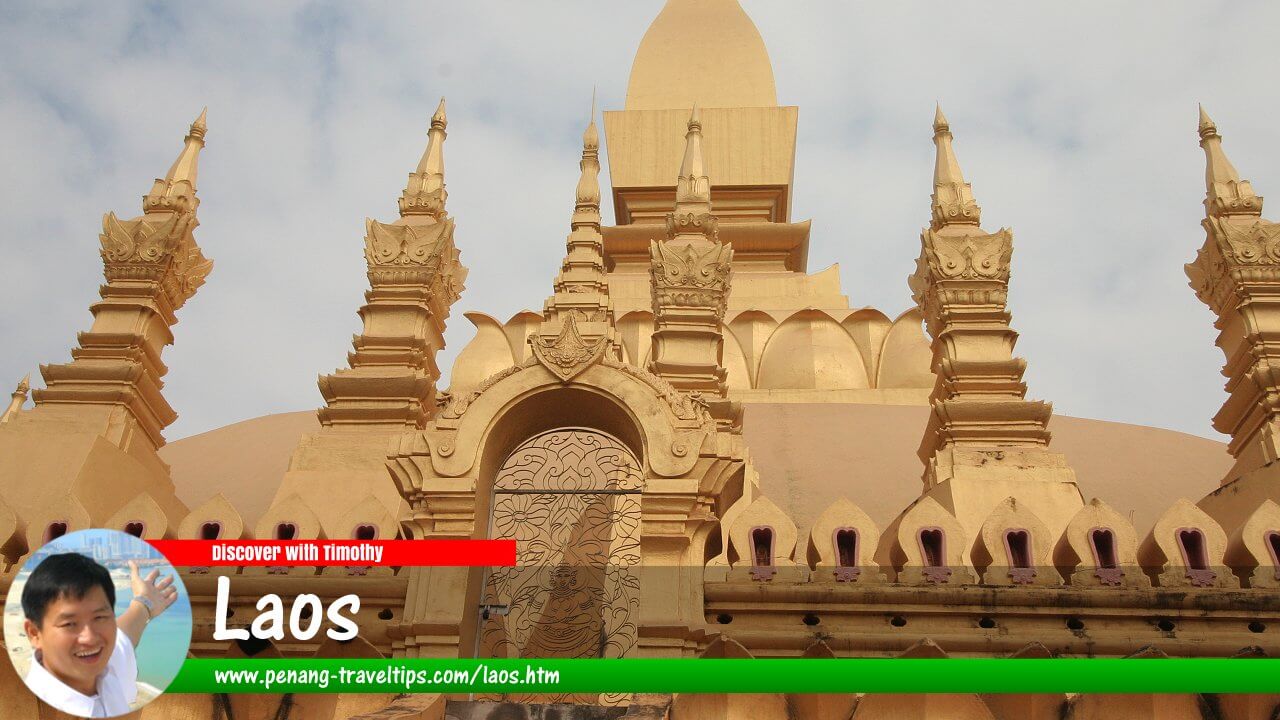
The city's most important landmark is Pha That Luang, the great golden stupa regarded as a national symbol of Laos. Other significant attractions include Wat Si Saket, Haw Phra Kaew, Patuxai and Buddha Park.
Vientiane is also the most convenient place in Laos for Malaysian Muslim travellers to locate mosques and halal food, although choices remain much more limited than in Malaysia.
Pha That Luang
Pha That Luang is one of the most important Buddhist monuments in Laos and a national symbol of the country.
The large golden stupa dominates its surrounding temple complex and is particularly impressive when viewed against the Vientiane skyline.
The monument has undergone several periods of construction and restoration throughout its history. Its annual festival, Boun That Luang, is one of the most important religious celebrations in Vientiane.
Patuxai
Patuxai is a monumental arch located in central Vientiane. It is sometimes compared with the Arc de Triomphe in Paris because of its general form, although its decoration incorporates distinctly Lao Buddhist motifs.
Visitors can climb to the upper levels for views over the city.
Wat Si Saket
Wat Si Saket is one of the oldest surviving temples in Vientiane. It is notable for the large number of Buddha images displayed within its cloisters.
The temple provides an excellent introduction to Lao Buddhist architecture and is particularly worthwhile for visitors interested in the history of Vientiane.
Buddha Park
Buddha Park, also known as Xieng Khouane, is located outside central Vientiane near the Mekong.
The park contains a collection of large concrete sculptures depicting Buddhist and Hindu religious figures and mythical beings. It is very different in character from the historic temples of central Vientiane.
Luang Prabang
Luang Prabang is arguably the most culturally important tourist destination in Laos. The former royal capital is situated at the confluence of the Mekong and Nam Khan rivers and is famous for its temples, traditional architecture and peaceful atmosphere.
The historic town was designated a UNESCO World Heritage Site in 1995 because of its remarkably well-preserved combination of traditional Lao architecture and European colonial buildings.
Visitors can explore numerous temples, climb Mount Phousi, walk along the Mekong, visit the former Royal Palace and explore the town's markets.
Luang Prabang is also one of the most popular destinations for witnessing the traditional alms-giving ceremony in which Buddhist monks receive offerings from local residents. Visitors should observe the ceremony quietly and respectfully.
Wat Xieng Thong
Wat Xieng Thong is one of the most celebrated temples in Luang Prabang.
Its distinctive sweeping roof and elaborate decorative details represent the traditional architectural style of the city.
The temple is an important example of Lao Buddhist architecture and is one of the essential sights for first-time visitors to Luang Prabang.
Mount Phousi
Mount Phousi rises above the centre of Luang Prabang and provides panoramic views over the historic town, Mekong River and surrounding mountains.
The climb involves a substantial number of steps, but the summit is one of the most popular places in the city for sunrise and sunset views.
Kuang Si Falls
Kuang Si Falls is one of the most famous natural attractions around Luang Prabang.
The waterfall descends through a series of turquoise pools surrounded by forest. Visitors can walk along established trails and, where conditions permit, swim in designated areas.
Because the falls are located outside the city, visitors generally reach them by tuk-tuk, taxi, private vehicle or organized tour.
Pak Ou Caves
The Pak Ou Caves are located along the Mekong north of Luang Prabang. The caves contain numerous Buddha images that have been placed there over generations.
The journey to the caves can itself be part of the experience, as visitors travel along the Mekong through a landscape of forested hills and riverside villages.
Vang Vieng
Vang Vieng is famous for its dramatic limestone karst mountains, caves, rivers and outdoor activities.
The town was once particularly associated with backpacker nightlife and river tubing, but its tourism industry has evolved considerably. Today, visitors come for kayaking, hiking, cycling, rock climbing, cave exploration and scenic views.
The Nam Song River runs through the town, with limestone mountains rising spectacularly on both sides.
Vang Vieng is particularly convenient for Malaysian travellers because it is located on the Laos-China Railway between Vientiane and Luang Prabang.
Vang Vieng's Caves and Mountains
The countryside around Vang Vieng contains numerous caves and limestone formations.
Tham Chang, Tham Phu Kham and other caves are popular with visitors, although access conditions vary.
Travellers should use established paths and follow local safety instructions, particularly when entering caves or hiking in mountainous areas.
Nam Ngum Lake
Nam Ngum Lake is a large reservoir north of Vientiane surrounded by forested hills and numerous small islands.
It provides opportunities for boat trips, fishing and relaxation and can be visited as an excursion from Vientiane or as part of a longer journey through central Laos.
Phonsavan and the Plain of Jars
Phonsavan is the main town of Xieng Khouang Province and serves as the gateway to the mysterious Plain of Jars.
The Plain of Jars contains thousands of enormous stone vessels scattered across several archaeological sites. Their precise purpose and origins remain subjects of archaeological study, although they are generally associated with ancient burial practices.
The area was heavily affected by the conflicts of the 20th century, and unexploded ordnance remains a serious issue in parts of Xieng Khouang.
Visitors should therefore visit only established archaeological sites and follow local safety instructions at all times.
Luang Namtha
Luang Namtha in northern Laos is an important centre for nature and community-based tourism.
The surrounding region is characterized by mountains, forests and ethnic villages. Trekking, cycling and river-based activities are among the main attractions.
The town is also conveniently connected by the Laos-China Railway and is close to the northern border with China.
Muang Xay
Muang Xay, also known as Oudomxay, is an important transportation and commercial centre in northern Laos.
It is less visited by international tourists than Luang Prabang or Vang Vieng but can serve as a base for exploring northern mountain landscapes and ethnic communities.
Its location along major road and railway routes makes it increasingly relevant to travellers exploring northern Laos.
Huay Xai
Huay Xai is located on the Mekong opposite Thailand and serves as one of the principal gateways between the two countries.
The town is particularly well known as the starting point for the traditional slow-boat journey down the Mekong towards Luang Prabang.
It is also associated with the Gibbon Experience, a forest adventure involving zip lines and treehouse accommodation in the surrounding protected forest.
Thakhek
Thakhek is a town in central Laos located along the Mekong opposite Thailand.
It is best known among adventure travellers as the gateway to the Thakhek Loop, a scenic motorbike route through limestone mountains, caves, villages and rural landscapes.
Travellers who choose to ride the loop should have suitable riding experience and allow enough time for changing weather and road conditions.
Kong Lor Cave
Kong Lor Cave is one of the most spectacular natural attractions in central Laos.
The cave forms a huge natural tunnel through a limestone mountain and is explored by boat. The journey takes visitors through an enormous underground passage before emerging on the other side.
The cave is best suited to travellers who enjoy nature and adventure rather than those looking for conventional sightseeing.
Savannakhet
Savannakhet is one of the largest cities in Laos and an important commercial centre in the country's central region.
Its historic quarter contains French colonial buildings and traditional Lao structures, reflecting the city's position along the Mekong and its history as a regional trading centre.
Savannakhet is less tourist-oriented than Vientiane or Luang Prabang and can therefore provide a more everyday view of urban life in Laos.
Pakse
Pakse is the principal city of southern Laos and an important base for exploring the region.
The city sits near the confluence of the Mekong and Xe Don rivers and is well positioned for journeys to the Bolaven Plateau, Champasak and Si Phan Don.
Pakse itself is relatively quiet, but its importance as a transportation hub makes it a useful starting point for exploring southern Laos.
Champasak
Champasak is a small historic town on the Mekong south of Pakse.
Its principal attraction is Vat Phou, an ancient Khmer temple complex situated at the foot of a sacred mountain.
The site forms part of the Vat Phou and Associated Ancient Settlements within the Champasak Cultural Landscape, a UNESCO World Heritage property.
The combination of Khmer architecture, mountains and Mekong scenery makes Champasak one of the most interesting destinations in southern Laos.
Vat Phou
Vat Phou, also written as Wat Phou, is an ancient Khmer temple complex dating back many centuries.
The temple is aligned with the sacred mountain behind it and forms part of a larger ancient cultural landscape that once extended along the Mekong valley.
Although the temple predates the modern Lao state, it is an important part of the country's archaeological and cultural heritage.
Bolaven Plateau
The Bolaven Plateau is one of the major natural attractions of southern Laos.
Its higher elevation gives it a cooler climate, while fertile volcanic soils support extensive coffee cultivation.
The plateau is particularly famous for waterfalls, including Tad Fane and Tad Yuang.
A road trip around the plateau is an excellent choice for travellers who enjoy scenery, coffee, waterfalls and rural landscapes.
Si Phan Don — The 4,000 Islands
Si Phan Don, meaning "Four Thousand Islands", is located where the Mekong widens dramatically in southern Laos.
The area has a relaxed atmosphere and is particularly popular with travellers who want to slow down and enjoy river scenery.
Don Det is the best-known island for backpackers and independent travellers, while Don Khon offers a somewhat quieter experience.
Khon Phapheng Falls
Khon Phapheng Falls is the largest waterfall by volume in Southeast Asia and is located on the Mekong in southern Laos.
Rather than a single vertical waterfall, it consists of a vast series of rapids and cascades spread across the river.
The falls are particularly impressive during periods of high water and are one of the major attractions of southern Laos.
Dong Hua Sao and Southern Nature
Southern Laos contains extensive forests and protected areas that support a variety of wildlife.
The region around the Bolaven Plateau and Champasak is particularly suitable for travellers interested in nature, waterfalls and rural landscapes.
Nature-based tourism is an important part of the region's tourism potential, although visitors should always follow local regulations and respect protected areas.
Choosing Where to Go in Laos
The best destinations depend on what you want from your trip.
Vientiane — Capital, temples, history, food and urban sightseeing.
Luang Prabang — Culture, temples, history, heritage and relaxation.
Vang Vieng — Mountains, caves, rivers and outdoor activities.
Phonsavan — Plain of Jars and wartime history.
Luang Namtha — Trekking, ethnic cultures and nature.
Huay Xai — Mekong travel and northern Laos.
Thakhek — Road trips, caves and limestone scenery.
Savannakhet — Colonial heritage and local urban life.
Pakse — Southern Laos and regional transport.
Champasak — Ancient Khmer heritage and Mekong scenery.
Bolaven Plateau — Coffee, waterfalls and highland scenery.
Si Phan Don — Islands, riverside relaxation and rural Laos.
Suggested Itinerary for a First Visit
For Malaysian travellers making their first trip to Laos, a journey of around 7 to 10 days can provide a good introduction to the country.
One practical itinerary is to begin in Vientiane, travel north by train to Vang Vieng, and continue to Luang Prabang.
This route combines the capital's historical attractions, Vang Vieng's dramatic natural scenery and Luang Prabang's exceptional cultural heritage without requiring long road journeys.
Travellers with additional time can extend the trip to Luang Namtha in the north or travel south to Pakse, Champasak and Si Phan Don.
Laos for Different Types of Travellers
Laos can appeal to a surprisingly wide range of travellers.
- History and culture lovers will particularly enjoy Luang Prabang, Vientiane and Champasak.
- Nature lovers can explore the mountains of northern Laos, Vang Vieng, the Bolaven Plateau and the Mekong.
- Adventure travellers can go trekking, kayaking, caving, cycling and motorcycling.
- Slow travellers will appreciate the relaxed atmosphere of Luang Prabang, Champasak and Si Phan Don.
- Families can focus on Vientiane, Luang Prabang and selected nature attractions while avoiding unnecessarily demanding journeys.
- Malaysian Muslim travellers may find Vientiane the easiest starting point because of its Muslim community, mosques and greater availability of halal food.
Beyond the Main Tourist Route
Travellers with more time can venture beyond the three main destinations of Vientiane, Vang Vieng and Luang Prabang.
Northern Laos offers mountains, ethnic communities and remote landscapes, while central Laos contains spectacular caves and limestone formations. Southern Laos provides a completely different experience centred around the Mekong, waterfalls, coffee and ancient Khmer heritage.
The development of the Laos-China Railway has made northern Laos considerably more accessible, while improved roads and tourism infrastructure continue to open up other parts of the country.
For Malaysian travellers who have already experienced the major destinations, exploring these less-visited regions can provide a deeper understanding of Laos beyond its most famous tourist attractions.
Practical Travel Advice for Malaysian Travellers
Laos is generally a welcoming and rewarding country for Malaysian travellers. Its geographical proximity, cultural links with the rest of Southeast Asia and relatively relaxed pace make it an appealing destination for a short holiday or a longer exploration.
Nevertheless, Laos has a different level of infrastructure from Malaysia, particularly outside the main cities. Travellers who prepare properly and allow sufficient time for transportation will generally have a much more enjoyable experience.
Respecting Lao Culture
Laos has a predominantly Buddhist culture, and Buddhism remains an important part of everyday life. Visitors should therefore show appropriate respect when visiting temples, monasteries and religious ceremonies.
Dress modestly when entering temples. Shoulders and knees should generally be covered, and visitors should remove their shoes before entering designated areas.
Do not climb onto Buddhist statues, touch religious objects unnecessarily or behave loudly inside temples.
When photographing monks or religious ceremonies, be discreet and respectful. A photograph should never take priority over the religious practice taking place.
Alms-Giving Ceremony in Luang Prabang
The morning alms-giving ceremony in Luang Prabang is an important Buddhist tradition rather than a tourist performance.
Visitors who wish to observe should stand at an appropriate distance, remain quiet and avoid obstructing the monks or local residents.
Anyone participating in the offering should do so respectfully and understand the significance of the ceremony rather than treating it simply as a photographic opportunity.
Dress Code
Laos is generally relaxed about clothing, particularly in tourist areas. However, visitors should dress more conservatively when visiting temples and religious sites.
Lightweight clothing is suitable for the tropical climate, but it is useful to carry a shawl, long-sleeved shirt or other covering when visiting religious monuments.
Muslim travellers who dress modestly will generally find that this is compatible with local expectations at Buddhist sites.
Photography
Laos is an exceptionally photogenic country, with temples, mountains, rivers, markets and traditional villages providing abundant opportunities for photography.
However, ask permission before photographing people closely, particularly monks, villagers and members of ethnic communities.
Some religious sites may have restrictions on photography. Always follow posted instructions or guidance from temple staff.
Interacting with Local People
Lao society generally places considerable value on politeness, calm behaviour and maintaining social harmony.
Visitors should avoid shouting, aggressive behaviour or confrontational arguments, particularly in public.
A friendly greeting and a patient attitude can go a long way. Travellers should also remember that customs in rural communities may differ from those in tourist centres.
Responsible Tourism
Tourism provides important income for communities throughout Laos, but visitors should consider how their spending affects local people and the environment.
Whenever possible, support locally owned guesthouses, restaurants, guides, handicraft producers and tour operators.
Purchasing locally made products provides a more direct benefit to communities than buying mass-produced souvenirs.
Travellers should also avoid purchasing archaeological artefacts, wildlife products or other items that may have been illegally removed from the country.
Protecting the Environment
Laos contains extensive forests, rivers, caves and other fragile natural environments.
Visitors should take their rubbish with them, avoid damaging vegetation and follow designated paths in protected areas.
When swimming in rivers or waterfalls, follow local instructions because water conditions can change rapidly, particularly during the rainy season.
Avoid single-use plastic where practical and carry a reusable water bottle.
Unexploded Ordnance
One of the most important safety issues specific to Laos is the presence of unexploded ordnance (UXO) left from conflicts during the 20th century.
Large parts of the country, particularly areas of eastern and northern Laos, were heavily affected by bombing during the Indochina conflicts.
Although many areas have been cleared, unexploded bombs and other remnants of war remain dangerous.
Travellers should never touch unfamiliar metal objects, ammunition or military remnants. When visiting rural areas, caves or archaeological sites, stay on established paths and follow local instructions.
Road Safety
Road safety deserves particular attention in Laos. Traffic conditions can differ considerably from those in Malaysia, while rural roads may be narrow, winding or poorly surfaced.
Mountain roads can be particularly challenging during rain.
If you are not an experienced motorcyclist, consider using a driver or organized transport rather than renting a motorbike simply because it appears to be a convenient option.
Always wear a helmet when riding a motorcycle and avoid riding after dark in unfamiliar areas.
Swimming and River Activities
Rivers are an important part of tourism in Laos, particularly around Vang Vieng and the Mekong.
Water conditions can vary considerably according to the season. Strong currents, submerged rocks and sudden changes in water levels can create hazards.
Use reputable operators for kayaking, tubing and other water activities, and wear appropriate safety equipment.
Trekking and Hiking
Northern Laos offers excellent trekking opportunities, but mountain terrain can be challenging.
Travellers should use established trails and, where appropriate, hire a local guide familiar with the area.
Do not wander away from marked routes in areas that may contain unexploded ordnance.
Weather and Travel Delays
Laos's tropical climate means that heavy rainfall can occasionally disrupt transportation.
During the wet season, road journeys may take longer than expected, and boat services can be affected by river conditions.
When planning a journey involving several transport connections, leave a reasonable buffer between arrivals and departures.
Internet and Communication
Mobile internet is generally adequate in major towns and tourist areas, but coverage can become unreliable in remote mountain regions.
Travellers should download important maps, hotel information and travel documents before leaving areas with reliable connectivity.
An offline translation tool can also be useful when travelling outside the main tourist centres.
Using Money Wisely
Carry a mixture of cash and cards. Cash is particularly important for small purchases, local transport, markets and rural areas.
Avoid carrying all your money in one place. Keep a small amount readily accessible and store the remainder securely.
When using an ATM, choose machines located at established banks or reputable locations whenever possible.
Booking Accommodation
Accommodation in major tourist destinations can become busy during the November-to-February high season and around major festivals.
For a first visit, it is sensible to book accommodation in advance in Vientiane, Vang Vieng and Luang Prabang.
Travellers heading into smaller towns can generally find simpler accommodation locally, although booking ahead is advisable if you have particular requirements.
Booking Train Tickets
The Laos-China Railway has made travel between the main northern destinations much easier, but trains can become busy during peak travel periods.
Travellers should check the current ticketing system and book ahead when possible, especially for popular journeys such as Vientiane to Vang Vieng and Luang Prabang.
Keep your passport or other required identification available when purchasing and boarding trains.
How Long Should You Spend in Laos?
The ideal length of a Laos trip depends on how much of the country you want to see.
A 5-day trip can cover Vientiane and one additional destination, while 7 to 10 days allows a much more comfortable introduction to Vientiane, Vang Vieng and Luang Prabang.
A trip of two weeks or longer allows travellers to explore beyond the main northern route and include destinations such as Pakse, Champasak, the Bolaven Plateau and Si Phan Don.
Suggested 5-Day Laos Itinerary
Day 1: Arrive in Vientiane and explore the city centre, including the Mekong riverside.
Day 2: Visit Pha That Luang, Patuxai, Wat Si Saket and other major attractions.
Day 3: Travel by train to Vang Vieng and explore the surrounding scenery.
Day 4: Continue to Luang Prabang by train and explore the historic centre.
Day 5: Visit selected attractions in Luang Prabang before departure.
Suggested 7-Day Laos Itinerary
Day 1: Arrive in Vientiane.
Day 2: Explore Vientiane's temples, monuments and Mekong riverside.
Day 3: Take the train to Vang Vieng and explore the town and surrounding landscape.
Day 4: Enjoy Vang Vieng's caves, river and limestone scenery.
Day 5: Travel by train to Luang Prabang.
Day 6: Explore Luang Prabang's temples and historic centre.
Day 7: Visit a nearby attraction such as Kuang Si Falls before departure.
Suggested 10-Day Laos Itinerary
Days 1–2: Vientiane — explore the capital and its major historical and religious attractions.
Days 3–4: Vang Vieng — explore the limestone mountains, caves and Nam Song River.
Days 5–7: Luang Prabang — explore the historic town, temples, Mekong and surrounding attractions.
Days 8–10: Extend the journey either north towards Luang Namtha or south towards another destination, depending on flight and transport arrangements.
Combining Laos with Other Countries
Laos is particularly easy to combine with neighbouring countries because it shares land borders with Thailand, Vietnam, Cambodia, China and Myanmar.
For Malaysian travellers, combining Laos with Thailand is especially convenient because of the extensive transport connections between the two countries.
A multi-country itinerary could, for example, combine Thailand and Laos, with Bangkok followed by Vientiane, Vang Vieng and Luang Prabang.
Another possibility is to combine Vietnam and Laos, particularly for travellers interested in the history and cultures of mainland Southeast Asia.
Is Laos Suitable for Families?
Laos can be a rewarding family destination, particularly for families who enjoy culture, nature and a slower pace of travel.
Vientiane and Luang Prabang are relatively easy to explore, while the train makes travel between several major destinations more comfortable than it was in the past.
Families should nevertheless avoid packing too many destinations into a short itinerary. Long road journeys and frequent hotel changes can make travelling with young children tiring.
Is Laos Suitable for Older Travellers?
Laos can also be enjoyed by older travellers, provided the itinerary is planned around comfort and accessibility.
The railway is particularly useful because it reduces the need for long journeys on winding mountain roads.
Travellers with limited mobility should check the accessibility of individual hotels and attractions in advance. Some temples and natural attractions involve considerable numbers of steps or uneven surfaces.
Is Laos Expensive?
Compared with many developed tourist destinations in Asia, Laos can be relatively affordable. Local food, simple accommodation and public transportation can offer good value.
However, the cost can rise considerably when using private transportation, international-standard hotels, organized tours or domestic flights.
For Malaysian travellers, Laos is best thought of as a destination where both budget and comfortable travel are possible.
Is Laos Safe for Malaysian Travellers?
Laos is generally a welcoming destination for Malaysian visitors. As with travel anywhere, however, visitors should take ordinary precautions regarding personal belongings, transportation, money and unfamiliar surroundings.
The most important country-specific safety consideration is the presence of unexploded ordnance in some areas. Visitors should stay on established paths and never handle suspicious objects.
Travellers should also exercise caution when riding motorcycles, undertaking outdoor activities and travelling through remote areas.
Final Advice for Visiting Laos
The most important thing to remember when visiting Laos is to allow time for the country. Laos is not a destination that needs to be rushed.
Its greatest attractions are not limited to individual monuments. They include the experience of travelling slowly along the Mekong, watching life unfold in a riverside town, exploring a Buddhist temple at the beginning of the day, travelling through mountain scenery by train and discovering villages and landscapes away from the main tourist routes.
For Malaysian travellers, the country's improving transport network makes Laos easier to visit than ever before. The Laos-China Railway provides a particularly convenient way to connect Vientiane, Vang Vieng and Luang Prabang, while air and road connections make it possible to explore other regions.
A first-time visitor should not try to see everything in one trip. A carefully chosen itinerary focusing on a few destinations will usually provide a richer experience than spending most of the holiday travelling from one place to another.
References
- Tourism Laos — Official tourism information for Laos.
- UNESCO World Heritage Centre — Lao People's Democratic Republic — Information on Laos's World Heritage sites.
- World Bank — Lao PDR — Background information on Laos and its development.
- Encyclopaedia Britannica — Laos — General geographical and historical reference.
- IATA Travel Centre — Travel-document and entry information for international travellers.
Conclusion
Laos is a fascinating destination for Malaysian travellers looking for history, Buddhist culture, spectacular landscapes and a more relaxed Southeast Asian travel experience. From the temples and colonial heritage of Vientiane and Luang Prabang to the limestone mountains of Vang Vieng and the waterfalls and Mekong islands of the south, the country offers remarkable variety.
The opening of the Laos-China Railway has also transformed the way visitors can explore the country, making it much easier to combine several of its principal destinations in one trip. At the same time, travelling beyond the railway corridor reveals a quieter Laos of mountain villages, forests, waterfalls, coffee plantations and traditional communities.
For Malaysians, Laos is close enough for a relatively easy holiday while still offering a distinctly different cultural experience. With sensible planning, respect for local customs and sufficient time to appreciate the journey itself, Laos can be one of the most rewarding destinations to explore in mainland Southeast Asia.
Page Details
This page was created on 14 August 2026. Hi, my name is Timothy and created it from my research, for my own entertainment, knowledge and to satisfy my curiosity. I am providing the information to you in good faith and hope it is useful. I try to get the details as accurate as possible. I also try to update the page whenever I stumble on new details. So this and all my other pages are perpetual work in progress. If you discover any error, please politely inform me, pointing out where the error lies, and I will correct it as soon as possible. Your helpfulness will keep this page accurate, relevant and helpful to those who need the information.Buy Me A Coffee
If you enjoy the information I provide and want to support the work I do, please buy me a coffee! I appreciate it immensely, thank you so much!
