
Millennium Dome (The O2 Arena)
The dome is served by North Greenwich tube station on the Jubilee Line. The Thames Clipper fast catamaran also ply between it and central London. In addition there is a bus station providing bus services to south and east London.
The Millennium Dome is the largest domed structure in the world. It is held up by twelve 100-metre tall support poles. The poles represent either the 12 months of the year or the 12 hours on the clock's face. Both are to emphasize the role played by Greenwich as the keeper of time. From above, the dome looks circular. It is 365 metres in diametre, again symbolically representing one day for each metre. The Millennium Dome is one of the most recognisable landmarks in London, as well as the most photographed.
The Millennium Dome was designed by Richard Rogers and built by the firm of Sir Robert McAlpine. The structural engineer was Buro Happold. The entire roof structure weighs less than the air contained within it. The canopy is made of glass fibre fabric which is a highly durable and weather resistant plastic.
The land on which the Millennium Dome is located used to be a derelict from gasworks industries from the late 19th century. It was redeveloped under a project called the Thames Gateway. The Dome was originally conceived at a much smaller scale under John Major's government. However the incoming Labour government of Tony Blair greatly expanded its magnitude. It as to represent "a glittering New Labour achievement", to quote BBC correspondent Robert Orchard.
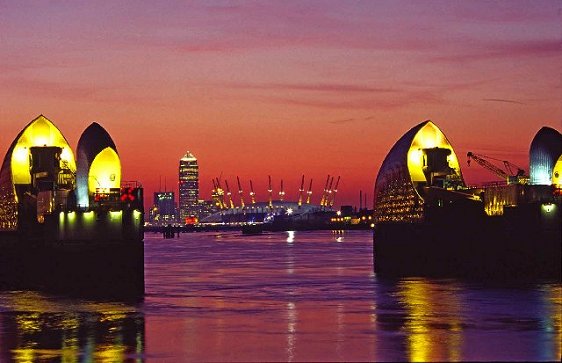 The Millennium Dome at dusk
Source: https://commons.wikimedia.org/wiki/File:Thames_Barrier_at_Dusk_with_Canary_Wharf_and_Millennium_Dome_-_geograph.org.uk_-_107657.jpg
Author: Christine Matthews

However, even before it opened, critics were already forecasting its failure. That prediction was accurate. In retrospect, the Millennium Dome was regarded as a flop, something badly thought out, badly executed and at the end of it, saddling the government with the question of what to do with it when the celebration was done. Nevertheless, visitors loved it. Although failing to attract the numbers expected, it was the most popular tourist attraction in Britain in 2000, followed by London Eye and Alton Towers.
The Millennium Dome was officially renamed The O2 on 31 May 2005. In its new incarnation, it is an Entertainment District housing an indoor arena, a music club, a cinema, an exhibition space, bars and restaurants.
List of Modern Architecture in London
Want to share your London travel experiences or get tips from fellow travellers?
Join the London Travel Tips Facebook GroupMore information for visiting London
Here are some related articles to help you get to know London better.- Cost of Living in London: Discover the true cost of living in London, including housing, transport, groceries, and more - plus tips for budgeting in one of the world's most expensive cities.
- Driving in London: Planning to drive in London? Learn about roads, car rentals, parking, tolls, and key tips for tourists and visitors from outside the capital.
- Driving Tips for Visiting London: Thinking of driving to London? Discover the best times to travel, congestion tips, parking apps, breakdown help, and petrol advice for a smoother journey.
- Evolution of London's Streets: Discover the fascinating history of how London's streets developed from ancient footpaths to today's complex network of roads across the capital.
- History of Immigration to London: Discover the rich history of immigration to London, from Huguenots to Bangladeshis, and how diverse communities have shaped the city's vibrant identity.
- How Big Is London Compared to Other World Cities?
- How London's Streets Measure Up: A Global Comparison of Road Widths
- How Streets of London are Named: Discover how London streets get their names, who decides them, and how historic, political, and public influences shape street naming in the capital.
- How the Grosvenor Family Came to Own Much of Mayfair, Belgravia and Pimlico: Explore how the Grosvenor family came to own much of Mayfair, Belgravia, and Pimlico, and learn about their historical connection (or lack thereof) with the British royal family and government.
- Living and working in London
- London's Quiet Collapse: How Living Standards Fell as Costs Skyrockted (1975-2025): Explore how London residents endured rising costs and falling living standards from 1975 to 2025 - from rocketing rents to wage stagnation and inflation.
- Marvel of the London Underground: Discover the history, challenges, and triumphs of the London Underground - the world's first underground railway and a vital transport lifeline for the UK capital since 1863.
- Moving to London: Expat Tips for Settling in Westminster: Essential advice for expats moving to London's Westminster: neighborhood insights, cost of living, transportation, housing, healthcare, schools, and tips to help you feel at home in the heart of the city.
- Places in London that aren't pronounced the way they're spelled
- Shopping in London: Discover London's diverse shopping scene
- Taking the bus in London: This is your complete guide to taking the bus when in London.
- The Anglican Faith: A Visitor's Guide to the Church of England: Learn about the Anglican faith and its deep ties to London's landmarks like Westminster Abbey and St Paul's Cathedral.
- Top 10 London Streets Every Visitor Must See: Discover London through its most iconic thoroughfares - 10 streets every visitor must experience. From historic Abbey Road to vibrant Camden High Street, explore culture, shopping, and hidden gems.
- Why are most roads in Central London so narrow? Learn why there are so few multi-lane roads and elevated highways in the heart of the city.
 Latest Pages & Updates
Buy Me A Coffee
If you enjoy the information I provide and want to support the work I do, please buy me a coffee! I appreciate it immensely, thank you so much!
