
Turkey Travel Guide
 Go Back
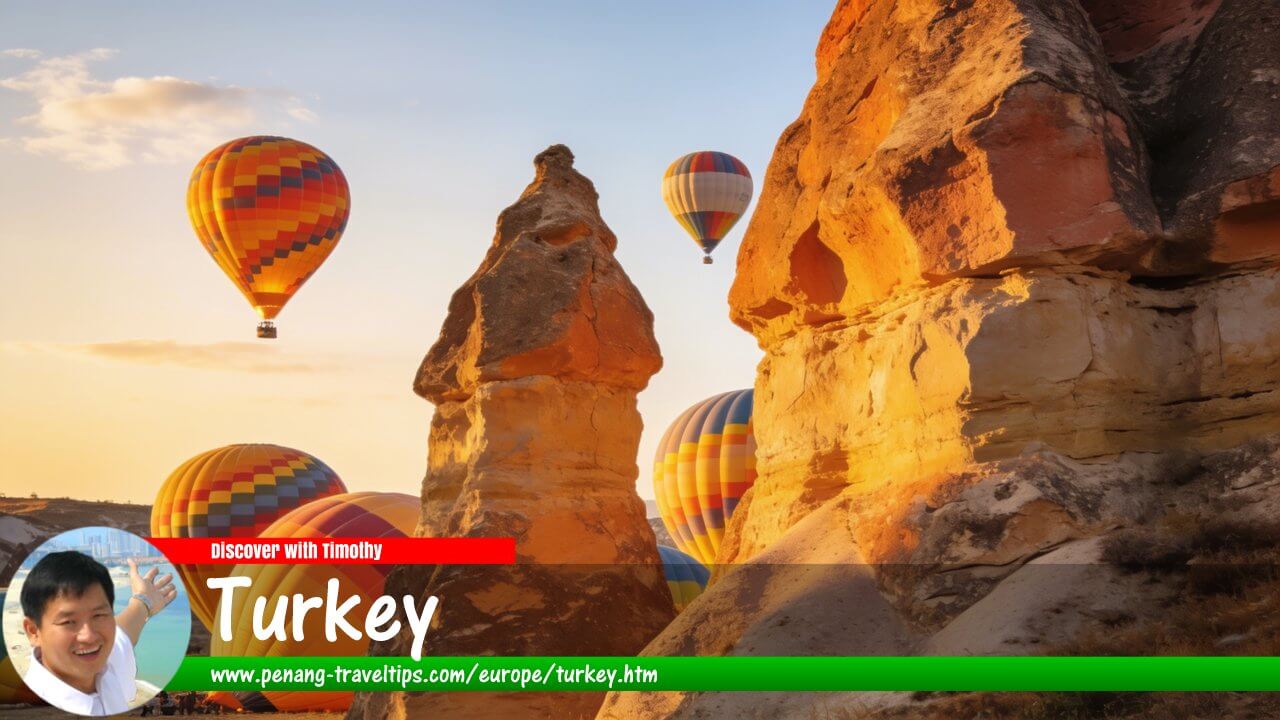 Turkey Travel Guide (AI Image generated on 2 September 2026)
Also available: Panduan Melawat Turki
Turkey, officially the Republic of Türkiye, is a country at the crossroads of Europe and Asia. Its unique geographical position has made it a meeting place of civilisations, religions, languages and cultures for thousands of years. Today, Turkey combines historic cities, ancient ruins, dramatic landscapes, Mediterranean and Aegean beaches, mountain regions and a rich culinary tradition.
For travellers, Turkey offers an unusually wide variety of experiences within one country. Istanbul provides Byzantine and Ottoman monuments, bustling bazaars and modern urban life, while Cappadocia is famous for its extraordinary rock formations, cave settlements and hot-air balloons. Along the Aegean and Mediterranean coasts are ancient cities, beaches and resort towns, while central and eastern Anatolia contain important archaeological and historical sites.
Geography of Turkey
Turkey occupies a large part of the Anatolian Peninsula in western Asia and also includes a smaller European territory known as Eastern Thrace. The two parts are separated by the Bosphorus, the Sea of Marmara and the Dardanelles.
The country is bordered by the Black Sea to the north, the Aegean Sea to the west and the Mediterranean Sea to the south. It shares land borders with several countries, including Greece and Bulgaria in the west, Georgia and Armenia in the northeast, Iran in the east, and Iraq and Syria in the southeast.
Turkey has a highly varied landscape. Mountains occupy much of the country, while broad plateaus, fertile valleys, river basins and coastal plains create very different environments from one region to another. The country also has a long coastline, providing extensive opportunities for beach holidays, sailing and water sports.
Anatolia
Anatolia, or Asia Minor, forms the great majority of Turkey's territory. It contains the central Anatolian plateau, mountain ranges and many of the country's most important archaeological sites.
The region has been inhabited by numerous civilisations, including the Hittites, Phrygians, Persians, Greeks, Romans, Byzantines, Seljuks and Ottomans. As a result, archaeological remains can be found throughout the Anatolian landscape.
Eastern Thrace
Eastern Thrace is the European portion of Turkey. Although relatively small compared with Anatolia, it contains Istanbul's European side and the historic city of Edirne.
Black Sea region
The Black Sea coast is greener and generally more humid than much of inland Turkey. Forested mountains rise behind the coast, and the region is known for tea plantations, hazelnuts, traditional villages and distinctive local cuisine.
Aegean region
The Aegean coast combines beaches and resort towns with some of Turkey's most important ancient ruins. Ephesus, Pergamon and Aphrodisias are among the major archaeological sites in western Anatolia.
Mediterranean coast
The Mediterranean coast is one of Turkey's major holiday regions. Antalya and surrounding destinations offer beaches, resorts, mountains and ancient ruins. The coastline includes popular destinations such as Alanya, Side, Kemer, Kaş and Fethiye.
Central Anatolia
Central Anatolia is dominated by a high plateau and is home to Ankara, the modern capital of Turkey. It also contains Cappadocia, one of the country's most distinctive landscapes, formed from volcanic rock and shaped by erosion over millions of years.
Eastern and Southeastern Anatolia
Eastern Turkey is characterised by mountains, high plateaus and a more rugged landscape. Southeastern Anatolia contains some of the country's most important archaeological discoveries, including Göbekli Tepe, while eastern Anatolia is associated with sites such as Mount Nemrut and the ancient city of Ani.
Major Cities and Destinations
Istanbul
Istanbul is Turkey's largest city and one of the world's great historic cities. It occupies land on both sides of the Bosphorus, making it a city that physically connects Europe and Asia.
The city's historic attractions include Hagia Sophia, the Blue Mosque, Topkapı Palace, Basilica Cistern, Grand Bazaar and Spice Bazaar. Other neighbourhoods such as Galata, Karaköy, Balat, Kadıköy and Üsküdar provide a very different perspective on modern Istanbul.
Ankara
Ankara is the capital of Turkey and the country's political and administrative centre. Although it receives fewer international tourists than Istanbul, it has important museums, monuments and historical sites, including Anıtkabir, the mausoleum of Mustafa Kemal Atatürk.
Cappadocia
Cappadocia is one of Turkey's most recognisable destinations. Its landscape is characterised by unusual volcanic rock formations known as fairy chimneys, valleys, cave dwellings, rock-cut churches and underground cities.
The towns and villages around Göreme, Ürgüp, Uçhisar and Avanos provide access to the region. Hot-air balloon flights at sunrise have become one of Cappadocia's best-known experiences, although hiking, archaeological exploration and staying in cave hotels are also important attractions.
Antalya
Antalya is the major tourism centre of Turkey's Mediterranean coast. It combines a historic old town, beaches, modern hotels and easy access to numerous ancient sites.
The surrounding region includes destinations such as Side, Alanya, Kemer, Kaş and the ancient cities of Perge, Aspendos and Termessos.
Izmir
Izmir is a major city on the Aegean coast and an important commercial and cultural centre. Its waterfront, markets and surrounding archaeological sites make it a useful base for exploring western Anatolia.
One of its greatest attractions is its proximity to Ephesus, one of the best-preserved and most important ancient cities in the Mediterranean world.
Bodrum
Bodrum is a popular Aegean resort town known for its beaches, marina, nightlife and historical heritage. The city is associated with the ancient city of Halicarnassus, home of the Mausoleum of Halicarnassus, one of the Seven Wonders of the Ancient World.
Fethiye
Fethiye is a popular destination on the Turquoise Coast, surrounded by mountains, bays and islands. It is particularly associated with sailing, beaches, hiking and the nearby Blue Lagoon at Ölüdeniz.
Konya
Konya is an important cultural and religious centre in central Anatolia. It is closely associated with Jalaluddin Rumi, the 13th-century Persian poet and mystic, and the Mevlevi tradition of the Whirling Dervishes.
Other important destinations
Turkey has many other destinations of interest, including Pamukkale, Troy, Pergamon, Ephesus, Göbekli Tepe, Mount Nemrut, Safranbolu, Bursa, Edirne, Çanakkale and the ancient Hittite capital of Hattusa. The diversity of these destinations reflects the many civilisations that have occupied Anatolia over the centuries.
A Brief History of Turkey
The history of the land that is now Turkey extends back thousands of years. Anatolia was home to some of the world's earliest settled communities and later became the territory of major Bronze Age and Iron Age civilisations.
Early civilisations
Among the earliest major civilisations were the Hittites, whose capital at Hattusa was located in central Anatolia. Other ancient peoples included the Phrygians, Lydians and Urartians.
The western and southern coasts subsequently became strongly influenced by Greek civilisation. Greek cities and colonies developed along the Aegean and Mediterranean coasts, contributing to the region's importance in the ancient world.
Persian, Greek and Roman rule
The Persian Empire controlled much of Anatolia before Alexander the Great conquered the region in the 4th century BC. After Alexander's death, his empire fragmented into several Hellenistic kingdoms.
Rome subsequently expanded into Anatolia. Cities such as Ephesus, Pergamon and Hierapolis became important centres within the Roman world. Many of the ruins visited by tourists today date from the Greek and Roman periods.
The Byzantine Empire
Constantinople, founded as the new capital of the Roman Empire in AD 330, became the centre of the Eastern Roman Empire, later known as the Byzantine Empire.
The city remained one of the most important centres of Christianity and the eastern Mediterranean for centuries. Hagia Sophia, originally built as a Christian cathedral, is one of the most famous surviving monuments of this period.
The arrival of the Turks
Turkic peoples migrated into Anatolia over a long period, with the Seljuk Turks establishing a powerful presence after their victory over the Byzantine army at the Battle of Manzikert in 1071.
The Seljuks established the Sultanate of Rum, which controlled large parts of central and eastern Anatolia. Their architecture and cultural traditions remain visible in cities such as Konya.
The Ottoman Empire
The Ottoman state emerged in northwestern Anatolia in the late 13th century and gradually expanded into southeastern Europe, the Middle East and North Africa.
In 1453, Sultan Mehmed II conquered Constantinople, bringing the Byzantine Empire to an end. The city became the capital of the Ottoman Empire and developed into one of the world's most important political, commercial and cultural centres.
The Turkish Republic
The Ottoman Empire collapsed following the First World War. The Republic of Turkey was established on 29 October 1923 under the leadership of Mustafa Kemal Atatürk, who became its first president. Ankara was established as the capital of the new republic.
Atatürk introduced extensive political, social and cultural reforms intended to create a modern Turkish state. The legacy of these reforms continues to play an important role in Turkey's national identity.
Culture and Heritage
Turkey's cultural identity reflects the interaction of Anatolian, Central Asian Turkic, Greek, Roman, Byzantine, Islamic, Ottoman and European influences. This mixture is particularly visible in architecture, music, food, crafts and everyday life.
In Istanbul, Byzantine churches stand alongside Ottoman mosques and palaces. In Anatolia, ancient Greek and Roman ruins can be found close to Seljuk and Ottoman monuments. Cappadocia provides another example, where natural rock formations were transformed into homes, monasteries and churches.
Religion
Islam is the predominant religion in Turkey, although the country has a long history of religious diversity. The landscape contains historic mosques, churches, monasteries and synagogues, reflecting the communities that have lived in Anatolia and Istanbul over many centuries.
For Muslim travellers, Turkey is generally a convenient destination, with mosques found throughout the country and halal food widely available. At the same time, Turkey's Christian and Jewish heritage provides an important part of its historical and cultural landscape.
Turkish Cuisine
Turkish cuisine is one of the country's major attractions. It combines influences from Anatolia, the Mediterranean, the Middle East, the Balkans and Central Asia.
Well-known dishes include kebab, köfte, pide, lahmacun, mantı, meze, dolma and baklava. Breakfast is also an important part of Turkish food culture, often involving bread, cheese, olives, eggs, tomatoes, cucumbers and various spreads.
Each region has its own specialities. Seafood is particularly important along the Aegean and Mediterranean coasts, while central and eastern Anatolia have distinctive meat dishes, breads and stews.
Why Visit Turkey?
Turkey is particularly appealing because several different types of holiday can be combined in one trip.
- History: Explore remains from the Hittites, Greeks, Romans, Byzantines, Seljuks and Ottomans.
- Istanbul: Experience one of the world's great historic cities, situated between Europe and Asia.
- Cappadocia: See fairy chimneys, cave settlements and underground cities in a unique volcanic landscape.
- Ancient ruins: Visit Ephesus, Pergamon, Troy, Hierapolis and numerous other archaeological sites.
- Beaches: Enjoy the Aegean and Mediterranean coasts, including the Turkish Riviera.
- Food: Discover a cuisine that ranges from street food and kebabs to elaborate regional dishes.
- Islamic and Ottoman heritage: Visit historic mosques, bazaars, palaces and religious sites.
- Nature: Explore mountains, valleys, forests, beaches and unusual geological landscapes.
- Shopping: Browse traditional bazaars, markets, carpets, ceramics, textiles and other handicrafts.
Turkey's greatest strength as a destination is this combination of history, culture, scenery and food. A single journey can include the cosmopolitan streets of Istanbul, ancient Greek and Roman ruins, the landscapes of Cappadocia and the beaches of the Mediterranean.
History and Cultural Heritage of Turkey
Turkey has one of the world's richest historical landscapes. The Anatolian peninsula has been inhabited for thousands of years and has been home to prehistoric communities, Bronze Age kingdoms, Greek cities, the Roman and Byzantine empires, Turkic states and the Ottoman Empire. Each period has left behind monuments, ruins, traditions and cultural influences that remain visible today.
Prehistoric Anatolia
Anatolia was inhabited by some of the world's earliest settled communities. The transition from hunting and gathering to farming led to permanent settlements in several parts of the region.
One of the most important prehistoric sites is Göbekli Tepe in southeastern Anatolia. Dating to around the 10th millennium BC, it contains monumental stone structures decorated with carvings of animals and other symbols. Its existence has changed scholarly understanding of the relationship between permanent settlements, ritual activity and the development of agriculture.
Another important archaeological site is Çatalhöyük in central Anatolia. Dating from the Neolithic period, it was a large settlement of closely packed houses and provides valuable evidence of early settled life.
The Hittites
The Hittites established one of the major Bronze Age kingdoms of Anatolia. Their capital was Hattusa, located near modern Boğazkale in central Turkey.
Hattusa contained monumental gates, temples, defensive walls and royal buildings. The Hittites also developed an extensive system of writing using cuneiform and maintained diplomatic relations with other major powers of the ancient Near East.
The Hittites are particularly famous for their conflict with ancient Egypt. The Battle of Kadesh in the 13th century BC was followed by a peace treaty between the Hittite king Hattusili III and the Egyptian pharaoh Ramesses II. Versions of the treaty survive in both Egyptian and Hittite records.
Phrygians, Lydians and Other Ancient Kingdoms
Following the decline of the Hittite Empire, Anatolia became home to several regional kingdoms and peoples.
The Phrygians established a kingdom in central Anatolia, with Gordion as an important centre. The legendary King Midas is traditionally associated with the Phrygians.
The Lydians controlled much of western Anatolia and established their capital at Sardis. They are traditionally credited with developing some of the earliest widely used coinage made from precious metals, contributing to the development of monetary economies in the ancient world.
In eastern Anatolia, the Urartian Kingdom developed around Lake Van. Its remains include fortresses, inscriptions, irrigation systems and other impressive examples of ancient engineering.
Greek Civilisation in Anatolia
The Aegean and Mediterranean coasts of Anatolia became closely connected with the Greek world. Greek settlements and cities developed along the western coastline and became important centres of commerce, philosophy, science and culture.
Ephesus was among the most important of these cities. It became a major centre of trade and religion and was associated with the Temple of Artemis, one of the Seven Wonders of the Ancient World.
Other important Greek cities included Miletus, Priene, Smyrna, Halicarnassus and Pergamon. Their remains demonstrate the sophistication of ancient urban planning, architecture and public life.
The Persian Empire
In the 6th century BC, much of Anatolia came under the control of the Persian Achaemenid Empire. Western Anatolia became a frontier between the Persian Empire and the Greek city-states.
The Persian period contributed another important layer to Anatolia's cultural history. Royal roads connected different parts of the empire, facilitating trade, communication and administration.
Alexander the Great and the Hellenistic Period
Alexander the Great invaded Anatolia in the 4th century BC during his campaign against the Persian Empire. His victories brought much of the region into the Hellenistic world.
After Alexander's death, his empire was divided among his successors. Several Hellenistic kingdoms competed for control of Anatolia, including the Seleucid Empire and the Kingdom of Pergamon.
Pergamon became a major centre of culture and learning. Its monumental acropolis contained temples, theatres, palaces and a famous library.
The Roman Period
Rome gradually expanded its influence into Anatolia. By the 1st century BC, much of the region had become part of the Roman world.
Roman cities in Anatolia developed impressive public buildings, including theatres, temples, baths, libraries, aqueducts and marketplaces. Many of the ruins that visitors see today date from this period.
Ephesus became one of the largest and most prosperous cities in the eastern Mediterranean. Its surviving monuments include the Library of Celsus, the Great Theatre, the Temple of Hadrian and extensive residential areas.
Other important Roman sites include Hierapolis at Pamukkale, Aphrodisias, Perge and Aspendos. The Roman heritage of Turkey is therefore not confined to one region but is spread across much of the country.
The Rise of Christianity
Anatolia played an important role in the early history of Christianity. Several early Christian communities were established in cities across the region, and some of the earliest Christian councils were held in Anatolia.
According to Christian tradition, the Apostle Paul travelled extensively through Asia Minor, while several of the churches mentioned in the New Testament were located in cities that are now within Turkey.
The Council of Nicaea was held in AD 325 at Nicaea, modern İznik. The council addressed major theological questions concerning Christianity and produced the foundation of what became known as the Nicene Creed.
Constantinople and the Byzantine Empire
In AD 330, the Roman Emperor Constantine the Great established Constantinople as a new imperial capital. The city was strategically located beside the Bosphorus and became one of the most important cities in the ancient and medieval world.
After the Roman Empire divided into eastern and western spheres, Constantinople became the capital of the Eastern Roman Empire, later commonly known as the Byzantine Empire.
The Byzantine Empire lasted for more than a thousand years. Constantinople became a centre of Christianity, imperial government, scholarship, art and commerce.
Hagia Sophia
Hagia Sophia is one of the most important surviving monuments of Byzantine architecture. The present building was constructed during the reign of Emperor Justinian I in the 6th century.
Its enormous dome was an extraordinary engineering achievement for its time. For centuries, Hagia Sophia was one of the largest Christian churches in the world.
Following the Ottoman conquest of Constantinople in 1453, the building was converted into a mosque. It later became a museum and was subsequently reconverted into a mosque. Its architectural and artistic history reflects the different civilisations that shaped Istanbul.
The Seljuk Turks
Turkic peoples had been moving into Anatolia over a long period, but the arrival of the Seljuk Turks marked a major transformation in the region's political history.
The Seljuk victory over the Byzantine army at the Battle of Manzikert in 1071 opened much of Anatolia to Turkic settlement and political control. The Sultanate of Rum subsequently established its capital at Konya.
Seljuk architecture can still be seen in caravanserais, mosques, madrasas, tombs and other buildings throughout central Anatolia. Stone carving and geometric decoration are characteristic features of many Seljuk monuments.
The Rise of the Ottoman Empire
The Ottoman state emerged in northwestern Anatolia around the end of the 13th century. Under a succession of rulers, it expanded from a small frontier principality into a major empire.
The Ottomans captured important Byzantine territories in the Balkans and Anatolia and eventually surrounded Constantinople.
The Conquest of Constantinople
In 1453, Sultan Mehmed II, also known as Mehmed the Conqueror, captured Constantinople. The conquest brought the Byzantine Empire to an end and transformed the city into the centre of the Ottoman Empire.
Constantinople was gradually developed with new mosques, palaces, markets, schools, baths and other public buildings. The city became an important centre connecting Europe, Asia, the Middle East and the Mediterranean.
The Ottoman Empire
The Ottoman Empire reached its greatest territorial extent during the 16th and 17th centuries. At various times it controlled large parts of southeastern Europe, the Middle East, North Africa and the eastern Mediterranean.
The empire was ruled by sultans from Istanbul and was organised around a complex administrative, military and religious system. Different religious communities were incorporated into the empire, contributing to the cultural diversity of its major cities.
Süleymaniye and Ottoman Architecture
Ottoman architecture reached a high point during the reign of Sultan Süleyman the Magnificent. The architect Mimar Sinan designed some of the most important buildings of the period.
The Süleymaniye Mosque in Istanbul is one of Sinan's masterpieces. Other important works include the Selimiye Mosque in Edirne and numerous bridges, caravanserais, baths and public buildings throughout the empire.
Ottoman architecture combined elements inherited from Byzantine traditions with Islamic architectural principles, producing a distinctive style characterised by large domes, slender minarets, courtyards and elaborate interior decoration.
Ottoman Palace Culture
Topkapı Palace served as the principal residence and administrative centre of Ottoman sultans for centuries. The palace complex contains courtyards, audience halls, gardens, religious buildings and the famous Imperial Harem.
Dolmabahçe Palace, built beside the Bosphorus in the 19th century, represents a later period of Ottoman architecture. Its design incorporates strong European influences and illustrates the changing tastes of the Ottoman court.
The Decline of the Ottoman Empire
From the late 18th century onward, the Ottoman Empire faced increasing military, political and economic challenges. European powers were becoming stronger, while nationalist movements developed among several of the empire's subject peoples.
The Ottoman government introduced a series of reforms intended to modernise the military, administration, education and legal system. These reforms became particularly important during the 19th century.
The First World War
The Ottoman Empire entered the First World War on the side of the Central Powers. The war resulted in enormous human and economic losses and ultimately led to the dissolution of the empire.
The Gallipoli campaign of 1915 became a particularly important event in Turkish national history. Ottoman forces successfully defended the Dardanelles against an Allied invasion, and Mustafa Kemal emerged as one of the prominent military leaders of the campaign.
Mustafa Kemal Atatürk
Mustafa Kemal Atatürk became the central figure in the establishment of the modern Turkish Republic. Following the First World War, he led the Turkish national movement during the Turkish War of Independence.
The Republic of Turkey was proclaimed on 29 October 1923, with Ankara as its capital. Atatürk became the country's first president.
The Reforms of Atatürk
Atatürk introduced sweeping reforms intended to transform Turkey into a modern secular nation-state. These included changes to the legal system, education, government institutions and writing system.
The Latin alphabet replaced the Ottoman Turkish Arabic-based script in 1928. The education system was reorganised, and civil law was substantially changed. The reforms had a profound effect on Turkish society and remain an important part of the country's modern history.
Modern Turkey
Turkey experienced considerable political, economic and social change throughout the 20th century. The country became increasingly integrated into the modern international economy while retaining strong cultural connections with its Ottoman and Anatolian past.
Istanbul developed into a major international metropolis, while Ankara remained the political centre. Tourism became an increasingly important part of the economy, supported by the country's archaeological sites, historic cities, beaches and cultural attractions.
Turkish Language and Cultural Identity
Turkish is the official language of Turkey and belongs to the Turkic language family. Modern Turkish uses the Latin alphabet, introduced during the reforms of Atatürk.
The vocabulary and cultural traditions of modern Turkey reflect several historical influences, including Central Asian Turkic heritage, Persian and Arabic influences from the Ottoman period, and extensive interaction with European cultures.
Islamic Heritage
Islam has played a major role in Turkey's history since the arrival and settlement of Turkic Muslim communities in Anatolia. Seljuk and Ottoman rulers constructed thousands of mosques, madrasas, tombs, fountains and charitable institutions.
Istanbul contains some of the finest examples of Ottoman Islamic architecture, including the Blue Mosque, Süleymaniye Mosque and Rüstem Pasha Mosque. Outside Istanbul, cities such as Bursa, Edirne and Konya contain important Islamic monuments.
Christian Heritage
Turkey also contains an extraordinary Christian heritage dating back to the earliest centuries of Christianity. Ancient churches, monasteries and pilgrimage sites can be found in many parts of the country.
Cappadocia is particularly notable for its rock-cut churches and monasteries. The region contains extensive religious art dating from the Byzantine period.
The ancient cities of western Anatolia are also associated with early Christianity. Ephesus, for example, is traditionally linked with the Apostle Paul and early Christian communities.
Jewish Heritage
Jewish communities have lived in Anatolia and Istanbul for many centuries. Their history includes communities that existed under the Byzantine Empire as well as Sephardic Jews who arrived in the Ottoman Empire after the expulsion of Jews from Spain in 1492.
Istanbul's historic Jewish heritage can still be seen in synagogues and neighbourhoods associated with Jewish communities.
Turkish Arts and Crafts
Traditional Turkish culture includes a wide range of arts and crafts. Carpets and kilims are among the best-known examples, with different regions developing distinctive patterns and weaving traditions.
Ceramics are another important craft tradition, particularly the famous İznik tiles used extensively in Ottoman architecture. Other traditional crafts include calligraphy, illumination, metalwork, wood carving and glassmaking.
Turkish Coffee and Tea Culture
Turkish coffee is prepared by boiling finely ground coffee together with water, traditionally in a small pot known as a cezve. It is served in small cups and has an important place in Turkish social culture.
Tea is equally important in everyday life. Turkish tea is traditionally served in small tulip-shaped glasses and is consumed throughout the day in homes, workplaces, restaurants and cafés.
Turkish Bazaars and Markets
Markets have long been an important part of urban life in Turkey. The Grand Bazaar in Istanbul is one of the world's oldest and largest covered markets and contains thousands of shops selling jewellery, carpets, textiles, ceramics, leather goods and souvenirs.
The Spice Bazaar, also in Istanbul, is associated with spices, dried fruits, sweets, nuts, teas and other food products. Traditional markets can also be found in cities and towns throughout Turkey.
UNESCO World Heritage in Turkey
Turkey has numerous UNESCO World Heritage properties representing different periods of its history. They include archaeological sites, historic cities, religious monuments and cultural landscapes.
Among the best-known are the Historic Areas of Istanbul, Göreme National Park and the Rock Sites of Cappadocia, Ephesus, Hierapolis-Pamukkale, Hattusha, Troy, Pergamon, Aphrodisias, Göbekli Tepe and the archaeological site of Ani.
The concentration of World Heritage sites demonstrates how many different civilisations have contributed to the cultural landscape of modern Turkey.
A Living Historical Landscape
One of the most remarkable aspects of travelling in Turkey is that its history is not confined to museums. Ancient ruins, Byzantine churches, Ottoman mosques, Seljuk monuments and modern Turkish buildings often exist within the same city or region.
A visit to Istanbul, for example, can encompass Roman and Byzantine remains, Ottoman palaces and mosques, traditional markets and a modern international city. In Anatolia, a journey can pass from prehistoric archaeological sites to Greek and Roman ruins and then to Seljuk and Ottoman towns.
This extraordinary layering of history is one of the defining characteristics of Turkey and provides much of the country's appeal as a travel destination.
Major Attractions and Destinations in Turkey
Turkey offers an exceptional variety of attractions, ranging from ancient archaeological sites and Byzantine churches to Ottoman palaces, spectacular natural landscapes, beaches and bustling bazaars. For a first-time visitor, Istanbul, Cappadocia and the ancient cities of western and southern Anatolia are usually the main highlights, while travellers with more time can explore the Black Sea, eastern Turkey and the country's Mediterranean resorts.
Istanbul
Istanbul is the most popular starting point for international visitors and contains an extraordinary concentration of historic attractions. The city extends across both Europe and Asia, with the Bosphorus separating its two sides.
Hagia Sophia
Hagia Sophia is one of Istanbul's most famous landmarks. Originally completed as a Byzantine cathedral in the 6th century, it was converted into a mosque after the Ottoman conquest of Constantinople in 1453. It later served as a museum before becoming a mosque again.
Its enormous dome, Byzantine mosaics and later Islamic additions reflect the different historical periods through which the building has passed.
Blue Mosque
The Sultan Ahmed Mosque, popularly known as the Blue Mosque, was constructed in the early 17th century during the reign of Sultan Ahmed I. It is famous for its six minarets, large central dome and extensive use of blue İznik tiles in its interior.
Topkapı Palace
Topkapı Palace was the principal residence and administrative centre of the Ottoman sultans for several centuries. The extensive complex contains courtyards, gardens, state rooms, religious objects, imperial collections and the former Imperial Harem.
Dolmabahçe Palace
Dolmabahçe Palace stands beside the Bosphorus and represents the more European-influenced architectural style of the later Ottoman Empire. Its lavish interiors, ceremonial rooms and waterfront setting make it one of Istanbul's most impressive palaces.
Basilica Cistern
The Basilica Cistern is an underground Byzantine water reservoir constructed during the reign of Emperor Justinian I. Hundreds of columns support the ceiling, creating an atmospheric underground space beneath the historic city.
Grand Bazaar
The Grand Bazaar is one of Istanbul's most famous markets. Its covered streets contain shops selling carpets, jewellery, ceramics, leather goods, textiles, souvenirs and other products.
Spice Bazaar
The Spice Bazaar specialises in spices, dried fruits, nuts, Turkish delight, tea and other food products. It is a colourful introduction to Turkey's culinary traditions.
Galata and Karaköy
The neighbourhoods around Galata and Karaköy combine historic buildings, cafés, restaurants, galleries and shops. Galata Tower provides a prominent landmark and a panoramic view over parts of Istanbul.
Bosphorus
A cruise along the Bosphorus provides a different perspective of Istanbul. Palaces, mosques, historic waterfront mansions and modern neighbourhoods line both sides of the strait.
Short sightseeing cruises are available, while longer cruises can be used to explore areas farther north toward the Black Sea.
Cappadocia
Cappadocia is one of Turkey's most distinctive destinations. Volcanic activity created thick layers of soft rock, which were subsequently shaped by erosion into valleys, pinnacles and unusual formations known as fairy chimneys.
Göreme
Göreme is one of the main bases for exploring Cappadocia. The town is surrounded by valleys and rock formations and contains numerous hotels built into or inspired by the region's traditional cave dwellings.
Göreme Open-Air Museum
The Göreme Open-Air Museum contains rock-cut churches and monasteries decorated with Byzantine-era frescoes. It provides an insight into the region's Christian heritage and its monastic communities.
Uçhisar
Uçhisar is dominated by a large natural rock citadel containing caves and tunnels. Its elevated position provides extensive views across the Cappadocian landscape.
Underground Cities
Cappadocia contains extensive underground settlements, including Derinkuyu and Kaymaklı. These multi-level complexes contained living quarters, storage areas, places of worship and other facilities and could shelter large numbers of people.
Hot-air Balloon Flights
Hot-air balloon flights at sunrise have become one of Cappadocia's signature experiences. Balloons rise above the valleys and fairy chimneys, providing a spectacular aerial view of the landscape.
Cappadocia Hiking
The valleys around Göreme, Uçhisar and other towns offer opportunities for walking and hiking. Popular areas include Love Valley, Rose Valley, Red Valley and Pigeon Valley.
Pamukkale
Pamukkale is famous for its white terraces formed by mineral-rich thermal waters. The terraces descend the hillside in a series of pools and formations that have become one of Turkey's most recognisable natural landscapes.
Above Pamukkale is the ancient city of Hierapolis, whose remains include a large theatre, temples, streets, baths and a substantial necropolis. The combination of natural scenery and Roman ruins makes Pamukkale particularly distinctive.
Ephesus
Ephesus is one of the best-preserved ancient cities in the eastern Mediterranean and one of Turkey's most important archaeological attractions.
Visitors can see the Library of Celsus, the Great Theatre, the Temple of Hadrian, Curetes Street and extensive remains of residential and civic buildings.
The nearby House of the Virgin Mary is an important Christian pilgrimage site associated by tradition with Mary, the mother of Jesus.
Pergamon
The ancient city of Pergamon, near modern Bergama, was a major Hellenistic cultural and political centre. Its acropolis contains the remains of temples, a theatre, palaces and other monumental structures.
Pergamon also became an important centre of early Christianity and is one of the ancient cities traditionally associated with the Seven Churches of Asia mentioned in the Book of Revelation.
Troy
Troy, near Çanakkale, is associated with the legendary Trojan War described in Homer's Iliad. Archaeological excavations have revealed multiple layers of settlement built over thousands of years.
The site illustrates how archaeology and ancient literature can intersect, although the precise relationship between the historical settlement and the events described in the epic remains a subject of scholarly discussion.
Çanakkale and Gallipoli
Çanakkale is an important gateway to the Dardanelles and the nearby archaeological site of Troy. Across the strait lies the Gallipoli peninsula, where the 1915 Gallipoli campaign took place during the First World War.
Memorials and cemeteries commemorate soldiers from Turkey and the Allied forces. The site is particularly significant to Australians and New Zealanders because of its association with the ANZAC campaign.
Antalya
Antalya is the principal tourism centre of Turkey's Mediterranean coast. The city combines beaches, hotels, restaurants and modern facilities with a historic old town.
Kaleiçi
Kaleiçi, the historic centre of Antalya, contains narrow streets, Ottoman-era houses, small hotels, restaurants and shops. Hadrian's Gate is one of the best-known surviving monuments from the Roman period.
Düden Waterfalls
The Düden Waterfalls are a popular natural attraction near Antalya. The waterfalls and surrounding parks provide an easy excursion from the city.
Perge
The ancient city of Perge lies near Antalya and contains extensive Roman remains. Its monumental street, colonnades, baths, stadium and theatre illustrate the scale of urban development in Roman Anatolia.
Aspendos
Aspendos is particularly famous for its remarkably well-preserved Roman theatre. Built in the 2nd century AD, the theatre remains one of the most impressive examples of Roman architecture in Turkey.
Termessos
Termessos is an ancient city situated in the mountains west of Antalya. Its elevated location and rugged surroundings distinguish it from the coastal Roman cities.
The ruins include a theatre, tombs, temples and other structures set among pine forests and rocky mountain terrain.
Side
Side combines a popular Mediterranean resort with an ancient city. Its ruins include a large theatre, temples, colonnaded streets and a Roman bath, while the modern town has beaches, hotels and restaurants.
The Temple of Apollo beside the sea is one of Side's most recognisable landmarks.
Fethiye and Ölüdeniz
Fethiye is a popular base for exploring Turkey's Turquoise Coast. The surrounding area contains beaches, islands, bays, mountains and ancient Lycian sites.
Ölüdeniz is particularly famous for its Blue Lagoon and turquoise-coloured water. The surrounding mountains also make the area popular for paragliding and hiking.
Kaş
Kaş is a smaller Mediterranean coastal town known for its waterfront, diving, sailing and relaxed atmosphere. The surrounding region contains numerous Lycian ruins and mountain landscapes.
Bodrum
Bodrum is one of the best-known resort destinations on the Aegean coast. It combines beaches, marinas, restaurants and nightlife with an ancient history dating back to Halicarnassus.
Bodrum Castle
Bodrum Castle was built by the Knights Hospitaller during the medieval period. Its towers and walls dominate the harbour and provide an important reminder of the town's strategic history.
The castle is also associated with the Museum of Underwater Archaeology.
Izmir
Izmir is Turkey's third-largest city and a major Aegean port. Its waterfront promenade, markets and urban neighbourhoods provide a contrast to the archaeological sites of the surrounding region.
Izmir is also a convenient base for exploring Ephesus, Pergamon and other destinations in western Anatolia.
Alaçatı and Çeşme
Çeşme and nearby Alaçatı are popular Aegean destinations known for beaches, windsurfing, stone houses, restaurants and a lively summer atmosphere.
Alaçatı is particularly recognisable for its traditional architecture, narrow streets and windmills.
Bursa
Bursa was the first major capital of the Ottoman state before the conquest of Constantinople. The city contains important Ottoman mosques, tombs, markets and traditional architecture.
Bursa is also located near Mount Uludağ, a popular destination for winter sports and mountain recreation.
Edirne
Edirne, near Turkey's European borders, was another important Ottoman capital before Constantinople became the permanent imperial centre.
The city's greatest architectural attraction is the Selimiye Mosque, designed by the Ottoman architect Mimar Sinan. Its monumental dome and minarets dominate the city skyline.
Konya
Konya is associated with Jalaluddin Rumi, the 13th-century poet and mystic whose teachings inspired the Mevlevi order.
The Mevlana Museum, centred around Rumi's tomb, is one of the city's principal attractions. Visitors may also encounter performances of the sema, the ceremonial whirling associated with the Mevlevi tradition.
Mount Nemrut
Mount Nemrut in southeastern Turkey contains the monumental remains of the Kingdom of Commagene. Large stone statues representing deities and rulers were erected around the summit during the 1st century BC.
The site is particularly famous for sunrise and sunset views over the surrounding mountains.
Göbekli Tepe
Göbekli Tepe near Şanlıurfa is one of the world's most important prehistoric archaeological sites. Its monumental stone structures date to the Neolithic period and contain carved representations of animals.
The site has changed scholarly understanding of early human communities and the development of monumental ritual architecture.
Şanlıurfa
Şanlıurfa is an important cultural centre in southeastern Turkey. The city is associated with several religious traditions and contains historic mosques, markets and traditional neighbourhoods.
The nearby archaeological sites of Göbekli Tepe and Karahan Tepe make the region particularly important for visitors interested in early human history.
Ani
Ani is a medieval ruined city in eastern Turkey near the border with Armenia. Once an important capital of the Armenian Bagratid kingdom, it contains the remains of churches, defensive walls and other monumental structures.
Its isolated location on a plateau overlooking a gorge gives the ruins a particularly dramatic setting.
Safranbolu
Safranbolu is famous for its well-preserved Ottoman houses and historic urban landscape. The town provides an opportunity to see traditional Ottoman residential architecture away from the major cities.
Its historic centre contains wooden houses, mosques, inns, baths and narrow streets and is recognised as a UNESCO World Heritage site.
Black Sea Coast
Turkey's Black Sea region offers a very different landscape from the dry interior and Mediterranean coast. Forested mountains rise behind the coastline, while tea plantations and traditional villages are characteristic of parts of the region.
Trabzon is an important city on the eastern Black Sea coast. Nearby attractions include the dramatic Sumela Monastery, built into a cliff face in the Pontic Mountains.
Eastern Turkey
Eastern Turkey is less visited by international tourists but contains significant historical and natural attractions. Lake Van, Mount Ararat, Ani and the ruins associated with Urartu are among the region's highlights.
The area is particularly suitable for travellers who have already visited the better-known destinations in western and central Turkey and want to explore a less tourist-oriented part of the country.
Choosing Destinations in Turkey
For a first visit, Istanbul and Cappadocia provide two very different experiences and are a strong combination. Travellers interested in ancient history can continue to Ephesus, Pamukkale and Antalya or the Aegean coast.
Those interested primarily in Ottoman history can add Bursa and Edirne, while travellers interested in early Christianity may wish to explore Ephesus, Cappadocia and other historic Christian sites.
For a beach holiday, Antalya, Fethiye, Bodrum, Marmaris, Kaş and the surrounding Aegean and Mediterranean coastline provide numerous choices. Travellers with more time can venture into central, eastern or Black Sea Turkey for a broader experience of the country.
Turkish Food and Dining
Turkish cuisine is one of the great culinary traditions of the Mediterranean and Middle East, shaped by the many peoples and empires that have occupied Anatolia and the surrounding regions. Turkish food combines Central Asian, Middle Eastern, Mediterranean, Balkan and Caucasian influences, while regional differences make eating your way across Turkey a particularly rewarding part of the journey.
Meals in Turkey range from simple street food and inexpensive neighbourhood restaurants to elaborate Ottoman-inspired cuisine. Meat, vegetables, grains, yoghurt, legumes, fresh herbs, olive oil, bread and spices form the foundation of the cuisine. Seafood is especially important along the Aegean, Mediterranean and Black Sea coasts.
Turkish Breakfast
Kahvaltı, or Turkish breakfast, is much more than a quick meal of toast and coffee. A traditional breakfast may consist of several small dishes placed on the table, including bread, cheese, olives, tomatoes, cucumbers, eggs, honey, jam and butter.
One of the most recognisable breakfast foods is menemen, made by cooking eggs with tomatoes, green peppers and sometimes onions. It is usually eaten with bread. Another popular item is sucuk, a strongly seasoned sausage made from beef or other meats. Visitors should check the ingredients if they require halal food.
Breakfast is often accompanied by çay, or Turkish tea, served in small tulip-shaped glasses. Turkish tea is an important part of everyday social life and is commonly offered to visitors in shops, homes and restaurants.
Bread and Pastries
Bread is an essential part of Turkish dining. Simit, a circular bread covered with sesame seeds, is one of the country's most familiar street foods. It is inexpensive, portable and commonly eaten with cheese, olives or tea.
Pide is a flatbread with a boat-shaped form that is commonly topped with minced meat, cheese, vegetables or eggs before being baked in a hot oven. It is sometimes described as Turkish pizza, although its texture, preparation and toppings are distinctly Turkish.
Lahmacun is another popular flatbread. A very thin layer of seasoned minced meat, herbs and vegetables is spread over the dough before it is baked. It is commonly served with lemon, parsley and fresh vegetables and rolled up before eating.
Gözleme is a thin, filled flatbread traditionally cooked on a griddle. Common fillings include spinach, cheese, potatoes and minced meat. It is particularly popular at markets, roadside establishments and casual restaurants.
Kebabs
When people think of Turkish food, kebab is often the first thing that comes to mind. The word covers a large family of grilled and roasted meat dishes rather than one particular recipe.
- Döner kebab consists of seasoned meat cooked on a slowly rotating vertical spit. Slices are shaved from the outside as the meat cooks.
- Şiş kebab consists of pieces of meat, usually lamb, beef or chicken, grilled on skewers.
- Adana kebab is made from minced meat mixed with spices and traditionally grilled on a wide skewer. It is associated with the city of Adana.
- Urfa kebab is similar to Adana kebab but is generally milder in flavour and associated with Şanlıurfa.
- İskender kebab originated in Bursa and consists of sliced döner meat served over pieces of bread with tomato sauce, butter and yoghurt.
Kebabs are often served with grilled vegetables, rice, bulgur, salad, bread and yoghurt. For Muslim visitors from Malaysia, Turkey is generally a convenient destination for halal meat, but it is still sensible to check the ingredients and preparation methods when eating at unfamiliar establishments.
Köfte
Köfte refers to meatballs or seasoned minced-meat preparations and is found throughout Turkey in numerous regional forms. The meat may be shaped into balls, patties or elongated pieces and grilled, fried or cooked in sauce.
Different towns and regions have their own versions. Köfte is commonly served with bread, rice, bulgur, salad, grilled peppers and yoghurt, making it a simple but satisfying meal.
Mantı
Mantı consists of small dumplings filled with minced meat and served with yoghurt and garlic, usually accompanied by a sauce containing butter or oil and spices such as dried mint or red pepper.
The dish is particularly associated with central Anatolia and is strongly linked with the cuisine of Kayseri. Traditional mantı can be extremely small, with considerable skill required to prepare the dumplings.
Meze
Meze refers to a selection of small dishes served as appetisers or as part of a larger meal. Meze is especially prominent in western and southern Turkey and in restaurants influenced by Mediterranean and Aegean cuisine.
Examples include hummus, aubergine preparations, stuffed vine leaves, yoghurt-based salads, bean dishes, olives, seafood and various vegetable preparations. A selection of meze can itself become a substantial meal when accompanied by bread.
Vegetables, Olive Oil and Dolma
Vegetables play a particularly important role in Aegean and Mediterranean Turkish cooking. Dishes prepared with olive oil, known collectively as zeytinyağlı, are commonly served cold or at room temperature and may include green beans, artichokes, aubergines and other seasonal vegetables.
Dolma and sarma describe various stuffed or wrapped foods. Grape leaves may be wrapped around a filling of rice, herbs and sometimes meat, while peppers, aubergines and other vegetables may also be stuffed.
Soups
Soup is a common part of Turkish cuisine and may be eaten at breakfast, lunch, dinner or as a late-night meal.
Mercimek çorbası, or lentil soup, is particularly popular. It is a simple, filling soup made primarily from red lentils and vegetables and is widely available in restaurants throughout the country.
Other traditional soups include yayla çorbası, made with yoghurt and rice, and various regional soups containing vegetables, grains or meat.
Seafood
Turkey has extensive coastlines on the Black Sea, Sea of Marmara, Aegean Sea and Mediterranean Sea, so seafood is an important part of regional cuisine.
Along the Aegean and Mediterranean coasts, restaurants commonly serve grilled fish, prawns, squid, octopus and other seafood. Istanbul also has a strong seafood tradition, partly because of its position between the Black Sea and the Sea of Marmara.
On the Black Sea coast, fish such as hamsi, the European anchovy, is especially important. It can be fried, grilled, baked or incorporated into other dishes.
Turkish Street Food
Street food provides one of the easiest ways to experience everyday Turkish eating culture. Popular choices include simit, döner, lahmacun, grilled corn, roasted chestnuts and baked potatoes.
Kumpir is a large baked potato that is split open and mixed with butter and cheese before being topped with a choice of ingredients. It is particularly associated with Ortaköy in Istanbul.
Balık ekmek, meaning "fish in bread", consists of grilled or fried fish served in bread with salad and other accompaniments. It is especially associated with Istanbul's waterfront.
Midye dolma consists of mussels stuffed with seasoned rice and is sold by street vendors in many Turkish cities. Visitors who are unfamiliar with the preparation or hygiene standards of a particular vendor may prefer to eat it at an established restaurant.
Kokoreç is another well-known Turkish street food, made from seasoned grilled sheep intestines. Although it is an important part of Turkish food culture, travellers who avoid offal may wish to skip it.
Turkish Desserts
Turkey is famous for its rich variety of sweets and pastries. Baklava is perhaps the best known, consisting of layers of thin pastry filled with nuts and soaked or brushed with syrup.
Künefe is a warm dessert made with fine strands of pastry and a stretchy cheese filling, usually soaked in syrup and topped with pistachios. It is particularly associated with southeastern Turkey.
Lokum, commonly known in English as Turkish delight, is a soft confection traditionally made from starch and sugar and flavoured with ingredients such as rose, lemon or mastic. Nuts such as pistachios or hazelnuts may also be incorporated.
Sütlaç is a traditional rice pudding, while dondurma is Turkish ice cream. The latter is famous for its chewy texture and for the playful serving performances often associated with vendors in tourist areas.
Turkish Tea and Coffee
Turkish tea is consumed throughout the day and is an important part of Turkish hospitality. It is normally served without milk in small glasses, although visitors can add sugar according to taste.
Turkish coffee is prepared by boiling finely ground coffee together with water and, when desired, sugar in a small pot known as a cezve or ibrik. The coffee grounds remain in the cup, so the drink is not filtered in the usual way.
Turkish coffee has an important cultural tradition and is often served after meals or during social occasions. The coffee itself is strong and concentrated, so it is normally consumed slowly.
Ayran and Other Traditional Drinks
Ayran is a savoury yoghurt drink made by mixing yoghurt with water and salt. It is one of the most common non-alcoholic drinks served with Turkish meals and is particularly refreshing alongside grilled meat and kebabs.
Şalgam is a fermented drink made primarily from turnip and other vegetables and is associated particularly with southern Turkey. It has a distinctive salty and tangy taste.
Salep is a warm, thick drink traditionally made using powdered orchid tubers and is especially associated with winter. Cinnamon is often sprinkled over the top.
Regional Turkish Cuisine
The diversity of Turkish cuisine becomes especially apparent when travelling between regions.
- Istanbul and the Marmara region: The cuisine reflects Ottoman, Balkan, Black Sea and Mediterranean influences. Visitors can find everything from sophisticated Ottoman-inspired dishes to street food and seafood.
- Aegean region: Olive oil, vegetables, herbs and seafood are particularly important. The cuisine tends to be lighter and strongly influenced by Mediterranean traditions.
- Mediterranean region: Fresh vegetables, citrus fruits, seafood, grilled meats and spicy dishes are common. Adana and surrounding areas are particularly famous for kebabs.
- Central Anatolia: Dishes tend to make extensive use of grains, meat, legumes and yoghurt. Mantı and the cuisine of Kayseri are especially well known.
- Black Sea region: Corn, fish, cabbage, beans and other locally available ingredients are prominent. Hamsi is one of the region's signature foods.
- Southeastern Anatolia: The food is known for bold flavours, grilled meats, spices, pistachios and elaborate desserts. Gaziantep, Şanlıurfa and Hatay are particularly renowned for their cuisines.
- Eastern Anatolia: The colder climate has encouraged a cuisine based on grains, meat, dairy products and hearty dishes.
Halal Food for Muslim Travellers
For Muslim travellers from Malaysia, Turkey is generally a relatively easy destination for finding food suitable for a halal diet. The overwhelming majority of the population is Muslim, and restaurants commonly serve beef, lamb and chicken rather than pork.
However, Muslim travellers should not automatically assume that every restaurant is halal-certified. Where certification is important, look for an appropriate halal indication or ask the restaurant about the ingredients and preparation. Particular care should also be taken with processed foods, sauces, desserts and establishments serving alcohol.
Vegetarian and seafood dishes can provide convenient alternatives when there is uncertainty about meat ingredients. Major cities and tourist centres also have restaurants catering to international dietary requirements.
Ramadan and Turkish Dining
During Ramadan, eating patterns change significantly in Muslim-majority parts of Turkey. Many people fast from dawn until sunset and then gather for iftar, the evening meal that breaks the fast.
Restaurants may offer special Ramadan menus, while mosques and public areas can become focal points for evening gatherings. Visitors should be respectful of people who are fasting, particularly outside tourist-oriented areas.
Dining Etiquette
Turkish meals are generally social occasions, and hospitality is highly valued. When invited into a Turkish home, guests are often offered food or tea several times, and refusing the first offer does not necessarily mean the host will stop offering.
At restaurants, bread and small accompaniments may be placed on the table automatically. Whether these are complimentary or charged can vary, so visitors can ask if they are unsure.
In casual restaurants, it is common to order dishes individually, while family-style dining allows several people to share a variety of dishes. In more formal restaurants, the pace of a meal may be considerably slower.
Tipping in Restaurants
Tipping is customary in Turkey, although the amount depends on the type of establishment and quality of service. In ordinary restaurants, rounding up the bill or leaving a modest percentage is generally appropriate. More upscale restaurants may have different practices, so checking the bill before paying is advisable.
Food Markets and Bazaars
Food markets are excellent places to experience the ingredients behind Turkish cuisine. Markets commonly sell olives, cheese, spices, dried fruits, nuts, vegetables, fruit and sweets.
Istanbul's Spice Bazaar is particularly famous for spices, dried fruits, nuts, sweets and other food products. Outside Istanbul, local markets provide an opportunity to discover regional ingredients and specialities that may not be as widely available elsewhere in Turkey.
Practical Tips for Eating in Turkey
- Try eating at both traditional restaurants and ordinary neighbourhood establishments rather than limiting yourself to tourist-oriented restaurants.
- Ask about portion sizes before ordering, especially when ordering several meze or sharing dishes.
- Try regional specialities wherever you travel rather than ordering the same familiar dishes everywhere.
- Turkish breakfast is often substantial, so allow plenty of time for it.
- Tea is frequently offered as a gesture of hospitality, even when you are not making a formal purchase.
- For halal requirements, ask about the meat, cooking methods and sauces if the restaurant's halal status is unclear.
- At street-food stalls, choose busy vendors with high turnover and good visible hygiene practices.
- Keep some Turkish lira available for small food purchases, although cards are widely accepted in cities and tourist areas.
Food is one of the most enjoyable ways to experience Turkey because its cuisine changes noticeably from one region to another. From a simple simit and tea in Istanbul to kebabs in southeastern Anatolia, seafood on the Aegean coast and breakfast in Cappadocia, eating is an integral part of discovering the country's culture.
Getting to and Around Turkey
Turkey is a large country, stretching from Europe into Asia, so transportation is an important consideration when planning a trip. Fortunately, the country has an extensive network of domestic flights, long-distance buses, trains, ferries and roads. For most visitors, a combination of air travel and ground transportation is the most efficient way to explore Turkey.
Getting to Turkey from Malaysia
For travellers from Malaysia, Istanbul is normally the main gateway to Turkey. The city is served by Istanbul Airport on the European side and Sabiha Gökçen International Airport on the Asian side.
From Malaysia, travellers can look for flights from Kuala Lumpur International Airport to Istanbul. Direct services may be available depending on the airline and current schedule, while one-stop services provide additional choices through major Middle Eastern and Asian aviation hubs.
Istanbul's position makes it a particularly convenient entry point because it has extensive connections to other Turkish cities. Travellers arriving in Istanbul can continue their journey by domestic flight, train, bus or rental car depending on their destination.
Istanbul Airport
Istanbul Airport is the city's principal international airport and one of the major aviation hubs connecting Turkey with Europe, Asia, the Middle East and other parts of the world.
The airport is located northwest of central Istanbul. Travellers can reach the city by airport bus, metro, taxi or private transfer. Because Istanbul is a large and congested city, visitors should allow sufficient time for the journey between the airport and their accommodation.
Sabiha Gökçen International Airport
Sabiha Gökçen International Airport is located on the Asian side of Istanbul and is particularly useful for travellers staying in the eastern part of the metropolitan area.
The airport also handles numerous international and domestic flights. When comparing flights, travellers should check which Istanbul airport is being used, as the two airports are on opposite sides of the city and the transfer between them can take considerable time.
Domestic Flights
For a country as large as Turkey, domestic flights are often the fastest way to travel between distant destinations.
Istanbul has frequent flights to major cities including Ankara, Izmir, Antalya, Kayseri, Nevşehir, Trabzon and other regional centres. A traveller can therefore combine destinations that would otherwise require long journeys by road.
For example, a traveller visiting Istanbul and Cappadocia may fly to Kayseri or Nevşehir rather than spending many hours travelling overland. Similarly, flying between Istanbul and Antalya can save considerable time compared with travelling by bus.
When planning an itinerary, remember to include the time required to reach the airport, check in, pass security and travel from the destination airport to your hotel. A short flight does not necessarily mean a short door-to-door journey.
Travelling by Intercity Bus
Long-distance buses are an important part of Turkey's transport network. They connect Istanbul, Ankara, Izmir, Antalya, Cappadocia and many smaller cities and towns.
Modern intercity coaches are generally comfortable and may provide reclining seats, air-conditioning, Wi-Fi and onboard refreshments. Overnight buses can also be useful for covering long distances while saving the cost of a hotel night.
Bus travel can be particularly convenient when visiting destinations that do not have direct flights. However, journey times can be long, so travellers should compare the total travel time with the cost and convenience of flying.
Turkey's Railway Network
Rail travel is an increasingly attractive option for travelling between some of Turkey's major cities. High-speed trains operate on selected routes and provide a comfortable alternative to driving or taking a bus.
High-speed rail services are particularly useful for journeys involving Istanbul, Ankara, Konya and Eskişehir. The railway network does not cover every major tourist destination, however, so rail travel usually works best as part of a larger transportation plan.
High-Speed Trains
High-speed trains offer a particularly convenient way to travel between Istanbul and Ankara. They also connect Ankara with other major cities on the high-speed network.
Compared with flying, trains have the advantage that stations are generally closer to city centres and passengers do not need to undergo the same airport procedures. This can make the overall journey surprisingly competitive in terms of time.
Travelling Around Istanbul
Istanbul has an extensive public transportation system consisting of metro lines, trams, buses, ferries, funiculars and other rail services.
The metro is useful for covering longer distances across the city, while trams are particularly convenient for reaching many major sights in the historic areas. Ferries provide an especially enjoyable way to cross between the European and Asian sides of Istanbul.
The historic centre is also highly walkable in many areas. Visitors staying around Sultanahmet can reach several major attractions on foot, including Hagia Sophia, the Blue Mosque, Topkapı Palace and the Basilica Cistern.
Using Ferries in Istanbul
Ferries are more than a tourist attraction in Istanbul; they are an important part of everyday transportation. They connect different parts of the European and Asian sides of the city across the Bosphorus and the Sea of Marmara.
A ferry ride also provides excellent views of the city's waterfront, mosques, palaces and bridges. Travellers who have time should consider using a regular public ferry rather than relying exclusively on sightseeing cruises.
Taxis and Ride-Hailing
Taxis are widely available in Turkish cities. They can be useful when travelling with luggage or when public transportation does not reach the desired destination conveniently.
Traffic congestion can be severe in Istanbul and other major cities, so a taxi journey that looks short on a map may take considerably longer during peak periods.
Ride-hailing and taxi-booking applications are also available in Turkey. Using an established booking service can make it easier to identify the vehicle and reduce uncertainty over the fare.
Renting a Car
Renting a car can be an excellent choice when exploring rural areas, archaeological sites and destinations where public transportation is limited.
A rental car is particularly useful for road trips through the Aegean and Mediterranean regions, where visitors may want to combine several archaeological sites and coastal towns.
Driving is on the right-hand side of the road in Turkey. Malaysian travellers, who are accustomed to driving on the left, should take particular care when adapting to the different road system.
Before renting a car, check whether your Malaysian driving licence is accepted for the intended period of travel and whether an International Driving Permit is required by the rental company or local authorities. Insurance coverage should also be checked carefully before accepting the vehicle.
Driving in Turkey
Driving conditions vary considerably across Turkey. Major highways can be modern and well maintained, while roads in mountainous or rural areas can be narrower and more demanding.
Distances can also be deceptive. Turkey is much larger than it may appear when looking at a map of Europe, and travelling between major destinations can take many hours.
Drivers should allow extra time for mountain roads, roadworks, traffic and rest stops. In cities such as Istanbul, heavy traffic can make public transportation more practical than driving.
Travelling Around Cappadocia
Cappadocia is spread across a large area, with attractions located around Göreme, Uçhisar, Avanos, Ürgüp and other towns.
Visitors staying in Göreme can walk to some nearby attractions, but a vehicle or organised tour is useful for exploring the wider region. Rental cars, taxis and organised sightseeing tours are common options.
The two principal airports serving visitors to Cappadocia are at Kayseri and Nevşehir. Both are outside the main tourist towns, so travellers should arrange onward transportation to their accommodation.
Travelling Along the Aegean and Mediterranean Coasts
The coastal regions of western and southern Turkey are well suited to a road trip. Travellers can combine archaeological sites, beaches, resort towns and small villages along the way.
Popular routes may include destinations such as Izmir, Ephesus, Pamukkale, Bodrum, Fethiye, Kaş and Antalya. Depending on the itinerary, travellers can use a combination of rental cars, buses and domestic flights.
During the summer holiday season, popular coastal destinations can become busy and accommodation prices may rise. Booking accommodation and rental cars in advance is advisable for peak periods.
Travelling to Ancient Sites
Many of Turkey's most important archaeological sites are outside major cities. Ephesus, for example, is close to Selçuk rather than central Izmir, while Pamukkale is near Denizli.
For independent travellers, buses, local trains, taxis and rental cars can be combined to reach these places. Organised tours can be worthwhile when visiting several sites in one day or when public transportation would make the journey complicated.
Getting Around Small Towns
In smaller Turkish towns, visitors may find local buses, minibuses known as dolmuş, taxis and walking to be the most practical forms of transportation.
A dolmuş normally follows a fixed route and can be inexpensive, although the system may be less intuitive for first-time visitors. Asking your hotel or a local resident which route to take can be helpful.
Walking
Walking is one of the best ways to explore Turkey's historic neighbourhoods and smaller towns. In Istanbul, for example, walking allows visitors to discover markets, mosques, cafés, residential streets and waterfront areas that can easily be missed when travelling exclusively by vehicle.
Some destinations, however, involve steep hills or uneven archaeological terrain. Comfortable shoes are therefore particularly important when visiting places such as Cappadocia, Ephesus and ancient hilltop sites.
Planning Transportation for a First Visit
For a first trip to Turkey, it is usually more efficient to divide the country into geographical sections rather than attempting to cover everything from a single base.
A common itinerary might begin in Istanbul, followed by a flight to Cappadocia, then continue by air or road to the Aegean or Mediterranean coast. Another option is to travel from Istanbul to Ankara and central Anatolia by high-speed train before continuing to Cappadocia.
Travellers interested mainly in history may choose an overland route through western Turkey, while those interested in beaches may concentrate on the Aegean and Mediterranean coasts.
Choosing Between Flights, Trains and Buses
The best form of transportation depends on the distance and the destinations involved.
- Domestic flights: Best for long distances when time is limited.
- High-speed trains: Excellent for selected routes between major cities.
- Intercity buses: Useful for destinations not conveniently connected by rail or air.
- Rental cars: Best for flexible road trips and rural or archaeological destinations.
- Public transportation: Usually the most convenient way to move around Istanbul and other large cities.
- Walking: Ideal for historic districts and compact town centres.
Travel Time and Itinerary Planning
One of the most common mistakes made by first-time visitors is underestimating the size of Turkey. Although several famous destinations may appear relatively close together on a map, travelling between them can consume a significant portion of the day.
It is better to spend several days exploring a region properly than to spend much of the holiday sitting on buses, waiting at airports and transferring between hotels.
When planning a multi-city itinerary, consider the door-to-door travel time rather than simply the advertised flight or train duration. This will make the trip considerably more relaxed.
Accessibility
Accessibility varies between modern transportation facilities and historic destinations. Major airports, train stations and urban rail systems generally offer better accessibility than ancient archaeological sites, old neighbourhoods and rural attractions.
Travellers with mobility requirements should check their accommodation, transportation and individual attractions in advance. Ancient sites may contain uneven paving, stairs, steep paths and limited facilities for visitors with mobility difficulties.
Transportation Tips for Malaysian Travellers
- Check which Istanbul airport your flight uses before booking accommodation or onward transportation.
- For long distances, compare domestic flights with overnight buses before deciding.
- Do not underestimate travel time between destinations.
- Book domestic flights and intercity trains early during busy holiday periods.
- If renting a car, remember that Turkey drives on the right, unlike Malaysia.
- Keep some cash available for smaller buses, minibuses and local purchases.
- Use public transportation extensively in Istanbul rather than driving in congested areas.
- Allow extra time when transferring between airports, train stations and hotels.
- For a relaxed holiday, avoid changing hotels every night.
Turkey's extensive transportation network makes it possible to combine very different experiences within one trip, from the historic streets of Istanbul and the landscapes of Cappadocia to the archaeological sites of the Aegean and the beaches of the Mediterranean. The key is to build an itinerary around realistic travel times rather than trying to see the entire country in one visit.
Accommodation and Practical Travel Information
Turkey offers a wide range of accommodation, from international luxury hotels and seaside resorts to family-run guesthouses, hostels and distinctive cave hotels. The best choice depends on the destination, season, budget and type of holiday. Because Turkey covers a large area and has considerable regional differences in climate and landscape, practical considerations such as the time of year, local transportation and location of accommodation can have a major effect on the travel experience.
Hotels in Turkey
Hotels are the most common form of accommodation in Turkey. Major cities such as Istanbul, Ankara and Izmir have properties ranging from budget hotels to international five-star establishments.
In popular tourist destinations, accommodation can also be highly specialised. Istanbul has historic hotels, boutique properties and modern business hotels, while Antalya and other Mediterranean destinations have large beachfront resorts offering extensive facilities and, in some cases, all-inclusive packages.
Boutique Hotels
Boutique hotels are particularly popular in historic districts and smaller tourist towns. They often occupy restored traditional buildings and offer fewer rooms and a more individual character than large hotel chains.
In Istanbul, boutique accommodation can be found in historic neighbourhoods such as Sultanahmet, Galata, Karaköy and other central districts. In coastal towns and historic settlements, restored houses may also have been converted into small hotels.
Cave Hotels in Cappadocia
One of Turkey's most distinctive accommodation experiences is the cave hotel in Cappadocia. These properties are built into or adapted from the region's soft volcanic rock formations.
Many cave hotels are concentrated around Göreme, Uçhisar, Ürgüp and surrounding areas. Some offer rooms that retain traditional rock interiors while providing modern bathrooms, heating, air-conditioning and other hotel facilities.
A cave hotel can be an enjoyable part of a Cappadocia visit, but the term does not necessarily mean that the room is completely underground. Some properties combine genuine cave rooms with conventional stone buildings.
Beach Resorts
The Aegean and Mediterranean coasts have a large selection of beach resorts. Antalya and its surrounding resort areas are particularly well known for large hotels offering swimming pools, restaurants, private or nearby beaches and recreational facilities.
Bodrum, Fethiye, Marmaris, Kaş and other coastal destinations offer a wider variety of accommodation, including luxury resorts, boutique hotels, pensions and apartments.
Guesthouses and Pensions
Pensions, known locally as pansiyon, are generally smaller and more informal than conventional hotels. They can be a good option in smaller towns and coastal destinations where visitors want a more personal experience.
Some pensions are family-run and may include breakfast. Facilities vary considerably, so travellers should read recent descriptions and reviews carefully before booking.
Hostels and Budget Accommodation
Hostels are available in major tourist centres, particularly Istanbul and other destinations popular with younger independent travellers. They can provide inexpensive dormitory accommodation as well as private rooms.
Budget hotels and simple guesthouses are also widely available. During the busiest periods, however, the cheapest properties can sell out quickly, particularly in popular destinations such as Cappadocia and the Aegean coast.
Where to Stay in Istanbul
Istanbul is enormous, so choosing the right neighbourhood is important.
- Sultanahmet: Convenient for first-time visitors interested in major historic attractions such as Hagia Sophia, the Blue Mosque and Topkapı Palace.
- Eminönü and the Grand Bazaar area: Convenient for historic sights, markets and transportation connections.
- Galata and Karaköy: Good choices for cafés, restaurants, nightlife, shopping and access to both historic and modern Istanbul.
- Beyoğlu and Taksim: Convenient for restaurants, shops, entertainment and urban life.
- Kadıköy: A lively choice on the Asian side, with markets, restaurants, cafés and ferry connections.
For a first visit focused on sightseeing, staying close to a convenient tram, metro or ferry connection can be more useful than choosing a hotel simply because it appears close to an attraction on a map.
Where to Stay in Cappadocia
Göreme is one of the most convenient bases for visitors to Cappadocia because it has a large concentration of hotels, restaurants, tour operators and transportation services.
Uçhisar offers a quieter atmosphere and some accommodation with impressive views over the surrounding landscape. Ürgüp is another established tourist centre with hotels, restaurants and wineries.
When booking a cave hotel, travellers should check whether the room is genuinely carved into the rock, partly cave-like or simply designed in a traditional style.
Where to Stay Along the Aegean Coast
The Aegean region offers a mixture of historic towns, beaches and resort destinations. Visitors interested in ancient history may choose to stay around Selçuk when visiting Ephesus, while beach-oriented travellers may prefer Bodrum, Çeşme, Alaçatı, Fethiye or other coastal towns.
The best location depends on whether the priority is archaeological sightseeing, beaches, nightlife, food or a quiet holiday.
Where to Stay on the Mediterranean Coast
Antalya is a major base for exploring Turkey's Mediterranean coast. Visitors can stay in the city itself, in the historic Kaleiçi district or in one of the large resort areas outside the city.
Fethiye and Kaş are particularly popular with travellers seeking a combination of beaches, scenery, boating and smaller-town atmosphere. Large resorts and independent hotels are both available.
When to Visit Turkey
Turkey can be visited throughout the year, but the best time depends greatly on the destinations included in the itinerary.
Spring, particularly April to May, is generally an attractive period for sightseeing. Temperatures are often comfortable, landscapes can be green and many archaeological and outdoor attractions are pleasant to explore.
Autumn, particularly September to October, is another excellent period for touring. The intense summer heat begins to ease, while coastal destinations can remain warm enough for swimming early in the season.
Summer is the main season for beach holidays and is popular for visiting the Aegean and Mediterranean coasts. However, July and August can be very hot, particularly inland and in southeastern Turkey. Popular resort destinations can also become crowded.
Winter is colder and quieter. Istanbul remains an interesting year-round destination, while Cappadocia can be especially atmospheric when dusted with snow. Turkey also has ski resorts, making winter suitable for travellers interested in skiing and winter scenery.
Climate Differences
Turkey does not have a single uniform climate. Istanbul and the Black Sea region can be relatively humid, while the Aegean and Mediterranean coasts have hot, dry summers. Central Anatolia has a more continental climate, with hot summers and cold winters, while eastern Turkey can experience severe winter conditions.
Travellers planning to visit several regions should therefore check the weather for each destination rather than relying on a single national forecast.
Money and Currency
The official currency of Turkey is the Turkish lira, written as TRY and commonly represented by the symbol ₺.
Credit and debit cards are widely accepted in hotels, restaurants, shops and other businesses in cities and tourist areas. Nevertheless, carrying some cash is useful for small shops, markets, local transportation and establishments that do not accept cards.
Currency exchange and ATM availability are generally good in major cities and tourist destinations. Travellers should compare exchange rates and fees when withdrawing money or changing currency.
Using Cards and ATMs
Before travelling, Malaysian visitors should inform their bank or check whether overseas transactions need to be enabled on their cards. It is also wise to have more than one payment method available in case a card is declined or lost.
When using an ATM, check the transaction carefully before accepting any optional currency-conversion service. If the machine offers to convert the withdrawal into Malaysian ringgit, compare the displayed exchange rate with the rate offered by your own bank before proceeding.
Language
The official language of Turkey is Turkish. English is widely understood in hotels, airports, tourist attractions and many restaurants in major tourist destinations, but it is less commonly spoken in rural areas.
Learning a few basic Turkish expressions can make everyday interactions easier and is generally appreciated by local people.
- Merhaba: Hello
- Teşekkür ederim: Thank you
- Lütfen: Please
- Evet: Yes
- Hayır: No
- Ne kadar? How much?
Internet and Mobile Connectivity
Mobile coverage is generally good in cities and populated tourist areas. Travellers can obtain a local Turkish SIM card or use an international roaming plan or eSIM, depending on their phone and provider.
Wi-Fi is widely available in hotels, cafés and restaurants. Visitors who depend heavily on mobile navigation should arrange mobile data before leaving the airport or other major transport hub.
Electricity
Turkey uses 230 volts at 50 hertz. Power sockets commonly accept Type C and Type F plugs.
Malaysia uses the Type G plug, so Malaysian travellers will normally need a plug adapter for Turkish sockets. Most modern phone and laptop chargers support a broad voltage range, but travellers should check the rating printed on any electrical appliance before plugging it in.
Time Zone
Turkey uses Turkey Time, which is UTC+3 throughout the year. Turkey does not currently change its clocks seasonally.
For travellers from Malaysia, Turkey is normally five hours behind Malaysia. This difference should be taken into account when arranging flights, tours and communications with family or businesses back home.
Safety
Turkey is a major tourist destination, but normal travel precautions are still appropriate. Visitors should take care of their belongings in crowded areas, particularly around major tourist attractions and public transportation.
Pickpocketing and tourist scams can occur in busy areas. Travellers should be cautious about unsolicited offers, unofficial guides, suspiciously generous deals and requests for payment that were not clearly explained beforehand.
It is also sensible to keep passports, money and important documents secure and to retain digital copies of essential travel documents.
Travel Insurance
Travel insurance is advisable for a trip to Turkey, particularly when the itinerary involves several flights, rental cars, outdoor activities or expensive accommodation.
Insurance policies differ, so travellers should check coverage for medical treatment, trip cancellation, lost luggage, flight disruption and activities such as hot-air ballooning, skiing or water sports when applicable.
Health and Medical Care
Major Turkish cities and tourist centres have hospitals, clinics and pharmacies. Travellers who take regular medication should bring an adequate supply and keep medication in its original packaging where possible.
Good travel practice includes drinking safe water, practising normal food hygiene and protecting yourself from excessive sun exposure during hot weather. Visitors planning outdoor activities should also take local weather and terrain into account.
Emergency Services
Turkey has a national emergency service system that can be contacted in urgent situations. Travellers should save the appropriate emergency number in their phone before travelling and know the location of their hotel or accommodation so that they can provide an address if necessary.
It is also useful to keep the contact details of your travel insurer and the Malaysian diplomatic mission responsible for Turkey.
Muslim Travellers
Turkey is a Muslim-majority country and travellers will encounter mosques throughout the country. In major cities and tourist destinations, finding places for Muslim prayer is generally straightforward.
Halal food is also widely available, particularly because Turkish cuisine traditionally makes extensive use of lamb, beef, chicken, seafood, vegetables and yoghurt. However, travellers who require formal halal certification should still check individual restaurants rather than assuming that every establishment is certified.
During Ramadan, visitors may notice changes in restaurant opening hours and dining patterns. Outside tourist areas, travellers should be considerate of people who are fasting.
Visiting Mosques
Visitors are welcome at many Turkish mosques outside prayer times, although individual arrangements can vary. Non-Muslim visitors should dress modestly and follow instructions at the entrance.
Women may be asked to cover their hair, while visitors generally need to remove their shoes before entering the prayer area. Some mosques provide coverings for visitors who need them.
Photography is often permitted in visitor areas, but visitors should avoid photographing worshippers in a way that disturbs their prayers.
Dress and Cultural Etiquette
Turkey is relatively relaxed in many tourist areas, particularly along the Aegean and Mediterranean coasts. Nevertheless, more conservative dress is appropriate when visiting mosques, religious sites and some rural communities.
Simple courtesy goes a long way. Ask before photographing people, avoid unnecessarily loud behaviour at religious sites and respect signs restricting access to particular areas.
Photography
Turkey offers exceptional opportunities for photography, from Istanbul's skyline and Bosphorus to Cappadocia's rock formations, ancient ruins and Mediterranean coastline.
Some museums and archaeological sites restrict photography or the use of tripods and flash. Visitors should follow the rules displayed at each attraction.
Archaeological and Historic Sites
Many Turkish archaeological sites contain fragile structures that have survived for centuries or millennia. Visitors should remain on designated paths, avoid climbing monuments unless expressly permitted and never remove stones, pottery fragments or other archaeological material.
Good footwear is particularly important at large sites such as Ephesus, Hierapolis and Pergamon, where walking distances can be substantial and surfaces may be uneven.
Responsible Tourism
Responsible travel is particularly important in Turkey because the country contains extensive archaeological heritage and environmentally sensitive landscapes.
- Do not remove archaeological objects, stones or artefacts from historic sites.
- Respect religious buildings and local customs.
- Dispose of rubbish properly, particularly in natural areas.
- Support local restaurants, artisans and small businesses where practical.
- Use established operators for activities such as hot-air ballooning and adventure sports.
- Respect restrictions designed to protect Cappadocia's landscapes and other sensitive environments.
Travelling with Children
Turkey can be a rewarding destination for families. Istanbul offers museums, palaces, ferries and markets, while Cappadocia provides unusual landscapes and outdoor experiences. Beach resorts along the Aegean and Mediterranean coasts also cater extensively to families.
Families should remember that some historic areas involve substantial walking, stairs and uneven surfaces. A hotel close to public transportation can therefore be particularly useful when travelling with young children.
What to Pack
The appropriate clothing depends heavily on the season and regions visited. Comfortable walking shoes are essential for city sightseeing and archaeological sites.
- Comfortable walking shoes
- Light clothing for warm weather
- A jacket or layers for cooler evenings
- Sun protection during summer
- A plug adapter suitable for Type C/F sockets
- Universal travel charger or USB charging equipment
- Copies of important travel documents
- Any regular medication required during the trip
Visitors travelling in spring or autumn should consider layers because temperatures can vary significantly between daytime and evening, particularly in inland regions.
Booking Accommodation and Tours
Popular destinations such as Istanbul, Cappadocia and the Mediterranean coast can become busy during peak travel periods. Booking accommodation in advance is therefore recommended, particularly when travelling during summer or around major holidays.
For organised excursions, compare what is included in the price before booking. A seemingly inexpensive tour may exclude entrance fees, meals, transportation or other costs.
Practical Advice for First-Time Visitors
- Do not attempt to cover the whole of Turkey in one short trip.
- Choose accommodation based on location as well as price.
- Allow extra time for Istanbul traffic.
- Carry a small amount of Turkish lira for incidental expenses.
- Keep digital copies of your passport and travel documents.
- Check the weather separately for coastal, inland and eastern destinations.
- Wear comfortable shoes because many attractions involve considerable walking.
- Respect local customs when entering mosques and religious sites.
- Check cancellation policies before booking hotels, flights and tours.
- Allow some unplanned time to enjoy cafés, markets and neighbourhoods rather than filling every hour with sightseeing.
With sensible planning, Turkey is a relatively easy country to explore. The most important considerations are choosing the right season, allowing realistic travel time between destinations, selecting accommodation in convenient locations and adapting to the considerable differences between Istanbul, the interior, the Aegean and Mediterranean coasts, and eastern Turkey.
Planning Your Trip to Turkey
Planning a trip to Turkey requires some thought because the country is large and its attractions are widely dispersed. A first-time visitor can easily spend two weeks travelling between Istanbul, Cappadocia, ancient cities and the Mediterranean coast without running out of things to see. Rather than attempting to cover the entire country, it is better to select destinations that match your interests and group them into a practical route.
How Long to Spend in Turkey
The ideal length of a Turkey holiday depends on how many regions you want to visit. A week is enough for a focused trip, particularly if you concentrate on Istanbul and Cappadocia. Ten days allows a more varied itinerary, while two weeks is a comfortable length for combining Istanbul with central Anatolia and either the Aegean or Mediterranean coast.
Travellers with three weeks or more can explore several regions at a slower pace. This is particularly worthwhile for visitors interested in archaeology, regional cuisine, landscapes and smaller towns.
One-Week Turkey Itinerary
A seven-day itinerary should concentrate on two destinations rather than trying to cover too much ground.
- Days 1–4: Istanbul – Explore Sultanahmet, Hagia Sophia, the Blue Mosque, Topkapı Palace, the Basilica Cistern and the Grand Bazaar. Allow time for a Bosphorus ferry ride and for exploring neighbourhoods such as Galata and Karaköy.
- Days 5–7: Cappadocia – Fly to Kayseri or Nevşehir and stay around Göreme, Uçhisar or Ürgüp. Visit the rock valleys, underground cities and Göreme Open-Air Museum, and consider a hot-air balloon flight.
This is one of the most practical itineraries for a first visit because it combines Turkey's most famous historic city with its distinctive inland landscape.
Ten-Day Turkey Itinerary
With ten days, travellers can add a third region without making the journey excessively complicated.
- Days 1–4: Istanbul
- Days 5–7: Cappadocia
- Days 8–10: Antalya – Explore the old town and use Antalya as a base for nearby ancient sites such as Perge, Aspendos and Termessos.
This route combines history, culture, spectacular landscapes and the Mediterranean coast. Domestic flights make the three-region itinerary practical.
Two-Week Turkey Itinerary
A two-week trip provides enough time to experience several sides of Turkey without constantly changing hotels.
- Days 1–4: Istanbul
- Days 5–7: Cappadocia
- Days 8–10: Pamukkale and Ephesus – Travel through Denizli and Selçuk to visit Hierapolis, Pamukkale and Ephesus.
- Days 11–14: Aegean or Mediterranean coast – Continue to Bodrum, Fethiye, Kaş or Antalya depending on your interests.
Travellers who prefer ancient history can spend more time around Ephesus and the Aegean archaeological sites. Those who prefer beaches and relaxation can devote more of the final days to the Mediterranean coast.
Three-Week Turkey Itinerary
Three weeks allows a more ambitious journey and makes it possible to explore several distinct regions.
- Days 1–4: Istanbul
- Days 5–7: Ankara and central Anatolia
- Days 8–11: Cappadocia
- Days 12–15: Pamukkale, Ephesus and the Aegean
- Days 16–20: Mediterranean coast
- Day 21: Return to Istanbul and departure
An alternative three-week itinerary could head east after Cappadocia, visiting destinations such as Mount Nemrut, Şanlıurfa and Göbekli Tepe. This route is more demanding but particularly rewarding for travellers interested in ancient history.
Turkey for First-Time Visitors
For a first trip, Istanbul and Cappadocia make an excellent combination. Istanbul introduces visitors to the country's Ottoman, Byzantine and modern heritage, while Cappadocia provides an entirely different landscape and cultural experience.
After these two destinations, the choice of a third region should reflect personal interests. The Aegean is particularly attractive to history lovers, while Antalya and the Mediterranean coast are better suited to visitors who want beaches, resorts and ancient ruins combined.
Turkey for History Lovers
Turkey is an exceptional destination for travellers interested in history because its archaeological heritage spans thousands of years.
A history-focused itinerary could include Göbekli Tepe, Şanlıurfa, Cappadocia, Ankara, Istanbul, Troy, Pergamon, Ephesus, Pamukkale and the ancient cities of the Mediterranean coast.
Visitors particularly interested in the Roman and Greek periods should spend more time in western Turkey, while those interested in the earliest civilisations of Anatolia should consider eastern and southeastern destinations.
Turkey for Beach Holidays
The Aegean and Mediterranean coasts are the natural choice for a beach holiday. Bodrum, Fethiye, Ölüdeniz, Kaş and Antalya offer different styles of coastal tourism.
Bodrum is known for its resort atmosphere, restaurants and nightlife. Fethiye and Ölüdeniz combine beaches with dramatic scenery and outdoor activities. Kaş has a smaller-town character, while Antalya provides a much wider range of accommodation and attractions.
Summer is the principal beach season, but early autumn can be particularly pleasant for travellers who prefer warm weather without the peak of the summer crowds.
Turkey for Food Lovers
Food lovers should avoid treating Turkish cuisine as simply a collection of kebabs. Regional specialities vary considerably, and travelling between regions provides an opportunity to discover different ingredients and cooking traditions.
In Istanbul, try street food, meze, seafood and traditional breakfasts. In Bursa, look for İskender kebab. In southeastern Turkey, explore kebabs, pistachio-based sweets and regional dishes. Along the Aegean coast, look for olive-oil dishes, vegetables, herbs and seafood.
Food markets, bakeries and neighbourhood restaurants can sometimes provide a more authentic experience than restaurants located immediately beside major tourist attractions.
Turkey for Muslim Travellers
Turkey can be particularly convenient for Muslim travellers because mosques and halal food are widely available. Travellers can incorporate visits to historic mosques into their sightseeing itinerary while also enjoying the country's rich Islamic architectural heritage.
A Muslim-friendly itinerary could include Istanbul, Bursa, Konya, Cappadocia and southeastern Turkey. Istanbul provides an exceptional introduction to Ottoman mosque architecture, while Konya is associated with the Mevlevi tradition and Rumi.
Although halal food is widely available, travellers who require formal halal certification should still check individual establishments. This is particularly relevant in international hotels and restaurants serving a wide range of cuisines.
Turkey for Nature and Outdoor Activities
Turkey's varied geography provides opportunities for hiking, boating, diving, skiing, hot-air ballooning and other outdoor activities.
Cappadocia is famous for hiking and hot-air ballooning. The Mediterranean and Aegean coasts offer swimming, sailing, diving and other water activities. Mountainous areas of eastern Turkey provide opportunities for trekking and winter sports.
Outdoor activities should be planned according to the season, since summer temperatures can be extreme in some inland regions while winter conditions can make eastern Turkey difficult to access.
Independent Travel or Organised Tour?
Independent travel offers greater flexibility and works particularly well in Istanbul, Cappadocia and the major coastal destinations. Travellers can choose their own hotels, restaurants and sightseeing schedules.
Organised tours can be useful when visiting several archaeological sites in a short period or travelling through regions where public transportation is less convenient. A guided tour can also add historical context that may be difficult to obtain from the site alone.
A combination of the two approaches can work particularly well: explore major cities independently while joining selected day tours for places where transportation or local knowledge is more complicated.
Choosing Accommodation
Location is often more important than the number of stars when choosing a hotel. In Istanbul, staying near a convenient public transportation connection can save considerable time. In Cappadocia, choosing a hotel in or near Göreme can simplify access to tours and restaurants.
Along the coast, decide whether you want to stay in a large resort, a small boutique hotel or a town-centre property. Resorts are convenient for relaxation, while town-centre accommodation provides greater access to local restaurants and everyday life.
Planning Transportation
Use domestic flights when covering long distances and trains or buses when the journey itself is part of the experience. Rental cars are particularly useful for exploring the Aegean and Mediterranean regions, where several archaeological sites and coastal towns can be combined into a road trip.
Try to avoid unnecessary backtracking. For example, flying from Istanbul to Cappadocia and then continuing south or west is usually more efficient than repeatedly returning to Istanbul between destinations.
How Much Does a Trip to Turkey Cost?
The cost of travelling in Turkey varies considerably according to the season, accommodation standard, transportation and activities. Istanbul and major resort destinations can be relatively expensive, while smaller towns and inland regions can offer considerably better value.
Travellers should budget separately for international flights, domestic transportation, accommodation, food, attraction entrance fees, tours and shopping. Hot-air balloon flights in Cappadocia and organised excursions can represent significant additional expenses.
Budget travellers can reduce costs by staying in guesthouses or modest hotels, using public transportation and eating at local establishments. Mid-range travellers can combine comfortable hotels with selected tours and occasional domestic flights, while luxury travellers have extensive five-star and resort options.
Saving Money While Travelling
- Travel outside the busiest summer period when practical.
- Book domestic flights and popular accommodation in advance.
- Use public transportation in Istanbul.
- Eat some meals at local restaurants rather than tourist-oriented establishments.
- Compare the cost of organised tours with independent transportation.
- Group nearby attractions together to reduce transportation costs.
- Do not assume that the cheapest hotel is the best value; location can save both time and transport expenses.
How to Plan a Trip from Malaysia
For travellers from Malaysia, the simplest approach is usually to begin by deciding how many days are available and then selecting two or three regions. Kuala Lumpur to Istanbul is the natural starting point for most itineraries, after which domestic flights can be used to reach other parts of the country.
Check passport validity, entry requirements, airline schedules and travel insurance before booking non-refundable arrangements. Malaysian travellers should also check the latest official entry requirements before departure because immigration policies can change.
Booking in Advance
Advance booking is particularly important for popular destinations and peak travel periods. Accommodation in Cappadocia, beach resorts along the Aegean and Mediterranean coasts, and well-located Istanbul hotels can become heavily booked during busy periods.
Activities with limited capacity, such as hot-air balloon flights, should also be booked early when they are an important part of the itinerary. However, travellers should avoid filling every day with pre-booked activities, since flexibility can make a holiday more enjoyable.
Allow Time for Rest
Turkey's attractions can be physically demanding. A day exploring Istanbul's historic centre may involve several kilometres of walking, while archaeological sites such as Ephesus and Pergamon can require extended periods outdoors.
It is therefore wise to include occasional slower days. Sitting down for a Turkish breakfast, drinking tea at a café, visiting a local market or simply wandering through a neighbourhood can be as memorable as visiting another major attraction.
Avoiding an Overcrowded Itinerary
A common mistake is to treat every famous destination as an essential stop. Turkey has so many historic cities, beaches, museums and natural attractions that attempting to visit all of them can turn a holiday into a sequence of airport transfers and hotel check-ins.
Choose the destinations that genuinely interest you and give them enough time. Three memorable days in one region are usually more rewarding than seeing three regions in a rushed single day each.
Useful Final Tips
- Allow realistic travel time between destinations.
- Keep your itinerary flexible enough to accommodate weather or transportation changes.
- Carry some Turkish lira for small purchases and local transportation.
- Use comfortable footwear for archaeological sites and historic neighbourhoods.
- Dress respectfully when visiting mosques and religious sites.
- Check halal requirements individually if formal certification is important to you.
- Keep copies of your passport, travel insurance and important bookings.
- Do not rely entirely on mobile internet for navigation; keep important addresses and reservations available offline.
- Book popular Cappadocia activities ahead of time.
- Leave some free time to experience Turkish food, cafés, markets and neighbourhoods.
Turkey as a Travel Destination
Turkey is unusual in offering such a wide range of experiences within one country. A single journey can combine the Byzantine and Ottoman monuments of Istanbul, the surreal landscapes of Cappadocia, the ruins of ancient Greek and Roman cities, the beaches of the Aegean and Mediterranean, and the archaeological treasures of southeastern Anatolia.
For a first visit, it is sensible to concentrate on a manageable route such as Istanbul, Cappadocia and either the Aegean or Mediterranean coast. Travellers returning for a second trip can then explore destinations such as Bursa, Konya, the Black Sea coast, Mount Nemrut, Şanlıurfa, Göbekli Tepe and eastern Turkey.
With its combination of history, landscapes, cuisine, architecture and cultural diversity, Turkey rewards both the first-time visitor and the traveller who returns to explore it in greater depth.
References
- GoTürkiye – Official Travel Guide of Türkiye
- UNESCO World Heritage Centre – Türkiye
- Republic of Türkiye Ministry of Culture and Tourism
- Republic of Türkiye Ministry of Foreign Affairs
- International Air Transport Association
Page Details
This page was created on 2 September 2026. Hi, my name is Timothy and created it from my research, for my own entertainment, knowledge and to satisfy my curiosity. I am providing the information to you in good faith and hope it is useful. I try to get the details as accurate as possible. I also try to update the page whenever I stumble on new details. So this and all my other pages are perpetual work in progress. If you discover any error, please politely inform me, pointing out where the error lies, and I will correct it as soon as possible. Your helpfulness will keep this page accurate, relevant and helpful to those who need the information.Buy Me A Coffee
If you enjoy the information I provide and want to support the work I do, please buy me a coffee! I appreciate it immensely, thank you so much!
