
 Go Back
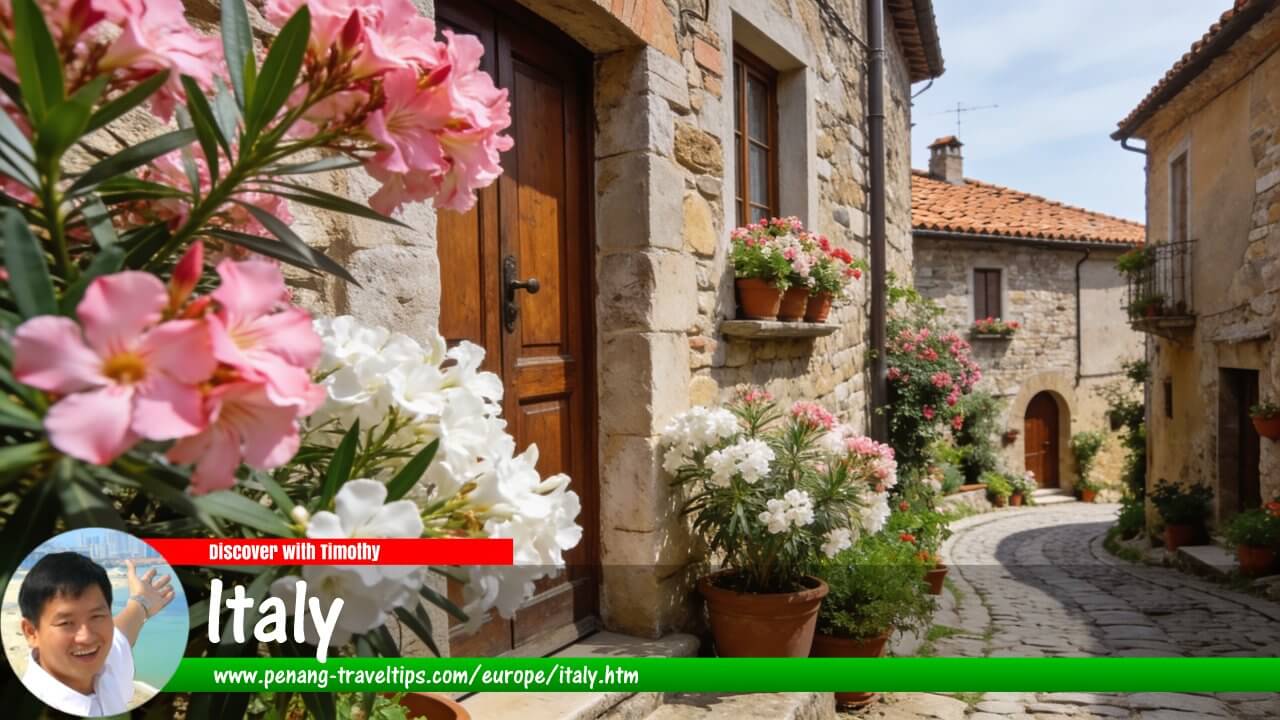 Italy Travel Guide (AI Image generated on 2 September 2026)
Also available: Panduan Melawat Itali
Italy is one of Europe's most popular travel destinations, renowned for its ancient history, Renaissance art, spectacular architecture, beautiful landscapes, world-famous cuisine and distinctive regional cultures. From the ancient monuments of Rome and the canals of Venice to the art treasures of Florence, the rolling hills of Tuscany and the dramatic Amalfi Coast, Italy offers an extraordinary variety of experiences within a relatively compact country.
Overview of Italy
Italy is a country in southern Europe occupying a long peninsula that extends into the Mediterranean Sea. Its distinctive boot-shaped mainland is surrounded by several seas, while the large islands of Sicily and Sardinia form important parts of the country. Italy also has numerous smaller islands, particularly around Sicily, Sardinia and the Tuscan Archipelago.
The country has a population of around 59 million people and is divided into 20 administrative regions. Its capital and largest city is Rome, which is also one of the world's great historic cities. Other major cities include Milan, Naples, Turin, Palermo, Genoa, Bologna, Florence and Venice.
Italy shares land borders with France, Switzerland, Austria and Slovenia. Two independent states, Vatican City and San Marino, are completely surrounded by Italian territory.
Geography of Italy
Italy's geography is remarkably varied. The northern part of the country is dominated by the Alps, which form a natural boundary with France, Switzerland, Austria and Slovenia. South of the Alps lies the broad Po Valley, one of Europe's important agricultural and industrial regions.
The Apennine Mountains run down much of the length of the Italian peninsula, creating a mountainous backbone between the western and eastern sides of the country. The landscape becomes increasingly Mediterranean towards the south, with vineyards, olive groves, citrus plantations and coastal areas.
Italy has a long coastline along the Mediterranean and its associated seas. Popular coastal areas include the Ligurian Riviera, the Amalfi Coast, Puglia, Calabria, Sicily and Sardinia. The country also contains several major lakes, including Lake Garda, Lake Como and Lake Maggiore.
Major Cities in Italy
Rome
Rome is the capital of Italy and one of the world's most historically significant cities. Its attractions include the Colosseum, Roman Forum, Pantheon, Trevi Fountain, Piazza Navona and Vatican City. Rome combines ancient Roman monuments with Renaissance and Baroque churches, museums, fountains and lively neighbourhoods.
Venice
Venice is famous for its canals, bridges, historic palaces and unusual location across a group of islands in a lagoon. St Mark's Square, St Mark's Basilica, the Doge's Palace and the Grand Canal are among its best-known sights. The city is also an important gateway to the Venetian Lagoon and nearby islands such as Murano and Burano.
Florence
Florence is regarded as the birthplace of the Renaissance and is one of Italy's most important centres of art and architecture. The city is associated with artists such as Michelangelo, Leonardo da Vinci and Botticelli. Major attractions include the Cathedral of Santa Maria del Fiore, the Uffizi Gallery, Ponte Vecchio and Palazzo Vecchio.
Milan
Milan is Italy's leading commercial and financial centre and is particularly famous for fashion, design and shopping. Its landmarks include the magnificent Milan Cathedral, Galleria Vittorio Emanuele II and La Scala opera house. Milan is also a convenient base for exploring northern Italy and the Italian Alps.
Naples
Naples is the largest city in southern Italy and a major cultural centre. It is known for its historic centre, lively street life and proximity to Mount Vesuvius, Pompeii and the islands of Capri and Ischia. Naples is also closely associated with the development of modern pizza.
Bologna
Bologna is an important university city and one of Italy's great food destinations. It is known for its medieval centre, porticoes, historic towers and rich culinary traditions. The city is particularly associated with pasta dishes such as tagliatelle al ragù.
Palermo
Palermo is the capital of Sicily and reflects the island's long history of Greek, Roman, Arab, Norman, Spanish and Italian influences. Its historic buildings, markets, churches and cuisine reveal the cultural diversity of Sicily.
Regions of Italy
Italy is divided into 20 regions, each with its own character, traditions and cuisine. The regions are particularly important to travellers because Italian culture and food vary considerably from one part of the country to another.
- Lazio – home to Rome and many important ancient and religious sites.
- Tuscany – famous for Florence, Siena, vineyards, Renaissance art and rolling countryside.
- Veneto – home to Venice, Verona and the Dolomites.
- Lombardy – centred on Milan and including the Italian Lakes and part of the Alps.
- Campania – home to Naples, Pompeii, the Amalfi Coast and Capri.
- Liguria – known for Genoa, the Italian Riviera and Cinque Terre.
- Emilia-Romagna – renowned for Bologna and some of Italy's most celebrated foods.
- Piedmont – known for Turin, Alpine scenery, wine and truffles.
- Umbria – a landlocked region with medieval hill towns and religious heritage.
- Puglia – famous for its Adriatic and Ionian coasts, olive groves and distinctive trulli houses.
- Sicily – Italy's largest island, with ancient ruins, beaches, Mount Etna and distinctive cuisine.
- Sardinia – known for beaches, rugged landscapes and Mediterranean culture.
Brief History of Italy
Italy has one of the world's richest historical traditions. The Italian peninsula was home to several ancient peoples before becoming the centre of the Roman Empire. Rome eventually developed into a vast empire whose political, legal, architectural and cultural influence extended across much of Europe, North Africa and the Middle East.
After the fall of the Western Roman Empire, the Italian peninsula was divided among different kingdoms, city-states and political powers. During the Middle Ages, cities such as Venice, Florence and Genoa became wealthy centres of commerce and international trade.
Italy became a major centre of the Renaissance from the 14th century onwards. Florence in particular played a crucial role in the development of Renaissance art, architecture, literature and scholarship. The cultural achievements of this period left an extraordinary legacy that can still be seen throughout Italy.
For centuries, the peninsula remained politically fragmented. The modern Kingdom of Italy was established in 1861 through the process known as Italian unification, or the Risorgimento. Rome became the capital in 1871.
Italy experienced significant political and social upheaval during the 20th century, including Fascist rule under Benito Mussolini, participation in the Second World War and the establishment of the Italian Republic in 1946. Modern Italy is a parliamentary republic and a member of the European Union.
Italy's Cultural Heritage
Italy possesses an extraordinary concentration of cultural heritage. Ancient Roman ruins, medieval towns, Renaissance masterpieces, Baroque churches, historic palaces and archaeological sites can be found throughout the country.
Italian cities and landscapes have also played a major role in the development of Western art, architecture, music, literature and science. Visitors can encounter the work of artists and architects such as Michelangelo, Leonardo da Vinci, Raphael, Caravaggio, Bernini and Andrea Palladio in museums, churches and public buildings.
Italy's heritage is not limited to famous monuments. Traditional villages, historic town centres, regional festivals, handicrafts, food traditions and local customs form an important part of the country's cultural identity.
Italy as a Travel Destination
Italy appeals to a remarkably wide range of travellers. History enthusiasts can explore ancient Roman and archaeological sites, while art lovers can visit some of the world's greatest museums and galleries. Food lovers can experience highly distinctive regional cuisines, and nature enthusiasts can explore the Alps, lakes, mountains, countryside and Mediterranean islands.
Italy is also well suited to travellers interested in architecture, fashion, shopping, wine, beaches and religious heritage. Because the country has such a dense concentration of attractions, it is possible to combine several different types of experience in a single trip.
For first-time visitors, Rome, Florence and Venice form one of the classic Italian itineraries. Travellers with more time can add Milan, Naples, Tuscany, the Amalfi Coast, Sicily, Sardinia or other regions according to their interests.
Planning a Trip to Italy
Italy is relatively easy to explore, particularly because its major cities are connected by an extensive railway network. High-speed trains make it possible to travel between cities such as Rome, Florence, Bologna, Milan and Naples much faster than would have been possible in the past.
However, Italy's attractions are spread across a large geographical area. Travellers should therefore avoid trying to see too much in a short period. Spending several days in one city or region often provides a more rewarding experience than constantly moving from one destination to another.
The ideal itinerary depends on the season, length of stay and interests of the traveller. A first visit might concentrate on Rome, Florence and Venice, while a longer trip can explore Tuscany, southern Italy, the Italian Lakes or the islands.
Italy for Malaysian Travellers
For travellers from Malaysia, Italy offers an appealing combination of European history, architecture, art, food and scenery. Malaysians should take into account the length of the journey to Europe, the season of travel and the amount of walking involved in many Italian cities.
Muslim travellers can also find halal food and mosques or prayer facilities in several major Italian cities, particularly in areas with larger Muslim communities. However, availability varies considerably between cities and smaller towns, so it is useful to plan ahead.
Italian food is diverse enough that travellers with dietary restrictions can usually find suitable alternatives, although it is advisable to communicate dietary requirements clearly when eating outside major tourist centres.
Why Visit Italy?
Italy's greatest strength as a destination is its extraordinary variety. Within the same country, travellers can walk among ancient Roman ruins, admire Renaissance masterpieces, cruise through Venetian canals, relax beside Alpine lakes, explore medieval hill towns and enjoy Mediterranean beaches.
Its regional diversity also means that Italy rewards repeat visits. Rome is very different from Venice, Tuscany differs greatly from Sicily, and northern Italian cuisine can be quite different from the food found in Naples or Puglia.
Whether the goal is to explore history, admire art, enjoy food, experience Italian city life or simply enjoy beautiful scenery, Italy provides an exceptional range of travel experiences.
History and Cultural Heritage of Italy
Italy has a history stretching back thousands of years, with successive civilisations leaving their mark on the peninsula. Ancient peoples, the Roman Empire, medieval city-states, the Renaissance, foreign powers and the modern Italian state have all contributed to the country's rich cultural landscape.
Ancient Italy
Before the rise of Rome, the Italian peninsula was inhabited by many different peoples. Among the most influential were the Etruscans, who established a sophisticated civilisation in central Italy. Greek settlers also established numerous colonies in southern Italy and Sicily, a region later known as Magna Graecia.
The city of Rome began as a settlement on the Tiber River and gradually developed into a powerful state. According to traditional Roman accounts, Rome was founded in 753 BC. The Roman Republic eventually expanded across the Italian peninsula before becoming the foundation of a vast Mediterranean empire.
The Roman Empire
Rome is the heart of Italy's ancient heritage. At its height, the Roman Empire controlled territories extending across much of Europe, North Africa and the Middle East. Roman roads, aqueducts, amphitheatres, temples, forums and administrative systems left a lasting influence on European civilisation.
The Colosseum, Roman Forum, Pantheon and remains of the ancient city can still be visited in Rome. Elsewhere in Italy, important Roman archaeological sites include Pompeii, Herculaneum, Ostia Antica and Verona.
Roman influence can also be seen in the layout and remains of many Italian towns. The Latin language used by the Romans eventually developed into Italian and several other Romance languages.
The Fall of Rome
The Western Roman Empire gradually weakened under political, economic and military pressures and formally came to an end in AD 476. Italy subsequently became divided among different rulers and political powers.
The peninsula experienced invasions and migrations involving peoples such as the Ostrogoths and Lombards. The Byzantine Empire also retained control over parts of Italy for several centuries, while the Papacy became an increasingly important political and cultural force in central Italy.
Medieval Italy
During the Middle Ages, Italy was not a unified country. Instead, it consisted of kingdoms, duchies, republics, papal territories and independent city-states. This political fragmentation helped create strong local identities that remain evident today.
Several Italian cities became major centres of commerce and maritime trade. Venice, Genoa, Pisa and Amalfi developed powerful trading networks across the Mediterranean and beyond. Venice in particular became a major commercial and naval power.
In central and northern Italy, cities such as Florence, Siena, Milan and Bologna became important centres of banking, education, manufacturing and political activity. Their rivalry contributed to the construction of many of the historic buildings and monuments that attract visitors today.
The Renaissance
Italy played a central role in the Renaissance, a period of artistic, intellectual and scientific development that began in the late Middle Ages and flourished from the 14th to the 16th centuries.
Florence was one of the most important centres of the Renaissance. Wealthy families, particularly the Medici, supported artists, architects, writers and scholars. The city became associated with figures such as Michelangelo, Leonardo da Vinci and Botticelli.
Renaissance architecture and art subsequently spread to Rome, Venice, Milan and other Italian cities. Visitors today can see masterpieces of the period in churches, palaces, museums and public squares throughout the country.
Renaissance Art and Architecture
Renaissance artists placed greater emphasis on realism, perspective, human anatomy and the study of classical Greek and Roman culture. Italian artists produced some of the most influential paintings and sculptures in European history.
Leonardo da Vinci was an artist, inventor and scholar whose works include the Mona Lisa and The Last Supper. Michelangelo created celebrated sculptures such as David and painted the ceiling of the Sistine Chapel in Vatican City.
Architects of the Renaissance developed new approaches to proportion, symmetry and classical forms. The Cathedral of Santa Maria del Fiore in Florence, with its enormous dome designed by Filippo Brunelleschi, is one of the most famous examples.
Venice and the Maritime Republics
Venice developed into one of Europe's most powerful maritime republics. Its location in the Venetian Lagoon helped it establish an extensive trading empire linking Europe with the eastern Mediterranean.
The city's wealth financed magnificent churches, palaces and public buildings. St Mark's Basilica, the Doge's Palace and the Grand Canal reflect the city's historical importance and its connections with Byzantine, Islamic and European artistic traditions.
Other maritime republics, particularly Genoa, also became important commercial powers. Their activities helped connect Italian ports with markets throughout the Mediterranean.
The Papal States and Vatican City
The Roman Catholic Church has played a major role in the history and culture of Italy. For centuries, the Pope ruled territories in central Italy known as the Papal States.
Today, Vatican City is an independent sovereign state surrounded by Rome. It is the headquarters of the Roman Catholic Church and the residence of the Pope. St Peter's Basilica, the Vatican Museums and the Sistine Chapel make Vatican City one of the world's most important destinations for religious and cultural tourism.
Foreign Rule and Political Fragmentation
For centuries, different parts of Italy came under the influence or direct control of foreign powers. France, Spain, Austria and other European states competed for influence over Italian territories.
Despite political division, Italian-speaking communities shared many cultural traditions. Literature, art, music and intellectual movements gradually contributed to the idea of a unified Italian nation.
Italian Unification
The movement to unite the Italian states became known as the Risorgimento. During the 19th century, political leaders and military figures worked to bring the various territories together.
Giuseppe Garibaldi, Count Camillo di Cavour and King Victor Emmanuel II were among the prominent figures associated with Italian unification. The Kingdom of Italy was proclaimed in 1861, although some territories were incorporated later.
Rome became the capital of unified Italy in 1871. The creation of the Italian state transformed the political map of the peninsula while leaving its strong regional identities largely intact.
Italy in the 20th Century
Italy experienced major political and social changes during the 20th century. The country fought on the Allied side during the First World War, but the post-war period was marked by economic difficulties and political instability.
Benito Mussolini and the Fascist movement came to power in the 1920s. Mussolini established an authoritarian regime that lasted until the final stages of the Second World War.
Italy entered the Second World War as an ally of Germany but later changed sides after Mussolini was removed from power in 1943. Fighting continued in Italy until the end of the war.
The Italian Republic
Following the Second World War, Italians voted in a referendum in 1946 to abolish the monarchy and establish a republic. The modern Italian Republic was subsequently formed.
The post-war period brought rapid economic development and industrialisation. Northern cities such as Milan, Turin and Genoa became major industrial centres, while southern Italy developed along a different economic path.
Italy became a founding member of the European Economic Community in 1957 and has remained an important participant in European integration. It is now a member of the European Union and uses the euro as its currency.
Italian Language and Regional Identity
Italian is the official language of Italy, but the country's linguistic heritage is highly diverse. Regional languages and dialects developed over centuries when Italy was politically fragmented.
Some recognised minority languages include German in parts of South Tyrol, French in the Aosta Valley, Slovene in parts of northeastern Italy and several other historic minority languages.
Regional identity remains particularly strong. Italians may identify closely with their city, province or region, and differences can be seen in accents, cuisine, festivals, architecture and traditions.
Italian Food Heritage
Food is an essential part of Italian cultural identity. Italian cuisine is not a single uniform tradition but a collection of highly distinctive regional cuisines.
Northern Italy is known for foods such as risotto, polenta and fresh egg pasta, while central Italy is associated with dishes such as Tuscan soups, Florentine steak and Roman pasta. Southern Italy is famous for tomatoes, olive oil, seafood and pasta, while Sicily has a distinctive cuisine influenced by its long history of contact with Mediterranean cultures.
Pizza developed in Naples into the form that became internationally famous, while pasta exists in an enormous variety of shapes, preparations and regional traditions. Cheese, cured meats, vegetables, seafood and locally produced wines also form important parts of Italian food culture.
Italian Art, Music and Literature
Italy's cultural influence extends well beyond painting and architecture. Italian composers played a central role in the development of opera, with figures such as Giuseppe Verdi and Giacomo Puccini becoming internationally renowned.
Italian literature has also had a profound influence on European culture. Dante Alighieri, Francesco Petrarch and Giovanni Boccaccio were among the great writers of the late medieval and early Renaissance periods.
Italian design continues to have a global reputation, particularly in fashion, furniture, automobiles and architecture. Milan is one of the world's major fashion capitals, while cities throughout the country maintain distinctive traditions of craftsmanship.
Italy's World Heritage
Italy contains an exceptional concentration of cultural and natural heritage sites recognised internationally. Historic city centres, archaeological sites, religious monuments, villas, landscapes and mountain areas are represented among the country's heritage attractions.
Among the best-known heritage destinations are the historic centre of Rome, the historic centre of Florence, Venice and its lagoon, the archaeological areas of Pompeii and the Amalfi Coast. These sites demonstrate the extraordinary range of Italy's historical and cultural legacy.
A Living Cultural Heritage
Italy's heritage is not confined to museums and archaeological ruins. It remains part of everyday life through local food, religious celebrations, traditional crafts, music, family customs and regional festivals.
For travellers, this means that experiencing Italy involves more than visiting famous monuments. Wandering through a historic neighbourhood, eating at a local restaurant, visiting a market or attending a regional festival can provide an equally valuable insight into Italian culture.
The combination of ancient history, regional diversity and living traditions is one of the main reasons Italy remains such a compelling destination for travellers from around the world.
Major Attractions and Destinations in Italy
Italy offers an extraordinary concentration of attractions, ranging from ancient Roman monuments and Renaissance masterpieces to medieval towns, mountain landscapes, picturesque lakes and Mediterranean islands. Its major destinations are spread across the country, allowing travellers to choose between historic cities, countryside, coastlines and cultural experiences.
Rome
Rome is the natural starting point for many first-time visitors to Italy. The city contains an extraordinary collection of ancient, Renaissance and Baroque landmarks, many of which can be reached on foot from the historic centre.
Colosseum
The Colosseum is Rome's most recognisable ancient monument. This enormous amphitheatre was built during the Roman imperial period and was used for public spectacles. Visitors can explore the arena and parts of the underground and upper levels while learning about ancient Roman society.
Roman Forum
The Roman Forum was the political, religious and commercial centre of ancient Rome. Its surviving temples, basilicas, arches and columns provide an impressive glimpse into the heart of Roman civilisation.
Pantheon
The Pantheon is one of the best-preserved ancient Roman buildings. Its enormous concrete dome and central opening, known as the oculus, remain remarkable examples of Roman engineering.
Trevi Fountain
The Trevi Fountain is one of Rome's most famous Baroque landmarks. The monumental fountain is particularly atmospheric when illuminated at night, although it can become extremely crowded during the day.
Vatican City
Vatican City, an independent state surrounded by Rome, contains some of the world's most important religious and artistic treasures. Major attractions include St Peter's Basilica, the Vatican Museums and the Sistine Chapel.
Venice
Venice is one of the world's most distinctive cities, built across islands in a lagoon and connected by bridges and waterways. Its historic centre is best explored on foot, with boats providing an alternative way to move around.
St Mark's Square
St Mark's Square is the symbolic centre of Venice. It is surrounded by important landmarks including St Mark's Basilica, the Doge's Palace and the Campanile.
St Mark's Basilica
St Mark's Basilica is renowned for its Byzantine-influenced architecture, mosaics and elaborate decoration. Its appearance reflects Venice's historic connections with the eastern Mediterranean.
Doge's Palace
The Doge's Palace was the centre of political power in the Venetian Republic. Visitors can explore its grand halls, courtyards and historic prison areas, including the famous Bridge of Sighs.
Grand Canal
The Grand Canal forms the principal waterway through Venice. Historic palaces line its banks, and travelling along the canal by vaporetto provides one of the best ways to appreciate the city's architecture.
Murano and Burano
The nearby islands of Murano and Burano are popular excursions from Venice. Murano is famous for glassmaking, while Burano is known for brightly coloured houses and traditional lace-making.
Florence
Florence is one of Italy's great art cities and a central destination for anyone interested in the Renaissance. Many of its major attractions are concentrated around the historic centre.
Florence Cathedral
The Cathedral of Santa Maria del Fiore, commonly called the Duomo, is one of Florence's most recognisable landmarks. Its enormous dome, designed by Filippo Brunelleschi, dominates the city skyline.
Uffizi Gallery
The Uffizi Gallery contains one of the world's most important collections of Renaissance art. Works associated with Botticelli, Leonardo da Vinci, Michelangelo and Raphael are among its highlights.
Ponte Vecchio
The Ponte Vecchio is Florence's famous medieval bridge crossing the Arno River. Shops have occupied the bridge for centuries, and today it is particularly associated with jewellery and luxury goods.
Accademia Gallery
The Accademia Gallery is best known for Michelangelo's David. The sculpture is one of the most celebrated works of Renaissance art.
Tuscany
Tuscany is famous for its countryside, vineyards, olive groves, medieval towns and Renaissance heritage. It is an excellent region for travellers who want to experience Italy beyond the major cities.
Siena
Siena is a historic hill city known for its medieval architecture and the distinctive Piazza del Campo. The city hosts the famous Palio horse race, a traditional event held in the main square.
San Gimignano
San Gimignano is a picturesque medieval town recognised for its historic towers. Its compact centre makes it particularly suitable for exploring on foot.
Pisa
Pisa is famous for the Leaning Tower of Pisa, which forms part of the Piazza dei Miracoli. The complex also contains Pisa Cathedral and the Baptistery.
Milan
Milan combines historic architecture with modern Italian fashion, design and commerce. It is one of the country's most important cities and a useful base for exploring northern Italy.
Milan Cathedral
The Duomo di Milano is one of the largest and most elaborate Gothic cathedrals in Europe. Visitors can also access its rooftop terraces for views across the city.
Galleria Vittorio Emanuele II
The Galleria Vittorio Emanuele II is a magnificent 19th-century shopping arcade near the cathedral. Its glass roof, mosaics and elegant architecture make it an attraction in its own right.
La Scala
La Scala is one of the world's most famous opera houses. Even visitors who do not attend a performance can explore its museum and learn about the history of Italian opera.
Naples and Campania
Naples is a lively southern Italian city with a distinctive character and deep historical roots. It is also an important gateway to several of Italy's most famous archaeological and coastal attractions.
Historic Centre of Naples
The historic centre is filled with narrow streets, churches, palaces, small shops and traditional restaurants. Walking through the old city provides a very different experience from the more formal atmosphere of northern Italian cities.
Pompeii
Pompeii is one of the world's most remarkable archaeological sites. The Roman city was buried by the eruption of Mount Vesuvius in AD 79, preserving streets, houses, shops, public buildings and wall paintings.
Herculaneum
Herculaneum was another Roman town affected by the eruption of Mount Vesuvius. Although smaller than Pompeii, it is exceptionally well preserved and provides another perspective on Roman urban life.
Mount Vesuvius
Mount Vesuvius dominates the landscape around Naples. Visitors can hike towards the crater and enjoy views over the Bay of Naples and surrounding countryside.
Amalfi Coast
The Amalfi Coast is renowned for its dramatic cliffs, colourful villages and Mediterranean scenery. The coastal road passes through towns and villages including Positano, Amalfi and Ravello.
Positano
Positano is famous for its steeply stacked houses descending towards the sea. Its narrow lanes, shops, restaurants and beaches make it one of the coast's most popular destinations.
Amalfi
Amalfi was once a powerful maritime republic. Today, its historic cathedral and compact old town provide a convenient base for exploring the coast.
Ravello
Ravello sits high above the coast and is known for its gardens and panoramic views. Villa Rufolo and Villa Cimbrone are among its best-known attractions.
Verona
Verona is a historic city in northern Italy associated with Shakespeare's Romeo and Juliet. Its Roman arena, medieval centre and attractive squares make it a popular destination between Venice and Milan.
Verona Arena
The Verona Arena is a remarkably preserved Roman amphitheatre that is still used for large-scale performances, particularly opera.
Bologna
Bologna is known for its medieval architecture, historic university and culinary traditions. The city is characterised by extensive covered porticoes, making it pleasant to explore even in wet weather.
Piazza Maggiore
Piazza Maggiore is the principal square of Bologna and is surrounded by important historic buildings, including the Basilica of San Petronio.
Two Towers
The Two Towers, known as the Torre degli Asinelli and Torre Garisenda, are among Bologna's most recognisable medieval landmarks.
Italian Lakes
Northern Italy contains several spectacular lakes surrounded by mountains, villages and historic villas. They are particularly attractive during spring, summer and early autumn.
Lake Como
Lake Como is famous for its dramatic Alpine scenery, elegant lakeside towns and historic villas. Como, Bellagio, Varenna and Menaggio are among the best-known places to visit.
Lake Garda
Lake Garda is Italy's largest lake. It offers a combination of mountain scenery, beaches, historic towns and outdoor activities.
Lake Maggiore
Lake Maggiore extends across northern Italy and into Switzerland. The Borromean Islands and the lakeside town of Stresa are among its principal attractions.
Dolomites
The Dolomites are a spectacular mountain range in northeastern Italy, known for their distinctive pale rock formations and dramatic peaks. The region offers hiking, climbing and winter sports, as well as scenic mountain roads and villages.
The Dolomites are particularly attractive to travellers seeking outdoor activities and landscapes that contrast sharply with Italy's historic cities.
Puglia
Puglia, occupying the heel of Italy's boot, is known for its Adriatic and Ionian coastlines, olive groves, whitewashed towns and traditional architecture.
Alberobello
Alberobello is famous for its distinctive trulli, traditional stone houses with conical roofs. The unusual architecture makes the town one of southern Italy's most recognisable destinations.
Lecce
Lecce is renowned for its elaborate Baroque architecture and is sometimes described as the Baroque capital of southern Italy.
Sicily
Sicily is Italy's largest island and offers an extraordinary mixture of ancient history, Mediterranean scenery, volcanic landscapes and distinctive cuisine.
Palermo
Palermo is Sicily's capital and contains monuments reflecting Arab, Norman, Byzantine and Italian influences.
Mount Etna
Mount Etna is Europe's highest active volcano and one of Sicily's defining natural landmarks. Visitors can explore parts of the volcanic landscape through guided excursions and hiking routes.
Taormina
Taormina is a picturesque hill town overlooking the Ionian Sea. Its ancient Greek theatre provides spectacular views towards Mount Etna and the coastline.
Valley of the Temples
The Valley of the Temples near Agrigento contains an impressive collection of ancient Greek temples and is one of Sicily's most important archaeological attractions.
Sardinia
Sardinia is known for its clear Mediterranean waters, sandy beaches, rugged interior and distinctive local traditions. The island is particularly attractive to travellers seeking a combination of beaches, nature and cultural exploration.
Italian Islands and Coastal Destinations
Beyond Sicily and Sardinia, Italy has many smaller islands and coastal areas worth exploring. Capri, Ischia, Elba, the Aeolian Islands and the Tremiti Islands each offer different landscapes and experiences.
Capri is famous for its dramatic coastline, luxury resorts and Blue Grotto. The island is easily reached by boat from Naples and the Sorrento area.
Choosing Italian Attractions by Interest
- Ancient history: Rome, Pompeii, Herculaneum and Sicily.
- Renaissance art: Florence, Rome and Milan.
- Romantic scenery: Venice, Lake Como, Tuscany and the Amalfi Coast.
- Food: Bologna, Naples, Sicily, Emilia-Romagna and Tuscany.
- Mountains: The Dolomites and Italian Alps.
- Beaches: Sardinia, Sicily, Puglia and the Italian Riviera.
- Architecture: Rome, Florence, Venice, Milan, Bologna and Puglia.
- Small historic towns: Tuscany, Umbria, Puglia and Sicily.
With so many attractions distributed across different regions, travellers should choose destinations according to the time available rather than attempting to cover the whole country in a single trip. Italy rewards slower travel, allowing visitors to appreciate not only its famous landmarks but also its neighbourhoods, food, landscapes and local way of life.
Food and Dining in Italy
Italian cuisine is among the world's most widely recognised culinary traditions, but there is no single style of food that represents the whole country. Italian cooking is strongly regional, with local ingredients, recipes and traditions differing considerably from one part of Italy to another. Travelling through the country therefore provides an opportunity to experience many different cuisines rather than simply one national menu.
Italian Food Culture
Food plays an important role in Italian family and social life. Meals are often enjoyed slowly, particularly when dining with family or friends. Traditional Italian meals may consist of several courses, although visitors are not expected to order every course.
A traditional meal may begin with an antipasto, followed by a primo such as pasta, risotto or soup. A secondo may consist of meat or fish, accompanied by a contorno, or side dish. Dessert, fruit or cheese may follow, with coffee commonly served towards the end of the meal.
Pizza
Pizza is one of Italy's most famous culinary exports. Although pizza is now prepared in countless styles around the world, Naples is particularly associated with the traditional Italian form.
Neapolitan pizza is characterised by a soft, elastic dough and a relatively thin centre with a raised edge. Classic varieties include Pizza Margherita, made with tomato, mozzarella and basil, and Pizza Marinara, traditionally prepared with tomato, garlic, oregano and olive oil.
Pizza styles vary across Italy. Roman pizza may have a thinner and crispier base, while other regions have their own distinctive approaches to dough, toppings and preparation.
Pasta
Pasta is another fundamental part of Italian cuisine. Italy has hundreds of pasta shapes and countless regional preparations. The same ingredients may be combined in very different ways depending on where they are prepared.
Well-known dishes include spaghetti alla carbonara from Rome, ragù alla bolognese associated with Bologna, pesto alla Genovese from Liguria and pasta alla Norma from Sicily.
Fresh egg pasta is particularly associated with parts of northern and central Italy, while dried durum-wheat pasta is especially common throughout the south.
Risotto
Risotto is especially associated with northern Italy, where rice cultivation has long been important. The dish is prepared by gradually adding liquid to rice while stirring, producing a creamy consistency.
Risotto alla Milanese, traditionally flavoured with saffron, is one of the best-known versions. Other varieties may include mushrooms, seafood, vegetables or regional cheeses.
Italian Bread and Baked Goods
Bread is an important part of Italian food culture, and different regions have their own varieties. Tuscan bread is traditionally made without salt, while focaccia from Liguria is known for its olive-oil-rich dough.
Visitors will encounter many types of bread in bakeries, markets and restaurants. Italian bakeries also offer savoury pastries, biscuits, cakes and regional baked specialities.
Cheese
Italy produces an enormous variety of cheeses. Some are fresh and soft, while others are aged and intensely flavoured.
Parmigiano Reggiano, mozzarella, Gorgonzola, Pecorino Romano and Grana Padano are among the best-known Italian cheeses. Cheese may be served as part of an antipasto, used in cooking or eaten towards the end of a meal.
Cured Meats
Cured meat products are common in many parts of Italy. Prosciutto, salami, mortadella and various regional cured meats are frequently served as antipasti or included in sandwiches and other dishes.
Because many traditional Italian cured meats are made from pork, travellers who do not eat pork should check ingredients carefully. Restaurants may be able to provide alternatives, particularly in larger cities.
Seafood
With its extensive coastline, Italy has a rich seafood tradition. Fish, squid, octopus, mussels, clams, prawns and other seafood feature prominently in coastal cuisines.
Seafood dishes are particularly common in Sicily, Sardinia, Liguria, Campania and other coastal regions. The preparation varies from simple grilled fish to elaborate pasta and rice dishes.
Meat Dishes
Meat is used extensively in many regional Italian cuisines. Beef, veal, chicken and other meats appear in dishes ranging from simple grilled preparations to elaborate stews.
Bistecca alla Fiorentina, a large grilled Tuscan steak, is one of Florence's best-known specialities. In northern Italy, dishes such as ossobuco are associated with Milan.
Vegetables and Olive Oil
Vegetables are central to many Italian dishes, particularly in southern and Mediterranean regions. Tomatoes, aubergines, courgettes, peppers, artichokes, leafy greens and legumes are widely used.
Extra virgin olive oil is an important ingredient throughout much of Italy. It is used for cooking, dressing salads, finishing dishes and serving with bread.
Italian Desserts
Italy has a wide range of desserts and sweet foods, many of which have strong regional associations.
- Tiramisu – a layered dessert made with coffee-soaked biscuits, mascarpone and cocoa.
- Panna cotta – a chilled dessert made primarily from cream, traditionally associated with northern Italy.
- Cannoli – crisp pastry tubes filled with sweetened ricotta, strongly associated with Sicily.
- Gelato – Italian-style frozen dessert available in a wide range of flavours.
- Panettone – a sweet enriched bread traditionally associated with Milan and Christmas.
- Cantucci – traditional Tuscan almond biscuits often served with a sweet wine.
Gelato
Gelato is one of Italy's most popular treats. Although the word is often used internationally for any Italian-style ice cream, traditional gelato generally has a denser texture and is served at a somewhat warmer temperature than conventional ice cream.
Gelaterias can be found throughout Italian cities and towns. Visitors will encounter both classic flavours such as pistachio, hazelnut and chocolate and seasonal fruit varieties.
Coffee in Italy
Coffee is deeply embedded in Italian daily life. Espresso is commonly ordered simply as un caffè, while cappuccino, caffè latte and other milk-based drinks are also widely available.
Italian coffee culture can be quite different from the café culture found in some other countries. Many Italians drink espresso quickly at the counter, while sitting at a café may involve an additional service charge in some establishments.
Cappuccino and other milk-based coffees are traditionally associated with breakfast, although visitors can order them at any time. There is no strict rule preventing this, but ordering a large milk-based coffee after a heavy meal is less typical of Italian dining culture.
Regional Italian Cuisine
Northern Italy
Northern Italian cuisine tends to make greater use of butter, rice, polenta, cream and certain Alpine cheeses, although olive oil is also widely used. Risotto, polenta, fresh pasta and hearty meat dishes are common.
Central Italy
Central Italian cuisine includes the food traditions of Tuscany, Umbria, Lazio and neighbouring areas. Pasta, olive oil, vegetables, beans, grilled meats and pecorino cheeses feature prominently.
Southern Italy
Southern Italian cuisine generally reflects the Mediterranean climate and extensive use of tomatoes, olive oil, vegetables, seafood and dried pasta. Naples, Puglia, Calabria and Basilicata each have their own culinary traditions.
Sicily
Sicilian cuisine reflects centuries of contact between Mediterranean civilisations. Citrus fruits, aubergines, seafood, pistachios, almonds and sweet-and-sour flavours are common. Arab, Greek, Roman, Norman and other influences can be seen in the island's food traditions.
Sardinia
Sardinian cuisine includes distinctive breads, cheeses, pasta, seafood and meat dishes. The island's food traditions developed in relative isolation and therefore differ in interesting ways from mainland Italian cuisine.
Markets and Food Halls
Italian markets are excellent places to experience local food culture. Fresh produce, cheese, bread, meat, seafood and regional specialities are commonly sold in traditional markets.
Major cities also have modern food halls and covered markets where visitors can sample several types of food in one location. Markets can be particularly useful for travellers looking for inexpensive meals or regional ingredients.
Dining in Italian Restaurants
Italian restaurants range from informal pizzerias and family-run trattorie to elegant restaurants and fine-dining establishments. A bar in Italy may also function as a café where customers can order coffee, pastries, sandwiches and light meals.
Meal times may differ from those familiar to Malaysian travellers. Lunch is commonly taken around midday to early afternoon, while dinner often begins later in the evening. In tourist areas, however, restaurants may accommodate a wider range of dining hours.
Halal Food in Italy
Muslim travellers can find halal food in Italy, particularly in larger cities such as Rome, Milan, Turin, Bologna and Florence. Availability is generally greater in neighbourhoods with established Muslim communities and around major transport hubs.
Halal restaurants may serve Middle Eastern, North African, South Asian, Turkish or other cuisines rather than traditional Italian food. Some Italian restaurants may also offer vegetarian, seafood or other dishes that are suitable for Muslim travellers, but ingredients and cooking methods should be confirmed when halal certification is important.
Travellers should be particularly careful with dishes containing pork, pork-derived ingredients and alcoholic beverages. Traditional Italian cuisine uses pork products extensively in some regions, while wine is also an ingredient in certain recipes.
Muslim-Friendly Dining Tips
- Look for restaurants displaying a recognised halal certification or clearly identifying themselves as halal.
- Ask whether meat is halal and whether it is prepared separately from non-halal meat.
- Check sauces and soups, as some may contain wine or other alcoholic ingredients.
- Vegetarian and seafood dishes can provide additional choices, but should still be checked for ingredients and preparation.
- In smaller towns, plan meals in advance because halal options may be limited.
- Major Italian cities generally offer more international and halal dining choices than rural areas.
Food Experiences to Consider
Travellers who enjoy food can plan their Italian itinerary around regional specialities. Bologna and Emilia-Romagna are particularly rewarding for pasta, cured meats and cheese, Naples for pizza, Tuscany for traditional rural cuisine, Sicily for Mediterranean and island specialities, and northern Italy for risotto and Alpine-influenced dishes.
Food markets, cooking classes, vineyard visits, cheese-making experiences and guided food tours can also provide a deeper understanding of Italian culinary traditions.
One of the pleasures of travelling through Italy is discovering that familiar dishes can taste completely different in their place of origin. Exploring regional food alongside Italy's history, architecture and landscapes makes the culinary experience an important part of any Italian journey.
Getting to and Around Italy
Italy is well connected to the rest of Europe and the world, and its major cities are linked by an extensive network of high-speed trains, conventional railways, buses and roads. For Malaysian travellers, flying is generally the most practical way to reach Italy, while trains are often the most convenient way to travel between major Italian cities.
Getting to Italy by Air
Most international visitors arrive in Italy by air. The country has several major international airports, with Rome, Milan and Venice serving as important gateways.
Rome Fiumicino Airport
Leonardo da Vinci–Fiumicino Airport is the main international airport serving Rome and one of Italy's principal aviation hubs. It is located southwest of the city and is connected to central Rome by train, bus, taxi and road.
Milan Airports
Milan is served primarily by Malpensa Airport, which handles many international flights. Milan also has Linate Airport, which is closer to the city centre and serves a large number of European and domestic routes.
Venice Marco Polo Airport
Venice Marco Polo Airport is the main airport serving Venice. Visitors can reach Venice by road, bus, taxi or water transport. The airport's location on the mainland means that travellers continuing to the historic island city need to make a short onward journey.
Flights from Malaysia
Travellers from Malaysia can reach Italy through connecting flights from Kuala Lumpur International Airport and other regional airports. Depending on the airline and itinerary, connections may be made through major Middle Eastern, Asian or European aviation hubs.
When comparing flights, consider not only the ticket price but also connection time, baggage allowance, arrival airport and the onward transport required to reach the final destination.
Travelling Around Italy by Train
Rail travel is one of the best ways to explore Italy, particularly when travelling between major cities. The railway network connects most major population centres, while high-speed trains dramatically reduce journey times between northern and southern cities.
High-Speed Trains
High-speed trains connect cities such as Turin, Milan, Bologna, Florence, Rome and Naples. These trains are comfortable and usually much faster than conventional services.
Two major operators provide high-speed services. Trenitalia operates its Frecciarossa and other high-speed services, while Italo operates high-speed trains on major routes.
Frecciarossa
Frecciarossa trains are Trenitalia's flagship high-speed services. They operate on major routes including Turin–Milan, Milan–Bologna, Bologna–Florence, Florence–Rome and Rome–Naples.
Italo
Italo is a private high-speed rail operator serving many of the same major cities. Travellers can compare schedules and fares between Italo and Trenitalia when planning journeys.
Regional Trains
Regional trains are useful for shorter journeys and destinations that are not served by high-speed services. They connect cities with surrounding towns and countryside and can be particularly useful when exploring Tuscany, Liguria, the Italian Lakes and other regions.
Buying Train Tickets
Tickets for major high-speed trains can generally be purchased online, through railway applications, at stations or from ticket machines. Advance booking can provide lower fares, particularly on popular long-distance routes.
High-speed trains normally require a specific reservation, while many regional trains operate differently. Travellers should check the ticket conditions carefully, especially regarding seat reservations, changes and refunds.
When using regional trains, pay attention to ticket validation requirements where applicable. Electronic tickets usually follow different procedures from traditional paper tickets.
Travelling by Bus
Long-distance buses provide an alternative to trains, particularly for routes where rail services are less convenient. Several private bus companies operate between Italian cities and between Italy and neighbouring European countries.
Buses can sometimes be cheaper than trains, although journey times are generally longer. They may also be useful for reaching smaller towns that do not have direct railway connections.
Driving in Italy
Driving provides greater flexibility for exploring rural areas, mountain regions and small towns. It can be particularly useful in Tuscany, Umbria, Puglia, Sicily and Sardinia, where attractions may be widely distributed.
Cars are less useful in the historic centres of major cities. Rome, Florence, Venice and other popular destinations can have restricted traffic zones, narrow streets, expensive parking and heavy congestion.
Driving on the Right
Italy drives on the right-hand side of the road. Drivers from Malaysia, where vehicles drive on the left, should take particular care when adapting to Italian road conditions.
International Driving Permit
Malaysian travellers planning to drive should check the current requirements for an International Driving Permit, as well as the requirements of their rental company and insurance provider, before travelling.
Motorways
Italy has an extensive motorway network, known as the autostrada. Many motorways are toll roads. Toll payments can be made using various payment methods, and travellers should ensure that they enter the appropriate lane when approaching a toll station.
Restricted Traffic Zones
Many historic Italian cities operate Zona a Traffico Limitato, or ZTL, areas where vehicle access is restricted. Entering a restricted zone without authorisation can result in a fine, sometimes issued to rental-car drivers after they have returned home.
Travellers should check their accommodation's location before driving into a historic city centre and follow the instructions provided by the hotel or accommodation provider.
Public Transportation in Italian Cities
Rome
Rome has a public transport system consisting of metro, buses, trams and urban railway services. The metro is particularly useful for reaching attractions that are some distance from the historic centre, although many central sights are best explored on foot.
Milan
Milan has an extensive metro system complemented by trams and buses. Public transportation makes it relatively easy to travel between the central railway station, shopping districts, museums and other attractions.
Florence
Much of central Florence can be explored on foot. Buses and trams are useful for destinations outside the compact historic centre, while walking is often the most enjoyable way to see the central streets and squares.
Venice
Venice has no conventional road network within its historic island centre. Visitors primarily walk or use vaporetti, the city's public water buses.
Water taxis are also available but are considerably more expensive than public water transport. Travellers should choose between walking, vaporetti and water taxis according to their budget and luggage.
Naples
Naples has metro, buses, trams and funicular railways. The city's public transport network can be useful for reaching neighbourhoods and attractions beyond the historic centre.
Taxis and Ride Services
Taxis are available in major Italian cities and are particularly useful when travelling with luggage or reaching places not conveniently served by public transportation.
Official taxis generally operate from designated ranks or can be booked through approved services. Travellers should use licensed taxis and check the fare arrangements before beginning a journey when necessary.
Walking in Italy
Walking is one of the best ways to experience Italy's historic cities. Rome, Florence, Venice, Bologna and many other destinations have compact historic centres filled with monuments, churches, squares, shops and restaurants.
Visitors should wear comfortable shoes. Historic streets may have cobblestones, uneven surfaces, steps and steep inclines, particularly in hill towns and older neighbourhoods.
Ferries and Boats
Ferries play an important role in travelling between Italy's mainland and its islands. Services connect the mainland with Sicily, Sardinia and smaller islands such as Capri and Ischia.
Ferries are also useful around the Italian Lakes and along parts of the coast. On Lake Como, for example, public boats connect several lakeside towns and provide an enjoyable alternative to road travel.
Travelling to Sicily and Sardinia
Sicily can be reached by air, train, bus, car and ferry. The island has several airports, with Palermo and Catania being the most important for many international and domestic travellers.
Sardinia is also accessible by air and ferry. Its main airports include Cagliari, Olbia and Alghero. A rental car can be particularly useful for exploring beaches, villages and rural areas away from the main cities.
Travel Passes
Italy does not require most visitors to purchase a national transport pass. In many cases, buying individual train tickets according to the itinerary is straightforward and can be cheaper.
Travellers planning extensive rail travel through several European countries may also consider a European rail pass. However, the value depends on the number and length of journeys, and high-speed services may require additional reservations or supplements.
Booking Transport in Advance
Advance booking is particularly useful for high-speed trains, popular attractions and certain ferry routes. During the busiest travel periods, popular trains can fill up and the cheapest fares may disappear quickly.
Travellers who want flexibility can choose more flexible tickets, while those with a fixed itinerary may benefit from purchasing discounted advance fares.
Choosing the Best Transport
- Major city to major city: High-speed train is usually the most convenient option.
- Short regional journey: Regional train or bus can be practical.
- Historic city centre: Walking and public transport are usually preferable to driving.
- Rural Tuscany or Umbria: A rental car provides greater flexibility.
- Amalfi Coast: Public buses, ferries and organised transfers can be easier than driving.
- Italian Lakes: Trains, buses and lake ferries can be combined effectively.
- Sicily or Sardinia: A combination of domestic flights, trains, buses and rental cars may be appropriate.
Accessibility and Mobility
Accessibility varies considerably across Italy. Modern trains and major transport facilities generally provide better accessibility, while historic centres may contain cobblestones, stairs, narrow passages and steep streets.
Travellers with mobility requirements should check the accessibility arrangements of trains, stations, hotels and attractions in advance. Large cities generally provide more accessible transport options than small historic towns.
Practical Transport Tips
- Keep train and transport tickets accessible until the journey is completed.
- Check the departure station carefully, particularly in large cities with several stations.
- Allow extra time at major railway stations, especially when travelling with luggage.
- Book high-speed trains early when travelling during busy periods.
- Use official taxi ranks and licensed taxis.
- Be alert to pickpockets in crowded stations and on busy public transport.
- When renting a car, photograph the vehicle before driving away and check the rental agreement carefully.
- Check whether accommodation is inside a ZTL before driving into a historic city.
For most first-time visitors, a combination of high-speed trains, regional trains, public transportation and walking is the easiest way to explore Italy. A rental car becomes more useful when the itinerary moves away from the major cities and into rural landscapes, mountain areas and smaller towns.
Accommodation and Practical Travel Information for Italy
Italy offers a wide range of accommodation, from luxury hotels and historic palaces to budget hostels, family-run guesthouses, farm stays and holiday apartments. Choosing where to stay depends greatly on the destination, budget and type of trip. Italy can also become considerably more expensive during the peak summer season and around major festivals and events.
Where to Stay in Italy
Major Italian cities offer the widest selection of accommodation. Rome, Milan, Florence, Venice and Naples have hotels in almost every price category, while smaller towns may have fewer choices but often provide more character.
Hotels
Hotels are the most straightforward option for many international visitors. Italy has everything from simple one-star and two-star establishments to luxury five-star properties.
Hotel prices vary significantly according to location. Staying directly in a historic centre can be convenient but expensive, while accommodation slightly outside the main tourist area may offer better value and good public transport connections.
Historic Hotels
Some Italian hotels occupy historic buildings such as former palaces, monasteries, villas and country estates. These properties can provide a particularly memorable experience, especially in cities such as Rome, Florence and Venice.
Paradores and Historic Properties
Italy does not have the Spanish Paradores system, but it has numerous historic accommodation properties in castles, villas, monasteries and other heritage buildings. These can be particularly attractive to travellers interested in history and architecture.
Hostels
Hostels provide some of the least expensive accommodation in Italy, especially for solo travellers and younger visitors. Private rooms are also available in many hostels for travellers who want a lower price without sharing a dormitory.
Guesthouses and Bed-and-Breakfasts
Small guesthouses and bed-and-breakfast establishments are common in Italian cities and towns. They can provide a more personal experience and are often located in historic neighbourhoods.
Holiday Apartments
Holiday apartments can be useful for families and longer stays. Having a kitchen may also help travellers control food expenses or prepare meals according to dietary requirements.
Travellers should check the location, building access, check-in arrangements, cleaning fees and local regulations before booking an apartment.
Agriturismo
Agriturismo refers to accommodation associated with working farms or rural properties. These stays are particularly popular in Tuscany, Umbria, Sicily and other countryside areas.
An agriturismo can be an excellent choice for travellers who want to experience rural Italy, local food and landscapes away from the major cities.
Where to Stay in Major Destinations
Rome
Visitors to Rome can choose between staying near the historic centre, around the Termini railway station, in the Vatican area or in neighbourhoods such as Trastevere and Monti. Staying near a metro station can be useful when accommodation is outside the main sightseeing area.
Florence
Central Florence is compact and convenient for sightseeing. Staying within or near the historic centre makes it easy to walk to major attractions, although prices can be high during busy periods.
Venice
Accommodation is available both in the historic island city and on the mainland. Staying in the historic centre provides a distinctive experience but can be expensive and inconvenient with heavy luggage because of bridges and water transport.
Mainland areas such as Mestre can offer more affordable accommodation and convenient rail connections to Venice.
Milan
Milan has accommodation ranging from luxury hotels in central districts to more affordable properties around railway and metro stations. The city is particularly convenient for travellers using Milan as a base for northern Italy.
Naples
Naples offers hotels, guesthouses, apartments and hostels in and around the historic centre. Travellers should choose accommodation according to proximity to public transport and the neighbourhood's character.
Best Time to Visit Italy
Italy can be visited throughout the year, but the best season depends on the destinations and activities planned.
Spring
Spring, particularly April to June, is one of the most pleasant periods for visiting many parts of Italy. Temperatures are generally comfortable, landscapes are green and many destinations are less crowded than during the height of summer.
Summer
Summer is the busiest tourist season, especially in July and August. Coastal resorts and major cities can become very crowded, while temperatures can be high, particularly in central and southern Italy.
Summer can nevertheless be an excellent time for beaches, the Alps and northern mountain areas. Travellers should book accommodation and major attractions well in advance.
Autumn
Autumn is another excellent period for travelling through Italy. September and October can offer pleasant temperatures, fewer crowds and attractive countryside. Autumn is also associated with harvests, food festivals and wine-related activities in many regions.
Winter
Winter is generally quieter and can be an economical time to visit major cities. Rome, Florence and other cultural destinations remain attractive, while the Alps and Dolomites become important destinations for skiing and other winter activities.
Venice can be cold and damp during winter, but travelling outside the peak periods can provide a more relaxed experience.
Weather and What to Pack
Italy has considerable regional differences in climate. Northern Italy can experience cold winters and snow in the Alps, while southern Italy and the islands generally have milder Mediterranean conditions.
Summers can be hot throughout much of the country. Lightweight clothing, comfortable walking shoes, sunglasses and sun protection are useful for summer travel.
Visitors travelling in spring or autumn should bring layers because temperatures can vary considerably between morning and evening. Waterproof clothing or an umbrella can also be useful.
Travellers visiting churches and religious sites should dress respectfully. Some churches may require shoulders and knees to be covered.
Currency in Italy
The currency of Italy is the euro (€). Euro banknotes and coins are used throughout the country.
Credit and debit cards are widely accepted in hotels, restaurants, shops and major attractions. Nevertheless, carrying some cash is useful for small purchases, markets, cafés and establishments that do not accept cards.
ATMs and Cash
ATMs are widely available in Italian cities and towns. Travellers should preferably use ATMs operated by established banks rather than unfamiliar standalone machines offering unfavourable exchange rates or fees.
When an ATM or card terminal offers a choice between paying in euros or converting the transaction into Malaysian ringgit, paying in euros will often avoid an unnecessary dynamic currency conversion. The exact cost depends on the traveller's bank and card provider.
Tipping in Italy
Tipping is not generally compulsory in Italy in the same way that it may be expected in some other countries. Restaurants may include a service charge or cover charge, sometimes shown separately on the bill.
Customers may leave a small additional amount when they are pleased with the service, but there is generally no need to follow a fixed percentage in every situation.
Language
Italian is the main language spoken throughout the country. English is commonly understood in major tourist destinations, hotels and attractions, but it is less widely spoken in small towns and rural areas.
Learning a few basic Italian expressions can make travel easier and is generally appreciated by local residents.
- Buongiorno – Good morning / Good day.
- Buonasera – Good evening.
- Grazie – Thank you.
- Per favore – Please.
- Scusi – Excuse me.
- Dov'è il bagno? – Where is the toilet?
- Il conto, per favore – The bill, please.
Internet and Mobile Connectivity
Mobile coverage and internet access are generally good throughout Italy, particularly in urban areas. Hotels, cafés, restaurants and many public facilities provide Wi-Fi.
Travellers from Malaysia should check international roaming charges before departure. A suitable travel eSIM or local SIM can provide a more economical option for longer stays, depending on the traveller's phone and requirements.
Electricity
Italy uses a 230-volt electrical system with a frequency of 50 Hz. Italian sockets commonly accept Type C and Type F plugs, while Type L sockets are also widely used.
Travellers from Malaysia should bring a suitable travel adaptor. Devices that are not designed for 230 volts may require a voltage converter.
Safety in Italy
Italy is generally safe for tourists, but visitors should take sensible precautions in crowded tourist areas. Pickpocketing can be a particular concern in busy railway stations, public transport, markets and major attractions.
- Keep wallets and phones secure in crowded places.
- Avoid displaying large amounts of cash.
- Keep passports and important documents in a secure place.
- Be particularly alert when boarding crowded trains and buses.
- Use official taxis and established transport services.
- Be cautious of unsolicited offers or distractions around major tourist attractions.
Health and Travel Insurance
Travellers should consider comprehensive travel insurance covering medical treatment, trip interruption, lost luggage and other appropriate risks.
Italy has a developed healthcare system, with hospitals, pharmacies and medical facilities available throughout the country. Travellers taking prescription medication should carry sufficient supplies and keep medication in its original packaging.
European summers can become very hot, particularly in cities. Travellers should drink sufficient water, use sun protection and avoid prolonged exposure to intense midday heat.
Public Holidays and Opening Hours
Italy observes numerous national and religious holidays. On major holidays, museums, shops, restaurants and public services may operate reduced hours or close completely.
Travellers should check opening times before visiting major attractions, particularly around Christmas, Easter and other important holidays.
Italian Customs and Etiquette
Italian social customs are generally relaxed, but visitors should observe basic courtesy. Greetings are important, and buongiorno is commonly used when entering shops, restaurants and other establishments during the day.
Dress tends to be casual in everyday settings, although churches and some upscale establishments expect more conservative clothing.
It is also useful to remember that Italian cities and towns are often pedestrian-friendly, but visitors should avoid blocking narrow pavements, entrances and busy walkways.
Muslim Travellers in Italy
Italy has established Muslim communities, particularly in major cities, and Muslim travellers can find halal restaurants and prayer facilities in several urban areas.
Rome, Milan, Turin, Bologna and Florence generally provide more options than smaller towns. Rome is also home to the Great Mosque of Rome, one of the largest mosques in Europe.
Travellers should nevertheless plan ahead when visiting rural areas or smaller historic towns, where halal restaurants and dedicated prayer facilities may be limited.
Travelling with Children
Italy can be an enjoyable destination for families. Children may particularly enjoy attractions such as the Colosseum, ancient ruins, castles, beaches, lakes and gelaterias.
Parents should be prepared for uneven pavements, stairs and cobblestone streets in historic centres. Strollers can be difficult to manoeuvre in some older neighbourhoods.
Responsible Tourism
Italy's most famous destinations face significant pressure from tourism. Visitors can help by avoiding unnecessary litter, respecting historic buildings and religious sites, using public transport where practical and supporting local businesses.
Travelling outside the busiest periods and exploring lesser-known towns can also reduce pressure on heavily visited destinations while providing a more relaxed experience.
Practical Tips for a Comfortable Trip
- Book popular attractions and high-speed trains in advance during busy periods.
- Wear comfortable shoes because sightseeing often involves substantial walking.
- Carry a reusable water bottle, particularly during hot weather.
- Keep valuables secure in crowded tourist areas.
- Check church dress requirements before visiting religious sites.
- Carry some euros for small purchases.
- Allow time to enjoy meals rather than scheduling every minute of the day.
- Consider staying near public transport rather than paying a premium for a location directly beside an attraction.
- For rural trips, check transport connections carefully or consider renting a car.
- Learn a few Italian expressions before travelling.
Italy is easiest to enjoy when travellers allow enough time to experience each destination rather than attempting to cover too much ground. A well-planned combination of cities, countryside, food and cultural attractions can provide a rewarding introduction to the country while leaving plenty of reasons to return.
Suggested Itineraries for Italy
Italy is a large and diverse country, and trying to see everything in a single trip can result in spending too much time travelling between destinations. A better approach is to choose a region or a group of destinations that fit naturally together. Italy's official tourism portal provides itineraries covering cities, villages, nature, food, culture and road trips, reflecting the country's considerable regional diversity.1
7-Day Italy Itinerary
For a first visit, a week can be used to experience Italy's most famous historic and cultural destinations.
- Days 1–3: Rome – Visit the Colosseum, Roman Forum, Pantheon, Trevi Fountain, Piazza Navona and Vatican City.
- Days 4–5: Florence – Explore the Duomo, Uffizi Gallery, Ponte Vecchio and historic centre.
- Days 6–7: Venice – See St Mark's Square, St Mark's Basilica, Doge's Palace and the Grand Canal.
This itinerary is suitable for first-time visitors who want to experience Italy's ancient Roman heritage, Renaissance art and Venetian culture. Travel between Rome, Florence and Venice is convenient by high-speed train.
10-Day Italy Itinerary
With ten days, the classic route can be expanded to include Tuscany and Milan.
- Days 1–3: Rome
- Days 4–5: Florence and Tuscany – Include Siena or San Gimignano if time permits.
- Days 6–7: Venice
- Days 8–9: Milan – Visit the Duomo, Galleria Vittorio Emanuele II and La Scala.
- Day 10: Milan – Use the final day for sightseeing, shopping or a day trip around the Italian Lakes.
14-Day Italy Itinerary
A two-week trip allows visitors to combine northern and central Italy with some of the country's southern highlights.
- Days 1–3: Rome
- Days 4–5: Florence and Tuscany
- Days 6–7: Venice
- Days 8–9: Milan and Lake Como
- Days 10–11: Naples and Pompeii
- Days 12–13: Amalfi Coast
- Day 14: Return to Rome or depart from Naples
This route provides a broad introduction to Italy, from ancient monuments and Renaissance cities to lakes, archaeological sites and Mediterranean coastlines.
Three-Week Italy Itinerary
Visitors with three weeks can travel more slowly and add destinations that are often omitted from shorter trips.
- Rome and Lazio
- Florence and Tuscany
- Bologna and Emilia-Romagna
- Venice and the Veneto
- Milan and the Italian Lakes
- Naples, Pompeii and the Amalfi Coast
- Puglia
- Sicily
It is usually better to select several destinations rather than attempting to visit every major city. Italy's regions have their own landscapes, food traditions and cultural identities, so spending several days in one area often provides a richer experience than constantly changing hotels.
Italy Itineraries by Interest
Art and History
Travellers particularly interested in art and history should concentrate on Rome, Florence, Venice, Naples and Milan. Rome provides ancient Roman monuments and Vatican collections, Florence is central to Renaissance art, Venice offers Byzantine and Venetian heritage, while Naples provides access to Pompeii and Herculaneum.
Italy's cultural importance is reflected in its exceptionally large UNESCO World Heritage portfolio. UNESCO currently lists 62 World Heritage properties in Italy, including archaeological sites, historic cities, monuments and cultural landscapes.2
Food and Wine
A food-focused itinerary could include Bologna and Emilia-Romagna, Tuscany, Naples, Sicily and Puglia. Each area has its own culinary traditions, and regional specialities are often a better reason to travel than trying to find one standard version of Italian cuisine.
Bologna is particularly suitable for travellers interested in pasta and traditional northern Italian cuisine, Naples for pizza, Tuscany for its rustic cuisine and olive oil, while Sicily and Puglia offer distinctive southern Mediterranean flavours.
Italian Lakes and Mountains
For scenery and outdoor activities, consider Milan, Lake Como, Lake Garda, the Dolomites and the Alps. These destinations are particularly attractive during spring, summer and early autumn, while the mountain regions also offer winter sports.
Southern Italy
A southern itinerary could combine Naples, Pompeii, the Amalfi Coast, Puglia, Calabria and Sicily. Distances can be greater and transport may require more planning than on the main high-speed rail corridor, but the region offers archaeological sites, historic towns, beaches, islands and distinctive food traditions.
Sicily
Sicily deserves at least a week if the intention is to explore more than one part of the island. A possible itinerary is Palermo, Agrigento, Syracuse, Noto, Taormina and Mount Etna. Sicily's official tourism material also promotes itineraries combining archaeological heritage, historic towns, nature and coastal scenery.1
Planning the Cost of a Trip to Italy
The cost of travelling in Italy varies considerably according to the season, destination, accommodation standard and style of travel. Rome, Venice, Milan, Florence and popular coastal destinations can be significantly more expensive than smaller towns and less heavily visited regions.
Budget Travel
- Stay in hostels, guesthouses or simple hotels.
- Use regional trains and buses where practical.
- Eat at bakeries, markets, cafés and casual restaurants.
- Choose accommodation outside the most expensive historic centres.
- Travel during the shoulder seasons.
Mid-Range Travel
A mid-range traveller can combine three- or four-star hotels with occasional higher-end meals and paid attractions. Booking accommodation close to railway stations or public transport can also reduce the time and cost of getting around.
Luxury Travel
Italy has a wide range of luxury hotels, historic properties, villas, resorts and private experiences. Popular destinations such as Venice, the Amalfi Coast, Lake Como and Tuscany are particularly associated with luxury travel.
How Far in Advance Should You Book?
Advance planning is particularly useful when travelling during summer, around major holidays or to destinations with limited accommodation. Popular museums, archaeological sites and attractions may also have timed-entry systems or sell out for particular dates.
For a multi-city trip, it is sensible to decide the broad route before booking hotels and long-distance trains. This avoids unnecessary backtracking and makes it easier to arrange an open-jaw journey, such as arriving in Rome and departing from Milan or Venice.
Travelling Slowly in Italy
One of the best ways to experience Italy is not to treat every destination as a checklist. A smaller town can be just as rewarding as a famous city when visitors have time to walk through its streets, visit a local market, eat regional food and observe everyday life.
Italy's official tourism portal encourages itineraries that extend beyond the major cities to villages, natural areas, food destinations and cultural sites throughout the country.1
Travellers should therefore consider spending several nights in selected destinations rather than moving to a new hotel every day. This is especially worthwhile in Tuscany, Umbria, the Italian Lakes, Puglia, Sicily and the smaller towns of northern Italy.
Advice for Malaysian Travellers
For Malaysians, Italy is most conveniently explored by combining air travel with trains rather than attempting to drive everywhere. High-speed rail is particularly useful for journeys between major cities, while a rental car becomes more useful for countryside destinations and rural areas.
Travellers should check passport, visa, insurance and entry requirements before departure and allow additional time for immigration procedures at airports. Requirements can change, so current official information should always be checked before travelling.
For Muslim travellers, major cities generally provide more halal dining and prayer options than smaller towns. It is advisable to identify suitable restaurants and prayer facilities before travelling to rural areas, islands and smaller destinations.
Emergency Information
In an emergency in Italy, the general emergency number is 112. The number is free to call and connects the caller with the appropriate emergency service.3
Final Travel Advice
Italy rewards travellers who combine good planning with flexibility. Reserve major attractions and accommodation when necessary, but leave some time for spontaneous discoveries. Use trains for major city-to-city journeys, consider a car for rural areas, and allow enough time to appreciate each destination.
Most importantly, do not try to see all of Italy in one trip. Rome, Florence and Venice alone can fill a week, while Tuscany, the Italian Lakes, the Amalfi Coast, Puglia, Sicily and Sardinia each deserve several days of their own. Choose an itinerary that matches your interests and travel at a comfortable pace.
Whether your interest is ancient history, Renaissance art, architecture, food, beaches, mountains, shopping or simply enjoying Italian daily life, Italy offers an extraordinary variety of experiences. A well-planned first journey may therefore become the beginning of several visits rather than a single trip that attempts to cover the entire country.
References
- Italia.it – Itineraries and road trips in Italy
- UNESCO World Heritage Convention – Italy
- Italia.it – Emergency numbers and assistance in Italy
Page Details
This page was created on 2 September 2026. Hi, my name is Timothy and created it from my research, for my own entertainment, knowledge and to satisfy my curiosity. I am providing the information to you in good faith and hope it is useful. I try to get the details as accurate as possible. I also try to update the page whenever I stumble on new details. So this and all my other pages are perpetual work in progress. If you discover any error, please politely inform me, pointing out where the error lies, and I will correct it as soon as possible. Your helpfulness will keep this page accurate, relevant and helpful to those who need the information.Buy Me A Coffee
If you enjoy the information I provide and want to support the work I do, please buy me a coffee! I appreciate it immensely, thank you so much!
