
France Travel Guide
 Go Back
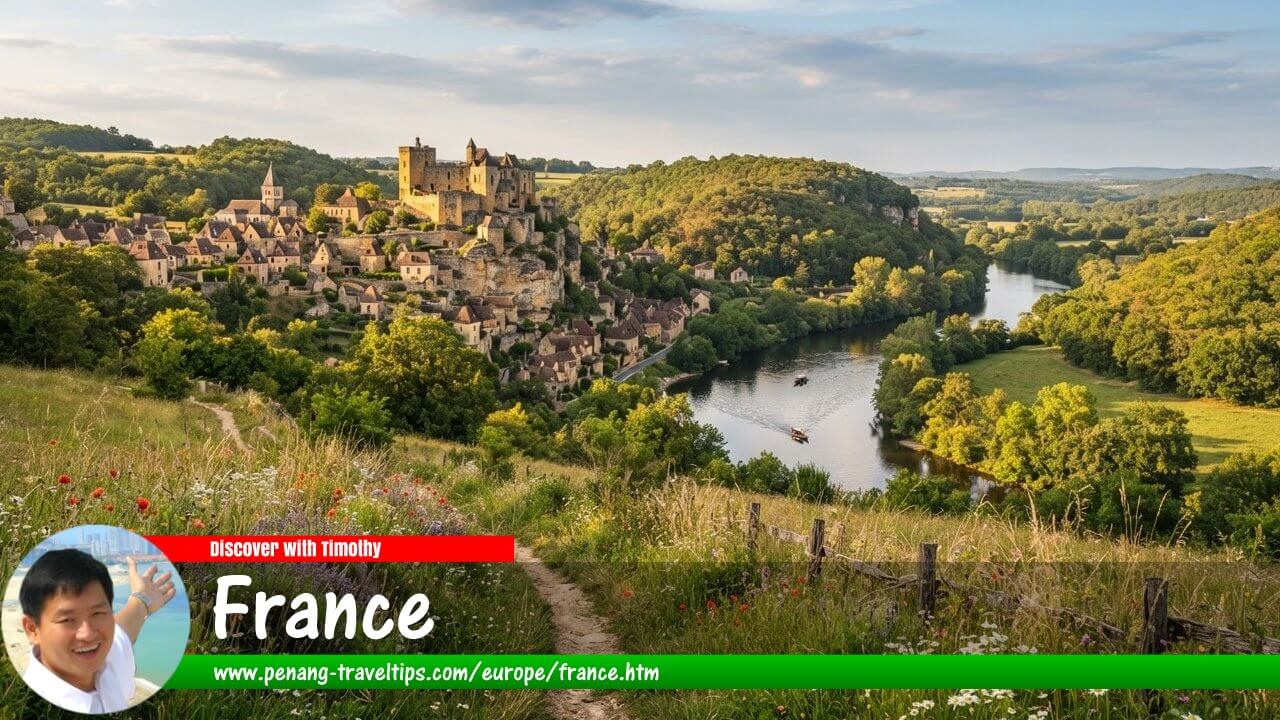 France Travel Guide (AI Image generated on 27 August 2026)
Also available: Panduan Melawat Perancis
Introduction to France
France is one of the world's most visited countries, renowned for its historic cities, magnificent architecture, art, fashion, cuisine and diverse landscapes. From the streets and monuments of Paris to the beaches of the Mediterranean, the vineyards of Bordeaux and Burgundy, the castles of the Loire Valley and the mountains of the Alps and Pyrenees, France offers an extraordinary variety of experiences.
For visitors from Malaysia, France is particularly appealing because it combines world-famous attractions with a rich cultural heritage and an extensive transport network. A first visit might focus on Paris, while longer trips can explore the countryside, coastal regions, historic towns and other major cities.
France at a Glance
- Official name: French Republic (République française)
- Capital: Paris
- Largest city: Paris
- Official language: French
- Currency: Euro (€)
- Time zone: Central European Time (CET) and Central European Summer Time (CEST)
- Population: More than 68 million people, including overseas France
- Government: Unitary semi-presidential republic
- Country code: FR
Where Is France?
France is located in Western Europe. Metropolitan France shares land borders with Belgium and Luxembourg to the northeast, Germany and Switzerland to the east, Italy and Monaco to the southeast, and Spain and Andorra to the southwest.
France also has extensive coastlines along the Atlantic Ocean, the English Channel and the Mediterranean Sea. Its position gives it easy access to several other European countries and makes it an important gateway for travel around Europe.
France in Europe
France is one of the largest countries in Europe by land area. Its central position in Western Europe makes it possible to combine a visit to France with neighbouring countries such as Belgium, Germany, Switzerland, Italy and Spain.
High-speed rail services also make it possible to travel between Paris and several major European cities in just a few hours.
Metropolitan France and Overseas France
When people refer to France, they often mean metropolitan France, the part of the country located in Europe. However, the French Republic also includes territories and departments outside Europe.
These overseas parts of France are scattered across the Caribbean, South America, the Indian Ocean and the Pacific Ocean. They have their own distinctive landscapes and cultures, ranging from tropical islands to the South American mainland.
This travel guide focuses primarily on metropolitan France, where most visitors to France from Malaysia begin their journey.
Paris
Paris is the capital and by far the most internationally famous city in France. It is known for landmarks such as the Eiffel Tower, Louvre Museum, Notre-Dame Cathedral, Arc de Triomphe and Champs-Élysées.
The city is also famous for its boulevards, cafés, museums, gardens, fashion houses and historic neighbourhoods. The Seine River runs through the heart of Paris, with many of the city's most important sights located along or near its banks.
The Eiffel Tower
The Eiffel Tower is perhaps the most recognisable symbol of France. Built for the 1889 Exposition Universelle, it was initially controversial but eventually became one of the world's most famous landmarks.
Visitors can view the tower from many parts of Paris or go up the tower itself for panoramic views of the city.
The Louvre
The Louvre Museum in Paris is one of the world's most famous museums. Its enormous collection covers thousands of years of art and civilisation.
The museum is particularly famous for Leonardo da Vinci's Mona Lisa, but the painting represents only a tiny part of its vast collection.
Notre-Dame de Paris
Notre-Dame de Paris is a historic Gothic cathedral situated on the Île de la Cité in the Seine. It is one of the best-known religious buildings in France.
The cathedral suffered a devastating fire in 2019 and underwent extensive restoration before reopening to visitors and worshippers.
French History
France has played a major role in European history for more than a thousand years. Its history includes medieval kingdoms, the French monarchy, the French Revolution, the Napoleonic era, two world wars and the development of the modern French Republic.
Many of France's historic buildings, castles, churches and monuments provide visible reminders of this long and sometimes turbulent history.
The French Revolution
The French Revolution began in 1789 and profoundly changed France and Europe. It brought an end to the old political order and eventually led to the establishment of a republic.
The revolution also introduced ideas about citizenship, equality and political rights that had a lasting influence far beyond France.
Napoleon Bonaparte
Napoleon Bonaparte became one of the most influential figures in French and European history. He rose to power following the French Revolution and eventually became Emperor of the French.
His campaigns transformed the political map of Europe, while the legal reforms associated with his rule influenced legal systems in many countries.
French Culture
France has had an enormous influence on world culture. French literature, painting, architecture, fashion, philosophy, cinema and cuisine have all influenced societies far beyond Europe.
Paris in particular became an important centre for artists, writers and intellectuals, attracting figures from France and abroad.
French Language
French is the official language of France and is spoken throughout metropolitan France. It is also one of the world's major international languages and is used officially in many countries and international organisations.
Visitors will find English spoken in many tourist areas, particularly in Paris and major hotels, although making an effort to use a few French expressions is generally appreciated.
Bonjour
Bonjour, meaning "hello" or "good day", is one of the most useful French words for visitors. It is customary to greet people when entering a small shop, restaurant or other establishment.
Simple expressions such as bonjour, merci (thank you), s'il vous plaît (please) and au revoir (goodbye) can make everyday interactions more pleasant.
French Cuisine
French cuisine is internationally renowned and forms an important part of the country's cultural identity. Regional traditions vary considerably, so there is no single type of food that represents all of France.
Visitors can encounter everything from delicate pastries and cheeses to hearty regional dishes, seafood, breads, wines and sophisticated restaurant cuisine.
Bread and Pastries
Bread is an important part of everyday French life. The baguette is perhaps the best-known French bread, while croissants, pain au chocolat and other pastries are popular breakfast and snack foods.
Local bakeries, or boulangeries, are found throughout French towns and cities and are often an essential part of neighbourhood life.
Cheese
France is famous for its enormous variety of cheeses. Different regions produce their own traditional varieties, using different types of milk and production methods.
Cheese is commonly served as part of a meal rather than simply regarded as a snack, and visitors may encounter an impressive selection in restaurants and markets.
Regional France
France is divided into regions with distinct landscapes, traditions and cuisines. Travelling beyond Paris reveals a much broader picture of the country.
Normandy, Brittany, the Loire Valley, Alsace, Burgundy, Provence, the French Riviera, the Alps and the southwest all offer experiences that differ considerably from those of Paris.
Normandy
Normandy lies in northern France along the English Channel. It is known for its coastline, medieval heritage, D-Day history, apple orchards, dairy products and the spectacular Mont-Saint-Michel.
Brittany
Brittany occupies the western peninsula of France. It is known for its rugged coastline, fishing communities, Celtic cultural influences, seafood and distinctive regional cuisine.
Loire Valley
The Loire Valley is famous for its grand Renaissance castles, historic towns and vineyards. The region's châteaux provide an impressive glimpse into the lives of French royalty and aristocratic families.
Burgundy
Burgundy is renowned for its wine, gastronomy and historic towns. It is one of France's most important wine-producing regions and is also associated with dishes such as boeuf bourguignon.
Alsace
Alsace lies near the German border and has a distinctive cultural identity shaped by both French and German influences. Strasbourg and Colmar are among its best-known cities.
Provence
Provence in southeastern France is famous for its Mediterranean landscapes, lavender fields, olive groves, vineyards and historic towns. The region is particularly attractive during the warmer months.
French Riviera
The Côte d'Azur, or French Riviera, stretches along the Mediterranean coast. Nice, Cannes, Antibes and Monaco are among the best-known destinations in the area.
The region is famous for its beaches, Mediterranean climate, luxury resorts, marinas and international events.
The French Alps
The French Alps occupy part of southeastern France and contain some of Europe's most spectacular mountain scenery. The region is popular for skiing and snowboarding in winter and hiking and other outdoor activities in summer.
Chamonix and Annecy are among the best-known destinations in the Alpine region.
The Pyrenees
The Pyrenees form a natural mountain barrier between France and Spain. They offer opportunities for hiking, skiing and exploring mountain villages.
French Wine
France is one of the world's most famous wine-producing countries. Important wine regions include Bordeaux, Burgundy, Champagne, the Rhône Valley, the Loire Valley, Alsace and Provence.
Wine is closely associated with French food culture, although visitors should not assume that every meal or social occasion involves alcohol.
Champagne
The Champagne region in northeastern France gives its name to the sparkling wine known as Champagne. Reims and Épernay are important centres for visiting Champagne houses and vineyards.
Bordeaux
Bordeaux is one of the world's best-known wine regions. The city itself is also an important architectural and cultural destination, with a historic centre listed as a UNESCO World Heritage Site.
French Art
France has been home to many influential artists and artistic movements. Paris was especially important to Impressionism and later developments in modern art.
Visitors can explore major collections in museums throughout the country, while smaller galleries and regional museums provide a more local perspective.
French Fashion
Paris is one of the world's major fashion capitals. French fashion houses have played a significant role in the development of modern haute couture and luxury fashion.
Fashion is particularly visible in Paris, but clothing and design traditions vary throughout the country.
France for Malaysian Visitors
France is a popular destination for Malaysians travelling to Europe. Paris is usually the starting point, but the country's extensive rail network makes it possible to travel to other regions without relying entirely on domestic flights.
For a first visit, combining Paris with one or two additional regions is generally more manageable than attempting to see the entire country in a single trip.
Halal Food in France
Halal food is available in France, particularly in Paris and other large cities with sizeable Muslim communities. Visitors can find halal restaurants serving French, North African, Middle Eastern, Turkish and South Asian food.
Outside major cities, halal options can become less common. Malaysian Muslim travellers may therefore wish to plan meals ahead when visiting rural areas or smaller towns.
Muslim Visitors
France has a large Muslim population, particularly in and around its major cities. Mosques and Islamic centres can be found in many urban areas.
Muslim visitors should have little difficulty finding prayer facilities in larger cities, although facilities may be less readily available in small towns and rural destinations.
France as a Travel Destination
France offers an unusually broad range of travel experiences within one country. Visitors can explore one of the world's great cities, relax on Mediterranean beaches, visit medieval villages, tour famous wine regions, hike in the Alps or discover centuries of history in castles and cathedrals.
For a visitor from Malaysia, France can be both a destination in its own right and a convenient starting point for exploring Western Europe.
The following sections of this France Travel Guide look more closely at the country's geography, history, major destinations, transport, accommodation, food, culture, seasons and practical information for travellers.
Geography, Regions and Major Destinations of France
France has an unusually varied geography for a European country. Its landscape ranges from Atlantic and Mediterranean coastlines to fertile plains, rolling countryside, forests and some of Europe's highest mountains. This geographical diversity is one of the reasons France offers such a wide variety of travel experiences.
Geography of France
Metropolitan France occupies the western part of Europe and has coastlines on the Atlantic Ocean, the English Channel and the Mediterranean Sea. The country has a roughly hexagonal shape, which has sometimes led to the informal French expression l'Hexagone when referring to metropolitan France.
Several major mountain ranges surround or cross the country, while large river valleys and plains provide fertile agricultural land.
Major Mountain Ranges
France has several important mountain systems. The Alps lie along the southeastern border with Italy and Switzerland, while the Pyrenees form a natural frontier with Spain and Andorra.
The Massif Central occupies a large area of central France, while the Jura Mountains and Vosges Mountains lie in the east.
The French Alps
The French Alps contain some of the country's most spectacular scenery. Snow-covered peaks, alpine lakes, glaciers and mountain valleys attract visitors throughout the year.
Winter brings skiing and snowboarding, while summer is popular for hiking, cycling, climbing and other outdoor activities.
Mont Blanc
Mont Blanc is the highest mountain in the Alps and one of the most famous peaks in Europe. It rises on the border between France and Italy, with the French resort town of Chamonix serving as one of the principal gateways to the mountain.
Pyrenees
The Pyrenees stretch along the southern border of France between the Atlantic Ocean and the Mediterranean Sea. The mountains offer hiking, skiing, mountain villages and spectacular scenery.
The small country of Andorra is situated in the Pyrenees between France and Spain.
Massif Central
The Massif Central is a large upland area in central and southern France. Its volcanic landscapes, plateaus, valleys and rural communities provide a quieter alternative to the country's major tourist centres.
French Rivers
France has several major rivers that have played an important role in the country's history, agriculture, trade and settlement.
Seine
The Seine flows through Paris before reaching the English Channel. Many of Paris's most famous landmarks stand along the river, making it one of the most recognisable waterways in France.
Loire
The Loire is the longest river entirely within France. Its valley is famous for vineyards, historic towns and magnificent Renaissance châteaux.
Rhône
The Rhône flows from the Swiss Alps through southeastern France before reaching the Mediterranean. Its valley is associated with major wine-producing areas and important cities such as Lyon and Avignon.
Garonne
The Garonne flows through southwestern France and passes through Toulouse and Bordeaux before reaching the Atlantic.
French Coastlines
France has several distinct coastal regions. The Atlantic coast includes long sandy beaches and dramatic cliffs, while the Mediterranean coast is known for its warmer climate, beaches and resort towns.
The northern coast along the English Channel has its own history and landscapes, including the white cliffs of Normandy and the beaches associated with the D-Day landings.
Atlantic Coast
The Atlantic coast extends from Brittany in the north to the Spanish border in the southwest. It includes fishing villages, beaches, estuaries, sand dunes and major port cities.
Mediterranean Coast
The Mediterranean coast includes the French Riviera, Provence and the coastal area around Marseille. It is known for sunny weather, beaches, marinas, historic towns and Mediterranean cuisine.
French Riviera
The French Riviera, or Côte d'Azur, is one of France's most famous coastal areas. Nice is its largest city, while Cannes, Antibes, Menton and Saint-Tropez are among its best-known destinations.
Corsica
Corsica is a French island in the Mediterranean Sea, located southeast of mainland France. It has a distinctive identity, mountainous interior, dramatic coastline and numerous beaches.
Ajaccio, the birthplace of Napoleon Bonaparte, is the island's capital.
Administrative Regions of France
Metropolitan France is divided into administrative regions, each with its own geographical and cultural characteristics. For travellers, these regional distinctions are useful because food, landscapes, architecture and traditions can change considerably from one part of the country to another.
Île-de-France
Île-de-France is the region surrounding Paris. It is the political, economic and cultural heart of France and contains many attractions beyond the capital itself.
The Palace of Versailles, located just outside Paris, is one of the region's most famous attractions.
Normandy
Normandy occupies the northwestern part of France along the English Channel. It is famous for its coastline, medieval architecture, apple orchards, dairy products and its role in the Second World War.
Rouen
Rouen is the historic capital of Normandy. Its old centre contains medieval streets, timber-framed buildings and the impressive Rouen Cathedral.
Mont-Saint-Michel
Mont-Saint-Michel is one of France's most recognisable landmarks. The medieval abbey and settlement stand dramatically on a tidal island off the Normandy coast.
Its unusual setting and historic architecture make it one of the country's most popular tourist attractions.
Brittany
Brittany occupies the western peninsula of France and has a strong regional identity. Its rugged coastline, fishing villages, stone architecture and seafood are among its main attractions.
Rennes
Rennes is the capital of Brittany and a lively university city with a historic centre containing traditional half-timbered houses.
Saint-Malo
Saint-Malo is a historic fortified port city on the northern coast of Brittany. Its old town is enclosed by massive stone walls overlooking the sea.
Loire Valley
The Loire Valley is one of the most celebrated cultural landscapes in France. It is particularly famous for its Renaissance castles, including Château de Chambord, Château de Chenonceau and Château de Villandry.
Tours
Tours is one of the principal cities of the Loire Valley and a convenient base for exploring the surrounding châteaux and vineyards.
Grand Est
The Grand Est region lies in northeastern France and borders Belgium, Luxembourg, Germany and Switzerland. It combines French and German cultural influences.
Strasbourg
Strasbourg is the capital of the Grand Est region and an important European city. Its historic centre, including the picturesque Petite France district and Strasbourg Cathedral, is particularly attractive to visitors.
Colmar
Colmar is famous for its colourful historic buildings, canals and traditional Alsatian architecture. It is also an important gateway to the Alsace wine route.
Burgundy-Franche-Comté
This region in eastern France is associated with wine, gastronomy, historic towns and countryside.
Dijon
Dijon is the historic capital of Burgundy and is well known for its architecture, food traditions and association with mustard.
Auvergne-Rhône-Alpes
Auvergne-Rhône-Alpes covers a large area of southeastern France, including much of the French Alps and the Massif Central.
Lyon
Lyon is France's third-largest city by population and one of the country's most important gastronomic centres. Its historic districts, Roman remains and location at the meeting of the Rhône and Saône rivers make it an important destination.
Annecy
Annecy is known for its beautiful lake, canals and mountain setting. The historic centre is particularly picturesque and has earned the city the nickname "Venice of the Alps".
Provence-Alpes-Côte d'Azur
This region covers Provence, the French Riviera and parts of the southern Alps. It combines Mediterranean landscapes with mountain scenery.
Marseille
Marseille is France's second-largest city and a major Mediterranean port. Its history stretches back more than two thousand years, and its multicultural character reflects its long connection with the Mediterranean world.
Avignon
Avignon is famous for the Palais des Papes, which recalls the period when the papacy was based in the city during the 14th century. The city's historic centre is surrounded by impressive medieval walls.
Nice
Nice is the principal city of the French Riviera. Its Mediterranean setting, Promenade des Anglais, old town and mild climate make it one of the country's most popular destinations.
Cannes
Cannes is internationally known for the Cannes Film Festival. The city is also famous for its waterfront, luxury hotels, beaches and elegant shopping streets.
Nouvelle-Aquitaine
Nouvelle-Aquitaine occupies much of southwestern France. It includes Atlantic beaches, vineyards, forests, historic towns and the Pyrenees.
Bordeaux
Bordeaux is one of France's most important wine cities. Its elegant historic centre and location along the Garonne River make it a major cultural and tourist destination.
La Rochelle
La Rochelle is a historic Atlantic port city known for its old harbour, medieval towers and maritime heritage.
Occitanie
Occitanie covers a large area in southern France, extending from the Mediterranean to the Pyrenees.
Toulouse
Toulouse is known as the "Pink City" because of the colour of many of its traditional brick buildings. It is also an important centre for the European aerospace industry.
Carcassonne
Carcassonne is famous for its remarkably preserved medieval fortified city. Its walls, towers and castle make it one of the most spectacular historic sites in southern France.
Pays de la Loire
The Pays de la Loire region extends along the lower Loire River and the Atlantic coast. It contains historic towns, vineyards and coastal destinations.
Nantes
Nantes is a major city on the Loire and an important cultural centre. It has a long maritime and commercial history.
Hauts-de-France
Hauts-de-France occupies the northernmost part of France and borders Belgium and the English Channel. The region has a rich industrial, military and medieval history.
Lille
Lille is the region's principal city and is known for its historic architecture, lively squares, museums and Flemish cultural influences.
Paris and Its Surroundings
Paris deserves special consideration because it is not only a destination in itself but also a convenient base for visiting attractions in the surrounding Île-de-France region.
Versailles
The Palace of Versailles was the principal royal residence of France before the French Revolution. Its grand palace, Hall of Mirrors and extensive gardens make it one of the country's most important historic attractions.
Giverny
Giverny is associated with the Impressionist painter Claude Monet. Visitors can explore the house and gardens that inspired some of his best-known works.
Historic Cities
France has numerous historic cities beyond Paris. Many retain medieval streets, Renaissance buildings, Roman remains or elegant 18th- and 19th-century architecture.
Exploring these cities can provide a deeper understanding of French history than visiting only the country's most famous landmarks.
Medieval Villages
France is also known for its picturesque villages. Stone houses, narrow streets, village churches and local markets are common features, particularly in rural regions.
Some villages have become major tourist attractions, while others remain relatively quiet.
French Wine Regions
Wine production is closely connected to the geography of France. Different combinations of climate, soil and traditional production methods have created distinctive wine regions.
- Bordeaux: famous for red wines.
- Burgundy: renowned for Pinot Noir and Chardonnay.
- Champagne: famous for sparkling wine.
- Loire Valley: produces a wide range of white, red and sparkling wines.
- Rhône Valley: known for both red and white wines.
- Alsace: particularly known for aromatic white wines.
- Provence: especially associated with rosé wine.
France's Natural Diversity
One of France's greatest strengths as a travel destination is that mountains, beaches, forests, vineyards, farmland and major cities can all be found within relatively manageable distances.
A visitor can spend a morning exploring a historic city, an afternoon travelling through vineyards and an evening in a small village or coastal resort.
Choosing Where to Go
For a first trip, Paris is the obvious starting point, but visitors who have more time should consider adding a region that matches their interests.
- History and castles: Loire Valley, Normandy and Île-de-France.
- Wine: Bordeaux, Burgundy, Champagne, Loire Valley and Rhône Valley.
- Beaches: French Riviera, Corsica and the Atlantic coast.
- Mountains: French Alps and Pyrenees.
- Food: Lyon, Provence, Burgundy and many regional towns.
- Art and culture: Paris, Lyon, Marseille and regional museums.
- Quiet countryside: rural Provence, Dordogne, Burgundy and parts of southwestern France.
France's geographical and regional diversity means that there is no single itinerary that can represent the entire country. The most rewarding trips usually concentrate on a manageable area rather than attempting to cover too much territory.
History and Heritage of France
France has one of Europe's longest and most influential histories. Its territory has been shaped by prehistoric communities, Celtic peoples, the Roman Empire, Germanic kingdoms, medieval monarchies, religious conflicts, the French Revolution, Napoleon and the modern republic. The result is a country with an exceptionally rich collection of historical monuments and cultural heritage.
Prehistoric France
Human communities have lived in what is now France for hundreds of thousands of years. Prehistoric sites and cave paintings provide evidence of early human settlement and artistic expression.
The Lascaux Caves in southwestern France are particularly famous for their prehistoric paintings of animals. Because the original caves are highly protected, visitors view a carefully created replica rather than entering the original decorated chambers.
The Celts in Gaul
Before the Roman conquest, much of present-day France was inhabited by Celtic peoples. The Romans referred to the region as Gaul, or Gallia.
Gaul was not a single unified kingdom but consisted of numerous tribes and communities. Their culture was later profoundly influenced by Roman rule.
Roman Gaul
Roman forces under Julius Caesar conquered most of Gaul during the 1st century BC. The region subsequently became an important part of the Roman Empire.
The Romans built roads, bridges, theatres, temples, aqueducts and cities. Many Roman remains can still be visited today.
Nîmes
Nîmes contains some of the finest Roman monuments in France, including the remarkably preserved Arènes de Nîmes, a large Roman amphitheatre that is still used for events.
Pont du Gard
The Pont du Gard is a spectacular Roman aqueduct bridge in southern France. Built to carry water across the Gardon River, it is one of the best-preserved examples of Roman engineering in the country.
Arles
Arles was an important Roman city and still contains significant Roman remains, including an ancient amphitheatre and theatre.
The Franks
Following the decline of the Western Roman Empire, various Germanic peoples established kingdoms in former Roman territories. The Franks became particularly important and eventually gave their name to France.
Clovis I
Clovis I was a Frankish king who united a large part of Gaul under his rule during the late 5th and early 6th centuries. His conversion to Christianity helped establish an important relationship between the Frankish monarchy and the Catholic Church.
Charlemagne
Charlemagne, or Charles the Great, became one of the most powerful rulers of medieval Europe. He expanded the Frankish kingdom across much of western and central Europe and was crowned Emperor in Rome in AD 800.
His empire did not survive intact for long after his death, but his legacy profoundly influenced the political development of Europe.
Medieval France
During the Middle Ages, the French monarchy gradually increased its authority over territories controlled by powerful nobles. At the same time, towns expanded, trade developed and great cathedrals were constructed.
Many of France's most beautiful historic centres date from this period.
Gothic Architecture
France played a central role in the development of Gothic architecture. The style is characterised by pointed arches, ribbed vaults, flying buttresses and large stained-glass windows.
Chartres Cathedral
Chartres Cathedral is one of the finest examples of French Gothic architecture. It is particularly famous for its medieval stained-glass windows and labyrinth.
Amiens Cathedral
Amiens Cathedral is one of the largest Gothic cathedrals in France and is recognised as a UNESCO World Heritage Site.
Reims Cathedral
Reims Cathedral played an important role in French history because many French kings were crowned there. Its magnificent Gothic façade and sculptures are among the highlights of the city.
The Hundred Years' War
The Hundred Years' War was a prolonged series of conflicts between England and France that lasted, with interruptions, from the 14th to the 15th centuries.
The war had a profound effect on the development of both countries and included the famous figure of Joan of Arc.
Joan of Arc
Joan of Arc became a national heroine of France after helping French forces during the later stages of the Hundred Years' War. Captured and executed in 1431, she was later declared a saint by the Catholic Church.
Her story remains an important part of French national history.
The French Renaissance
During the 15th and 16th centuries, France was influenced by the Renaissance that began in Italy. French monarchs sponsored artists, architects and intellectuals, while magnificent royal residences were built or expanded.
The Loire Valley became an important centre of royal and aristocratic building during this period.
Châteaux of the Loire
The Loire Valley contains an extraordinary collection of castles and palaces. Many were originally medieval fortifications but were transformed into elegant Renaissance residences.
Château de Chambord
Château de Chambord is one of the most spectacular castles in France. Its enormous scale, elaborate towers and distinctive Renaissance architecture make it one of the most recognisable châteaux in the Loire Valley.
Château de Chenonceau
Château de Chenonceau is built partly across the River Cher. Its elegant architecture and gardens make it one of the most visited castles in France.
Religious Wars
The 16th century was marked by serious religious conflict between Catholics and Protestants in France. The French Wars of Religion caused widespread violence and political instability.
The conflict eventually contributed to the strengthening of royal authority and the development of policies intended to stabilise the kingdom.
Louis XIV
Louis XIV, known as the "Sun King", was one of the most powerful monarchs in French history. He ruled for more than seven decades and became closely associated with the centralisation of royal power.
His reign is also associated with the expansion of French influence in Europe and the flourishing of French arts and culture.
Palace of Versailles
The Palace of Versailles became the principal royal residence under Louis XIV. The enormous palace, formal gardens, fountains and Hall of Mirrors were designed to demonstrate the power and wealth of the French monarchy.
Versailles later became one of the most important settings of the French Revolution.
The Enlightenment
During the 18th century, French philosophers and intellectuals played an important role in the Age of Enlightenment. Thinkers such as Voltaire, Montesquieu and Rousseau discussed reason, political authority, individual rights and the organisation of society.
Their ideas influenced political developments both in France and elsewhere.
The French Revolution
The French Revolution began in 1789 amid a severe political, social and financial crisis. The monarchy was challenged, the old system of privileges was dismantled and France eventually became a republic.
The revolution remains one of the defining events in French history.
Bastille Day
14 July is France's national day. It commemorates the storming of the Bastille in 1789, an event that became a powerful symbol of the French Revolution.
Modern Bastille Day celebrations commonly include military ceremonies, public festivities, concerts and fireworks.
Declaration of the Rights of Man
The Declaration of the Rights of Man and of the Citizen, adopted in 1789, expressed principles of liberty, equality and political rights.
It became one of the foundational documents of the French Revolution and remains an important reference in French political history.
Napoleon Bonaparte
After years of revolutionary upheaval, Napoleon Bonaparte rose to power. He became First Consul and later Emperor of the French.
Napoleon's military campaigns extended French influence across much of Europe, while his administrative and legal reforms had effects that lasted long after his defeat.
Napoleonic Code
The Napoleonic Code, introduced in 1804, established a comprehensive civil law system based on principles such as equality before the law and protection of property.
Its influence extended beyond France and contributed to the development of legal systems in many countries.
Napoleon's Defeat
Napoleon's power eventually declined after a series of military defeats. His final defeat at the Battle of Waterloo in 1815 ended his rule.
He was subsequently exiled to the remote island of Saint Helena, where he died in 1821.
The 19th Century
The 19th century was a period of major political, industrial and social change in France. The country experienced changes between monarchy, republic and empire before eventually establishing the Third Republic.
Industrialisation also transformed French cities and transport networks.
Haussmann's Paris
During the 19th century, Paris underwent a dramatic transformation under Baron Georges-Eugène Haussmann.
Narrow medieval streets were replaced or supplemented by broad boulevards, parks and modern infrastructure. Much of the Parisian cityscape familiar to visitors today dates from this period.
The Eiffel Tower
The Eiffel Tower was constructed for the 1889 World's Fair, held to celebrate the centenary of the French Revolution.
Designed by engineer Gustave Eiffel's company, the tower was initially intended to be temporary. It eventually became the enduring symbol of Paris and France.
Impressionism
France played a central role in the development of Impressionism during the 19th century. Artists such as Claude Monet, Pierre-Auguste Renoir and Edgar Degas challenged traditional approaches to painting.
The movement's interest in light, colour and everyday life had a profound influence on modern art.
Claude Monet
Claude Monet was one of the most important Impressionist painters. His garden at Giverny, including the famous water-lily pond, became a major source of inspiration for his later works.
France in the First World War
France was one of the principal Allied powers during the First World War. Much of the fighting on the Western Front took place on French territory.
The war caused enormous loss of life and left a lasting mark on communities throughout northern and eastern France.
Normandy and D-Day
During the Second World War, France was occupied by Nazi Germany. On 6 June 1944, Allied forces landed on the Normandy coast in the operation known as D-Day.
The Normandy beaches and surrounding museums and cemeteries are now important historical destinations.
Charles de Gaulle
Charles de Gaulle was a central figure in modern French history. He led Free France during the Second World War and later became the first president of the Fifth Republic.
Paris's principal international airport is named after him.
The Fifth Republic
The current French political system, known as the Fifth Republic, was established in 1958. It strengthened the role of the French presidency while retaining a parliamentary system.
The president serves as head of state, while the prime minister leads the government.
European Integration
France became one of the founding participants in the European integration project following the Second World War. It later became a member of the European Union and remains one of its most influential member states.
UNESCO World Heritage
France has numerous sites recognised by UNESCO for their cultural or natural significance. These include historic city centres, cathedrals, castles, landscapes and archaeological sites.
Among the best-known are the historic banks of the Seine in Paris, Mont-Saint-Michel, the Palace and Park of Versailles, the Loire Valley and the fortified city of Carcassonne.
France's Architectural Heritage
France's architectural heritage spans many centuries. Roman amphitheatres, medieval cathedrals, Renaissance châteaux, royal palaces, 19th-century boulevards and modern architecture can all be found within the country.
This extraordinary variety means that travelling through France is almost like travelling through different periods of European history.
Living Heritage
French heritage is not limited to monuments and museums. Food, wine, crafts, festivals, regional languages, traditional markets and local customs remain important parts of everyday life.
For visitors, exploring these living traditions can be just as rewarding as visiting famous historical sites.
Why History Matters When Visiting France
Understanding France's history makes many of its attractions more meaningful. A visit to Versailles recalls the power of the monarchy, Normandy reveals the consequences of the Second World War, and Paris contains reminders of everything from medieval France to the Revolution and the modern republic.
France's history is therefore not confined to museums. It is visible in its streets, buildings, landscapes, food and traditions, making the country one of the world's richest destinations for cultural and historical travel.
Major Cities and Tourist Destinations in France
France has far more to offer than Paris. Its cities and regions each have their own character, history, architecture, food and landscapes. While Paris is an essential destination for first-time visitors, exploring other parts of France provides a broader understanding of the country.
Paris
Paris is the capital of France and its principal tourist destination. Known as the "City of Light", it combines historic monuments, world-class museums, elegant boulevards, parks, cafés and neighbourhoods with centuries of artistic and intellectual heritage.
Among its best-known attractions are the Eiffel Tower, Louvre Museum, Notre-Dame de Paris, Arc de Triomphe, Champs-Élysées, Sacré-Cœur and the Seine River.
Montmartre
Montmartre occupies a hill in northern Paris and is famous for its artistic history and village-like streets. The Basilica of the Sacré-Cœur stands at the summit and provides extensive views over the city.
Latin Quarter
The Latin Quarter is one of the historic districts of Paris. It is associated with universities, bookshops, cafés and the Sorbonne and contains numerous medieval and historic buildings.
Le Marais
Le Marais is a historic central Paris neighbourhood known for its elegant hôtels particuliers, narrow streets, museums, cafés and shops.
Champs-Élysées
The Champs-Élysées is one of Paris's best-known avenues. It stretches from the Place de la Concorde towards the Arc de Triomphe and is lined with shops, restaurants and major landmarks.
Arc de Triomphe
The Arc de Triomphe stands at the western end of the Champs-Élysées. Commissioned by Napoleon, it commemorates French military victories and occupies the centre of the large Place Charles de Gaulle.
Versailles
Versailles lies southwest of Paris and is best known for the Palace of Versailles. The palace and its enormous formal gardens represent the power and splendour of the French monarchy before the Revolution.
The Hall of Mirrors is one of the palace's most famous interiors.
Giverny
Giverny is closely associated with the Impressionist painter Claude Monet. His house and gardens, particularly the water-lily pond and Japanese bridge, attract visitors interested in art and gardens.
Rouen
Rouen is the historic capital of Normandy. Its old town contains medieval and Renaissance buildings, timber-framed houses and the imposing Rouen Cathedral.
The city is also strongly associated with Joan of Arc, who was executed in Rouen in 1431.
Mont-Saint-Michel
Mont-Saint-Michel is one of the most spectacular landmarks in France. The medieval settlement and abbey rise dramatically from a tidal island off the Normandy coast.
The surrounding bay experiences significant tidal changes, contributing to the distinctive appearance of the site.
Caen
Caen is an important city in Normandy and a useful base for exploring the region. It is associated with William the Conqueror and also provides access to many sites connected with the D-Day landings.
D-Day Beaches
The Normandy coast contains several beaches where Allied forces landed on 6 June 1944 during the Second World War. Omaha Beach, Utah Beach, Gold Beach, Juno Beach and Sword Beach are collectively known as the D-Day beaches.
Museums, memorials, military cemeteries and preserved sites throughout the region help visitors understand the events of the Normandy landings.
Saint-Malo
Saint-Malo is a fortified port city on the northern coast of Brittany. Its historic centre is surrounded by substantial stone walls and overlooks the English Channel.
The city is particularly attractive for visitors interested in maritime history, historic architecture and coastal scenery.
Rennes
Rennes is the capital of Brittany and a lively university city. Its historic centre contains colourful half-timbered houses alongside elegant classical buildings.
Nantes
Nantes is a major city on the Loire River and an important cultural centre. Its attractions include the Château des Ducs de Bretagne and the extraordinary artistic installations of Les Machines de l'île.
Loire Valley Châteaux
The Loire Valley is one of the finest destinations in France for visitors interested in castles and Renaissance architecture. Numerous châteaux are scattered throughout the countryside.
Château de Chambord
Château de Chambord is one of the largest and most recognisable castles in the Loire Valley. Its distinctive towers, elaborate roofline and grand staircase reflect the ambitions of the French Renaissance.
Château de Chenonceau
Château de Chenonceau is built across the River Cher and is notable for its elegant design and gardens. Its unusual position over the river makes it one of the most photographed châteaux in France.
Château de Villandry
Château de Villandry is particularly famous for its beautifully designed Renaissance gardens. The gardens are divided into decorative and productive sections with carefully arranged geometric patterns.
Strasbourg
Strasbourg is the capital of the Grand Est region and one of the most distinctive cities in northeastern France. Its location near the German border has given it a cultural character influenced by both France and Germany.
The historic centre, known as Grande Île, contains Strasbourg Cathedral and the picturesque Petite France district.
Strasbourg Cathedral
Strasbourg Cathedral is a masterpiece of Gothic architecture. Its enormous façade and single tall spire dominate the historic city centre.
Colmar
Colmar is one of the most picturesque towns in Alsace. Its colourful buildings, canals and traditional architecture have made it a popular destination for visitors exploring northeastern France.
Colmar is also a convenient base for exploring the Alsace wine route.
Dijon
Dijon is the historic capital of Burgundy and an important centre of French gastronomy. The city contains a well-preserved historic centre with medieval and Renaissance buildings.
Dijon is also internationally associated with mustard, although Burgundy's culinary importance extends far beyond this famous condiment.
Beaune
Beaune is one of the most important wine towns of Burgundy. Its historic centre contains the famous Hôtel-Dieu, recognised for its distinctive colourful tiled roof.
The surrounding vineyards make Beaune a popular destination for wine tourism.
Lyon
Lyon is one of France's most important cities and is widely regarded as a major centre of French gastronomy. It stands at the meeting point of the Rhône and Saône rivers.
The historic districts of Vieux Lyon contain Renaissance buildings, narrow streets and hidden passageways known as traboules.
Vieux Lyon
Vieux Lyon is one of Europe's largest Renaissance districts. Its colourful buildings and narrow streets provide a glimpse into Lyon's prosperous past as a centre of trade.
Annecy
Annecy lies beside Lake Annecy in the French Alps. The combination of turquoise water, mountains, canals and historic buildings has made it one of France's most scenic destinations.
The city is particularly popular in summer, when visitors can enjoy walking, cycling, boating and other outdoor activities.
Chamonix
Chamonix is a famous Alpine resort situated beneath Mont Blanc. It is associated with mountaineering and winter sports and provides spectacular views of the surrounding mountains.
In summer, the area attracts hikers, climbers and visitors interested in mountain scenery.
Grenoble
Grenoble is surrounded by mountains and is an important gateway to the French Alps. The city combines a university atmosphere with museums, historic sites and access to numerous mountain activities.
Avignon
Avignon is one of the most important historic cities of Provence. Its medieval walls surround a historic centre dominated by the Palais des Papes.
Palais des Papes
The Palais des Papes is one of the largest medieval Gothic buildings in Europe. It served as the residence of the popes during the period in the 14th century when the papacy was based in Avignon.
Pont d'Avignon
The Pont Saint-Bénézet, commonly known as the Pont d'Avignon, is a famous medieval bridge extending partway across the Rhône River. It is one of the city's best-known symbols.
Arles
Arles is a historic city in Provence with important Roman remains. Its ancient amphitheatre and other monuments demonstrate the city's significance during Roman times.
Arles is also strongly associated with Vincent van Gogh, who spent an important period of his artistic career there.
Aix-en-Provence
Aix-en-Provence is known for its elegant streets, fountains, historic buildings and association with the painter Paul Cézanne.
The city provides an excellent introduction to the more refined side of Provence.
Marseille
Marseille is France's principal Mediterranean port and one of its largest cities. Founded by Greek settlers more than 2,600 years ago, it has a long history as a crossroads of Mediterranean cultures.
Vieux-Port
The Vieux-Port, or Old Port, lies at the heart of Marseille. It is surrounded by restaurants, cafés and historic buildings and remains one of the city's most lively areas.
Notre-Dame de la Garde
Notre-Dame de la Garde is a basilica situated on a hill overlooking Marseille. Its elevated position provides extensive views of the city and Mediterranean coast.
Nice
Nice is the principal city of the French Riviera. Its Mediterranean climate, beaches, historic old town and famous Promenade des Anglais make it one of France's most popular coastal destinations.
Promenade des Anglais
The Promenade des Anglais stretches along the waterfront of Nice. It is one of the city's defining landmarks and is popular for walking, cycling and enjoying views of the Mediterranean.
Vieux Nice
Vieux Nice is the historic old town. Its narrow streets, colourful buildings, markets, churches, cafés and restaurants create a distinctly Mediterranean atmosphere.
Cannes
Cannes is famous worldwide for the Cannes Film Festival, which attracts leading figures from the international film industry each year.
The city is also known for its waterfront boulevard, luxury hotels, beaches and marina.
Antibes
Antibes combines a historic old town with a Mediterranean coastline and large marina. The town is associated with Pablo Picasso, who worked at the Château Grimaldi, now the Musée Picasso.
Saint-Tropez
Saint-Tropez began as a fishing village but became internationally famous as a resort associated with artists, celebrities and the French Riviera lifestyle.
It remains popular for its beaches, harbour, restaurants and old-town streets.
Montpellier
Montpellier is a lively university city in southern France, relatively close to the Mediterranean coast. Its historic centre contains narrow streets, elegant squares and historic buildings.
Toulouse
Toulouse is known as the "Pink City" because of the warm-coloured brick used in many of its buildings. It is also an important centre of the European aerospace industry.
The city's historic centre contains churches, mansions and lively public squares.
Carcassonne
Carcassonne is famous for its extraordinary medieval fortified city. Its massive walls, towers and castle create one of the most dramatic historic landscapes in France.
The fortified city is particularly atmospheric when explored on foot.
Bordeaux
Bordeaux is one of the world's great wine capitals. The city itself has an elegant historic centre stretching along the Garonne River.
Visitors can combine sightseeing in Bordeaux with excursions to surrounding vineyards and wine estates.
La Rochelle
La Rochelle is a historic Atlantic port city. Its old harbour, medieval towers and maritime heritage make it one of the most attractive cities on the western French coast.
Biarritz
Biarritz is a coastal resort in southwestern France near the Spanish border. It is known for beaches, surfing, elegant architecture and its historic connection with European aristocracy.
Straddling France and Spain
The southwest of France has strong cultural connections with Spain and the Basque Country. Towns and cities in this area provide an opportunity to experience a different side of French culture from that found in Paris or northern France.
Corsica
Corsica offers a very different experience from mainland France. The island combines rugged mountains, forests, dramatic coastal scenery, beaches and villages with a strong Corsican identity.
Ajaccio
Ajaccio is the capital of Corsica and the birthplace of Napoleon Bonaparte. The city has a Mediterranean atmosphere and several sites associated with Napoleon.
Bastia
Bastia lies on the northeastern coast of Corsica and is one of the island's principal ports. Its old harbour and historic centre are among its main attractions.
French National Parks
France also has numerous national parks and protected natural areas. These provide opportunities for hiking, wildlife observation, mountain activities and enjoying landscapes far removed from the country's major cities.
The national parks include areas in the Alps, Pyrenees, Mediterranean region, Massif Central and overseas France.
Choosing Destinations in France
Visitors should choose destinations according to their interests rather than attempting to see everything. Paris is ideal for art, history and urban culture, while Provence offers Mediterranean landscapes and cuisine, the Alps provide mountain scenery, and Normandy combines coastal landscapes with important historical sites.
France's excellent rail and road networks make multi-destination trips possible, but the country's size means that travelling between distant regions can still take several hours.
First-Time Visitors
For a first visit of around one week, Paris alone can easily fill the itinerary. With 10 to 14 days, visitors can consider adding destinations such as Versailles, the Loire Valley, Normandy, Lyon or the French Riviera.
Longer trips allow visitors to combine several regions, but it is generally better to explore fewer places in greater depth than spend most of the holiday travelling from one destination to another.
Beyond the Famous Destinations
Some of France's most memorable experiences can come from smaller towns and villages rather than its famous landmarks. Local markets, village churches, regional food, vineyards and quiet countryside provide a different perspective on French life.
Once the major attractions have been visited, leaving the main tourist routes can be a rewarding way to discover the country's regional character.
French Food, Cuisine and Dining
Food is one of the defining aspects of French culture, and eating is an important part of the travel experience in France. French cuisine varies greatly from one region to another, reflecting differences in climate, agriculture, history and local traditions.
Visitors will encounter everything from simple bread and pastries bought from a neighbourhood bakery to elaborate meals in Michelin-starred restaurants. France is also famous for its cheeses, regional specialities, markets, desserts and wines.
French Cuisine
French cuisine is often associated with sophisticated cooking techniques and carefully presented dishes, but everyday French food can be quite simple. Fresh bread, cheese, vegetables, meat, seafood and seasonal produce form the basis of many meals.
Regional cuisine is particularly important. A dish that is common in Provence may be almost unknown in Brittany, while the food of Alsace reflects its historical connections with Germany and the food of southwestern France has strong influences from the Atlantic and Pyrenees.
French Meals
A traditional French meal can consist of several courses, although everyday meals are often much simpler. A formal meal may include an appetiser, main course, cheese and dessert.
Lunch remains an important meal in French culture, although eating habits have become more flexible, particularly in large cities.
Breakfast
Traditional French breakfast is generally lighter than breakfast in many Asian countries. Bread, butter, jam, croissants, other pastries, fruit and coffee are common choices.
Baguette
The baguette is perhaps the most recognisable French bread. It is a long, narrow loaf with a crisp crust and soft interior.
Baguettes are sold in bakeries throughout France and are commonly eaten with butter, cheese, cold meats or other foods.
Boulangerie
A boulangerie is a bakery specialising in bread and baked goods. Visiting a local bakery is one of the simplest ways to experience everyday French food culture.
In addition to baguettes, bakeries commonly sell croissants, pain au chocolat, brioche, tarts and other pastries.
Croissant
The croissant is a crescent-shaped pastry made from laminated dough containing butter. It is particularly associated with French breakfast and cafés.
Pain au Chocolat
Pain au chocolat is a rectangular laminated pastry containing bars of chocolate. It is another popular choice at French bakeries.
French Cheese
France is famous for its enormous variety of cheeses. Different regions have developed their own traditional cheeses using cow's, goat's or sheep's milk.
Some famous examples include Camembert from Normandy, Brie from the Île-de-France area, Roquefort from southern France, Comté from the Jura region and chèvre made from goat's milk.
Cheese as a Course
In a traditional French meal, cheese may be served after the main course and before dessert. A selection of several cheeses may be presented together.
Visitors unfamiliar with French dining customs may find the variety surprising, but sampling regional cheeses is one of the pleasures of travelling around France.
French Desserts
France has a long tradition of pastry and dessert making. Patisseries throughout the country display an impressive selection of cakes, tarts, pastries and other sweets.
Crème Brûlée
Crème brûlée is a creamy custard dessert topped with a thin layer of caramelised sugar. The contrast between the crisp caramel surface and soft custard is one of its defining characteristics.
Crêpes
Crêpes are thin pancakes that can be served with sweet or savoury fillings. They are particularly associated with Brittany, where they remain an important part of local cuisine.
Macarons
Macarons are small almond-based meringue pastries with a filling between two shells. They come in many flavours and colours and are particularly associated with French pâtisserie.
Tarte Tatin
Tarte Tatin is an upside-down caramelised apple tart traditionally associated with the Loire Valley. It is served either warm or at room temperature.
French Chocolate
Chocolate is widely used in French desserts and pastries. Visitors can find specialist chocolatiers in many cities, particularly in Paris and other major tourist destinations.
French Markets
Local markets are an excellent way to experience regional French food. Depending on the location, markets may sell fresh fruit and vegetables, cheese, bread, meat, seafood, prepared food and local specialities.
Markets are particularly valuable for visitors staying in apartments or other accommodation with cooking facilities.
Regional French Cuisine
France does not have one uniform cuisine. Its regional dishes reflect local ingredients and centuries of culinary traditions.
Normandy Cuisine
Normandy is famous for dairy products, butter, cream, apples and seafood. The region is particularly associated with Camembert cheese, cider and Calvados apple brandy.
Seafood is also an important part of the cuisine along the Normandy coast.
Brittany Cuisine
Brittany is particularly famous for crêpes and galettes. Galettes are savoury buckwheat pancakes traditionally filled with ingredients such as cheese, ham and eggs.
Because Brittany has a long coastline, seafood is also prominent in the regional cuisine.
Alsatian Cuisine
Alsace has a distinctive cuisine influenced by both French and German traditions. Popular regional dishes include choucroute garnie, a preparation of sauerkraut served with various meats and sausages, and flammekueche, a thin flatbread topped traditionally with cream, onions and bacon.
Burgundy Cuisine
Burgundy is famous for dishes such as boeuf bourguignon, a slow-cooked beef dish traditionally prepared with red wine.
The region is also associated with escargots, mustard and some of France's most prestigious wines.
Provence Cuisine
Provençal cuisine reflects the Mediterranean climate. Olive oil, tomatoes, garlic, herbs, vegetables and seafood are important ingredients.
Ratatouille
Ratatouille is a vegetable dish traditionally prepared with ingredients such as tomatoes, aubergines, courgettes, onions and peppers, together with herbs and olive oil.
Bouillabaisse
Bouillabaisse is a traditional fish stew associated with Marseille. It developed from the cooking of local fishermen and is now one of the city's best-known culinary specialities.
Lyon Cuisine
Lyon is widely regarded as one of France's great food cities. Traditional establishments known as bouchons lyonnais serve regional dishes in an informal setting.
The city's cuisine includes hearty meat dishes, sausages, salads, quenelles and a variety of traditional desserts.
Southwestern French Cuisine
Southwestern France has a rich culinary tradition influenced by its agricultural heritage and proximity to Spain. Duck, goose, beans and local vegetables feature prominently in many regional dishes.
Cassoulet
Cassoulet is a slow-cooked dish of white beans and meat associated particularly with the towns of Castelnaudary, Carcassonne and Toulouse.
French Seafood
With coastlines on the Atlantic, English Channel and Mediterranean, France has a rich seafood tradition. Oysters, mussels, fish, prawns and other shellfish are commonly found in coastal areas.
Oysters are particularly associated with the Atlantic and Brittany, Normandy and southwestern France.
Escargots
Escargots, or cooked land snails, are one of the dishes most strongly associated internationally with French cuisine. They are commonly prepared with garlic, butter and parsley.
They are a traditional speciality rather than something that appears on every French menu.
Foie Gras
Foie gras is a rich food made from the liver of specially raised ducks or geese. It is traditionally associated with southwestern France and is often served as an appetiser.
French Mustard
Dijon mustard takes its name from the city of Dijon in Burgundy. It is widely used in French cooking and is available in many varieties.
French Wine
Wine has an important place in French culinary culture. France is home to some of the world's most famous wine-producing regions, each with distinctive grapes, climates and traditions.
Major wine regions include Bordeaux, Burgundy, Champagne, the Loire Valley, the Rhône Valley, Alsace, Provence and Languedoc.
Bordeaux Wine
The Bordeaux region is particularly famous for red wines made from blends of grape varieties such as Cabernet Sauvignon and Merlot. The area contains numerous prestigious wine estates.
Burgundy Wine
Burgundy is particularly associated with Pinot Noir and Chardonnay. Its vineyards are divided into many small appellations and individual vineyard sites.
Champagne
Champagne is the northeastern French region where the sparkling wine bearing the same name is produced. Reims and Épernay are important centres for visitors interested in Champagne production.
The name Champagne is protected, and sparkling wines produced elsewhere are not legally called Champagne.
Loire Valley Wine
The Loire Valley produces a wide range of wines, including white, red, rosé and sparkling wines. The region's vineyards are spread along the Loire and its tributaries.
Rhône Valley Wine
The Rhône Valley is divided broadly into northern and southern wine-producing areas, each with distinctive traditions and grape varieties.
Provence Wine
Provence is particularly famous for rosé wine. The warm Mediterranean climate and coastal landscape contribute to the character of the region's wines.
Cafés in France
French cafés are an important part of urban life, particularly in Paris. They can be places for breakfast, coffee, lunch, conversation or simply sitting and observing the surrounding streets.
Visitors should not feel obliged to order a large meal. A café may be perfectly suitable for a simple coffee or light snack.
French Coffee
Coffee is commonly served in relatively small quantities compared with many Malaysian coffee drinks. An espresso is a common choice after a meal.
Visitors who prefer a larger coffee can ask for a café allongé or other preparations, although terminology can vary between establishments.
Dining in Restaurants
Restaurants in France range from inexpensive cafés and neighbourhood establishments to highly sophisticated fine-dining restaurants. Prices can vary substantially depending on location and style.
Restaurants in central tourist districts, particularly in Paris, may be considerably more expensive than establishments away from the main attractions.
Menu of the Day
Many French restaurants offer a menu du jour, or daily set menu. This can provide better value than ordering individual dishes, particularly at lunchtime.
Set menus commonly include two or three courses, with the available dishes changing according to the day and season.
French Restaurant Hours
Traditional French restaurants often serve lunch and dinner during defined periods rather than continuously throughout the day. Lunch may finish in the afternoon, with dinner beginning in the evening.
This is worth remembering when planning meals, particularly in smaller towns where dining hours may be less flexible than in Paris.
Tipping in France
Service is generally included in restaurant prices in France. Unlike in countries where a large percentage tip is routinely expected, customers are not normally required to leave a substantial additional gratuity.
Leaving some extra money for particularly good service is possible, but it is generally discretionary.
Halal Food in France
Halal food is widely available in Paris and in many other French cities, particularly in neighbourhoods with large Muslim communities. Restaurants offering halal North African, Middle Eastern, Turkish, South Asian and other cuisines can be found relatively easily.
Halal French-style food is also available in some establishments, although visitors should check the restaurant's certification or halal practices if strict compliance is important to them.
Halal Food Outside Major Cities
Halal options become less predictable in smaller towns and rural areas. Muslim visitors travelling through the countryside may therefore find it useful to plan ahead and carry suitable food when travelling long distances.
Large supermarkets can also be useful for finding packaged halal products, although availability varies by location.
Vegetarian Food
Vegetarian food is increasingly easy to find in French cities. Paris, Lyon, Bordeaux, Nice and other major destinations have numerous vegetarian and vegan restaurants as well as restaurants offering plant-based choices.
Muslim-Friendly Dining
Muslim visitors should be aware that dishes that appear to contain no meat may nevertheless include ingredients such as wine, cooking alcohol or non-halal animal products. When necessary, it is advisable to ask restaurant staff about ingredients and preparation methods.
French Food and Travel
One of the pleasures of travelling through France is discovering how dramatically cuisine changes from region to region. A visitor who eats only international food in Paris misses an important part of the country's cultural experience.
Trying local bread, cheese, pastries and regional dishes can be a simple way to understand the character of each destination.
Food Markets and Local Specialities
Visitors should look out for local markets and food halls when travelling. These provide opportunities to sample regional products without necessarily spending the amount required for a formal restaurant meal.
Local specialities also make useful souvenirs, although travellers should check customs and airline restrictions before bringing food products home to Malaysia.
Eating on a Budget
France can be expensive, particularly in central Paris and major tourist destinations, but eating well does not necessarily require a large budget.
- Buy bread and pastries from a local bakery.
- Look for a reasonably priced menu du jour.
- Eat at neighbourhood cafés away from major tourist attractions.
- Visit local markets for fresh produce and prepared food.
- Consider supermarkets for breakfast and simple meals.
- Stay in accommodation with kitchen facilities if planning a longer trip.
French Food as Cultural Heritage
French cuisine is more than a collection of famous dishes. It encompasses agricultural traditions, local ingredients, regional recipes, markets, bakeries, restaurants and the social importance of sharing meals.
For many visitors, experiencing this food culture is an essential part of understanding France itself.
Getting Around France, Accommodation and Travel Practicalities
France has an extensive transport network that makes it relatively easy to travel between its major cities and tourist destinations. The high-speed railway, conventional trains, domestic flights, buses and motorways provide visitors with a range of options.
Getting to France
Most international visitors arrive by air, although France can also be reached by train, road and ferry from neighbouring European countries.
Paris is the country's main international gateway, but airports in cities such as Nice, Lyon, Marseille, Toulouse and Bordeaux also receive international flights.
Flying to France from Malaysia
For travellers from Malaysia, Paris is normally the most convenient international gateway. Flights from Kuala Lumpur may be available either directly or through major international transit hubs, depending on the airline and current schedule.
Travellers should check current airline schedules when planning a trip because routes and frequencies can change.
Paris Charles de Gaulle Airport
Paris Charles de Gaulle Airport is France's largest international airport and the principal gateway for overseas visitors arriving in Paris.
The airport is connected to central Paris by rail and road. Visitors can use the RER suburban train, airport buses, taxis and private transfers.
Paris Orly Airport
Paris Orly Airport is the second major airport serving Paris. It handles domestic, European and some international flights.
Its connection to the Paris public transport network has improved considerably, making it a practical alternative to Charles de Gaulle depending on the flight itinerary.
Other Major Airports
Travellers visiting a particular region may find it more convenient to fly directly to an airport outside Paris.
- Nice Côte d'Azur Airport: convenient for Nice and the French Riviera.
- Lyon-Saint Exupéry Airport: useful for Lyon and the French Alps.
- Marseille Provence Airport: convenient for Marseille and Provence.
- Toulouse-Blagnac Airport: useful for Toulouse and southwestern France.
- Bordeaux-Mérignac Airport: convenient for Bordeaux and surrounding wine country.
- Nantes Atlantique Airport: useful for Nantes and western France.
Travelling by Train
Rail travel is one of the best ways to move around France. The national railway network connects Paris with virtually all major cities, while regional services connect smaller towns.
For many journeys, trains are more convenient than flying because city-centre railway stations eliminate much of the time spent travelling to and from airports.
TGV High-Speed Trains
The TGV is France's high-speed train network. It allows passengers to travel between major cities at speeds of up to around 320 km/h on some routes.
High-speed services connect Paris with cities including Lyon, Marseille, Bordeaux, Lille, Strasbourg and Nice, although journey times vary considerably according to the route.
Paris to Lyon
The high-speed train is particularly convenient between Paris and Lyon. The journey takes roughly two hours on the fastest services, making Lyon an easy addition to a Paris itinerary.
Paris to Marseille
High-speed trains connect Paris with Marseille in roughly three hours on the fastest services. This makes it possible to combine the capital with the Mediterranean coast without taking a domestic flight.
Paris to Bordeaux
The high-speed railway has made Bordeaux readily accessible from Paris. The fastest services take around two hours, although journey times depend on the specific service and station.
Paris to Nice
Nice is considerably farther from Paris. High-speed and other long-distance trains connect the two cities, but the journey takes several hours. Flying may be preferable for travellers with limited time.
Regional Trains
Regional trains, including TER services, connect cities and smaller communities within each region.
These trains are particularly useful for exploring areas such as Provence, Normandy, Brittany and the Loire Valley.
Train Tickets
Train fares vary according to the route, train type, booking time and ticket conditions. High-speed trains often offer cheaper fares when booked in advance.
Visitors should check the conditions of their ticket carefully, particularly whether it is refundable, exchangeable or tied to a specific train.
Travelling by Bus
Long-distance buses provide an alternative to trains and can sometimes be considerably cheaper. They are particularly useful for budget travellers.
Buses can also reach smaller towns that are not directly served by high-speed rail.
Driving in France
Renting a car is useful for exploring rural areas, vineyards, villages and destinations that are inconvenient to reach by public transport.
Driving is generally unnecessary in Paris and can be inconvenient because of traffic, parking costs and restricted traffic zones.
French Motorways
France has an extensive motorway network, known as the autoroute system. Motorways are generally well maintained and provide efficient connections between major cities.
Many French motorways are toll roads. Drivers should therefore budget for toll charges when planning a long road trip.
Driving in Cities
Driving in central Paris and other major cities can be stressful for visitors unfamiliar with French traffic patterns. Parking may also be expensive and difficult to find.
For city-based holidays, public transport is usually more convenient than renting a car.
French Traffic Rules
France drives on the right-hand side of the road. Seat belts are compulsory, and drivers must observe French speed limits and other road regulations.
Speed limits can vary according to road type, weather conditions and local restrictions, so drivers should pay attention to road signs.
International Driving Permit
Visitors who intend to drive in France should check whether their driving licence is recognised and whether an International Driving Permit is required or recommended for their particular circumstances.
Malaysian travellers should verify the current requirements with the relevant French authorities and their car-rental company before departure.
Public Transport in Paris
Paris has an extensive public transport system consisting of the Metro, RER suburban trains, buses, trams and other services.
The Metro is particularly useful for sightseeing because stations are distributed throughout the central city.
Paris Metro
The Paris Métro is one of the world's oldest and most extensive urban metro systems. It provides fast connections between most central neighbourhoods and major attractions.
Visitors should pay attention to the direction of travel and the final destination displayed on trains and platforms.
RER
The RER is a suburban rail network that extends beyond central Paris. It is particularly useful for destinations such as Versailles and Charles de Gaulle Airport.
Buses and Trams
Paris buses provide an alternative to the Metro and can be particularly pleasant when visitors want to see the city while travelling. Trams are more useful in the outer areas of the metropolitan region.
Walking in France
Many French cities are best explored on foot. Historic districts such as Vieux Lyon, Vieux Nice, central Strasbourg and the old towns of many smaller cities contain narrow streets that are more enjoyable to explore by walking.
Comfortable footwear is recommended because historic streets may be paved with cobblestones or uneven surfaces.
Cycling in France
Cycling is popular in many parts of France. Major cities increasingly provide dedicated cycle lanes and bicycle-sharing systems.
The countryside is also popular with recreational cyclists, particularly the Loire Valley, Provence, Brittany and the Alps.
Taxis and Ride-Hailing
Taxis are available in major French cities and at airports and railway stations. Ride-hailing services are also available in many urban areas.
Visitors should use reputable services and confirm the fare or pricing method before beginning a journey when appropriate.
Accommodation in France
France offers accommodation ranging from luxury hotels and historic châteaux to budget hostels, guesthouses, holiday apartments and rural farm stays.
The best type of accommodation depends greatly on the destination and style of travel.
Hotels
Hotels are widely available in French cities and tourist destinations. Paris has an especially broad range, from international luxury hotels to small independent establishments.
Outside major cities, smaller family-run hotels can provide a more local experience.
Luxury Hotels
France is home to some of the world's most prestigious hotels. Paris, the French Riviera, the Alps and other major tourist regions have numerous luxury properties.
Prices can rise substantially during major events, festivals and peak holiday periods.
Boutique Hotels
Boutique hotels are popular in historic city centres and resort destinations. Many occupy renovated historic buildings and offer a more distinctive atmosphere than large chain hotels.
Budget Accommodation
Budget-conscious travellers can find hostels, simple hotels and guesthouses in most major destinations. Booking in advance is advisable during the busy summer season.
Holiday Apartments
Self-catering apartments can be particularly useful for families and longer stays. Having a kitchen also allows visitors to buy food from local markets and supermarkets.
Châteaux and Historic Accommodation
Some historic estates and châteaux operate as hotels or guesthouses. Staying in one can be an interesting way to experience France's architectural heritage.
Rural Accommodation
In the countryside, visitors may encounter farm stays, country guesthouses and other forms of rural accommodation. These can be particularly appealing in wine-producing regions and areas such as Provence and the Loire Valley.
When to Book Accommodation
Popular destinations can become expensive or fully booked during peak periods. Paris, the French Riviera, Alpine resorts and major festival cities are particularly affected.
Travellers should book early when visiting during summer, Christmas and New Year, major sporting or cultural events, and the winter ski season.
Best Time to Visit France
France can be visited throughout the year, but the best period depends on the destination and the activities planned.
Spring
Spring is generally an attractive time to visit France. Temperatures become milder, gardens and countryside come alive, and tourist crowds are often lower than during the peak summer season.
April and May can be particularly pleasant for city sightseeing.
Summer
Summer is the busiest travel season in France. June, July and August generally bring warm weather, long daylight hours and numerous outdoor events.
However, popular destinations can be crowded, and accommodation prices may rise significantly.
Autumn
Autumn is an excellent season for visiting wine regions and the countryside. September and October can bring pleasant temperatures, changing foliage and the atmosphere of the grape harvest.
Major cities are also often more comfortable to explore after the peak summer season.
Winter
Winter is suitable for visitors interested in Christmas markets, museums, festive events and skiing. Alpine resorts become particularly busy during the ski season.
Southern France generally has milder winters than northern and central parts of the country.
Weather in France
France has several climatic zones. The Atlantic coast has a maritime climate, the Mediterranean coast has hot, relatively dry summers, and the mountainous regions experience colder conditions and substantial snowfall.
Paris and northern France can be cool and rainy at times even during summer, so visitors should be prepared for changing weather.
Time Zone
Metropolitan France uses Central European Time during the standard period and Central European Summer Time during daylight saving time.
France is seven hours behind Malaysia during the European winter and six hours behind Malaysia during the European summer.
Currency
The currency of France is the euro (€). Euros are also used in several other countries in the European Union.
Credit and debit cards are widely accepted, particularly in cities and tourist areas. Cash remains useful for small purchases, markets and some smaller establishments.
ATMs and Banking
ATMs are widely available in French cities and towns. Visitors should use machines operated by reputable banks where possible and be aware that their Malaysian bank may charge foreign transaction or withdrawal fees.
Credit Cards
Visa and Mastercard are widely accepted in France. Contactless payment is common, particularly in urban areas.
Visitors should nevertheless carry a small amount of cash because some small businesses or market stalls may have minimum card-payment requirements or may not accept cards.
Language
French is the official language of France. English is widely understood in major tourist destinations, especially among younger people and those working in the tourism industry.
Outside major tourist areas, English may be less commonly spoken. Learning a few basic French expressions can make communication easier and is generally appreciated.
Electricity
France uses a 230-volt electrical supply and Type C and Type E plugs. Travellers from Malaysia will generally need a suitable plug adapter because Malaysian electrical plugs are different.
Internet and Mobile Connectivity
Mobile coverage is generally good throughout France, although coverage can be weaker in remote mountain and rural areas.
Visitors can use international roaming, purchase a local SIM card or use an eSIM, depending on their phone and travel requirements.
Emergency Numbers
France uses several emergency telephone numbers. The general European emergency number is 112. Other emergency services have dedicated numbers, including 15 for medical emergencies, 17 for police and 18 for fire services.
Tourist Information
Major French cities and tourist regions maintain official tourist offices. These can provide maps, local information, event schedules and practical assistance.
Travel Insurance
Travel insurance is advisable for visitors to France. A suitable policy can provide protection against medical expenses, trip cancellation, lost baggage and other unexpected problems.
Travellers should check the policy carefully to ensure that it covers the activities they intend to undertake, particularly skiing, hiking and other outdoor activities.
Safety in France
France is generally safe for tourists, but visitors should take normal precautions in crowded places. Pickpocketing can occur around major attractions, railway stations, public transport and other busy tourist areas.
Keep passports, wallets, phones and other valuables secure, especially in crowded areas of Paris and other major tourist destinations.
Travel Documents
International visitors should carry a valid passport and any required visa or travel authorisation. Requirements vary according to nationality and can change, so Malaysian travellers should check the current requirements before travelling.
Planning a Trip Around France
France is large enough that visitors should avoid trying to cover the entire country in one short holiday. A more enjoyable approach is to combine Paris with one or two regions that match your interests.
For example, a traveller interested in history might combine Paris with Normandy and the Loire Valley, while someone interested in food and wine might choose Lyon, Burgundy and Bordeaux.
Using Paris as a Base
Paris can serve as a convenient base for several day trips. Versailles, Giverny, Chartres and other destinations can be reached relatively easily by public transport or organised excursion.
Regional Travel
For longer journeys, France's high-speed railway makes it practical to travel between major cities without a car. Renting a car becomes more useful once visitors leave the main railway corridors and begin exploring villages, vineyards and rural landscapes.
Practical Travel Advice
- Book high-speed trains and popular accommodation early when travelling during peak periods.
- Allow extra time when changing between railway stations or airports.
- Keep valuables secure in crowded tourist areas.
- Carry a small amount of cash even when using cards.
- Learn a few basic French phrases.
- Check restaurant opening hours, particularly in smaller towns.
- Wear comfortable shoes for walking on historic streets.
- Check motorway tolls if planning a road trip.
- Allow for seasonal weather differences between northern, southern and mountainous France.
Travelling Responsibly
France's historic cities, monuments and natural landscapes attract millions of visitors. Travellers can help protect these places by respecting local regulations, disposing of rubbish properly, using public transport where practical and avoiding damage to historic structures and natural environments.
Supporting local businesses, staying in locally operated accommodation and eating regional food can also help spread tourism benefits beyond the country's most famous attractions.
France as a Travel Destination
France is unusually easy to explore because of its combination of excellent transport infrastructure, diverse accommodation and enormous geographical and cultural variety. Visitors can travel from medieval towns to modern cities, from vineyards to mountains and from Atlantic beaches to the Mediterranean coast.
With thoughtful planning, travellers can use the country's railway network for major journeys and then slow down in smaller towns and rural areas. This combination often provides a much richer experience than simply moving from one famous attraction to another.
France Travel Guide – Travel Tips, Culture, Etiquette and References
France is a country where understanding a little of the local culture can make a significant difference to the travel experience. Visitors who take time to observe local customs, greet people politely and adapt to French dining and social habits will generally find travelling around the country much more enjoyable.
French Language and Greetings
French is the official language of France, and making an effort to use a few French words is usually appreciated.
When entering a small shop, bakery or other establishment, it is customary to greet the person serving you with bonjour. In the evening, bonsoir is appropriate. When leaving, au revoir is a useful expression.
Simply beginning a conversation in English without a greeting can sometimes come across as abrupt. A friendly "Bonjour, do you speak English?" is generally a better approach.
Basic French Expressions
- Bonjour – Hello / Good morning
- Bonsoir – Good evening
- Au revoir – Goodbye
- Merci – Thank you
- S'il vous plaît – Please
- Excusez-moi – Excuse me
- Oui – Yes
- Non – No
- Parlez-vous anglais ? – Do you speak English?
- Où sont les toilettes ? – Where is the toilet?
French Dining Etiquette
Meals in France can be leisurely, particularly in traditional restaurants. It is normal for diners to spend considerably more time at the table than they might in a fast-food restaurant.
Visitors should not expect the meal to be rushed. In many restaurants, the emphasis is on enjoying the food and conversation rather than eating as quickly as possible.
Bread at the Table
Bread is an important part of French meals. In traditional settings, it is common for bread to be placed directly on the table rather than on a separate plate.
It is generally better to break bread into pieces with your hands rather than cutting a baguette with a knife at the dining table.
Water in Restaurants
Visitors may ask for carafe d'eau if they would like ordinary tap water. This is different from ordering bottled mineral water, which will normally be charged.
Smoking
Smoking is restricted in indoor public places and workplaces in France. Outdoor smoking may still be encountered, particularly on terraces and in busy urban areas.
Visitors should follow posted restrictions and avoid smoking where it is prohibited.
Public Behaviour
French cities are generally informal, but visitors should respect the same basic standards of courtesy expected elsewhere. Speaking quietly in churches, museums and other places of worship is appropriate.
Photography may be restricted in certain museums, exhibitions and religious buildings, so visitors should look for signs before taking photographs.
Visiting Churches
France has thousands of churches, cathedrals and other religious buildings that are open to visitors. Some are active places of worship rather than simply tourist attractions.
Visitors should dress and behave respectfully, particularly when religious services are taking place.
Museums in France
France has an extraordinary collection of museums, ranging from internationally famous institutions to small local museums devoted to regional history and culture.
The Louvre in Paris is the best known, but visitors should not overlook museums in cities such as Lyon, Lille, Strasbourg, Marseille, Bordeaux and Nice.
Visiting the Louvre
The Louvre Museum is enormous, and attempting to see everything in one visit is unrealistic. Visitors should decide in advance which collections or works they most want to see.
The museum is famous for works including the Mona Lisa, but its collections cover thousands of years of art and civilisation.
Musée d'Orsay
The Musée d'Orsay is particularly important for visitors interested in Impressionism and Post-Impressionism. Its collection includes works by artists such as Monet, Renoir, Degas, Cézanne and Van Gogh.
Centre Pompidou
The Centre Pompidou is one of Europe's major institutions for modern and contemporary art. Its distinctive architecture has itself become a landmark of Paris.
Shopping in France
France is well known for fashion, cosmetics, perfume, food products and luxury goods. Paris is one of the world's major shopping destinations, but regional cities also offer excellent shopping opportunities.
French Fashion
Paris has long been associated with haute couture and international fashion. Major fashion houses operate flagship stores in the city, while independent boutiques can be found throughout many neighbourhoods.
Perfume
The French Riviera and particularly the town of Grasse have a long association with perfume production. Visitors interested in fragrance can explore perfume museums, workshops and manufacturers in the region.
Markets and Antiques
France has numerous outdoor markets, food markets and antique markets. These can be excellent places to experience local life and find regional products.
When purchasing antiques or valuable objects, visitors should be aware that exporting cultural property can be subject to regulations.
Tax Refunds for Visitors
Visitors who normally reside outside the European Union may be eligible for a VAT refund on qualifying purchases, subject to the applicable conditions and minimum purchase requirements.
The procedure generally requires documentation from the retailer and validation when leaving the European Union. Travellers should check the current rules before making expensive purchases.
Public Holidays in France
France observes a number of national public holidays. On some holidays, shops, restaurants, museums and tourist attractions may operate on reduced schedules or close completely.
Important holidays include New Year's Day, Easter-related holidays, Labour Day on 1 May, Victory in Europe Day on 8 May, Bastille Day on 14 July, Assumption Day on 15 August, All Saints' Day on 1 November, Armistice Day on 11 November and Christmas Day.
Christmas in France
Christmas is celebrated throughout France, although traditions vary between regions. Christmas markets are particularly famous in Alsace, with Strasbourg often promoted as the "Christmas Capital".
Paris and other major cities are also decorated with lights and seasonal displays during the Christmas period.
French Festivals
France hosts a large number of cultural festivals throughout the year. These range from music and film festivals to traditional regional celebrations.
Cannes Film Festival
The Cannes Film Festival is one of the world's most prestigious film festivals. It takes place annually in Cannes and attracts filmmakers, actors, journalists and film enthusiasts from around the world.
Tour de France
The Tour de France is one of the world's most famous cycling races. Although the route changes every year, it traditionally passes through numerous regions of France and often includes stages in the Alps and Pyrenees.
Avignon Festival
The Festival d'Avignon is an internationally recognised performing-arts festival. It brings theatre and other performances to historic venues throughout Avignon.
French National Day
Bastille Day is celebrated on 14 July. Paris hosts a major military parade along the Champs-Élysées, while fireworks and public celebrations take place in many towns and cities.
French Countryside
One of the best ways to experience France is to leave the major cities and spend time in smaller towns and villages.
The countryside offers vineyards, farms, forests, rivers, historic churches, castles and local markets. A slower pace of travel also allows visitors to appreciate regional differences that can be missed on a conventional city tour.
Wine Tourism
Wine-producing regions such as Bordeaux, Burgundy, Champagne, the Loire Valley and the Rhône Valley attract visitors interested in vineyards and wine production.
Wine tourism can include visits to vineyards, cellars and wine museums. Some producers require advance reservations, particularly during busy periods.
Responsible Wine Tourism
Visitors taking part in wine tastings should drink responsibly. Those driving should avoid drinking alcohol and should make alternative transportation arrangements when necessary.
Beaches and Coastal France
France has extensive coastlines along the Atlantic Ocean, English Channel and Mediterranean Sea. Each coast has its own character.
The French Riviera is famous for its Mediterranean resorts, while Brittany and Normandy offer rugged Atlantic and Channel scenery. The Atlantic coast of southwestern France is particularly popular for surfing.
Mountain Tourism
The French Alps and Pyrenees offer hiking, skiing, climbing and other outdoor activities.
Mountain conditions can change quickly, so visitors should check weather forecasts and local safety information before heading into the mountains.
Skiing in France
France is home to some of Europe's most famous ski resorts, particularly in the Alps. Resorts such as Chamonix, Courchevel, Méribel and Val d'Isère attract visitors during the winter season.
Ski accommodation and transport can become expensive during school holidays and peak winter periods, so early booking is recommended.
Hiking in France
France has an extensive network of hiking trails, ranging from easy walks through vineyards and coastal areas to demanding Alpine and Pyrenean routes.
Visitors should choose routes appropriate to their experience and fitness, carry adequate water and supplies, and check local conditions before setting out.
France with Children
France can be an excellent destination for families. Major attractions, museums, castles, beaches and amusement parks provide a wide range of activities for children.
Paris has attractions such as the Eiffel Tower and Disneyland Paris, while the countryside offers castles, beaches, cycling and outdoor activities.
Disneyland Paris
Disneyland Paris is located east of central Paris and is one of Europe's most popular family attractions. It can be reached from Paris by suburban rail.
Families should allow sufficient time because the resort consists of more than one major theme park and associated entertainment and shopping facilities.
Travelling with Elderly Visitors
France's major cities can be physically demanding because sightseeing often involves substantial walking. Historic districts may also contain cobbled streets, stairs and uneven pavements.
Travellers with limited mobility should check accessibility information when selecting hotels, attractions and transport options.
Accessibility
France has made significant efforts to improve accessibility in public transport, accommodation and tourist attractions, although accessibility varies considerably between locations.
Older historic buildings may have physical limitations that are difficult to eliminate without altering their heritage features.
Solo Travel in France
France is suitable for solo travel, particularly in major cities and tourist destinations. Public transport makes independent travel relatively straightforward.
Solo travellers should nevertheless use normal precautions with personal belongings, especially in crowded transport hubs and tourist areas.
Photography
France offers countless opportunities for photography, from famous Paris landmarks to Mediterranean coastlines and Alpine landscapes.
Tripods, professional photography equipment and commercial photography may require permission at certain attractions. Visitors should follow the rules of individual sites.
Mobile Phones and Photography in Museums
Many museums allow photography for personal use, but flash photography may be prohibited. Some temporary exhibitions or individual works may have stricter restrictions.
Always follow the signs displayed in galleries.
Shopping Hours
Opening hours vary between cities and businesses. Large department stores and shopping centres generally have longer and more predictable hours than small independent shops.
In smaller towns, some shops may close for several hours around lunchtime or on particular days of the week.
Sunday in France
Sunday opening has become more common in major cities and tourist areas, but many smaller shops and businesses may still close on Sundays.
Visitors should not assume that every shop or restaurant will operate seven days a week.
Public Transport Strikes
Industrial action can occasionally affect trains, buses, Metro services and other public transport in France. When travelling during periods of planned strikes, visitors should check transport announcements and allow additional time.
Having some flexibility in an itinerary can be useful when travelling long distances by public transport.
French Travel Etiquette
- Say bonjour when entering a shop or beginning a conversation.
- Use merci and s'il vous plaît regularly.
- Respect queues and personal space.
- Keep noise low in museums, churches and other quiet places.
- Follow photography restrictions.
- Dress appropriately when visiting religious sites.
- Be patient during leisurely restaurant meals.
- Keep valuables secure in crowded tourist areas.
- Respect local customs in smaller towns and villages.
Common Mistakes to Avoid
Visitors sometimes try to see too much of France in one trip. Because the country is geographically large, moving constantly between distant destinations can result in spending more time on trains and roads than actually enjoying the places visited.
Another common mistake is concentrating exclusively on Paris. France's regional diversity is one of its greatest attractions, and even a short trip outside the capital can reveal a very different side of the country.
Suggested Travel Styles
Culture and History
Paris, Versailles, Normandy and the Loire Valley are particularly suitable for visitors interested in history, architecture and museums.
Food and Wine
Lyon, Burgundy, Bordeaux, Champagne and Provence provide excellent opportunities for visitors interested in French cuisine and wine.
Nature and Outdoors
The Alps, Pyrenees, Provence, Brittany and the Atlantic coast are suitable for visitors interested in hiking, beaches, cycling and other outdoor activities.
Family Travel
Paris, Disneyland Paris, the Loire Valley and the Mediterranean coast offer a mixture of cultural attractions and activities suitable for families.
France for Malaysian Travellers
For Malaysians, France offers a particularly broad range of attractions, from European history and architecture to food, fashion, shopping and scenic landscapes.
Muslim travellers will find halal food relatively easy to locate in Paris and many larger cities, although halal choices become less predictable in smaller towns and rural areas. Travellers who require halal meals should plan ahead when visiting less populated regions.
Prayer Facilities
France has many mosques and Islamic centres, particularly in Paris and other large cities. Muslim travellers can generally find places for daily prayers in urban areas, although dedicated prayer facilities may be less common at tourist attractions.
Travellers should check the location of a nearby mosque or prayer facility when planning a day in an unfamiliar area.
Ramadan in France
Muslim visitors travelling during Ramadan will find Muslim communities and halal restaurants in major French cities. Opening hours may vary, and some halal establishments may become particularly busy around sunset.
Visitors should plan meals and prayer times in advance, especially when travelling between cities.
Travel Costs
France can be an expensive destination, particularly Paris and the French Riviera. Accommodation is often the largest expense, while transportation and admission fees can also add up.
Travellers can reduce costs by using public transport, booking accommodation in advance, eating at local cafés and bakeries, and visiting free attractions and public spaces.
Free Attractions
Many of France's most enjoyable experiences cost little or nothing. Walking through historic neighbourhoods, visiting public parks, exploring markets and admiring architecture from outside are inexpensive ways to experience the country.
Some museums also offer free admission on particular days or to certain categories of visitors, although policies vary.
Travel Planning Checklist
- Check passport validity and current entry requirements.
- Arrange appropriate travel insurance.
- Book accommodation according to the season and destination.
- Reserve popular attractions where advance booking is required.
- Check train schedules before planning intercity journeys.
- Prepare suitable clothing for the season and region.
- Arrange mobile connectivity before or soon after arrival.
- Keep copies of important travel documents.
- Plan halal food and prayer facilities if required.
- Check weather conditions before outdoor activities.
Final Travel Advice
France rewards travellers who slow down. Rather than treating the country as a collection of famous landmarks to be ticked off a list, allow time to sit at a café, browse a market, walk through a historic neighbourhood or explore a small town.
Paris may be the country's most famous destination, but the real richness of France lies in its regional diversity. Normandy, Brittany, Alsace, the Loire Valley, Burgundy, Provence, the French Riviera, the Alps and southwestern France each offer experiences that are distinctly different.
Whether your interest is history, art, architecture, food, wine, shopping, beaches, mountains or simply enjoying the atmosphere of a European city, France offers an unusually wide range of experiences within a single country.
References
- France Diplomatie – Ministry for Europe and Foreign Affairs. Information on France, travel and consular matters.
- Atout France – France's official tourism development agency and national tourism organisation.
- INSEE – National Institute of Statistics and Economic Studies of France. Statistical and demographic information.
- UNESCO World Heritage Centre – Information on cultural and natural heritage sites in France.
- Service-Public.fr – Official French public service information, including administrative and travel-related information.
- SNCF Connect – French railway travel information, routes and ticketing.
- Paris je t'aime – Paris Tourist Office. Visitor information for Paris and the surrounding region.
- Musée du Louvre – Official information on the Louvre Museum and its collections.
- Musée d'Orsay – Official information on the museum and its collections.
- Château de Versailles – Official information on the Palace of Versailles and its gardens.
- Centre des monuments nationaux – Official information on major historic monuments and heritage sites in France.
- Ministère de la Culture – French Ministry of Culture. Information on French cultural heritage, museums and monuments.
Page Details
This page was created on 26 August 2026. Hi, my name is Timothy and created it from my research, for my own entertainment, knowledge and to satisfy my curiosity. I am providing the information to you in good faith and hope it is useful. I try to get the details as accurate as possible. I also try to update the page whenever I stumble on new details. So this and all my other pages are perpetual work in progress. If you discover any error, please politely inform me, pointing out where the error lies, and I will correct it as soon as possible. Your helpfulness will keep this page accurate, relevant and helpful to those who need the information.Buy Me A Coffee
If you enjoy the information I provide and want to support the work I do, please buy me a coffee! I appreciate it immensely, thank you so much!
