
The Shang Dynasty: Bronze Age Power and Oracle Bone Legacy
The Shang Dynasty (c. 1600–1046 BCE) is widely regarded as the first historically attested dynasty in Chinese history. While the Xia Dynasty exists primarily in legend, the Shang left behind a wealth of archaeological evidence—cities, bronzeware, oracle bones, royal tombs, and inscriptions—that illuminate the rich and complex civilization they built. This Bronze Age dynasty flourished along the Yellow River in northern China and laid many of the cultural and religious foundations of later Chinese civilization.
Unearthing the Shang
The rediscovery of the Shang Dynasty began in earnest in the 20th century, with the excavation of oracle bones near Anyang in Henan province. These bones, inscribed with the earliest known Chinese writing, linked the dynasty mentioned in classical texts like the Shujing and Shiji with concrete archaeological remains. The site of Yinxu, near modern-day Anyang, proved to be the last capital of the Shang and yielded temples, palaces, bronze foundries, and royal tombs.
For centuries, the Shang was known only through textual traditions. The oracle bones confirmed their existence, listing dozens of kings, naming clans, and recording rituals and wars. The synchrony between written and material evidence makes the Shang the first Chinese dynasty to step firmly out of legend and into history.
Yinxu: The First Historical Chinese City
Yinxu, or the "Ruins of Yin," was the political and ritual heart of the late Shang Dynasty. Unlike earlier settlements, Yinxu was a true city—complete with urban planning, specialized workshops, defensive walls, and a clear administrative hierarchy. Its layout reflected a centralizing monarchy capable of organizing large labor forces for construction, metallurgy, and religious rituals.
Within the city, elite neighborhoods coexisted with burial grounds, bronze casting foundries, and oracle bone archives. The discovery of thousands of inscribed bones and turtle plastrons provides insight into daily governance and the concerns of kings: warfare, agriculture, illness, childbirth, and omens from ancestors and the heavens.
The Kings and the Court
The Shang king was not merely a political ruler, but the chief religious figure as well. He mediated between the human world and the divine, performed ancestral rites, and interpreted the will of Heaven. Kingship was hereditary but not always linear; younger brothers sometimes succeeded older ones, as clan politics dictated.
Shang courts were sophisticated, with scribes recording divinations, officials administering regions, and artisans producing ceremonial bronzes. The king’s power extended through a network of subordinate nobles and allied clans, linked by marriage, tribute, and shared rites. This elite class was responsible for defending Shang interests on the battlefield and upholding ritual norms at home.
Oracle Bones and the Birth of Writing
Among the Shang Dynasty’s most significant contributions to world history is the development of Chinese writing. Oracle bone inscriptions represent the earliest form of Chinese script and were used primarily for divination. Questions were inscribed onto ox scapulae or turtle shells, which were then heated until they cracked. Diviners interpreted the crack patterns to discern answers from ancestors or deities, and the results were sometimes recorded beside the question.
The texts found on oracle bones are remarkably systematic. They provide names of kings, dates, military campaigns, harvests, sacrificial rites, and even astronomical observations. These inscriptions show that Shang scribes had already developed a stable set of characters that would evolve into modern Chinese writing, making this one of the world's oldest continuous writing systems.
The Ancestral Religion
Religion permeated every aspect of Shang society. The Shang believed their ancestors remained active in the spiritual realm and could influence the living. Thus, they offered sacrifices of food, wine, and even human lives to ensure ancestral favor. The king served as the chief priest, maintaining communication with the spirits and the high god Shangdi (上帝, Shàngdì), whose will was considered absolute.
Rituals were carried out with bronze vessels, each shape and decoration imbued with symbolic meaning. These rites were held in temples or at royal tombs, and often accompanied by music, dance, and precise ceremonial procedures. The integration of religion and politics gave legitimacy to the king's rule and strengthened the state’s cohesion.
Bronze: Symbol of Power
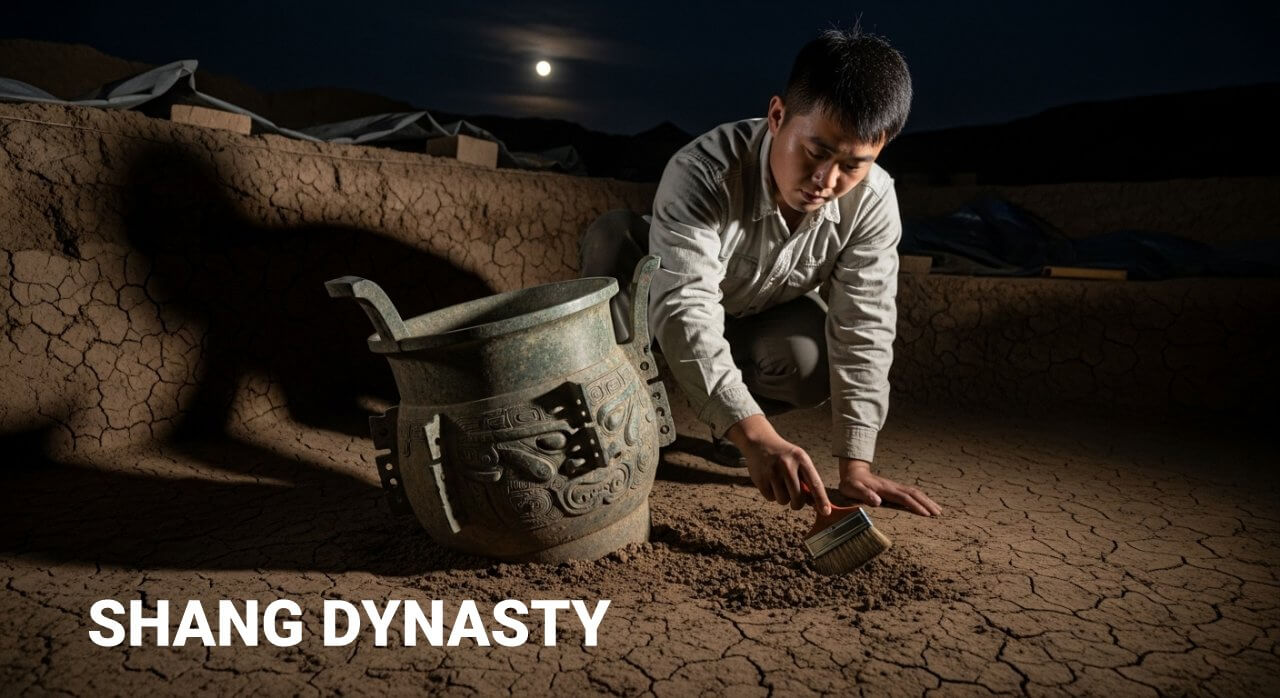
The Shang Dynasty's mastery of bronze technology set it apart from earlier and contemporary cultures. Bronze was used not only for tools and weapons, but more importantly for ritual vessels that symbolized authority, lineage, and divine favor. These vessels, often cast with intricate taotie (饕餮) motifs, were commissioned by nobles and buried with them to ensure continuity in the afterlife.
Shang foundries were capable of producing large, complex pieces using piece-mold casting, a technique unique to China. The volume and quality of Shang bronzes demonstrate centralized control of resources and labor, and suggest a high level of artistic sophistication. These bronzes remain among the most iconic artifacts of ancient China.
Society and Daily Life
Shang society was hierarchical and clan-based. At the top were the king and noble lineages, who controlled land, conducted rituals, and led military campaigns. Beneath them were artisans, bronze workers, and scribes. Farmers—mostly commoners—lived in small villages and cultivated millet, wheat, and rice using stone tools and wooden plows.
Slavery existed, and prisoners of war were sometimes sacrificed in rituals or buried with nobles. Human and animal sacrifices—particularly dogs and horses—were common in tombs, reflecting the importance of serving one's master even in death. Social mobility was limited, and lineage determined one's role in society.
Lady Fu Hao: Warrior and Priestess
One of the most remarkable figures of the Shang Dynasty was Lady Fu Hao (婦好, Fù Hǎo), wife of King Wu Ding. She was a military general, high priestess, and noblewoman. Inscriptions on oracle bones confirm she led campaigns against enemy tribes and was deeply involved in rituals. Her tomb, discovered intact at Yinxu, contained over 1,000 artifacts including weapons, bronzes, jade carvings, and even a battle ax with her name inscribed.
Fu Hao's prominence challenges assumptions about gender roles in early China and underscores the complexity of Shang society. Her life demonstrates that women of noble rank could wield significant religious and military power.
King Wu Ding and the Peak of Shang Power
King Wu Ding (武丁, Wǔ Dīng) ruled during the height of Shang power and expansion. He solidified the dynasty’s borders, led numerous military campaigns, and presided over a flourishing of bronze casting and divination. His reign, which lasted over four decades, is the most thoroughly documented in oracle bone records.
Wu Ding expanded Shang influence through strategic alliances and displays of ritual grandeur. His court was a hub of political, religious, and military activity. Under his rule, the Shang state grew more centralized, and its rituals more elaborate. His era marks the golden age of the Shang Dynasty.
The Fall of the Shang
The last Shang king, Zhou of Shang (紂王, Zhòu Wáng), is remembered in traditional accounts as a tyrant who indulged in extravagance and cruelty. Whether exaggerated or not, these portrayals reflect a loss of moral legitimacy that made rebellion conceivable. Around 1046 BCE, the Zhou people, led by King Wu of Zhou, launched a successful uprising against the Shang. The decisive Battle of Muye resulted in the capture and suicide of King Zhou.
The fall of the Shang marked the end of China’s first historically attested dynasty and the rise of the Zhou, who would rule for centuries. Yet even in defeat, the Shang left behind a legacy that the Zhou would preserve and reinterpret.
The Mandate of Heaven
To justify their conquest, the Zhou developed the concept of the Mandate of Heaven (天命, tiānmìng). They argued that Heaven had withdrawn its favor from the corrupt Shang and bestowed it upon the virtuous Zhou. This ideological innovation provided a moral rationale for dynastic change and became a core doctrine in Chinese political thought.
Although the Shang did not use the Mandate concept themselves, their fall laid the groundwork for its emergence. The idea that rulers must govern with virtue and harmony or risk divine retribution would echo through every dynasty that followed.
Legacy of the Shang Dynasty
The Shang Dynasty’s legacy endures in multiple dimensions. Its advances in writing, metallurgy, statecraft, and religion shaped the foundations of Chinese civilization. Oracle bones gave birth to Chinese script. Bronze vessels influenced later ritual practices. Concepts of kingship, ancestry, and sacrifice became embedded in Chinese culture for millennia.
Today, Shang bronzes are housed in museums around the world. Archaeological sites like Yinxu are UNESCO World Heritage Sites. The Shang are no longer just a name in ancient texts—they are a vivid, tangible part of China’s past. Their story reminds us that the roots of Chinese identity reach deep into the Bronze Age, where the voices of kings and diviners still echo on cracked bones and cast metal.
 Shang Dynasty
Page Details
This page was created on 7 August 2025. Latest Pages & Updates
Buy Me A Coffee
If you enjoy the information I provide and want to support the work I do, please buy me a coffee! I appreciate it immensely, thank you so much!
