
Zhaoqing, China
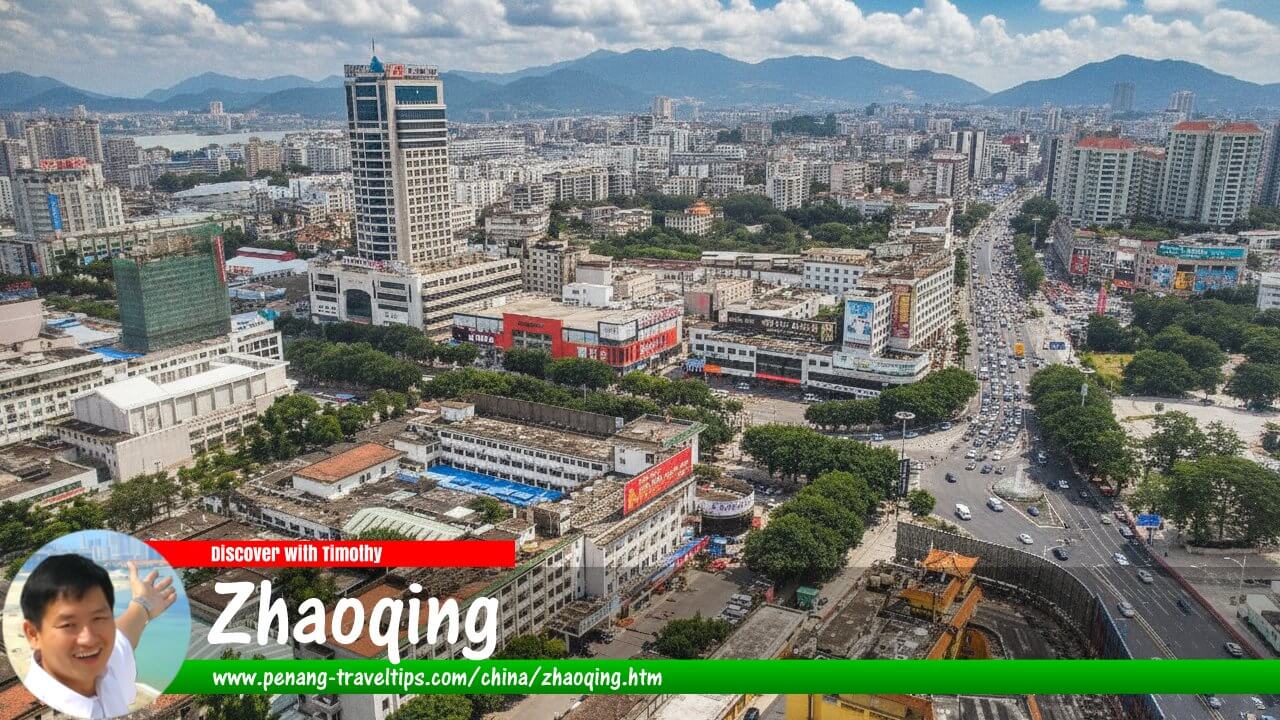 Zhaoqing, China (Photo edited with AI on 16 June 2026)
Zhaoqing (肇庆, Zhàoqìng) is a prefecture-level city in western Guangdong Province, China. Situated along the middle reaches of the Xijiang River, one of the major tributaries of the Pearl River, Zhaoqing is renowned for its rich history, distinctive Lingnan culture, picturesque karst landscapes, and important role as a transportation gateway between Guangdong and southwestern China. Often regarded as one of Guangdong's oldest continuously inhabited cities, Zhaoqing combines historic heritage with modern development and remains one of the province's most attractive destinations for tourism, culture, and commerce.1
Quick Facts
- English Name: Zhaoqing
- Chinese Name: 肇庆
- Pinyin: Zhàoqìng
- Province: Guangdong
- Administrative Status: Prefecture-level city
- Location: Western Guangdong Province, China
- Population: Approximately 4 million
- Area: About 14,900 square kilometres
- Famous For: Seven Star Crags, Dinghu Mountain, Lingnan culture
- Main River: Xijiang River
- Climate: Humid subtropical
- Major Railway Stations: Zhaoqing East Railway Station, Zhaoqing Railway Station
- Nearest Major Airport: Guangzhou Baiyun International Airport
Name and Origin
The name Zhaoqing is written as 肇庆 in Chinese and romanized as Zhàoqìng in Hanyu Pinyin. The character zhao (肇) means "to initiate," "to begin," or "to found," while qing (庆) means "celebration" or "auspicious occasion." Together, the name can be interpreted as "beginning of prosperity" or "founding of celebration."
The city received its present name during the Song Dynasty in 1118. The imperial court chose the name to symbolize a favorable beginning and prosperity for the region. Before adopting the name Zhaoqing, the area was known by several other names throughout its long history. The current name reflects both the historical significance and auspicious status the city enjoyed during the imperial era.2
Geography
Zhaoqing is located in western Guangdong Province, approximately 90 kilometres west of Guangzhou. The city occupies a strategic position along the Xijiang River, which serves as one of the major waterways in southern China. It borders Foshan and Guangzhou to the east and extends westward toward Guangxi Zhuang Autonomous Region.
The geography of Zhaoqing is highly diverse. The central urban area is situated on relatively flat land along the river, while mountainous regions dominate much of the northern and western portions of the municipality. Numerous rivers, lakes, wetlands, and forests contribute to the city's scenic beauty and ecological significance.
One of the most remarkable geographical features is the karst landscape found around Seven Star Crags. Limestone formations have been sculpted by natural erosion over millions of years, creating distinctive peaks, caves, and lakes that attract visitors from across China and abroad.
Dinghu Mountain, located northeast of the city centre, is one of southern China's most important nature reserves. The mountain is covered by subtropical forests and contains diverse plant and animal species. Scientists regard the area as an important site for ecological research.
Zhaoqing experiences a humid subtropical climate characterized by hot, humid summers and mild winters. Rainfall is abundant throughout the year, supporting lush vegetation and productive agricultural land.3
Languages and Dialects
Mandarin is the official language used in government, education, and public administration. However, several Chinese dialects are spoken throughout Zhaoqing.
Cantonese is the dominant local language in the urban districts and many surrounding communities. The Cantonese spoken in Zhaoqing belongs to the Yue dialect family and shares many similarities with the varieties spoken in Guangzhou and Hong Kong.
In some counties and rural areas, particularly those closer to Guangxi, local variants of Yue Chinese are spoken. These dialects may differ significantly in pronunciation and vocabulary from standard Cantonese.
Hakka Chinese is also spoken in certain parts of the municipality, particularly in areas that experienced historical migration by Hakka communities. Hakka speakers maintain distinctive cultural traditions, cuisine, and linguistic characteristics.
Some residents in border areas may also speak local dialects influenced by neighboring regions. Despite this linguistic diversity, Mandarin serves as a common language that enables communication across different communities.4
History
Zhaoqing possesses one of the longest recorded histories in Guangdong Province. Archaeological evidence suggests that people inhabited the area thousands of years ago.
During the Qin Dynasty (221–206 BCE), southern China was incorporated into the unified Chinese empire. The region that would become Zhaoqing gradually developed as settlers moved southward and established administrative centers.
During the Han Dynasty (206 BCE–220 CE), the city emerged as an important political and commercial center. Its location along major river routes facilitated trade between inland China and the southern coast.
By the Tang and Song dynasties, Zhaoqing had become one of the most significant cities in Lingnan, the historical region encompassing much of modern Guangdong and Guangxi. Scholars, merchants, and government officials contributed to the city's cultural and economic development.
In 1118, during the Song Dynasty, the city received the name Zhaoqing. Over subsequent centuries, it served as an important administrative center and transportation hub.
European missionaries and traders reached the region during the Ming Dynasty. Notably, the Italian Jesuit missionary Matteo Ricci spent time in Zhaoqing during the sixteenth century, where he established one of the earliest Christian missions in mainland China.
During the Qing Dynasty, river commerce continued to support prosperity. Agricultural production, handicrafts, and trade flourished throughout the region.
Following the establishment of the People's Republic of China in 1949, Zhaoqing underwent extensive modernization. Transportation infrastructure, manufacturing industries, and urban development transformed the city into an important component of Guangdong's economy.5
Economy and Products
Zhaoqing's economy is based on manufacturing, agriculture, tourism, logistics, and emerging high-technology industries. Its strategic location within the Guangdong-Hong Kong-Macao Greater Bay Area has strengthened its role as a regional economic center.
Manufacturing
The city has developed industrial parks specializing in electronics, automotive parts, machinery, building materials, metal products, and household goods. Investment from domestic and international companies has accelerated industrial growth.
Agriculture
Zhaoqing's fertile plains and favorable climate support the cultivation of rice, fruits, vegetables, sugarcane, and aquatic products. Citrus fruits, lychees, and longans are among the region's notable agricultural products.
Tourism
Tourism contributes significantly to the local economy. Scenic attractions such as Seven Star Crags and Dinghu Mountain attract millions of visitors annually. Hotels, restaurants, transportation services, and cultural attractions generate substantial revenue.
Traditional Products
Zhaoqing is famous for producing high-quality inkstones known as Duan Inkstones (端砚). These inkstones have been prized by Chinese calligraphers and scholars for more than a thousand years and are regarded as one of China's Four Famous Inkstones.
Logistics and Trade
The Xijiang River continues to serve as an important transportation corridor. River ports facilitate the movement of goods between Guangdong and inland provinces, supporting regional trade and industrial development.6
How to Go There
By Air
Zhaoqing does not currently operate a major commercial airport with extensive scheduled passenger services. Most international and domestic visitors arrive through Guangzhou Baiyun International Airport, located approximately 100 to 120 kilometres east of central Zhaoqing.
Guangzhou Baiyun International Airport is one of China's busiest aviation hubs. Airlines serving the airport include China Southern Airlines, Air China, China Eastern Airlines, Hainan Airlines, Cathay Pacific, Singapore Airlines, Emirates, Qatar Airways, Malaysia Airlines, Thai Airways, and many others. Direct flights connect Guangzhou with major cities throughout China, Asia, Europe, Australia, Africa, and North America.
Travelers can continue to Zhaoqing by high-speed rail, airport bus, taxi, private transfer, or ride-hailing service.
By Rail
Zhaoqing enjoys excellent railway connections.
- Zhaoqing East Railway Station – Located in Dinghu District and served by high-speed trains connecting Guangzhou, Shenzhen, Hong Kong, Nanning, Guiyang, and other major cities.
- Zhaoqing Railway Station – Located closer to the urban centre and served by conventional and regional rail services.
- Dinghu East Railway Station – Another important station within the city's high-speed rail network.
High-speed trains connect Guangzhou and Zhaoqing in approximately 30 to 60 minutes depending on the service.
By Long-Distance Bus
Major long-distance bus terminals include Zhaoqing Long-Distance Passenger Transport Terminal and district-level passenger stations. Regular services connect the city with Guangzhou, Shenzhen, Foshan, Dongguan, Zhuhai, Jiangmen, Nanning, Guilin, and numerous other destinations.
How to Travel Locally
Taxis
Taxis are widely available throughout the urban districts and provide convenient transportation to hotels, railway stations, shopping centres, and tourist attractions.
E-Hailing Services
Ride-hailing services such as Didi are commonly used throughout Zhaoqing. Visitors can easily book rides using smartphone applications.
Public Buses
Zhaoqing operates an extensive public bus network connecting residential neighborhoods, business districts, transportation hubs, and scenic attractions.
Tourist Shuttle Services
Dedicated tourist buses operate between major attractions such as Seven Star Crags, Dinghu Mountain, and other scenic areas.
Rail Transit
Zhaoqing currently does not have a subway, MRT, LRT, or metro system. However, regional railway services provide convenient transportation between districts and nearby cities.
Rickshaws and Tuk Tuks
Traditional rickshaws, trishaws, and tuk tuks are generally not part of the city's transportation system. Modern buses, taxis, and ride-hailing vehicles are the primary modes of local travel.
Tourist Attractions
Seven Star Crags (Qixingyan)
The city's most famous attraction, Seven Star Crags features seven limestone peaks rising dramatically from lakes and wetlands. The landscape is often compared to Guilin and is celebrated for its natural beauty.
Dinghu Mountain
One of China's earliest nature reserves, Dinghu Mountain is known for ancient forests, waterfalls, temples, and biodiversity. It is a UNESCO-recognized biosphere reserve.
Duan Inkstone Cultural Village
This attraction showcases the history and craftsmanship of Duan inkstones, allowing visitors to observe traditional carving techniques.
Ancient City Wall of Zhaoqing
Built during the Song Dynasty and expanded in later periods, the city wall is one of the best-preserved ancient urban fortifications in Guangdong.
Mei'an Temple
Founded during the Song Dynasty, this historic Buddhist temple contains valuable cultural relics and traditional architecture.
Xijiang River Scenic Area
The riverfront offers picturesque views, walking paths, parks, and opportunities to observe the important waterway that has shaped the city's history.
Yanzhou Island
Known for its rural scenery, traditional villages, and birdlife, Yanzhou Island provides a peaceful contrast to the urban environment.
Baogong Temple
This temple commemorates Bao Zheng, the famous Song Dynasty official renowned for integrity and justice.
Xinghu Lake
Surrounding the Seven Star Crags, Xinghu Lake offers boating, photography, and scenic walking opportunities.
Longmu Temple
Dedicated to the legendary Dragon Mother, this important religious site reflects local folk beliefs and cultural traditions.
Zhaoqing, China is  the Map of Cities in China
References
- Encyclopaedia Britannica – Zhaoqing
- Travel China Guide – Zhaoqing Overview
- UNESCO World Heritage Centre
- Ethnologue – Languages of Guangdong
- Encyclopaedia Britannica – Matteo Ricci
- Guangdong Provincial Government – Economic and Tourism Information
Page Details
This page was created/modified on 16 June 2026. Hi, my name is Timothy and created it from my research, for my own entertainment, knowledge and to satisfy my curiosity. I am providing the information to you in good faith and hope it is useful. I try to get the details as accurate as possible. I also try to update the page whenever I stumble on new details. So this and all my other pages are perpetual work in progress. If you discover any error, please politely inform me, pointing out where the error lies, and I will correct it as soon as possible. Your helpfulness will keep this page accurate, relevant and helpful to those who need the information.