
Shaoguan, China
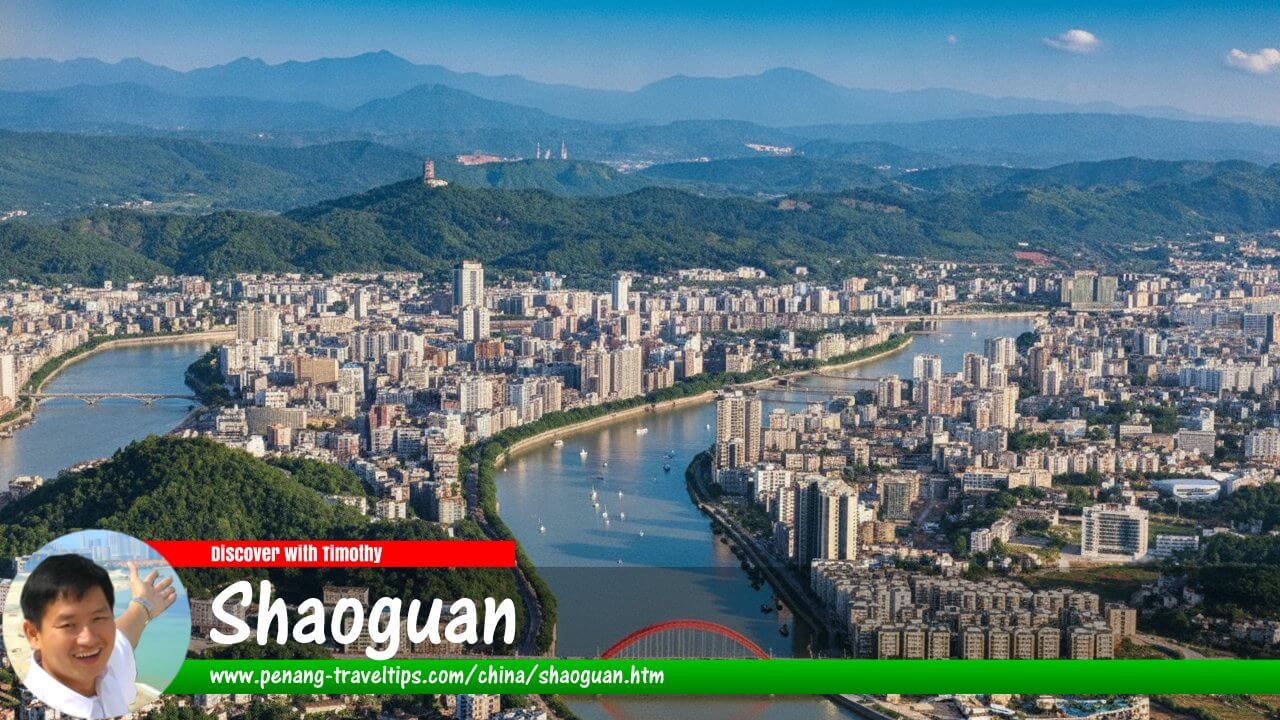 Shaoguan, China (Photo edited with AI on 18 June 2026)
Shaoguan (Chinese: 韶关; pinyin: Sháoguān) is a prefecture-level city in northern Guangdong Province, China. Located at the junction of Guangdong, Hunan, and Jiangxi provinces, it serves as an important gateway between southern and central China. The name "Shaoguan" derives from the ancient Shaozhou (韶州), a historic administrative region established during imperial times. The character "Shao" (韶) is associated with the nearby Shaoshi Mountain and the legendary Shao music mentioned in ancient Chinese texts, while "guan" (关) means a mountain pass or strategic gateway. Together, the name reflects the city's historical role as a key transportation and military passage through the Nanling Mountains.1
Today, Shaoguan is renowned for its spectacular natural scenery, including the UNESCO-listed Danxia Mountain, rich mineral resources, and diverse cultural heritage. As one of Guangdong's largest cities by land area, it combines mountainous landscapes, historic sites, Hakka traditions, and modern industry.2
Quick Facts
- English Name: Shaoguan
- Chinese Name: 韶关
- Pinyin: Sháoguān
- Province: Guangdong
- Region: Northern Guangdong
- Administrative Status: Prefecture-level city
- Population: Approximately 2.8 million
- Area: About 18,400 square kilometres
- Climate: Humid subtropical climate
- Famous For: Danxia Mountain, Nanhua Temple, Hakka culture
- Main Industries: Mining, metallurgy, manufacturing, tourism
The Name of Shaoguan
The city's name evolved from Shaozhou, an important prefecture established during the Sui and Tang dynasties. The term "Shao" is linked to local mountains and ancient cultural references, while "guan" refers to a strategic mountain pass. Historically, the city controlled one of the most important routes connecting Guangdong with inland China, making it a vital military and commercial checkpoint.1
Because of its location near the Nanling mountain passes, Shaoguan became known as the "Northern Gate of Guangdong." Merchants, officials, soldiers, and travelers moving between northern and southern China often passed through the city.
Geography
Shaoguan is situated in northern Guangdong Province and borders Hunan Province to the north and Jiangxi Province to the east. The city occupies a strategic position among the Nanling Mountains, which form a natural barrier between southern and central China.2
The terrain is predominantly mountainous and hilly, with numerous rivers, valleys, and forested areas. The North River (Beijiang), one of Guangdong's major waterways, flows through the city and has historically supported transportation, agriculture, and settlement.
Shaoguan experiences a humid subtropical climate characterized by warm summers, mild winters, and abundant rainfall. Annual precipitation supports extensive forests and agricultural activities. The mountainous environment also contributes to cleaner air and cooler temperatures compared with many cities in the Pearl River Delta.
The region is particularly famous for the Danxia landform, a unique geological landscape characterized by red sandstone cliffs, steep peaks, natural bridges, and unusual rock formations. Danxia Mountain is one of China's most celebrated geological attractions and has been recognized as part of the China Danxia UNESCO World Heritage Site.3
Languages and Dialects
Mandarin is the official language used in government, education, and media. However, Shaoguan has significant linguistic diversity due to its position between several cultural regions.
Cantonese is widely spoken, particularly in urban areas and communities with close connections to the Pearl River Delta. The local Cantonese dialect differs somewhat from the Guangzhou variety due to regional influences.
Hakka Chinese is also extensively spoken, especially in rural districts and counties such as Nanxiong, Shixing, and Wengyuan. The Hakka people have lived in northern Guangdong for centuries and have preserved distinctive linguistic and cultural traditions.
In some border areas, local dialects influenced by Gan Chinese and Xiang Chinese may also be found because of proximity to Jiangxi and Hunan provinces. This linguistic diversity reflects Shaoguan's historical role as a crossroads between different regions of China.
History
The area around Shaoguan has been inhabited for thousands of years. Archaeological discoveries indicate that human communities lived in the region during prehistoric times. During the Qin Dynasty, northern Guangdong was gradually incorporated into the Chinese empire, and the area became part of important transportation routes linking the south with the central plains.4
During the Sui and Tang dynasties, Shaozhou Prefecture became an important administrative center. The city's location along mountain passes made it strategically valuable for controlling trade and military movements.
Throughout the Song, Yuan, Ming, and Qing dynasties, Shaoguan remained a significant transportation hub. Merchants carrying tea, ceramics, silk, and agricultural products frequently traveled through the city.
The region also played a role in the spread of Buddhism. Nanhua Temple, located near Shaoguan, became one of the most influential Buddhist temples in China and is closely associated with Huineng, the Sixth Patriarch of Zen Buddhism.
During the twentieth century, Shaoguan experienced industrialization based on mining and manufacturing. Following China's economic reforms, the city diversified its economy and expanded tourism centered on its natural and cultural attractions.
Economy and Products
Shaoguan possesses one of Guangdong Province's richest concentrations of mineral resources. Deposits of iron ore, lead, zinc, tungsten, and rare earth elements have supported mining and metallurgical industries for decades.5
The city is an important producer of steel, non-ferrous metals, machinery, and construction materials. Industrial parks have attracted investment in electronics, advanced manufacturing, and renewable energy industries.
Agriculture remains significant in rural areas. Major agricultural products include rice, vegetables, tea, citrus fruits, mushrooms, and bamboo products. The mountainous environment is also suitable for forestry, making timber and bamboo important local resources.
Tourism has become a growing economic sector. Visitors are attracted by Danxia Mountain, Buddhist temples, hot springs, forest parks, and Hakka cultural heritage sites. Eco-tourism and outdoor recreation activities such as hiking and photography contribute significantly to local income.
How to Go There
By Air
Shaoguan currently does not have a major international commercial airport. Most travelers arrive via Guangzhou Baiyun International Airport, located approximately 220 kilometres south of Shaoguan. The airport serves numerous domestic and international airlines, including China Southern Airlines, Air China, China Eastern Airlines, Cathay Pacific, Singapore Airlines, Emirates, and many others.
From Guangzhou Baiyun Airport, travelers can reach Shaoguan by high-speed rail, airport shuttle buses, or highway coaches. The journey typically takes between one and two hours depending on the mode of transport.
By Rail
Shaoguan is well connected by China's high-speed rail network. Shaoguan Station, located in Wujiang District, serves the Beijing–Guangzhou High-Speed Railway and provides direct services to Guangzhou, Shenzhen, Changsha, Wuhan, Beijing, and other major cities.
Shaoguan East Railway Station, closer to the city center, serves conventional rail routes and regional services.
By Long-Distance Bus
Several major bus terminals operate within Shaoguan, including Shaoguan Passenger Transport Terminal. Long-distance buses connect the city with Guangzhou, Shenzhen, Dongguan, Foshan, Hunan Province, Jiangxi Province, and neighboring cities throughout Guangdong.
How to Travel Locally
Transportation within Shaoguan is convenient and affordable. Taxis are widely available throughout the urban districts and can be hailed on the street or booked through mobile applications.
E-hailing services such as Didi are commonly used and provide an easy way to travel between attractions, hotels, and transportation hubs.
The city operates an extensive public bus network connecting residential areas, commercial districts, railway stations, and tourist attractions.
Shaoguan does not currently have a subway, MRT, LRT, or metro system. There are also no traditional trishaws, rickshaws, or tuk-tuks in regular urban use. Most residents rely on buses, taxis, ride-hailing services, bicycles, electric scooters, and private vehicles.
For visitors exploring scenic areas such as Danxia Mountain, dedicated tourist shuttle buses and sightseeing vehicles are available within the attraction zones.
Tourist Attractions
Danxia Mountain (丹霞山)
Danxia Mountain is Shaoguan's most famous attraction and a UNESCO World Heritage Site. The area features dramatic red sandstone cliffs, unusual rock formations, caves, and scenic hiking trails. It is considered one of the best examples of Danxia landforms in China.3
Nanhua Temple (南华寺)
Nanhua Temple is one of China's most important Buddhist temples and is closely associated with Huineng, the Sixth Patriarch of Chan (Zen) Buddhism. The temple attracts pilgrims and visitors from around the world.
Mount Yunmen Scenic Area (云门山)
This mountain attraction offers spectacular natural scenery, glass walkways, waterfalls, and panoramic views. It is a popular destination for hiking and outdoor recreation.
Nanling National Forest Park (南岭国家森林公园)
Located in the Nanling Mountains, the park contains dense forests, rare wildlife, waterfalls, and some of Guangdong's highest peaks. It is one of the province's premier eco-tourism destinations.
Zhuji Ancient Lane (珠玑古巷)
This historic settlement in Nanxiong preserves traditional architecture and is considered an important ancestral homeland for many Cantonese families whose ancestors migrated southward.
Chebaling National Nature Reserve (车八岭国家级自然保护区)
This protected reserve is known for its biodiversity and subtropical forests. Birdwatchers and nature enthusiasts visit to observe rare plant and animal species.
Jinji Ridge (金鸡岭)
Jinji Ridge features distinctive red rock formations and scenic viewpoints. The area is particularly popular among photographers during sunrise and sunset.
Shaoguan, China is  the Map of Cities in China
References
- Shaoguan – Wikipedia
- Encyclopaedia Britannica – Shaoguan
- UNESCO World Heritage Centre – China Danxia
- China.org.cn – Guangdong History Resources
- Guangdong Provincial Government
Page Details
This page was created/modified on 18 June 2026. Hi, my name is Timothy and created it from my research, for my own entertainment, knowledge and to satisfy my curiosity. I am providing the information to you in good faith and hope it is useful. I try to get the details as accurate as possible. I also try to update the page whenever I stumble on new details. So this and all my other pages are perpetual work in progress. If you discover any error, please politely inform me, pointing out where the error lies, and I will correct it as soon as possible. Your helpfulness will keep this page accurate, relevant and helpful to those who need the information.