
Shanwei, China
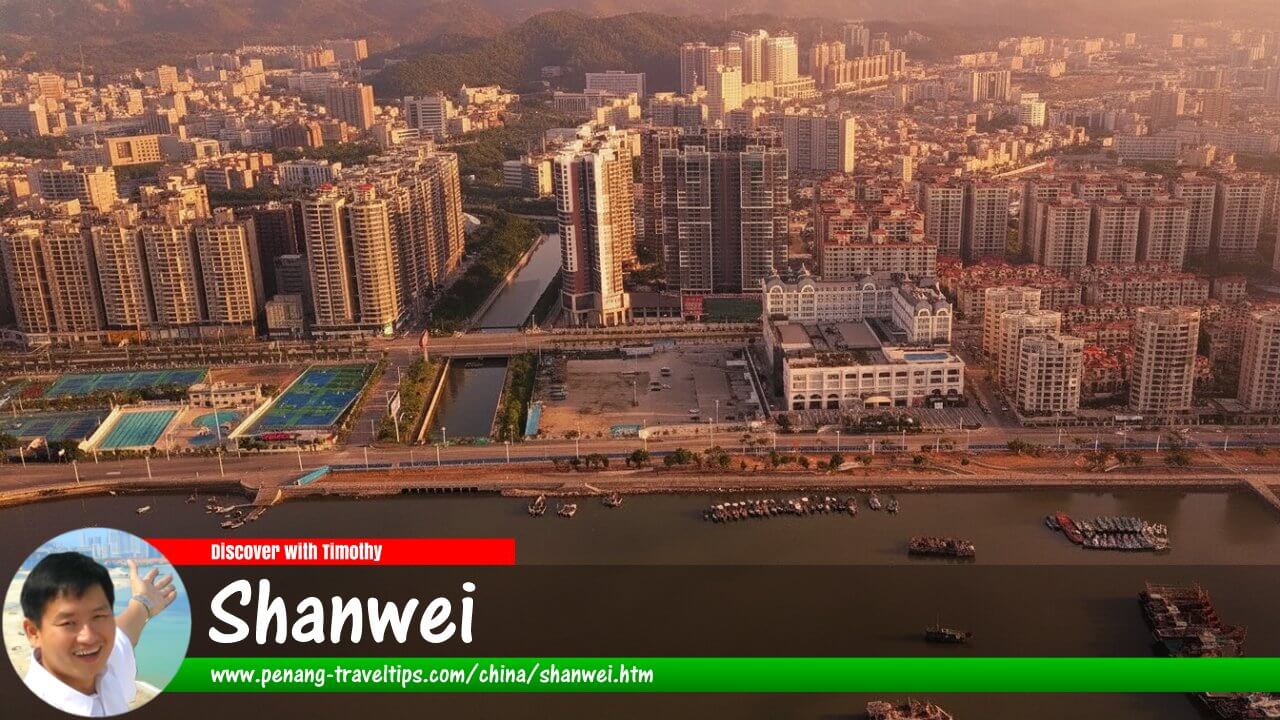 Shanwei, China (Photo edited with AI on 16 June 2026)
Shanwei (Chinese: 汕尾; pinyin: Shànwěi) is a prefecture-level city on the southeastern coast of Guangdong Province, China. Facing the South China Sea, Shanwei is known for its long coastline, fishing traditions, beautiful beaches, island scenery, seafood cuisine, and rich maritime heritage. Although less internationally known than neighboring Shenzhen or Guangzhou, Shanwei possesses a unique coastal character shaped by centuries of trade, fishing, migration, and cultural exchange. The city serves as an important link between the Pearl River Delta and eastern Guangdong and has increasingly emerged as a tourism destination thanks to its natural landscapes and historic sites.1
The name "Shanwei" literally means "the tail of Swatow." Historically, the first character "汕" (shàn) referred to a fishing weir or fish trap commonly found along the coast, while "尾" (wěi) means "tail" or "end." The name reflects the city's historical connection to the coastal region formerly associated with Swatow (Shantou) and its position along the southeastern shoreline of Guangdong Province. Over time, Shanwei developed into an important fishing port and commercial center while retaining its distinctive maritime identity.2
Quick Facts
- English Name: Shanwei
- Chinese Name: 汕尾
- Pinyin: Shànwěi
- Province: Guangdong
- Location: Southeastern Guangdong Province, China
- Population: Approximately 3 million
- Area: About 4,865 square kilometres
- Climate: Humid Subtropical
- Coastline: More than 450 kilometres
- Main Railway Station: Shanwei Railway Station
- Nearest Airport: Jieyang Chaoshan International Airport
- Known For: Fishing industry, Red Bay, beaches, seafood, maritime culture
- Major Water Body: South China Sea
Geography
Shanwei is located on the southeastern coast of Guangdong Province, facing the South China Sea. The city borders Huizhou to the west, Jieyang to the east, Meizhou to the northeast, and Heyuan to the north. Its coastal position has shaped its history, economy, and culture for centuries.1
The municipality covers approximately 4,865 square kilometres and includes the districts of Chengqu and urban Shanwei, as well as the county-level cities and counties of Haifeng, Lufeng, and Luhe. The terrain consists of coastal plains, hills, mountains, bays, islands, and river valleys.
One of Shanwei's most distinctive geographical features is its extensive coastline, which stretches for more than 450 kilometres. Numerous peninsulas, fishing harbors, sandy beaches, and offshore islands contribute to the city's maritime character.
The famous Red Bay (Honghai Bay) forms a prominent coastal feature. The bay is known for its clear waters, scenic beaches, and favorable conditions for water sports and tourism.
Mountainous terrain occupies parts of the northern and inland regions of the municipality. Forested hills provide ecological resources and contribute to biodiversity conservation efforts.
Shanwei experiences a humid subtropical climate. Summers are hot and humid, while winters are generally mild. Average annual temperatures range from 21°C to 23°C, and annual rainfall often exceeds 1,800 millimetres. The city may experience tropical storms and typhoons during the summer and autumn months.
History
The history of Shanwei extends back more than two thousand years. Archaeological discoveries indicate human settlement in the region during ancient times. The area's coastal location made it attractive for fishing, maritime trade, and transportation.2
During the Qin and Han dynasties, the region became integrated into China's imperial administrative system. Fishing villages and agricultural communities gradually developed along the coast and river valleys.
Throughout the Tang and Song dynasties, maritime trade increased significantly. Coastal settlements benefited from commercial exchanges between southern China and neighboring regions across the South China Sea.
During the Ming and Qing periods, Shanwei became known for fishing, salt production, coastal commerce, and maritime activities. Local ports facilitated trade between Guangdong and Southeast Asia.
The city was also associated with the migration of Chinese communities overseas. Many residents left for Southeast Asia and other regions, maintaining cultural and family connections with their ancestral homeland.
In the early twentieth century, parts of the Shanwei region became significant during political and revolutionary movements. Haifeng County, in particular, played an important role in modern Chinese political history through peasant movements led by revolutionary figures such as Peng Pai.3
Following the establishment of the People's Republic of China in 1949, infrastructure, education, and industry gradually developed throughout the region. In 1988, Shanwei was formally established as a prefecture-level city.
Today, Shanwei continues to balance economic development with environmental protection while promoting tourism and preserving its maritime traditions.
Economy and Products
Shanwei's economy is based on fishing, aquaculture, agriculture, manufacturing, renewable energy, logistics, and tourism. The city's coastal location gives it particular advantages in marine industries.
The fishing industry remains one of Shanwei's most important economic sectors. Local fishing fleets harvest a variety of seafood, including fish, shrimp, crab, squid, oysters, and shellfish. Seafood products are distributed throughout Guangdong and beyond.4
Aquaculture has expanded significantly in recent decades. Fish farms and shellfish cultivation operations contribute to local employment and economic output.
Agricultural products include rice, sweet potatoes, vegetables, peanuts, fruits, and tea. The region's warm climate and fertile soils support year-round cultivation.
Manufacturing industries include food processing, textiles, electronics, building materials, machinery, and consumer goods. Industrial parks have attracted investment from companies seeking locations outside the more expensive core areas of the Pearl River Delta.
Tourism is becoming increasingly important. Beaches, coastal scenery, islands, hot springs, and historical sites attract visitors from across Guangdong Province and other parts of China.
Renewable energy projects, particularly offshore wind power, have become significant components of the local economy. Shanwei's coastal waters offer favorable conditions for wind energy development.
How to Go There
By Air
Shanwei does not currently have a major commercial airport serving extensive passenger traffic. Most visitors arrive through nearby airports.
Jieyang Chaoshan International Airport is located approximately 130 kilometres east of Shanwei city centre. Airlines operating there include Air China, China Southern Airlines, China Eastern Airlines, Shenzhen Airlines, Xiamen Airlines, Hainan Airlines, and several other domestic carriers. Flights connect the airport with Beijing, Shanghai, Guangzhou, Shenzhen, Chengdu, Chongqing, Xi'an, Kunming, and numerous other Chinese cities.5
Shenzhen Bao'an International Airport, approximately 170 kilometres west of Shanwei, offers extensive domestic and international connections throughout Asia, Europe, North America, Oceania, and the Middle East.
By Train
Shanwei Railway Station is located in Chengqu District and serves the Xiamen–Shenzhen Railway. High-speed trains connect Shanwei with Shenzhen, Guangzhou, Hong Kong, Xiamen, Fuzhou, and other major cities along China's southeastern coast.6
Additional railway stations within the municipality include Lufeng Railway Station and other stations on regional rail lines.
By Long-Distance Bus
Shanwei Bus Terminal and regional bus stations provide regular services to Guangzhou, Shenzhen, Huizhou, Dongguan, Shantou, Jieyang, and neighboring provinces.
By Road
Modern expressways connect Shanwei with the Pearl River Delta and eastern Guangdong. Travel by coach or private vehicle is convenient due to continuous highway improvements.
How to Travel Locally
Visitors can travel around Shanwei using several transportation options.
- Public Buses: City and regional bus networks connect urban districts, beaches, tourist attractions, and surrounding counties.
- Taxis: Metered taxis are widely available.
- E-Hailing Services: Didi operates throughout the city and functions similarly to Uber.
- Tourist Coaches: Some scenic areas provide shuttle transportation.
- Bicycle and Electric Scooters: Shared bicycles and electric mobility options are available in some urban areas.
Shanwei does not currently have a subway, MRT, metro, or LRT system. Traditional trishaws, rickshaws, and tuk-tuks are generally not part of the city's transportation network. Most residents rely on buses, taxis, ride-hailing services, motorcycles, and private vehicles.
Tourist Attractions
Red Bay (Honghai Bay)
Red Bay is Shanwei's most famous attraction. Known for its long sandy beaches, clear waters, and scenic coastal landscapes, it is a popular destination for swimming, surfing, and relaxation.7
Nanao Peninsula
This scenic coastal area offers dramatic ocean views, fishing villages, beaches, and opportunities for photography and sightseeing.
Xuanwu Mountain Scenic Area
Located in Lufeng, this cultural and religious site contains historic temples, traditional architecture, and important places of worship.
Fengshan Mazu Scenic Area
This attraction is dedicated to Mazu, the Chinese sea goddess revered by coastal communities throughout East and Southeast Asia. Visitors can see a large Mazu statue and enjoy panoramic coastal views.
Haifeng Red Palace
An important historical site associated with revolutionary leader Peng Pai and the early peasant movement in China.
Lotus Mountain Scenic Area
This mountain attraction features hiking trails, forests, temples, waterfalls, and scenic viewpoints overlooking the surrounding countryside.
Jinting Bay
A modern coastal tourism area known for beaches, seaside resorts, recreational facilities, and water sports.
Shanwei Fishing Port
One of the city's busiest fishing harbors, offering visitors a glimpse into the local maritime lifestyle and seafood industry.
Lufeng Ancient Temples
The Lufeng region contains numerous historic temples reflecting local religious traditions and architectural styles.
Marine Ecological Islands
Several offshore islands near Shanwei offer opportunities for boating, fishing, birdwatching, and nature tourism.
Shanwei, China is  the Map of Cities in China
References
- Wikipedia – Shanwei
- Encyclopaedia Britannica – Guangdong Province
- Wikipedia – Peng Pai
- Invest Guangdong – Regional Economic Information
- Wikipedia – Jieyang Chaoshan International Airport
- Wikipedia – Shanwei Railway Station
- Wikipedia – Honghai Bay
Page Details
This page was created/modified on 16 June 2026. Hi, my name is Timothy and created it from my research, for my own entertainment, knowledge and to satisfy my curiosity. I am providing the information to you in good faith and hope it is useful. I try to get the details as accurate as possible. I also try to update the page whenever I stumble on new details. So this and all my other pages are perpetual work in progress. If you discover any error, please politely inform me, pointing out where the error lies, and I will correct it as soon as possible. Your helpfulness will keep this page accurate, relevant and helpful to those who need the information.