
Qingyuan, China
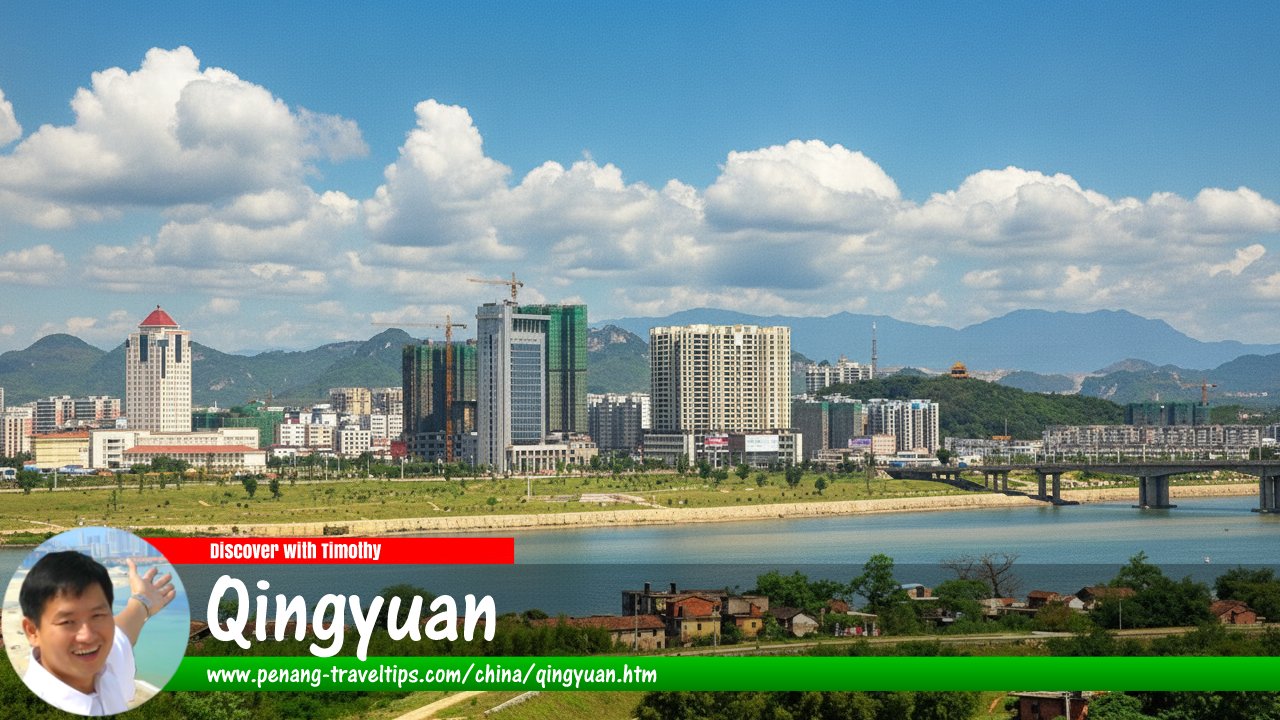 Qingyuan, China (Photo edited with AI on 16 June 2026)
Qingyuan (清远, Qīngyuǎn) is a prefecture-level city in northern Guangdong Province, China. Located along the upper reaches of the Pearl River system and bordering the mountainous regions of southern China, Qingyuan is renowned for its spectacular natural scenery, clear rivers, hot springs, karst formations, and rich cultural heritage. The city serves as an important gateway between the prosperous Pearl River Delta and the inland provinces of southern China. Today, Qingyuan combines traditional rural landscapes with modern industrial development, making it one of Guangdong's most attractive destinations for both tourism and investment.1
Quick Facts
- English Name: Qingyuan
- Chinese Name: 清远
- Pinyin: Qīngyuǎn
- Province: Guangdong
- Administrative Status: Prefecture-level city
- Location: Northern Guangdong Province, China
- Population: Approximately 4 million
- Area: About 19,000 square kilometres
- Known For: Karst landscapes, hot springs, rafting, eco-tourism
- Main Language: Mandarin and Cantonese
- Airport: Guangzhou Baiyun International Airport (nearest major airport)
- Major Railway Stations: Qingyuan Railway Station, Qingyuan East Railway Station
Name and Origin
The name Qingyuan is written as 清远 in Chinese and romanized as Qīngyuǎn in Hanyu Pinyin. The character qing (清) means "clear," "pure," or "clean," while yuan (远) means "far" or "distant." Together, the name can be interpreted as "clear and distant" or "pure and far-reaching."
The name reflects the region's historical reputation for pristine rivers, fresh mountain air, and remote location relative to the more densely populated areas of southern Guangdong. Ancient Chinese officials and scholars often described the region as a place of natural beauty and tranquility, and the name captures this impression. Qingyuan has retained its identity as one of Guangdong's greenest and most environmentally rich cities.2
Geography
Qingyuan occupies a strategic location in northern Guangdong Province. It borders Guangzhou to the south and stretches northward toward the mountainous regions connecting Guangdong with Hunan Province. The city covers a vast area characterized by mountains, valleys, forests, rivers, and karst formations.
The terrain is predominantly mountainous and hilly. Numerous rivers flow through the region, including tributaries of the Pearl River system. These waterways have played an important role in transportation, agriculture, and tourism throughout Qingyuan's history.
One of the city's most distinctive geographical features is its extensive karst landscape. Limestone erosion over millions of years has created dramatic peaks, caves, sinkholes, and underground rivers. These formations attract geologists, photographers, and tourists from across China and abroad.
Qingyuan experiences a humid subtropical climate. Summers are hot and wet, while winters are mild and relatively dry. Annual rainfall is abundant, supporting lush vegetation and extensive forest cover. The region is often regarded as one of Guangdong's most ecologically important areas.
The city's natural resources include timber, mineral deposits, fertile farmland, and abundant water supplies. These resources have contributed significantly to Qingyuan's economic development and environmental significance.3
History
Human settlement in the Qingyuan region dates back thousands of years. Archaeological discoveries indicate that indigenous communities inhabited the area long before it became integrated into the Chinese imperial system.
During the Qin Dynasty (221–206 BCE), southern China was incorporated into a unified Chinese empire. The Qingyuan area gradually came under imperial administration as Chinese settlers expanded southward.
During the Han Dynasty (206 BCE–220 CE), the region became more closely connected to central Chinese political and economic networks. Agricultural development increased, and transportation routes were established along rivers and mountain passes.
Throughout the Tang and Song dynasties, Qingyuan served as an important frontier region linking Guangdong with inland China. Trade and migration encouraged cultural exchanges between different ethnic groups and communities.
During the Ming and Qing dynasties, Qingyuan developed into a significant agricultural area. Rice cultivation expanded, while river transport facilitated commerce with Guangzhou and other major cities. The region also became known for its forest products and traditional handicrafts.
In the twentieth century, Qingyuan underwent substantial modernization. Roads, railways, schools, and industries were established, transforming the local economy. Following China's economic reforms beginning in 1978, Qingyuan benefited from its proximity to the rapidly growing Pearl River Delta.
Today, Qingyuan is recognized as both an industrial center and a major eco-tourism destination. The city continues to balance economic growth with environmental conservation.4
Economy and Products
Qingyuan's economy is diverse, encompassing manufacturing, agriculture, tourism, logistics, and renewable resources. Its location near Guangzhou gives it excellent access to domestic and international markets.
Manufacturing
The city has developed industrial parks specializing in electronics, machinery, automotive components, construction materials, and household products. Many manufacturers choose Qingyuan because of lower land and labor costs compared with major Pearl River Delta cities.
Agriculture
Agriculture remains an important sector. Farmers produce rice, vegetables, fruits, tea, and livestock. Qingyuan chicken is particularly famous throughout China for its high quality and distinctive flavor. The region's clean environment supports the production of premium agricultural products.
Forestry
Extensive forests provide timber, bamboo, medicinal plants, and other forest products. Sustainable forestry management plays an important role in protecting ecological resources while supporting local livelihoods.
Tourism
Tourism has become one of Qingyuan's most dynamic industries. Visitors are drawn by rafting opportunities, hot springs, mountain scenery, cave systems, and rural tourism experiences. Hotels, resorts, restaurants, and recreational facilities contribute significantly to the local economy.
Mineral Resources
The region contains deposits of limestone, granite, and various industrial minerals. These resources support construction and manufacturing industries throughout Guangdong Province.5
How to Go There
By Air
Qingyuan does not currently have a major commercial airport serving large numbers of scheduled passenger flights. Most visitors arrive via Guangzhou Baiyun International Airport, located approximately 60 to 80 kilometres south of central Qingyuan depending on destination within the municipality.
Guangzhou Baiyun International Airport is one of China's busiest airports and is served by airlines including China Southern Airlines, Air China, China Eastern Airlines, Hainan Airlines, Cathay Pacific, Singapore Airlines, Emirates, Qatar Airways, Malaysia Airlines, and many others. The airport offers direct flights from major Chinese cities as well as destinations throughout Asia, Europe, Australia, Africa, and North America.
From the airport, travelers can reach Qingyuan by high-speed rail, intercity rail, airport shuttle buses, private transfers, taxis, or ride-hailing services.
By Rail
Qingyuan is well connected to China's high-speed railway network. Major stations include:
- Qingyuan Railway Station – Located in Qingcheng District and served by high-speed trains connecting Guangzhou, Wuhan, Beijing, Changsha, and other cities.
- Qingyuan East Railway Station – Part of the regional rail system serving nearby urban areas.
- Yingde West Railway Station – An important station serving northern parts of the municipality.
High-speed rail travel from Guangzhou to Qingyuan typically takes less than 30 minutes.
By Long-Distance Bus
Several long-distance bus terminals operate within Qingyuan, including Qingyuan Passenger Transport Terminal and district-level bus stations. Services connect the city with Guangzhou, Shenzhen, Foshan, Dongguan, Zhuhai, and many other destinations throughout Guangdong and neighboring provinces.
How to Travel Locally
Qingyuan has a developing transportation network that enables convenient travel throughout the city and surrounding scenic areas.
Taxis
Taxis are widely available in urban districts. They operate using metered fares and provide convenient transportation between hotels, railway stations, shopping centers, and tourist attractions.
E-Hailing Services
Ride-hailing applications such as Didi are commonly used throughout Qingyuan. These services offer an easy way for visitors to travel within the city and surrounding districts.
Public Buses
An extensive bus network connects residential neighborhoods, commercial districts, transportation hubs, and tourist sites. Bus fares are generally inexpensive.
Rail Transit
Qingyuan does not currently have a metro, MRT, LRT, or subway system. However, intercity rail services provide rapid connections to Guangzhou and other nearby cities.
Rickshaws and Tuk Tuks
Traditional rickshaws and tuk tuks are not a significant part of Qingyuan's transportation system. Visitors primarily rely on buses, taxis, ride-hailing services, and private vehicles.
Car Rentals
Rental cars are available, although many visitors prefer guided tours when visiting scenic mountain and countryside destinations.
Tourist Attractions
Gulong Gorge (Gulongxia)
Gulong Gorge is one of China's most famous rafting destinations. Visitors enjoy white-water rafting, glass bridges, waterfalls, and spectacular canyon scenery.
Yingxi Peak Forest Corridor
Often called the "Little Guilin of Guangdong," this area features dramatic karst peaks, caves, rivers, and traditional villages. It is popular for cycling, photography, and hiking.
Lianzhou Underground River
This remarkable cave system contains underground rivers, illuminated rock formations, and vast chambers. Boat tours allow visitors to explore the subterranean landscape.
Xile Valley Hot Springs
Located amid forested hills, these hot springs attract visitors seeking relaxation and wellness experiences in a natural environment.
Feilai Temple
This historic Buddhist temple has a long history and remains an important religious and cultural site. The temple is surrounded by scenic mountain landscapes.
Qingyuan Xuanzhen Rafting Resort
Known for adventurous rafting experiences, the resort combines outdoor recreation with accommodation and leisure facilities.
Niuyuzui Scenic Area
This ecological park features waterfalls, forests, suspension bridges, and hiking trails. It is a popular destination for families and nature lovers.
Taihe Ancient Cave
The cave complex contains impressive stalactites and stalagmites, along with historical inscriptions and cultural relics.
Pengjiaci Ancient Village
This well-preserved village showcases traditional southern Chinese architecture and offers insight into local history and customs.
Beijiang River Scenic Area
The Beijiang River provides opportunities for river cruises, sightseeing, fishing, and enjoying the picturesque landscapes that define much of Qingyuan's natural beauty.
Qingyuan, China is  the Map of Cities in China
References
- Encyclopaedia Britannica – Qingyuan
- China Daily – Guangdong Regional Information
- Travel China Guide – Qingyuan Overview
- Government of China – Historical and Administrative Information
- Guangdong Provincial Government – Economic and Tourism Information
Page Details
This page was created/modified on 16 June 2026. Hi, my name is Timothy and created it from my research, for my own entertainment, knowledge and to satisfy my curiosity. I am providing the information to you in good faith and hope it is useful. I try to get the details as accurate as possible. I also try to update the page whenever I stumble on new details. So this and all my other pages are perpetual work in progress. If you discover any error, please politely inform me, pointing out where the error lies, and I will correct it as soon as possible. Your helpfulness will keep this page accurate, relevant and helpful to those who need the information.