
Dadiwan and the Birth of Millet Farming in Northern China
In the foothills of the Qinling Mountains, along the upper reaches of the Yellow River, lies an archaeological site that quietly reveals the beginnings of Chinese agriculture. Known as Dadiwan (大地湾, Dàdìwān), this Neolithic settlement flourished as early as 5800 BCE, making it one of the earliest farming communities in East Asia.
Dadiwan’s significance lies in its association with millet cultivation. The grains unearthed here—both foxtail and broomcorn millet—suggest that the people of this region were not just gathering wild plants, but actively domesticating and cultivating them. This marks a major step in the transition from foraging to farming in northern China.
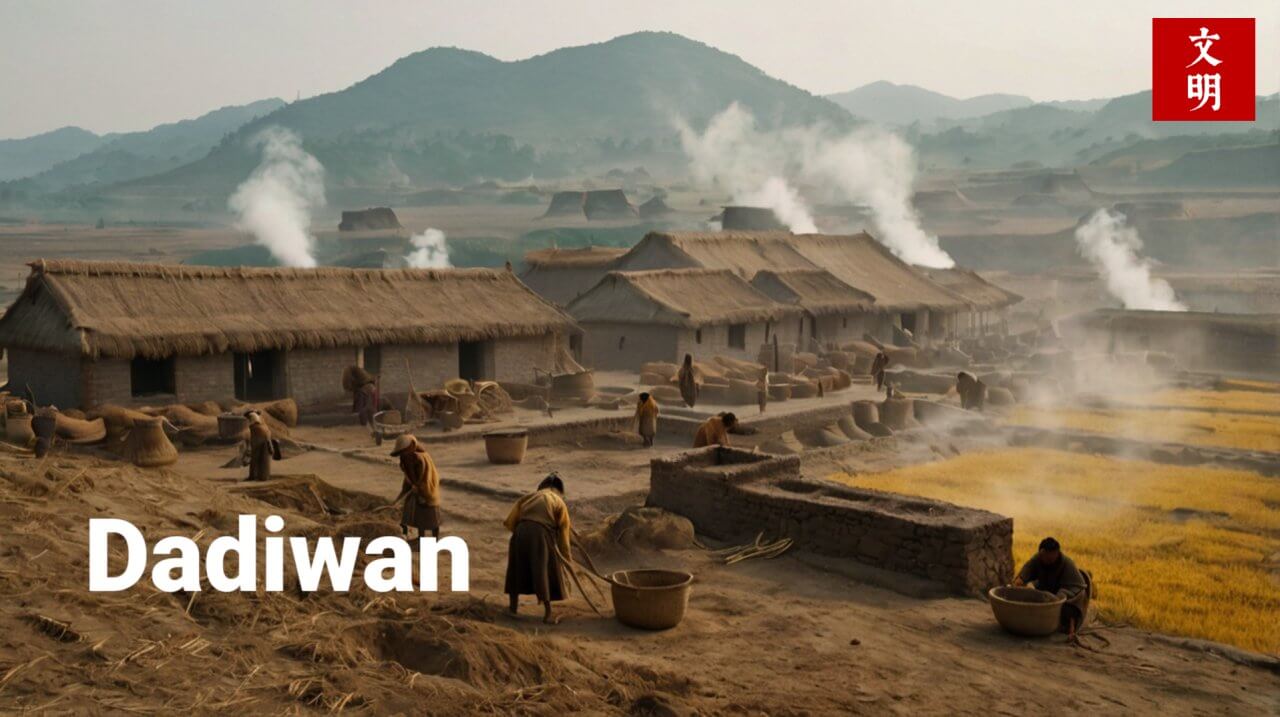
Beyond agriculture, Dadiwan also reveals a sophisticated village life. Archaeologists have discovered rectangular houses with stone foundations, communal buildings, hearths, burial sites, and distinctive red pottery decorated with simple patterns. These findings suggest a degree of social organisation, with shared rituals and emerging cultural identities.
The people of Dadiwan belonged to what is known as the Laoguantai culture, a forerunner of later, more well-known Neolithic traditions like the Yangshao. Their reliance on millet—suited to the dry loess soils of the north—laid an agricultural foundation that would endure in Chinese civilisation for thousands of years.
Though modest in scale, Dadiwan offers us a precious glimpse into a time when human communities began to shape their environment deliberately. It was here, amid the river valleys and yellow earth, that agriculture took root, and with it, the slow unfolding of settled life in China’s north.
Related Topics:
Back to Prehistoric China: The Dawn of Chinese Civilisation
Page Details
This page was created on 11 July 2025.Featured Video: The Shang Dynasty
 Latest Pages & Updates
Buy Me A Coffee
If you enjoy the information I provide and want to support the work I do, please buy me a coffee! I appreciate it immensely, thank you so much!
