
Banpo and the Yangshao Culture: A Neolithic Village in Ancient China
On the outskirts of modern-day Xi’an, long before the city’s imperial walls rose, a different kind of community thrived. The Banpo site (半坡, Bànpō), dating back to around 4800 to 3600 BCE, is one of the best-preserved and most evocative examples of early Neolithic life in China. It belonged to the vibrant Yangshao Culture (仰韶文化, Yǎngsháo wénhuà), whose influence stretched widely across the Yellow River basin.
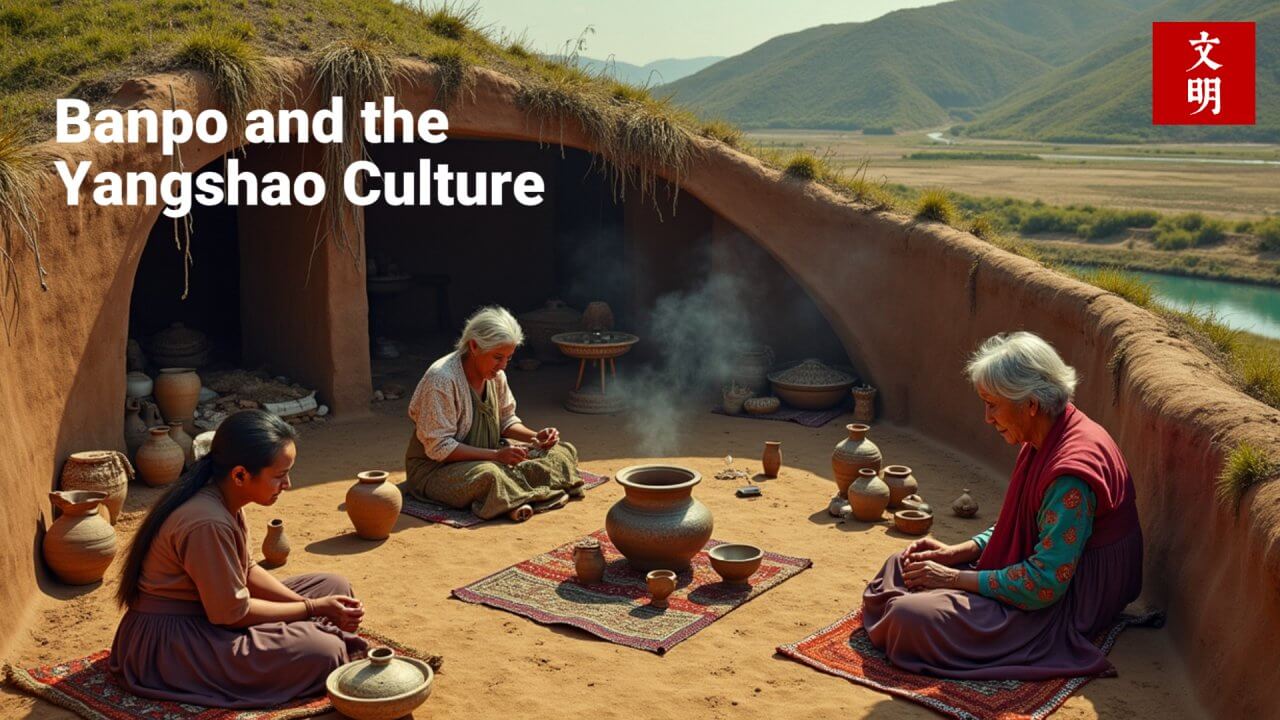
Banpo was more than a cluster of huts — it was a planned village. Archaeologists uncovered over 40 semi-subterranean houses, arranged around a central plaza, with clearly demarcated residential, industrial, and burial zones. The presence of kilns, pottery workshops, storage pits, and drainage systems reveals a high level of practical organisation and community life.
The people of Banpo were millet farmers, supported by domesticated animals such as pigs and dogs. They also hunted and fished to supplement their diet. What truly sets Banpo apart, however, is its pottery. Red clay pots with bold black geometric designs — and in some cases, early proto-symbols — hint at artistic expression and possibly even rudimentary forms of communication or clan identity.
Burials at Banpo reflect social and ritual life. Some graves include grave goods like pottery, tools, and ornaments, suggesting a society that respected its dead and possibly held spiritual beliefs. There’s also evidence that women may have held central roles in the community, based on the positioning of grave goods and other cultural markers.
Banpo allows us to walk through a vanished world — not one of kings or armies, but of ordinary people who planted, crafted, cooked, raised children, and buried their loved ones. In their patterns of daily life, we see the roots of civilisation beginning to take hold in the heart of Neolithic China.
Related Topics:
Back to Prehistoric China: The Dawn of Chinese Civilisation
Page Details
This page was created on 11 July 2025.Featured Video: The Shang Dynasty
 Latest Pages & Updates
Buy Me A Coffee
If you enjoy the information I provide and want to support the work I do, please buy me a coffee! I appreciate it immensely, thank you so much!
