
Meizhou, China
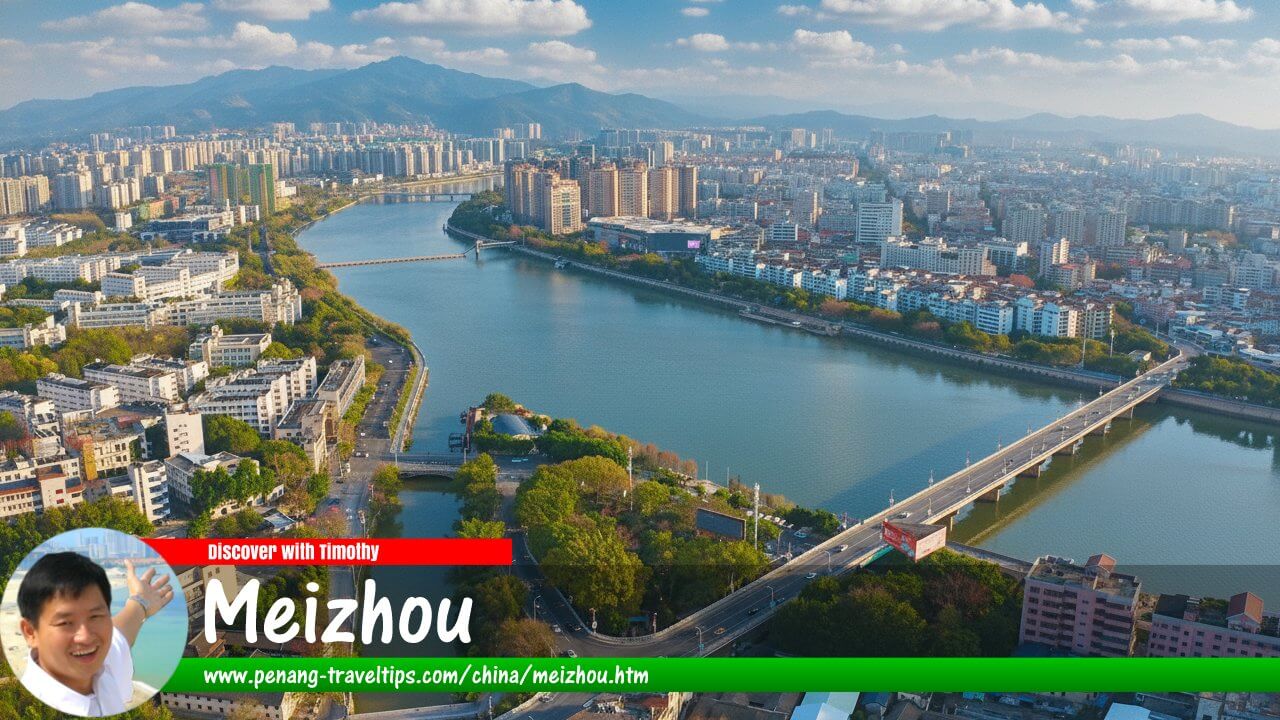 Meizhou, China (Photo edited with AI on 16 June 2026)
Meizhou (Chinese: 梅州; pinyin: Méizhōu) is a prefecture-level city in northeastern Guangdong Province, China. Widely recognized as the ancestral home and cultural heartland of the Hakka people, Meizhou occupies a unique position in Chinese history and culture. The city is known for its mountainous landscapes, distinctive Hakka architecture, traditional customs, tea production, and deep connections with overseas Chinese communities around the world. Situated at the junction of Guangdong, Fujian, and Jiangxi provinces, Meizhou has long served as an important cultural and transportation gateway between southern and southeastern China.1
The name "Meizhou" literally means "Plum Prefecture." The first character, "梅" (méi), means plum, referring to the plum trees that historically grew in the region and the nearby Mei River, while "州" (zhōu) was a traditional Chinese administrative term for a prefecture. The city's modern name reflects both its historical administrative status and its close association with the Mei River, which has played a central role in local development for centuries.2
Quick Facts
- English Name: Meizhou
- Chinese Name: 梅州
- Pinyin: Méizhōu
- Province: Guangdong
- Administrative Status: Prefecture-level city
- Population: Approximately 4 million
- Area: Approximately 15,800 square kilometres
- Main River: Mei River
- Climate: Humid Subtropical
- Airport: Meizhou Meixian Airport
- Known For: Hakka culture and heritage
- Main Language: Hakka Chinese and Mandarin
- Major Industries: Agriculture, tea, manufacturing, tourism
- Nickname: Capital of Hakka Culture
Geography
Meizhou is located in northeastern Guangdong Province and borders Fujian Province to the east and Jiangxi Province to the north. The city occupies a strategic position within the mountainous interior of southern China and serves as a geographical link between the Pearl River Delta and inland regions.1
The municipality covers a large area characterized by mountains, hills, river valleys, and forests. Much of the terrain belongs to the southern extensions of the Wuyi and Nanling mountain systems. Elevations vary considerably across the municipality, creating diverse landscapes and ecological environments.
The Mei River, from which the city derives its name, flows through the urban area before joining larger river systems that ultimately reach the South China Sea. The river has historically provided transportation routes, irrigation, and fertile agricultural land.
Meizhou enjoys a humid subtropical climate. Summers are warm and humid, while winters are relatively mild compared to northern China. Average annual temperatures range between 20°C and 22°C, while annual rainfall generally exceeds 1,400 millimetres. The abundant precipitation supports agriculture and contributes to the region's lush vegetation.
The city's extensive forests and mountain scenery make it one of Guangdong's most environmentally rich regions. Protected natural areas preserve biodiversity and attract ecotourism activities.
History
The history of Meizhou stretches back more than two thousand years. Archaeological evidence indicates human settlement in the region since prehistoric times. During the Qin and Han dynasties, the area became incorporated into the imperial administrative system, laying the foundation for future development.3
Meizhou's historical significance is closely linked to the migration of the Hakka people. Beginning during periods of political instability in northern China, waves of migrants moved southward over many centuries. Many settled in the mountainous regions of present-day Meizhou, where they developed a distinctive cultural identity while preserving aspects of northern Chinese traditions.
During the Tang and Song dynasties, the region experienced significant population growth and agricultural expansion. New settlements were established, irrigation systems improved, and local commerce flourished.
Throughout the Ming and Qing dynasties, Meizhou became one of the most important centers of Hakka culture. Unique architectural styles, clan organizations, educational traditions, and dialects evolved during this period. The region also produced numerous scholars, officials, military leaders, and merchants.
In the nineteenth and early twentieth centuries, large numbers of Hakka residents emigrated overseas. Many settled in Southeast Asia, the Caribbean, North America, and other regions. These emigrants maintained strong ties to their ancestral homeland, contributing to the city's international cultural connections.4
During the twentieth century, Meizhou experienced political and economic changes associated with the fall of the Qing Dynasty, the Republican era, the Second World War, and the establishment of the People's Republic of China. Infrastructure improvements and modernization gradually transformed the city while preserving many traditional cultural elements.
Today, Meizhou is widely recognized as one of China's foremost centers of Hakka heritage and culture. Numerous cultural festivals, museums, and historical sites celebrate this unique identity.
Economy and Products
Meizhou's economy combines agriculture, manufacturing, tourism, and cultural industries. The city has traditionally been an agricultural region, although industrial and service sectors have expanded significantly in recent decades.
Agriculture remains important, particularly in rural areas. Major products include rice, vegetables, fruits, tea, tobacco, and medicinal herbs. Meizhou is especially known for producing high-quality tea varieties, including several types of green and oolong tea.5
The city is also famous for pomelos, oranges, and other subtropical fruits grown in its fertile valleys. Livestock farming and aquaculture contribute additional income to rural communities.
Manufacturing industries include electronics, building materials, machinery, food processing, textiles, pharmaceuticals, and consumer products. Industrial development has accelerated with improved transportation infrastructure linking Meizhou to major economic centers in Guangdong.
Tourism has become an increasingly important economic sector. Visitors are attracted by Hakka cultural heritage, traditional architecture, mountain scenery, hot springs, and historical landmarks.
Traditional handicrafts, including bamboo products, woodcarving, ceramics, and folk art, continue to play a role in the local economy. These industries preserve cultural traditions while providing employment opportunities.
The overseas Hakka community also contributes to economic development through investment, business partnerships, educational initiatives, and cultural exchanges.
How to Go There
By Air
Meizhou Meixian Airport is located approximately 5 kilometres southwest of Meizhou city centre. The airport serves as the primary aviation gateway to the region and offers convenient access to major Chinese cities.6
Airlines operating at the airport include China Southern Airlines, China Eastern Airlines, Air China, Shenzhen Airlines, and several regional carriers. Flights connect Meizhou with destinations such as Beijing, Shanghai, Guangzhou, Shenzhen, Chengdu, Chongqing, Haikou, and other major cities.
For additional international connections, travelers may also use Jieyang Chaoshan International Airport, Guangzhou Baiyun International Airport, or Shenzhen Bao'an International Airport.
By Train
Meizhou Railway Station is located within the urban area and provides conventional rail services. High-speed rail services are available through newer stations connected to China's expanding rail network.
Rail connections link Meizhou with Guangzhou, Shenzhen, Xiamen, Fuzhou, Nanchang, Ganzhou, and other important cities in southern China.7
By Long-Distance Bus
Several long-distance bus terminals serve Meizhou, offering regular routes throughout Guangdong Province as well as neighboring Fujian, Jiangxi, Hunan, and Guangxi provinces.
By Road
Modern expressways connect Meizhou with Guangzhou, Shenzhen, Shantou, Chaozhou, Ganzhou, Longyan, and other regional centers. These highways have significantly improved accessibility and reduced travel times.
How to Travel Locally
Meizhou offers a range of transportation options suitable for both residents and tourists.
- Public Buses: Extensive urban and suburban routes connect major districts and attractions.
- Taxis: Metered taxis are readily available throughout the city.
- E-Hailing Services: Didi Chuxing operates extensively and serves a similar role to Uber.
- Private Vehicles: Car rentals and private transportation are available.
- Bicycles and Electric Scooters: Popular for short-distance travel.
Meizhou currently does not have a subway, MRT, metro, or LRT system. Traditional transportation methods such as trishaws, rickshaws, and tuk-tuks are generally not part of the city's public transport network. Most travelers rely on buses, taxis, ride-hailing services, bicycles, or private vehicles.
Tourist Attractions
Hakka Round Houses and Traditional Villages
Although more famous in neighboring Fujian, Meizhou contains numerous traditional Hakka settlements and fortified residences that illustrate the architectural heritage of the Hakka people.
Ye Jianying Memorial Park
This memorial honors Marshal Ye Jianying, one of the founders of the People's Republic of China, who was born in Meizhou. The complex includes museums, monuments, and landscaped gardens.
Yannanfei Tea Plantation Scenic Area
One of Meizhou's most popular attractions, this scenic tea plantation offers beautiful landscapes, tea culture exhibitions, and opportunities to sample local teas.
Lingguang Temple
Located on Yinna Mountain, Lingguang Temple is one of the most important Buddhist temples in the Hakka region. The temple has a history dating back more than a thousand years.
Yinna Mountain
This mountain is among the highest peaks in eastern Guangdong and offers hiking trails, scenic viewpoints, forests, and cultural sites.
China Hakka Museum
The museum provides a comprehensive introduction to Hakka history, migration, culture, architecture, language, and traditions.
Qianfo Pagoda
Located within Meizhou's urban area, this impressive pagoda is a prominent local landmark and religious site.
Songkou Ancient Town
This historic riverside town preserves traditional architecture and offers insight into the lives of generations of Hakka merchants and emigrants.
Ketianxia Scenic Area
A large cultural tourism complex featuring Hakka-themed architecture, museums, gardens, recreational facilities, and cultural performances.
Longjing River Scenic Area
Known for its waterfalls, streams, forests, and hiking opportunities, this natural attraction showcases the beauty of Meizhou's mountainous environment.
Meizhou, China is  the Map of Cities in China
References
- Wikipedia – Meizhou
- Encyclopaedia Britannica – Guangdong Province
- Meizhou Municipal Government
- Wikipedia – Hakka People
- Travel China Guide – Meizhou
- Wikipedia – Meixian Airport
- Wikipedia – Meizhou Railway Station
Page Details
This page was created/modified on 16 June 2026. Hi, my name is Timothy and created it from my research, for my own entertainment, knowledge and to satisfy my curiosity. I am providing the information to you in good faith and hope it is useful. I try to get the details as accurate as possible. I also try to update the page whenever I stumble on new details. So this and all my other pages are perpetual work in progress. If you discover any error, please politely inform me, pointing out where the error lies, and I will correct it as soon as possible. Your helpfulness will keep this page accurate, relevant and helpful to those who need the information.