
Kaiping, China
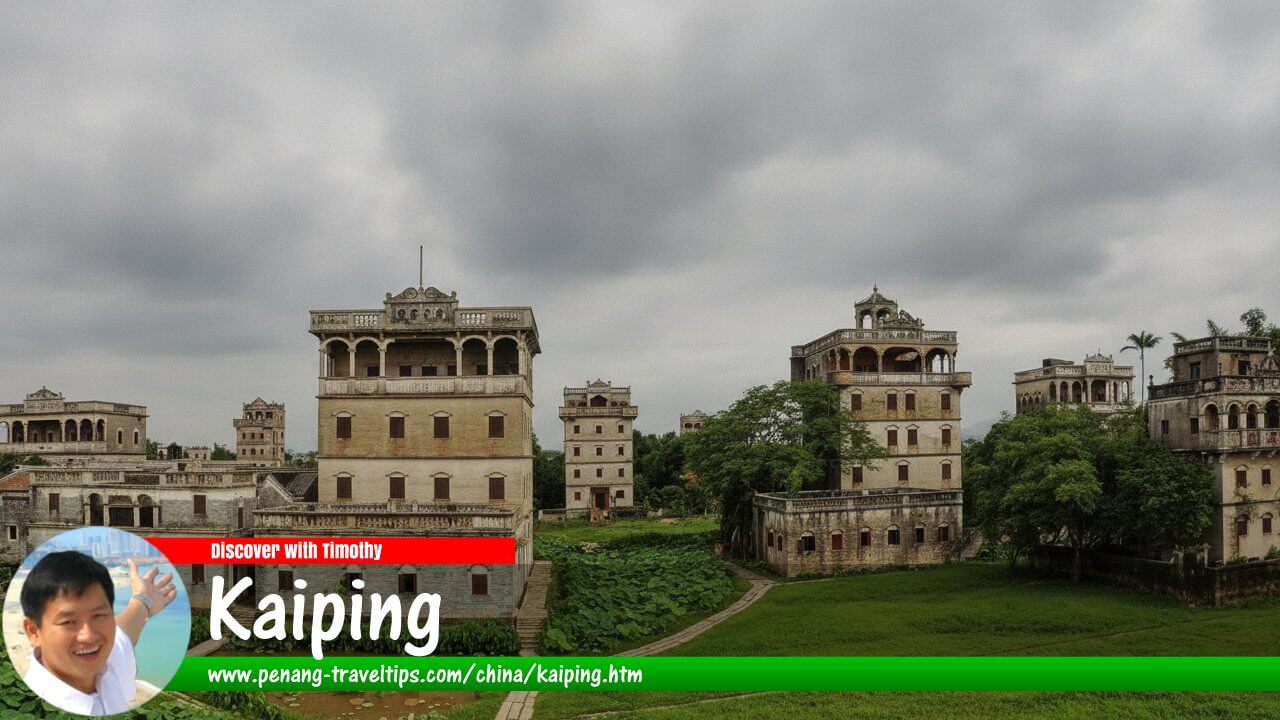 Kaiping, China (Photo edited with AI on 16 June 2026)
Kaiping (Chinese: 开平; pinyin: Kāipíng) is a county-level city in Guangdong Province, China, administered by the prefecture-level city of Jiangmen. Located in the western part of the Pearl River Delta, Kaiping is internationally renowned for its unique architectural heritage, particularly the Kaiping Diaolou, a collection of fortified multi-storey watchtowers that have been designated a UNESCO World Heritage Site. The city is also known as one of China's most important hometowns of overseas Chinese, whose migration to Southeast Asia, North America, Australia, and other regions profoundly influenced the area's culture, architecture, and economy.1
The name "Kaiping" literally means "Open and Peaceful" or "Opening Peace." The name reflects historical aspirations for stability, prosperity, and security in the region. The city was formally established during the Ming Dynasty when administrative reforms reorganized the area into a separate county. Over the centuries, Kaiping developed into an important agricultural and commercial center while maintaining close links with Chinese communities abroad.2
Quick Facts
- English Name: Kaiping
- Chinese Name: 开平
- Pinyin: Kāipíng
- Province: Guangdong
- Administrative Status: County-level city under Jiangmen
- Area: Approximately 1,659 square kilometres
- Population: Approximately 750,000
- Climate: Humid Subtropical
- Known For: Kaiping Diaolou, overseas Chinese heritage
- UNESCO Status: Kaiping Diaolou and Villages World Heritage Site
- Main Railway Station: Kaiping South Railway Station
- Nearest Airport: Zhuhai Jinwan Airport
- Main Industries: Agriculture, manufacturing, tourism
- Major Rivers: Tanjiang River system
Geography
Kaiping is situated in southwestern Guangdong Province within the jurisdiction of Jiangmen. The city lies approximately 140 kilometres southwest of Guangzhou and occupies part of the fertile western Pearl River Delta region. It borders Taishan, Enping, Xinhui, and Heshan, making it an important part of the Greater Bay Area's wider economic zone.1
The city's landscape consists primarily of plains, low hills, river valleys, and agricultural land. Numerous rivers and tributaries flow through Kaiping, particularly the Tanjiang River, which has historically provided water for irrigation, transportation, and settlement development.
Large areas of Kaiping are devoted to agriculture, with rice paddies, fish ponds, orchards, and vegetable farms forming a characteristic rural landscape. These fertile lands have supported local communities for centuries.
The climate is humid subtropical, characterized by hot, humid summers and mild winters. Average annual temperatures range between 21°C and 23°C. Annual rainfall exceeds 1,700 millimetres, supporting both agriculture and lush vegetation.
Although Kaiping is not directly on the coast, it benefits from proximity to the South China Sea and the Pearl River Delta transportation network. This advantageous location has contributed to the city's economic development and cultural exchanges throughout history.
History
The history of Kaiping can be traced back over a thousand years. The area was originally inhabited by indigenous groups before becoming integrated into successive Chinese dynasties. During the Tang and Song periods, agriculture expanded and settlements became more organized.2
Kaiping County was officially established during the Ming Dynasty. During this period, the region prospered through rice cultivation, trade, and handicrafts. However, rural communities also faced challenges from banditry and local conflicts.
One of the most significant chapters in Kaiping's history began during the nineteenth century when large numbers of residents emigrated overseas. Economic difficulties, political instability, and opportunities abroad encouraged migration to Southeast Asia, North America, Australia, New Zealand, and Latin America.3
Many emigrants achieved financial success and later returned to their hometowns or sent money home to their families. Their wealth transformed Kaiping's villages and towns. Schools, roads, hospitals, ancestral halls, and residences were constructed using overseas funds.
The most visible legacy of this period is the construction of the diaolou, fortified multi-storey towers that combined Chinese architectural traditions with Western influences. These buildings served both as residences and defensive structures against bandits and social unrest.
Architectural styles incorporated elements from Romanesque, Gothic, Baroque, and other Western traditions while remaining fundamentally Chinese in function and layout. This remarkable fusion of cultures has few parallels anywhere in the world.
Following the establishment of the People's Republic of China in 1949, Kaiping underwent agricultural reforms, infrastructure development, and industrialization. Economic reforms beginning in the late twentieth century brought renewed growth, investment, and modernization.
In 2007, the Kaiping Diaolou and Villages were inscribed on the UNESCO World Heritage List, bringing international recognition to the city's unique cultural landscape.4
Economy and Products
Kaiping's economy is based on agriculture, manufacturing, tourism, construction materials, food processing, and services. The city benefits from its strategic location within Guangdong Province and its strong overseas Chinese connections.
Agriculture remains an important sector. Rice cultivation is particularly significant, supported by fertile alluvial soils and abundant water resources. Other agricultural products include vegetables, fruits, sugarcane, flowers, and aquaculture products.5
Fish farming and freshwater aquaculture are common throughout the region. Fish ponds integrated with agricultural production have long been part of the local rural economy.
Manufacturing industries include textiles, machinery, electronics, building materials, household goods, and food processing. Industrial parks have attracted domestic and foreign investment.
The city is also known for producing sanitary ware, bathroom equipment, and plumbing products, which are exported to markets worldwide.
Tourism has become increasingly important due to the popularity of the UNESCO World Heritage Site. Visitors are attracted by the diaolou towers, historic villages, rural scenery, and overseas Chinese heritage.
The service sector continues to expand as transportation, retail, hospitality, and cultural industries grow alongside tourism.
How to Go There
By Air
Kaiping does not have its own commercial airport. Most visitors arrive through nearby regional airports.
Zhuhai Jinwan Airport is located approximately 100 kilometres from Kaiping city centre. Airlines operating there include Air China, China Southern Airlines, China Eastern Airlines, Shenzhen Airlines, Hainan Airlines, and several other domestic carriers. Flights connect the airport with Beijing, Shanghai, Chengdu, Chongqing, Xi'an, Kunming, Wuhan, Changsha, and many other Chinese cities.6
Guangzhou Baiyun International Airport is approximately 150 kilometres away and serves extensive domestic and international destinations throughout Asia, Europe, Africa, Oceania, and North America.
Shenzhen Bao'an International Airport provides another convenient option for international travelers.
By Train
Kaiping South Railway Station is located in Cuishanhu New District and serves the Shenzhen–Zhanjiang High-Speed Railway. The station provides direct services to Guangzhou, Shenzhen, Jiangmen, Zhuhai, Maoming, and Zhanjiang.7
High-speed rail has significantly reduced travel times between Kaiping and major cities across southern China.
By Long-Distance Bus
Kaiping Bus Terminal offers coach services to Guangzhou, Shenzhen, Foshan, Dongguan, Zhuhai, Jiangmen, and other destinations throughout Guangdong Province.
By Road
Modern expressways connect Kaiping with the wider Pearl River Delta. Travel by private car or coach is convenient and efficient.
How to Travel Locally
Visitors can travel around Kaiping using several transportation options.
- Public Buses: Local bus services connect urban districts, villages, tourist attractions, and transportation hubs.
- Taxis: Metered taxis are available throughout the city.
- E-Hailing Services: Didi operates extensively in Kaiping and functions similarly to Uber.
- Tourist Shuttle Services: Some major diaolou sites provide dedicated shuttle transportation.
- Private Vehicles: Car rental and private transportation are popular for exploring rural attractions.
Kaiping does not currently have a subway, MRT, metro, or LRT system. Traditional transportation methods such as trishaws, rickshaws, and tuk-tuks are generally not used. Most local travel relies on buses, taxis, ride-hailing services, bicycles, and private vehicles.
Tourist Attractions
Zili Village Diaolou Cluster
Zili Village contains some of the most famous diaolou towers in China. Surrounded by rice fields and traditional houses, the village provides an outstanding example of the architectural fusion that characterizes Kaiping's cultural landscape.4
Majianglong Village
This picturesque village is known for its bamboo forests, traditional residences, and beautifully preserved diaolou. It offers visitors a glimpse into rural life and overseas Chinese heritage.
Jinjiangli Village
Home to Ruishi Lou, one of the tallest and most impressive diaolou towers, Jinjiangli showcases remarkable architecture and defensive design.
Li Garden (Liyuan)
Built by a wealthy overseas Chinese family, Li Garden combines Chinese garden traditions with Western architectural influences. The estate includes lakes, bridges, pavilions, and elegant residences.
Ruishi Lou
Standing nine storeys high, Ruishi Lou is among the most iconic diaolou towers and offers panoramic views of the surrounding countryside.
Chikan Ancient Town
Located near Kaiping, Chikan features historic arcaded streets, colonial-era buildings, traditional markets, and architecture influenced by overseas Chinese communities.
South Tower Memorial Park
This historical site commemorates local resistance efforts during periods of conflict and provides insight into regional history.
Kaiping People's Park
A popular urban park featuring gardens, lakes, recreational facilities, and cultural events.
Cangdong Heritage Education Centre
This restored historic village complex serves as a center for cultural preservation and educational programs focused on local heritage.
Tanjiang River Scenic Areas
Various sections of the Tanjiang River provide attractive landscapes, riverside walks, and opportunities to appreciate Kaiping's rural environment.
Kaiping, China is  the Map of Cities in China
References
- Wikipedia – Kaiping
- Encyclopaedia Britannica – Guangdong Province
- Wikipedia – Overseas Chinese
- UNESCO World Heritage Centre – Kaiping Diaolou and Villages
- Invest Guangdong – Regional Economic Information
- Wikipedia – Zhuhai Jinwan Airport
- Wikipedia – Kaiping South Railway Station
Page Details
This page was created/modified on 16 June 2026. Hi, my name is Timothy and created it from my research, for my own entertainment, knowledge and to satisfy my curiosity. I am providing the information to you in good faith and hope it is useful. I try to get the details as accurate as possible. I also try to update the page whenever I stumble on new details. So this and all my other pages are perpetual work in progress. If you discover any error, please politely inform me, pointing out where the error lies, and I will correct it as soon as possible. Your helpfulness will keep this page accurate, relevant and helpful to those who need the information.