
Heyuan, China
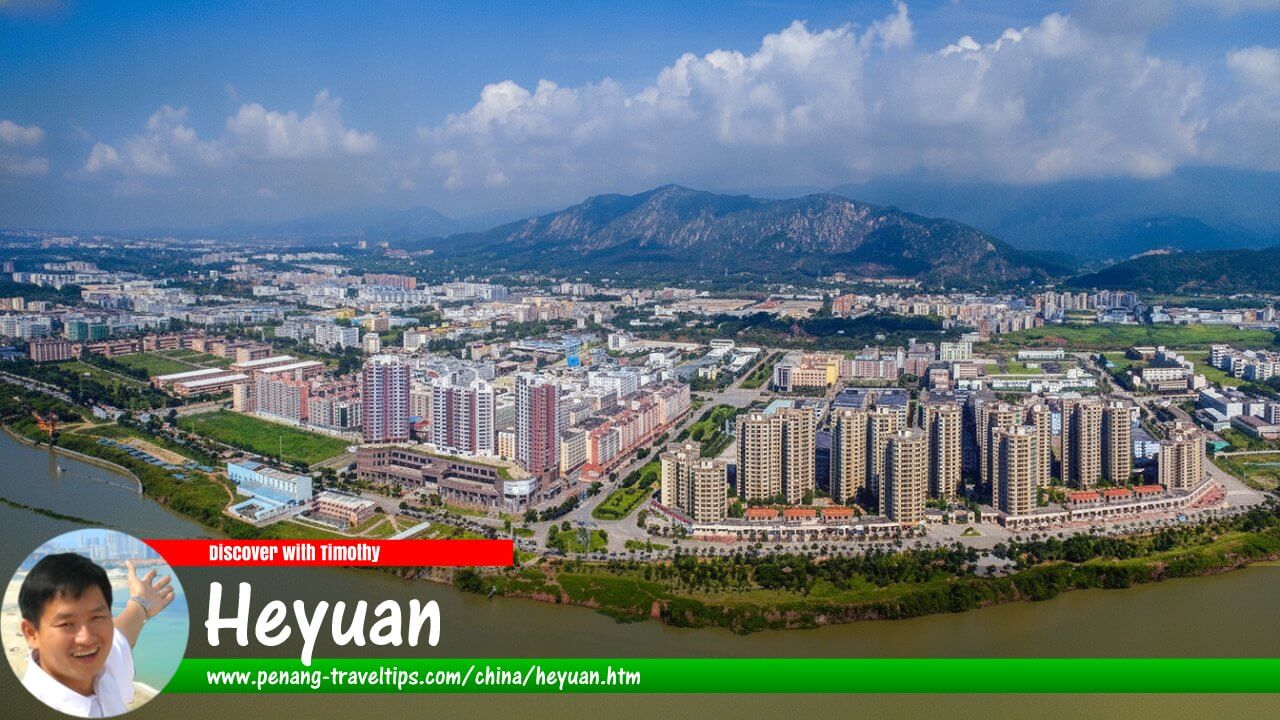 Heyuan, China (Photo edited with AI on 16 June 2026)
Heyuan (Chinese: 河源; pinyin: Héyuán) is a prefecture-level city in northeastern Guangdong Province, China. Nestled among mountains, rivers, forests, and reservoirs, the city is renowned for its natural beauty, ecological environment, rich Hakka cultural heritage, and significant paleontological discoveries. Heyuan is often called the "Hometown of Dinosaurs in China" because thousands of dinosaur eggs and fossils have been discovered in the area. The city also serves as an important ecological barrier and water source for the Pearl River Delta region. Today, Heyuan combines tourism, agriculture, manufacturing, and environmental conservation while maintaining its reputation as one of Guangdong's greenest cities.1
The name "Heyuan" literally means "Source of the River" or "River Origin." The name derives from the city's location near the upper reaches of the Dongjiang (East River), one of southern China's most important waterways. The Dongjiang originates in neighboring Jiangxi Province and flows through Heyuan before continuing toward Huizhou, Dongguan, Shenzhen, and Hong Kong. Because of its position near the river's upper basin, the settlement became known as Heyuan.2
Quick Facts
- English Name: Heyuan
- Chinese Name: 河源
- Pinyin: Héyuán
- Province: Guangdong
- Location: Northeastern Guangdong Province
- Meaning of Name: Source of the River
- Population: Approximately 3 million
- Area: About 15,600 square kilometres
- Climate: Humid Subtropical
- Main Railway Station: Heyuan East Railway Station
- Nearest Airport: Heyuan does not currently have a major commercial airport
- Known For: Wanlv Lake, dinosaur fossils, Hakka culture, eco-tourism
- Major River: Dongjiang (East River)
Geography
Heyuan is located in the northeastern part of Guangdong Province and borders Jiangxi Province to the north. Within Guangdong, it shares boundaries with Meizhou, Huizhou, Shaoguan, and other municipalities. The city occupies a strategic position between the mountainous interior of southern China and the economically dynamic Pearl River Delta.1
Covering approximately 15,600 square kilometres, Heyuan is one of Guangdong's largest prefecture-level cities by area. Much of the municipality consists of mountains, hills, forests, river valleys, and reservoirs. Compared with many highly urbanized cities in Guangdong, Heyuan retains a relatively natural landscape.
The Dongjiang River is the city's most important waterway. Originating in Jiangxi Province, the river passes through Heyuan and supplies water to several major cities in southern China. Water quality protection is therefore a major priority for local authorities.
One of Heyuan's most famous geographical features is Wanlv Lake, also known as Green Lake. Created by the construction of the Xinfengjiang Dam, the lake is one of the largest artificial freshwater lakes in southern China. It covers hundreds of square kilometres and contains numerous islands, peninsulas, and scenic shorelines.
The region experiences a humid subtropical climate with hot summers, mild winters, and abundant rainfall. Average annual temperatures range from 20°C to 22°C. Rainfall generally exceeds 1,700 millimetres per year, supporting dense vegetation and extensive forest cover.
Forests cover a significant portion of the municipality, making Heyuan one of Guangdong's most important ecological conservation areas. These forests support biodiversity and contribute to the city's growing eco-tourism industry.
History
The history of Heyuan dates back more than two thousand years. Archaeological evidence indicates that human settlements existed in the region long before formal Chinese administration was established. During the Qin and Han dynasties, the area became incorporated into China's imperial system.2
For centuries, Heyuan remained a relatively rural region characterized by agriculture, forestry, fishing, and river trade. The Dongjiang River served as a major transportation corridor connecting inland areas with the Pearl River Delta.
The region became an important settlement area for the Hakka people, a Han Chinese subgroup known for its distinct language, architecture, traditions, and migration history. Hakka culture continues to play an important role in local identity.
During the Tang and Song dynasties, administrative structures were strengthened, and agricultural production expanded. Trade increased as merchants used the Dongjiang River to transport goods throughout southern China.
In the Ming and Qing periods, Heyuan remained primarily agricultural but benefited from growing regional commerce. Hakka communities constructed fortified villages and developed unique cultural traditions that can still be observed today.
The twentieth century brought significant social and economic changes. Transportation infrastructure improved, and modernization gradually reached previously isolated areas. Following the establishment of the People's Republic of China in 1949, the city experienced agricultural development and industrial growth.
A major milestone occurred with the construction of the Xinfengjiang Reservoir in the late 1950s. The resulting Wanlv Lake transformed the region's geography, economy, and tourism potential.
In the 1990s, Heyuan gained international attention when thousands of dinosaur eggs were discovered within the city. Subsequent excavations uncovered additional fossils, earning the city its nickname as China's "Hometown of Dinosaurs."3
Economy and Products
Heyuan's economy is based on a combination of agriculture, tourism, manufacturing, energy production, and ecological industries. Compared with the manufacturing-heavy cities of the Pearl River Delta, Heyuan places greater emphasis on environmental sustainability and natural resources.
Agriculture remains an important sector. Major products include rice, vegetables, tea, fruits, peanuts, sweet potatoes, and livestock. The region's clean environment supports the production of high-quality agricultural goods.
Tea cultivation is particularly significant in some mountainous districts. Various local tea varieties are produced and marketed throughout Guangdong and beyond.
The forestry sector contributes timber, bamboo, and related products. Extensive forest resources have supported sustainable forestry development for many years.
Hydroelectric power generation plays a major role in the local economy. The Xinfengjiang Dam and associated facilities provide electricity while also supporting water management and tourism.
Tourism has become increasingly important due to attractions such as Wanlv Lake, hot springs, Hakka villages, mountain scenery, and dinosaur-related museums. Eco-tourism and recreational tourism are among the fastest-growing sectors.
Manufacturing industries include electronics, food processing, building materials, textiles, machinery, and renewable energy products. Industrial parks have attracted investment from both domestic and international companies.4
How to Go There
By Air
Heyuan does not currently have a major commercial passenger airport with extensive scheduled services. Most visitors arrive through nearby airports.
Huizhou Pingtan Airport is approximately 110 kilometres south of central Heyuan and offers domestic flights to numerous Chinese cities.
Shenzhen Bao'an International Airport, located approximately 180 kilometres away, is one of southern China's busiest airports. Airlines operating there include Air China, China Southern Airlines, China Eastern Airlines, Shenzhen Airlines, Cathay Pacific, Singapore Airlines, Emirates, and many others serving destinations across Asia, Europe, Oceania, North America, Africa, and the Middle East.
Guangzhou Baiyun International Airport is another major gateway located roughly 190 kilometres southwest of Heyuan.
By Train
Heyuan East Railway Station is the city's principal high-speed rail station and forms part of the Ganzhou–Shenzhen High-Speed Railway. The station provides convenient connections to Shenzhen, Guangzhou, Ganzhou, Nanchang, and many other destinations.5
Heyuan Railway Station serves conventional rail services and remains an important transportation hub.
By Long-Distance Bus
Heyuan Bus Terminal and other regional bus stations provide services to Guangzhou, Shenzhen, Huizhou, Dongguan, Meizhou, Shaoguan, and neighboring provinces.
By Road
Several expressways connect Heyuan with major cities throughout Guangdong Province. Travel by coach or private vehicle is convenient due to modern highway infrastructure.
How to Travel Locally
Visitors can travel around Heyuan using several transportation options.
- Public Buses: Extensive bus routes connect urban districts, residential areas, and tourist attractions.
- Taxis: Metered taxis are widely available throughout the city.
- E-Hailing Services: Didi operates extensively and serves as the primary ride-hailing platform.
- Tourist Shuttle Buses: Popular attractions such as Wanlv Lake often provide shuttle services.
- Bicycle Sharing: Shared bicycles are available in some urban districts.
Heyuan does not currently operate a subway, metro, MRT, or LRT system. Traditional transport modes such as trishaws, rickshaws, and tuk-tuks are generally not available. Most travel is conducted using buses, taxis, ride-hailing services, or private vehicles.
Tourist Attractions
Wanlv Lake (Green Lake)
Wanlv Lake is Heyuan's most famous attraction. One of the largest freshwater reservoirs in southern China, it offers scenic cruises, island excursions, forested landscapes, and excellent opportunities for photography and recreation.6
Heyuan Dinosaur Museum
This museum showcases the city's remarkable collection of dinosaur eggs and fossils. Visitors can learn about prehistoric life and the discoveries that made Heyuan internationally famous.
Dinosaur Egg Museum
Home to one of the world's largest collections of fossilized dinosaur eggs, this specialized museum is a major attraction for families and researchers.
Sujiawei Hakka Village
This well-preserved Hakka settlement features traditional architecture, ancestral halls, and exhibits highlighting local customs and history.
Guishan Scenic Area
Located near Wanlv Lake, Guishan offers hiking trails, forest scenery, temples, and panoramic views of the surrounding landscape.
Xinfengjiang National Forest Park
This protected area showcases Heyuan's rich biodiversity, forests, waterfalls, and ecological resources.
Bavarian Manor
A modern tourism complex featuring hot springs, themed architecture, recreational facilities, and family-friendly attractions.
Hot Spring Resorts
Several hot spring resorts around Heyuan offer therapeutic mineral waters, spa treatments, and relaxing accommodations.
Dongjiang Gallery Scenic Area
This scenic river corridor highlights the beauty of the Dongjiang River through boat tours, viewpoints, and nature-based activities.
Heyuan Museum
The museum presents exhibits on local history, archaeology, Hakka culture, natural resources, and the city's development.
Heyuan, China on  the Map of Cities in China
References
- Encyclopaedia Britannica – Guangdong Province
- Wikipedia – Heyuan
- UNESCO Resources on Chinese Paleontology
- Invest Guangdong – Regional Economic Information
- Wikipedia – Heyuan East Railway Station
- Wikipedia – Xinfengjiang Reservoir (Wanlv Lake)
Page Details
This page was created/modified on 16 June 2026. Hi, my name is Timothy and created it from my research, for my own entertainment, knowledge and to satisfy my curiosity. I am providing the information to you in good faith and hope it is useful. I try to get the details as accurate as possible. I also try to update the page whenever I stumble on new details. So this and all my other pages are perpetual work in progress. If you discover any error, please politely inform me, pointing out where the error lies, and I will correct it as soon as possible. Your helpfulness will keep this page accurate, relevant and helpful to those who need the information.