
Baoding (保定), China
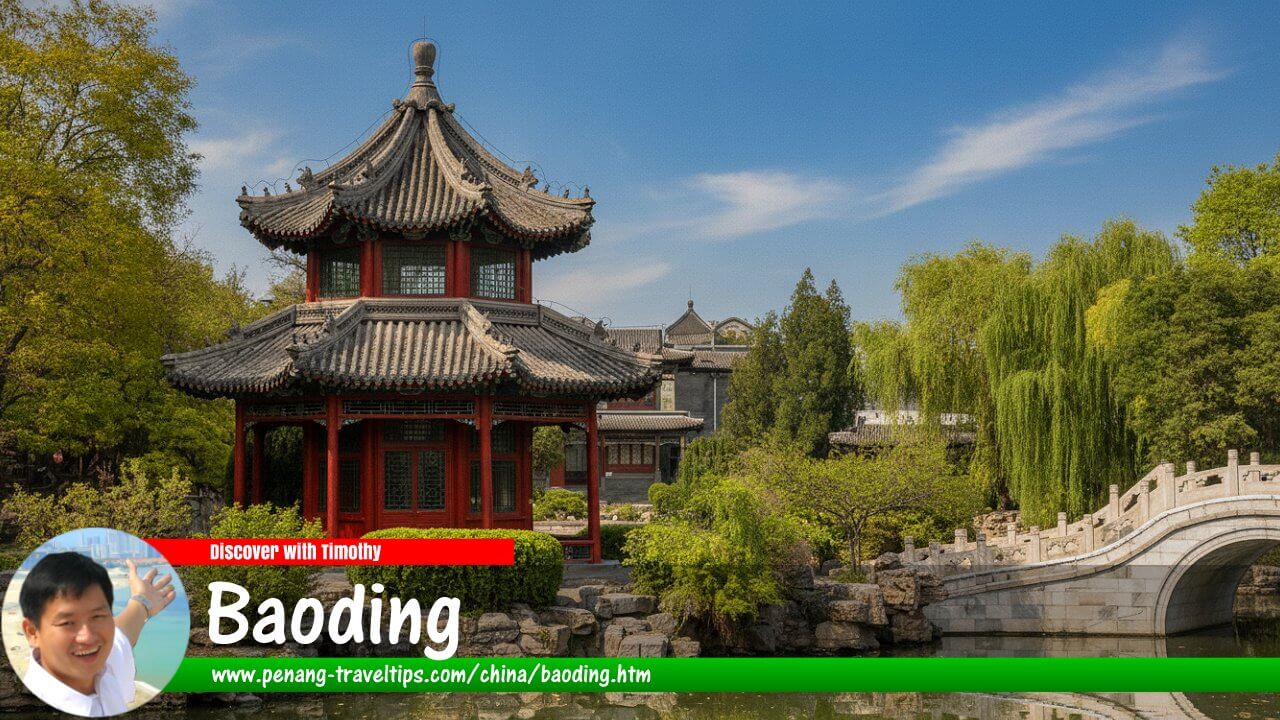 Baoding, China (Photo edited with AI on 8 June 2026)
Baoding is a major prefecture-level city in Hebei Province in northern China. Located southwest of Beijing on the North China Plain, it has served for centuries as an important administrative, military, cultural, and transportation center.1 Today, Baoding is one of the most significant cities in Hebei, known for its long history, educational institutions, industrial development, and proximity to the Chinese capital. With a history stretching back more than 3,000 years, the city combines ancient heritage with modern economic growth.2
Quick Facts
- Location: Hebei Province, China
- Chinese Name: 保定 (Bǎodìng)
- Meaning of Name: "Protecting and Stabilizing"
- Region: North China Plain
- Distance from Beijing: Approximately 140 km southwest
- Area: About 19,000 square km
- Historical Status: Former administrative center of Zhili Province
- Main Industries: Manufacturing, renewable energy, electronics, machinery
- Major Railway Stations: Baoding Railway Station, Baoding East Railway Station
- Nearest Major Airport: Beijing Daxing International Airport
- Famous Attractions: Lotus Pond Garden, Zhili Governor's Office, Baiyangdian Lake, Yesanpo Scenic Area
The Name of Baoding and Its Origin
The name "Baoding" (保定) can be translated as "protecting and stabilizing" or "defending and securing." The name reflects the city's historic role as a strategic stronghold protecting the imperial capital. During the Yuan Dynasty, the city occupied a crucial position on routes leading to Beijing. In 1275, the name Baoding was adopted to signify its role in defending the capital and maintaining stability in the surrounding region.3
Over the centuries, Baoding became one of the most important military and administrative centers in northern China. Its name continues to symbolize its historical function as a guardian city for the capital.
Geography
Baoding is situated in the southwestern part of Hebei Province, occupying a strategic position between Beijing, Tianjin, and Shijiazhuang. The city lies primarily on the fertile North China Plain, while the Taihang Mountains rise to the west.1
The municipality covers approximately 19,000 square kilometers and includes urban districts, county-level cities, counties, and development zones.2 The terrain varies from mountainous landscapes in the west to flat agricultural plains in the east.
The region enjoys a temperate continental monsoon climate characterized by four distinct seasons. Summers are generally hot and humid, while winters are cold and dry. Spring and autumn offer relatively pleasant weather, making these seasons popular among visitors.
One of the most important natural features associated with Baoding is Baiyangdian Lake, the largest freshwater lake system in northern China. The wetland area provides important ecological functions and serves as a major tourist destination.
History
Baoding's history dates back more than three millennia. The area was settled long before the Qin Dynasty and occupied an important position between the ancient states of Yan and Zhao.1
During the Northern Wei Dynasty, the settlement was known as Qingyuan. Because of its location on routes connecting northern and central China, the city acquired considerable military significance. Throughout the Tang Dynasty, it served as a frontier defense center against northern nomadic groups.1
Its importance increased during the Song, Yuan, Ming, and Qing dynasties. As Beijing became the imperial capital, Baoding emerged as a crucial defensive and administrative center guarding the approaches to the capital. During the Qing Dynasty, it served as the seat of the provincial government of Zhili Province, one of the most influential provinces in imperial China.1
The city was heavily fortified and contained government offices, military academies, educational institutions, and administrative headquarters. During this period, Baoding earned a reputation as a center of learning and governance.
Following the establishment of the People's Republic of China in 1949, Baoding continued to play an important administrative role. Although the provincial capital was later transferred to Shijiazhuang in 1968, Baoding remained an important regional center and experienced substantial industrial growth during the second half of the twentieth century.1
Economy and Products
Modern Baoding possesses a diversified economy that includes manufacturing, technology, education, logistics, and renewable energy industries.2
The city has become particularly known for advanced manufacturing and clean-energy industries. Baoding has developed a reputation as a center for renewable energy production, including wind turbine equipment, solar technology, and smart-grid systems.2
Major industrial sectors include:
- Machinery manufacturing
- Automobile parts production
- Electronics manufacturing
- Chemical products
- Building materials
- Textiles
- Paper production
- Food processing
- Renewable energy equipment
Baoding also serves as an agricultural center due to the fertile lands of the North China Plain. Agricultural products from surrounding areas include wheat, corn, vegetables, fruits, and livestock products.
In recent years, local authorities have encouraged the growth of high-tech industries, biomedical research, new materials, information technology, and environmental protection technologies.2
How to Go to Baoding
By Air
Baoding does not currently have a major commercial airport serving extensive domestic and international routes. Most visitors arrive through Beijing Daxing International Airport, located approximately 100–120 kilometers northeast of the city, depending on the destination within Baoding.
Beijing Daxing International Airport is served by numerous airlines, including Air China, China Eastern Airlines, China Southern Airlines, Hainan Airlines, XiamenAir, and many international carriers. Flights connect the airport with major cities throughout China as well as destinations across Asia, Europe, the Middle East, and other regions.
Travelers can continue from the airport to Baoding using high-speed rail, airport shuttle services, taxis, or private transfers.
By Train
Rail transportation is one of the easiest ways to reach Baoding. The city is connected to China's extensive railway network and is located on major routes linking Beijing with southern China.1
Baoding Railway Station is located within the urban area and serves both conventional and some high-speed rail services. The station lies on the historic Beijing–Guangzhou Railway and also connects with the Tianjin–Baoding Intercity Railway.4
Baoding East Railway Station, situated approximately 9.5 kilometers east of the city center, serves high-speed trains operating on the Beijing–Guangzhou High-Speed Railway.5
Frequent high-speed services connect Baoding with Beijing, Shijiazhuang, Tianjin, Zhengzhou, Wuhan, Guangzhou, and many other Chinese cities.
By Long-Distance Bus
Several long-distance bus terminals operate within Baoding, providing services to destinations throughout Hebei Province and neighboring regions. Bus routes connect the city with Beijing, Tianjin, Shijiazhuang, and numerous county-level destinations.
By Road
Baoding is linked to major Chinese cities through an extensive network of expressways. The Jingshi Expressway connects the city directly with Beijing and Shijiazhuang, while other highways provide convenient access to Tianjin and surrounding provinces.6
Traveling Within Baoding
Getting around Baoding is relatively straightforward due to its modern transportation infrastructure.
Taxis
Taxis are widely available throughout the city and can be hailed on the street or at transportation hubs, hotels, and commercial districts.
E-Hailing Services
Ride-hailing applications such as Didi are widely used and provide a convenient alternative to traditional taxis.
City Buses
An extensive public bus network serves the urban districts and suburban areas. Buses are affordable and cover most tourist attractions and transportation centers.
Rail Transit
As of 2026, Baoding does not operate a full metro or subway system comparable to those found in Beijing or Shanghai. However, urban transportation is supplemented by buses, taxis, and regional rail connections.
Bicycles and E-Bikes
Shared bicycles and electric bicycles are commonly available throughout the city, providing an economical and environmentally friendly means of transportation.
Rickshaws and Tuk-Tuks
Traditional rickshaws and tuk-tuks are not a significant part of Baoding's transportation system.
Tourist Attractions
Lotus Pond Garden (Lianchi)
Originally established during the Tang Dynasty, Lotus Pond Garden is one of Baoding's most famous historical attractions. The garden features traditional Chinese landscaping, pavilions, bridges, and ancient inscriptions.1
Zhili Governor-General's Office
This well-preserved Qing Dynasty administrative complex served as the headquarters of the governors of Zhili Province. It offers visitors insights into imperial governance and official architecture.
Baiyangdian Lake
Known as the "Pearl of North China," Baiyangdian is the largest freshwater wetland in northern China. Visitors can enjoy boat tours, birdwatching, and scenic views of reed-covered waterways.
Yesanpo Scenic Area
Located in the western part of Baoding Municipality, Yesanpo is renowned for its dramatic mountain scenery, rivers, gorges, forests, and outdoor recreational opportunities.2
Langya Mountain
This scenic mountain area is famous for its natural beauty and its association with important events during the Second Sino-Japanese War. Hiking trails and viewpoints attract visitors throughout the year.
Ancient Lotus Academy Site
The historic academy played a significant role in traditional Chinese education and scholarship, contributing to Baoding's reputation as a center of learning.
Baoding Military Academy Site
Often regarded as China's first modern military academy, this historic institution trained many military leaders during the late Qing and Republican periods.
Western Tombs of the Qing Dynasty
Located near Baoding, these imperial mausoleums contain the tombs of several Qing emperors and members of the imperial family. The site is recognized for its architectural and historical significance.
References
- Encyclopaedia Britannica – Baoding
- China.org.cn – Baoding Overview
- Wikipedia (Spanish) – Toponymy of Baoding
- Wikipedia – Baoding Railway Station
- Wikipedia – Baoding East Railway Station
- Wikipedia – Transport and Economy of Baoding
Page Details
This page was created/modified on 7 June 2026. Hi, my name is Timothy and created it from my research, for my own entertainment, knowledge and to satisfy my curiosity. I am providing the information to you in good faith and hope it is useful. I try to get the details as accurate as possible. I also try to update the page whenever I stumble on new details. So this and all my other pages are perpetual work in progress. If you discover any error, please politely inform me, pointing out where the error lies, and I will correct it as soon as possible. Your helpfulness will keep this page accurate, relevant and helpful to those who need the information.