
Brunei Travel Guide
 Go Back
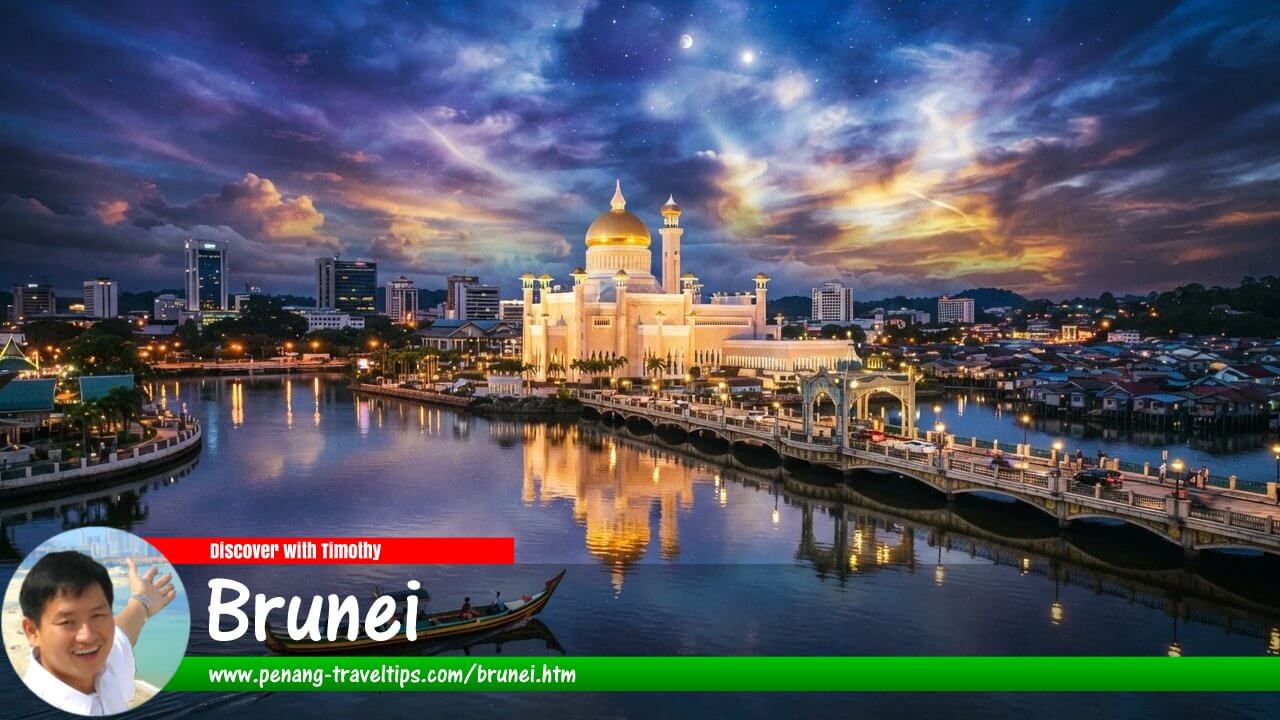 Brunei Travel Guide (AI Image generated on 18 August 2026)
Also available: Panduan Melawat Brunei
Brunei – Overview and Geography
Brunei, officially known as Brunei Darussalam, is a small sovereign country on the northern coast of the island of Borneo in Southeast Asia. It is bordered on land by the Malaysian state of Sarawak and has a coastline facing the South China Sea.
Although Brunei is one of the smallest countries in Southeast Asia by population and territory, it has a distinctive national identity shaped by its Malay heritage, Islamic faith and centuries-old sultanate. The country is also known for its petroleum wealth, extensive tropical forests, quiet cities and well-preserved traditional culture.
Location of Brunei
Brunei is located on the northern coast of Borneo, the world's third-largest island. Its territory is almost completely surrounded by Sarawak, Malaysia, except along its northern coast, where it faces the South China Sea.
The country's location makes it part of the wider Borneo region, together with the Malaysian states of Sabah and Sarawak and the Indonesian provinces occupying the southern and eastern parts of the island.
Name of Brunei
The official name of the country is Brunei Darussalam. The Arabic-derived term Darussalam means "Abode of Peace".
The name Brunei has a long history and has been recorded in various forms in historical sources. The country is also traditionally associated with the name Barunai, which was used in earlier periods of its history.
Capital of Brunei
Bandar Seri Begawan is the capital and largest city of Brunei. It is the country's political, administrative, commercial and cultural centre.
The city is located beside the Brunei River and contains many of the country's most important landmarks, including the Omar Ali Saifuddien Mosque, Jame' Asr Hassanil Bolkiah Mosque, Royal Regalia Museum and Kampong Ayer.
Geography of Brunei
Brunei has a total area of approximately 5,765 square kilometres. Despite its relatively small size, the country contains a variety of landscapes, ranging from coastal plains and mangrove areas to hills and extensive tropical rainforest.
The country is divided into two main geographical sections by a portion of Malaysian territory belonging to Sarawak. The larger western section contains the districts of Brunei-Muara, Tutong and Belait, while the smaller eastern section consists of Temburong District.
Brunei River
The Brunei River is one of the country's most important waterways. It flows through the area around Bandar Seri Begawan and has historically played an important role in settlement, transportation and trade.
The river is also closely associated with Kampong Ayer, the historic water settlement that remains one of Brunei's best-known cultural attractions.
Temburong
Temburong District occupies the eastern part of Brunei and is separated from the rest of the country by Sarawak. It is considerably more rural and heavily forested than the areas around Bandar Seri Begawan.
Temburong is particularly important for nature tourism. Much of the district is covered by rainforest, including Ulu Temburong National Park, which protects an extensive area of relatively undisturbed tropical forest.
Rainforests of Brunei
Tropical rainforest covers a substantial portion of Brunei. The country's forests form part of the wider Borneo rainforest ecosystem, one of the most biologically diverse environments in the world.
The forests provide habitat for numerous species of plants, mammals, birds and insects. Among the wildlife associated with Borneo are proboscis monkeys, hornbills and various species of primates.
The protection of these forests is an important part of Brunei's environmental and tourism policies, particularly in Temburong.
Coastline
Brunei has a coastline along the South China Sea. Coastal areas include sandy beaches, mangrove forests, estuaries and river mouths.
The coastline is also important for the country's petroleum industry, fisheries and maritime activities. Several beaches and coastal recreational areas can be visited within relatively easy reach of Bandar Seri Begawan.
Districts of Brunei
Brunei is divided administratively into four districts: Brunei-Muara, Belait, Tutong and Temburong.
Brunei-Muara District
Brunei-Muara is the smallest district by land area but contains the country's largest concentration of population and economic activity. Bandar Seri Begawan is located within this district.
Many of Brunei's principal tourist attractions, government buildings, shopping areas and major hotels are found in Brunei-Muara.
Belait District
Belait is the largest district by land area and is closely associated with Brunei's petroleum and natural gas industries. Kuala Belait is the district's main town, while Seria is an important centre of the country's oil industry.
Tutong District
Tutong lies between Brunei-Muara and Belait. It has a lower population density and contains a mixture of agricultural land, villages, forests and coastal areas.
The district is known for its beaches, lakes and natural landscapes and offers a quieter experience away from the capital.
Temburong District
Temburong is Brunei's easternmost district and is separated from the rest of the country by Sarawak. Its extensive rainforest makes it the country's principal destination for nature-based tourism and outdoor activities.
Population of Brunei
Brunei has a population of less than half a million people. The majority of its population lives in the western part of the country, particularly in and around Bandar Seri Begawan and the Brunei-Muara District.
The population is ethnically diverse, although the country's national identity is strongly associated with the Malay community and Malay culture. Other communities include Chinese and various indigenous peoples of Borneo.
Malay Identity
Malay culture occupies a central position in Brunei's national identity. The country's official national philosophy, known as Melayu Islam Beraja (MIB), combines Malay cultural traditions, Islam and the institution of the monarchy.
This combination is reflected in Brunei's architecture, ceremonies, dress, public institutions and social customs.
Religion
Islam is the official religion of Brunei and has an important role in public life. The country is predominantly Muslim, while other religions are also practised by parts of the population.
Mosques are prominent features of Brunei's towns and villages, with the Omar Ali Saifuddien Mosque and Jame' Asr Hassanil Bolkiah Mosque being among the country's most recognisable landmarks.
Language
Malay is the official language of Brunei. English is also widely understood and used, particularly in education, business and tourism.
Brunei Malay, commonly known as Bahasa Melayu Brunei, is the local variety of Malay used in everyday conversation. It has vocabulary and pronunciation that distinguish it from standard Malay used in Malaysia and Indonesia.
Currency
The official currency of Brunei is the Brunei dollar, abbreviated as BND or commonly written as B$.
The Brunei dollar is maintained at par with the Singapore dollar under the Currency Interchangeability Agreement. Singapore dollar notes and coins are therefore generally accepted in Brunei, while Brunei currency can also be used in Singapore under the agreement.
Climate of Brunei
Brunei has a tropical equatorial climate throughout the year. Temperatures are generally warm and humidity is high, with rainfall occurring during much of the year.
There is no sharply defined dry season comparable to those found in some other parts of Southeast Asia. Rain can occur at any time, although rainfall patterns vary during the year.
Temperature
Daytime temperatures in Brunei commonly remain around the upper 20s to low 30s degrees Celsius. The combination of heat and humidity can make outdoor activities feel warmer than the actual temperature suggests.
Visitors should drink sufficient water and allow time to rest when exploring outdoor attractions.
Rainfall
Heavy tropical showers can occur throughout the year. Rainfall is particularly important when planning activities in rainforest areas such as Temburong.
A compact umbrella or lightweight rain jacket can be useful even when the morning begins with clear skies.
Time Zone
Brunei follows Brunei Darussalam Time, which is UTC+8. The country does not observe daylight saving time.
Brunei therefore shares the same standard time as Malaysia, Singapore, China, Hong Kong and several other parts of East and Southeast Asia.
National Character of Brunei
Brunei has a quieter and less densely populated character than many neighbouring Southeast Asian countries. Bandar Seri Begawan is relatively compact, while large areas of the country remain covered by forest.
The country's considerable petroleum wealth has enabled it to develop modern infrastructure and public facilities while retaining a strong connection to Malay and Islamic traditions.
For visitors, Brunei offers an opportunity to experience a distinctive side of Borneo: a peaceful sultanate where royal heritage, Islamic architecture, Malay culture and tropical rainforest exist within a relatively small country.
History and Culture of Brunei
Brunei has one of the oldest continuing monarchies in the world and a history closely connected with the development of Malay civilisation in Borneo. At different periods, the influence of the Brunei Sultanate extended far beyond the country's present-day borders, reaching parts of Borneo and neighbouring islands.
Today, Brunei's identity is strongly shaped by three elements expressed in its national philosophy of Melayu Islam Beraja, or Malay Islamic Monarchy: Malay culture, Islam and the institution of the monarchy.
Early History of Brunei
The history of Brunei goes back many centuries. Chinese and other historical sources contain references to a polity in northern Borneo that has been associated with early Brunei.
The area was strategically located along maritime trading routes linking Southeast Asia, China and the wider Malay Archipelago. Its rivers and coastal settlements provided access to trade in forest products, spices and other valuable goods.
The Rise of the Brunei Sultanate
Brunei became an important regional power during the period when Islam was spreading through the Malay Archipelago. The establishment of the Islamic sultanate transformed the political and cultural character of Brunei.
The precise chronology of the earliest rulers is difficult to establish from surviving historical sources, but Brunei's royal tradition traces the present dynasty back many centuries.
Sultan Muhammad Shah
Sultan Muhammad Shah is traditionally regarded as the first Muslim ruler of Brunei. He is associated with the conversion of the Brunei ruling house to Islam and with the early development of the Islamic sultanate.
Historical details concerning the earliest sultans are partly intertwined with Brunei's traditional royal histories and later written sources.
Sultan Bolkiah
One of the most famous rulers in Brunei's history was Sultan Bolkiah, who is generally associated with the height of Brunei's power during the late 15th and early 16th centuries.
According to Bruneian tradition, Sultan Bolkiah was a powerful ruler whose influence extended across much of Borneo and into parts of the surrounding Malay Archipelago.
His reign is an important part of Brunei's historical identity and is commemorated in places and institutions bearing his name.
Brunei's Regional Influence
At its height, the Brunei Sultanate exercised influence over extensive areas of Borneo. Its sphere of influence also reached islands and coastal territories in the southern Philippines and other parts of the region.
The exact extent of political control varied over time. Some areas were directly governed, while others were connected through alliances, tribute relationships, trade or cultural influence.
Brunei and the Malay World
Brunei was part of the wider Malay maritime world, in which political power, commerce, language and Islam connected communities across Southeast Asia.
Malay served as an important language of communication and trade throughout the region, while Brunei developed its own distinctive traditions and form of Malay culture.
Islam in Brunei
Islam became firmly established as the religion of the Brunei ruling house and subsequently became a central element of Bruneian society.
Today, Islam is the official religion of Brunei. Islamic traditions influence public life, national ceremonies, architecture, education and social customs.
Islamic Architecture
The importance of Islam is particularly visible in Brunei's architecture. Large and elaborately decorated mosques can be found in Bandar Seri Begawan and other towns throughout the country.
The golden domes and distinctive design of the country's mosques have become some of the most recognisable features of the Bruneian landscape.
Omar Ali Saifuddien Mosque
The Omar Ali Saifuddien Mosque is one of Brunei's most famous landmarks. Located in the heart of Bandar Seri Begawan, it was named after Sultan Omar Ali Saifuddien III, the 28th Sultan of Brunei.
The mosque is noted for its golden dome, white marble structure and its setting beside an artificial lagoon. It is regarded as one of the finest examples of modern Islamic architecture in Southeast Asia.
Jame' Asr Hassanil Bolkiah Mosque
The Jame' Asr Hassanil Bolkiah Mosque is another major Islamic landmark in Bandar Seri Begawan. It was built during the reign of Sultan Hassanal Bolkiah and is distinguished by its numerous golden domes and grand scale.
The mosque is also known locally as Kiarong Mosque, after the area where it is located.
The Brunei Monarchy
The monarchy is central to the political and cultural identity of Brunei. The Sultan is both head of state and head of government and occupies a prominent position in national life.
The present ruler is Sultan Hassanal Bolkiah, who became Sultan in 1967 following the abdication of his father, Sultan Omar Ali Saifuddien III.
Sultan Hassanal Bolkiah
Sultan Hassanal Bolkiah is the 29th Sultan of Brunei and one of the world's longest-reigning monarchs. He has played a central role in the modern development of the country.
During his reign, Brunei experienced substantial economic development supported by its petroleum and natural gas resources, while the monarchy and Islamic traditions remained central to national identity.
Istana Nurul Iman
Istana Nurul Iman is the official residence of the Sultan of Brunei. Located near Bandar Seri Begawan, it is widely recognised as one of the world's largest residential palaces.
The palace is not generally open to tourists throughout the year. However, it traditionally opens to members of the public during Hari Raya Aidilfitri, when visitors may have the opportunity to attend the royal open house.
Royal Ceremonies
Royal ceremonies remain an important part of Bruneian public life. Events associated with the Sultan, the royal family and national celebrations are often conducted according to established Malay and Islamic traditions.
Visitors may encounter royal symbolism and ceremonial traditions throughout Bandar Seri Begawan, particularly around important national and religious occasions.
Melayu Islam Beraja
Melayu Islam Beraja, commonly abbreviated as MIB, is the national philosophy of Brunei. It places Malay cultural identity, Islam and the monarchy at the centre of the country's national character.
MIB was formally emphasised as the national philosophy in the 20th century and continues to influence education, government, cultural policy and public life.
Malay Culture
Malay culture is deeply embedded in Bruneian society. Traditional customs, family relationships, hospitality, food, clothing and ceremonies reflect the country's Malay heritage.
Although Brunei shares many cultural features with Malaysia and Indonesia, Brunei Malay traditions have developed their own distinctive characteristics over the centuries.
Brunei Malay
The Malay spoken in Brunei has distinctive vocabulary and pronunciation. It is generally understandable to speakers of Malay from Malaysia, although some everyday expressions may be unfamiliar.
Brunei Malay is widely used in informal conversation, while Standard Malay is used in formal and official contexts.
Indigenous Peoples
Brunei is home to several indigenous communities, including the Belait, Bisaya, Brunei, Dusun, Kedayan, Murut and Tutong peoples.
Each community has its own traditions, language varieties and cultural heritage. The diversity of these communities forms an important part of Brunei's history as a Bornean society.
Kedayan Culture
The Kedayan are one of the indigenous Malay-related communities of Brunei and neighbouring parts of Borneo. They have traditionally been associated with agriculture and rural settlements.
Kedayan culture remains part of the broader cultural landscape of Brunei, particularly outside the capital.
Traditional Houses
Traditional Bruneian houses were adapted to the tropical environment and were often constructed using timber and other locally available materials. Houses in riverside and water settlements were particularly suited to life around waterways.
Modern construction has transformed much of the country's housing, but traditional architectural features continue to be preserved in heritage areas.
Kampong Ayer
Kampong Ayer, meaning "Water Village", is one of the most distinctive cultural features of Brunei. The settlement consists of houses and other buildings constructed over the Brunei River and connected by bridges and walkways.
Although its appearance today includes modern facilities, Kampong Ayer represents a much older form of settlement that has existed along the Brunei River for centuries.
Life in Kampong Ayer
Kampong Ayer is not simply a historical reconstruction. It remains a living community where residents live, work and carry out their daily activities.
Visitors can explore parts of the settlement by water taxi and observe houses, schools, mosques and other community facilities built over the river.
Traditional Food
Bruneian cuisine reflects Malay, Bornean and wider Southeast Asian influences. Rice, noodles, seafood, chicken and beef feature prominently in local cooking.
Popular foods include ambuyat, nasi katok, satay, various grilled seafood dishes and traditional kuih.
Ambuyat
Ambuyat is one of Brunei's best-known traditional foods. It is made from sago starch and has a sticky, smooth consistency.
Ambuyat is traditionally eaten using a pair of wooden sticks called candas. It is usually accompanied by dipping sauces and other dishes.
Nasi Katok
Nasi katok is a simple and popular Bruneian meal consisting of rice served with fried or roasted chicken and a spicy sambal. It is widely available and is known as an inexpensive everyday food.
Traditional Clothing
Traditional Malay clothing remains visible during formal occasions, religious celebrations and national ceremonies. Men may wear cara Melayu with a songkok, while women commonly wear traditional Malay attire such as the baju kurung.
Visitors may also see traditional clothing during weddings, Hari Raya celebrations and official events.
Hari Raya Aidilfitri
Hari Raya Aidilfitri is one of the most important celebrations in Brunei. Families gather, wear traditional clothing, visit relatives and friends, and enjoy festive meals.
The royal family's annual open house is a particularly notable feature of Hari Raya in Brunei and has traditionally allowed members of the public to meet members of the royal family.
Ramadan in Brunei
Ramadan has a significant influence on daily life in Brunei. Muslims fast from dawn to sunset, while mosques and communities organise religious activities throughout the month.
Visitors should be aware of local customs concerning eating, drinking and public behaviour during daylight hours. The Ramadan period can also be an interesting time to experience local markets and evening meals after sunset.
Friday Prayer
Friday is an important day in Brunei's Islamic calendar. The Friday congregational prayer is widely observed, and many businesses and services close or reduce their operations around the prayer period.
Visitors should take this into account when planning shopping, sightseeing and meals on Friday.
Public Holidays and Celebrations
Brunei observes a number of Islamic, national and royal occasions as public holidays. These include Hari Raya Aidilfitri, Hari Raya Aidiladha, Maulidur Rasul, National Day and the Sultan's birthday.
During major holidays, opening hours, traffic conditions and accommodation availability may differ from normal.
Brunei National Day
National Day is celebrated on 23 February. It commemorates Brunei's independence from British protection in 1984.
The occasion is marked by national ceremonies, parades, performances and displays of patriotism.
Independence of Brunei
Brunei became a British protectorate in the late 19th century. British influence continued for much of the 20th century, although the Sultanate retained its own ruler and internal institutions.
Brunei achieved full independence on 1 January 1984 and subsequently joined the United Nations as a sovereign state.
British Influence
The period of British protection left an influence on Brunei's administration, education and legal institutions. English remains widely used, particularly in business and education.
At the same time, Brunei has maintained its Malay and Islamic identity rather than becoming culturally assimilated into the British system.
Discovery of Oil
The discovery of petroleum transformed Brunei's economy and modern history. Commercial oil production began in the early 20th century, with Seria becoming an important centre of the petroleum industry.
The development of oil and natural gas provided the economic foundation for much of the country's modern infrastructure and high standard of living.
Seria and the Oil Industry
Seria is closely associated with Brunei's petroleum industry. Oil production has played a central role in the development of the Belait District and the country's economy.
The Oil and Gas Discovery Centre in Seria provides visitors with an opportunity to learn about petroleum, energy and science through educational exhibits.
Brunei During the Second World War
Brunei was occupied by Japanese forces during the Second World War. The occupation disrupted the country's economy and administration and formed an important chapter in its modern history.
The war also affected the petroleum industry, as oil facilities became strategically important to the Japanese military.
Brunei's Modern Identity
Modern Brunei combines a wealthy petroleum-based economy with a strong traditional identity. Contemporary buildings, shopping centres and modern infrastructure exist alongside mosques, royal institutions, traditional villages and rainforest.
For visitors, this mixture is one of the most interesting characteristics of the country. Brunei does not present itself primarily as a mass-tourism destination; instead, it offers a quieter experience centred on culture, nature, religion and royal heritage.
Culture and Respect for Visitors
Bruneians are generally known for their courteous and reserved manner. Visitors should show respect for Islamic customs, the monarchy and local traditions.
Photography should be undertaken thoughtfully, particularly around government buildings, royal properties, religious ceremonies and private residences. When visiting a mosque or traditional community, follow any instructions given by local authorities or residents.
Brunei's Cultural Appeal
Brunei's appeal lies not in the sheer number of attractions but in the opportunity to experience a distinctive society in which Malay traditions, Islam, monarchy, Bornean heritage and tropical rainforest remain closely connected.
Its history as a powerful maritime sultanate, its continuing royal institution, its Islamic architecture and its traditional water villages give Brunei a character that is quite different from neighbouring destinations in Borneo.
Getting Around Brunei
Brunei is a relatively small country with a good road network, and most of its populated areas can be reached by road. For visitors, the most practical ways to get around are by car, taxi, ride-hailing service or bus. Public transport is available, but it is less extensive than in neighbouring Malaysia or Singapore.
Travelling by Car
A car is generally the most convenient way to explore Brunei, particularly for visitors who want to travel beyond Bandar Seri Begawan. The country's roads are generally well maintained, traffic is relatively light and major destinations are connected by highways.
Driving is especially useful for visiting places outside the capital, including Tutong, Kuala Belait, Seria and the coastal areas of Brunei-Muara District.
Driving in Brunei
Brunei drives on the left-hand side of the road, as does Malaysia. Malaysian visitors will therefore find the basic driving system familiar.
Road signs are generally easy to understand, and many are similar to those found elsewhere in Southeast Asia. Drivers should nevertheless observe Brunei's speed limits and other local traffic regulations.
Road Network
Brunei has a relatively compact road network centred on Bandar Seri Begawan and the country's main towns. The major highways allow visitors to travel between districts without difficulty.
The main roads are generally suitable for ordinary cars, although roads in rural and forested areas may be narrower or less developed.
Driving Distances
Because Brunei is small, many journeys that appear substantial on a map can be completed within a few hours. Bandar Seri Begawan to Tutong, for example, is a manageable drive, while travelling to Kuala Belait and Seria takes longer but is still straightforward.
The journey to Temburong is different because of its geographical separation from the rest of Brunei. Travellers need to take the route through Limbang or use the modern road connection across the Temburong Bridge.
Brunei–Muara Bridge
The Temburong Bridge, officially known as the Sultan Haji Omar Ali Saifuddien Bridge, is one of Brunei's major infrastructure projects. Opened in 2020, it provides a direct road connection between the main part of Brunei and Temburong District.
The bridge greatly reduced the need for travellers to pass through Malaysian territory when travelling between Bandar Seri Begawan and Temburong.
Temburong Bridge
The Temburong Bridge is approximately 30 kilometres long and is one of the longest bridges in Southeast Asia. It crosses Brunei Bay and includes a series of viaducts and bridges connecting the two parts of the country.
For visitors, the bridge is particularly useful because it makes Temburong considerably more accessible from Bandar Seri Begawan.
Travelling to Temburong
Visitors travelling from Bandar Seri Begawan to Temburong can now drive directly across the Temburong Bridge. The journey is considerably more convenient than the older route, which involved crossing several Malaysian border checkpoints.
The bridge has made it easier for visitors to include Temburong's rainforest attractions in a Brunei itinerary.
Rental Cars
Rental cars are available in Brunei, particularly around Bandar Seri Begawan International Airport. Renting a car is suitable for visitors who plan to explore several districts independently.
Before collecting a rental car, check the rental agreement, insurance coverage, fuel policy and requirements concerning driving licences and cross-border travel.
Fuel
Fuel is relatively inexpensive in Brunei compared with many other countries because of the country's petroleum resources. Petrol stations are available in the main populated areas.
Nevertheless, drivers travelling into rural or less populated areas should avoid allowing the fuel tank to become nearly empty.
Parking
Parking is generally much easier in Brunei than in densely populated Southeast Asian cities. Shopping centres, hotels and major attractions commonly provide parking facilities.
Visitors should observe signs indicating restricted parking areas, particularly around government buildings, mosques and other important public facilities.
Traffic in Bandar Seri Begawan
Traffic in Bandar Seri Begawan is generally light compared with major regional capitals such as Kuala Lumpur, Jakarta or Bangkok. Congestion can occur during peak periods, but it is usually manageable.
The relatively low population density means that visitors can often drive around the capital without experiencing the long traffic delays common in larger cities.
Driving at Night
Driving at night is generally possible on major roads, which are usually well lit in populated areas. However, rural roads may have less lighting.
Drivers should be particularly alert for animals, pedestrians and motorcycles when travelling outside urban areas after dark.
Rain and Driving
Heavy tropical rain can occur suddenly in Brunei. During intense rain, visibility can deteriorate quickly and roads may become slippery.
Drivers should reduce speed and maintain a greater following distance during heavy downpours.
Taxis
Taxis are available in Bandar Seri Begawan and other populated areas, although they are not as ubiquitous as taxis in Kuala Lumpur or Bangkok.
Visitors should consider arranging a taxi in advance when travelling early in the morning, late at night or to destinations outside the main urban areas.
Ride-Hailing Services
Ride-hailing applications provide an additional transport option in Brunei. They can be particularly convenient for short journeys around Bandar Seri Begawan.
Availability may be more limited outside the capital, so visitors exploring rural areas should make alternative arrangements rather than assuming a ride will always be available.
Buses
Public buses operate in and around Bandar Seri Begawan and connect the capital with other parts of Brunei. They are an inexpensive way to travel, although the network is relatively limited.
Bus services may not be the most convenient option for visitors with a tight sightseeing schedule because routes and frequencies are less extensive than those found in larger Southeast Asian cities.
Bandar Seri Begawan Bus Network
The local bus network serves Bandar Seri Begawan and surrounding areas. Several routes connect the capital with nearby residential and commercial districts.
The buses can be useful for budget-conscious travellers who are comfortable allowing additional time for their journeys.
Water Taxis
Water taxis are one of the most distinctive forms of transport in Brunei. Small motorised boats operate along the Brunei River and provide an important connection between Bandar Seri Begawan and Kampong Ayer.
For visitors, a water taxi ride is not only a means of transport but also one of the easiest ways to experience Brunei's traditional river culture.
Travelling to Kampong Ayer
Water taxis can be taken from jetties near the centre of Bandar Seri Begawan to different parts of Kampong Ayer. The journey is generally short.
Visitors can arrange a ride to a particular jetty or negotiate with a boat operator for a sightseeing trip around the water village.
Exploring Kampong Ayer by Boat
A boat trip around Kampong Ayer allows visitors to see houses, schools, mosques, bridges and other facilities built over the Brunei River.
Some boat operators also provide informal guided tours, although the exact services and prices vary.
Walking
Walking is practical within selected parts of Bandar Seri Begawan, particularly around the city centre and the cluster of attractions near the Omar Ali Saifuddien Mosque.
However, Brunei's tropical heat and humidity, together with the distances between some attractions, mean that walking is not always the most practical way to explore the wider city.
Walking Around Bandar Seri Begawan
The central area of Bandar Seri Begawan contains several attractions that can be visited on foot. These include the Omar Ali Saifuddien Mosque, Royal Regalia Museum, Yayasan Sultan Haji Hassanal Bolkiah Shopping Complex and the waterfront.
Visitors should carry drinking water and consider the weather when planning a walking tour.
Cycling
Cycling is possible in Brunei, particularly on quieter roads and in recreational areas. However, the country does not have the extensive dedicated cycling infrastructure found in some major cities.
Cyclists should take extra care when sharing roads with motor vehicles, particularly on major highways.
Tourist Tours
Organised tours can be a convenient way to visit Brunei, especially for travellers who do not want to rent a car. Tours may cover Bandar Seri Begawan, Kampong Ayer, Temburong and other attractions.
Private tours offer greater flexibility and can be particularly useful for families or small groups who want to visit several destinations in one day.
Guided Tours to Temburong
A guided tour is often the easiest way to experience Temburong's rainforest. Tour operators can arrange transportation, boat transfers where required, guides and activities such as jungle walks.
Visitors planning to enter protected rainforest areas should follow the instructions of their guide and observe conservation regulations.
Travelling Between Districts
Brunei's four districts can generally be reached by road. Bandar Seri Begawan is the main starting point for most visitors, while Kuala Belait and Seria form important centres in the west.
Temburong is the most distinctive district geographically because it is separated from the rest of the country by Sarawak.
Bandar Seri Begawan to Tutong
Tutong is located west of Bandar Seri Begawan and can be reached by road in roughly an hour, depending on the starting point and traffic conditions.
The journey makes Tutong suitable for a day trip from the capital.
Bandar Seri Begawan to Seria
Seria is considerably farther west and is associated with Brunei's petroleum industry. The journey from Bandar Seri Begawan generally takes around one and a half hours or more by road, depending on traffic and the route.
Kuala Belait lies farther west and can be combined with Seria on the same excursion.
Bandar Seri Begawan to Kuala Belait
Kuala Belait is the westernmost major town in Brunei. Travelling there from Bandar Seri Begawan is a longer journey, making an overnight stay worth considering for visitors who want to explore the Belait District properly.
Bandar Seri Begawan to Temburong
The Temburong Bridge has made the journey from Bandar Seri Begawan to Temburong much more direct. Travellers can cross the bridge by road without passing through Malaysian immigration checkpoints.
The journey time depends on the destination within Temburong, as the district is largely covered by rainforest and settlements are spread over a considerable area.
Travel to Remote Areas
Some of Brunei's rainforest attractions are not directly accessible by ordinary road. Travellers may need to use boats, four-wheel-drive vehicles or guided excursions.
This is particularly relevant when visiting areas around Ulu Temburong National Park.
River Transport in Temburong
Boats remain an important means of reaching some rainforest and riverside destinations in Temburong. Depending on the itinerary, visitors may travel along rivers before continuing on foot into the forest.
River journeys can form an enjoyable part of the experience, but conditions can change after heavy rainfall.
Accessibility
Major hotels, shopping centres and public buildings in Brunei generally provide modern facilities, although accessibility can vary considerably at older buildings and natural attractions.
Visitors with mobility limitations should check with hotels and tour operators in advance, especially when planning excursions involving boats, rainforest trails or uneven terrain.
Transport for Families
Families travelling with children may find a rental car particularly convenient. It allows greater flexibility with meal stops, luggage and changes to the itinerary.
Families using taxis or ride-hailing services should ensure that appropriate child-safety arrangements are available where necessary.
Transport for Older Travellers
Older travellers may also find private transport more comfortable than relying on buses. Brunei's attractions are spread across different locations, and the tropical heat can make extended outdoor walking tiring.
Private tours and hotel-arranged transportation can provide a more relaxed way to explore the country.
Choosing the Best Way to Get Around
For most visitors, the best combination is to use a car or private transport for longer journeys and walking or short taxi rides within central Bandar Seri Begawan.
Water taxis are particularly worthwhile for Kampong Ayer, while a guided tour is often the most convenient option for Temburong's rainforest attractions.
Practical Advice
Brunei's relatively small size can give visitors the impression that every destination is close by. In practice, the country has long stretches of forest and low-density settlement between its main towns.
It is therefore better to group attractions geographically rather than repeatedly returning to Bandar Seri Begawan. With sensible planning, however, Brunei is one of the easier countries in Southeast Asia to explore independently.
Accommodation, Food and Practical Matters
Brunei offers a good range of accommodation, from luxury hotels in Bandar Seri Begawan to comfortable mid-range hotels, budget accommodation and rainforest lodges. Food is predominantly halal, reflecting the country's Muslim majority and official Islamic identity. For visitors, Brunei is generally an easy and comfortable country in which to travel.
Where to Stay in Brunei
Most first-time visitors choose to stay in Bandar Seri Begawan, where there is the greatest concentration of hotels, restaurants, shopping centres and tourist attractions. Staying in the capital also provides a convenient base for day trips to other parts of the country.
Visitors who want to experience Brunei's natural environment can instead stay outside the capital, including at accommodation in or near Temburong.
Hotels in Bandar Seri Begawan
Bandar Seri Begawan has accommodation ranging from international luxury hotels to simpler local establishments. Many hotels are located within easy driving distance of the city centre, while some are situated near shopping and commercial areas.
For sightseeing, a hotel in or near central Bandar Seri Begawan is particularly convenient because several major attractions can be reached within a short drive.
Luxury Hotels
Brunei has several high-end hotels offering spacious rooms, restaurants, swimming pools, meeting facilities and other services expected by international travellers.
Luxury accommodation can be considerably more expensive than budget hotels, but it may be worthwhile for visitors who prefer a resort-style experience or who want to enjoy Brunei's famously quiet and relaxed atmosphere.
Mid-Range Hotels
Mid-range hotels provide a practical balance between comfort and price. They are suitable for travellers who spend most of their day sightseeing and simply need a comfortable room, breakfast and convenient access to transport.
Budget Accommodation
Budget accommodation is available in Bandar Seri Begawan and other towns. Guesthouses and simpler hotels can provide good value for independent travellers.
Because Brunei is not a major backpacker destination, the range of very inexpensive hostel-style accommodation is more limited than in popular tourist destinations such as Thailand or Indonesia.
Accommodation in Temburong
Temburong offers a very different accommodation experience from Bandar Seri Begawan. Visitors can stay at rainforest lodges, eco-resorts and other nature-oriented accommodation.
Some properties are designed specifically for visitors taking part in jungle activities, river excursions and other outdoor experiences.
Booking Accommodation
Hotels in Brunei can be booked through international hotel-booking platforms as well as directly through hotel websites. Comparing prices before booking is advisable, particularly during public holidays and major events.
Visitors travelling to Temburong should book accommodation in advance because the number of rooms available in rainforest areas is limited.
Food in Brunei
Bruneian food is influenced by Malay, Bornean and wider Southeast Asian cuisine. Rice and noodles are staples, while chicken, beef, seafood and vegetables feature prominently in local dishes.
Food is generally less heavily spiced than some Malaysian or Indonesian dishes, although sambal and other spicy condiments are commonly served alongside meals.
Halal Food
Halal food is widely available in Brunei. This is one of the easiest aspects of travelling in the country for Muslim visitors.
Most restaurants and food establishments serving Muslim customers follow halal requirements, and visitors can find halal Malay, Chinese, Indian, Indonesian and international cuisine.
Muslim-Friendly Environment
Brunei is particularly convenient for Muslim travellers. Mosques are widespread, halal food is readily available and Islamic customs are integrated into everyday public life.
Muslim visitors generally do not need to spend much time searching for suitable restaurants or prayer facilities, although it is still advisable to check opening hours and locations when travelling outside the main towns.
Restaurants
Restaurants can be found throughout Bandar Seri Begawan, particularly around shopping centres and commercial districts. Local eateries range from simple family-run establishments to modern restaurants serving international cuisine.
Outside the capital, restaurant choices become more limited, although the larger towns such as Kuala Belait and Seria still have a good selection.
Local Food Stalls
Local food stalls and casual eateries provide some of the best opportunities to sample everyday Bruneian food. Meals are often inexpensive and served quickly.
Visitors should look for busy establishments with a steady stream of local customers, particularly during breakfast and lunch periods.
Ambuyat
Ambuyat is one of Brunei's signature traditional dishes. It is made from sago starch and has a smooth, sticky texture.
Ambuyat is usually eaten with a pair of wooden sticks called candas and dipped into a sour or spicy sauce. It is commonly served with several accompanying dishes.
Nasi Katok
Nasi katok is one of the simplest and most popular everyday foods in Brunei. It normally consists of rice, fried or roasted chicken and sambal.
It is inexpensive, filling and widely available, making it an easy choice for travellers looking for a quick local meal.
Satay
Bruneian satay reflects the wider Malay culinary tradition. Skewered meat is grilled over charcoal and served with a peanut-based sauce and other accompaniments.
Seafood
Brunei's location on the coast means seafood is an important part of local cuisine. Fish, prawns, squid, crab and other seafood can be found in restaurants and markets.
Grilled and fried seafood dishes are particularly common.
Kuih and Desserts
Traditional Malay kuih are available in Brunei, especially in markets and during festive periods. These colourful snacks and desserts are often made from rice flour, coconut, palm sugar and other local ingredients.
Night Markets
Local markets and evening food stalls provide opportunities to sample a variety of Bruneian dishes and snacks. These markets can be particularly lively around sunset and after evening prayers.
Water
Tap water in Brunei is generally treated and considered safe in the country's developed urban areas. Visitors who prefer bottled water can easily purchase it from supermarkets, convenience stores and restaurants.
When travelling into remote rainforest areas, visitors should follow the advice of their guides regarding drinking water.
Currency
The currency of Brunei is the Brunei dollar, written as BND or B$. The currency is maintained at par with the Singapore dollar.
Singapore dollar notes and coins are generally accepted in Brunei, which is particularly convenient for travellers combining Singapore and Brunei in the same trip.
Using Malaysian Ringgit
The Malaysian ringgit is not the official currency of Brunei and should not be assumed to be accepted everywhere. Travellers from Malaysia should therefore obtain Brunei dollars for ordinary spending.
Major hotels and businesses may accept international payment cards, but cash remains useful for small food stalls, markets and other local establishments.
Credit and Debit Cards
Major credit and debit cards are widely accepted at hotels, shopping centres, supermarkets and larger restaurants in Bandar Seri Begawan.
Smaller businesses and market vendors may accept cash only, so carrying some Brunei dollars is advisable.
ATMs
Automated teller machines are available in Bandar Seri Begawan and other populated areas. International cards can generally be used at major bank ATMs, subject to the visitor's bank and card network.
Visitors travelling to remote areas should withdraw sufficient cash before leaving the main urban centres.
Banking
Brunei has a modern banking system with several local and international banking institutions. Banking facilities are concentrated in Bandar Seri Begawan and other major towns.
Cost of Travel
Brunei is not generally regarded as a budget destination in the same way as some parts of Southeast Asia. Accommodation and private transportation can account for a significant portion of a visitor's expenses.
However, local food can be inexpensive, fuel is relatively affordable and many sightseeing attractions, including several major public landmarks, can be visited without paying a substantial entrance fee.
Shopping
Shopping in Brunei is centred mainly around modern shopping centres, department stores, supermarkets and local markets. Bandar Seri Begawan and the Gadong area offer the widest selection.
Yayasan Sultan Haji Hassanal Bolkiah Complex
The Yayasan Sultan Haji Hassanal Bolkiah Complex is one of the best-known shopping centres in central Bandar Seri Begawan. It is located close to the waterfront and several major tourist attractions.
The complex contains shops, restaurants and other commercial facilities and is a convenient place to take a break while sightseeing in the city centre.
Gadong
Gadong is one of Brunei's main commercial areas. It has shopping centres, restaurants, supermarkets and entertainment facilities and is a popular area for both locals and visitors.
Local Products
Visitors looking for souvenirs can consider traditional handicrafts, woven products, textiles, local food products and items associated with Brunei's Malay heritage.
Brunei also produces handicrafts made from materials such as rattan, bamboo and wood.
Telecommunications
Brunei has modern mobile telecommunications networks and good coverage in populated areas. Visitors can use international roaming, purchase a local SIM card or use an eSIM where supported.
Coverage can become weaker in remote rainforest areas, particularly deep inside Temburong.
Internet Access
Wi-Fi is commonly available in hotels, shopping centres, cafés and other tourist-oriented establishments. Mobile data is also readily available in populated areas.
Visitors travelling into remote rainforest areas should not expect continuous internet connectivity.
Electricity
Brunei uses electricity at 240 volts and 50 hertz. The standard electrical socket is generally the British-style three-pin type, similar to the socket used in Malaysia and Singapore.
Malaysian visitors normally do not need a plug adapter when travelling to Brunei.
Language for Travellers
Malay is the official language of Brunei, while English is widely understood. Visitors who speak English should generally have little difficulty communicating in hotels, restaurants, shopping centres and tourist facilities.
Malaysian visitors who speak Malay will find that many words and expressions are familiar, although Brunei Malay has its own vocabulary and pronunciation.
Dress
Visitors should dress respectfully in Brunei, particularly because the country is a Muslim-majority society. Modest clothing is advisable when visiting mosques, government buildings and traditional communities.
Swimwear should be restricted to appropriate beach, swimming pool or resort environments.
Visiting Mosques
Visitors may be able to enter certain mosques outside prayer times, subject to local rules. Appropriate clothing is required, and women may be required to cover their hair and wear suitable robes provided at the mosque.
Visitors should remove their shoes before entering designated areas and should never photograph worshippers in a way that intrudes on their privacy.
Alcohol
Brunei has strict laws concerning alcohol. The country does not operate a conventional alcohol retail system, and alcoholic drinks are not served in restaurants and hotels in the way they are in many other Southeast Asian destinations.
Non-Muslim visitors may be permitted to bring limited quantities of alcohol into the country for private consumption, subject to declaration and applicable customs regulations. Travellers should check the latest rules before arrival.
Smoking
Smoking is restricted in many public places in Brunei. Visitors should follow no-smoking signs and use designated smoking areas where available.
Public Behaviour
Brunei places considerable importance on public decorum and respect for Islamic values. Visitors should avoid behaviour that could be considered offensive, particularly around mosques, religious events and government or royal institutions.
Public displays of affection should be kept discreet, and visitors should behave respectfully in public spaces.
Photography
Photography is generally welcomed at tourist attractions, but visitors should exercise discretion around government buildings, royal properties, military installations and religious ceremonies.
Always ask permission before photographing local residents, particularly people in traditional communities.
Friday in Brunei
Friday is the main Muslim day of congregational prayer. Many businesses and services close or reduce their operations around midday on Friday.
Visitors should therefore avoid scheduling an important meal, shopping trip or appointment during the Friday prayer period without first checking opening hours.
Ramadan
During Ramadan, visitors should be particularly mindful of local customs. Muslims fast from dawn until sunset, and eating or drinking openly in public during daylight hours may be considered disrespectful.
Restaurants may adjust their opening arrangements during Ramadan, while evening food markets can become especially lively after sunset.
Public Holidays
Brunei observes Islamic, royal and national public holidays. On major holidays, government offices, banks and some businesses may close.
Visitors should check the calendar when planning a trip, especially if they need to complete administrative or banking transactions.
Health
Brunei has modern healthcare facilities, particularly in the Bandar Seri Begawan area. Visitors should nevertheless carry appropriate travel insurance and any regular medication they require.
Those travelling into rainforest areas should take sensible precautions against insect bites and tropical weather conditions.
Medical Facilities
Hospitals and clinics are available in the main populated areas. Serious medical cases can be treated at major hospitals in Bandar Seri Begawan.
Visitors should retain their travel insurance information and emergency contact details while travelling.
Sun and Heat
Brunei's tropical climate can be hot and humid. Visitors spending time outdoors should drink sufficient water, use sun protection and take breaks from the heat.
Insects
Mosquitoes and other insects are present in tropical areas, particularly around forests and waterways. Visitors travelling to Temburong should use insect repellent and wear suitable clothing.
Safety
Brunei is generally regarded as a safe destination for travellers. Violent crime affecting tourists is uncommon, although normal precautions should still be taken with valuables and personal belongings.
Visitors should also remember that Brunei has laws and social regulations that may be stricter than those in some neighbouring countries.
Emergency Services
Brunei has established emergency services for police, fire and medical emergencies. Visitors should save the appropriate emergency numbers in their phone before travelling, particularly if they plan to drive independently.
Travel Insurance
Travel insurance is recommended for visitors to Brunei. A suitable policy can provide protection against medical expenses, trip cancellation, lost baggage and travel disruption, depending on its terms.
Time Zone
Brunei follows UTC+8 throughout the year and does not observe daylight saving time. This is the same standard time used by Malaysia and Singapore.
For Malaysian visitors, there is therefore no time difference when travelling to Brunei.
Best Time to Visit
Brunei can be visited throughout the year because of its equatorial climate. Visitors planning outdoor activities may nevertheless prefer periods when rainfall is less disruptive.
The ideal timing also depends on the type of experience desired. Those interested in Islamic and cultural celebrations may choose to visit around Hari Raya, while nature travellers may prefer a period with favourable conditions for rainforest activities.
Practical Advice for Visitors
Brunei rewards travellers who approach it at a relaxed pace. Rather than trying to fill every hour with sightseeing, visitors can combine the principal attractions of Bandar Seri Begawan with local food, river excursions and a trip into the rainforest.
The country's compact size, good roads, clean surroundings, widespread halal food and generally peaceful atmosphere make it a particularly straightforward destination for travellers who want to experience a less crowded side of Southeast Asia.
Major Destinations and Attractions in Brunei
Brunei's attractions are concentrated around Bandar Seri Begawan and the Brunei-Muara District, but worthwhile destinations can also be found in Tutong, Belait and Temburong. The country's attractions range from magnificent mosques and royal landmarks to traditional water villages, beaches, museums and tropical rainforest.
Bandar Seri Begawan
Bandar Seri Begawan is the natural starting point for exploring Brunei. The capital contains the country's most important collection of royal, religious, historical and cultural attractions.
Many of the principal sights are relatively close to one another, making it possible to explore the city centre in a day while allowing additional time for Kampong Ayer and other nearby attractions.
Omar Ali Saifuddien Mosque
The Omar Ali Saifuddien Mosque is one of the most recognisable landmarks in Brunei. Its golden dome, white marble walls and elegant minarets dominate the Bandar Seri Begawan skyline.
The mosque was named after Sultan Omar Ali Saifuddien III, the 28th Sultan of Brunei, and was completed in 1958. It is regarded as one of the most impressive modern Islamic buildings in Southeast Asia.
The mosque stands beside an artificial lagoon, where a replica of a traditional royal barge forms part of the architectural composition. The combination of water, gardens and the golden dome makes the mosque particularly attractive when viewed from the surrounding area.
Visiting Omar Ali Saifuddien Mosque
Non-Muslim visitors may be permitted to enter the mosque outside prayer times, subject to the mosque's visitor arrangements. Modest clothing is required, and visitors should follow instructions concerning footwear and photography.
Even when the interior is not accessible, the exterior and surrounding area are well worth visiting.
Jame' Asr Hassanil Bolkiah Mosque
The Jame' Asr Hassanil Bolkiah Mosque is Brunei's largest mosque and another major landmark in Bandar Seri Begawan. It was built during the reign of Sultan Hassanal Bolkiah and opened in 1994.
The mosque is distinguished by its numerous golden domes and large surrounding grounds. It is commonly known as Kiarong Mosque because of its location in the Kiarong area.
Royal Regalia Museum
The Royal Regalia Museum is one of the best places to learn about Brunei's monarchy. The museum houses royal ceremonial objects, gifts presented to the Sultan, historical displays and items associated with important royal occasions.
One of the highlights is the collection connected with the coronation of Sultan Hassanal Bolkiah.
Royal Regalia
The museum provides insight into the elaborate traditions surrounding the Brunei monarchy. Displays include ceremonial weapons, royal carriages, crowns, costumes and other objects used during state and royal ceremonies.
Visitors interested in Brunei's political history and royal culture should allow sufficient time to explore the museum rather than treating it as a brief stop.
Kampong Ayer
Kampong Ayer, meaning "Water Village", is one of Brunei's most distinctive attractions. It consists of a large collection of houses and community facilities built over the Brunei River.
The settlement has existed for centuries and was historically the centre of life in Brunei. Although modern Bandar Seri Begawan has developed on the riverbank, Kampong Ayer remains a living community.
Exploring Kampong Ayer
The most interesting way to explore Kampong Ayer is by water taxi. Visitors can take a short ride from Bandar Seri Begawan across the river and explore selected parts of the settlement.
Boat tours may also be arranged to view the village from the water and learn more about its history and daily life.
Kampong Ayer Cultural and Tourism Gallery
The Kampong Ayer Cultural and Tourism Gallery provides visitors with an introduction to the history, architecture and lifestyle of the water village.
The gallery is particularly useful for understanding why people historically chose to build their homes over the river and how Kampong Ayer developed into a large and complex community.
Bandar Seri Begawan Waterfront
The Bandar Seri Begawan Waterfront provides views across the Brunei River towards Kampong Ayer. It is a pleasant area for an evening stroll and a convenient place from which to take water taxis.
The waterfront is especially attractive around sunset, when the river and the city's landmarks can be viewed in changing light.
Istana Nurul Iman
Istana Nurul Iman is the official residence of the Sultan of Brunei and one of the world's largest residential palaces.
The palace is located on a hill overlooking the Brunei River and is surrounded by extensive grounds. Its enormous scale reflects the wealth and importance of the Brunei monarchy.
Visiting Istana Nurul Iman
Istana Nurul Iman is not normally open to tourists as an ordinary sightseeing attraction. Visitors can, however, view the exterior from permitted areas and may have opportunities to enter during the Sultan's traditional Hari Raya open house.
The annual open house has traditionally allowed members of the public, including visitors, to meet members of the royal family.
Royal Wharf
The Royal Wharf and surrounding riverfront area provide views of the Brunei River and Kampong Ayer. The area is closely connected with Brunei's maritime and royal history.
Brunei History Centre
The Brunei History Centre in Bandar Seri Begawan is dedicated to researching and presenting the history of Brunei.
It is particularly useful for visitors who want to understand the historical development of the Sultanate and the country's long royal tradition.
Malay Technology Museum
The Malay Technology Museum showcases traditional technologies and ways of life among the Malay and indigenous communities of Brunei.
Displays illustrate traditional houses, fishing techniques, boat building, weaving and other practical skills that developed in response to the environment of Borneo.
Brunei Museum
The Brunei Museum is the country's principal museum and contains collections relating to Brunei's history, culture, Islamic heritage, natural environment and archaeology.
The museum complex provides a broader overview of the country and its connections with the wider Malay world.
Arts and Handicrafts Centre
The Brunei Arts and Handicraft Training Centre promotes traditional Bruneian craftsmanship. Visitors can find examples of woven textiles, basketry, metalwork, woodwork and other traditional products.
The centre is a useful place to learn about traditional crafts and may also provide opportunities to purchase locally produced handicrafts.
Hassanal Bolkiah National Stadium
The Hassanal Bolkiah National Stadium is Brunei's principal sports stadium. It is located in Bandar Seri Begawan and hosts national sporting events and other large gatherings.
Gadong
Gadong is one of Brunei's principal commercial and entertainment districts. It is home to shopping centres, restaurants, supermarkets and other facilities.
Although Gadong is not a traditional tourist attraction, it is useful for visitors who want to experience contemporary Bruneian life, shop for necessities or sample local food.
Gadong Night Market
The Gadong Night Market is a popular place to sample inexpensive local food. Stalls sell grilled meat, seafood, noodles, rice dishes, snacks, drinks and traditional kuih.
The market is particularly lively in the evening and provides a good opportunity to experience Brunei's everyday food culture.
Jerudong Park
Jerudong Park is a major recreational attraction in Brunei-Muara District. The complex has historically included amusement rides, entertainment facilities and other attractions suitable for families.
It is located in the Jerudong area, west of Bandar Seri Begawan.
Royal Brunei Polo and Riding Club
The Royal Brunei Polo and Riding Club is associated with equestrian activities and the country's royal sporting tradition. Facilities and access may vary according to events and operating arrangements.
Muara
Muara is a coastal town in Brunei-Muara District. It is located near the country's main deep-water port and provides access to beaches and coastal recreational areas.
Muara Beach
Muara Beach is one of Brunei's better-known public beaches. Its sandy shoreline and coastal setting make it a popular recreational destination for local residents.
The beach can be visited as a short excursion from Bandar Seri Begawan, although the experience is more relaxed and local than that of a highly developed international beach resort.
Serasa Beach
Serasa Beach is another coastal recreational area near Muara. The beach is associated with water sports and leisure activities and is particularly popular with local residents.
Tutong
Tutong is a quieter district located between Brunei-Muara and Belait. It offers a more rural experience, with beaches, rivers, forests and villages.
Tutong can be visited as a day trip from Bandar Seri Begawan or incorporated into a longer journey towards western Brunei.
Tasek Merimbun
Tasek Merimbun is Brunei's largest natural lake and an important nature destination in Tutong District. The lake and surrounding wetlands provide habitat for birds and other wildlife.
The area is protected as part of the country's conservation efforts and forms part of the ASEAN Heritage Parks network.
Tasek Merimbun Heritage Park
Tasek Merimbun Heritage Park surrounds the lake and provides visitors with an opportunity to experience Brunei's natural environment away from the capital.
The park is particularly attractive to visitors interested in birdwatching, wetlands and quiet nature excursions.
Wasai Bedanu
Wasai Bedanu is a natural waterfall and forest attraction in Tutong District. It is associated with hiking and outdoor recreation.
Visitors should be prepared for tropical forest conditions, including uneven trails, humidity and the possibility of heavy rain.
Belait District
Belait is Brunei's largest district and is strongly associated with the country's petroleum industry. Its main towns include Seria and Kuala Belait.
The district also has beaches, forests and other attractions that provide a different perspective on Brunei beyond the capital.
Seria
Seria is closely connected with the history of Brunei's oil industry. Commercial petroleum production began in the area during the early 20th century, transforming the country's economy.
Visitors interested in Brunei's modern economic history should include Seria in their itinerary.
Oil and Gas Discovery Centre
The Oil and Gas Discovery Centre in Seria is an educational attraction focusing on science, technology, petroleum and energy.
Interactive exhibits make it particularly suitable for families and visitors who want to understand how the oil industry developed and why petroleum has been so important to Brunei.
Billionth Barrel Monument
The Billionth Barrel Monument in Seria commemorates the production of Brunei's billionth barrel of crude oil. The monument has become one of the symbols of the country's petroleum industry.
It is a useful stop for visitors exploring Seria and the surrounding oil-producing region.
Kuala Belait
Kuala Belait is the administrative centre of Belait District and the westernmost major town in Brunei.
The town has a quieter character than Bandar Seri Begawan and provides access to coastal areas and the western part of the country.
Kuala Belait Waterfront
The Kuala Belait waterfront provides views over the coastal area and is a pleasant place for a short walk. It offers visitors a glimpse of life in Brunei's westernmost urban centre.
Lumut Beach
Lumut Beach is a coastal recreation area in Belait District. It is known for its sandy shoreline and relatively quiet atmosphere.
It can be combined with a visit to other attractions in the Belait area.
Anduki Recreational Park
Anduki Recreational Park is a leisure area near Seria centred around a lake. It is used for recreation and outdoor activities and provides a pleasant contrast to the industrial landscape associated with the oil industry.
Temburong District
Temburong is the most important destination in Brunei for rainforest tourism. Much of the district remains covered by dense tropical forest, making it the best place in the country to experience Borneo's natural environment.
The district can now be reached more conveniently from Bandar Seri Begawan because of the Temburong Bridge.
Ulu Temburong National Park
Ulu Temburong National Park is Brunei's premier rainforest attraction. The park protects an extensive area of tropical forest and forms part of the country's efforts to preserve its natural environment.
The park is not a conventional sightseeing destination. Visitors generally experience it through guided excursions involving river travel, jungle trails and other outdoor activities.
Canopy Walkway
One of the highlights of the Ulu Temburong experience is the canopy walkway, which allows visitors to climb above the forest canopy and view the surrounding rainforest from an elevated position.
The experience provides a striking perspective on the scale and density of Borneo's tropical forest.
Rainforest Trekking
Guided rainforest walks allow visitors to observe the vegetation and wildlife of Temburong. The forest contains enormous trees, vines, ferns, insects and many other forms of tropical life.
Visitors should wear suitable footwear and clothing and follow their guide's instructions, particularly when walking on wet or uneven trails.
Temburong River
The rivers of Temburong are an important part of the district's landscape and tourism experience. Visitors may travel by longboat or other river craft to reach rainforest attractions.
The river journey itself can be one of the memorable parts of a Temburong excursion.
Batang Duri
Batang Duri is one of the main gateways to the rainforest attractions of Temburong. It is located along the Temburong River and serves as a starting point for excursions into the forest.
Frequent Rainforest Activities
Activities in Temburong may include jungle trekking, canopy walks, river trips, swimming in natural pools and visiting waterfalls. Some activities require a reasonable level of physical fitness.
Visitors should check the difficulty of an excursion before booking, particularly if travelling with young children or older family members.
Wildlife in Brunei
Brunei's forests support a diverse range of wildlife. Visitors may encounter birds, monkeys, reptiles, insects and other tropical species, although sightings in the wild are never guaranteed.
The forests are particularly valuable because large areas have remained relatively undisturbed compared with many other parts of Borneo.
Proboscis Monkeys
The proboscis monkey is one of Borneo's most distinctive animals. It is particularly associated with mangrove forests and riverine habitats.
Boat excursions along rivers and mangrove areas can sometimes provide opportunities to observe these monkeys in their natural environment.
Birdwatching
Brunei is a good destination for birdwatchers, with tropical forests supporting many species of birds, including hornbills and kingfishers.
Early morning is generally the most productive time for wildlife observation because many birds and other animals are more active before the heat of the day.
Mangrove Forests
Mangrove ecosystems occur along parts of Brunei's coast and rivers. They provide important habitats for fish, birds, monkeys and other wildlife while helping protect the coastline.
Boat excursions through mangrove areas offer a relatively accessible way to experience Brunei's natural environment without undertaking a demanding jungle trek.
Beaches and Coastal Attractions
Brunei's coastline includes several beaches and recreational areas. These are generally quieter and less commercially developed than the famous beaches of Thailand, Bali or the Philippines.
Visitors who enjoy uncrowded coastal environments may appreciate Brunei's more relaxed approach to beach recreation.
Nature Reserves and Protected Areas
A significant proportion of Brunei's land remains forested, and the government has established protected areas to conserve important ecosystems.
These protected forests are particularly valuable in the context of Borneo, where rainforest habitats elsewhere on the island have experienced substantial development.
Royal Heritage
Royal heritage is visible throughout Bandar Seri Begawan. Palaces, mosques, museums, ceremonial buildings and national monuments reflect the continuing importance of the monarchy.
Visitors interested in Brunei's royal history should combine Istana Nurul Iman with the Royal Regalia Museum and the major mosques in the capital.
Islamic Heritage
Brunei's Islamic heritage is one of its defining characteristics. The country's major mosques are not merely places of worship but also important examples of architecture and national identity.
Visitors should remember that these are functioning religious institutions and behave respectfully when visiting them.
Cultural Attractions
Brunei's cultural attractions provide an opportunity to understand how Malay, Islamic and indigenous traditions developed in the Borneo environment.
Kampong Ayer, the Malay Technology Museum and the Arts and Handicraft Training Centre are particularly useful for visitors who want to look beyond the country's royal landmarks.
Planning a Sightseeing Itinerary
A first visit to Brunei can be organised around several geographical clusters. Bandar Seri Begawan can be explored over one or two days, while Temburong deserves at least a full day if rainforest activities are included.
Tutong and Belait can be visited on longer journeys westward, while the coastal areas around Muara and Serasa can be combined with attractions in Brunei-Muara District.
Highlights for First-Time Visitors
For a short visit, the essential experiences include the Omar Ali Saifuddien Mosque, Jame' Asr Hassanil Bolkiah Mosque, Royal Regalia Museum, Kampong Ayer and the Bandar Seri Begawan waterfront.
Visitors with more time should add Ulu Temburong National Park, while those interested in Brunei's petroleum history can travel west to Seria and Kuala Belait.
Brunei's Appeal as a Destination
Brunei is not a destination where visitors need to rush from one major attraction to another. Its appeal lies in the combination of royal heritage, Islamic architecture, Malay culture, traditional river life and pristine rainforest.
The contrast between the elegant mosques of Bandar Seri Begawan, the homes of Kampong Ayer and the untouched forests of Temburong makes Brunei a particularly distinctive destination in Southeast Asia.
Suggested Itineraries and Travel Tips for Brunei
Brunei is a relatively small country, making it possible to see many of its principal attractions in a short visit. A first-time traveller can experience the royal and Islamic heritage of Bandar Seri Begawan in one or two days, while a longer stay allows time for Kampong Ayer, Temburong's rainforest, the beaches around Muara, and the oil-producing towns of western Brunei.
How Many Days to Spend in Brunei
A 2-day trip is sufficient for a brief introduction to Bandar Seri Begawan and its principal attractions. A 3- to 4-day trip provides a more comfortable pace and allows time for a visit to Temburong or another part of the country.
Travellers who want to explore Brunei as part of a wider Borneo journey can stay longer and combine the country with destinations in Sabah and Sarawak.
One-Day Brunei Itinerary
A one-day visit should focus on the attractions around Bandar Seri Begawan. Begin with the Omar Ali Saifuddien Mosque, followed by the Royal Regalia Museum and the city centre.
After lunch, visit Kampong Ayer by water taxi and explore the water village. Return to the waterfront in the late afternoon and enjoy views of the river before visiting the city again after sunset.
Two-Day Brunei Itinerary
With two full days, the first day can be devoted to Bandar Seri Begawan and its royal and Islamic landmarks. Include Omar Ali Saifuddien Mosque, the Royal Regalia Museum, Kampong Ayer and the waterfront.
On the second day, visit the Jame' Asr Hassanil Bolkiah Mosque, Istana Nurul Iman from an appropriate viewing area, and attractions around Gadong. Depending on time, continue to Muara or another nearby destination.
Three-Day Brunei Itinerary
A three-day itinerary allows visitors to combine the capital with a nature experience. Spend the first two days exploring Bandar Seri Begawan and Kampong Ayer.
Use the third day for a guided excursion to Temburong, particularly if rainforest activities such as a canopy walk, jungle trekking or a river journey are of interest.
Four-Day Brunei Itinerary
Four days allow a more relaxed exploration of the country. Spend two days around Bandar Seri Begawan, one day in Temburong and another day exploring Muara, Tutong or the western part of Brunei.
This itinerary is particularly suitable for travellers who do not want to spend the entire holiday moving from one attraction to another.
Five-Day Brunei Itinerary
With five days, visitors can explore the capital, Temburong, the coast and the western oil-producing region without having to rush.
One possible arrangement is two days in Bandar Seri Begawan, one day in Temburong, one day exploring Tutong and another day travelling through Seria and Kuala Belait.
Seven-Day Brunei Itinerary
A week in Brunei allows travellers to explore the country at a leisurely pace and include several nature and cultural experiences.
A possible itinerary is:
- Day 1: Bandar Seri Begawan city centre and Omar Ali Saifuddien Mosque
- Day 2: Royal Regalia Museum, Jame' Asr Hassanil Bolkiah Mosque and Kampong Ayer
- Day 3: Temburong rainforest excursion
- Day 4: Temburong or a relaxed day in Bandar Seri Begawan
- Day 5: Muara, Serasa and coastal attractions
- Day 6: Tutong and Tasek Merimbun
- Day 7: Seria, Kuala Belait and return to Bandar Seri Begawan
Brunei for a Weekend Trip
Brunei is well suited to a weekend getaway, particularly for travellers from Malaysia or Singapore. A Friday-to-Sunday or Saturday-to-Monday trip can cover the principal attractions of Bandar Seri Begawan.
For such a short visit, it is better to concentrate on the capital rather than attempting to cover the entire country.
Brunei as a Stopover
Brunei can also be visited as a stopover between other destinations in Southeast Asia. Because the airport is close to Bandar Seri Begawan, travellers with sufficient time between flights can potentially explore parts of the capital.
However, visitors should allow sufficient time for immigration, transportation and returning to the airport before their onward flight.
Brunei and Malaysian Borneo
Brunei works particularly well as part of a larger Borneo itinerary. Travellers can combine it with Kota Kinabalu in Sabah or Miri, Limbang and Kuching in Sarawak.
This allows visitors to experience several different environments, from coastal cities and cultural attractions to caves, mountains and tropical rainforest.
Brunei and Miri
The combination of Brunei and Miri is one of the easiest Borneo itineraries. Travellers can fly into Miri, explore the city and surrounding attractions, cross the border into Brunei, and return by road or continue to another destination.
This option is especially convenient for Malaysian travellers who want to include Brunei without making it the sole destination of their holiday.
Brunei and Kota Kinabalu
Brunei and Kota Kinabalu can be combined by air. The two destinations offer contrasting experiences: Kota Kinabalu provides access to Sabah's islands and mountains, while Brunei offers royal heritage, Islamic architecture and rainforest.
Brunei and Sarawak
Travellers exploring Sarawak can enter Brunei by road and continue westward through the Malaysian part of Borneo. This is particularly suitable for a road trip.
The journey can include Miri, Limbang and Lawas, depending on the route and time available.
Best Time to Visit Brunei
Brunei has an equatorial climate, with warm temperatures and high humidity throughout the year. Rain can occur at any time, so there is no completely dry season.
For outdoor activities, visitors should consider the current weather forecast and remain flexible, particularly when planning rainforest excursions.
Visiting During Ramadan
Ramadan offers a distinctive cultural experience for visitors who wish to observe Brunei's Islamic traditions. Mosques are active, evening markets become lively and families gather for meals after sunset.
Visitors should, however, respect the fasting practices of the local Muslim population and avoid eating, drinking or smoking openly in public during daylight hours.
Visiting During Hari Raya
Hari Raya Aidilfitri is one of the most festive periods in Brunei. Houses are decorated, families visit one another and people wear traditional clothing.
The royal family's traditional open house is a particularly notable event. Travellers visiting during this period should expect changes to normal opening hours and should book accommodation early.
Visiting During National Day
Brunei's National Day is celebrated on 23 February. National ceremonies, performances, parades and other activities take place around the country.
Visitors interested in contemporary Bruneian national identity may find this an interesting time to visit, although accommodation and transport arrangements should be made in advance.
What to Pack
Lightweight clothing is suitable for Brunei's tropical climate, but visitors should also pack modest clothing for religious and cultural attractions.
A practical packing list includes:
- Lightweight, breathable clothing
- Comfortable walking shoes
- An umbrella or lightweight rain jacket
- Sun protection
- Insect repellent
- A reusable water bottle
- Modest clothing for mosque visits
- Suitable footwear for rainforest activities
- Swimwear for beaches and swimming pools
What to Wear in Brunei
Visitors do not need to dress in traditional Bruneian clothing, but modest dress is appreciated. Clothing that covers the shoulders and knees is particularly appropriate when visiting mosques, museums and traditional communities.
For rainforest activities, lightweight long trousers and shirts can provide additional protection from insects and vegetation.
Money-Saving Tips
Travellers can reduce expenses by eating at local restaurants and food stalls rather than relying on hotel restaurants. Public buses can also be used for selected journeys, although a rental car or private transport is more convenient for sightseeing.
Several important attractions, including major mosques and public areas, can be enjoyed without expensive admission charges.
Food-Saving Tips
Local food is generally much more affordable than dining at upscale hotels. Nasi katok, local noodle dishes, rice meals and food from markets provide inexpensive ways to eat like a local.
Transport-Saving Tips
Travellers staying in Bandar Seri Begawan can group attractions that are close together and walk between selected sites. For longer excursions, sharing a private car or tour with other travellers can reduce the cost per person.
Travel Tips for Malaysian Visitors
Brunei is particularly straightforward for Malaysians because of its geographical proximity, shared language and cultural similarities. Malaysian visitors also drive on the same side of the road and use the same electrical plug standard.
Nevertheless, Brunei has its own laws and customs, particularly regarding alcohol, public behaviour and Islamic practices. Visitors should not assume that regulations are identical to those in Malaysia.
Travel Tips for Muslim Visitors
Brunei is one of the easiest destinations in Southeast Asia for Muslim travellers. Halal food is widely available, mosques are plentiful and Islamic customs are integrated into everyday life.
Visitors should still check prayer times and mosque visiting arrangements when planning sightseeing, especially on Fridays.
Travel Tips for Non-Muslim Visitors
Non-Muslim visitors are welcome in Brunei but should familiarise themselves with local customs. Dress modestly at religious sites and follow instructions concerning mosque visits.
Visitors should also understand Brunei's strict regulations concerning alcohol and other activities that may be treated differently from neighbouring countries.
Travel Tips for Families
Brunei can be a comfortable destination for families because it is relatively quiet, clean and easy to navigate by car. Family-friendly attractions include Kampong Ayer, museums, beaches, recreational parks and selected rainforest excursions.
Parents should take the tropical heat into account and avoid planning too many outdoor activities in the middle of the day.
Travel Tips for Older Travellers
Older travellers may find Brunei particularly manageable because roads are generally good and the country is not heavily crowded. Private transportation can reduce the need for long walks in the heat.
When visiting Temburong, choose activities according to your fitness level because rainforest trails, steps and boat journeys may be physically demanding.
Travel Tips for Nature Lovers
Travellers interested in nature should allocate sufficient time to Temburong. A guided excursion is preferable because local guides know the forest and can explain the wildlife and environment.
Visitors should avoid disturbing wildlife, removing plants or leaving rubbish in protected areas.
Travel Tips for Photographers
Brunei offers strong photographic subjects ranging from golden-domed mosques and river villages to rainforest landscapes and wildlife.
Early morning and late afternoon usually provide softer natural light, while sunset can be particularly attractive along the Bandar Seri Begawan waterfront.
Travel Tips for Birdwatchers
Birdwatchers should visit forests, wetlands and mangrove areas early in the morning. Tasek Merimbun and the forests of Temburong are among the more interesting areas for observing Brunei's birdlife.
A local guide can significantly improve the chances of locating less conspicuous species.
Responsible Tourism
Visitors should help preserve Brunei's relatively intact natural environment by following marked trails, avoiding litter and respecting wildlife.
When visiting Kampong Ayer and other living communities, travellers should remember that these are people's homes rather than open-air museums. Ask permission before photographing private residences or residents.
Environmental Conservation
Brunei's extensive forest cover is one of its greatest natural assets. The country has preserved large areas of rainforest, including important protected areas in Temburong.
Visitors can contribute to conservation by choosing responsible tour operators and avoiding activities that damage the environment.
Respecting the Monarchy
The monarchy occupies an important place in Bruneian society. Visitors should show appropriate respect when discussing or photographing the Sultan and members of the royal family.
Royal residences and government buildings should be photographed only where permitted.
Respecting Islamic Customs
Brunei's public life is strongly influenced by Islam. Visitors should dress modestly at religious sites, avoid disruptive behaviour during prayers and follow local rules concerning food, drink and public conduct.
Photography Etiquette
Brunei offers many attractive photographic subjects, but visitors should distinguish between photographing buildings and photographing people.
Always ask permission before taking close-up photographs of individuals, particularly children, religious worshippers and residents of Kampong Ayer.
Shopping for Souvenirs
Traditional handicrafts make meaningful souvenirs from Brunei. Visitors can look for woven products, textiles, baskets, woodcraft and locally produced food items.
Buying locally made handicrafts also supports artisans and helps preserve traditional skills.
What Not to Miss
A first visit should ideally include the following experiences:
- Seeing the golden dome of Omar Ali Saifuddien Mosque
- Visiting the Royal Regalia Museum
- Exploring Kampong Ayer by water taxi
- Seeing Jame' Asr Hassanil Bolkiah Mosque
- Visiting a local food market
- Experiencing Brunei's rainforest in Temburong
- Learning about the country's oil industry in Seria
- Watching the sunset over the Brunei River
Common Mistakes to Avoid
One common mistake is trying to treat Brunei like a conventional Southeast Asian city-break destination and expecting a large concentration of attractions, nightlife and shopping.
Brunei is better appreciated for its quiet atmosphere, Islamic and royal heritage, traditional communities and natural environment.
Another Common Mistake: Underestimating Distances
Although Brunei is geographically small, attractions are spread across a low-density landscape. Visitors should allow adequate travel time when planning trips between Bandar Seri Begawan, Temburong and western Brunei.
Another Common Mistake: Ignoring Opening Hours
Museums, government facilities and other attractions may have opening hours that differ from those of commercial tourist destinations. Friday and Islamic public holidays can be particularly important when planning a sightseeing schedule.
Another Common Mistake: Expecting Nightlife
Brunei does not have the nightlife scene associated with Bangkok, Kuala Lumpur or Bali. Alcohol is strictly regulated and entertainment tends to focus on restaurants, shopping, family activities and evening markets.
Travellers who appreciate cultural attractions, nature and a peaceful environment are more likely to enjoy the destination.
Why Visit Brunei?
Brunei offers a distinctive combination of Malay culture, Islam, monarchy and Bornean rainforest. Its compact size makes it easy to explore, while its low population density gives many places a calm atmosphere that is increasingly difficult to find in Southeast Asia.
For travellers from Malaysia and neighbouring countries, Brunei provides an opportunity to experience a familiar yet distinctly different part of the Malay world.
Brunei as a Southeast Asian Destination
Brunei may not have the vast number of attractions found in Thailand, Indonesia or Vietnam, but it offers something different. The country provides a closer look at a continuing Malay Islamic monarchy, a living water village and some of the best-preserved rainforest in Borneo.
Its attractions are best appreciated not as isolated sights but as parts of a broader story about the Sultanate, its people, its religion and its natural environment.
Final Travel Advice
Visitors to Brunei should travel with an open mind and a relaxed schedule. Allow time to appreciate the architecture of its mosques, the history of its monarchy, the everyday life of Kampong Ayer and the natural beauty of its rainforest.
For a short visit, concentrate on Bandar Seri Begawan and Kampong Ayer. With three or four days, add Temburong or another regional excursion. For a longer Borneo journey, Brunei can be combined easily with Sabah and Sarawak.
Brunei is a destination where the absence of crowds is itself part of the attraction. Its combination of royal heritage, Islamic culture, Malay traditions and tropical wilderness makes it one of Southeast Asia's most distinctive countries to explore.
Page Details
This page was created on 18 August 2026. Hi, my name is Timothy and created it from my research, for my own entertainment, knowledge and to satisfy my curiosity. I am providing the information to you in good faith and hope it is useful. I try to get the details as accurate as possible. I also try to update the page whenever I stumble on new details. So this and all my other pages are perpetual work in progress. If you discover any error, please politely inform me, pointing out where the error lies, and I will correct it as soon as possible. Your helpfulness will keep this page accurate, relevant and helpful to those who need the information.Buy Me A Coffee
If you enjoy the information I provide and want to support the work I do, please buy me a coffee! I appreciate it immensely, thank you so much!
