
Egypt Travel Guide
 Go Back - HOME | Latest PENANG | Travel Tips | Penang Hokkien : Dictionary | YouTube | Facebook | Contact Me
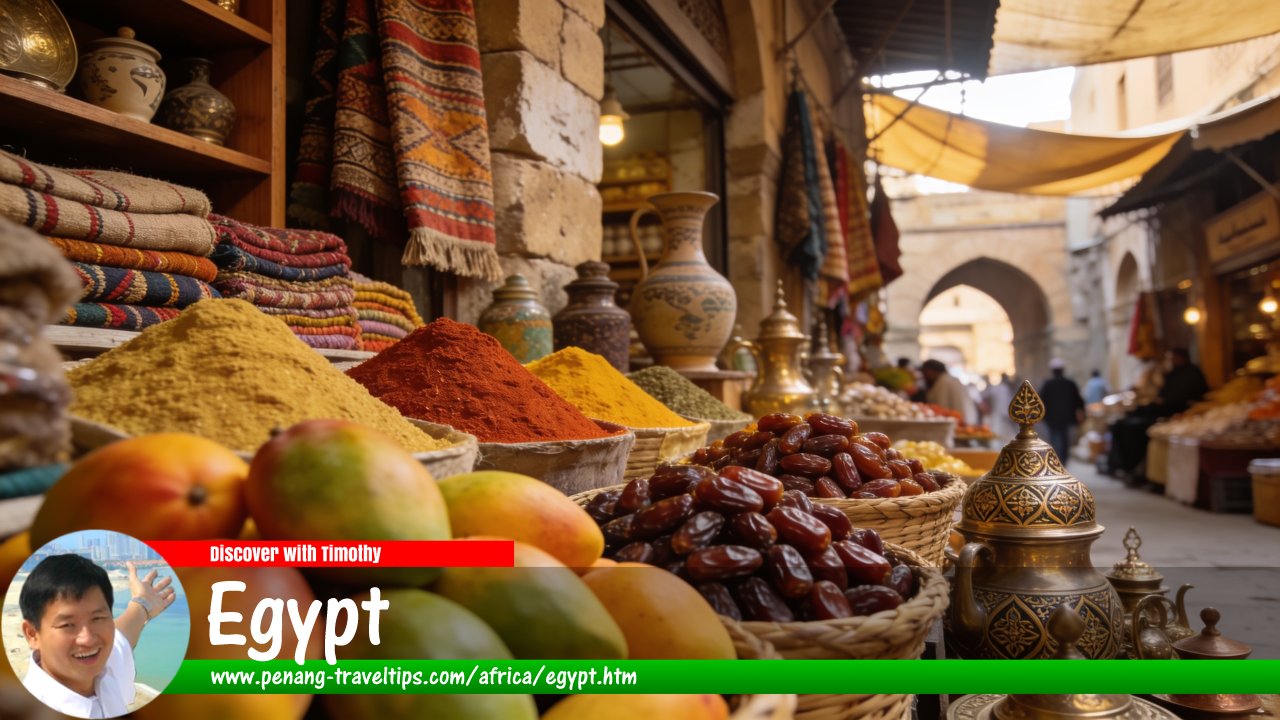 Egypt Travel Guide (AI Image generated on 2 September 2026)
Also available: Panduan Melawat Mesir
Egypt is a country in northeastern Africa, with a small part of its territory, the Sinai Peninsula, extending into Asia. It is one of the world's oldest centres of civilisation and is famous for the pyramids, ancient temples, tombs, the Nile River and its remarkable archaeological heritage. Modern Egypt combines this ancient heritage with Islamic and Christian traditions, busy cities, Mediterranean and Red Sea coastlines, and vast desert landscapes.
Geography of Egypt
Egypt covers much of the northeastern corner of Africa. It borders the Mediterranean Sea to the north, the Red Sea to the east, Libya to the west, and Sudan to the south. The Sinai Peninsula lies east of the Suez Canal and borders Israel and the Gaza Strip.
The Nile River is the geographical and historical centre of Egypt. Much of the country is desert, but the narrow Nile Valley and the broad Nile Delta provide fertile land for agriculture and support most of the country's population. The Nile flows northwards into the Mediterranean Sea, where it forms the Nile Delta.
Egypt can broadly be divided into several geographical regions, including the Nile Valley and Delta, the Western Desert, the Eastern Desert, the Sinai Peninsula and the Mediterranean and Red Sea coastal areas.
The Nile Valley and Delta
The Nile Valley is a long, relatively narrow strip of fertile land extending through Egypt from the Sudanese border towards Cairo. North of Cairo, the river spreads into the fertile Nile Delta before reaching the Mediterranean Sea. The valley and delta contain most of Egypt's major cities, agricultural land and population.
The Western Desert
The Western Desert occupies most of the area west of the Nile. It forms part of the Sahara and contains vast areas of sand dunes, rocky plains, oases and dramatic desert landscapes. Among the best known oases are Siwa, Bahariya, Farafra, Dakhla and Kharga.
The Eastern Desert
The Eastern Desert lies between the Nile Valley and the Red Sea. It is characterised by rugged mountains, dry valleys and mineral-rich landscapes. Several important ancient and modern mining areas are found in this region.
The Sinai Peninsula
The Sinai Peninsula is a triangular region between the Mediterranean Sea and the Red Sea. It is geographically part of Asia and contains mountainous terrain, desert landscapes and coastal resorts. Mount Sinai and the historic Saint Catherine's Monastery are among its best-known attractions.
Capital and Major Cities
Cairo
Cairo is the capital and largest city of Egypt and the political, cultural and economic centre of the country. It lies along the Nile and is the main gateway for visitors exploring Egypt. Major attractions include the Egyptian Museum, Islamic Cairo, historic mosques, Coptic churches and the nearby Giza pyramid complex.
Giza
Giza lies immediately west of Cairo and is best known for the Great Pyramid of Giza, the Pyramid of Khafre, the Pyramid of Menkaure and the Great Sphinx. Although often treated as part of the Cairo metropolitan area, Giza is a separate city and governorate.
Alexandria
Alexandria is Egypt's principal Mediterranean port and its second-largest city. Founded by Alexander the Great in 331 BC, it became one of the most important intellectual and cultural centres of the ancient Mediterranean. Modern Alexandria is known for its seafront, Mediterranean atmosphere, museums and the Bibliotheca Alexandrina.
Luxor
Luxor lies on the Nile in southern Egypt and is one of the country's most important archaeological destinations. The modern city stands near the site of ancient Thebes. Across the river are the Valley of the Kings, Valley of the Queens and numerous ancient temples and tombs.
Aswan
Aswan is a scenic city on the Nile in southern Egypt, close to the country's border with Sudan. It is known for the Aswan High Dam, the Nile cataracts, nearby islands and its connection with ancient Nubia. It is also an important starting point for visits to Abu Simbel.
Sharm El-Sheikh
Sharm El-Sheikh is a major resort city on the southern tip of the Sinai Peninsula. It is particularly popular for its Red Sea beaches, coral reefs, diving and snorkelling. The nearby Ras Mohammed National Park is an important marine and coastal environment.
Hurghada
Hurghada is one of Egypt's principal Red Sea resort destinations. It is known for its beaches, warm waters, coral reefs, diving, snorkelling and excursions into the Eastern Desert. Nearby resort areas include El Gouna and Makadi Bay.
A Brief History of Egypt
Egypt has a history stretching back thousands of years. Ancient Egyptian civilisation developed along the Nile and became one of the world's most influential early civilisations. The ancient Egyptians developed sophisticated systems of writing, administration, architecture, agriculture and religion.
The pyramids of Giza were constructed during Egypt's Old Kingdom, while later periods saw the development of great temple complexes and royal tombs. The New Kingdom, in particular, produced monuments at places such as Karnak, Luxor and Abu Simbel.
After the decline of the ancient Egyptian kingdoms, Egypt came under the rule of foreign powers including the Persians, Greeks and Romans. The conquest by Alexander the Great in 332 BC established the Ptolemaic dynasty, whose most famous ruler was Cleopatra VII.
Egypt subsequently became part of the Roman and Byzantine worlds before the Arab conquest in the seventh century. Islam gradually became the dominant religion, and Egypt developed into an important centre of Islamic scholarship, culture and government.
Egypt was later ruled by various Islamic dynasties, including the Fatimids, Ayyubids and Mamluks, followed by the Ottoman Empire. In the nineteenth century, Egypt came increasingly under European influence and later became a British-controlled territory before gaining greater independence.
Modern Egypt became a republic in 1953 following the Egyptian Revolution of 1952. The country has since played an important role in the political and cultural affairs of the Middle East and North Africa.
Ancient Egyptian Civilisation
The ancient civilisation of Egypt is one of the country's greatest attractions. Its monuments, temples, tombs, statues, inscriptions and artefacts provide an extraordinary record of a society that flourished for thousands of years.
Ancient Egyptian religion was closely connected with ideas about gods, kingship, death and the afterlife. Pharaohs were powerful rulers whose tombs and monuments were intended to preserve their status and support their journey into the afterlife.
The ancient Egyptians also developed hieroglyphic writing, sophisticated calendars, mathematical knowledge and engineering techniques. Their achievements can still be seen in monuments throughout the Nile Valley.
Islamic and Christian Heritage
Egypt's heritage is not limited to its ancient monuments. The country has been an important centre of Christianity and Islam for many centuries.
Coptic Christianity has deep roots in Egypt. Cairo's Coptic Quarter contains historic churches and monasteries, including the Hanging Church and the Church of Saints Sergius and Bacchus. The Monastery of Saint Catherine in Sinai is one of the world's oldest continuously operating Christian monasteries.
Egypt is also one of the most important centres of Islamic culture. Historic Cairo contains centuries-old mosques, religious schools, markets and monuments. Al-Azhar University and its associated institution, Al-Azhar Mosque, have played a major role in Islamic scholarship.
Egyptian Culture
Egyptian culture reflects thousands of years of interaction between African, Mediterranean, Middle Eastern and Islamic traditions. Ancient Egyptian heritage remains highly visible, while modern Egyptian culture is expressed through Arabic language, music, literature, cinema, food, architecture and everyday life.
Arabic is the official language. Egyptian Arabic is widely spoken in everyday life and is one of the most widely understood varieties of Arabic in the Arab world, partly because of the influence of Egyptian cinema, television and music.
Egypt has a predominantly Muslim population, with a significant Christian minority, particularly Coptic Christians. Mosques are widespread throughout the country, while churches and monasteries form an important part of Egypt's historical and cultural landscape.
Egyptian Food
Egyptian cuisine is based on ingredients that have long been important in the Nile Valley and surrounding region, including beans, lentils, rice, wheat, vegetables, herbs and meat.
Popular Egyptian dishes include koshari, a filling combination of rice, pasta, lentils, chickpeas and tomato sauce; ful medames, a traditional dish of cooked fava beans; ta'ameya, the Egyptian version of falafel traditionally made from fava beans; and molokhia, a leafy vegetable dish commonly served with rice or bread.
Grilled meats, seafood, breads, pastries and sweet dishes are also common. Egyptian cuisine varies by region, with coastal areas offering more seafood and southern Egypt retaining strong Nubian culinary influences.
Why Visit Egypt?
Egypt offers an unusual combination of ancient history, living culture, dramatic landscapes and coastal recreation. Visitors can explore ancient monuments in Cairo, Giza and Luxor, travel along the Nile, visit Nubian communities around Aswan, explore historic Islamic and Coptic districts, or relax beside the Red Sea.
The country also offers experiences beyond its famous monuments. Desert oases, traditional markets, Nile felucca rides, Mediterranean Alexandria and Red Sea diving provide different ways to experience Egypt.
For travellers interested in history and archaeology, Egypt is one of the world's outstanding destinations. For others, its combination of food, culture, religious heritage, beaches and desert scenery makes it possible to create a very different type of Egyptian journey.
History and Cultural Heritage of Egypt
Egypt's history spans more than five thousand years, with the Nile River providing the foundation for one of the world's earliest and most influential civilisations. Ancient Egyptian civilisation was followed by Greek, Roman, Byzantine, Islamic and Ottoman periods, each leaving its mark on the country. Today, these layers of history can be seen in Egypt's monuments, archaeological sites, religious buildings, museums, language and traditions.
Prehistoric Egypt
Human settlement in the Nile Valley dates back to prehistoric times. The river provided water, fertile soil and a dependable environment for agriculture, allowing communities to become increasingly settled. Over time, villages developed into larger communities and regional centres.
By around the fourth millennium BC, several cultures had developed along the Nile. The gradual unification of Upper and Lower Egypt created the political foundation for the ancient Egyptian state.
Ancient Egypt
The history of ancient Egypt is traditionally divided into periods and dynasties. Although there were periods of political division and foreign rule, Egyptian civilisation maintained many distinctive traditions for thousands of years.
Early Dynastic Period
The Early Dynastic Period began around 3100 BC, when Upper and Lower Egypt were unified under a single ruler. The king, later known as the pharaoh, became the central figure of Egyptian political and religious life.
Early royal centres were established along the Nile, and Egyptian writing, administration, religious institutions and monumental architecture continued to develop.
Old Kingdom
The Old Kingdom, roughly from the 27th to the 22nd century BC, is often called the great age of pyramid building. Pharaohs constructed enormous stone monuments as royal tombs and expressions of their power.
The most famous monuments are the pyramids of Giza, including the Great Pyramid built for Pharaoh Khufu. The Great Pyramid is the only surviving member of the Seven Wonders of the Ancient World.
Middle Kingdom
The Middle Kingdom followed a period of political fragmentation. During this era, Egypt was reunified and experienced renewed economic, political and cultural development.
The period is also remembered for advances in literature and administration. Egyptian influence expanded into neighbouring regions, including Nubia to the south.
New Kingdom
The New Kingdom, approximately from the 16th to the 11th century BC, was one of the most powerful periods in ancient Egyptian history. Egypt expanded its influence beyond the Nile Valley, while wealthy pharaohs commissioned some of the country's greatest temples and monuments.
Important rulers included Hatshepsut, Thutmose III, Akhenaten, Tutankhamun, Seti I and Ramesses II. The temples of Karnak and Luxor, the Valley of the Kings and many monuments in southern Egypt date from this period or contain major New Kingdom remains.
Akhenaten and the Amarna Period
Pharaoh Akhenaten introduced major religious changes during the 14th century BC. He promoted the worship of the Aten, represented by the sun disk, and established a new capital at Akhetaten, now known as Amarna.
After his death, many of his religious reforms were reversed. His successor, Tutankhamun, became famous centuries later when his relatively intact tomb was discovered in the Valley of the Kings in 1922.
Late Period
Following the New Kingdom, Egypt experienced periods of political instability and foreign domination. The country was ruled at various times by Libyan, Nubian and Persian dynasties before the arrival of Alexander the Great.
Greek and Ptolemaic Egypt
Alexander the Great conquered Egypt in 332 BC and founded the city of Alexandria on the Mediterranean coast. After Alexander's death, Egypt was ruled by the Ptolemaic dynasty, a Greek-speaking royal family that governed Egypt for almost three centuries.
Alexandria became one of the great intellectual and cultural centres of the ancient world. The city was associated with the famous Library of Alexandria and the ancient Pharos lighthouse, one of the Seven Wonders of the Ancient World.
The most famous Ptolemaic ruler was Cleopatra VII. Her reign ended when Egypt became part of the Roman Empire following her defeat and death in 30 BC.
Roman and Byzantine Egypt
Egypt became a province of the Roman Empire in 30 BC. The country was particularly important to Rome because the fertile Nile Valley produced large quantities of grain.
Christianity spread through Egypt during the Roman period. According to Christian tradition, Saint Mark introduced Christianity to Alexandria, and the Christian community eventually developed into what is now known as the Coptic Church.
After the division of the Roman Empire, Egypt became part of the Byzantine Empire. Christian communities established churches and monasteries throughout the country, many of which contributed to the development of early Christian monasticism.
Arab Conquest and Islamic Egypt
Arab armies conquered Egypt in the seventh century AD. The conquest brought Egypt into the Islamic world and began a major transformation of its political, cultural and linguistic landscape.
The new rulers established Fustat, near present-day Cairo, as an administrative centre. Over the following centuries, Arabic gradually replaced Greek and Coptic as the dominant language of administration and everyday life.
Islam became the majority religion, while Christian communities continued to maintain their religious institutions and traditions.
Fatimid Egypt
In 969 AD, the Fatimids conquered Egypt and established a new capital called al-Qahirah, meaning "the victorious". This became modern Cairo.
The Fatimids founded Al-Azhar Mosque and established an institution that developed into Al-Azhar University, one of the world's oldest and most influential centres of Islamic learning.
Many of the historic monuments and streets of Islamic Cairo developed during the Fatimid period and the centuries that followed.
Ayyubid and Mamluk Egypt
The Ayyubid dynasty was founded by Saladin, the Muslim ruler who became famous for his campaigns during the Crusades. Saladin strengthened Egypt's political and military position and developed Cairo's fortifications.
The Mamluks subsequently ruled Egypt for several centuries. Cairo became one of the most important political, commercial and intellectual centres of the medieval Islamic world.
Many of Cairo's historic mosques, madrasas, mausoleums and markets date from the Ayyubid and Mamluk periods.
Ottoman Egypt
Egypt became part of the Ottoman Empire in 1517 following the Ottoman conquest of the Mamluk Sultanate. Egypt remained an important agricultural and commercial region within the empire.
Although Cairo was no longer the centre of an independent empire, it remained a major city and regional centre. Ottoman influence can still be seen in some of Egypt's mosques and architecture.
Modern Egypt
Muhammad Ali Dynasty
In the early nineteenth century, Muhammad Ali Pasha established a powerful ruling dynasty in Egypt. He introduced military, agricultural and administrative reforms and pursued policies that helped modernise the country.
During the nineteenth century, Egypt became increasingly connected to European trade and finance. The construction of the Suez Canal, opened in 1869, transformed Egypt's strategic importance by creating a maritime link between the Mediterranean Sea and the Indian Ocean.
British Influence
Egypt came under British occupation in 1882, although the country formally remained part of the Ottoman Empire until the First World War. Britain declared a protectorate over Egypt in 1914.
Egypt gained formal independence in 1922, although British influence remained significant for several decades.
Egyptian Revolution of 1952
The Egyptian Revolution of 1952 ended the monarchy and eventually established a republic. Gamal Abdel Nasser became the country's dominant political leader and pursued policies of Arab nationalism and greater independence from foreign influence.
The nationalisation of the Suez Canal in 1956 led to the Suez Crisis, in which Britain, France and Israel launched military action against Egypt. International pressure eventually forced the invading forces to withdraw.
Egypt Since the Twentieth Century
Egypt continued to play an important role in Middle Eastern politics during the presidencies of Anwar Sadat and Hosni Mubarak. Sadat signed the Egypt-Israel Peace Treaty in 1979, making Egypt the first Arab country to establish formal diplomatic relations with Israel.
In 2011, widespread demonstrations contributed to the resignation of President Hosni Mubarak. Egypt subsequently experienced a period of political change and instability before the country's present political system emerged.
Egyptian Hieroglyphs
Hieroglyphs are the best-known form of ancient Egyptian writing. They use pictures and symbols to represent sounds, words and ideas. Hieroglyphic inscriptions can be found on temple walls, tombs, statues, monuments and other objects.
The ancient Egyptians also used other forms of writing, including hieratic and demotic scripts. These were generally more practical for administrative, religious and everyday purposes.
The Rosetta Stone
The Rosetta Stone was discovered in 1799 near the town of Rashid, known in English as Rosetta. The stone contains the same decree written in three scripts: Egyptian hieroglyphs, Demotic and ancient Greek.
Because scholars could understand ancient Greek, the stone provided a crucial key to deciphering Egyptian hieroglyphs. Jean-François Champollion announced a major breakthrough in deciphering the script in 1822.
The decipherment of hieroglyphs transformed the study of ancient Egypt because scholars could finally read large quantities of Egyptian inscriptions and documents.
Ancient Egyptian Religion
Religion was central to ancient Egyptian society. Egyptians worshipped numerous gods and goddesses associated with nature, kingship, fertility, death and other aspects of life.
Important deities included Ra, associated with the sun; Osiris, associated with the afterlife; Isis, associated with motherhood and magic; Horus, associated with kingship; and Anubis, associated with funerary practices and mummification.
Egyptian religious beliefs changed over time, and different regions often had their own important gods and religious traditions.
Mummification and the Afterlife
Ancient Egyptians placed great importance on the afterlife. They believed that preserving the body and providing the deceased with appropriate funerary equipment could help the person continue existence after death.
Mummification was a process used to preserve the body. Wealthy individuals could be buried with elaborate coffins, statues, jewellery, food and other objects intended to accompany them into the afterlife.
The famous royal tombs of the Valley of the Kings demonstrate the importance of funerary traditions during the New Kingdom.
Temples and Monuments
Ancient Egyptian temples were not simply places of public worship. They were religious institutions with priests, estates, workshops and administrative functions. Large temple complexes could contain pylons, courtyards, hypostyle halls, sanctuaries and monumental statues.
The temples of Karnak and Luxor are among the finest surviving examples. Other important monuments include the temples of Abu Simbel, the Temple of Hatshepsut and the temples of Edfu and Kom Ombo.
Egyptian Art and Architecture
Ancient Egyptian art followed conventions that remained remarkably consistent over long periods. Human figures were often depicted using a combination of frontal and profile views, while the size of figures could indicate their social importance.
Reliefs and paintings frequently depicted religious ceremonies, royal achievements, agricultural activities and scenes connected with the afterlife. Egyptian architecture is particularly notable for its monumental scale, carefully cut stonework and extensive use of columns and carved decoration.
Coptic Heritage
Coptic heritage represents the long Christian history of Egypt. The Coptic Orthodox Church traces its tradition to the early Christian community of Alexandria.
Christian monasteries developed particularly strongly in Egypt's deserts. The country's monastic tradition had a major influence on the development of Christian monasticism elsewhere.
Historic Coptic Cairo contains churches, monasteries and other religious buildings that reflect centuries of Christian history. The Hanging Church is among the best-known landmarks in the district.
Islamic Heritage
Islamic heritage is equally important to Egypt's cultural identity. Cairo contains an extraordinary concentration of historic mosques, madrasas, mausoleums, gates and traditional markets.
Al-Azhar Mosque is one of the most important religious landmarks in Cairo. Other notable monuments include the Mosque-Madrasa of Sultan Hasan, the Al-Rifa'i Mosque, the Mosque of Ibn Tulun and the Citadel of Cairo.
Historic Cairo demonstrates how Egypt developed as a major centre of Islamic architecture, scholarship and commerce after the Arab conquest.
Egypt's UNESCO World Heritage Sites
Egypt has several sites recognised by UNESCO for their outstanding cultural or natural value. Among the best known are the Ancient Thebes with its Necropolis, Historic Cairo, the Memphis and its Necropolis pyramid fields, Nubian Monuments from Abu Simbel to Philae, the Saint Catherine Area and Wadi Al-Hitan, known as the Valley of Whales.
These sites illustrate the extraordinary range of Egypt's heritage, from ancient pyramids and temples to Islamic architecture, Christian traditions and important desert ecosystems.
Egypt's Living Heritage
Egypt's heritage is not confined to archaeological sites and museums. Traditional music, crafts, markets, religious celebrations, food, architecture and everyday customs continue to form part of Egyptian life.
The Nile remains an important cultural symbol, while cities such as Cairo and Alexandria combine historic neighbourhoods with modern urban life. In southern Egypt, Nubian communities maintain distinctive cultural traditions, architecture, music and cuisine.
This combination of ancient monuments and living traditions is one of the defining characteristics of travelling in Egypt. A visit is therefore not simply a journey through ancient history, but an opportunity to see how successive civilisations have shaped a country that remains culturally vibrant today.
Major Attractions and Destinations in Egypt
Egypt has an extraordinary concentration of historical monuments and archaeological sites, particularly along the Nile Valley. Beyond the ancient sites, the country also offers historic Islamic and Christian districts, Mediterranean cities, desert oases and Red Sea resorts. Travellers can therefore combine sightseeing, history, culture, diving and relaxation in a single trip.
Cairo and Giza
Giza Pyramid Complex
The Giza Pyramid Complex is Egypt's most famous archaeological site and one of the world's most recognisable groups of monuments. It contains the Great Pyramid of Khufu, the Pyramid of Khafre, the Pyramid of Menkaure and the Great Sphinx.
The Great Pyramid was built as the tomb of Pharaoh Khufu during the Old Kingdom. The Pyramid of Khafre appears taller because it stands on higher ground and retains some of its original limestone casing near the summit. The Great Sphinx, with the body of a lion and the head of a human, is another major landmark of the complex.
Saqqara
Saqqara is an extensive ancient necropolis south of Cairo. Its most famous monument is the Step Pyramid of Djoser, generally regarded as the earliest large-scale stone pyramid in Egypt.
The wider archaeological area contains tombs, temples, pyramids and decorated burial chambers from different periods of ancient Egyptian history.
Memphis
Memphis was one of ancient Egypt's most important political and religious centres. The ancient city once stood near the entrance to the Nile Delta and served as the capital of Egypt during important periods of its history.
Today, the site is an archaeological area and open-air museum containing statues and other remains, including the enormous limestone statue of Ramesses II.
Egyptian Museum
The Egyptian Museum in central Cairo houses one of the world's most important collections of ancient Egyptian antiquities. Its collection includes statues, jewellery, funerary objects, papyri, royal artefacts and objects from different periods of Egyptian history.
Among its most famous holdings are objects associated with the tomb of Tutankhamun, although many of the Tutankhamun treasures have been transferred to the Grand Egyptian Museum.
Grand Egyptian Museum
The Grand Egyptian Museum, located near the Giza pyramids, is a major museum dedicated to ancient Egyptian civilisation. It was developed to provide a much larger setting for Egypt's archaeological collections and to present them using modern museum facilities.
Historic Cairo
Islamic Cairo
Historic Cairo contains one of the world's most important concentrations of medieval Islamic architecture. Its streets are lined with mosques, madrasas, mausoleums, historic houses, markets and other monuments.
Important landmarks include Al-Azhar Mosque, the Mosque of Ibn Tulun, the Mosque-Madrasa of Sultan Hasan and the Citadel of Cairo.
Khan el-Khalili
Khan el-Khalili is Cairo's best-known traditional market district. Its narrow streets contain shops selling souvenirs, jewellery, spices, handicrafts, textiles and other goods.
The surrounding area is also a useful place to experience historic Cairo, with mosques, traditional architecture, cafés and restaurants close to the market.
Cairo Citadel
The Citadel of Cairo is a historic fortified complex on Mokattam Hill. It was begun by Saladin in the twelfth century and subsequently expanded by later rulers.
The complex contains several important mosques, including the Mosque of Muhammad Ali, which is one of Cairo's most recognisable landmarks.
Coptic Cairo
Coptic Cairo contains some of Egypt's most important Christian monuments. Among the best-known buildings are the Hanging Church, the Church of Saints Sergius and Bacchus, and the Coptic Museum.
The area illustrates the long history of Christianity in Egypt and provides an important contrast with the Islamic monuments of historic Cairo.
Alexandria
Alexandria is Egypt's major Mediterranean city and has a distinctly different atmosphere from Cairo. Founded by Alexander the Great, it became an important centre of Hellenistic culture and scholarship.
Bibliotheca Alexandrina
The Bibliotheca Alexandrina is a modern library and cultural complex inspired by the ancient Library of Alexandria. The building contains extensive collections, museums, exhibition spaces and cultural facilities.
Qaitbay Citadel
The Citadel of Qaitbay stands on the Mediterranean waterfront. It was built in the fifteenth century on the site associated with the ancient Pharos Lighthouse, one of the Seven Wonders of the Ancient World.
Alexandria's Corniche
The Alexandria Corniche stretches along the Mediterranean waterfront and is one of the city's characteristic public spaces. It offers views of the sea and access to beaches, cafés and restaurants.
Luxor
Luxor is often described as one of the world's greatest open-air archaeological museums. The modern city occupies part of the area of ancient Thebes, which was an important capital of ancient Egypt.
Karnak Temple
Karnak Temple is a vast temple complex dedicated principally to the Theban god Amun-Ra. Construction and expansion continued for many centuries under successive pharaohs.
The Great Hypostyle Hall, with its enormous columns, is one of the most impressive parts of the complex.
Luxor Temple
Luxor Temple stands on the east bank of the Nile and was closely associated with the religious traditions of ancient Thebes. The temple is particularly atmospheric in the evening when it is illuminated.
Valley of the Kings
The Valley of the Kings lies on the west bank of the Nile opposite Luxor. It was used as a royal burial ground during the New Kingdom.
The valley contains numerous decorated tombs carved into the surrounding limestone hills. The tomb of Tutankhamun is the most famous, although many other tombs contain important paintings and inscriptions.
Valley of the Queens
The Valley of the Queens was used primarily for the burial of queens and other members of the royal family. Its most famous tomb is that of Queen Nefertari, which is noted for its exceptionally well-preserved wall paintings.
Temple of Hatshepsut
The Temple of Hatshepsut at Deir el-Bahari is a striking terraced monument built for the female pharaoh Hatshepsut. Its design incorporates large terraces against the cliffs and reliefs depicting important events from her reign.
Edfu and Kom Ombo
Temple of Edfu
The Temple of Edfu is one of the best-preserved ancient Egyptian temples. It was dedicated to the falcon-headed god Horus and was constructed during the Ptolemaic period.
Temple of Kom Ombo
The Temple of Kom Ombo is unusual because it was dedicated to two groups of deities. The temple is associated particularly with Sobek, the crocodile god, and Horus the Elder.
Its location beside the Nile makes it a popular stop on Nile cruises between Luxor and Aswan.
Aswan
Aswan is one of the most scenic destinations along the Nile. It is surrounded by islands, granite rocks and desert landscapes and has strong connections with Nubian culture.
Philae Temple
Philae Temple is located on Agilkia Island and was dedicated primarily to the goddess Isis. The temple complex was relocated from its original island in the twentieth century to protect it from rising waters following the construction of the Aswan High Dam.
Aswan High Dam
The Aswan High Dam was completed in the 1970s and created Lake Nasser, one of the world's largest artificial lakes. The dam plays an important role in flood control, irrigation and electricity generation.
Nubian Villages
The area around Aswan is home to Nubian communities with distinctive traditions, architecture, music and cuisine. Visiting a Nubian village can provide a different perspective on southern Egypt and the cultural diversity of the Nile Valley.
Abu Simbel
Abu Simbel is one of the most spectacular ancient sites in southern Egypt. The complex contains two enormous rock-cut temples commissioned by Pharaoh Ramesses II.
The larger temple has four monumental seated statues of Ramesses II at its entrance. The temples were relocated in the twentieth century to prevent them from being submerged by the rising waters of Lake Nasser after construction of the Aswan High Dam.
Nile River Cruises
A Nile cruise is one of the classic ways to experience Egypt. Most traditional cruises operate between Luxor and Aswan, allowing passengers to visit major temples along the river while travelling between the two cities.
Typical stops can include Edfu, Kom Ombo and various archaeological sites around Luxor and Aswan. Cruise lengths vary, with shorter cruises available for travellers with limited time.
Red Sea Coast
Hurghada
Hurghada is one of Egypt's best-known Red Sea resorts. Its warm waters, coral reefs and relatively easy access from mainland Egypt make it popular with international visitors.
Activities include diving, snorkelling, boat trips, fishing and desert excursions. The surrounding resort areas offer a wide range of hotels and holiday facilities.
El Gouna
El Gouna is a planned resort town north of Hurghada. It has lagoons, beaches, hotels, restaurants and recreational facilities and is particularly known for watersports and a resort-oriented atmosphere.
Sharm El-Sheikh
Sharm El-Sheikh is a major resort destination on the southern Sinai Peninsula. It is particularly well known for diving and snorkelling around coral reefs in the Red Sea.
Ras Mohammed National Park
Ras Mohammed National Park occupies the southern tip of the Sinai Peninsula and protects important marine and terrestrial ecosystems. Its coral reefs and clear waters make it one of Egypt's best-known diving and snorkelling areas.
Sinai Peninsula
Mount Sinai
Mount Sinai is traditionally identified as the mountain where Moses received the Ten Commandments. The mountain has great religious significance to Judaism, Christianity and Islam.
Visitors commonly reach the summit by hiking before sunrise or at other suitable times, depending on local conditions and arrangements.
Saint Catherine's Monastery
Saint Catherine's Monastery stands at the foot of Mount Sinai. Founded in the sixth century, it is one of the world's oldest continuously operating Christian monasteries and contains an important collection of manuscripts, icons and religious objects.
Western Desert Oases
Egypt's Western Desert contains several oases that provide a striking contrast to the densely populated Nile Valley.
Siwa Oasis
Siwa Oasis lies close to Egypt's border with Libya and is known for its palm groves, natural springs, salt lakes, desert scenery and distinctive local culture. The oasis is also associated with the ancient Oracle of Amun.
Bahariya Oasis
Bahariya Oasis is an important gateway to desert excursions. It is particularly known for archaeological discoveries and access to the Black Desert and White Desert.
White Desert
The White Desert is famous for its unusual chalk rock formations sculpted by wind erosion. The pale landscape creates one of Egypt's most distinctive desert environments.
Mediterranean Coast
Egypt's Mediterranean coastline stretches across the north of the country. In addition to Alexandria, the coast contains beaches and resort areas that are popular with domestic and international visitors, particularly during the warmer months.
Other Archaeological Sites
Egypt contains hundreds of additional archaeological sites beyond its most famous destinations. Important examples include Abydos, Dendera, Esna, Tanis and the ancient sites around Minya.
Abydos was an important religious centre associated with Osiris and contains the Temple of Seti I. Dendera is known for its well-preserved Temple of Hathor, while the archaeological sites of Upper Egypt reveal the diversity of religious and political centres that developed along the Nile.
Choosing Where to Go in Egypt
Travellers interested primarily in ancient monuments can focus on Cairo, Giza and Luxor. Those who want to experience the Nile can add Aswan and a river cruise. Travellers interested in diving and beaches can choose Hurghada or Sharm El-Sheikh, while those looking for desert landscapes can consider Siwa, Bahariya and the White Desert.
For a first visit, combining Cairo and Giza with Luxor and Aswan provides a strong introduction to Egypt's ancient heritage. Adding a Red Sea resort creates a more varied itinerary combining history with relaxation.
Food and Dining in Egypt
Egyptian cuisine reflects the country's long history and its position at the crossroads of Africa, the Middle East and the Mediterranean. Much of the traditional diet is based on inexpensive and filling ingredients such as beans, lentils, rice, wheat, vegetables and bread. Meat, chicken and fish are also widely eaten, while spices, herbs, garlic, onions and lemon are commonly used to add flavour.
Egyptian food is generally easy for travellers to find throughout the country. Cairo and Alexandria offer the greatest variety of restaurants, while Luxor, Aswan and the Red Sea resorts also have restaurants serving both Egyptian and international dishes.
Staple Egyptian Foods
Ful Medames
Ful medames is one of Egypt's most characteristic traditional foods. It consists of cooked fava beans, usually seasoned with olive oil, lemon juice, garlic, cumin and other ingredients.
Ful is commonly eaten for breakfast but can also be served at other times of the day. It is inexpensive, filling and widely available from restaurants and street-food stalls.
Ta'ameya
Ta'ameya is the Egyptian version of falafel. Unlike the chickpea-based falafel common in many parts of the Middle East, Egyptian ta'ameya is traditionally made primarily from crushed fava beans.
The mixture is seasoned with herbs and spices, shaped into small patties or balls and deep-fried. Ta'ameya is often served with bread, salad, tahini or other accompaniments.
Koshari
Koshari is one of Egypt's best-known vegetarian dishes. It combines rice, pasta, lentils and chickpeas and is usually topped with tomato sauce and fried onions.
The combination may seem unusual to visitors at first, but koshari is an important part of everyday Egyptian food culture. It is inexpensive, substantial and widely available in dedicated koshari restaurants.
Aish Baladi
Aish baladi is a traditional Egyptian flatbread made from wheat flour. Bread is an essential part of Egyptian meals and is commonly used to accompany beans, dips, grilled meats and other dishes.
The Arabic word aish means "life", reflecting the importance of bread in Egyptian food culture.
Popular Egyptian Dishes
Molokhia
Molokhia is made from the leaves of the jute plant. The leaves are finely chopped and cooked into a thick, green soup or stew, usually flavoured with garlic and coriander.
Molokhia is commonly served with rice and chicken, rabbit or other meat, although recipes vary between households and regions.
Fatta
Fatta is a traditional dish made with layers of bread, rice and meat, usually accompanied by a garlicky vinegar and tomato sauce. It is particularly associated with celebrations and special occasions.
Mahshi
Mahshi refers to vegetables stuffed with a seasoned mixture that commonly includes rice, herbs and tomato. Grape leaves, courgettes, peppers, aubergines and cabbage can all be prepared in this style.
Shawarma
Shawarma is widely available in Egypt, although it originated in the broader Middle Eastern culinary tradition. Thin slices of seasoned meat are cooked on a vertical rotating spit and served in bread with vegetables and sauces.
Kebab and Kofta
Kebab and kofta are popular grilled meat dishes. Kebab generally refers to pieces of meat grilled on skewers, while kofta is usually made from seasoned minced meat shaped into elongated portions before grilling.
These dishes are commonly served with bread, rice, salad, tahini and grilled vegetables.
Egyptian Seafood
Egypt has access to both the Mediterranean Sea and the Red Sea, while the Nile and its lakes also contribute to the country's fishing traditions. Seafood is therefore an important part of the diet in coastal areas.
Alexandria is particularly well known for seafood restaurants. Fish and other seafood are also widely available in Red Sea destinations such as Hurghada and Sharm El-Sheikh.
Common preparations include grilled, fried or baked fish, prawns, calamari and seafood rice dishes. Restaurants may allow customers to select fresh fish before it is cooked.
Egyptian Sweets and Desserts
Basbousa
Basbousa is a sweet semolina cake soaked in syrup. It is commonly flavoured with coconut, rose water or orange blossom water and may be decorated with almonds or other nuts.
Umm Ali
Umm Ali is a popular Egyptian dessert made from pastry or bread combined with milk, sugar, nuts and sometimes raisins or coconut. It is baked until the top becomes golden and is usually served warm.
Konafa
Konafa is made from very thin strands of pastry combined with sweet syrup and fillings such as cream, cheese or nuts. Different regions and bakeries have their own variations.
Dates and Fresh Fruit
Dates, oranges, bananas, melons, grapes and other fruits are commonly available in Egypt. Fresh fruit is particularly enjoyable during the warmer months, although visitors should take normal food-hygiene precautions when buying prepared or cut fruit.
Egyptian Drinks
Egyptian Tea
Tea is one of the most common drinks in Egypt. Black tea is often served sweetened and may be offered in homes, cafés and restaurants throughout the country.
Arabic Coffee
Arabic coffee and Turkish-style coffee are both found in Egypt. Egyptian coffee is usually prepared strong and served in a small cup, often with sugar according to the customer's preference.
Hibiscus Tea
Karkade, or hibiscus tea, is a popular Egyptian drink made from dried hibiscus flowers. It can be served hot or chilled and has a naturally tart flavour.
Sugar Cane Juice
Asab is fresh sugar cane juice extracted using a mechanical press. It is particularly refreshing in Egypt's hot climate and is commonly sold at juice shops and street stalls.
Egyptian Street Food
Street food is an important part of everyday eating in Egypt. Small restaurants and food stalls can provide inexpensive meals and snacks, particularly in busy urban neighbourhoods.
Popular choices include ful, ta'ameya, koshari, grilled meats, shawarma, sandwiches and freshly prepared juices. Street food can be an excellent way to experience ordinary Egyptian food culture, but travellers should choose busy establishments where food is prepared and served quickly.
Regional Food in Egypt
Cairo
Cairo offers the widest selection of Egyptian food. Traditional restaurants, street-food stalls, cafés and international restaurants can all be found throughout the metropolitan area.
Alexandria
Alexandria is particularly associated with seafood because of its location on the Mediterranean. Restaurants range from inexpensive local seafood establishments to more sophisticated dining venues along the waterfront.
Upper Egypt
Upper Egypt, particularly the areas around Luxor and Aswan, has its own culinary traditions. Nubian cuisine around Aswan includes dishes based on grains, vegetables, beans and meat, often prepared with distinctive local seasonings.
Sinai and the Red Sea
Restaurants in Sinai and the Red Sea resort areas serve a mixture of Egyptian, Bedouin, Middle Eastern and international food. Seafood is particularly popular along the coast.
Halal Food in Egypt
Halal food is widely available in Egypt because the country has a predominantly Muslim population. Most traditional Egyptian restaurants serve halal meat, and pork is generally absent from ordinary Egyptian cuisine.
Muslim travellers from Malaysia should generally find familiar ingredients and food practices in Egypt, although restaurant standards and preparation methods can vary. When in doubt, travellers can ask whether meat is halal and whether any alcohol or non-halal ingredients are used in a particular dish.
Eating During Ramadan
During Ramadan, Muslims fast from dawn until sunset. Restaurants and cafés may have different operating hours, while many establishments become particularly busy around sunset when people gather for iftar, the evening meal that breaks the fast.
Travellers visiting Egypt during Ramadan should be aware that daytime dining options may be more limited in some areas. At the same time, Ramadan can provide an opportunity to experience the country's evening food culture, when families and communities gather for large meals.
Egyptian Cafés
Cafés are an important part of Egyptian social life. They are places where people meet friends, drink tea or coffee, talk and relax. Traditional cafés can be found throughout Cairo and other Egyptian cities.
Some cafés also serve shisha, a traditional water pipe. Visitors should be aware that smoking is common in many traditional cafés and that indoor environments may therefore be smoky.
Dining Etiquette
Egyptian dining etiquette varies according to the setting. In more traditional situations, food may be shared from common dishes. When eating with local hosts, accepting food graciously is generally appreciated.
When eating with the right hand, it is customary to use the right hand for taking food from shared dishes. In restaurants, however, standard Western-style cutlery is commonly provided.
Food Safety for Travellers
Travellers should use ordinary precautions when eating in Egypt. Choose busy restaurants where food turnover is high, make sure meat and seafood are thoroughly cooked, and exercise care with raw foods and food that has been sitting unrefrigerated.
Bottled or properly treated water is generally the safer choice for visitors who are uncertain about local water supplies. When buying bottled water, check that the seal is intact.
Dining in Egypt
Egypt offers a wide range of dining experiences, from inexpensive street food and traditional neighbourhood restaurants to hotel restaurants and international establishments. Visitors who want to understand Egyptian culture should try local dishes rather than relying entirely on familiar international food.
For a first visit, ful, ta'ameya, koshari, molokhia, grilled meats, Egyptian bread, local desserts and karkade provide a good introduction to the country's traditional cuisine.
Getting to and Around Egypt
Egypt is well connected to Europe, the Middle East, Africa and Asia by air. Most international visitors arrive by plane, with Cairo serving as the country's principal international gateway. Once in Egypt, travellers can move between major destinations by domestic flight, train, long-distance bus, taxi, private car, Nile cruise and other local transport.
Getting to Egypt by Air
Cairo International Airport is Egypt's main international airport and the principal gateway for travellers visiting Cairo, Giza and the Nile Valley. It is located northeast of central Cairo and is served by numerous international airlines.
Other important international airports include Borg El Arab Airport serving Alexandria, Hurghada International Airport on the Red Sea coast, Sharm El-Sheikh International Airport in Sinai, and Luxor International Airport in southern Egypt.
Travellers heading directly to a Red Sea resort or southern Egypt may find it more convenient to fly directly to the nearest regional airport rather than travelling through Cairo.
Flights from Malaysia to Egypt
For travellers from Malaysia, Cairo is normally the most practical international entry point. Depending on the airline and season, flights from Kuala Lumpur to Cairo may be available either directly or with a connection.
Common connecting points for flights between Malaysia and Egypt include major Middle Eastern and Asian aviation hubs. Flight schedules change, so travellers should compare current routes, connection times and baggage allowances before booking.
Travellers planning to visit Luxor, Aswan or a Red Sea resort should compare the cost of flying directly to a regional Egyptian airport with the cost of travelling from Cairo by air, train or road.
Getting Around Egypt by Air
Domestic flights are useful when travelling long distances within Egypt. They can save considerable time when travelling between Cairo and destinations such as Luxor, Aswan, Hurghada and Sharm El-Sheikh.
For example, travelling by air between Cairo and Aswan is considerably faster than travelling by train. Domestic flights are therefore particularly useful for visitors with a short itinerary.
However, flights may cost more than trains or buses, especially when travelling with substantial luggage. Travellers should also allow sufficient time for airport transfers and security procedures.
Travelling by Train
Trains are an important means of transport along the Nile Valley. The main railway network connects Cairo with major cities including Alexandria, Luxor and Aswan.
Train travel can be a practical way to experience the country while avoiding the need to drive. Overnight trains can also save the cost of a hotel night, although comfort and service levels vary between different services.
Cairo to Alexandria
The railway provides frequent connections between Cairo and Alexandria. Because the two cities are relatively close, the train is one of the most convenient ways to travel between them.
Cairo to Luxor and Aswan
Long-distance trains connect Cairo with Luxor and Aswan. Travellers can choose between different classes and types of service depending on the route and current timetable.
Train journeys between Cairo and southern Egypt can take many hours, so travellers should consider whether the experience and lower cost outweigh the additional travel time compared with flying.
Travelling by Bus
Long-distance buses connect Cairo with many cities and tourist destinations. They can be cheaper than flying and may serve destinations not directly connected by rail.
Modern coaches are available on some major routes, although journey times can be long. Travellers should consider the road distance, departure time and expected traffic conditions when choosing bus travel.
Buses are particularly useful for reaching some Red Sea and Sinai destinations where rail services are limited or unavailable.
Travelling by Road
Egypt has an extensive road network linking Cairo with the Nile Valley, Mediterranean coast, Red Sea coast and other regions. Major highways connect the principal cities and tourist destinations.
Driving in Egypt is on the right-hand side of the road. Traffic in Cairo and other large cities can be heavy and unpredictable, and driving conditions may be very different from those familiar to visitors from Malaysia.
For most first-time visitors, hiring a car is not necessary. Private transfers, taxis, organised tours and hired drivers are often more convenient, particularly when travelling between archaeological sites.
Travelling by Taxi
Taxis are widely available in Egyptian cities. They can be useful for short journeys, although visitors should establish the fare or use a reputable ride-hailing service where available.
In Cairo, traffic congestion can make journeys by road considerably longer than the distance might suggest. Travellers should allow extra time when travelling to airports, railway stations or attractions at busy times.
Ride-Hailing Services
Ride-hailing applications are available in major Egyptian cities and can be useful for visitors who prefer to avoid negotiating fares with street taxis.
Before entering a vehicle, travellers should check the vehicle details shown in the application and confirm that the destination and fare are correct.
Cairo Public Transport
Cairo Metro
The Cairo Metro is one of the most useful forms of public transport in the capital. It connects important parts of Greater Cairo and can be considerably faster than travelling by road during periods of heavy traffic.
The metro is particularly useful for independent travellers who are comfortable navigating a busy urban transport system. Separate arrangements may apply to women on some trains, and travellers should follow the signs and local guidance.
Buses and Microbuses
Cairo has an extensive network of buses and smaller shared vehicles known as microbuses. They are inexpensive but can be difficult for visitors to use without knowledge of local routes and Arabic.
Travellers staying for a short holiday will generally find taxis, ride-hailing services and the metro easier to use.
Getting Around Alexandria
Alexandria has taxis, buses and a tram network. Its relatively linear layout along the Mediterranean coast makes some sightseeing possible by combining walking with local transport.
The city is also connected to Cairo by frequent trains, making it suitable as a day trip or as part of a longer itinerary.
Getting Around Luxor
Luxor is divided by the Nile into the east and west banks. Many major hotels and restaurants are located on the east bank, while important archaeological sites such as the Valley of the Kings and Temple of Hatshepsut are on the west bank.
Travellers can cross the Nile by road bridge or local boat. Taxis, private drivers and organised tours are commonly used to visit the archaeological sites on the west bank.
Because the sites are spread over a relatively large area, walking alone is generally not practical for visiting several attractions in one day.
Getting Around Aswan
Aswan is smaller and more relaxed than Cairo. Taxis and private drivers are commonly used for sightseeing, while boats provide access to islands and attractions along the Nile.
Feluccas, the traditional sailing boats of the Nile, are particularly associated with Aswan. Short boat trips can be arranged around the islands and riverfront.
Getting Around the Red Sea Resorts
Resort towns such as Hurghada and Sharm El-Sheikh are spread across relatively large areas. Hotels may be some distance from town centres and attractions.
Taxis, hotel transfers and organised excursions are commonly used. Visitors staying at large resort properties may find that much of their holiday can be spent within the resort itself.
Travelling Between Cairo and Giza
Cairo and Giza form part of the same large metropolitan area, although they are separate cities. Travelling between central Cairo and the Giza pyramids by road is straightforward in distance but can take much longer during periods of heavy traffic.
Travellers staying in central Cairo should allow plenty of time when arranging a visit to the pyramids, particularly in the morning and late afternoon when traffic conditions can be unpredictable.
Nile Cruises
A Nile cruise is both a form of transport and a holiday experience. Traditional cruises commonly operate between Luxor and Aswan, stopping at major archaeological sites along the river.
A cruise allows travellers to visit places such as Edfu and Kom Ombo without having to arrange separate road journeys between each destination. Cruise itineraries and schedules vary, so travellers should check exactly which sites are included before booking.
Felucca Trips
Feluccas are traditional wooden sailing boats used on the Nile. They are particularly popular in Aswan, where the river contains numerous islands and scenic stretches.
Felucca trips are generally short leisure excursions rather than a practical means of travelling long distances. They are especially enjoyable around sunset, although conditions on the river can affect sailing.
Travelling in the Desert
Travelling through Egypt's deserts requires more planning than travelling between major cities. Destinations such as Siwa Oasis, Bahariya Oasis and the White Desert are remote and may require organised transport.
For desert excursions, it is generally advisable to use an experienced local operator familiar with the terrain, access regulations and weather conditions. Travellers should carry sufficient water and follow local safety advice.
Walking in Egypt
Walking can be an enjoyable way to explore historic neighbourhoods, markets and waterfront areas. Parts of central Cairo, Islamic Cairo, Alexandria and the east bank of Luxor can be explored on foot.
However, pedestrians should take care when crossing roads. Traffic can be heavy, and driving practices may be unfamiliar to visitors. In hot weather, travellers should also avoid unnecessarily long walks during the hottest part of the day.
Accessibility and Mobility
Accessibility varies considerably across Egypt. Modern airports, hotels and some newer facilities may provide better accessibility, but many historic sites have uneven surfaces, stairs, narrow passages and limited facilities for visitors with mobility difficulties.
Travellers with mobility requirements should check individual hotels, attractions and transport providers before travelling and consider arranging private transport where appropriate.
Choosing the Best Way to Travel
The best form of transport depends on the distance and the amount of time available. Flying is generally the fastest option for long distances, while trains can provide a more economical and traditional way to travel along the Nile Valley.
Buses are useful for destinations without convenient rail connections, while private drivers and organised tours are particularly practical for sightseeing around archaeological areas. Nile cruises combine transportation with accommodation and sightseeing.
For a first visit, a combination of domestic flights or trains, local taxis and organised or private transfers usually provides a more comfortable experience than attempting to drive throughout Egypt independently.
Accommodation and Practical Information for Egypt
Accommodation in Egypt ranges from budget hostels and simple guesthouses to international hotels, Nile cruise vessels and luxury resorts. The best place to stay depends largely on the purpose of the trip. Cairo is useful for exploring the capital and Giza, Luxor and Aswan are convenient for ancient Egyptian sites, while Hurghada and Sharm El-Sheikh are popular for beach holidays and diving.
Types of Accommodation
Hotels
Hotels are available in all major Egyptian cities and tourist destinations. International hotel chains operate alongside Egyptian and independent hotels. Standards can vary considerably between properties with the same official star rating, so travellers should check recent reviews and the hotel's location before booking.
Budget Accommodation
Budget hotels, hostels and guesthouses are widely available, particularly in Cairo, Luxor and other popular tourist destinations. They can be a good choice for travellers who spend most of their day sightseeing and mainly need a convenient place to sleep.
Luxury Hotels
Luxury hotels can be found in Cairo, along the Nile and in major resort destinations. Some historic hotels are themselves part of Egypt's cultural heritage, while modern properties offer extensive restaurants, swimming pools, spas and other facilities.
Nile Cruise Ships
Nile cruise ships provide an unusual combination of accommodation, transportation and sightseeing. Most conventional cruises operate between Luxor and Aswan and include stops at important archaeological sites along the river.
Red Sea Resorts
Red Sea resorts are particularly suitable for travellers looking for a beach holiday. Hurghada, Sharm El-Sheikh, El Gouna and other resort areas offer hotels with swimming pools, beaches, restaurants and facilities for diving and watersports.
Where to Stay in Cairo
Cairo is a huge metropolitan area, so the location of a hotel can have a major effect on the convenience of sightseeing.
Downtown Cairo
Downtown Cairo is convenient for exploring central attractions, museums, historic streets and the Nile. It is a busy urban area with restaurants, cafés, shops and public transport.
Zamalek
Zamalek is located on an island in the Nile and is known for its restaurants, cafés, embassies and relatively leafy streets. It is a popular area for visitors who want a central location with a wide choice of dining options.
Giza
Staying in Giza can be convenient for visitors whose priority is the pyramids. Some hotels offer views towards the Giza Plateau, although traffic can make journeys between Giza and central Cairo considerably longer than the map distance suggests.
Where to Stay in Luxor
Luxor offers accommodation on both sides of the Nile. The east bank has a larger concentration of hotels, restaurants and transport services, while the west bank offers a quieter environment closer to many of the archaeological sites.
East Bank
The east bank is convenient for visiting Luxor Temple, Karnak Temple and the city's main commercial areas. It is generally the more practical choice for first-time visitors who want easy access to restaurants and transport.
West Bank
The west bank is suitable for travellers who prefer a quieter setting and want to be close to the Valley of the Kings, Valley of the Queens and other archaeological sites.
Where to Stay in Aswan
Aswan has hotels ranging from simple guesthouses to luxury properties overlooking the Nile. Some accommodation is located on islands or beside the river, providing particularly scenic surroundings.
The city is a useful base for visiting Philae Temple and other attractions around Aswan, as well as for arranging trips to Abu Simbel.
Where to Stay in Alexandria
Alexandria has hotels throughout the city, with many visitors choosing accommodation near the Mediterranean waterfront or in central areas with convenient access to the city's attractions.
The Corniche provides easy access to the seafront, while central neighbourhoods can be more convenient for exploring Alexandria's historical and cultural attractions.
Where to Stay in Hurghada and Sharm El-Sheikh
Hurghada and Sharm El-Sheikh have extensive resort accommodation. Many properties operate on an all-inclusive basis, with meals, drinks and selected activities included in the room rate.
When booking a resort, travellers should consider the hotel's distance from the airport, town centre, beach, diving operators and attractions. A resort described as being in a particular destination may actually be some distance from the centre.
Best Time to Visit Egypt
Egypt can be visited throughout the year, but the climate varies considerably by season and region. For sightseeing, the cooler months are generally more comfortable, particularly in southern Egypt where summer temperatures can become very high.
Winter
From roughly November to February, temperatures are generally more comfortable for sightseeing. This is a popular period for visiting Cairo, Luxor, Aswan and other archaeological destinations.
Spring
March to May can be a pleasant period for travelling, although temperatures gradually increase. Dust and strong winds can occasionally affect conditions in parts of the country.
Summer
June to August can be extremely hot, especially in Luxor, Aswan and the desert. Travellers visiting during this period should plan outdoor sightseeing for early morning or later in the afternoon and take precautions against heat and sun exposure.
Autumn
September and October are transitional months as temperatures gradually become more comfortable. Conditions can still be hot, particularly in southern Egypt.
Money in Egypt
The official currency is the Egyptian pound. Prices can vary significantly between local establishments and tourist-oriented businesses.
Travellers should carry some Egyptian currency for small purchases, local transport, tips and establishments that do not accept cards. International credit and debit cards are accepted at many hotels, larger restaurants and modern businesses, but cash remains important for everyday transactions.
Exchange rates can change, so travellers should check the current rate before their trip rather than relying on an old conversion.
Tipping in Egypt
Tipping, commonly known as baksheesh, is an established part of service culture in Egypt. Tips may be expected for services such as hotel assistance, restaurant service, guiding and certain small personal services.
The appropriate amount depends on the service and situation. Travellers should keep small denominations available rather than giving large notes for minor services.
Language
Arabic is the official language of Egypt. Egyptian Arabic is the main variety used in everyday conversation.
English is widely used in the tourism industry, particularly at hotels, major attractions, airports and restaurants serving international visitors. Some people working in tourism may also speak other European or Asian languages.
Internet and Mobile Communications
Mobile networks and internet services are widely available in Egyptian cities and tourist destinations. Hotels, cafés and restaurants often provide Wi-Fi, although connection quality varies.
Travellers who require regular internet access may consider obtaining a local SIM or eSIM, subject to current availability and registration requirements. Airport and city outlets may offer different packages.
Electricity
Egypt generally uses 220 volts and 50 hertz. Type C and Type F plugs are commonly used.
Travellers from Malaysia should bring a suitable travel adaptor because Malaysian Type G plugs are different from the commonly used Egyptian plug types.
Time Zone
Egypt uses Eastern European Time as its standard time zone, although daylight-saving arrangements can change the time difference during parts of the year.
Travellers from Malaysia should check the current time difference when planning flights, tours and online communications because Egypt's daylight-saving arrangements may affect the difference between the two countries.
Safety and Security
Most visitors travel through Egypt without serious problems, but normal precautions are advisable. Keep valuables secure, be careful in crowded areas and use reputable transport providers.
Travellers should also pay attention to current government travel advisories, particularly concerning border areas, parts of the Sinai Peninsula and other locations where security conditions can change.
Health and Travel Insurance
Travel insurance is recommended for a trip to Egypt. A suitable policy can provide protection for medical treatment, travel disruption, lost luggage and other unexpected problems.
Travellers should take normal precautions with food and drinking water, protect themselves from the strong sun and stay adequately hydrated, particularly when visiting archaeological sites in southern Egypt.
Emergency Services
Egypt has separate emergency numbers for services such as police, ambulance and fire. Travellers should confirm the current numbers before travelling and keep their accommodation address and important contact information readily available.
Hotels and tour operators can also assist visitors in contacting local emergency services when necessary.
Religion and Etiquette
Islam is the majority religion in Egypt, and religious customs are an important part of everyday life. Visitors should dress and behave respectfully, particularly when entering mosques, churches and other religious sites.
When visiting a mosque, visitors may be expected to remove their shoes and dress modestly. Women may need to cover their hair or wear additional covering at some religious sites.
During Ramadan, visitors should be particularly sensitive to local customs surrounding fasting, prayer and meals.
Muslim Travellers
Egypt is generally a convenient destination for Muslim travellers. Halal food is widely available, mosques are common and prayer facilities can be found throughout cities and towns.
Travellers from Malaysia may find Egyptian food and religious practices relatively familiar, although the style of food preparation and local customs may differ from those in Malaysia.
Travelling with Children
Egypt can be an exciting destination for families because its ancient monuments provide a memorable introduction to history. However, sightseeing can involve considerable walking, heat, crowds and uneven surfaces.
Families should choose accommodation carefully, allow sufficient rest time and avoid trying to visit too many archaeological sites in a single day.
Photography
Photography is permitted at many Egyptian attractions, but some sites and museums may impose restrictions or charge additional fees for photography or video.
Visitors should follow signs and instructions from site staff. Photography of certain government, military or security-related facilities may be restricted, and travellers should avoid photographing such locations.
Visiting Religious and Archaeological Sites
Egypt's historic sites often have uneven ground, steps, narrow passages and exposed areas. Comfortable footwear, sun protection and sufficient drinking water are particularly important when visiting archaeological sites.
Some tombs and enclosed monuments can also become crowded or poorly ventilated. Visitors should follow instructions from site staff and avoid entering restricted areas.
Responsible Tourism
Egypt's archaeological sites are fragile and require careful preservation. Visitors should not touch carvings or paintings, climb on monuments unless specifically permitted, remove archaeological objects or leave rubbish at historic sites.
Travellers can also support local communities by using licensed guides, purchasing genuine locally made crafts and choosing businesses that treat workers and animals responsibly.
Practical Travel Tips
- Carry small amounts of Egyptian currency for tips, local transport and small purchases.
- Allow extra time for traffic when travelling around Cairo.
- Wear comfortable shoes when visiting archaeological sites.
- Use sun protection and drink sufficient water, especially in southern Egypt.
- Check photography rules before taking photographs inside museums and monuments.
- Keep passports, money and important documents secure.
- Use reputable guides and transport providers for excursions.
- Check current travel advisories before visiting remote or sensitive areas.
- Dress respectfully when visiting religious sites.
- Book accommodation according to location as well as price, particularly in Cairo and Luxor.
With sensible planning, Egypt can be a rewarding destination for travellers interested in ancient history, religion, architecture, food, desert landscapes and the Nile. Choosing the right season, accommodation location and transportation can make a significant difference to the overall experience.
Egypt Travel Itineraries and Travel Planning
Planning a trip to Egypt requires deciding how much of the country to visit within the available time. Egypt is a large country, and the main attractions are spread along the Nile Valley, around Cairo, and along the Mediterranean, Red Sea and Sinai coasts. A well-planned itinerary should therefore allow enough time for travel between destinations rather than attempting to see everything in a single trip.
How Many Days to Spend in Egypt?
A first visit to Egypt can be planned in about one week, although 10 to 14 days allows a much more comfortable experience. Travellers with three weeks or more can add the Red Sea, Alexandria, desert oases or less frequently visited archaeological sites.
Cairo and Giza require at least two or three days for a first visit. Luxor deserves at least two days, while Aswan can be covered in one or two days. Travellers who want to include Abu Simbel, a Nile cruise or a Red Sea resort should allow additional time.
Seven-Day Egypt Itinerary
A seven-day itinerary is suitable for travellers who want to see the most famous ancient Egyptian attractions without attempting to cover the entire country.
Days 1–2: Cairo and Giza
Begin in Cairo, visiting the Egyptian Museum or Grand Egyptian Museum, depending on current opening arrangements. Explore historic Cairo, including important Islamic monuments and traditional markets.
On the second day, visit Giza to see the Great Pyramid, the other pyramids and the Great Sphinx. If time permits, add Saqqara and Memphis.
Days 3–4: Luxor
Fly or travel by train from Cairo to Luxor. Visit Karnak Temple and Luxor Temple on the east bank, followed by the Valley of the Kings and Temple of Hatshepsut on the west bank.
Days 5–6: Aswan
Travel south to Aswan, stopping at Edfu and Kom Ombo if travelling by Nile cruise. Visit Philae Temple and explore the Nile and Nubian heritage of the area.
Day 7: Abu Simbel or Return
Travellers with sufficient time can make an excursion to Abu Simbel. Alternatively, return to Cairo for the international flight home.
Ten-Day Egypt Itinerary
A ten-day itinerary provides more flexibility and allows the main ancient sites to be visited without rushing excessively.
- Days 1–3: Cairo and Giza, including the pyramids, museums, Islamic Cairo and Saqqara.
- Days 4–5: Luxor, including Karnak, Luxor Temple and the west-bank monuments.
- Days 6–8: Nile cruise or travel to Aswan, visiting Edfu and Kom Ombo.
- Day 9: Aswan and Philae Temple.
- Day 10: Abu Simbel or return to Cairo.
This itinerary is particularly suitable for first-time visitors whose main interest is ancient Egyptian history.
Fourteen-Day Egypt Itinerary
A 14-day itinerary allows travellers to combine Egypt's major historical attractions with some time at the Red Sea.
- Days 1–3: Cairo and Giza.
- Day 4: Saqqara and Memphis or additional time in Cairo.
- Days 5–6: Luxor.
- Days 7–9: Nile cruise towards Aswan.
- Day 10: Aswan.
- Day 11: Abu Simbel.
- Days 12–14: Hurghada or another Red Sea resort.
This itinerary gives travellers an opportunity to combine archaeological sightseeing with several days of rest beside the sea.
Three-Week Egypt Itinerary
Travellers with approximately three weeks can explore Egypt at a slower pace and include destinations outside the standard Cairo-Luxor-Aswan route.
- Days 1–4: Cairo, Giza, Saqqara and Memphis.
- Days 5–6: Alexandria.
- Days 7–9: Luxor and surrounding archaeological sites.
- Days 10–12: Nile cruise towards Aswan.
- Day 13: Aswan.
- Day 14: Abu Simbel.
- Days 15–18: Red Sea resort.
- Days 19–21: Cairo or a desert destination, depending on interests.
Another option is to replace the Red Sea portion with a desert journey to Siwa Oasis, Bahariya Oasis and the White Desert.
Egypt for History Lovers
Travellers primarily interested in history and archaeology should concentrate on Cairo, Giza, Saqqara, Luxor and Aswan. Additional destinations such as Abydos and Dendera can be included for visitors who want to explore beyond the most famous sites.
Luxor deserves particular attention because its surrounding area contains an exceptional concentration of temples and tombs from ancient Egypt.
Egypt for Beach and Diving Holidays
Travellers whose main interest is beaches and diving can combine a short visit to Cairo and Giza with several days on the Red Sea.
Hurghada and Sharm El-Sheikh offer beaches, coral reefs, diving and snorkelling. The choice between them can depend on the type of resort, diving sites and excursions that the traveller wants.
Egypt for Food and Culture
Travellers interested in food and everyday culture should allow time in Cairo, Alexandria and southern Egypt rather than spending the entire trip at major archaeological sites.
Traditional markets, cafés, neighbourhood restaurants and local food stalls provide opportunities to experience Egyptian life beyond the monuments. Aswan also provides an opportunity to learn about Nubian culture.
Egypt for Muslim Travellers
Muslim travellers will generally find Egypt convenient because halal food is widely available and mosques are common. Travellers can include historic Islamic Cairo, major mosques and other Islamic heritage sites alongside the ancient Egyptian attractions.
When planning a trip from Malaysia, travellers may wish to check the availability of prayer facilities at hotels and attractions and identify suitable halal restaurants in advance, particularly when travelling outside major cities.
Planning an Egypt Trip from Malaysia
Travellers from Malaysia should begin by checking the current entry and visa requirements for Egyptian visitors. Requirements can change, so travellers should confirm the latest information with the relevant Egyptian authorities or their airline before departure.
Flight schedules from Kuala Lumpur should also be checked well in advance. If the itinerary includes several Egyptian destinations, compare the cost and convenience of domestic flights with trains, buses and private transfers.
Booking Accommodation
Accommodation should be selected according to location as well as price. A cheaper hotel far from the attractions may cost more in time and transport than a slightly more expensive hotel in a convenient area.
In Cairo, consider whether the priority is central attractions, nightlife and restaurants, or proximity to Giza. In Luxor, decide whether the east bank or west bank better suits the itinerary.
Booking Tours and Guides
A qualified local guide can add considerable value to visits to archaeological sites. Ancient Egyptian monuments contain inscriptions, religious symbolism and historical details that may not be immediately obvious to visitors.
Travellers should check what is included in organised tours, including entrance fees, transportation, meals, guide services and optional activities. This helps avoid unexpected additional charges.
Independent Travel or Organised Tour?
Independent travel provides greater flexibility and allows visitors to choose their own hotels, restaurants and sightseeing schedule. It can be suitable for experienced travellers who are comfortable arranging transport and navigating unfamiliar cities.
Organised tours can simplify transportation, guides and entrance arrangements. They may be particularly useful for travellers who want to visit several archaeological sites without having to arrange every journey themselves.
A combination of both approaches can work well. For example, a traveller can arrange flights and hotels independently while hiring local guides for selected archaeological sites.
Budget Travel in Egypt
Egypt can be relatively affordable compared with many European destinations, particularly when using local restaurants, public transport and budget accommodation. However, prices at major tourist attractions, international hotels and organised tours can be significantly higher than local everyday prices.
Budget travellers can save money by staying in simple accommodation, eating at local establishments, travelling by train or bus where practical, and avoiding unnecessary private transfers.
Mid-Range Travel
A mid-range trip provides a balance between comfort and cost. Travellers can stay in good-quality hotels, use a mixture of trains, domestic flights and private transfers, and join guided tours at important archaeological sites.
This approach is suitable for many first-time visitors because it avoids the inconvenience of the cheapest options without requiring the expense of a luxury holiday.
Luxury Travel
Luxury travel in Egypt can include five-star hotels, private guides, private vehicles, premium Nile cruises and luxury Red Sea resorts.
Luxury travellers can also arrange private visits and customised itineraries, allowing more time at sites of particular interest and reducing the need to follow large group-tour schedules.
Saving Time While Travelling
Egypt's major attractions are widely separated, so efficient transportation can make a substantial difference to a short trip. Domestic flights are useful for long distances, while a Nile cruise can combine travel, accommodation and sightseeing.
Travellers should avoid changing hotels unnecessarily. Staying two or three nights in one destination is generally more efficient than moving every day.
Avoiding an Overcrowded Itinerary
It is tempting to include every famous monument in a first trip to Egypt, but an overcrowded itinerary can make the experience tiring. Ancient sites can require several hours of walking, and the Egyptian climate can make sightseeing physically demanding.
A better approach is to select a manageable number of major sites and leave some free time for rest, meals and unexpected delays.
Best Approach for a First Visit
For most first-time visitors, a combination of Cairo and Giza, Luxor and Aswan provides the strongest introduction to Egypt. These destinations cover the pyramids, museums, ancient temples, royal tombs, the Nile and Nubian culture.
Travellers with additional time can then add Abu Simbel, a Red Sea resort, Alexandria or a desert destination according to their interests.
Final Travel Planning Tips
- Decide which regions are most important before booking flights and hotels.
- Allow extra time for traffic, delays and long-distance travel.
- Choose accommodation based on location as well as price.
- Consider domestic flights for long journeys when time is limited.
- Consider a Nile cruise if you want to combine transport, accommodation and sightseeing.
- Book experienced guides for major archaeological sites if you want detailed historical explanations.
- Keep some Egyptian currency available for small purchases and tips.
- Carry water, sun protection and comfortable footwear when sightseeing.
- Check current entry requirements and travel advisories before departure.
- Leave some free time in the itinerary rather than scheduling every hour.
Egypt rewards travellers who allow themselves time to appreciate its different layers of history and culture. A carefully planned journey can combine the monuments of ancient Egypt with Islamic and Coptic heritage, the Nile Valley, Nubian culture, desert landscapes and the Red Sea, creating a much richer experience than simply visiting the pyramids and returning home.
References
- Experience Egypt – Official Tourism Portal
- UNESCO World Heritage Centre – Egypt
- Encyclopaedia Britannica – Egypt
- CIA World Factbook – Egypt
- IATA Travel Centre – Travel and Entry Information
Page Details
This page was created on 25 August 2026. Hi, my name is Timothy and created it from my research, for my own entertainment, knowledge and to satisfy my curiosity. I am providing the information to you in good faith and hope it is useful. I try to get the details as accurate as possible. I also try to update the page whenever I stumble on new details. So this and all my other pages are perpetual work in progress. If you discover any error, please politely inform me, pointing out where the error lies, and I will correct it as soon as possible. Your helpfulness will keep this page accurate, relevant and helpful to those who need the information.Buy Me A Coffee
If you enjoy the information I provide and want to support the work I do, please buy me a coffee! I appreciate it immensely, thank you so much!
